
Species guide
Chinese Quince Bonsai Care
Pseudocydonia sinensis
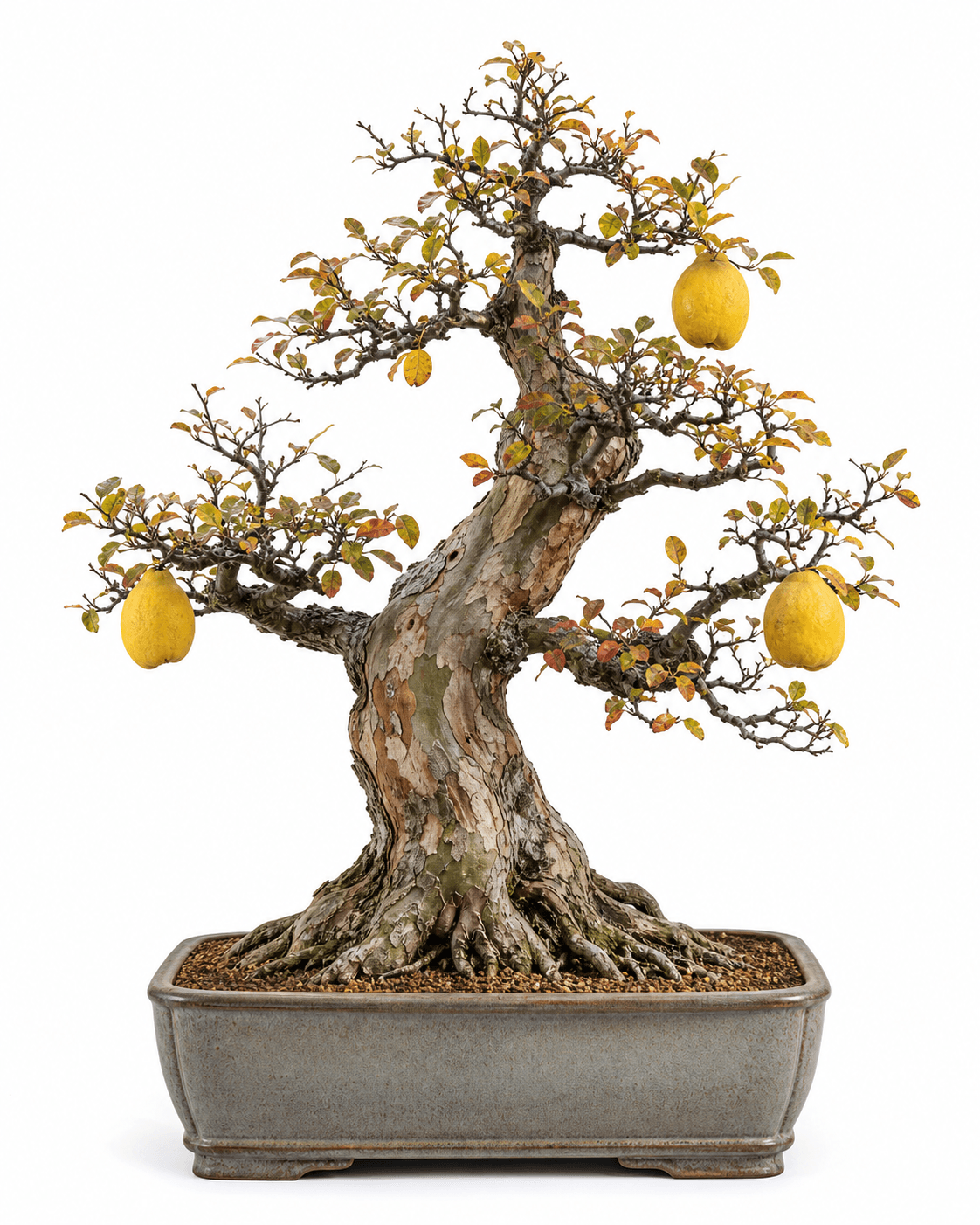
Chinese quince bonsai is an outdoor deciduous tree grown for exfoliating bark, spring flowers, autumn color, and a few fragrant yellow fruit on a strong medium or large composition. The tree needs sun, air, winter dormancy, steady container moisture, and fruit restraint because Pseudocydonia spends real energy on coarse flowering and fruiting wood.
Kew accepts Pseudocydonia sinensis in Rosaceae, with older Chaenomeles and Cydonia names in synonymy. That label history matters: Chinese quince, Japanese flowering quince, and common quince share trade-language overlap, yet their bark, fruit, branch behavior, and bonsai goals are different enough to keep separate.
The practical care frame is Broadleaf > Deciduous with a flowering and fruiting caution. Build roots, trunk, and primary branches first; use flowers and fruit as a restrained seasonal display after the tree has enough ramification and stored strength to pay for them.
Updated June 16, 2026. Written by EntGrove Editorial. Last verified June 16, 2026.
Care fingerprint
Read the species through its shared care pattern.
Repot and structural prune around dormant-to-active transitions; protect new leaves; time refinement work after growth hardens. Use this as the starting point before local conditions and tree strength refine the calendar.
Read the foliage first
Broadleaf stress usually shows in leaf color, leaf size, wilt, scorch, or delayed hardening before it becomes a branch problem.
Match work to dormancy
Deciduous, evergreen, tropical, succulent, and flowering broadleaf trees recover on different calendars.
Protect fine roots
Root work should preserve enough active fine roots for the tree to rehydrate quickly after the operation.
Care cadence
The calendar starts with the tree's seasonal state.
Placement
Timing: Grow outside in full sun with open air movement. Give small pots and freshly repotted trees afternoon relief during severe heat while keeping the tree bright.
Watch for: Indoor culture, shaded coarse shoots, weak flowering, stagnant wet foliage, overheated small pots, and winter wind that dries frozen soil.
NC State ExtensionMissouri Botanical GardenBonsai Mirai LibraryWatering
Timing: Water thoroughly when the soil begins to dry. Demand rises from spring leaf expansion through summer heat and again when fruit is swelling.
Watch for: Wilting fruiting shoots, dry inner root mass, sour compacted soil, and quick top-watering that leaves the central root column dry.
NC State ExtensionMissouri Botanical GardenBonsai Mirai LibraryFertilizer
Timing: Feed to match the development phase. Stronger organic feeding supports branch building and wound closure; refined trees need balanced nutrition and trace elements without forcing coarse late growth.
Watch for: Weak trees asked to carry fruit, excessive nitrogen before display, alkaline water that locks up iron, and fertilizer placed on stressed roots.
Bonsai Mirai LibraryPruning and flowering
Timing: Separate development years from display years. Build with extension and post-flush cutback, then protect flowering wood and fruit only on a refined, strong tree.
Watch for: Calendar pruning that removes next display, coarse runners left too long, fall cuts that trade away bloom, and pretty fruit on a tree still missing branch structure.
Bonsai Mirai LibraryNC State ExtensionRepotting
Timing: Repot around spring bud swell when recovery can follow quickly. Slower older trees can often run 4 or more years if drainage, oxygen, and spring strength remain good.
Watch for: Slow drainage, decomposed akadama, a stale central root mass, weak spring push, major fruit load after root reduction, and aggressive bare-rooting of old material.
Bonsai Mirai LibraryWiring
Timing: Wire young shoots only after the new growth has hardened and secured its attachment. Main structural wiring is safer at fall leaf drop on hydrated but dormant deciduous wood.
Watch for: Spring bud break, brittle new quince shoots snapping at the base, wire scars on smooth bark, and old hard wood forced past its natural plane.
Bonsai Mirai LibraryFlower and fruit load
Timing: Allow only a few fruit on a strong refined tree. Remove fruit on young, weak, recently repotted, collected, or branch-building trees before the crop drains reserves.
Watch for: Oversized fruit on a small tree, branch decline after display, short internodes disappearing into coarse fruiting wood, and fruit kept while roots are recovering.
Bonsai Mirai LibraryNC State ExtensionUniversity of Connecticut Plant DatabaseWinter
Timing: Keep the tree cold and dormant. In colder regions, set the pot on the ground, mulch around the container, or use an unheated cold frame.
Watch for: Warm indoor storage, random winter bud movement, frozen dry roots, repeated freeze-thaw cycles, and unprotected containers near the edge of the species range.
NC State ExtensionMissouri Botanical GardenUniversity of Connecticut Plant DatabaseDawes ArboretumBonsai Mirai LibraryPests and disease
Timing: Inspect from bud break through leaf drop, with extra attention during warm wet spring weather and around nearby junipers or other Rosaceae hosts.
Watch for: Blackened hooked shoots, fire-blight strikes, rust spots, aphids, scale, weevils, leaf spots, dense wet interiors, and fruit or leaves left under the bench.
NC State ExtensionMissouri Botanical GardenBonsai Mirai LibrarySpecies guide
Apply the species profile before copying another tree's calendar.
At a glance
Chinese quince is an outdoor deciduous fruiting bonsai with old-bark authority.
Chinese quince, Pseudocydonia sinensis, is a flowering deciduous tree or large shrub in Rosaceae. Kew accepts the name, places the native range in Central and South China, and lists older Chaenomeles, Cydonia, Malus, and Pyrus names that still appear in horticultural history. Kew POWONC State Extension
For bonsai, the appeal is old bark, seasonal flower, autumn color, and a restrained fruit display. NC State lists 2.5 to 4.5 in leaves and 4 to 6 in fragrant yellow fruit, while UConn lists 5 to 7 in fruit, so the best bonsai designs are usually medium, large, and visually honest about scale. NC State ExtensionUniversity of Connecticut Plant DatabaseMissouri Botanical Garden
Use the EntGrove Broadleaf > Deciduous playbook with flowering and fruiting adjustments. Full sun, moist well-drained soil, outdoor dormancy, spring root timing, fall structural options, brittle-shoot caution, and fruit-load restraint matter more than a fixed calendar recipe. NC State ExtensionMissouri Botanical GardenBonsai Mirai Library
Wild habitat
A temperate Chinese tree explains the sun, moisture, and dormant-season rhythm.
Kew gives the native range as Central and South China and describes Chinese quince as a shrub or tree of the temperate biome. NC State and Missouri Botanical Garden both describe the landscape plant as a deciduous flowering tree or large shrub grown in full sun. Kew POWONC State ExtensionMissouri Botanical Garden
Its wild and garden character is dense, upright, oval, and seasonal. The mature bark exfoliates into gray, green, and brown patches, spring flowers are pink and fragrant, and autumn fruit ripens yellow with a strong fragrance. Those traits should guide both care and styling. NC State ExtensionMissouri Botanical GardenDawes Arboretum
The care implication is a bright outdoor bench, steady moisture, and a cold rest rather than houseplant conditions. The design implication is a rugged old deciduous fruit tree: bark, trunk mass, branch hierarchy, autumn color, and a small number of fruit should carry the composition. Bonsai Mirai LibraryBonsai Mirai / Asymmetry
Reading the tree
Build the tree first, then spend energy on fruit.
Mirai flowering and fruiting guidance treats the display as a downstream result of structure and health. In primary and secondary development, Chinese quince should spend energy on extension, thickening, wound response, foliar expansion, back-budding, and root regeneration before it is asked to carry a crop. Bonsai Mirai Library
Pseudocydonia belongs with the coarse flowering and fruiting deciduous group. Mirai notes that Malus and Pseudocydonia do not develop usable bonsai branching in open field or grow-box freedom as reliably as they do under bonsai-container constraint, where internodes and callus behavior can be governed. Bonsai Mirai Library
Read the tree by energy and purpose. A strong young shoot may be useful for a new branch, a flowering spur may be worth keeping on a refined tree, and a large fruit on a weak branch is a liability. The grower decides which energy sinks remain. Bonsai Mirai Library
Pruning
Use separate pruning plans for development, flowering, and fruit.
During development, let selected shoots extend, thicken, and feed the branch, then cut back after the flush hardens to create direction changes and shorter internodes. This sacrifices some flowers and fruit, which is the correct trade when the trunk, primary branch, or secondary structure still needs work. Bonsai Mirai Library
Fall leaf-drop pruning can distribute strength evenly and avoid erratic winter response on quince, but it can also remove the next flowering or fruiting display. Use fall pruning for structural development and health correction; use post-flower and post-flush pruning when the seasonal display is part of the goal. Bonsai Mirai Library
Fruit thinning is horticulture, not vanity. Mirai frames fruit set as a high-cost reproductive load. Leave a few fruit only on a strong, refined tree, and strip fruit from weak, young, recently repotted, collected, or structure-building material. Bonsai Mirai Library
Repotting
Repot for oxygen, root renewal, and recovery energy.
Use the conservative deciduous window: repot around spring bud swell, when stored energy can become new roots and leaves soon after the operation. Very protected collections may work earlier, but public guidance should keep root reduction close to visible spring movement. Bonsai Mirai Library
Chinese quince should be handled as a slower, coarse flowering and fruiting deciduous root system. Work the surface, sides, and bottom to restore oxygen and drainage, preserve the central strength under the trunk, and avoid heroic bare-rooting on old material unless the tree is already staged for it. Bonsai Mirai Library
Repot intervals should be read from the pot. A young vigorous tree may need work every 2 to 3 years, while an older refined Chinese quince can often run 4 or more years if water still penetrates, the spring push is strong, and the tree did not spend the previous season carrying heavy fruit. Bonsai Mirai Library
Soil and pot
Give coarse fruiting roots enough depth and oxygen.
Mirai deciduous method favors akadama for refined temperate deciduous bonsai because root scaling in solid akadama supports finer roots, smaller leaves, and shorter internodes. For Chinese quince in development, a coarser soil can be used while the tree is still building trunk, roots, and primary structure. Bonsai Mirai Library
A fruiting Pseudocydonia usually deserves more pot depth than a fine-rooted maple. Mirai flowering and fruiting guidance warns that coarse fruiting species need root volume and depth to maintain water movement, recovery, and fruiting choices without daily crisis watering. Bonsai Mirai Library
Pot pairing should follow the aged bark and autumn display. Quiet glazed, ash, wood-fired, or warm unglazed surfaces can all work if they support the gray-green-brown bark, pink flower, red-yellow leaves, and yellow fruit rather than shouting over them. Bonsai Mirai / AsymmetryNC State ExtensionMissouri Botanical Garden
Climate
Landscape hardiness needs bonsai-container caution.
Hardiness references differ because they describe landscape plants in different regions. NC State lists USDA Zones 6a to 8b, Missouri Botanical Garden lists Zones 6 to 8, and both UConn and Dawes list Zone 5. Treat the bonsai pot as the limiting factor. NC State ExtensionMissouri Botanical GardenUniversity of Connecticut Plant DatabaseDawes Arboretum
In cold regions, mulch the pot, heel it into the ground, or use an unheated cold frame so the root zone stays cold, damp, and buffered. Warm indoor storage invites premature bud movement and weak, light-starved growth. Bonsai Mirai LibraryMissouri Botanical Garden
In hot-summer regions, keep full-sun culture but manage container heat and water demand. A fruiting Chinese quince in a shallow pot can dry faster than the landscape plant profile suggests, so top dressing, pot depth, shade cloth during extremes, and morning watering discipline matter. NC State ExtensionBonsai Mirai Library
Pests and diseases
Fire blight and rust pressure call for clean, open culture.
Fire blight is the most important named disease warning in the public horticultural sources. NC State says fire blight can be a problem, and Missouri Botanical Garden says it can cause significant problems. On bonsai, prune symptomatic strikes well below visible damage, disinfect tools, and avoid nitrogen excess during wet disease weather. NC State ExtensionMissouri Botanical Garden
Rust deserves bench awareness because Rosaceae hosts and Cupressaceae hosts can participate in alternating disease cycles. Keep Chinese quince away from wet, crowded corners, remove diseased leaves and fruit, and inspect nearby junipers when orange rust structures appear in spring. Bonsai Mirai Library
Routine pest prevention is cultural: full sun, open branch structure, quick drying after rain, clean leaf drop, restrained fruit load, and regular inspection for aphids, scale, mites, weevils, and leaf damage. Local extension guidance should govern any chemical decision. NC State ExtensionMissouri Botanical GardenBonsai Mirai Library
Wiring
Wire only wood that is ready to move.
Mirai deciduous fall-work guidance is explicit for quince: new growth in Cydonia, Pseudocydonia, and Chaenomeles is brittle and can snap where it joins older wood. Let shoots harden and secure their attachment before wiring. Bonsai Mirai Library
Fall leaf drop is the best general window for broadleaf deciduous structural wiring because the tree is flexible, the leaves are gone, and spring tearing risk is lower. Use spring wiring sparingly because hydrated new growth, tender buds, and flower buds are easy to damage. Bonsai Mirai Library
Use paper-wrapped copper only when initial structural holding power is truly needed, then shift to aluminum for most secondary and tertiary work. Support the branch with both hands, respect the branch plane from its point of origin, and use guy wires or clip-and-grow on older hard wood. Bonsai Mirai Library
Propagation
Seed is common; layers and grafts are design tools.
UConn lists seed propagation for Chinese quince. Seed-grown material is best used as a long-term trunk and root-base project, with root selection and movement introduced early while stems are still young enough to shape. University of Connecticut Plant DatabaseBonsai Mirai Library
Cuttings and air layers follow broad deciduous principles: match cutting stage to the season, limit transpiration, keep propagation media oxygenated, and separate air layers only after there is enough root to support the branch. Bonsai Mirai Library
Root grafting and branch grafting can improve old deciduous material when the design needs better nebari or branch placement. Use clean cuts, firm immobilization, cambial contact, and at least one full growing season before judging success. Bonsai Mirai Library
Buying and sourcing
Buy bark, base, and verified identity.
Chinese quince is not usually a cultivar-shopping species. UConn lists no commonly available cultivars, and Missouri Botanical Garden says the plant is not commonly sold in commerce. Individual trunk quality matters more than a named form. University of Connecticut Plant DatabaseMissouri Botanical Garden
Inspect the label before buying. Pseudocydonia sinensis may appear under old Chaenomeles or Cydonia names, while Japanese flowering quince and common quince can be sold under overlapping quince language. Verify leaf, bark, fruit, thorn habit, and growth form before applying this page. Kew POWONC State ExtensionDawes Arboretum
Good pre-bonsai has a believable base, taper, low branch options, sound roots, visible bark potential, and enough vigor to survive branch building. Avoid weak fruiting sticks, trees with obvious fire-blight strikes, and old field material with no fine-root transition plan. Bonsai Mirai LibraryNC State ExtensionMissouri Botanical Garden
Troubleshooting
Read the symptom before reaching for a recipe.
Weak long shoots with large leaves usually point to shade, indoor culture, excessive nitrogen, or a tree still in development. Move outdoors into stronger light, rebalance feeding, and prune for structure after the flush hardens. NC State ExtensionBonsai Mirai Library
Wilting fruiting shoots point first to water demand, compacted soil, or too much fruit for the root system. Water thoroughly, check percolation, shade the pot during extreme heat, and thin fruit immediately on weak branches. NC State ExtensionBonsai Mirai Library
Blackened hooked shoots point to possible fire blight. Isolate the tree from high-value Rosaceae material, remove infected wood below visible symptoms with clean tools, and adjust air movement, nitrogen, and overhead wetting habits. NC State ExtensionMissouri Botanical Garden
Branches snapping during wiring point to timing and tissue maturity. Let new quince shoots harden, wire in the leafless fall window when structure is the goal, and use pruning or guy wires when old wood is already too rigid. Bonsai Mirai Library
A strong tree with no flowers or fruit usually points to timing, structure phase, excessive pruning of flowering wood, or nutritional imbalance. Build healthy ramification first, then protect display wood and trace-element balance in the season before bloom. Bonsai Mirai LibraryNC State Extension
Design
Let the bark and fruit behave like a mature deciduous tree.
Chinese quince design should begin with base, trunk line, defining branch, and apex. The mature character is an old fruiting deciduous tree with exfoliating bark and seasonal weight, so abrupt decorative foliage pads usually feel less convincing than branch structure that explains the trunk. Bonsai Mirai / AsymmetryNC State ExtensionMissouri Botanical Garden
Mirai wound-healing material specifically calls out Chinese quince as exceptionally hard wood. Major carving and wound correction require patience, sharp tools, and realistic expectations; the species can develop beautiful bark, but heavy old cuts should be planned as long-term features. Bonsai Mirai Library
Partial defoliation can be used in refinement on vigorous Chinese quince by reducing the remaining leaf surface to push smaller, more numerous leaves. Reserve that work for healthy refined trees, because defoliation on a weak or fruit-loaded tree spends energy needed elsewhere. Bonsai Mirai Library
Forms
Most Chinese quince bonsai are selected individuals, not named cultivars.
UConn lists no commonly available cultivars for Chinese quince, and Missouri Botanical Garden says it is uncommon in commerce. That points bonsai buyers toward individual evaluation rather than cultivar collecting. University of Connecticut Plant DatabaseMissouri Botanical Garden
Selection criteria are practical: bark already beginning to exfoliate, compact internodes after container culture, healthy roots, low branching, branch planes that match the trunk, and fruit size that will read well with the eventual bonsai size. Bonsai Mirai LibraryNC State Extension
Keep Pseudocydonia separate from Chaenomeles forms such as Chojubai, Toyo Nishiki, and other Japanese flowering quince labels. Those plants can be outstanding bonsai, but their shrub habit, root behavior, flower display, and fruit scale require a different page. Kew POWONC State ExtensionBonsai Mirai Library
History
Chinese quince is valued for age, bark, fruit, and seasonal restraint.
Kew records Pseudocydonia sinensis as accepted under the 1906 Schneider combination, with earlier Cydonia, Chaenomeles, Malus, and Pyrus names explaining the long taxonomic shuffle. In bonsai, that history shows up as trade labels that lag behind current taxonomy. Kew POWO
The species earns its place in bonsai through mature-bark presence and seasonal contrast. Missouri Botanical Garden and NC State both emphasize attractive exfoliating bark, fragrant flowers, autumn color, and large fruit, all of which become stronger as the tree ages. NC State ExtensionMissouri Botanical Garden
Exhibition use should be selective. A refined Chinese quince can carry one or a few fruit as a seasonal accent; a developing tree is often better shown for trunk, bark, and branch promise while fruit is removed to keep the future stronger. Bonsai Mirai LibraryBonsai Mirai / Asymmetry
FAQ
Chinese quince bonsai questions, answered directly.
The short answers below mirror the care guidance above: outdoor culture, full sun, steady water, restrained fruiting, spring root work, fall structural options, and clear identity checks. Bonsai Mirai LibraryKew POWONC State Extension
Species questions
Answer the beginner questions before styling.
Is Chinese quince a good beginner bonsai?
Yes for a beginner with an outdoor bench, winter protection, and space for a medium or large tree. It is less forgiving as a tiny indoor tree because the leaves, shoots, and fruit are large.
Can Chinese quince bonsai live indoors?
No. Chinese quince is an outdoor deciduous tree that needs full sun, seasonal leaf drop, and a cold dormant winter.
How often should I water Chinese quince bonsai?
Water when the soil begins to dry, then water thoroughly enough to reach the whole root mass. Water demand rises during spring growth, summer heat, and fruit swelling.
When should I repot Chinese quince bonsai?
Repot around spring bud swell. Younger trees may need checks every 2 to 3 years, while older refined trees can often wait about 4 or more years if drainage and spring strength remain good.
When should I prune Chinese quince bonsai?
Prune for structure after shoots have extended and hardened, or at fall leaf drop when the goal is structural work. Protect flowering wood when display matters, and sacrifice flowers during development.
Can I wire Chinese quince bonsai?
Yes, but let young shoots harden first. Quince shoots can snap where new growth joins old wood, so leafless fall wiring, guy wires, and clip-and-grow are often safer than spring wiring.
Should I let Chinese quince fruit stay on the tree?
Keep only a few fruit on a strong refined tree. Remove fruit from weak, young, recently repotted, collected, or branch-building trees because fruit is a heavy energy load.
What diseases should Chinese quince bonsai growers watch for?
Fire blight is the major named disease warning from horticultural sources. Also watch for rust, aphids, scale, mites, weevils, leaf spots, and dense wet interiors that slow drying.
Is Chinese quince the same as Japanese flowering quince?
No. Chinese quince is Pseudocydonia sinensis. Japanese flowering quince is Chaenomeles, including Chojubai and Toyo Nishiki forms. Older synonym history can confuse labels, so verify the plant before applying care advice.
Why is Chinese quince usually a medium or large bonsai?
The species has coarse shoots, leaves that can run several inches long, and fruit that can be 4 to 7 inches long. Larger designs make those features feel proportional.
Sources
Species advice needs source discipline.
Next decisions
Plan the operation before copying the calendar.
A good care note for Chinese quince records the tree's stage, the work done, and the aftercare used. That record matters more than a month-name rule.
Related species
Compare nearby trees before transferring advice.
Japanese maple
Acer palmatum
Trident maple
Acer buergerianum
Amur maple
Acer tataricum subsp. ginnala
Field maple
Acer campestre
Korean hornbeam
Carpinus turczaninovii