
Species guide
Coastal Douglas-Fir Bonsai Care
Pseudotsuga menziesii var. menziesii
Coastal Douglas-fir bonsai are outdoor Pacific conifers that demand precise timing. Work the tree in spring just before growth pushes, prune after the new flush hardens in early summer, and avoid fall wounding because Douglas-fir shuts down vascular activity earlier than spruce, hemlock, fir, and many other conifers.
Treat Pseudotsuga menziesii var. menziesii as a coastal elongating species with strong apical dominance, brittle older wood, flat laterally arranged needles, and a narrow bud-based pruning rule: every cut must end at a visible juvenile or mature bud.
Updated June 5, 2026. Written by EntGrove Editorial. Last verified June 5, 2026.
Care fingerprint
Read the species through its shared care pattern.
Avoid dry-wind stress, preserve interior growth, and distinguish cypress-style pad work from juniper refinement. Use this as the starting point before local conditions and tree strength refine the calendar.
Note: Kew accepts Pseudotsuga menziesii var. menziesii and places the coastal variety from southeastern Alaska to the western United States. USDA Silvics distinguishes the coastal variety from var. glauca, while Oregon State and NC State ground Pacific Coast hardiness, cultivar labels, heat and humidity limits, and Douglas-fir / Oregon pine / red-fir naming. Mirai has direct Douglas-fir redesign, styling, pinching, pruning, and post-harden pruning coverage.
Do not prune like a pine
Elongating conifers extend from buds and shoots, so candle-cutting assumptions can remove the exact growth the tree needs.
Preserve interior growth
Spruce, fir, hemlock, cedar, redwood, cypress, and larch all become harder to design when interior buds are shaded out.
Keep recovery cool and steady
Many elongating conifers respond best when roots stay evenly moist, oxygenated, and protected from hot dry swings.
Care cadence
The calendar starts with the tree's seasonal state.
Watering
Timing: Check daily during active growth, hot weather, dry wind, and after hard pruning. Water thoroughly, then let oxygen return.
Watch for: Soft growth burn, dull needles, stale nursery cores, compacted duff, hot containers, and surface dryness hiding a dry center.
NC State ExtensionUSDA NRCS Plant GuideBonsai Mirai LibrarySpring structural work
Timing: Style, bend, and perform major structural work just before spring push, while buds swell and vascular recovery is coming online.
Watch for: Fully swollen buds are fragile. A bumped Douglas-fir bud is usually lost, so hand placement matters as much as wire placement.
Bonsai Mirai LibrarySpring pinching
Timing: Pinch only strong refined shoots during the short soft-extension window when those tips are suppressing weaker interior shoots.
Watch for: If all buds are pushing evenly, skip pinching and rely on early-summer post-flush pruning.
Bonsai Mirai LibraryPost-flush pruning
Timing: Prune as soon as the new growth hardens, usually around June or the summer solstice in many Northern Hemisphere climates.
Watch for: Every cut needs a visible mature bud, juvenile bud, or useful shoot. A bare cut causes dieback rather than new buds.
Bonsai Mirai LibraryNeedle cleanup
Timing: Clean or pluck only in the early-summer post-flush window, and only on refined, healthy branches that already carry enough buds.
Watch for: Late needle removal can create small tears that atrophy over winter and kill distal foliage in spring.
Bonsai Mirai LibraryRepotting
Timing: Repot in spring before active extension. Do not pair repotting with styling in the same year.
Watch for: Collected trees need mature back buds on older wood as recovery evidence. Tip growth alone does not prove root readiness.
Bonsai Mirai LibraryFertilizing
Timing: Feed during the active growing season after roots are functioning. Use organic nutrition to support microbial activity and vascular growth.
Watch for: Fertilizer cannot repair root rot, poor oxygen, or a dry core. Fix the root environment first.
Bonsai Mirai LibraryPest and disease inspection
Timing: Inspect in late winter, spring extension, early summer pruning season, and humid coastal periods.
Watch for: Swiss needle cast, Rhabdocline needle cast, Cooley spruce gall adelgid, Douglas-fir needle midge, spruce spider mite, root weevils, aphids, root rot, and bark beetles.
NC State ExtensionOregon State University ExtensionOregon State University ExtensionWinter protection
Timing: Keep the tree dormant and outdoors. Protect shallow containers from freeze-thaw, dry wind, and post-work cold exposure.
Watch for: Landscape hardiness does not equal bonsai-root hardiness, especially after repotting, heavy bending, or early-summer pruning.
Oregon State Landscape PlantsBonsai Mirai LibrarySpecies guide
Apply the species profile before copying another tree's calendar.
At a glance
Coastal Douglas-fir is powerful material with a narrow work calendar.
Pseudotsuga menziesii var. menziesii is the accepted coastal variety of Douglas-fir. Kew places it from southeastern Alaska to the western United States, while USDA Silvics separates it from the inland Rocky Mountain variety, var. glauca. Kew POWOUSDA Forest Service Silvics
As bonsai, coastal Douglas-fir sits in EntGrove's coastal elongating-conifer group with coast redwood, Sitka spruce, western hemlock, Japanese cedar, and cypress relatives. The shared theme is elongating shoot growth, visible bud targets, strong vascular swelling, and climate-sensitive roots. Bonsai Mirai Library
The species has deeper Mirai coverage than many North American conifers: redesign, styling, pinching, pruning, post-harden pruning, and coastal-conifer files all cover Douglas-fir method. This page focuses that method on coastal material while noting where Rocky Mountain Douglas-fir differs. Bonsai Mirai LibraryBonsai Mirai / Asymmetry
Wild habitat
The coastal variety is a disturbance tree of wet western forests.
USDA Silvics describes the coastal arm of Douglas-fir from central British Columbia south along the Pacific Coast ranges for about 2200 km, with nearly pure stands through western Washington, Oregon, and northern California. Kew lists Alaska, British Columbia, California, Oregon, and Washington for the accepted coastal variety. USDA Forest Service SilvicsKew POWO
FEIS describes coast Douglas-fir as a long-lived seral dominant of low- and middle-elevation moist forests. It often needs disturbance such as wildfire, logging, or windthrow to start a new seedling cohort, then can persist for centuries before shade-tolerant hemlock, western redcedar, or Pacific silver fir take over. USDA Forest Service FEIS
That ecology explains the bonsai compromise. The foliage wants bright light and air, young roots want partial protection on severe sites, and established trees need enough sun to create interior buds. A pot should provide the mineral-soil oxygen of a disturbed seedbed without drying like exposed summer duff. USDA Forest Service FEISUSDA NRCS Plant GuideBonsai Mirai Library
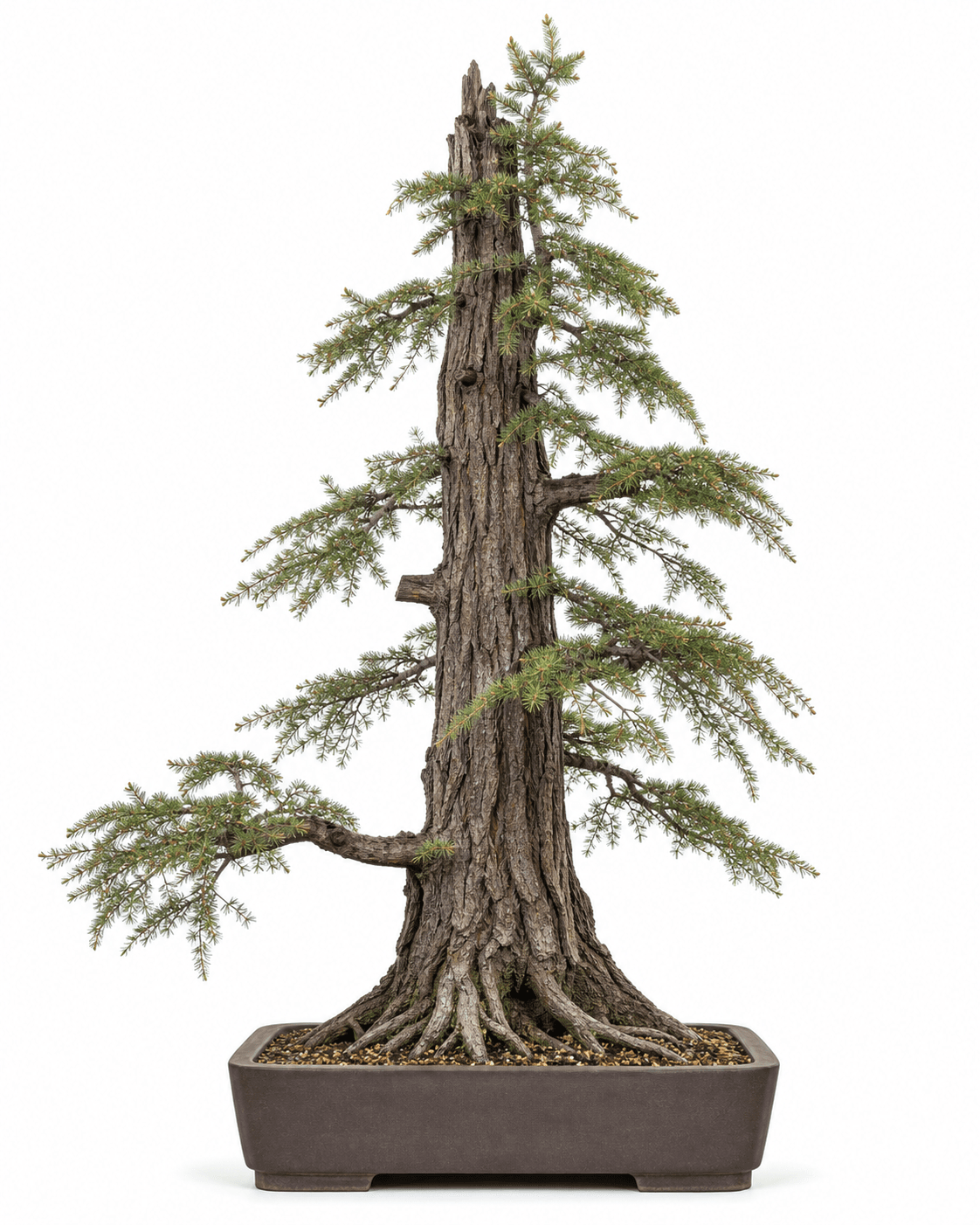
Design should respect the western forest image: tall trunks, drooping lower branches, ascending upper branches, broken tops, old furrowed bark, storm damage, and quiet deadwood rather than a generic pine silhouette. Oregon State Landscape PlantsNC State ExtensionBonsai Mirai / Asymmetry
Reading
Read roots, bud maturity, branch angle, and variety before touching the tree.
Mirai treats mature back buds on older wood as the practical recovery signal for collected Douglas-fir. Continued tip extension can happen on stored strength, so it should never be the only evidence that roots have recovered. Bonsai Mirai Library
Bud reading controls every cut. Mature buds are pointed, red, and firm. Juvenile buds are small white or red nodules near needle bases. A branch with neither mature nor juvenile buds should be grown, replaced, or redesigned rather than shortened blindly. Bonsai Mirai Library
Coastal and Rocky Mountain Douglas-fir differ in needle presentation. Mirai notes that coastal material usually carries flatter laterally arranged needles, while Rocky Mountain material often shows more radial needle distribution and more compact ancient form. Use the label, range, foliage, cones, and provenance together. Bonsai Mirai LibraryNC State ExtensionOregon State Landscape Plants
Apical dominance is severe. Douglas-fir naturally strengthens upper growth and abandons lower branches. Lower branches should be protected, allowed to extend, and given light while the top is pruned and pinched to reduce dominance. Bonsai Mirai LibraryUSDA Forest Service FEIS
Pruning
The year revolves around soft spring pinching and early-summer post-flush pruning.
Pinching is a refinement tool. Use it only on vigorous soft spring tips that are pulling too much strength from weaker interior shoots. The window can be only a few days because the soft stem quickly hardens and becomes a pruning target instead. Bonsai Mirai Library
The main pruning window is immediately after the spring flush hardens. Mirai repeatedly places this around June or the summer solstice because Douglas-fir transitions from foliar growth to vascular growth earlier than spruce, hemlock, and many other elongating conifers. Bonsai Mirai Library
Cut back to visible buds. Douglas-fir does not reliably create fresh buds from a bare cut, so pruning past the last bud creates dieback to the next live shoot. Leave a small margin in front of the bud so the cut does not crush it. Bonsai Mirai Library
Avoid fall pruning for immature buds, needle work, or heavy wounding. Mirai notes that Douglas-fir loses wound-compartmentalization capacity early, often by late August or early September, so fall work can turn into spring dieback. Bonsai Mirai Library
Weak lower branches get a different rule. Let them extend and keep needle mass until they produce useful buds. Reducing weak lower branches makes apical dominance worse and often removes the branch from the future design. Bonsai Mirai Library
Repotting
Root work is conservative, staged, and separated from styling.
Repot in spring before active extension, when stored energy can support root recovery and the foliage has not yet demanded full transpiration. Keep the tree firmly tied because rocking damages new roots. Bonsai Mirai Library
Mirai cautions that collected Douglas-fir can need at least three years before styling or repotting. Mature back buds on old wood are the sign that roots and vascular tissue are ready for the next operation. Bonsai Mirai Library
Do one major operation per year. Style or repot, then give the tree a full season to recover before asking for the other operation. Heavy bending needs an established root system to resist torque. Bonsai Mirai Library
Preserve some native organic duff during the first transition from collected or field soil. Mirai attributes part of Douglas-fir success to microbial continuity in the root ball, then uses staged mineral-soil conversion to improve oxygen without erasing that biology at once. Bonsai Mirai Library
If root rot is suspected, stabilize rather than repot immediately. Remove compacted surface soil and dead pockets, improve oxygen and water movement, and wait for recovery evidence before deeper work. Bonsai Mirai LibraryOregon State University Extension
Soil and pot
Build a cool oxygen-rich root pad before chasing refinement.
A practical established-tree baseline is equal parts akadama, pumice, and lava. Akadama holds water and nutrition, pumice buffers moisture, and lava protects air channels through the pot. Bonsai Mirai Library
Collected and nursery-core trees need staged conversion. Keep a protected core at first, then replace decomposed or compact material over future repots. The target is percolation through the whole root mass, not a fresh ring around a sour center. Bonsai Mirai Library
Pot choice should manage heat. Use training boxes, deep ovals, quiet rectangles, or forest slabs that protect root temperature while the branch structure is being built. Move into a shallower exhibition pot only after the root pad is dense and reliable. Bonsai Mirai LibraryUSDA NRCS Plant Guide
For design, unglazed clay usually suits the species. Bark color, old timber character, and western forest mood pair best with earthy rectangles, ovals, drums, or slabs rather than bright glazed containers. Bonsai Mirai / Asymmetry
Climate
Coastal Douglas-fir prefers cool nights, moist air, and bright outdoor light.
NC State describes Douglas-fir as best suited to northern or northwestern climates and intolerant of heat, humidity, drought, and warm night temperatures. That matters more in a shallow pot than in a forest soil profile. NC State Extension
In cool maritime climates, give full sun after spring growth hardens and watch wire bite during vascular swelling. In inland heat, use morning sun, afternoon shade, a shaded pot, and wind moderation during the soft-growth window. NC State ExtensionBonsai Mirai Library
In cold regions, preserve dormancy while protecting the container. A cold frame, mulch bed, or sheltered ground placement limits root desiccation and freeze-thaw without waking the tree early. Oregon State Landscape PlantsBonsai Mirai Library
Indoor culture is a short display event at most. Coastal Douglas-fir needs outdoor light, air movement, cool nights, seasonal dormancy, and a root environment that indoor rooms cannot provide for durable growth. NC State ExtensionBonsai Mirai Library
Pests
Needle cast, mites, adelgids, root disease, and bark stress are the main watch points.
NC State lists weevils, bark beetles, spider mites, aphids, galls, Douglas-fir beetle, shoestring rot, root rot, heart rot, and needle cast as potential issues. In bonsai, the first filter is vigor: heat, stale soil, and weak roots make every pest more consequential. NC State Extension
OSU Extension notes Rhabdocline needle cast symptoms such as reddish-brown spots and fruiting bodies on current-year needles, plus a late-winter to spring scouting window. Rocky Mountain seed sources can be more susceptible in western Oregon and Washington. Oregon State University Extension
Swiss needle cast is specific to Douglas-fir. OSU Extension describes yellowing foliage, low needle retention, thin crowns, and reduced growth when fungal structures plug stomates on older needles. Oregon State University Extension
Cooley spruce gall adelgid, Douglas-fir needle midge, and spruce spider mite all deserve close inspection on small bonsai. Look under needles for white cottony adelgid signs, swollen yellow midge-damaged needles, bronze mite stippling, webbing, and premature needle drop. Oregon State University Extension
Root disease is often cultural. Poor drainage, compacted organic cores, and overwatering reduce oxygen. Fix water movement and root health before escalating to fertilizer or major pruning. Oregon State University ExtensionBonsai Mirai Library
Wiring
Wire in spring with bud protection and respect for brittle old wood.
Spring before growth push is the safest major wiring window because recovery capacity is rising. Older barked Douglas-fir branches can be brittle, so bends should be planned before force is applied. Bonsai Mirai Library
Orient branch tips level or slightly upward. Mirai warns that drooping Douglas-fir tips lose strength under cultivation, while slight upward orientation keeps transpiration and auxin flow useful. Bonsai Mirai Library
Avoid raffia unless a bend truly requires it. Mature Douglas-fir bark is a design asset, and wrapping can abrade or hide damage. For heavy changes, use guy wires, rebar, padding, and staged pressure with a stable root anchor. Bonsai Mirai Library
Wire bite can advance quickly during vascular swelling. Check upper branches, strong shoots, and guy-wire contact points often, then unwind along the original coil path to protect bark. Bonsai Mirai Library
Propagation
Seedlings teach the species, while old collected trees require patience and permission.
USDA NRCS describes seed handling with cold stratification before late winter or early spring sowing, and notes that containers for seedlings should be narrow but deep enough for root development. Seed is useful for forests, exposed-root ideas, and long-term trunk projects. USDA NRCS Plant Guide
Cuttings and grafted dwarf forms can preserve cultivar habit, but they should be evaluated as nursery material rather than automatically superior bonsai. The graft, root flare, bud placement, and branch scale matter more than the cultivar tag. Oregon State Landscape PlantsNC State Extension
Air layering is uncommon for serious Douglas-fir bonsai and should be treated as experimental. The species is usually built from seed, nursery stock, field-grown trunks, legal salvage, or ethically collected mountain material. Bonsai Mirai LibraryUSDA NRCS Plant Guide
Collected material needs the slowest schedule. Keep some native soil, stabilize water and oxygen, protect from heat, and wait for mature back buds on older wood before styling. Bonsai Mirai Library
Buying
Buy for recoverable roots, visible buds, and believable western character.
Good starter material has a visible base, older bark or movement, interior buds, healthy needles, branch options near the trunk, and a root system that can be converted without erasing all native biology at once. Bonsai Mirai Library
Nursery trees often have straight trunks, buried flares, sheared outer shells, heavy peat, and weak interiors. Inspect under the green outline for juvenile buds, branch exits, root flare, pest signs, graft unions, and old pruning scars. NC State ExtensionBonsai Mirai Library
Cultivars such as Graceful Grace, Vail, Idaho Gem, Eddyville, Pendula, and Fastigiata can be useful when they solve scale or movement. Confirm that the habit helps the design rather than fighting the branch structure. Oregon State Landscape PlantsNC State Extension
Keep variety labels open until evidence agrees. Coast Douglas-fir has flatter lateral needles and larger coastal-tree character; Rocky Mountain Douglas-fir often provides compact, rugged, drought-stunted bonsai material. The care calendar overlaps, but heat, cold, needle arrangement, and design language differ. Bonsai Mirai LibraryNC State ExtensionOregon State Landscape Plants
Troubleshooting
Most failures come from mistimed cuts, weak roots, heat, or false recovery signals.
Symptom: a pruned shoot dies back past the cut. Likely cause: the cut was made behind the last viable bud. Fix: stop cutting, rebuild vigor, and prune only to visible juvenile or mature buds in the next early-summer window. Bonsai Mirai Library
Symptom: spring buds fall off during work. Likely cause: styling after buds became too swollen or rough hand placement around fragile tips. Fix: postpone remaining work and handle future spring styling before buds advance that far. Bonsai Mirai Library
Symptom: lower branches fade while the apex thickens. Likely cause: apical dominance, shade, over-pruning weak branches, or drooping tips. Fix: reduce strong top growth, lift useful lower tips slightly, and let weak branches extend. Bonsai Mirai Library
Symptom: older needles yellow and the crown thins. Likely cause: Swiss needle cast, Rhabdocline, mites, adelgids, drought, root stress, or normal third-year needle shed. Fix: inspect needle undersides, test water movement, and use local extension diagnosis before treatment. Oregon State University ExtensionOregon State University ExtensionBonsai Mirai Library
Symptom: strong tip growth after collection but no interior buds. Likely cause: stored vascular energy without enough new roots. Fix: wait, stabilize moisture and oxygen, and delay styling until mature back buds appear on older wood. Bonsai Mirai Library
Symptom: brown soft growth after a hot week. Likely cause: sun and heat while new shoots were tender, often above roughly 90 degrees F. Fix: use 30 percent shade during soft growth, cool the pot, and avoid additional stress. Bonsai Mirai LibraryNC State Extension
Design
Style for Pacific timber character, asymmetric age, and living branch efficiency.
Start with base, trunk line, defining branch, and apex direction. Mirai design method asks the tree to commit to a direction of movement; a trunk centered over the base can feel unresolved until the design chooses an asymmetry. Bonsai Mirai LibraryBonsai Mirai / Asymmetry
Coastal Douglas-fir can read as an old timber tree, wind-shaped coast-range survivor, forest element, or collected mountain form. Lower branches may droop, upper branches can ascend, and old trees can carry broken tops or sparse high canopies. Oregon State Landscape PlantsUSDA Forest Service FEISBonsai Mirai / Asymmetry
Foliage pads should stay efficient. On smaller trees, break mass into many small pads so the scale reads miniature. On larger trees, broader masses can feel more powerful, especially when old bark and deadwood carry the story. Bonsai Mirai Library
Deadwood should be structural and restrained. Douglas-fir can support aged dead tops, jin, shari, and fire or storm scars, but the carving should feel weathered, fibrous, and western rather than lace-like juniper work. Bonsai Mirai LibraryUSDA Forest Service FEIS
A convincing finished Douglas-fir shows bud-aware ramification, upward-oriented tips, controlled apical strength, visible old bark, and branch placement that keeps the lower tree alive rather than sacrificing it for a tidy top. Bonsai Mirai Library
Cultivars
Cultivars can help scale, but variety identity matters more.
Oregon State lists specialty forms including Graceful Grace, Vail, Idaho Gem, and Eddyville, while NC State lists Fastigiata, Graceful Grace, Idaho Gem, Vail, var. glauca, and var. menziesii. These names are sourcing clues rather than care guarantees. Oregon State Landscape PlantsNC State Extension
Dwarf and weeping forms can solve internode length or movement, but they can also bring weak grafts, awkward trunks, or growth too slow for training. Inspect plant structure first. Oregon State Landscape PlantsBonsai Mirai Library
Rocky Mountain Douglas-fir is often favored for bonsai because harsh native sites can create compact forms, ancient bark, and naturally aged deadwood. Coastal Douglas-fir usually asks the designer to emphasize height, branch sweep, and Pacific forest ecology. Bonsai Mirai LibraryUSDA Forest Service Silvics
Keep old synonyms in records, especially older Abies, Pinus, Picea, Tsuga, and Pseudotsuga douglasii labels. Kew accepts Pseudotsuga menziesii var. menziesii for the coastal variety. Kew POWO
History
Douglas-fir carries Pacific Northwest forest, timber, wildlife, and bonsai history.
USDA Silvics calls Douglas-fir one of the world's most important timber trees and notes that two recognized varieties define the coast and Rocky Mountain forms. Oregon State also identifies Douglas-fir as the state tree of Oregon. USDA Forest Service SilvicsOregon State Landscape Plants
The species also has deep ecological value. FEIS describes old coast Douglas-fir as habitat and food context for birds and mammals, with old-growth stands persisting for centuries in western forests. USDA Forest Service FEIS
USDA NRCS records ethnobotanical uses of needles, resin, wood, pitch, bark, and roots by several Indigenous peoples. That history argues for careful sourcing, transparent provenance, and avoidance of romanticized old-growth collection. USDA NRCS Plant Guide
In North American bonsai, Douglas-fir is valuable because it offers a native western image that cannot be reduced to pine or spruce. The finished tree should communicate place: coastal forest, Oregon pine history, wind, bark, and exact seasonal discipline. Bonsai Mirai / AsymmetryBonsai Mirai Library
Species questions
Answer the beginner questions before styling.
Can Coastal Douglas-fir be grown as bonsai?
Yes. Coastal Douglas-fir can be grown as outdoor bonsai when roots stay cool and oxygenated, spring work protects fragile buds, and pruning happens in the early-summer post-flush window.
Can Coastal Douglas-fir bonsai live indoors?
No. Coastal Douglas-fir needs outdoor light, moving air, cool nights, dormancy, and seasonal timing. Indoor rooms are too warm, dry, and dim for long-term health.
When should I prune Douglas-fir bonsai?
Prune as soon as new growth hardens, usually around June or the summer solstice in many Northern Hemisphere climates. Cut only to visible buds or useful shoots.
Should I pinch Douglas-fir bonsai?
Pinch only strong refined shoots while they are soft and suppressing weaker interior growth. If growth is balanced or already hardened, skip pinching and prune after the flush hardens.
When should I wire Coastal Douglas-fir?
Do major wiring and bending in spring just before growth pushes. Protect swelling buds, keep branch tips level or slightly upward, and check wire often during vascular swelling.
What soil works for Douglas-fir bonsai?
A useful established-tree baseline is 1 part akadama, 1 part pumice, and 1 part lava. Collected trees should keep some native duff during the first transition.
Why did my Douglas-fir branch die after pruning?
The usual cause is pruning behind the last viable bud. Douglas-fir does not reliably make new buds from bare cuts, so every cut must preserve a visible bud or shoot.
Is Coastal Douglas-fir the same as Rocky Mountain Douglas-fir?
They are varieties of Pseudotsuga menziesii. Coastal Douglas-fir is var. menziesii with flatter coastal foliage and larger forest character, while Rocky Mountain Douglas-fir is var. glauca and often more compact, blue-green, and rugged.
Why is my Douglas-fir turning yellow or thin?
Possible causes include Swiss needle cast, Rhabdocline needle cast, mites, adelgids, drought, stale roots, heat stress, or normal older-needle shedding. Inspect needles and roots before treating.
What styles suit Coastal Douglas-fir bonsai?
Informal upright, formal upright, slanting, literati, forest, exposed-root, windswept, broken-top, raft, and Pacific timber forms suit the species when the design keeps old bark, asymmetric direction, and upward-oriented tips.
Sources
Species advice needs source discipline.
Next decisions
Plan the operation before copying the calendar.
A good care note for Coastal Douglas-fir records the tree's stage, the work done, and the aftercare used. That record matters more than a month-name rule.
Related species
Compare nearby trees before transferring advice.
Coast redwood
Sequoia sempervirens
Sitka spruce
Picea sitchensis
Western hemlock
Tsuga heterophylla
Monterey cypress
Hesperocyparis macrocarpa
Japanese cedar / sugi
Cryptomeria japonica