
Species guide
Coast Redwood Bonsai Care
Sequoia sempervirens
Coast redwood bonsai are outdoor evergreen conifers that want strong light, moist oxygenated roots, fog or mist support in dry climates, and a timing plan built around stored vascular energy. Refined trees are pinched early and often, then pruned in narrow windows so new buds form near the cut instead of retreating to the branch base.
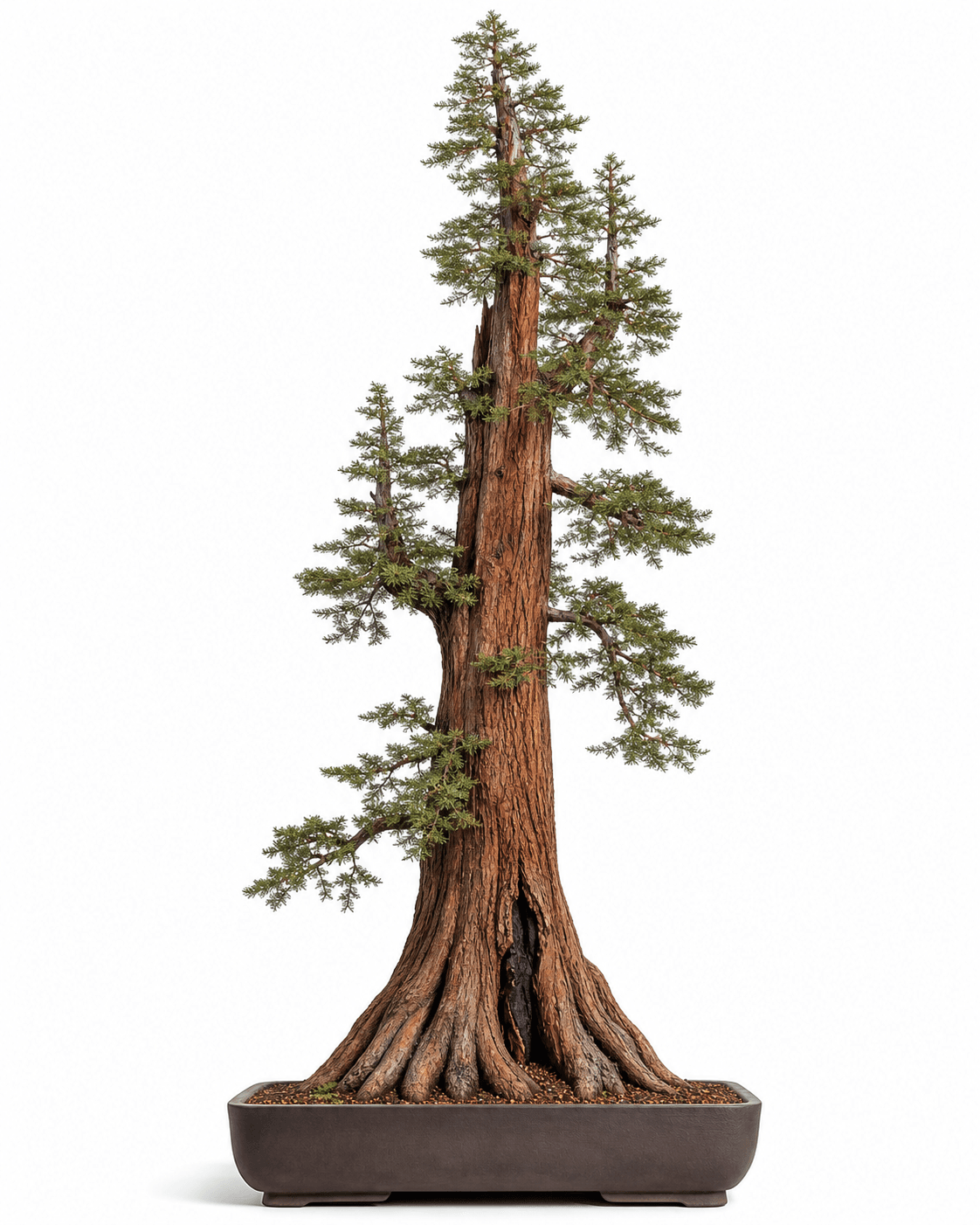
Treat Sequoia sempervirens as a coastal elongating species, separate from dawn redwood, bald cypress, and giant sequoia. The useful bonsai image comes from redwood ecology: vertical height, small aerodynamic pads, basal flare, fire scars, reiterating apices, and a narrow fog-belt climate that makes container heat and winter freeze protection central care issues.
Updated June 4, 2026. Written by EntGrove Editorial. Last verified June 4, 2026.
Care fingerprint
Read the species through its shared care pattern.
Avoid dry-wind stress, preserve interior growth, and distinguish cypress-style pad work from juniper refinement. Use this as the starting point before local conditions and tree strength refine the calendar.
Do not prune like a pine
Elongating conifers extend from buds and shoots, so candle-cutting assumptions can remove the exact growth the tree needs.
Preserve interior growth
Spruce, fir, hemlock, cedar, redwood, cypress, and larch all become harder to design when interior buds are shaded out.
Keep recovery cool and steady
Many elongating conifers respond best when roots stay evenly moist, oxygenated, and protected from hot dry swings.
Care cadence
The calendar starts with the tree's seasonal state.
Watering
Timing: Check daily through active growth and heat. Water before the akadama dries completely, then let oxygen return to the root zone.
Watch for: Uniform tip browning, hot pots, dry wind, and weak interior foliage usually point to hydration or root stress before they point to fertilizer.
Bonsai Mirai LibraryNational Park ServiceOregon State University ExtensionMisting and humidity
Timing: Use overhead misting or humidity pulses in hot, dry inland climates, especially away from coastal fog influence.
Watch for: Low humidity, high elevation UV, and dry summer wind can demand mist support even when the root ball is watered correctly.
Bonsai Mirai LibraryNational Park ServiceSpring pinching
Timing: Pinch new soft tips as elongation starts, then repeat two or three passes while shoots are still fleshy.
Watch for: Support the branch, remove the soft trumpet tip, and leave some new growth. Very weak shoots can be left until they have enough tissue to pinch safely.
Bonsai Mirai LibraryReductive pruning
Timing: Use late fall to early winter when green buds swell along stems, or post-flush hardening in late spring to early summer.
Watch for: Small green buds on shoulders, branch bases, and shoot tips signal that a cut can bud near the cut site.
Bonsai Mirai LibraryRepotting
Timing: Repot as terminal buds just begin to open. Collecting or salvage work belongs to a different winter-saturated-soil window.
Watch for: Avoid heavy root reduction and heavy foliage reduction in the same season. Secure the tree firmly after root work.
Bonsai Mirai LibraryWiring
Timing: Wire around May or after the first flush hardens. Avoid fall wiring unless the tree clearly shows active bud production and recovery capacity.
Watch for: Route wire between needles, support branch shoulders, and stop bends at the first tissue separation.
Bonsai Mirai LibraryFeeding
Timing: Withhold strong spring fertilizer on refined trees until after the first pinch. Feed moderately after the post-flush prune to fuel controlled growth.
Watch for: Heavy early fertilizer makes strong areas stronger, weak areas weaker, and spring tips too coarse to refine.
Bonsai Mirai LibraryWinter protection
Timing: Protect potted trees once consistent sub-freezing weather arrives; greenhouse benchmarks in the Mirai corpus sit around 36 to 45 F.
Watch for: Landscape Zone 7 hardiness does not make a shallow bonsai pot safe after major foliage work, root work, or sustained freeze-thaw cycling.
Bonsai Mirai LibraryOregon State Landscape PlantsSpecies guide
Apply the species profile before copying another tree's calendar.
At A Glance
Coast redwood is vigorous material, but refinement depends on restraint.
Coast redwood is Sequoia sempervirens, an accepted Cupressaceae species native from southwestern Oregon to western California. Public horticultural sources also use coastal redwood, California redwood, and redwood as common names. Kew POWOOregon State Landscape PlantsUSDA Forest Service Silvics
For bonsai, the species is an outdoor evergreen elongating conifer. It can grow rapidly, back-bud strongly when timed well, and produce very fine pad density, but the calendar is unforgiving when cuts are made before buds and vascular reserves are ready. Bonsai Mirai Library
Begin with three commitments: keep the roots moist and oxygenated, pinch while growth is soft, and protect the tree from potted winter freezing. A strong redwood can forgive heavy work, but heavy root work and heavy foliage reduction belong in separate seasons. Bonsai Mirai LibraryOregon State Landscape Plants
Wild Habitat
The fog belt explains the care: water in the air, water in the soil, and little salt tolerance.
USDA Silvics places redwood in a coastal strip roughly 450 miles long and 5 to 35 miles wide, from the Chetco River region of southwestern Oregon to Monterey County, California. Kew compresses the range to southwestern Oregon through western California. USDA Forest Service SilvicsKew POWO
The habitat is maritime and Mediterranean-influenced: cool wet winters, dry summers, and fog that reduces drought stress. NPS describes fog uptake through the foliage as a major part of dry-season water supply, which is why inland bonsai often need misting in addition to root watering. USDA Forest Service FEISNational Park ServiceBonsai Mirai Library
Redwood prefers deep, moist, acidic, well-drained soils, and Oregon State notes that its natural range rarely extends far beyond ocean-fog influence. The salt point matters for benches near the shore: OSU Extension warns that redwood is particularly intolerant of salt spray. Oregon State Landscape PlantsOregon State University ExtensionUSDA Forest Service FEIS
Design follows the same ecology. Interior forest trees shed low branches, edge trees can retain them, and ancient trees accumulate fire scars, basal hollows, and repeated apices after storms, lightning, fire, or breakage disrupt the leader. Bonsai Mirai LibraryNational Park Service
Reading The Tree
Read stored vascular strength before you decide where to cut.
Mirai frames coast redwood as a vascular-storage species. The tree carries major reserves through trunk and branch tissue, which is why a strong redwood can answer a timed cut with buds at or near the cut site. Bonsai Mirai Library
The visible cue is small green bud formation along branch shoulders, branch bases, shoot tips, and the base of elongated fronds. Those buds show that the tree has stored enough sugar and starch to repair damage and push growth where the cut is made. Bonsai Mirai Library
Mistimed pruning changes the location of regrowth. A cut made before those indicators can push new growth back at the branch origin or trunk, leaving the cut area empty and sometimes costing the branch. Bonsai Mirai Library
A developing redwood and a refined redwood are managed differently. Development needs strength and structure. Refinement needs soft-tip pinching, smaller pot volume, 100 percent akadama, and restrained fertilizer so the tree spends energy on dense ramification rather than long internodes. Bonsai Mirai Library
Pinching And Pruning
Pinch for density, then prune only when the tree can bud near the cut.
Coast redwood thickens branches through total foliage mass. In refinement, repeated spring pinching creates compact pads and can thicken a branch faster than unchecked elongation, because dense ramification carries more photosynthetic surface in a shorter space. Bonsai Mirai Library
Pinch while the new tip is soft, light green, and supple. Support the branch with one hand, grasp the fleshy tip with the other, and remove the tip while leaving some new growth. Hardened tips are pruned later rather than pinched. Bonsai Mirai Library
The first reliable reductive window is late fall through early winter, often November through January in Mirai examples, when buds are visibly amassing. The second window arrives after the first flush hardens, before the second flush begins. Bonsai Mirai Library
On an unramified elongated frond, shorten to the desired length during a valid window and expect a bud near the cut. On a ramified tip, work inside the ramified zone by reducing crowded clusters to two good shoots rather than cutting back into older interior tissue. Bonsai Mirai Library
Crotch shoots are often valuable on redwood. Strong compact shoots at the base of a leggy frond can become higher-quality replacements, so use them to compress the design instead of removing them automatically. Bonsai Mirai Library
Pine decandling has no role on coast redwood. Dawn redwood and bald cypress also need separate deciduous-conifer timing, so redwood pinching rules should stay with Sequoia sempervirens. Bonsai Mirai Library
Repotting
Repot as buds open, and separate root work from heavy foliage work.
Mirai separates redwood collecting from ordinary repotting. Collected or salvaged redwood can be lifted while soils are saturated and the tree is vascularly active, but established bonsai are repotted when terminal buds just begin to open. Bonsai Mirai Library
The repot cycle is tighter than pines or junipers. A refined redwood often needs inspection and work around every 4 to 5 years, and the corpus treats 7 to 8 years as a practical ceiling before water movement and hydration become unreliable. Bonsai Mirai Library
Avoid pairing a heavy root operation with a heavy foliage operation. Because reserves run through the vascular system, a strong tree can tolerate one major side of the system being reduced, then it needs the other side intact to recover. Bonsai Mirai Library
Collected redwood bases can include dense basal wood and old root crowns. Mirai examples reduce that material over successive repottings after fine roots accumulate near the trunk, rather than forcing the entire correction at the first repot. Bonsai Mirai Library
Soil And Pot
Use akadama and pot volume as refinement tools.
Mirai redwood refinement uses 100 percent akadama. The claim is specific: redwood roots colonize akadama pores, the particles gradually scale down with the root system, and the top growth responds with shorter internodes, smaller needles, and denser pads. Bonsai Mirai Library
This does not make watering casual. Pure akadama must be screened, tied down firmly, and watered before full dry-down. In hot or windy climates, the same mix may need misting, shade, or a deeper development container while the tree is gaining strength. Bonsai Mirai LibraryNational Park Service
Pot size has a direct design effect. Mirai recommends relatively small pots for refined redwoods because restricted root capacity helps hold ramification tight. Use larger boxes, Anderson flats, or ground-contact training containers only when trunk building is the goal. Bonsai Mirai Library
For display, tall redwoods usually suit quiet unglazed rectangles, slabs, ovals, or forest containers that make the tree read as a vertical forest subject. The pot should recede so basal flare, bark, pad scale, and verticality do the work. Bonsai Mirai / AsymmetryBonsai Mirai Library
Climate
The best coast redwood bonsai climate is cool, moist, bright, and protected from hard pot freezes.
Oregon State lists landscape hardiness to USDA Zone 7, while NC State lists Zones 7a to 9b. Bonsai culture is more conservative because the roots sit in a shallow container and can freeze, heat, and dry faster than landscape roots. Oregon State Landscape PlantsNC State ExtensionBonsai Mirai Library
In coastal California and similar maritime climates, full sun with steady watering often works well. In hot inland climates, use morning sun, afternoon protection, overhead mist pulses, and shade cloth when low humidity or heat pushes the canopy past its ability to cool itself. Bonsai Mirai LibraryNational Park Service
Cold-region growers should overwinter potted redwood just above freezing. Mirai greenhouse guidance clusters around 36 to 45 F with small temperature swings, giving the tree cool dormancy and metabolic activity without exposing recently worked tissue to hard freeze. Bonsai Mirai Library
Humid regions raise a different problem: fungal pressure. OSU Extension notes Botrytis tip blight on shaded saplings and nursery redwoods, and ramorum leaf blight can infect coast redwood. Airflow and clean sourcing matter. Oregon State University Extension
Pests And Disease
Most redwood bonsai problems start as environment, then invite pests or disease.
The common bonsai insects named in the Mirai corpus are red spider mites and aphids. They are uncommon on vigorous, well-watered redwoods, but dense weak foliage in hot or dry positions should be inspected closely. Bonsai Mirai Library
Needle tip browning needs careful diagnosis. OSU Extension links some browning to a cool spring followed by high heat, while Mirai distinguishes uniform desiccation or root stress from small irregular red spots that expand into fungal lesions. Oregon State University ExtensionBonsai Mirai Library
OSU Extension also lists Botrytis as a common tip-blight problem on nursery-grown redwoods and shaded saplings or sprouts, especially where humidity is high and airflow is restricted. That maps directly onto over-dense bonsai pads. Oregon State University Extension
Ramorum leaf blight is a regional sourcing issue. Buy healthy plants, avoid moving sick material, disinfect tools, and follow local quarantine guidance where Phytophthora ramorum is regulated. Oregon State University Extension
Wiring
Wire redwood when it can repair, and protect every needle you keep.
The safest broad wiring window is around May or after the first flush hardens, when the tree is active enough to compartmentalize damage. Fall wiring has produced branch dieback in Mirai examples when the tree was semi-dormant and unable to repair shoulder damage. Bonsai Mirai Library
Needle protection is non-negotiable. Route wire between needles, strip only old fully lignified needles where wiring requires it, and avoid tearing soft green shoots. Crushed redwood needles redden, die, and can invite disease. Bonsai Mirai Library
Support the branch shoulder during each turn. Redwood can be flexible, but it tears before it snaps, so visible tissue separation or a gap along the bend is the stop signal. Bonsai Mirai Library
For tall vertical reiterations, use wire strong enough to keep the line still through watering, handling, and weather. Repeated movement prevents the vascular tissue from setting a straight, rigid redwood silhouette. Bonsai Mirai Library
Check wire within six to eight months. Some bite can swell out on vigorous redwood, but deep bite restricts water movement and rewiring over the same groove keeps the scar alive. Bonsai Mirai Library
Propagation
Coast redwood roots easily from living tissue, but seed is slow and variable.
NC State lists seed and root cutting as propagation strategies, while USDA Silvics describes both sexual reproduction and asexual sprouting. NPS explains the familiar rings of trunks as basal burl sprouts from old trees or stumps. NC State ExtensionUSDA Forest Service SilvicsNational Park Service
For bonsai, cuttings and air layers are practical ways to preserve compact foliage, dwarf forms, or a useful trunk section. Mirai also notes success with stump and flat-cut propagation when living tissue and moisture management are present. Bonsai Mirai Library
Seed is possible, but USDA sources describe low viability as a norm. Seedlings grow fast once established and can make excellent forest or formal-upright training material, especially when grown in boxes with annual escape-root pruning. USDA Forest Service SilvicsBonsai Mirai Library
Grafting is rarely the first choice for bonsai because the species roots so readily. Use it only for cultivar preservation or nursery production cases where a named form needs to be carried onto a different root system. Bonsai Mirai LibraryNC State Extension
Buying
Choose redwood for root health, basal character, and legal origin.
Young nursery redwood is inexpensive and fast. For trunk development, Mirai recommends boxes, Anderson flats, or colanders set on the ground so escape roots can run, then be severed annually while fine roots stay close to the container. Bonsai Mirai LibraryOregon State University Extension
Pre-bonsai should show a visible root flare, compact interior buds, branch options near the trunk, and a root system that can move into akadama in stages. Avoid plants with sour organic cores, salt-burned tips, and no interior growth. Bonsai Mirai LibraryOregon State University Extension
Collected redwood is often salvage material from logging-road disturbance, old root crowns, or legally obtained stumps. Freshly collected trees need root establishment and reserve rebuilding before styling; Mirai puts the refinement-quality growth phase at two to three years after initial styling. Bonsai Mirai Library
Separate the label before applying care. Coast redwood is Sequoia sempervirens. Dawn redwood is Metasequoia glyptostroboides and drops its needles. Giant sequoia is Sequoiadendron giganteum and has a different high-elevation Sierra profile. Kew POWOBonsai Mirai LibraryNational Park Service
Troubleshooting
Most failures trace to timing, water movement, roots, or climate mismatch.
Symptom: long leggy fronds and no compact pads. Likely cause: unchecked elongation, heavy spring fertilizer, or too little pinching. Fix: pinch soft tips in spring, reduce later to compact interior shoots, and withhold strong fertilizer until after the first pinch. Bonsai Mirai Library
Symptom: buds push at the branch base after pruning. Likely cause: cutting outside the late-fall or post-flush hardened windows. Fix: wait for visible green buds along stems before length-dictating cuts. Bonsai Mirai Library
Symptom: soft green fronds brown after wiring. Likely cause: fall wiring, crushed needles, or shoulder damage on tissue that could not repair. Fix: stop work, shade the tree, stabilize moisture, and postpone additional wiring until active recovery. Bonsai Mirai Library
Symptom: uniform canopy tip browning. Likely cause: desiccation, hot container roots, salt exposure, or root dysfunction. Fix: improve water penetration, cool the pot, add humidity, check drainage, and move away from salt-laden wind. Bonsai Mirai LibraryOregon State University Extension
Symptom: small red spots expanding into brown foliage lesions. Likely cause: fungal red-spot or tip-blight pressure in dense humid foliage. Fix: open airflow, remove heavily affected dead tips, identify the pathogen, and use a locally labeled treatment if needed. Bonsai Mirai LibraryOregon State University Extension
Symptom: many water sprouts on trunk and branch shoulders. Likely cause: redwood epicormic vigor redirecting energy away from refined pads. Fix: remove green sprouts flush and keep repeating until sap flow is trained outward. Bonsai Mirai Library
Design
Style the tallest tree in miniature through verticality, scale, and reiteration.
The strongest redwood bonsai image usually emphasizes height. Mirai reads scale through pad size: small aerodynamic pads, narrow lateral spread, and vertical apical lines make the tree feel like a 300-foot to 400-foot forest giant reduced into a pot. Bonsai Mirai LibraryNational Park Service
Reiterations are central to old redwood character. A storm, fire, lightning strike, or broken leader releases subordinate stems, so ancient trees often carry multiple apical regions rather than one perfect spire. Bonsai Mirai LibraryNational Park Service
Build the design from the top down when wiring a formal upright. Pull dominant upper branches into a narrow vertical silhouette first, then evaluate lower structure once the canopy stops obscuring the trunk line. Bonsai Mirai Library
Deadwood should stay species-aware. Redwood heartwood is tannic and rot-resistant, and ancient bases often show fire scars or hollows. Small jin, basal hollows, and weathered scars are more convincing than excessive carved lacework. Bonsai Mirai LibraryNational Park Service
A naturalistic redwood can be tall, quiet, and vertical. A more bonsai-coded redwood can use compact pads and stronger trunk focus. Let the base, trunk age, available branches, and foliage scale decide which language the material supports. Bonsai Mirai / AsymmetryBonsai Mirai Library
Cultivars
Most bonsai decisions come from structure, but named forms can solve scale.
Oregon State and NC State list several selections, including Adpressa, Albospica, Kellys Prostrate, Soquel, and Yurok Prince. These are landscape cultivar names first, so verify the actual habit before assuming bonsai suitability. Oregon State Landscape PlantsNC State Extension
Dwarf, white-tipped, or prostrate forms can be useful when they bring shorter internodes, compact branching, or unusual movement. Some can also bring weak growth, irregular vigor, or a form that resists a tall redwood image. NC State ExtensionBonsai Mirai Library
For most growers, ordinary species seedlings or cuttings are the best training material. They grow quickly, root easily, and teach the redwood pinching cycle without the cost of an old collected base. Bonsai Mirai LibraryUSDA Forest Service Silvics
Avoid confusing common names. Sierra redwood, giant redwood, giant sequoia, dawn redwood, Japanese redwood, and western redcedar all point to different care assumptions. Kew POWOBonsai Mirai LibraryNational Park Service
History
Coast redwood bonsai carries the burden of an iconic forest tree.
NPS describes coast redwood as the tallest tree in the world, with some trunks over 350 feet tall and some old trees already seedlings 2,000 years ago. Oregon State cites Hyperion in Redwood National Park as a measured world-height reference. National Park ServiceOregon State Landscape Plants
The conservation story is equally important. NPS notes that old-growth redwood once covered roughly 2 million acres in California and that only a small fraction remains as old growth, much of it in Redwood National and State Parks. National Park Service
That history should shape sourcing. Strong bonsai can come from nursery seedlings, legal cuttings, field-grown trunks, or salvage, without romanticizing protected old-growth collection. Bonsai Mirai LibraryNational Park Service
In bonsai, the species is valuable because it can make a distinctly North American image: red bark, buttressed base, fog-belt foliage, vertical silhouettes, fire memory, and reiterating crowns that read as old redwood rather than borrowed pine. Bonsai Mirai / AsymmetryBonsai Mirai Library
Species questions
Answer the beginner questions before styling.
Can coast redwood be grown as bonsai?
Yes. Coast redwood is strong bonsai material outdoors when it receives bright light, moist oxygenated roots, spring pinching, timed pruning, humidity support in dry climates, and winter pot protection.
Can coast redwood bonsai live indoors?
Coast redwood belongs outdoors. It needs strong light, moving air, seasonal cooling, and a root environment that indoor rooms rarely provide for long-term health.
How often should I water coast redwood bonsai?
Water before the akadama or root ball dries completely. In summer, shallow redwood pots may need daily watering plus misting in hot, dry inland climates.
When should I pinch coast redwood bonsai?
Pinch in spring as new tips elongate while they are still soft and fleshy. Refined trees often receive two or three pinching passes before post-flush pruning.
When should I prune coast redwood bonsai?
Use late fall to early winter when green buds swell along shoots, or late spring to early summer after the first flush hardens. These windows give the best chance of buds near the cut.
What soil works for coast redwood bonsai?
The Mirai refinement baseline is 100 percent akadama. Development trees can stay in larger training containers, but refined redwoods rely on akadama, tie-down, and close watering.
Is coast redwood the same as dawn redwood?
Coast redwood and dawn redwood need separate calendars. Coast redwood is Sequoia sempervirens, an evergreen coastal conifer, while dawn redwood is Metasequoia glyptostroboides, a deciduous conifer.
Can coast redwood bonsai survive freezing?
Landscape trees are Zone 7 plants, but potted bonsai need more caution. Protect container roots and recently worked trees once consistent sub-freezing weather arrives.
Why is my coast redwood turning brown?
Common causes include hot dry roots, salt wind, mistimed wiring, crushed needles, root dysfunction, fungal tip blight, or pruning before the tree had buds ready to respond.
What styles suit coast redwood bonsai?
Formal upright, informal upright, forest, clump, raft, collected naturalistic, fire-scarred base, and multi-apex old-growth designs all suit coast redwood when the pads stay small and verticality remains clear.
Sources
Species advice needs source discipline.
Next decisions
Plan the operation before copying the calendar.
A good care note for Coast redwood records the tree's stage, the work done, and the aftercare used. That record matters more than a month-name rule.
Related species
Compare nearby trees before transferring advice.
Sitka spruce
Picea sitchensis
Western hemlock
Tsuga heterophylla
Coastal Douglas-fir
Pseudotsuga menziesii var. menziesii
Monterey cypress
Hesperocyparis macrocarpa
Japanese cedar / sugi
Cryptomeria japonica