
Species guide
Sitka Spruce Bonsai Care
Picea sitchensis
Sitka spruce bonsai are outdoor coastal conifers for cool, moist, bright conditions. Treat Picea sitchensis as a single-flush elongating spruce: develop with extension, refine with brief soft-tip pinching, prune only to viable buds after hardening, and protect roots from stale wet soil.
The species has a thin but useful Mirai footprint, with direct Sitka mentions in spruce and coastal-conifer method files rather than a dedicated Sitka demonstration. The safest care plan combines those Picea rules with the tree ecology: maritime air, fog influence, sharp coastal needles, shallow lateral roots, wind exposure, and a narrow Pacific range from Alaska to northern California.
Updated June 5, 2026. Written by EntGrove Editorial. Last verified June 5, 2026.
Care fingerprint
Read the species through its shared care pattern.
Avoid dry-wind stress, preserve interior growth, and distinguish cypress-style pad work from juniper refinement. Use this as the starting point before local conditions and tree strength refine the calendar.
Do not prune like a pine
Elongating conifers extend from buds and shoots, so candle-cutting assumptions can remove the exact growth the tree needs.
Preserve interior growth
Spruce, fir, hemlock, cedar, redwood, cypress, and larch all become harder to design when interior buds are shaded out.
Keep recovery cool and steady
Many elongating conifers respond best when roots stay evenly moist, oxygenated, and protected from hot dry swings.
Care cadence
The calendar starts with the tree's seasonal state.
Watering
Timing: Check daily in active growth and heat. Water thoroughly, then allow oxygen to return before watering again.
Watch for: Dry wind, sharp-needle dullness, drooping new growth, old organic cores, and repeated shallow watering that never hydrates the center.
Oregon State Landscape PlantsNC State ExtensionBonsai Mirai LibrarySpring pinching
Timing: Pinch only refined, healthy shoots while the central stem is soft, usually within a few days of elongation.
Watch for: Pinching development branches, recently repotted trees, or hardened shoots causes weakness and tip loss.
Bonsai Mirai LibraryPost-flush pruning
Timing: After the spring flush hardens, reduce to visible buds or useful ramification and organize crowded junctions to two pieces.
Watch for: A cut made mid-shoot with no bud target usually dies back on spruce.
Bonsai Mirai LibraryStructural work
Timing: Use spring before push or early fall after summer heat for heavy branch removal, major bends, and first styling.
Watch for: Skip consecutive heavy fall work and avoid pairing major styling with root work in the same year.
Bonsai Mirai LibraryRepotting
Timing: Repot at spring bud swell while the tree is hydrated and aftercare can exclude freezing, hard sun, and drying wind.
Watch for: Preserve the root core under the trunk on refined trees and replace old soil over two or three cycles.
Bonsai Mirai LibraryNeedle cleaning
Timing: Clean dead or old needles when they release with light rubbing. Keep at least two years of productive needles on strong branches.
Watch for: Tearing attached needles redirects energy into compartmentalization and weakens the buds you want to build.
Bonsai Mirai LibraryPest inspection
Timing: Inspect during spring soft growth, humid early summer, dry late summer, and fall needle-shed periods.
Watch for: Green spruce aphid, Cooley spruce gall adelgid, spider mites, scales, white pine weevil, spruce beetle, root rot, and needle cast.
NC State ExtensionOregon State Landscape PlantsUniversity of Minnesota ExtensionWinter protection
Timing: Keep dormant and cool. Protect shallow containers from hard freeze-thaw, drying wind, and warm storage that breaks dormancy early.
Watch for: Landscape hardiness does not equal bonsai root hardiness after pruning, repotting, or slab planting.
Oregon State Landscape PlantsNC State ExtensionBonsai Mirai LibrarySpecies guide
Apply the species profile before copying another tree's calendar.
At a glance
Sitka spruce is a coastal spruce first and a bonsai subject second.
Picea sitchensis is an accepted Pinaceae species. Kew places its native range from Alaska to the western United States, while USDA and extension sources describe the familiar narrow Pacific coastal band from south-central Alaska through British Columbia, Washington, Oregon, and northern California. Kew POWOUSDA Forest Service SilvicsNC State Extension
As bonsai, it belongs with coastal elongating conifers. The calendar follows Picea rules: root work at bud swell, refinement pinching only while shoots are soft, pruning after hardening to visible buds, and structural work in spring before push or early fall. Bonsai Mirai Library
The care mistake is treating Sitka like a generic cold spruce. It wants cool maritime air, steady water movement, salt and wind tolerance in the landscape, and a shallow lateral root habit that makes container stability, oxygen, and aftercare central. Oregon State Landscape PlantsNC State ExtensionUSDA Forest Service FEIS
Wild habitat
The range is narrow, wet, windy, and close to tidewater.
USDA Silvics describes Sitka spruce as the largest spruce in the world and a major tree of the northwest coast. It is seldom found far from tidewater, where moist maritime air and summer fogs maintain the humidity needed for strong growth. USDA Forest Service Silvics
The range runs as a narrow strip along the north Pacific coast from about 61 degrees N in south-central Alaska to about 39 degrees N in northern California. Oregon State adds the practical bonsai clue: in Oregon, Sitka is mostly on moist, well-drained coastal sites and seldom more than tens of miles from the ocean. USDA Forest Service SilvicsOregon State Landscape Plants
The habitat includes coastal fog belts, wet sandy or organic soils, floodplains, valley bottoms, sea-facing slopes, and western hemlock forests. This explains why a good bonsai bench gives the tree bright exposure, moving air, cool roots, and moisture without letting the pot become sour. Oregon State Landscape PlantsNC State ExtensionUSDA Forest Service FEIS
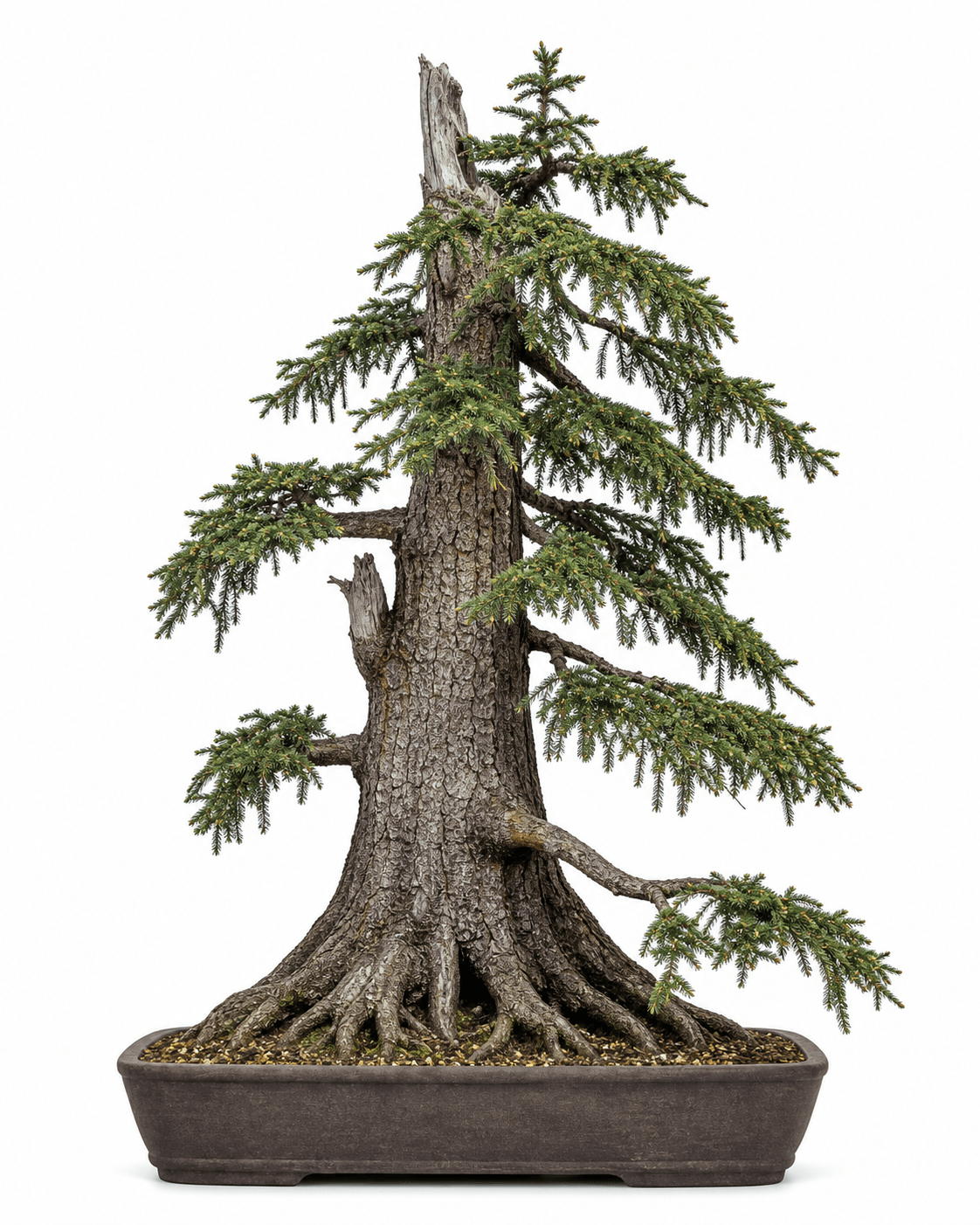
Design should start with that ecology. Sitka can read as a tall coastal timber tree, a wind-loaded shoreline survivor, a forest element with hemlock and cedar, or a rugged broken-top spruce with shallow roots gripping rock, slab, or drifted soil. Bonsai Mirai / AsymmetryBonsai Mirai LibraryUSDA Forest Service FEIS
Reading
Read phase, needle coarseness, buds, and root condition before work.
Mirai spruce method starts with phase. A developing Sitka needs extension, needle mass, and vascular expansion before refinement. Let shoots elongate, harden, and feed the trunk, then prune to actual buds when the branch has earned reduction. Bonsai Mirai Library
A refined branch is read by silhouette, bud density, needle generations, and the location of strong, medium, and weak shoots. Pinch only shoots that break the design line or over-strengthen a pad. Leave useful interior shoots to fill voids. Bonsai Mirai Library
Sitka has sharper, relatively coarse needles compared with fine mountain spruces such as Engelmann and Ezo. Coarser spruce generally tolerate heat, drought, roots, and wiring better than fine spruce, but Sitka still has a coastal moisture expectation. Oregon State Landscape PlantsBonsai Mirai Library
Root reading matters as much as shoot reading. FEIS describes Sitka spruce roots as shallow and platelike with long laterals. In a pot, that habit rewards wide stable containers, strong tie-downs, and staged soil conversion instead of sudden bare-rooting. USDA Forest Service FEISBonsai Mirai Library
Spring growth
Pinch refined soft tips, prune hardened shoots to buds, and skip pine decandling.
Pinching on Sitka spruce is a refinement technique. Remove only the soft terminal tip while supporting the branch, and only on branches that already have a target silhouette. Removing the whole new shoot can kill the tip. Bonsai Mirai Library
The window is short. Once the central stem stiffens, shifts color, or tears instead of breaking cleanly, the shoot has moved from pinching into pruning territory. Daily observation during spring matters more than a fixed calendar date. Bonsai Mirai Library
Development branches should extend first. Mirai method teaches that back buds on elongating conifers come after needle mass expands, hardens, and reloads the vascular system. Pinching too early sacrifices the energy needed to create future interior options. Bonsai Mirai Library
After the spring flush hardens, cut back only to visible buds or existing ramification. Tiny brown buds between needles are usable targets. A blind cut along a Sitka shoot usually dies back because spruce do not reliably create lateral buds on command. Bonsai Mirai Library
At crowded junctions, reduce to two useful pieces when strength allows. Prefer strong ramified pieces with bud quality over mechanical left-right rules, because spruce branch selection starts with vigor and usable buds. Bonsai Mirai Library
Sitka spruce is not decandled. Japanese black pine techniques belong to multiflush pines. Sitka is a single-flush elongating conifer, so the tools are spring soft-tip pinching, post-harden pruning, needle cleaning, and staged structural timing. Bonsai Mirai Library
Roots
Repot at bud swell, then protect the shallow root system.
Use spring bud swell as the primary repotting window. Hydrate the tree first, work cleanly, tie it firmly, and protect it afterward from freezing, drying wind, and harsh sun while fine roots resume growth. Bonsai Mirai Library
Established refinement trees should keep the central root core under the trunk. Work the sides, bottom, and surface first so the tree keeps the root sheath that supports existing branch refinement. Bonsai Mirai Library
Nursery or collected Sitka should be converted in stages. Organic field or nursery soil can hold too much water in the center while fresh aggregate dries around it, so replace the core over two or three repots after new roots colonize the outer mix. Bonsai Mirai Library
Do not combine major root reduction and major foliage reduction in the same year. Mirai treats spruce strength as vascular storage across trunk, branches, and roots. A heavy operation on one side needs the other side intact for recovery. Bonsai Mirai Library
Soil and pot
Use an oxygenated, water-retentive spruce mix and choose broad stable containers.
A practical established-tree baseline is 3 parts akadama, 1 part lava, and 1 part pumice. The akadama supports fine roots and scale reduction, while pumice and lava preserve air in wet coastal or humid benches. Bonsai Mirai Library
Oregon State describes Sitka as preferring moist to wet sandy soil and cool moist air. NC State lists clay, high-organic, loam, and sand as possible textures, with good drainage, moist soil, and occasional wetness. Bonsai soil should translate that into water availability plus oxygen. Oregon State Landscape PlantsNC State ExtensionBonsai Mirai Library
Particle size should match climate and pot depth. Hot inland growers often need more water retention and pot shade; humid regions need airflow, clean old needles, and enough aggregate structure that the root ball does not remain saturated overnight. Bonsai Mirai LibraryUniversity of Minnesota Extension
Use unglazed rectangles, ovals, slabs, crescent stones, or forest trays that support a coastal conifer image. Because Sitka roots are shallow and lateral, broad stable containers and excellent tie-down are often more convincing than narrow display pots. Bonsai Mirai / AsymmetryUSDA Forest Service FEIS
Climate
Cool coastal benches are easiest; hot dry regions require active protection.
Oregon State lists Sitka spruce as Zone 7 and describes a plant of sun, moist to wet sandy soil, and coastal fog-belt air. NC State lists Zones 7a to 8b, full sun to partial shade, moist cool coasts, and best performance in foggy rainforests. Oregon State Landscape PlantsNC State Extension
In maritime Pacific Northwest, coastal British Columbia, coastal Alaska, the United Kingdom, Ireland, and similar climates, Sitka can take brighter exposure with steady water and airflow. Watch wind because shallow bonsai roots anchor less deeply than landscape roots. USDA Forest Service SilvicsNC State Extension
In hot inland regions, treat the tree as a specialty coastal conifer. Use morning sun, afternoon shade, pot shade, misting or humidity pulses, and extra caution when soft spring growth is present. Mirai spruce guidance warns that soft uncuticularized growth can burn at surprisingly mild spring temperatures. Bonsai Mirai Library
Cold-region care needs nuance. Sitka grows far north in maritime Alaska, but bonsai roots in shallow pots see colder and faster swings than forest roots. Overwinter cold and dormant, with protection from hard freeze-thaw and drying wind. Kew POWOUSDA Forest Service SilvicsBonsai Mirai Library
Pests and diseases
Expect aphids, adelgids, mites, needle cast, root rot, and stress insects.
NC State lists green spruce aphid, white pine weevil, ambrosia beetle, spruce beetle, scales, adelgids, spider mites, Cooley spruce gall adelgid, root and stem rots, and windthrow as Sitka spruce problems. Oregon State also notes tip-galling adelgids in the Willamette Valley. NC State ExtensionOregon State Landscape Plants
Green spruce aphid matters because it can defoliate Sitka during cool-season activity. Inspect inner and lower shoots, especially after mild winters or cool damp spring weather, before unexplained needle drop empties the branch structure. NC State Extension
Spider mites are a common bonsai failure mode in hot, dry, dusty conditions. A Sitka that looks gray, stippled, or dull should be checked with magnification or a white-paper tap test before spraying. NC State ExtensionBonsai Mirai Library
Rhizosphaera-style needle cast is less Sitka-specific in the public extension literature than it is for Colorado blue spruce, but the spruce prevention rules still matter: air, sun, spacing, clean needles, and local diagnosis. University of Minnesota notes that several fungi mimic Rhizosphaera symptoms, so lab confirmation matters. University of Minnesota Extension
Root and stem rots usually trace to oxygen failure, old organic cores, constant saturation, or weak aftercare after repotting. A coastal tree still needs water movement, not stale water. NC State ExtensionBonsai Mirai Library
Wiring
Clean first, wire with enough gauge, and protect the sharp needles.
Needle cleaning comes before wiring. Remove only dead needles and older needles that release easily with light rubbing. Needles that hold firmly are still vascularly attached and should remain. Bonsai Mirai Library
Spruce is strongly phototropic and resists weak wire. Use enough gauge to place the branch once, then monitor closely during spring and fall vascular swelling because bite can arrive quickly. Bonsai Mirai Library
Wire through needle mass as a loose tube, then contact the wood firmly only on woody shoulders. Crushed Sitka needles brown, and branch inversion can bleach underside needles even in cool weather. Bonsai Mirai Library
For large bends, combine linear flexion with rotation and anchor guy wires before force is applied. Wedge-cut bending should be avoided on spruce because partial deadwooding of elongating-conifer tissue is unreliable. Bonsai Mirai Library
Propagation
Seed is the natural path, while cuttings, layering, nursery stock, and legal collection are specialist paths.
NC State lists seed as the main propagation route, with cuttings and layering as options. USDA Silvics and FEIS describe seed reproduction, wind dispersal, shallow roots, and natural hybridization with white spruce into Lutz spruce where ranges meet. NC State ExtensionUSDA Forest Service SilvicsUSDA Forest Service FEIS
Seedlings are the cleanest route for forests, upright development, and root control. They need years of trunk building before bark, scale, and branch age become convincing. Bonsai Mirai / AsymmetryUSDA NRCS Plant Guide
Cuttings and air layers should be treated as advanced spruce work. Use them to preserve compact selections or useful trunk sections, then protect the new roots from heat, drought, and stale water. NC State ExtensionBonsai Mirai Library
Collected Sitka can offer buttress, coastal bark, driftwood movement, and old branch character. That path requires legal permission, site repair, intact roots, cool humid aftercare, and delayed styling until the tree has grown strongly for at least one full season. Bonsai Mirai LibraryUSDA Forest Service FEIS
Buying
Buy for root base, interior buds, and coastal suitability before trunk size.
Good nursery Sitka has a discoverable flare, live interior buds, strong fall buds, manageable whorls, and a root ball that can be converted without bare-rooting. A dense landscape cone with foliage only at the tips usually needs years before it becomes bonsai material. Bonsai Mirai Library
Inspect for aphid or mite damage, Cooley gall distortion, old wet organic soil, circling roots, unstable trunk movement, and long branch sections with no interior bud options. NC State ExtensionOregon State Landscape PlantsBonsai Mirai Library
Dwarf selections can solve scale. Oregon State and NC State both list Papoose, a dwarf form with short blue and green needles. Verify grafts, vigor, reversion, and root quality before paying a bonsai premium. Oregon State Landscape PlantsNC State Extension
Collected or pre-bonsai material should come with a recovery history. Ask when it was lifted, how many growing seasons it has completed, whether it has pushed interior buds, and what soil remains under the trunk. Bonsai Mirai Library
Troubleshooting
Most problems trace to heat, stale roots, mistimed pruning, pests, or missing coastal humidity.
Symptom: older needles drop and the interior thins. Likely cause: normal old-needle shed, aphids, mites, shade, needle disease, or root stress. Fix: identify needle age, inspect pests, open light and air, and use local diagnosis for suspected disease. NC State ExtensionUniversity of Minnesota ExtensionBonsai Mirai Library
Symptom: soft spring tips brown after work. Likely cause: pinching too late, scissor damage, sunburn on soft growth, or crushed needles. Fix: stop work, shade, stabilize water, and use fingertip pinching only in the next soft window. Bonsai Mirai Library
Symptom: cut shoots die back. Likely cause: pruning to no visible bud or reducing a weak branch before it had stored energy. Fix: let the branch run, rebuild needle mass, then cut to actual buds after hardening. Bonsai Mirai Library
Symptom: yellowing after repotting. Likely cause: a wet organic core, unstable tie-down, damaged fine roots, or too much foliage reduction in the same year. Fix: stabilize aftercare and plan staged core conversion later. Bonsai Mirai Library
Symptom: gray or dusty foliage in summer. Likely cause: spider mites, dry heat, or salt and wind stress. Fix: inspect first, rinse when appropriate, improve humidity and airflow, and treat only after confirming active pests. NC State ExtensionBonsai Mirai Library
Symptom: pineapple-like galls or dead young tips. Likely cause: Cooley spruce gall adelgid or related adelgid pressure. Fix: remove badly distorted tips when appropriate, improve vigor, and follow local extension timing for treatment. Oregon State Landscape PlantsNC State Extension
Design
Make the image coastal, tall, sharp, and wind-literate.
Start with the trunk line, defining branch, and apex. USDA and NC State describe Sitka as a giant coastal spruce with open crown, pendulous branches, buttressed bases, and very large forest scale. Bonsai design should preserve that sense of height and exposure. USDA Forest Service FEISNC State ExtensionBonsai Mirai / Asymmetry
Forests and groups are especially credible because Sitka commonly grows with western hemlock in dense coastal stands. Use varied trunk sizes, asymmetric spacing, and a low wet-forest floor rather than identical Christmas-tree cones. USDA Forest Service SilvicsBonsai Mirai / Asymmetry
Single-tree designs can be formal upright, informal upright, slanting, cascade, or windswept. Coastal wind can lift, flatten, or flag branches, but branch pads still need clear light paths and enough foliage to feed future buds. Bonsai Mirai LibraryUSDA Forest Service FEIS
Spruce deadwood should look broken, cylindrical, and weathered. Mirai method favors natural aging and bark shedding on spruce deadwood rather than fine carved juniper-style grain. Bonsai Mirai Library
Apex work should fit the story. A young coastal tree can carry a strong pointed top. An older tree can use a smaller broken top, subordinate replacement apices, or a wind-directed crown that still reads as Sitka spruce. Bonsai Mirai / AsymmetryBonsai Mirai Library
Cultivars
Papoose is the practical dwarf label, while Lutz spruce and old aliases require caution.
Oregon State and NC State list Papoose as a dwarf Sitka selection with blue and green short needles. That form can be useful for smaller bonsai, but inspect actual internodes, root base, graft, and vigor rather than buying the name alone. Oregon State Landscape PlantsNC State Extension
FEIS notes that Sitka naturally hybridizes with white spruce to produce Lutz spruce where their ranges meet, especially in Alaska and British Columbia. Lutz material may need a hybrid care read rather than a pure Sitka assumption. USDA Forest Service FEIS
Older labels include Abies falcata, Abies menziesii, Picea falcata, Picea menziesii, Pinus menziesii, tideland spruce, coast spruce, yellow spruce, western spruce, silver spruce, and Menzies spruce. Some are ambiguous in horticultural use, so confirm Picea sitchensis before applying this page. Kew POWONC State ExtensionUSDA NRCS Plant Guide
Most growers should begin with ordinary seedlings, young nursery trees, or locally adapted pre-bonsai. Dwarf forms help scale, but healthy root conversion and timing skill matter more than rarity. Bonsai Mirai LibraryNC State Extension
History
Sitka spruce carries Pacific forest history, craft wood, and coastal scale.
USDA sources describe Sitka spruce as a major commercial and cultural tree. NRCS notes its use for high-grade lumber, aircraft and glider construction, boats, oars, ladders, scaffolding, piano sounding boards, and guitars. USDA NRCS Plant GuideUSDA Forest Service Silvics
Indigenous uses are part of the tree history as well. The NRCS guide records uses of inner bark, roots, pitch, and boughs by Pacific Northwest peoples, including basketry, medicine, adhesive, and ceremonial use. USDA NRCS Plant Guide
NC State describes Sitka as Alaska state tree and notes old specimens over 1300 years old. FEIS describes the species as long-lived, with some trees exceeding 800 years and giant forest specimens reaching enormous height and diameter. NC State ExtensionUSDA Forest Service FEIS
For bonsai, that history argues for restraint: honest coastal sourcing, patient root work, sharp spruce foliage, weathered bark, and designs that communicate Pacific maritime scale rather than generic conifer styling. Bonsai Mirai / AsymmetryBonsai Mirai Library
Species questions
Answer the beginner questions before styling.
Can Sitka spruce be grown as bonsai?
Yes. Sitka spruce can be grown as bonsai outdoors when it receives cool bright conditions, steady moisture, oxygenated roots, spring bud-swell repotting, refinement-only pinching, post-flush pruning, and winter container protection.
Can Sitka spruce bonsai live indoors?
No. Sitka spruce needs outdoor light, moving air, cool dormancy, and seasonal temperature change. Indoor rooms are too warm, dry, and dim for long-term health.
When should I repot Sitka spruce bonsai?
Repot in spring as buds swell. Keep the central root core on refined trees, tie the tree firmly, and protect it from freezing, hot sun, and drying wind during aftercare.
Should I pinch Sitka spruce?
Pinch only healthy refined shoots while the new tip is soft. Development branches, weak trees, and recently repotted trees should extend first and be pruned after hardening.
How do I prune Sitka spruce bonsai?
After the spring flush hardens, prune back to visible buds or useful ramification. Avoid blind mid-shoot cuts, reduce crowded junctions to two pieces, and leave weak branches with enough foliage to recover.
What soil mix works for Sitka spruce bonsai?
A useful established-tree baseline is 3 parts akadama, 1 part lava, and 1 part pumice. Adjust particle size and watering for wet coastal benches, hot inland benches, and container depth.
Why is my Sitka spruce turning brown?
Common causes include dry wind, hot roots, stale wet nursery soil, aphids, mites, needle cast, root rot, crushed needles from wiring, pruning without viable buds, or loss of coastal humidity.
Is Sitka spruce the same as white spruce?
No. Sitka spruce is Picea sitchensis. White spruce is usually Picea laxa or Picea glauca in public sources. Where their ranges overlap, hybrid Lutz spruce can occur and should be identified separately.
What styles suit Sitka spruce bonsai?
Medium and large uprights, forests, slants, cascades, windswept coastal trees, raft forms, and broken-top old spruce designs suit Sitka best.
Is Sitka spruce beginner friendly?
It is best for growers who can provide outdoor coastal-style conditions and can watch timing closely. The species is strong in the right climate, but weakens quickly when roots overheat, soil stays sour, or pruning is mistimed.
Sources
Species advice needs source discipline.
Next decisions
Plan the operation before copying the calendar.
A good care note for Sitka spruce records the tree's stage, the work done, and the aftercare used. That record matters more than a month-name rule.
Related species
Compare nearby trees before transferring advice.
Coast redwood
Sequoia sempervirens
Western hemlock
Tsuga heterophylla
Coastal Douglas-fir
Pseudotsuga menziesii var. menziesii
Monterey cypress
Hesperocyparis macrocarpa
Japanese cedar / sugi
Cryptomeria japonica