
Species guide
Monterey Cypress Bonsai Care
Hesperocyparis macrocarpa
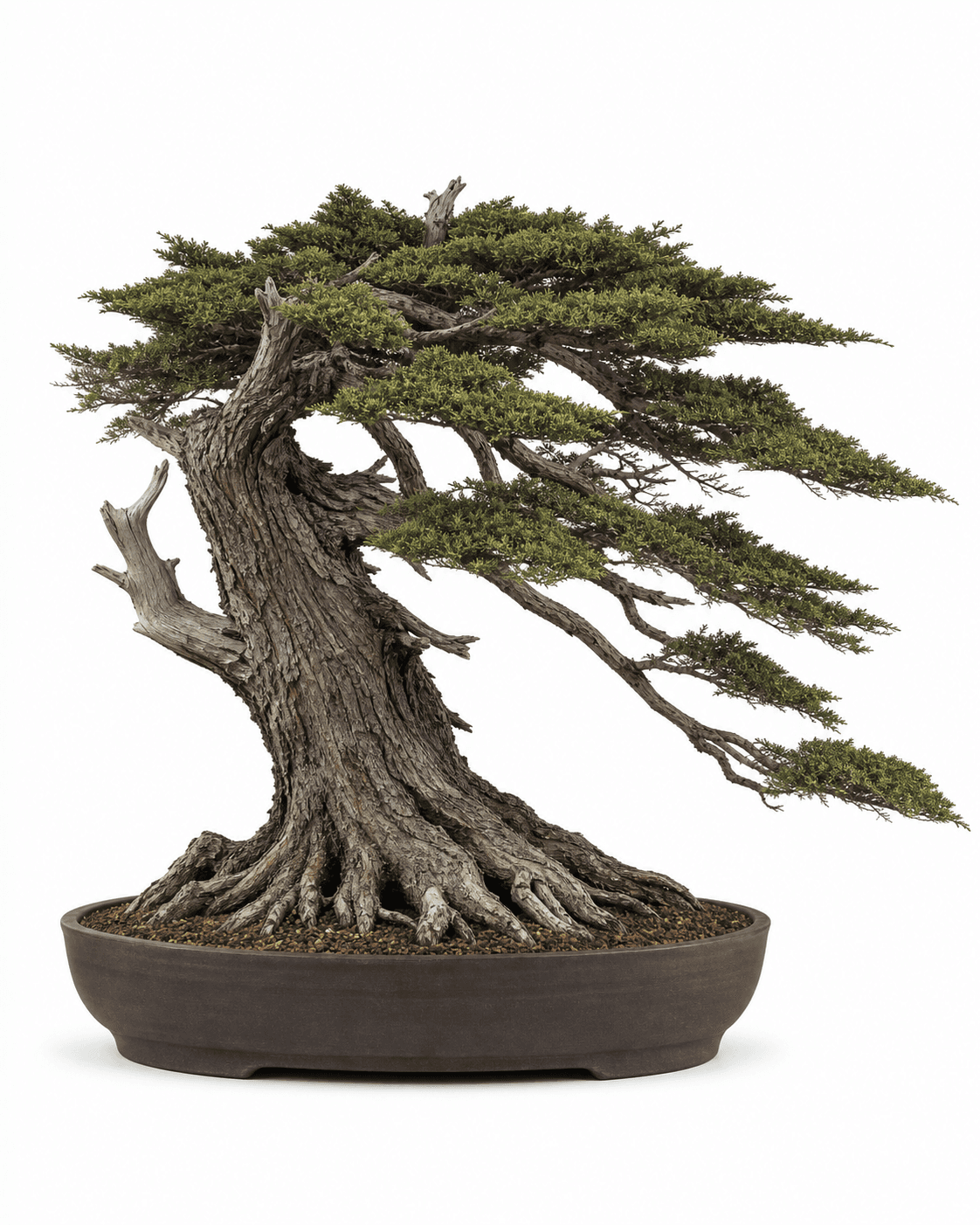
Monterey cypress bonsai are outdoor coastal conifers, best handled as Hesperocyparis macrocarpa with the older Cupressus macrocarpa label kept in records. The core calendar is unusual: major root work is safest in January as daylight starts lengthening, while heavy structural styling can be done in late summer on a vigorous established tree.
The tree rewards growers who preserve interior green, flush salt and stale soil from the root zone, avoid inland heat stress, and style from the species' coastal image: compressed windward foliage, elongated leeward branches, strong deadwood remnants, and a broad flat upper canopy.
Updated June 5, 2026. Written by EntGrove Editorial. Last verified June 5, 2026.
Care fingerprint
Read the species through its shared care pattern.
Avoid dry-wind stress, preserve interior growth, and distinguish cypress-style pad work from juniper refinement. Use this as the starting point before local conditions and tree strength refine the calendar.
Do not prune like a pine
Elongating conifers extend from buds and shoots, so candle-cutting assumptions can remove the exact growth the tree needs.
Preserve interior growth
Spruce, fir, hemlock, cedar, redwood, cypress, and larch all become harder to design when interior buds are shaded out.
Keep recovery cool and steady
Many elongating conifers respond best when roots stay evenly moist, oxygenated, and protected from hot dry swings.
Care cadence
The calendar starts with the tree's seasonal state.
Watering
Timing: Check daily during active growth, warm wind, fresh repot aftercare, and summer recovery. Water thoroughly enough to flush salts and fines.
Watch for: Interior shedding, dry root pockets, sour old field soil, stagnant water, hot black pots, and salt accumulation on coastal or fertilized trees.
Bonsai Mirai LibraryNC State ExtensionRepotting
Timing: Repot as early as possible in the new year, with January as the strongest Mirai window for severe root reduction on Cupressus.
Watch for: Risk rises through February, March, and April. Keep post-repot trees warm and protected from freezing.
Bonsai Mirai LibraryRoot exploration
Timing: On unknown root systems, decide front, rotation, and angle before extraction, then expose nebari uniformly and avoid pockets you cannot refill.
Watch for: Fleshy white feeder roots, thick perimeter roots, torn root tips, inaccessible old-soil cavities, and sharp interfaces between old and new soil.
Bonsai Mirai LibraryLate-summer structural work
Timing: Heavy styling can happen in late summer before the fall vascular flush if the tree is vigorous and established.
Watch for: Avoid heavy reduction when forecast temperatures approach 100 degrees F. Use morning sun and afternoon shade immediately after work.
Bonsai Mirai LibraryPruning and back-budding
Timing: Reduce strong foliage while the tree has visible vigor, then keep cuts within zones that still have young bark or existing interior growth.
Watch for: Corked older branches cannot be counted on for back-budding behind the cork cambium. Bare interiors need redesign, grafting, or branch replacement.
Bonsai Mirai LibraryWiring checks
Timing: Set structure with heavy wire and guy wires during planned styling windows, then inspect contact points through May and June vascular swelling.
Watch for: Inverse swelling, guy-wire bite, crotch tearing, elastic rebound, bark rub, and pressure points on old valuable bark.
Bonsai Mirai LibraryFertilizing
Timing: Feed established trees during active growth and especially through fall after heavy summer reduction.
Watch for: Use nutrition to drive recovery and microbial activity. Rot, stale soil, heat stress, and canker need correction first.
Bonsai Mirai LibraryPest and disease inspection
Timing: Inspect after pruning, during foggy or rainy moderate weather, after inland heat, and whenever branches flag yellow or brown.
Watch for: Cypress canker, resinous bark lesions, girdled shoots, bark beetles, borers, cypress bark moth larvae, armillaria, phytophthora, and root rot.
NC State ExtensionUC IPMWinter protection
Timing: Keep outside and dormant, but protect bonsai roots from hard freeze, drying wind, and freezing immediately after root work.
Watch for: Landscape Zone 7 hardiness does not make a shallow bonsai pot equally hardy after January root work.
Oregon State Landscape PlantsBonsai Mirai LibrarySpecies guide
Apply the species profile before copying another tree's calendar.
At a glance
Monterey cypress is a rare coastal tree with a bonsai calendar of its own.
Kew accepts Hesperocyparis macrocarpa and places it in Cupressaceae. The older Cupressus macrocarpa and Callitropsis macrocarpa labels remain common in nurseries, books, and bonsai collections, so keep all names in the tree record. Kew POWOOregon State Landscape PlantsNC State Extension
The species is naturally restricted to the central California coast near Monterey. Oregon State says only two native stands persist on the Monterey Peninsula, and NC State describes it as relatively rare around Monterey. Kew POWOOregon State Landscape PlantsNC State Extension
As bonsai, Monterey cypress belongs in EntGrove's coastal elongating-conifer group with coast redwood, Sitka spruce, western hemlock, coastal Douglas-fir, Japanese cedar, and false cypresses. The shared care problem is balancing moist coastal roots, strong extension, interior foliage, and climate sensitivity. Bonsai Mirai Library
Mirai has unusually direct Monterey cypress coverage: a dedicated Katsumi Kinoshita Monterey cypress styling, a dedicated cypress repotting session, coastal cypress workshop method, and forest-design material that reads the species through wind, salt, fog, and coastal exposure. Bonsai Mirai LibraryBonsai Mirai / Asymmetry
Wild habitat
Its native image comes from the Monterey coast.
Kew lists the native range as California near Monterey. USDA FEIS records Monterey cypress as rare in its range and notes that native grove areas on Monterey Peninsula have been reduced by development and golf courses. Kew POWOUSDA Forest Service FEIS
Oregon State describes a tree that is conical when young, broadly spreading with age, and hardy to USDA Zone 7. NC State adds that old trees can reach 80 to 90 feet and develop a broad spreading crown, while the crushed foliage has a lemon fragrance. Oregon State Landscape PlantsNC State Extension
Mirai reads the wild design through coastal exposure. Prevailing onshore wind compresses the seaward side and lets branches elongate inland, creating a single aerodynamic canopy line with little resemblance to a stacked garden-conifer triangle. Bonsai Mirai Library
Care follows that ecology. The tree likes sun, salt-air tolerance, cool coastal movement, and steady moisture, but a shallow container turns salt, heat, and old compacted soil into real risks. NC State ExtensionBonsai Mirai LibraryUC IPM
Reading
Read interior green, bark age, root history, and coastal versus inland growth.
The first read is interior foliage. Mirai notes that back-budding is available only on younger smoother bark or where interior buds already exist. Once cork cambium has formed on a branch, new buds should not be expected behind it. Bonsai Mirai Library
The second read is vigor. A Monterey cypress showing vigorous canopy extension can tolerate heavy foliar reduction because the root system already exceeds current foliage demand. A weak tree should be stabilized before styling. Bonsai Mirai Library
The third read is provenance. Mirai distinguishes coastal, wind-exposed Monterey cypress from inland sheltered examples: coastal trees flatten, compress, and stretch away from the wind, while inland trees grow more upright, rounded, and billowy. Bonsai Mirai Library
The fourth read is root history. A collected or old container tree may hide a compacted bottom mat, decomposed field soil, fleshy white feeder roots, and thick perimeter roots. Those conditions decide whether the next work is repotting, styling, or recovery. Bonsai Mirai Library
Pruning
Prune for tapered pointed pads and preserve the long top lines.
Mirai treats cypress pruning as a design operation. The goal is to break the naturally globular growth pattern into elongated lateral forms with negative space, then taper each foliar pad to a pointed tip. Bonsai Mirai Library
Avoid the habit of shortening every long shoot. On coastal-style cypress, long upper branches can be the defining feature because they carry the wind-shaped canopy line. Wire and set the structure before removing length. Bonsai Mirai Library
The foliage gives useful directional choices. Mirai notes that Cupressus elongating shoots produce lateral leaf pairs in alternating planes, which lets the grower prune toward a desired direction without shearing the outline. Bonsai Mirai Library
Branch junctions matter. When three branches emerge from one node, reduce to two because the trio keeps swelling. In coastal cypress design, Mirai often keeps the upward-flowing branch from a trio because that gesture fits the species better than a conventional lower-branch selection rule. Bonsai Mirai Library
Repotting
January root work is the signature technical difference.
Mirai places the safest severe Cupressus root window in January in the Northern Hemisphere, as daylight lengthens and root activity begins. Tolerance drops through February, March, and April, especially for heavy reductions. Bonsai Mirai Library
Never remove a majority of the soil in one repot. Monterey cypress can be strong above ground and sensitive below ground, with fleshy feeder roots that take up water efficiently but bruise and tear easily. Bonsai Mirai Library
On an unknown root mass, decide front, rotation, and inclination before extraction. Shifting angle after the root ball is loose causes avoidable root damage. Plane the bottom to the new angle while preserving the high side when the planting angle changes. Bonsai Mirai Library
The repot should improve water and oxygen movement. Break the bottom mat, prune damaged root tips cleanly, avoid inaccessible old-soil pockets, and intermix new soil with existing roots so the tree does not sit in two separate root environments. Bonsai Mirai Library
After repotting, keep the tree warm, protected from freezing, and stable in the pot. Flood and drain the soil column repeatedly at the first watering to settle particles and flush fines without compacting the surface by hand. Bonsai Mirai Library
Soil and pot
Use akadama-heavy soil and a container that supports asymmetry.
Mirai uses 3 parts akadama, 1 part lava, and 1 part pumice for long-term Cupressus soil, with particles around 1/16 inch to 1/4 inch. This mix supports moisture, cation exchange, and fine root proliferation while leaving enough air. Bonsai Mirai Library
If old field soil remains, use a transitional 2 parts akadama, 1 part lava, and 1 part pumice blend so the old core and new soil move water more similarly. Finish the conversion across future repots. Bonsai Mirai Library
Akadama-heavy soil also supports ramification. Mirai links finer roots with finer foliage development on coarse-growing Cupressus, while noting that confinement itself can shorten internodes and reduce foliage quantity over time. Bonsai Mirai Library
Container choice should reinforce movement. Mirai notes that an asymmetric Monterey cypress can sit in the geometric center of the pot so the container stability amplifies the tree movement, while square containers force apex-over-base symmetry and often weaken the composition. Bonsai Mirai Library
Climate
Cool coastal air is the ideal, and inland heat raises the stakes.
Oregon State says Monterey cypress is susceptible to coryneum canker when grown inland away from cool coastal winds. UC IPM gives the same practical warning and singles out Monterey cypress as a poor inland choice away from the cool coastal climate. Oregon State Landscape PlantsUC IPM
NC State describes the tree as salt-spray tolerant and better in cooler coastal climates, with hot-summer plantings less successful. For bonsai, this means full sun near the coast but heat moderation, pot cooling, and afternoon shade in inland valleys. NC State Extension
After heavy late-summer work, Mirai shelters the tree from intense heat, using morning sun and afternoon shade until the weather breaks. Forecasts near 100 degrees F are a reason to delay heavy reduction. Bonsai Mirai Library
Winter handling should separate dormancy from frozen-root risk. Keep the tree outdoors in bright air, but protect a shallow pot from hard freeze, drying wind, and sudden cold immediately after January root work. Oregon State Landscape PlantsBonsai Mirai Library
Pests and diseases
Cypress canker is the disease that should shape placement and pruning hygiene.
UC IPM identifies cypress canker, Seiridium or Coryneum cardinale, as a disease that primarily affects Cupressus species. Monterey cypress is especially susceptible when planted away from the coast. UC IPM
Symptoms include resinous bark lesions, yellow or brown branches or tops, girdled shoots, and gradual dieback. The pathogen moves by wind, splashing water, pruning tools, and infected nursery stock, and cankers enlarge faster on drought-stressed trees. UC IPM
Bonsai prevention is practical: use clean tools, avoid unnecessary wounds during stressful weather, do not buy infected nursery stock, keep roots functioning, and prune out diseased branches with local extension guidance. UC IPMBonsai Mirai Library
NC State also lists bark beetles, borers, larvae of moths, armillaria, phytophthora, root rot, and coryneum canker. In bonsai, many of those problems start with a weakened tree, old soil, heat, poor drainage, or a wounded branch. NC State Extension
Wiring
The wood is strong and elastic, so wiring must be deliberate and checked often.
Mirai describes Cupressus wood as stronger than pine and capable of long-lasting deadwood, but Monterey cypress branches are elastic and rebound after bending. Large primary branches on a big tree may need 4-gauge AWG wire to hold position. Bonsai Mirai Library
Set primary structure before doing secondary and tertiary wiring. Heavy upper branches often need wire anchored lower on the trunk for leverage, and structural bends should be made before irreversible cuts remove fallback options. Bonsai Mirai Library
Protect crotches. Mirai notes that acute crotches are weaker than wide crotches, and coastal cypress can tear under torsion. Gap-wire over the shoulder, lash fibers if a pressure point starts splitting, and seal exposed vascular tears immediately. Bonsai Mirai Library
Guy wires should be visually quiet but inspected frequently. Coastal cypress lays down heavy vascular tissue during the growing season, so May and June checks prevent tie wires and guy wires from causing inverse swelling. Bonsai Mirai Library
Propagation
Seeds, semi-hardwood cuttings, grafting, and group planting all have a role.
NC State lists propagation by seeds and semi-hardwood cuttings. USDA FEIS notes that California cypress cones release seed after fire heat, with seed falling onto exposed mineral soil followed by winter rain in the wild. NC State ExtensionUSDA Forest Service FEIS
Mirai notes that Cupressus species can be grafted onto other Cupressus species. Grafting is useful for restoration, branch replacement, and cultivar work, but it should be planned around strong root function and aftercare. Bonsai Mirai Library
Air-layering should preserve maximum foliage above the ring while pruning only below the layer when stress reduction is needed. The same principle used on other cypress work applies: foliage above the ring feeds callus and roots. Bonsai Mirai Library
Small pygmy-cypress or Monterey-cypress forms can be used in group compositions when individual scale is small. Mirai treats group planting as a way to express the coastal ecosystem, with the shared scene giving small individual trees visual power. Bonsai Mirai Library
Buying
Buy for interior foliage, clean roots, and coastal character.
Good material has a visible base, older bark, interior green, recoverable branch options, vigorous color, and a root system that can be explored in January without erasing all old soil at once. Bonsai Mirai Library
Reject nursery trees with dry bare interiors, canker lesions, oozing bark, dead tops from disease, sour old soil, severe root binding, or foliage that exists only as a sheared outer shell. UC IPMBonsai Mirai Library
Cultivars such as Goldcrest, Golden Pillar, Karoonda, Wilma, and Wilma Goldcrest can solve scale or color, but many juvenile golden forms are columnar retail plants with weak bonsai structure. Inspect grafts, branch exits, root flare, and future style before buying. Oregon State Landscape PlantsNC State Extension
Collected material and native-range material require legal, ethical sourcing. USDA FEIS records Monterey cypress as rare in its natural range and notes California Native Plant Society Category 1B status, so casual collection from wild trees is inappropriate. USDA Forest Service FEIS
Troubleshooting
Most failures trace back to old soil, inland stress, canker, or bare interiors.
Symptom: branch tips turn yellow or brown with resinous bark lesions. Likely cause: cypress canker. Fix: isolate the tree, prune infected branches with clean tools, improve water and vigor, and use local extension diagnosis before treatment. UC IPM
Symptom: interior branches drop after salty wind, hard fertilizing, or poor flushing. Likely cause: salt accumulation or stale container conditions. Fix: water deeply, flush the substrate, improve percolation, and protect from extreme drying wind. Bonsai Mirai Library
Symptom: pruning creates a bare hole that never fills. Likely cause: cutting behind the back-budding zone on corked older wood. Fix: preserve young interior growth, graft, redesign, or grow replacement branches from live zones. Bonsai Mirai Library
Symptom: the tree weakens after a spring repot. Likely cause: root work happened too late or too much old soil was removed. Fix: protect warmth, shade lightly, stabilize moisture, and wait for recovery before styling. Bonsai Mirai Library
Symptom: wire or guy wire leaves a swollen groove by early summer. Likely cause: strong vascular growth around contact points. Fix: remove or reset anchors earlier, pad contact points, and check May and June growth more often. Bonsai Mirai Library
Symptom: brown foliage after inland heat. Likely cause: heat stress compounded by drought, old soil, or recent reduction. Fix: move to morning sun and afternoon shade, cool the pot, water thoroughly, and postpone heavy work until weather moderates. NC State ExtensionBonsai Mirai Library
Design
Style for coastal wind, negative space, and old cypress strength.
Start with the defining branch, trunk lean, deadwood, and apex compression. Mirai uses Monterey cypress to show age through deadwood remnants, greater negative space, and asymmetric movement away from the windward side. Bonsai Mirai LibraryBonsai Mirai / Asymmetry
Style coastal Monterey cypress from its own silhouette. The canopy often reads as flat-topped, compressed on one side, and elongated inland, with multiple discrete foliar layers instead of a stack of broad flat pads. Bonsai Mirai Library
Deadwood is important but restrained. Mirai advises keeping old bark on cypress deadwood branches because weathered cypress bark carries visual value. Stripped juniper-style wood can erase that character. Bonsai Mirai Library
Pad scale changes the apparent age and size of the tree. Smaller pointed pads make a trunk read larger, while oversized pads shrink the perceived scale. Use pad size to support the wild tree image you are representing. Bonsai Mirai Library
Forests and groups can be especially strong. Mirai treats Monterey and pygmy cypress forests as ecosystem portraits, using shared wind direction, varied trunk height and thickness, and irregular spacing to make the composition read as one coastal scene. Bonsai Mirai Library
Cultivars
Cultivar names are useful, but growth habit decides bonsai value.
Oregon State lists Golden Pillar, Karoonda, and Wilma Goldcrest. NC State lists Goldcrest, Golden Pillar, Karoonda, and Wilma, with Goldcrest and Wilma described as bright yellow or chartreuse juvenile-foliage forms. Oregon State Landscape PlantsNC State Extension
Columnar golden forms can be useful for small design studies, but their retail appeal can hide poor trunk movement, weak interiors, or awkward branch placement. Treat the cultivar as a starting clue, then judge the actual structure. Bonsai Mirai LibraryNC State Extension
Pygmy cypress material can substitute for Monterey cypress at miniature scale because it carries similar coastal foliar character with smaller scale leaves. Keep the label clear, since Hesperocyparis pygmaea and Hesperocyparis macrocarpa have different conservation and sourcing contexts. Bonsai Mirai Library
Keep old taxonomic names in the record. Kew lists Cupressus macrocarpa, Callitropsis macrocarpa, Neocupressus macrocarpa, Cupressus lambertiana, and other historical synonyms under the accepted Hesperocyparis macrocarpa name. Kew POWO
History
The species is famous, rare, and heavily planted outside its small native range.
Oregon State notes that the Lone Cypress at Cypress Point is one of the most photographed trees in California. That image explains why Monterey cypress bonsai often work best when they reference wind, rock, exposure, and coastal age. Oregon State Landscape Plants
USDA FEIS records wide planting as an ornamental, hedge, and windbreak in the Pacific states, Europe, South America, Australia, New Zealand, and the Falkland Islands, plus plantation use in Africa and New Zealand. USDA Forest Service FEIS
The same FEIS review notes rare status in the native range and habitat losses on Monterey Peninsula. A bonsai page should therefore separate cultivated nursery material from wild native stands and avoid normalizing casual collection. USDA Forest Service FEIS
In bonsai, Monterey cypress is valuable because it offers a place-specific California coastal image. The best trees feel shaped by fog, salt, wind, hard wood, age, and a clear California coastal identity. Bonsai Mirai / AsymmetryBonsai Mirai Library
Species questions
Answer the beginner questions before styling.
Can Monterey cypress be grown as bonsai?
Yes. Monterey cypress can be grown as outdoor bonsai when it gets cool bright air, consistently moist but oxygenated soil, January-root-work timing, and careful preservation of interior foliage.
Can Monterey cypress bonsai live indoors?
Indoor culture fails long term because Monterey cypress needs outdoor light, moving air, seasonal temperature change, and a cool coastal rhythm. Brief display is fine when the tree returns outside quickly.
When should I repot Monterey cypress bonsai?
Repot in January in the Northern Hemisphere when daylight starts lengthening. February through April carries rising risk, and a majority of the old soil should never be removed in one session.
What soil works for Monterey cypress bonsai?
A strong established-tree mix is 3 parts akadama, 1 part lava, and 1 part pumice. If old field soil remains, use a transitional 2:1:1 mix while the root mass is converted gradually.
When should I prune Monterey cypress bonsai?
Prune and style heavily in late summer only on a vigorous established tree before the fall vascular flush. Avoid heavy reduction during extreme heat or on a weak tree.
Does Monterey cypress back-bud?
It can back-bud on younger smoother bark and where interior buds remain. Once cork cambium has formed on older branches, do not expect reliable back-budding behind that point.
Is Monterey cypress the same as Cupressus macrocarpa?
Yes. Hesperocyparis macrocarpa is the accepted name used by Kew, while Cupressus macrocarpa and Callitropsis macrocarpa remain common synonyms in horticulture and bonsai records.
Why is my Monterey cypress dropping interior branches?
Common causes include salt accumulation, stale compacted soil, heat stress, canker, drought stress, or loss of interior buds after over-pruning. Check water movement, bark lesions, and live interior growth first.
What disease is most important on Monterey cypress?
Cypress canker is the main disease to watch. It causes resinous lesions and yellow or brown branch dieback, and Monterey cypress is especially vulnerable when grown inland away from cool coastal influence.
What styles suit Monterey cypress bonsai?
Windswept, slanting, informal upright, coastal flat-top, literati, group, forest, and old dead-top forms suit the species when the design shows coastal wind, asymmetry, weathered bark, and pointed layered foliage.
Sources
Species advice needs source discipline.
Next decisions
Plan the operation before copying the calendar.
A good care note for Monterey cypress records the tree's stage, the work done, and the aftercare used. That record matters more than a month-name rule.
Related species
Compare nearby trees before transferring advice.
Coast redwood
Sequoia sempervirens
Sitka spruce
Picea sitchensis
Western hemlock
Tsuga heterophylla
Coastal Douglas-fir
Pseudotsuga menziesii var. menziesii
Japanese cedar / sugi
Cryptomeria japonica