
Species guide
Japanese Cedar Bonsai Care
Cryptomeria japonica
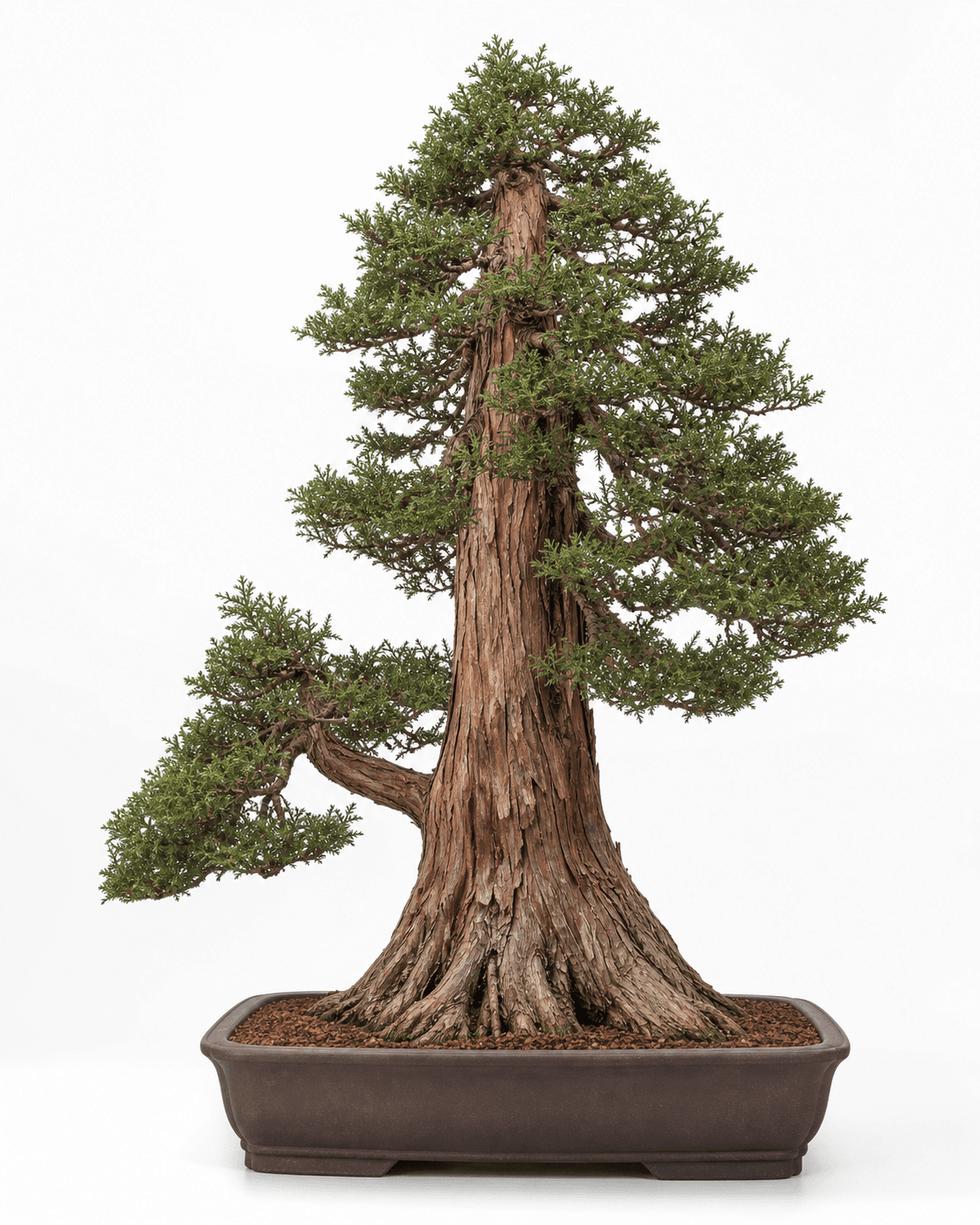
Japanese cedar bonsai, usually called sugi in Japanese, is an outdoor evergreen conifer for bright benches, even moisture, oxygenated roots, and patient detail pruning. It rewards careful growers with fine texture, red-brown bark, formal upright character, and reliable refinement when the tree is allowed to build strength before it is cut.
Treat Cryptomeria japonica as Elongating Species > Coastal in the EntGrove taxonomy. The Mirai corpus frames it as a high-water-mobility conifer: repot at spring bud swell, preserve root continuity, prune to visible buds after growth hardens, and use its natural up-and-out branch habit instead of pine, juniper, or Cedrus assumptions.
The beginner answer is conditional. Sugi is forgiving enough to backbud and air-layer better than many conifers, but it punishes indoor culture, dry wind, blind cuts, root-and-foliage work in the same season, and rough wiring on brittle branch forks.
Updated July 12, 2026. Written by EntGrove Editorial. Last verified July 12, 2026.
Care fingerprint
Read the species through its shared care pattern.
Avoid dry-wind stress, preserve interior growth, and distinguish cypress-style pad work from juniper refinement. Use this as the starting point before local conditions and tree strength refine the calendar.
Do not prune like a pine
Elongating conifers extend from buds and shoots, so candle-cutting assumptions can remove the exact growth the tree needs.
Preserve interior growth
Spruce, fir, hemlock, cedar, redwood, cypress, and larch all become harder to design when interior buds are shaded out.
Keep recovery cool and steady
Many elongating conifers respond best when roots stay evenly moist, oxygenated, and protected from hot dry swings.
Care cadence
The calendar starts with the tree's seasonal state.
Placement and light
Timing: Grow outdoors in bright light with moving air. Use afternoon shade after repotting, during sustained hot dry weather, or when branch undersides have been newly exposed by styling.
Watch for: Warm indoor display, reflected heat, dry wind, post-repot sunburn, branch inversion that exposes shaded tissue, and winter windburn.
Bonsai Mirai LibraryNC State ExtensionOregon State Landscape PlantsWatering
Timing: Water thoroughly whenever the root zone approaches dry but before full dry-down. Let oxygen return between waterings and check old field or nursery cores separately.
Watch for: Water bypassing a compact center, new aggregate drying faster than old clay, post-repot shade that leads to overwatering, and hot wind after root work.
Bonsai Mirai LibrarySpring root work
Timing: Repot when buds swell and before new growth fully extends. Keep a central root sheen, tie the tree firmly, and separate major root work from major foliage reduction.
Watch for: Bare-rooting, reducing the clay core too fast, leaving the tree loose, sunburning newly exposed bark, and styling in the same season as a hard repot.
Bonsai Mirai LibrarySpring pinching
Timing: On vigorous trees, pinch the strongest spring extensions to remove apical dominance, redirect strength, and produce compact lateral buds.
Watch for: Pinching weak branches, recently repotted trees, or moderate shoots that should extend. Strong apexes may need control before lower branches can ramify.
Bonsai Mirai LibraryAnnual refinement pruning
Timing: After spring growth hardens, prune dense masses once per year by cleaning the underside, reducing junctions to two shoots, and cutting back to visible buds.
Watch for: Blind cuts into bare internodes, stub cuts that form burled clumps, runaway pruning, and interiors becoming a shaded shell.
Bonsai Mirai LibraryWiring and bending
Timing: Wire during the post-flush spring window while branches are most flexible. Support branch shoulders, concentrate force at the wire, and remove wire before papery bark marks deeply.
Watch for: Brittle forks, branch tips pulled instead of supported, underside sunburn after rotation, and wire bite that remains visible on flaky bark.
Bonsai Mirai LibraryFertilizer
Timing: Feed developing trees after root function is stable. On refined trees, moderate nitrogen and container size so pruning does not trigger coarse oversized foliage.
Watch for: Heavy clay rootballs where water and oxygen matter more than fertilizer, or oversized pots that produce thick fast regrowth.
Bonsai Mirai LibraryWinter protection
Timing: Keep cold and dormant. Shelter the pot and foliage from drying wind, especially in continental Zone 6 and colder benches.
Watch for: Frozen-dry roots, strong winter wind, warm indoor storage, and mistaking normal winter bronzing for certain death.
Bonsai Mirai LibraryOregon State Landscape PlantsPurdue ArboretumSpecies guide
Apply the species profile before copying another tree's calendar.
At a glance
Japanese cedar is a moist-root, detail-pruned outdoor conifer.
Cryptomeria japonica is an accepted Cupressaceae species. Kew places the native range in China and central to southern Japan, while American Conifer Society describes Cryptomeria as a monotypic conifer genus known in Japan as sugi. Kew POWOAmerican Conifer Society
The common name Japanese cedar is horticultural shorthand. In care terms, sugi belongs with high-water-mobility coastal elongating conifers such as hinoki and redwood, so its bonsai calendar follows bud swell, flush hardening, moisture movement, and foliage-powered recovery. Bonsai Mirai LibraryAmerican Conifer Society
As a bonsai subject, it is strongest when the grower accepts the species character: upright habit, fine green mass, red-brown peeling bark, soft-looking but brittle branches, and a refinement workload measured in individual shoots rather than broad shearing. Bonsai Mirai LibraryOregon State Landscape PlantsAmerican Conifer Society
The profile is best for outdoor growers who can water consistently, protect winter roots from wind, and delay major work until the tree has built enough foliage. Indoor shelves, dry patios, and one-session nursery-stock makeovers are the usual failure paths. Bonsai Mirai LibraryNC State ExtensionOregon State Landscape Plants
Wild habitat
Wild and cultivated sugi explains the care: moisture, verticality, and wind shelter.
Kew records Cryptomeria japonica as a temperate tree native to China and Japan. NC State gives the practical landscape summary: central and southern Japan and China, with mature landscape trees capable of 50 to 70 ft height and 20 to 30 ft width. Kew POWONC State Extension
Oregon State describes the landscape preference as sun or partial shade, rich deep light well-drained acidic soil, ample moisture, and shelter from cold drying winds. That combination is the bonsai care map: bright enough to build foliage, moist enough to sustain high water movement, and airy enough to avoid stale interiors. Oregon State Landscape Plants
The Mirai design read is coastal and vertical. Cryptomeria branches naturally move up and out from the trunk, reflecting low-elevation moist habitat rather than snow-loaded alpine conifers. Styling gains credibility when branches lift, layer, and alternate rather than all being forced downward. Bonsai Mirai LibraryBonsai Mirai / Asymmetry
For design, read old sugi as forest, shrine-tree, or coastal-grove material: buttressed base, aged bark, multiple upper regions, visible branch undercarriages, and a layered crown that breathes. The species loses identity when shaped into a generic pine triangle. Bonsai Mirai LibraryBonsai Mirai / Asymmetry
Reading
Read density, phase, roots, and branch direction before choosing work.
A development-stage sugi needs extension and foliage mass before refinement. Mirai warns that cryptomeria should be allowed to grow into a dense, vigorous mass before detail pruning, because density reveals which branches are strong and which need protection. Bonsai Mirai Library
A refined sugi is read node by node. Remove underside growth first, expose the branch undercarriage, reduce crowded junctions to two shoots, and cut elongated tips according to the branch direction you want to preserve. Bonsai Mirai Library
Roots decide how brave the session can be. Field-grown or balled-and-burlapped stock often hides the real nebari below the visible soil line, and the final front can change after root discovery. Nursery-stock sugi should often be repotted and stabilized before hard styling. Bonsai Mirai Library
Branch direction is diagnostic. If a branch fights downward placement, try a more lifted coastal line. Cryptomeria often resolves visually when the design respects its natural up-and-out branch angle. Bonsai Mirai LibraryBonsai Mirai / Asymmetry
Roots
Repot at spring bud swell and preserve continuity through old root cores.
The repotting window opens as buds swell and before new growth fully extends. Mirai ties this timing to rising sugars, starches, and water mobility in elongating species such as cryptomeria, spruce, larch, fir, and hemlock. Bonsai Mirai Library
Conifer root work should retain a central soil sheen under the trunk. For field-grown or balled-and-burlapped sugi, expose the root flare from the top, work the rootball from below, and reduce depth in stages rather than washing the entire system clean. Bonsai Mirai Library
Major root reduction and major foliage reduction belong in different seasons. Foliage mass is the engine that rebuilds roots, especially through fall vascular growth, so a hard first repot should be followed by shelter and patience. Bonsai Mirai Library
Aftercare has three priorities: shelter from significant wind, shelter from direct sun, and strict water-oxygen balance. Freshly exposed trunk bark can sunburn in 90 F or hotter direct heat after repotting. Bonsai Mirai Library
Established refined cryptomeria can often wait about 5 years between repots. A first conversion from heavy field clay commonly runs 3 to 4 years before the next repot, especially when the work was more about root architecture than health decline. Bonsai Mirai Library
Pruning
Refinement is annual detail pruning, with selective spring pinching on strong growth.
Pinching is a spring strength-management tool, not a reflex. Mirai uses pinching on excessively vigorous cryptomeria to remove apical dominance and convert long extension into compact lateral growth. The follow-up work matters because each pinched internode can respond with several new buds. Bonsai Mirai Library
Annual refinement pruning happens after the spring flush hardens. Let the tree mass out, compare strong and weak areas, then prune stronger zones down toward the density of weaker zones so vigor evens across the silhouette. Bonsai Mirai Library
The sequence is precise: remove downward and underside shoots, clear crotches and shaded interiors, shorten elongated tips to the desired height and direction, then reduce crowded nodes to two by keeping usable intermediate shoots. Bonsai Mirai Library
Cut quality matters. Reductive cuts should terminate at visible buds, since blind cuts die back to the next living point. Flush cuts avoid stubby burled clumps that become difficult to wire and repair later. Bonsai Mirai Library
The page should not be read as approval for hedge shearing. The best sugi pruning keeps branch undercarriages visible, creates air and light between pads, and leaves enough growing tips to power roots and future buds. Bonsai Mirai Library
Wiring
Wire in the post-flush window and support every brittle fork.
Mirai places the best wiring and shaping window after the spring flush, when cryptomeria branches are most flexible. This window reduces breakage compared with forcing older, drier, or fully set branches. Bonsai Mirai Library
Bends must be supported from the branch shoulder. Cryptomeria wood is brittle and tears easily at acute forks, so force should be concentrated at the wired section while the other hand supports the branch base. Bonsai Mirai Library
Wire marks are hard to hide on flaky papery bark. Let wire bite only minimally, check fast-growing branches often, and use guy wires or rebar leverage for large positional changes instead of over-twisting a branch. Bonsai Mirai Library
Avoid rotating branches so far that shaded undersides suddenly face full sun. Mirai notes that cryptomeria branches have a fixed top and bottom, and underside burn on elongating conifer foliage does not recover like a pine or juniper response. Bonsai Mirai Library
Detail wiring should reveal branch length and depth rather than hide every interior. Front branch tips can angle slightly toward the viewer, rear branches can stay shorter, and vertical interior shoots can become secondary pad layers when shortened hard to interior buds. Bonsai Mirai LibraryBonsai Mirai / Asymmetry
Soil and pot
Use akadama-rich soil, then adjust for retained clay, pot depth, and climate.
Cryptomeria is a high-water-mobility conifer that wants moist, oxygen-balanced soil. Mirai places it near hinoki and redwood in root behavior, with strong photosynthetic and vascular productivity when water movement and oxygen stay balanced. Bonsai Mirai Library
For a first repot with retained clay, Mirai used 2:1:1 akadama:pumice:lava to compensate for water held in the old core. For established cryptomeria, the Mirai guidance moves richer: 3:1:1 akadama:lava:pumice, with pure akadama reserved for fully domesticated refined roots and suitable benches. Bonsai Mirai Library
Landscape sources support the same moisture pattern without dictating bonsai mix. NC State and Oregon State both describe moist, well-drained acidic soil. Purdue gives the same preference for Globosa Nana. NC State ExtensionOregon State Landscape PlantsPurdue Arboretum
Pot pairing should match the tree phase. Development stock can use a training container that solves roots before beauty. Refined upright sugi usually reads best in restrained unglazed rectangles, ovals, slabs, or forest trays with enough surface width to express a root base and vertical forest character. Bonsai Mirai / AsymmetryBonsai Mirai Library
Shallow pots hold water differently from deep pots, so particle size and watering must change with container depth. A shallow refined pot needs excellent tie-down and a soil choice that keeps moisture even without turning the root zone stale. Bonsai Mirai Library
Pests and diseases
Most pest pressure starts with dry heat, crowded foliage, or wet stale interiors.
NC State lists leaf spot, leaf blight, and fungi as problems. In bonsai, dense pads and late-day wet interiors create the same risk pattern, especially when the tree has been kept too shaded or overwatered after pruning. NC State ExtensionBonsai Mirai Library
Mites and scale are common practical checks on stressed evergreen conifers. Inspect with magnification when foliage looks dusty, dull, stippled, or weak after dry heat. Improve water, airflow, and placement before assuming spray is the main fix. Bonsai Mirai LibraryNC State Extension
Root pests and root dysfunction need care. The Mirai repot corpus favors biological integration, stable oxygen, and careful diagnosis over harsh chemical drenches that can leave delayed damage. Bonsai Mirai Library
Disease prevention is mostly structural: open the undercarriage, keep junctions from becoming wet clumps, allow morning dry-down, avoid overfertilizing weak roots, and keep newly repotted trees sheltered without sealing them in stagnant air. Bonsai Mirai LibraryNC State Extension
Cultivars
Cultivar names matter less than scale, vigor, and roots.
Oregon State notes that many cultivars have been developed, including reduced-size forms and foliage variants. NC State lists practical landscape selections such as Black Dragon, Compacta, Elegans, Elegans Nana, Globosa, Globosa Nana, Tenzan, and Yoshino. Oregon State Landscape PlantsNC State Extension
American Conifer Society names dwarf cultivars used in rock gardens and bonsai, including Tansu, Koshyi, Little Diamond, Yokohama, and Kilmacurragh. These labels are useful buying clues, but each plant still needs a root and branch inspection. American Conifer Society
Purdue describes Globosa Nana as a compact rounded shrub that may take more than 20 years to reach 4 to 8 ft, with blue-green needles, rust-red winter foliage, and moist acidic well-drained soil preference. Purdue Arboretum
Dwarf and compact forms can solve foliage scale and reduce pinching workload. They can also slow trunk building, hide weak roots under a premium label, or arrive in dense nursery peat that needs staged conversion. Bonsai Mirai LibraryPurdue Arboretum
For EntGrove taxonomy and search, keep Yoshino, Tansu, Elegans Nana, Globosa Nana, Black Dragon, and similar forms on this parent page until a cultivar has enough distinct search demand and care divergence to justify its own guide. NC State ExtensionAmerican Conifer Society
Climate
Adapt the bench around water movement, summer heat, and winter wind.
In cool humid regions, sugi can take more direct sun and stronger growth, provided the roots never become stagnant. Watch density, because strong growth can produce a green outer shell that shades interior buds. Bonsai Mirai LibraryOregon State Landscape Plants
In hot inland regions, shift the problem from sun to heat load. Use morning sun, afternoon shade, larger water buffers during development, and wind protection after root work. Newly exposed bark and inverted branch undersides are especially vulnerable to hot sun. Bonsai Mirai LibraryNC State Extension
Cold regions need dormancy with protection from desiccation. Mirai notes that cryptomeria can tolerate hard freezes but fails in cold drying wind. Landscape hardiness does not make a shallow bonsai pot equivalent to a forest root system. Bonsai Mirai LibraryNC State ExtensionOregon State Landscape Plants
Winter bronzing is common on many forms. Oregon State describes bronzy foliage in winter, and Purdue notes rust-red winter foliage on Globosa Nana. Evaluate root moisture, wind, and bud condition before treating bronze foliage as collapse. Oregon State Landscape PlantsPurdue Arboretum
Propagation
Seed, cuttings, air layers, and raft rooting are all possible.
NC State lists seed and stem cutting propagation for Cryptomeria japonica. Seedlings are useful for forests, formal uprights, and root control, but cultivar identity and dwarf habit are not preserved reliably from seed. NC State Extension
Mirai treats cryptomeria as an exception among conifers because high water mobility allows strong air-layering. Young vigorous material can layer without the same below-layer branch requirement that protects many pines, junipers, and spruces. Bonsai Mirai Library
Air layers can take patience. One Mirai separation example covered a two-year ground-layered dwarf cryptomeria, and the guidance used a transitional 1:1:1 akadama:pumice:lava mix to push new fine roots into the container. Bonsai Mirai Library
Raft or ground-contact propagation is also plausible because cryptomeria roots adventitiously when trunk wood is kept in contact with moisture and soil. That makes layered rafts and low branches worth considering on young vigorous stock. Bonsai Mirai Library
Cuttings are most useful for compact cultivars and young material. Treat new roots as fragile: warmth, humidity, oxygen, tie-down, and staged sun exposure matter more than fast styling. NC State ExtensionBonsai Mirai Library
Buying
Buy for recoverable roots, interior branch options, and climate fit.
The best nursery sugi has a base worth exposing, live interior growth, branch choices close to the trunk, healthy buds, and a rootball that can be converted without full bare-rooting. A tall landscape cone with foliage only at the tips can require years of rebuilding before it becomes bonsai material. Bonsai Mirai Library
Check the hidden base. Mirai repeatedly notes that field soil can bury a meaningful percentage of the trunk, and ball-and-burlap twine can create girdling ridges or inverse swelling near the base. Bonsai Mirai Library
Inspect cultivar material for actual bonsai value. Compact forms such as Tansu, Koshyi, Little Diamond, Yokohama, Kilmacurragh, Globosa Nana, Elegans Nana, Black Dragon, and Yoshino can help scale or habit, but roots and branch options still matter most. American Conifer SocietyNC State ExtensionOregon State Landscape PlantsPurdue Arboretum
Avoid weak bargains with hot black nursery cans, hydrophobic cores, loose trunks, branch forks already torn, heavy shade interiors, or bronzed foliage paired with dry roots. Winter color can be normal, but drought plus wind makes the same color dangerous. Bonsai Mirai LibraryOregon State Landscape PlantsPurdue Arboretum
For collected, field-grown, or imported material, ask when it was dug, whether it has completed at least one vigorous season after major work, how much field soil remains, and whether styling has already reduced the foliage that roots need for recovery. Bonsai Mirai Library
Troubleshooting
Most problems trace to water-oxygen imbalance, blind cuts, dry wind, or branch damage.
Symptom: tips die back after pruning. Likely cause: blind cuts into bare internodes, weak branch energy, or cutting before useful buds were present. Fix: stop pruning, rebuild foliage mass, and reduce only to visible buds after hardening. Bonsai Mirai Library
Symptom: foliage grows coarse after pruning. Likely cause: roots are too unconstrained, the pot is too large, fertilizer is high, or the tree is still in development vigor. Fix: shift to refinement only after root volume and feeding match the target scale. Bonsai Mirai Library
Symptom: the tree yellows or dulls after repotting. Likely cause: lost root continuity, old clay staying wet, new aggregate drying too fast, unstable tie-down, or sun and wind before roots reconnected. Fix: stabilize, shelter, and water by actual moisture difference between old and new soil. Bonsai Mirai Library
Symptom: interior foliage browns in patches. Likely cause: shaded wet pads, leaf spot, leaf blight, fungi, mites, scale, or natural old-foliage shedding. Fix: inspect first, open light and air, improve morning dry-down, and treat confirmed pests or disease locally. NC State ExtensionBonsai Mirai Library
Symptom: winter bronzing appears. Likely cause: normal cultivar or seasonal color when roots are hydrated, or desiccation when wind and frozen soil coincide. Fix: check buds, root moisture, and wind exposure before changing the winter plan. Oregon State Landscape PlantsPurdue ArboretumBonsai Mirai Library
Symptom: a branch splits during wiring. Likely cause: brittle acute forks, insufficient support, or force applied from the branch tip. Fix: stop the bend, support the tear, reduce stress on that branch, and use guy wires or staged leverage later. Bonsai Mirai Library
Design
Style sugi as a coastal vertical conifer with aged bark and visible undercarriage.
Start with base, trunk line, defining branch, and apex. A formal upright sugi can still have slight forward inclination, subtle trunk movement, and multiple apical regions so the image reads as an old tree rather than a nursery cone. Bonsai Mirai / AsymmetryBonsai Mirai Library
Mirai recommends long-short-long rhythm in cryptomeria silhouettes instead of a uniform pyramid. Alternating extended branches and compressed interior zones gives the crown breath and keeps the tree from becoming a smooth green triangle. Bonsai Mirai Library
Keep branch undercarriages visible. A visible underside is an age signal in cryptomeria, and it creates the negative space needed for fine foliage pads to read as old branch structure. Bonsai Mirai LibraryBonsai Mirai / Asymmetry
Bark is part of the species identity. Mirai cautions against cleaning cryptomeria bark because accumulation signals age. High-tannin wood and moist coastal ecology support hollowing from the core better than crisp carved jin. Bonsai Mirai Library
Forest and group designs are especially natural for sugi. Use unequal spacing, different trunk sizes, restrained pad layers, and a pot or slab that gives the vertical trunks room to breathe. Bonsai Mirai / AsymmetryAmerican Conifer Society
History
Sugi carries Japanese forestry, shrine, and bonsai character.
American Conifer Society records sugi as the Japanese name for the monotypic genus Cryptomeria. NC State notes the wood is highly valued for building, and Kew records environmental, food, and medicinal uses at the species level. American Conifer SocietyNC State ExtensionKew POWO
The horticultural confusion with true cedar is longstanding. ACS explains that Japanese cedar is the English common name, while Cedrus is a separate true-cedar genus. Bonsai labels should preserve Cryptomeria on records so care is not borrowed from Cedrus. American Conifer Society
In bonsai history, the species is credible because its natural image already matches formal upright and forest ideals: straight trunks, layered green, old red bark, and a strong sense of vertical place. Bonsai Mirai / AsymmetryBonsai Mirai Library
A mature sugi bonsai should be judged by clarity: visible base, stable roots, clean branch undercarriages, compact but lively foliage, bark that has been protected, and a crown that suggests age without hiding the trunk. Bonsai Mirai / AsymmetryBonsai Mirai Library
Species questions
Answer the beginner questions before styling.
Can Japanese cedar be grown as bonsai?
Yes. Japanese cedar, or Cryptomeria japonica, can be grown as outdoor bonsai when it has bright light, even moisture, oxygenated roots, spring bud-swell repotting, annual detail pruning, and winter wind protection.
Can Japanese cedar bonsai live indoors?
No. Japanese cedar is an outdoor conifer. It needs strong light, moving air, seasonal cooling, and winter dormancy, with container roots protected from drying wind.
Is Japanese cedar the same as true cedar?
Japanese cedar is Cryptomeria japonica in Cupressaceae. True cedars are Cedrus species, so Cedrus care and styling rules should not be transferred without checking the actual tree.
When should I repot Japanese cedar bonsai?
Repot at spring bud swell before new growth fully extends. Preserve a central root core, tie the tree firmly, and separate heavy root work from heavy foliage reduction.
What soil mix works for Japanese cedar bonsai?
A first conversion with retained clay can use 2:1:1 akadama:pumice:lava. Established refined trees often use akadama-rich mixes such as 3:1:1 akadama:lava:pumice, adjusted for climate and pot depth.
How should Japanese cedar bonsai be pruned?
Let the tree build density, then prune after spring growth hardens. Clean undersides first, reduce crowded junctions to two shoots, and cut back only to visible buds.
Should Japanese cedar be pinched?
Pinch only strong spring extension when you need to redirect vigor and build compact lateral growth. Weak, newly repotted, or developing branches should usually extend before pruning.
Why is my Japanese cedar turning bronze in winter?
Winter bronzing can be normal on Cryptomeria and several cultivars. Check whether buds are firm, roots are hydrated, and the tree is sheltered from drying wind before diagnosing decline.
Can Japanese cedar be air-layered?
Yes. Mirai treats cryptomeria as unusually layer-friendly for a conifer because its high water mobility can support air layers and ground layers on vigorous young material.
What styles suit Japanese cedar bonsai?
Formal upright, informal upright, twin trunk, forest, group, raft, and larger root-over-rock designs suit Japanese cedar, especially when the design keeps an up-and-out branch habit and visible undercarriages.
Sources
Species advice needs source discipline.
Next decisions
Plan the operation before copying the calendar.
A good care note for Japanese cedar / sugi records the tree's stage, the work done, and the aftercare used. That record matters more than a month-name rule.
Related species
Compare nearby trees before transferring advice.
Coast redwood
Sequoia sempervirens
Sitka spruce
Picea sitchensis
Western hemlock
Tsuga heterophylla
Coastal Douglas-fir
Pseudotsuga menziesii var. menziesii
Monterey cypress
Hesperocyparis macrocarpa