
Species guide
Dawn Redwood Bonsai Care
Metasequoia glyptostroboides
Dawn redwood bonsai care starts with outdoor dormancy, strong light, a moist oxygenated root zone, and restraint around timing. Metasequoia glyptostroboides is a fast deciduous conifer, so autumn bronze color and needle drop are normal seasonal signals.
Treat dawn redwood as Elongating Species > Deciduous Conifer in EntGrove. Mirai method centers the work on bare-spring wiring, early-summer post-flush pruning after the central stems bronze, visible bud selection, spring root work, and avoiding fall structural wounds.
The beginner fit is good for outdoor growers who can water consistently and inspect fast swelling. The species develops trunks, upright silhouettes, and forests quickly, while weak timing, dry roots, indoor culture, and forgotten wire create most failures.
Updated June 14, 2026. Written by EntGrove Editorial. Last verified June 14, 2026.
Care fingerprint
Read the species through its shared care pattern.
Use bud swell, needle hardening, and autumn color as signals; root work is seasonal and refinement depends on soft new extension. Use this as the starting point before local conditions and tree strength refine the calendar.
Do not prune like a pine
Elongating conifers extend from buds and shoots, so candle-cutting assumptions can remove the exact growth the tree needs.
Preserve interior growth
Spruce, fir, hemlock, cedar, redwood, cypress, and larch all become harder to design when interior buds are shaded out.
Keep recovery cool and steady
Many elongating conifers respond best when roots stay evenly moist, oxygenated, and protected from hot dry swings.
Care cadence
The calendar starts with the tree's seasonal state.
Placement
Timing: Grow outdoors in full sun through the growing season. In hot, dry, or windy sites, manage pot temperature and water availability because deep shade weakens the tree.
Watch for: Indoor holding, shade-stretched shoots, overheated shallow pots, hot wind, and summer drought that collapses soft foliage.
Missouri Botanical GardenNC State ExtensionWatering
Timing: Keep the root zone evenly moist through active growth, then reduce only after needle drop while preventing dormant roots from drying hard.
Watch for: Crisp needle tips, limp soft shoots, water bypassing an old core, sour anaerobic soil, and confusing moisture-loving with stagnant.
Missouri Botanical GardenThreatened Conifers of the WorldBonsai Mirai LibraryFertilizer
Timing: Feed strongly in spring to build the first flush, then supplement after the early-summer ramification prune so the second flush hardens before leaf drop.
Watch for: Weak second flushes, coarse apex growth on refined trees, fertilizer on impaired roots, and heavy nitrogen late enough to leave soft growth before autumn.
Bonsai Mirai LibraryRepotting
Timing: Repot in spring as green buds first become visible. Use root density, percolation, soil age, and vigor to decide the interval.
Watch for: Root congestion, stale nursery cores, water running around the root ball, drainage decline, and late root work after foliage demand has surged.
Bonsai Mirai LibrarySpring structure
Timing: Wire and do structural corrections in early spring while the tree is bare and before soft fronds open.
Watch for: Breaking new fronds, hiding flaws under foliage, leaving shoulder buds that compete with chosen leaders, and letting the apex dominate the lower structure.
Bonsai Mirai LibraryRamification pruning
Timing: Make one post-flush prune in early summer once central stems bronze, tips bifurcate, and visible adventitious buds exist at the intended cut point.
Watch for: Cutting green fronds, cutting without a visible bud, returning for late-season micromanagement, and treating dawn redwood like a maple with repeated defoliation passes.
Bonsai Mirai LibraryWiring
Timing: Wire bare spring structure, then inspect often through the growing season because branches thicken quickly.
Watch for: Wire bite, crushed soft fronds, full-leaf wiring that strips ramification, and wire turns ending in a way that lets shoots lift above the intended line.
Bonsai Mirai LibraryWinter rest
Timing: Let needles bronze and drop, then keep the dormant tree outside with pot protection where the container freezes harder than landscape roots.
Watch for: Heated indoor storage, dry dormant roots, exposed pots in freeze-thaw wind, and fall pruning that creates dieback through winter.
Missouri Botanical GardenNC State ExtensionBonsai Mirai LibraryPests and disorders
Timing: Inspect during watering and before/after pruning. Public references describe minimal pest pressure, with Japanese beetles, root problems, mites, and stress browning as practical checks.
Watch for: Japanese beetle feeding, mites in hot dry air, sour roots, alkaline chlorosis, foliar spotting in crowded foliage, and autumn color misread as active-season decline.
NC State ExtensionMissouri Botanical GardenBonsai Mirai LibrarySpecies guide
Apply the species profile before copying another tree's calendar.
At a glance
Dawn redwood is a fast outdoor deciduous conifer for moist roots and timed pruning.
Use this page for Metasequoia glyptostroboides, accepted by Kew and listed by Missouri Botanical Garden in Cupressaceae. The common bonsai target is the dawn redwood, a deciduous conifer with soft opposite needles, copper-bronze fall color, and winter leaflessness. Kew POWOMissouri Botanical GardenNC State Extension
The care specification is simple to state and precise to execute: full sun, consistently moist and well-drained soil, spring root work, bare-spring wiring, one early-summer ramification prune, strong apical control, and protected outdoor dormancy. Missouri Botanical GardenNC State ExtensionBonsai Mirai Library
In EntGrove taxonomy it sits in Elongating Species > Deciduous Conifer beside bald cypress, pond cypress, larch, golden larch, and Montezuma cypress. Pine candle cutting, juniper tip pinching, and tropical indoor timing belong elsewhere. Bonsai Mirai LibraryKew POWO
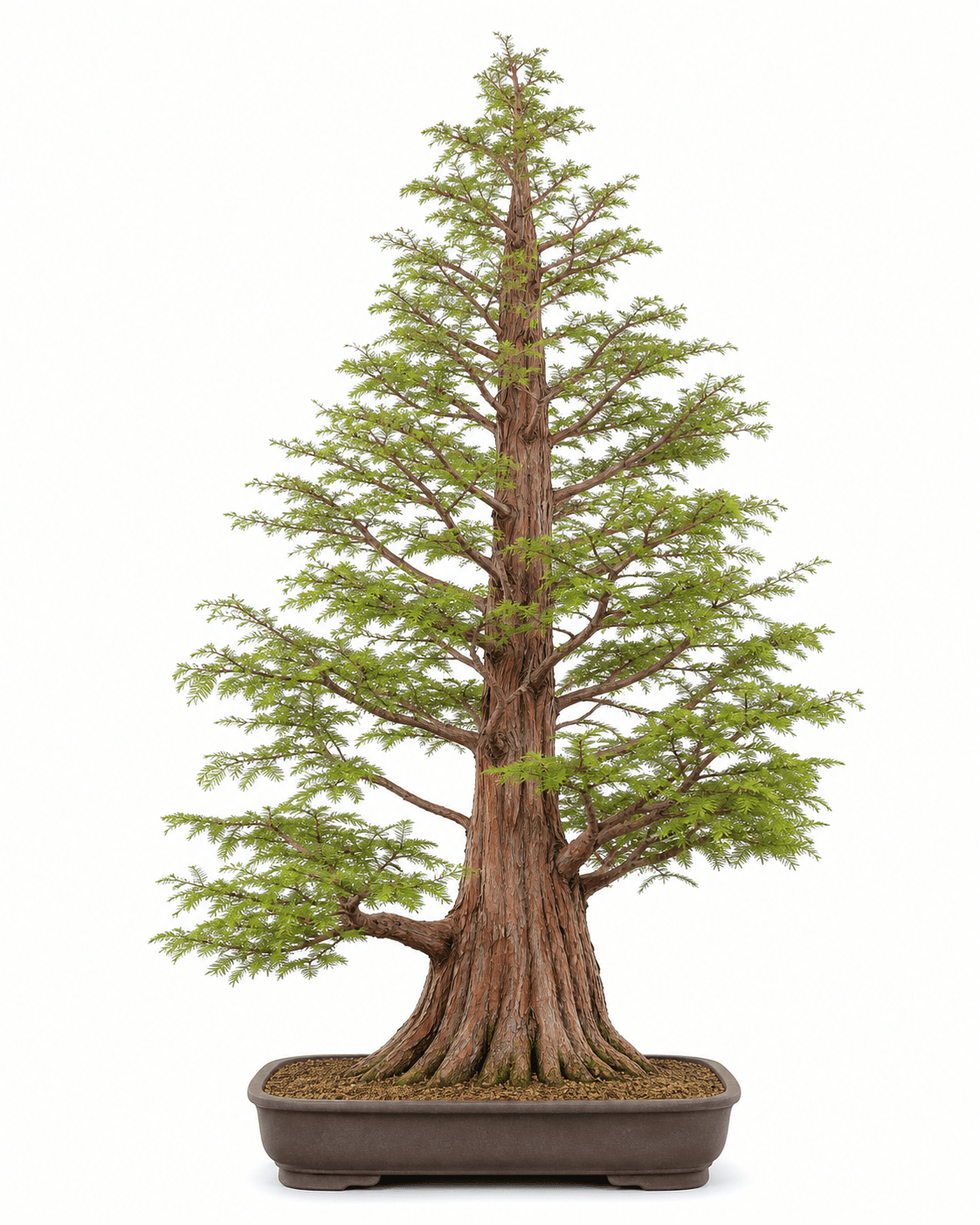
Good bonsai sizes are medium, large, tall upright, multi-apex, and forest compositions. Shohin is possible with compact stock, yet the species naturally wants height, flare, strong leaders, and a winter silhouette. Bonsai Mirai / AsymmetryNC State Extension
Habitat
The wild signal is a moist central-China valley tree with a vertical race for light.
Kew gives the native range as China, specifically Chongqing, Hubei, and Hunan. Threatened Conifers describes remaining wild dawn redwoods as restricted to central China, with old trees in valley floors and ravines tied to seepage water and riparian habitat. Kew POWOThreatened Conifers of the World
The habitat reads as moist, bright, seasonal, and root-active. Threatened Conifers notes clay and sand from sandstone, slightly acid to neutral pH, a fluctuating water table, hot summers, and cold winters. Missouri translates the garden culture into moist, humusy, well-drained soil in full sun. Threatened Conifers of the WorldMissouri Botanical Garden
For care, that ecology means water access plus oxygen. A dawn redwood bonsai can drink heavily and tolerate dampness, yet a shallow pot still needs aggregate structure, drainage, and no sour old core. Bonsai Mirai LibraryMissouri Botanical Garden
For design, read the ecology before imposing style. The straight trunk, fluted base, up-and-out branch gesture, and strong apical drive come from a fast riparian tree racing upward in a forest. Upright and forest designs feel native to the species. Bonsai Mirai / AsymmetryNC State ExtensionThreatened Conifers of the World
Reading
Read dawn redwood by apical dominance, shoot maturity, and visible buds.
Mirai identifies dawn redwood as strongly apically dominant. Upper shoots mature fastest, carry more visible buds, and suppress lower branches unless the grower prunes the apex harder and leaves weak low growth to gain strength. Bonsai Mirai Library
Development and refinement have different jobs. A developing tree can be allowed to extend for trunk girth, branch thickening, root strength, and wound closure. A refined tree needs selected extension followed by a timed cutback once shoots have produced surplus energy. Bonsai Mirai LibraryBonsai Mirai / Asymmetry
The useful shoot sequence has three stages: a green frond, a bronzing central stem, and a lignified gray branch. Cutting a green frond simply removes it. Cutting after bronzing and visible bud formation creates the chance for a second flush close to the trunk. Bonsai Mirai Library
Bud orientation matters as much as length. Opposite buds create wide, symmetrical forks. Alternating buds create tighter, more natural ramification. Bud maturity and direction decide a good dawn redwood cut; fixed pair-count recipes are secondary. Bonsai Mirai Library
Pruning
Let shoots harden, then make one deliberate ramification cut.
Mirai timing centers on post-flush hardening. When the central stem turns ruby or bronze on the sun-facing side, the shoot has formed enough vascular backbone to prune. In much of the temperate Northern Hemisphere this starts around early to late June, but the tree signal matters more than the date. Bonsai Mirai Library
Three signs should line up before shortening: bronzing central stem, visible bifurcation at the tip, and identifiable adventitious buds in the needle crotches along the stem. Dawn redwood differs from bald cypress here because the cut needs a visible bud to push from. Bonsai Mirai Library
At an opposite pair, remove the central extension and one of the two opposing laterals, then alternate the retained side at successive junctions. At a useful alternating-bud section, keep the layout and prune back to preserve tight crotches and short internodes. Bonsai Mirai Library
Make one intentional ramification pass. Late July pruning often leaves too little season for the second flush to lignify before autumn. Repeated late-season cleanup undermines the winter silhouette the work is meant to build. Bonsai Mirai Library
Use post-harden pruning for dawn redwood. Elongating deciduous conifers need extension, hardening, and then pruning to actual buds. Tip pinching weakens the energy system without producing reliable interior structure. Bonsai Mirai Library
Repotting
Repot at bud swell, preserve conifer continuity, and keep the roots breathing.
Spring is the root-work window. Mirai dawn redwood guidance uses the moment when green buds first become visible for maximum-aggression root work because recovery can align with the first flush. Bonsai Mirai Library
Treat the tree as a conifer even though it drops foliage like a deciduous tree. Mirai deciduous-conifer method avoids bare-rooting and avoids pairing heavy root reduction with heavy foliage loss. Keep enough old root function for the first flush to rehydrate the tree. Bonsai Mirai Library
A refined high-water-mobility deciduous conifer should be inspected before the root system outruns drainage. Mirai places this group on roughly a four- to five-year upper cycle, with the actual decision based on water movement, root density, soil collapse, and vigor. Bonsai Mirai Library
Aftercare is ordinary but strict: firm tie-down, complete watering through the new mix, protection from drying wind, and a pause on pruning until the tree shows active recovery. Bonsai Mirai Library
Soil and pot
Use a retentive aggregate soil and a pot that supports vertical scale.
Missouri and NC State agree on moist, well-drained soil. In bonsai, Mirai refines that into a retentive aggregate root system, often solid akadama or high-akadama soil for refined deciduous conifers. Missouri Botanical GardenNC State ExtensionBonsai Mirai Library
Fine, screened particles around one-sixteenth to one-quarter inch help build finer roots and shorter, more controllable growth. Coarse organic nursery soil can grow a trunk, but it usually creates thick roots, excess moisture pockets, and coarse bonsai response. Bonsai Mirai Library
Pot choice should preserve height. Formal upright specimens suit quieter unglazed rectangles, while forests and groups often read better in broad shallow ovals, trays, or slabs that let varied trunk spacing create depth. Bonsai Mirai / AsymmetryNC State Extension
Color should stay restrained. Warm unglazed clay and subdued stoneware let the salmon-bronze autumn foliage, reddish bark, and bare winter branchwork carry the image. Bonsai Mirai / Asymmetry
Climate
Cold hardiness is generous, but bonsai roots and hot benches narrow the margin.
Missouri lists USDA Zones 4 to 8 and full sun. Landscape hardiness is a starting point; a bonsai pot exposes roots to faster freezing, thawing, drying, and heat than the ground does. Missouri Botanical GardenNC State Extension
In cold climates, shelter the dormant pot after leaf drop once hard freezes threaten. Mulch the container, use an unheated cold frame, or place the tree where roots stay cold and protected from drying freeze-thaw wind. Missouri Botanical GardenBonsai Mirai Library
In hot summer climates, the tree can grow strongly when water is abundant, but shallow pots heat and dry fast. Use full sun as the strength goal, then cool the root zone with pot placement, water timing, wind management, and temporary afternoon relief when needed. Missouri Botanical GardenThreatened Conifers of the World
Low-dormancy climates can blur the calendar by producing irregular or semi-evergreen behavior. Keep the work tied to phenology: bud swell for roots, hardening color for pruning, and real dormancy for structural review. Bonsai Mirai Library
Pests and diseases
Most dawn redwood problems start as stress, dryness, crowding, or root oxygen failure.
NC State says dawn redwood has minimal pest and disease problems, with Japanese beetles as a possible foliage feeder. Missouri also lists the tree as low maintenance and tolerant of wet soils and urban conditions. NC State ExtensionMissouri Botanical Garden
Root rot is the bonsai problem to take seriously. The species likes moisture, while oxygen-starved old soil can still turn roots dark, sour, and weak. Fix water movement and soil structure before assuming a spray will solve decline. Bonsai Mirai LibraryMissouri Botanical Garden
Spider mites can appear in hot, dry, stagnant air and create stippling or dull bronzing during active growth. Increase airflow, rinse foliage, improve humidity around the bench, and treat early when colonies are confirmed. Bonsai Mirai Library
Fungal spotting and needle browning are most likely in crowded warm wet foliage. Pruning for light, watering at the soil, and removing spent diseased foliage are usually more important than routine fungicide use. Bonsai Mirai LibraryNC State Extension
Always separate seasonal color from active-season stress. NC State describes brownish copper fall color before shedding. Browning in June or July calls for checks of drought, roots, pests, heat, wire, and recent pruning. NC State Extension
Wiring
Wire while bare, protect the fronds, and check swelling often.
Mirai places dawn redwood wiring in early spring before bud push. The structure is visible, branch lines are easier to set, and the new soft fronds emerge after the main wire paths are already placed. Bonsai Mirai Library
Avoid wiring newly emerged fleshy shoots. Mirai warns that this tissue is too supple and that wire can disrupt water flow or kill the shoot. Full-leaf wiring can be done by expert hands, but it often strips ramification for ordinary growers. Bonsai Mirai Library
End the last wire turn across the top of the branch on elongating species where upward phototropic lift is expected. Use enough gauge to set direction, then remove before active thickening cuts into the bark. Bonsai Mirai Library
Wiring is one setup tool among several. Once a long wired shoot carries useful interior ramification, cut back to that interior structure and let the next section build in-and-out movement. Bonsai Mirai LibraryBonsai Mirai / Asymmetry
Propagation
Seed, cuttings, and air layers all work, with cuttings and seedlings doing most of the bonsai work.
NC State lists seed and stem cuttings as propagation methods. That matches the horticultural reality: cultivated dawn redwood spread widely because the species is easy to raise once seed and cuttings are available. NC State ExtensionArnold Arboretum
Seedlings are excellent for forests because they grow straight, fast, and in matched age cohorts. The tradeoff is less control over exact foliage color, internode length, and base character. NC State ExtensionArnold Arboretum
Stem cuttings preserve a selected clone and produce affordable batches for group plantings. Choose vigorous material, keep humidity and oxygen balanced, and grow young plants hard before asking for refined branch scale. NC State ExtensionBonsai Mirai Library
Mirai identifies the post-flush bronzing window as a strong air-layering moment for dawn redwood. Use layering for trunk sections, low branches, or redesigns, then give the new root system years of recovery before heavy refinement. Bonsai Mirai Library
Grafting is rarely the first propagation choice because the species roots readily. It can still matter for unusual cultivars or repair work, but most bonsai growers get better value from seedlings, cuttings, and layers. NC State ExtensionBonsai Mirai Library
Buying
Buy nursery-grown material with taper, flare, and a root system you can convert.
Dawn redwood is widely planted outside its tiny native range. Threatened Conifers notes that the species has spread as an ornamental in many temperate countries since introduction, and Arnold documents the historic seed distribution that helped make that possible. Threatened Conifers of the WorldArnold Arboretum
Landscape nursery whips and young trees are legitimate bonsai starts. Look for a straight or gently moving trunk, an even basal flare, low buds or branches, healthy bark, and roots that can be staged out of field or container soil. NC State ExtensionBonsai Mirai Library
Pre-bonsai saves time when it already has taper, candelabra apex character, or varied trunks for forest work. Forest sets should include different trunk diameters, heights, and spacing possibilities so depth and hierarchy are available from the start. Bonsai Mirai / Asymmetry
Avoid wild-collected framing for this species. Threatened Conifers lists wild Metasequoia as Endangered and describes a restricted fragmented native population. Bonsai material should come from cultivated nursery stock, seed-grown batches, cuttings, or air layers. Threatened Conifers of the World
Red flags are reverse taper from an unchecked leader, coarse opposite forks, dry or sour roots, weak lower branches under a dominant apex, hidden wire scars, and labels confusing dawn redwood with coast redwood or giant sequoia. Bonsai Mirai LibraryNC State Extension
Troubleshooting
Most fixes start with timing, water movement, and apical control.
Needles turn bronze and drop in fall: normal dormancy. NC State describes brownish copper fall color before the foliage is shed. NC State Extension
A green frond died after trimming: it was cut before the shoot became a real branch. Wait for bronzing, bifurcation, and visible adventitious buds before shortening. Bonsai Mirai Library
Wide bullhorn forks keep appearing: opposing buds were kept as pairs. Remove one side at opposite junctions and favor alternating bud structure when building tertiary ramification. Bonsai Mirai Library
Fine tips died after fall work: fall pruning or wiring interrupted the season when deciduous conifers should be hardening and storing. Move structural work back to bare spring and the post-flush prune back to early summer. Bonsai Mirai Library
The apex thickens too fast: apical dominance is unchecked. Prune the top harder, preserve low branch strength, and prevent a single leader from starving the lower design. Bonsai Mirai Library
The tree wilts despite watering: water may be bypassing an old core, or the root zone may be anaerobic. Inspect drainage, soil smell, root color, pot heat, and whether the fresh mix actually accepts water. Missouri Botanical GardenBonsai Mirai Library
Needles bronze during summer: check drought, spider mites, hot wind, alkaline stress, root damage, or wire bite. Seasonal bronze belongs in autumn; active-growth bronze needs diagnosis. NC State ExtensionBonsai Mirai Library
Design
Design from a vertical riparian tree with an upward branch gesture.
Start with the trunk line, defining branch, and apex. Dawn redwood usually wants a tall read: straight or gently moving trunk, narrow lateral spread, and branch gestures that move up and out before ramifying. Bonsai Mirai / AsymmetryBonsai Mirai Library
The multi-apex or candelabra top can be an age signal. When the central leader is lost, laterals compete and form multiple tops. Use that feature deliberately when the trunk and upper mass support it. Bonsai Mirai / AsymmetryBonsai Mirai Library
Dawn redwood deadwood should be restrained. Large field cuts and old stumps often look more convincing when allowed to decay naturally from the interior than when carved into sharp conifer drama. Bonsai Mirai / Asymmetry
Forests are especially strong. Different trunk heights, asymmetrical spacing, small back trunks, and a consistent vertical gesture make the planting read like a stand of fast riparian trees with depth and hierarchy. Bonsai Mirai / AsymmetryThreatened Conifers of the World
The judged refined image is often winter. Every pruning decision should build lignified woody ramification that remains after needle drop. Bonsai Mirai Library
Forms
Choose cultivar names only after the trunk, roots, and internodes pass inspection.
NC State lists cultivars including Hamlet's Broom, Miss Grace, Ogon, and Schirrmann's Nordlicht. Missouri notes the species value through pyramidal habit, fluted base, soft foliage, and autumn color. NC State ExtensionMissouri Botanical Garden
Ogon or Gold Rush type golden foliage can be useful in a collection, but vigor and internode length matter more than color. A weak gold form in poor light makes worse bonsai material than a plain green seedling with usable structure. NC State ExtensionBonsai Mirai Library
Miss Grace and other weeping selections need a design plan before purchase. Weeping habit can soften a tree, while the core species image remains vertical and up-and-out. NC State ExtensionBonsai Mirai / Asymmetry
Keep common names separate. Coast redwood is Sequoia sempervirens and evergreen. Giant sequoia is Sequoiadendron giganteum. Dawn redwood is Metasequoia glyptostroboides and deciduous. Kew POWONC State Extension
History
The living fossil story is real, and it shapes the species appeal.
Dawn redwood was known from fossils before living trees were recognized in China in the 1940s. NC State summarizes the living fossil history, and Arnold Arboretum documents the 1948 seed-distribution story and its later archival questions. NC State ExtensionArnold Arboretum
Missouri Botanical Garden records seed from the original site being made available to the garden in 1947, with seedlings planted in 1952 that became large mature trees. Missouri Botanical Garden
Threatened Conifers gives the current conservation weight: wild Metasequoia is Endangered, with a small central-China distribution and fragmented habitat. That history is a reason to use cultivated material responsibly. Threatened Conifers of the World
As bonsai, dawn redwood earns its place through fast development, fine seasonal texture, forest plantings, fluted bases, and a bare winter silhouette that can be built within a practical training horizon. Bonsai Mirai LibraryBonsai Mirai / AsymmetryNC State Extension
Species questions
Answer the beginner questions before styling.
Is dawn redwood a good beginner bonsai?
Yes, for an outdoor grower who can water consistently and inspect fast growth. It is vigorous, roots readily, and suits upright or forest work, while indoor culture and dry roots cause most beginner failures.
Can dawn redwood bonsai live indoors?
Permanent indoor culture fails this species. Dawn redwood is an outdoor deciduous conifer that needs full seasonal light, autumn needle drop, winter dormancy, and spring reactivation.
How much sun does dawn redwood bonsai need?
Use full sun as the baseline. In very hot or windy sites, protect the pot and root zone from drying or baking while keeping the tree in strong light.
How often should I water dawn redwood bonsai?
Use observation to set the interval. Keep the root zone evenly moist during active growth, let water drain cleanly, and prevent hard drying in summer or winter dormancy.
When should I repot dawn redwood bonsai?
Repot in spring as green buds begin to show. Use drainage, root density, soil age, and vigor to set the interval; refined high-water-mobility deciduous conifers should usually be inspected before four or five years pass.
When should I prune dawn redwood bonsai?
Do structural work while bare in early spring. Make the ramification prune in early summer when central stems bronze and visible buds are present, then let the second flush harden before autumn.
Should I pinch dawn redwood bonsai?
Let shoots extend and harden, then prune to visible buds. Pinching elongating deciduous conifers interrupts energy without reliably creating interior ramification.
Can I wire dawn redwood bonsai?
Yes. Wire in early spring while the tree is bare, avoid newly emerged soft fronds, and check often because branches thicken quickly enough to scar.
Why did my dawn redwood turn bronze and drop needles?
In autumn, bronze or copper foliage followed by needle drop is normal dormancy. Bronze foliage during active growth needs checks for drought, mites, heat, roots, wire damage, or recent pruning.
How is dawn redwood different from bald cypress bonsai?
Both are deciduous conifers, but dawn redwood has opposite needle and bud structure and needs a visible adventitious bud at the cut point. Bald cypress back-buds more freely and carries a different flat-top design tradition.
Sources
Species advice needs source discipline.
Next decisions
Plan the operation before copying the calendar.
A good care note for Dawn redwood records the tree's stage, the work done, and the aftercare used. That record matters more than a month-name rule.
Related species
Compare nearby trees before transferring advice.
European larch
Larix decidua
Japanese larch
Larix kaempferi
American / tamarack larch
Larix laricina
Alpine larch
Larix lyallii
Western larch
Larix occidentalis