
Species guide
Desert Rose Bonsai Care
Adenium obesum
Desert rose bonsai care starts with identity: this page covers Adenium obesum, a semisucculent shrub from West Tropical Africa to the Arabian Peninsula and Tanzania. Its swollen caudex, thick roots, summer flowers, and poisonous milky sap make it a succulent bonsai subject with different rules from temperate trees.
Grow it as Broadleaf > Succulent material: full sun or very bright indoor light, a fast-draining mineral soil column, thorough watering during warm active growth, and a much drier winter rest. The decisive failure pattern is cold wet roots, especially after repotting or in peat-heavy nursery soil.
The local Mirai corpus has no dedicated Adenium file. This profile transfers Mirai succulent-repotting, succulent-kusamono, propagation, watering, soil, wiring, fertilizer, and design method transparently, while Kew, NC State, and UF/IFAS ground the accepted name, range, morphology, hardiness, toxicity, flowering, propagation, and pest facts.
Updated June 13, 2026. Written by EntGrove Editorial. Last verified June 13, 2026.
Care fingerprint
Read the species through its shared care pattern.
Err on mineral drainage, warm recovery, and conservative watering; many tolerate pruning but not cold wet roots. Use this as the starting point before local conditions and tree strength refine the calendar.
Note: Flowering caudex succulent from dry Africa-to-Arabian-Peninsula shrublands. Grow in full sun, warm active growth, sharply drained soil, and dry winter rest; verify Adenium obesum before applying this page to arabicum, somalense, socotranum, swazicum, oleifolium, or grafted hybrid labels.
Read the foliage first
Broadleaf stress usually shows in leaf color, leaf size, wilt, scorch, or delayed hardening before it becomes a branch problem.
Match work to dormancy
Deciduous, evergreen, tropical, succulent, and flowering broadleaf trees recover on different calendars.
Protect fine roots
Root work should preserve enough active fine roots for the tree to rehydrate quickly after the operation.
Care cadence
The calendar starts with the tree's seasonal state.
Placement
Timing: Give 6 or more hours of direct sun outdoors, or the brightest warm indoor position available through winter. Move gradually between indoor shade and outdoor sun.
Watch for: Weak extension, sparse flowers, leaning toward glass, sunburn after a sudden move, cold windowsills, and wind tipping a top-heavy caudex.
NC State ExtensionUF/IFAS Gardening SolutionsBonsai Mirai LibraryWatering
Timing: During hot active growth, water when the soil has dried and the plant is using moisture. During cool winter rest, water very sparingly or pause until warmth returns.
Watch for: Soft caudex tissue, sour soil smell, yellow leaves with wet soil, leaves dropping after chill, and a nursery mix that remains wet for many days.
NC State ExtensionUF/IFAS Ask IFASBonsai Mirai LibraryFeeding
Timing: Feed only during active growth. UF/IFAS recommends low-dose liquid fertilizer weekly indoors in the summer growing season, or balanced slow-release fertilizer outdoors in summer.
Watch for: Feeding a resting or stressed plant, heavy nitrogen in low light, fertilizer on fresh root cuts, and salt buildup in shallow pots.
UF/IFAS Ask IFASBonsai Mirai LibraryFlowering and pruning
Timing: Prune in warm active growth after the plant is moving strongly. Flowering depends on high light and summer strength, so keep enough foliage to power the next bloom cycle.
Watch for: Cutting a cold dormant plant, removing all active tips, cutting below useful buds, and pruning so late that new cuts enter winter wet.
UF/IFAS Gardening SolutionsNC State ExtensionBonsai Mirai LibraryRepotting
Timing: Repot in late spring or early summer warmth. Reduce peat-heavy nursery soil in stages, anchor the caudex, and treat exposed roots gently.
Watch for: Cold nights, wet unhealed roots, over-chopsticking fleshy roots, rocking in the pot, and styling immediately after root work.
Bonsai Mirai LibraryUF/IFAS Ask IFASWiring
Timing: Wire only young flexible shoots, or use pruning and leader selection. Check often because warm succulent growth can swell around wire quickly.
Watch for: Wire bite on smooth bark, branch cracking, milky sap exposure, hidden pressure at forked shoots, and bending when tissues are cold or water-stressed.
Bonsai Mirai LibraryNC State ExtensionPropagation
Timing: Use seed for the best natural caudex, stem cuttings for backups, and grafting for named flower forms. Warmth is the rooting driver.
Watch for: Cold rooting media, wet uncallused cuttings, graft unions hidden under soil, and expecting cutting-grown plants to build caudex as quickly as seed-grown stock.
NC State ExtensionUF/IFAS Ask IFASBonsai Mirai LibraryWinter rest
Timing: Move indoors before cool nights become sustained. UF/IFAS says to withhold water for a 3-4 month winter rest and restart water and fertilizer when warmth returns.
Watch for: Panic watering after leaf drop, freeze exposure, damp soil in a leafless plant, and spring sun exposure before the indoor-grown leaves harden.
UF/IFAS Ask IFASNC State ExtensionPests and disease
Timing: Inspect during indoor winter, flowering, and new growth. NC State lists aphids, scales, mealybugs, root mealybugs, fungal leaf spot, southern blight, and rot from wet soil.
Watch for: Scale on stems, mealybugs in crevices or roots, aphids on tender growth, mites outdoors in heat, oleander caterpillar in Florida, and soft basal tissue.
NC State ExtensionUF/IFAS Gardening SolutionsUF/IFAS Ask IFASSpecies guide
Apply the species profile before copying another tree's calendar.
At a glance
Desert rose is a flowering caudex succulent for bright, warm culture.
Apply this page to Adenium obesum. Kew accepts that name and gives the native range as West Tropical Africa to the Arabian Peninsula and Tanzania. NC State lists desert rose, desert azalea, impala lily, mock azalea, and Sabi star as common names. Kew POWONC State Extension
In the EntGrove taxonomy it belongs to Broadleaf > Succulent. That placement matters because the calendar follows stored water, warm active growth, full sun, and dry winter rest rather than outdoor temperate dormancy. Bonsai Mirai LibraryNC State Extension
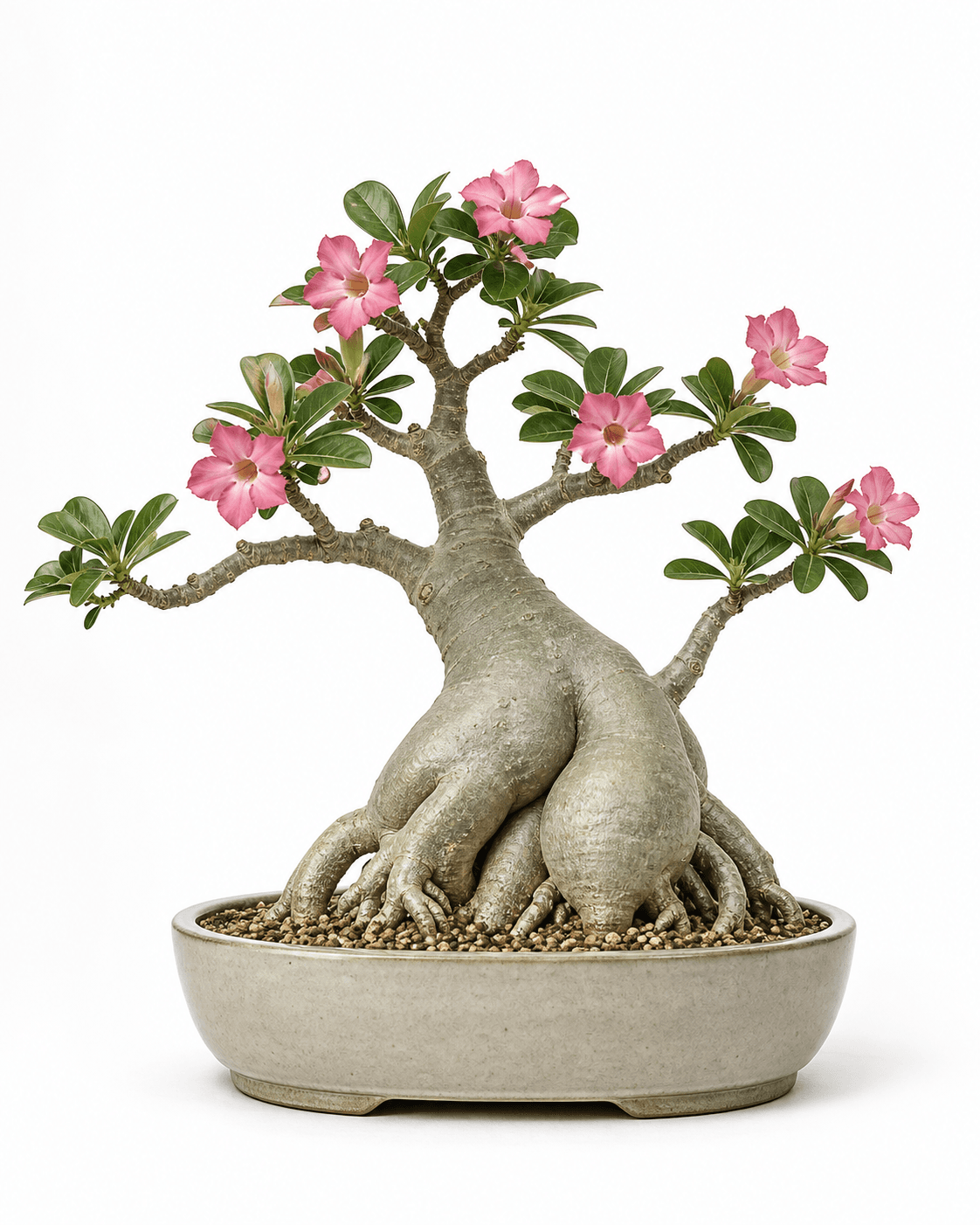
The bonsai promise is the caudex: a swollen base, exposed roots, smooth gray bark, glossy leaves at shoot tips, and summer flowers in red, pink, white, or hybrids. The constraint is horticultural precision. High light creates flowers, but cold wet soil creates rot. NC State ExtensionUF/IFAS Gardening Solutions
Keep it separate from Madagascar palm, dwarf jade, jade plant, Pachira money tree, true azaleas, Plumeria, and oleander. Some visual cues overlap, but Adenium sap, caudex growth, flowering habit, and winter rest need their own decisions. NC State ExtensionKew POWOKew POWO
Habitat
Dry shrubland ecology explains the caudex, sun demand, and winter restraint.
Kew describes Adenium obesum as a semisucculent shrub that grows primarily in desert or dry shrubland biome. UF/IFAS gives the practical cultivated translation: bright, warm, dry conditions, with winter protection in containers. Kew POWOUF/IFAS Gardening Solutions
For care, translate that habitat into full sun, quick drainage, and a soil column that returns air after each watering. A dry-origin succulent can still rot in a bonsai pot when nursery peat, cool temperatures, and frequent watering overlap. Bonsai Mirai LibraryNC State Extension
For design, let the habitat show. The exposed base, smooth trunk, sparse branching, terminal leaves, and seasonal flowers read as dry-country survival and flowering abundance, not as a dense maple canopy. Bonsai Mirai / AsymmetryNC State Extension
Reading the tree
Read caudex firmness, leaf demand, and root oxygen before every intervention.
A strong desert rose has a firm caudex, glossy active leaves, bright shoot tips, a soil column that dries predictably, and no black soft tissue at the base. NC State ExtensionBonsai Mirai Library
Development is caudex, root flare, and primary line. Give young plants enough light, heat, and root room to thicken before asking them to live in a very shallow container. UF/IFAS Ask IFASBonsai Mirai / Asymmetry
Refinement is flower-aware and conservative. Keep enough leaf area to power roots and blooms, prune only in warm growth, and separate root work from hard pruning when the plant has just been moved from nursery soil. Bonsai Mirai LibraryUF/IFAS Gardening Solutions
Pruning
Prune in warm growth, then preserve enough active tips for flowers.
UF/IFAS ties profuse flowering to 6 or more hours of bright light each day, and NC State describes summer bloom that may repeat. In bonsai, pruning decisions should protect that light and strength relationship. UF/IFAS Gardening SolutionsNC State Extension
Cut back long shoots during warm active growth to select forks, shorten coarse extensions, and keep the crown proportional to the caudex. Leave visible nodes or active tips so the plant has a route back into growth. Bonsai Mirai LibraryNC State Extension
Clean tools and careful sap handling matter. NC State identifies the milky sap as poisonous and lists contact dermatitis risk, so pruning belongs with gloves, eye awareness, and deliberate cleanup of clippings. NC State Extension
Roots
Repot only when warmth can restart fleshy roots and seal cuts.
Mirai succulent repotting method emphasizes granular media, clean cuts, gentle handling of fleshy roots, firm tie-downs, and avoiding heavy chopstick damage. Desert rose adds a caudex that must be positioned and immobilized without bruising the root base. Bonsai Mirai Library
Use late spring or early summer warmth when nights are stable and new leaves are active. UF/IFAS gives 75-95 F as the temperature preference, which is the kind of heat that supports post-repot recovery. UF/IFAS Ask IFASBonsai Mirai Library
After root work, water in deliberately, then allow a real drying interval before returning to regular growth-season watering. The local Mirai corpus includes a succulent note to keep freshly repotted succulents dry for several weeks before light watering where climate and species allow; for Adenium, adjust that restraint by caudex firmness, heat, leaf demand, and soil drying speed. Bonsai Mirai LibraryUF/IFAS Ask IFAS
Soil and pot
Use mineral drainage, strong tie-downs, and enough pot mass for the caudex.
NC State recommends cactus and succulent potting media with several drainage holes. For bonsai, a gritty mineral column is safer than a peat-heavy houseplant mix once roots are being reduced into a shallow pot. NC State ExtensionBonsai Mirai Library
A 1:1:1 akadama:pumice:lava mix is a conservative development baseline when watering is attentive. In cool indoor winter sites, increase durable aggregate and reduce organic content so the pot dries more cleanly. Bonsai Mirai Library
Pot choice should stabilize the plant and frame the caudex. UF/IFAS notes that Adenium specimens are often lifted or root washed to display the sculptural roots and caudex, so the container must hold that display without exposing fresh roots too aggressively in one step. UF/IFAS Ask IFASBonsai Mirai / Asymmetry
Climate
Cold is the hard limit; light and water are the seasonal dials.
NC State lists Zones 11a to 12b, while UF/IFAS allows outdoor year-round planting in Zones 10B to 12. In colder regions, treat desert rose as a bright indoor winter subject and a warm-season outdoor subject. NC State ExtensionUF/IFAS Ask IFAS
UF/IFAS says chill between 55 F and 35 F can cause leaf yellowing and drop, and freezing is unsafe. NC State gives a practical action point: bring the plant indoors when outside temperatures reach 55 F. UF/IFAS Ask IFASNC State Extension
In humid summer regions, root oxygen becomes the main adjustment. Use more mineral structure, protect from prolonged rain if the pot stays wet, and avoid heavy fertilizer when heat and low airflow already stress the plant. Bonsai Mirai LibraryUF/IFAS Gardening Solutions
Pests
Most problems are scale, mealybugs, aphids, mites, caterpillars, and wet-root disease.
NC State lists aphids, scales, mealybugs, root mealybugs, fungal leaf spot, southern blight, and rots from soils that are too wet. UF/IFAS adds mealybugs indoors and mites or aphids outdoors. NC State ExtensionUF/IFAS Ask IFAS
UF/IFAS Gardening Solutions also notes scale and oleander caterpillar risk. Because desert rose is related to oleander, inspect tender leaves, flower buds, stem crevices, and the underside of foliage during warm weather. UF/IFAS Gardening SolutionsNC State Extension
The most serious disease pattern in bonsai culture is rot from wet soil and low oxygen. Mirai watering method frames this as a water and oxygen imbalance, especially after repotting or when organic soil collapses. Bonsai Mirai LibraryNC State Extension
Use gloves and keep clippings away from children and pets. NC State lists poisonous sap, all plant parts as poisonous if ingested, cardiac glycosides, contact dermatitis, and specific pet and livestock risk flags. NC State Extension
Wiring
Wire young shoots lightly; shape older structure by pruning and leader selection.
Desert rose stems are smooth, succulent, and sap-bearing. Structural bonsai wiring principles still apply, but pressure must be lighter, inspections more frequent, and bends smaller than on woody temperate branches. Bonsai Mirai LibraryNC State Extension
Use aluminum on flexible young shoots, support the outside of each bend, and remove wire before warm swelling bites into bark. Guy wires and clip-and-grow are often cleaner than trying to force an old caudex branch. Bonsai Mirai Library
For major direction changes, grow a new leader or branch. Desert rose designs are strongest when the caudex, root flare, and flower-bearing crown carry the image instead of wire forcing artificial pads. Bonsai Mirai / AsymmetryUF/IFAS Ask IFAS
Propagation
Seed builds the best caudex; cuttings and grafting solve different problems.
NC State lists grafting, seed, and stem cuttings as recommended propagation strategies. UF/IFAS also notes that retail Adenium often includes many hybrids and that larger plants are available from specialty growers. NC State ExtensionUF/IFAS Ask IFAS
Seed is the best route for a natural swollen base and exposed-root bonsai. Cuttings can preserve a plant or branch, but the caudex character usually develops more slowly and less evenly than seed-grown stock. NC State ExtensionBonsai Mirai Library
Mirai succulent propagation method adds the aftercare: let fresh succulent cuts skin over, then root in a medium that favors oxygen and low excess water. General Mirai propagation guidance favors warm nights above 60 F for rooting. Bonsai Mirai Library
Grafted plants are common for flower forms. Inspect the graft union, rootstock vigor, and whether the graft line will improve or distract from the future bonsai image. NC State ExtensionUF/IFAS Ask IFASBonsai Mirai / Asymmetry
Buying
Choose firm caudex stock with light-grown structure and honest roots.
The best starting material has a firm caudex, no soft dark base, active leaves, visible lower structure, a stable pot, and a root flare that can become a feature after staged exposure. NC State ExtensionUF/IFAS Ask IFAS
Inspect retail plants for peat-heavy wet soil, scale, mealybugs, mites, aphids, graft unions buried below the soil line, weak low-light growth, and flower-driven buying that ignores the trunk. NC State ExtensionUF/IFAS Gardening Solutions
UF/IFAS notes that 8-10 inch retail pots are common and larger plants come from specialty growers. For bonsai, smaller seed-grown plants with a promising base often beat tall flowering stock with no lower movement. UF/IFAS Ask IFASBonsai Mirai / Asymmetry
Because Kew gives a broad native range and collector trade includes many Adenium forms, favor cultivated nursery stock with clear labels. Verify Adenium obesum before applying this page to arabicum, somalense, socotranum, swazicum, oleifolium, or hybrid labels. Kew POWO
Troubleshooting
Diagnose from caudex firmness, soil moisture, light, and recent temperature.
Leaves yellow or drop after chill: move warmer and brighter, reduce water, and wait for active growth. UF/IFAS says leaf yellowing and drop can occur under chill, and winter leaf loss can be part of the natural cycle. UF/IFAS Ask IFAS
Caudex or base softens: treat it as rot risk. Stop watering, improve warmth and airflow, inspect drainage, and delay pruning or wiring until the plant is firm and growing. NC State ExtensionBonsai Mirai Library
Few or no flowers: increase light first. UF/IFAS states that Adenium will not flower under low light and needs 6 or more hours of bright light for summer flowering. UF/IFAS Ask IFASUF/IFAS Gardening Solutions
White cottony insects or sticky residue: check mealybugs, aphids, and scale. Inspect stem crevices, leaf tips, flower buds, and the root zone if the plant declines while the top looks clean. NC State ExtensionUF/IFAS Ask IFAS
Tree rocks after repotting: re-anchor immediately. A moving caudex tears new roots, and Mirai succulent method puts firm but gentle tie-downs at the center of aftercare. Bonsai Mirai Library
Design
Design around the swollen base, exposed roots, flower canopy, and empty space.
Start with base, trunk line, defining branch, and apex. With desert rose, the base often has more visual value than the branches, so the front should first explain the caudex and root flare. Bonsai Mirai / AsymmetryUF/IFAS Ask IFAS
Use lifting cautiously. UF/IFAS describes root-washed specimens lifted to display the sculptural roots and caudex. In bonsai, staged exposure is safer than uncovering tender roots abruptly after repotting. UF/IFAS Ask IFASBonsai Mirai Library
Flower color and caudex mass can carry the composition, so avoid overbuilding branch pads. A compact asymmetric crown, negative space around the base, and a stable warm-toned pot usually support the species better than dense foliage. Bonsai Mirai / AsymmetryUF/IFAS Gardening Solutions
The most believable styles are caudex-forward informal upright, exposed-root, clump from seedlings, compact flowering tree, patio specimen, and larger dry-country container image. NC State ExtensionBonsai Mirai / Asymmetry
Forms
Flower forms, grafts, and species labels need verification before care transfers.
UF/IFAS says desert rose and its many hybrids are common in retail garden centers, with flowers that may be single, double, or triple. That flower diversity often drives grafted or named stock. UF/IFAS Gardening SolutionsUF/IFAS Ask IFAS
Kew treats several familiar Adenium labels as synonyms under Adenium obesum, including Adenium arabicum, Adenium somalense, and Adenium socotranum. Horticultural trade can still use those labels for distinctive forms, so verify the plant and grower context before flattening all care decisions into one schedule. Kew POWO
For bonsai, the practical split is seed-grown caudex stock, cutting-grown backups, grafted flower cultivars, and specialty Adenium forms. Each asks different sourcing questions even when the basic succulent culture overlaps. NC State ExtensionUF/IFAS Ask IFASBonsai Mirai / Asymmetry
History
Desert rose entered bonsai through caudex culture, houseplants, and warm-climate containers.
NC State says desert rose is often used as a houseplant for flowers and small tree-like form, and is also used in bonsai. UF/IFAS describes its retail availability and dramatic patio or deck use. NC State ExtensionUF/IFAS Ask IFAS
In bonsai terms, it is best understood as a specialist succulent study: bright light, dry-back watering, caudex display, flower timing, and warm recovery matter more than classical twig ramification. Bonsai Mirai LibraryBonsai Mirai / Asymmetry
The strongest specimens look intentional before they look miniature: stable base, clean exposed roots, compact flower-bearing crown, healthy seasonal leaf rhythm, and enough empty space to let the caudex read clearly. Bonsai Mirai / AsymmetryUF/IFAS Ask IFAS
Species questions
Answer the beginner questions before styling.
Can desert rose be grown as bonsai?
Yes. Adenium obesum is used in bonsai and works best as a caudex-focused succulent bonsai with full sun, warm active growth, fast drainage, dry winter rest, and careful sap handling.
Can desert rose bonsai live indoors?
Yes, if indoors means very bright and warm. A sunny south or west window, conservatory, greenhouse, or strong grow light is much more realistic than a dim shelf.
How much sun does desert rose bonsai need?
Aim for 6 or more hours of direct sun or equivalent bright light. UF/IFAS states that Adenium will not flower under low light conditions.
How often should I water desert rose bonsai?
Water during warm active growth after the mix dries, then let air return to the roots. In cool winter rest, water very sparingly or pause until warmth and growth return.
What soil should I use for desert rose bonsai?
Use a sharply draining cactus, succulent, or mineral bonsai mix. Dense peat-heavy soil is risky in a shallow pot because it can stay wet around fleshy roots.
When should desert rose bonsai be repotted?
Repot in late spring or early summer warmth when nights are stable and new growth can restart roots. Avoid cold-season root work and keep fresh root cuts from staying wet.
Can I prune desert rose bonsai?
Yes. Prune during warm active growth to select branches, shorten long shoots, and balance the crown. Wear gloves because NC State lists the milky sap and plant parts as poisonous.
Is desert rose poisonous?
Yes. NC State lists cardiac glycosides, poisonous sap, contact dermatitis risk, and ingestion risks for people, pets, and horses. Keep clippings away from children and animals.
Why did my desert rose drop its leaves?
Leaf drop can follow chill, winter rest, low light, dry rest, or stress. If the caudex is firm and the soil is dry, wait for warmer brighter growth. If the base is soft or soil is wet, suspect rot.
Should I grow desert rose from seed or cuttings for bonsai?
Seed is usually better for a natural swollen caudex. Cuttings can preserve a branch or plant, and grafting is common for flower forms, but each route changes the future trunk and graft-line decisions.
Sources
Species advice needs source discipline.
Next decisions
Plan the operation before copying the calendar.
A good care note for Desert rose records the tree's stage, the work done, and the aftercare used. That record matters more than a month-name rule.
Related species
Compare nearby trees before transferring advice.
Dwarf jade / elephant bush
Portulacaria afra
Jade plant
Crassula ovata
Madagascar palm
Pachypodium lamerei
Operculicarya
Operculicarya decaryi, Operculicarya pachypus
Boojum tree
Fouquieria columnaris