
Species guide
Dwarf Jade Bonsai Care
Portulacaria afra
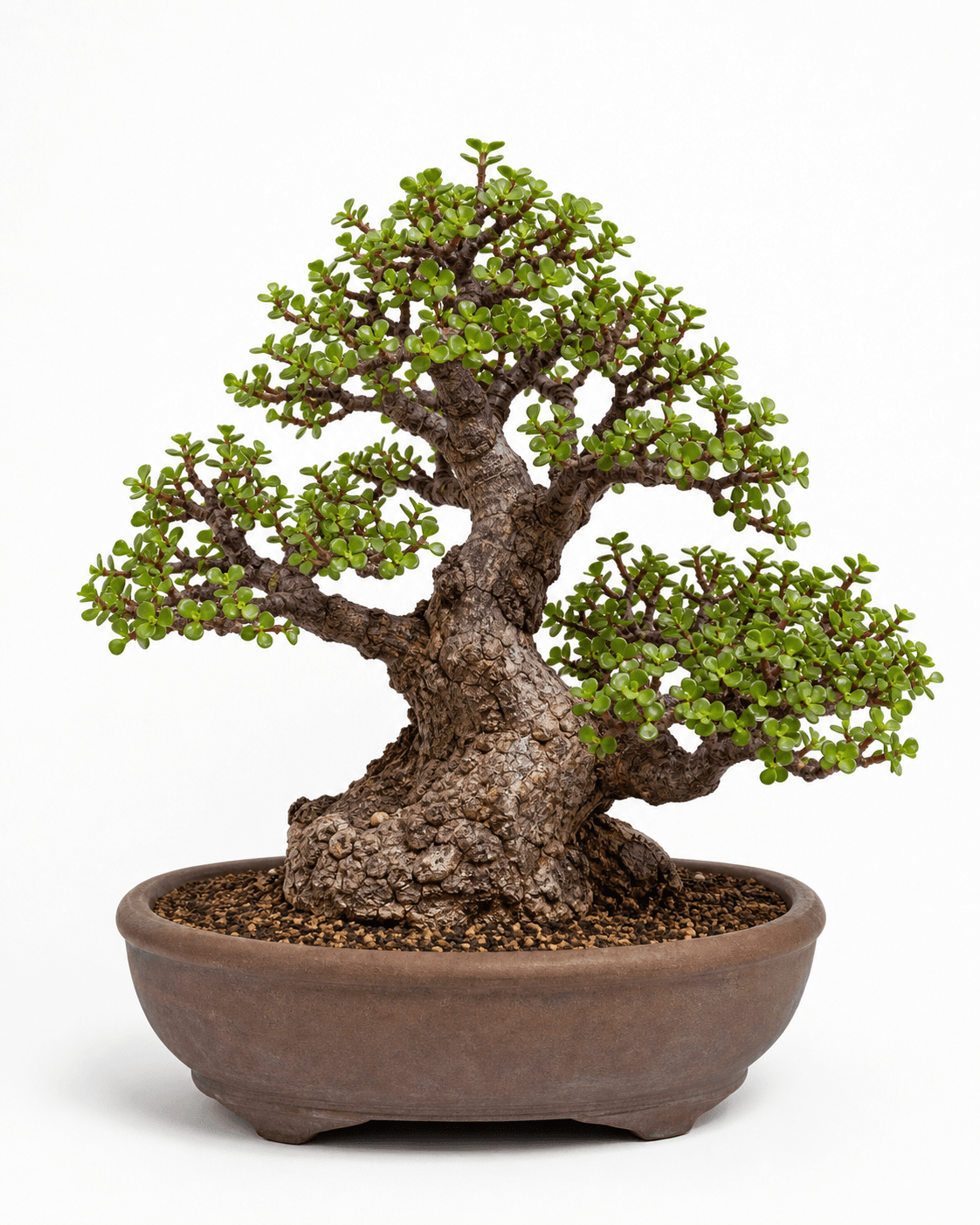
Dwarf jade, Portulacaria afra, is one of the strongest beginner bonsai choices for bright indoor growers and warm outdoor growers because it stores water, roots easily, and tolerates dry intervals. Its main failure pattern is cold wet roots in weak light.
Treat this page as a succulent bonsai guide. The Bonsai Mirai corpus supports a dry-between-waterings rhythm, granular oxygen-rich soil, warm active-growth work, gentle handling of fleshy roots, and cuttings that callus before rooting.
The practical rule is simple: give dwarf jade more light than a houseplant label implies, let the pot dry cleanly, protect it before nights approach 40 F / 5 C, and build structure with clip-and-grow before asking wire to do much.
Updated July 5, 2026. Written by EntGrove Editorial. Last verified July 5, 2026.
Care fingerprint
Read the species through its shared care pattern.
Err on mineral drainage, warm recovery, and conservative watering; many tolerate pruning but not cold wet roots. Use this as the starting point before local conditions and tree strength refine the calendar.
Read the foliage first
Broadleaf stress usually shows in leaf color, leaf size, wilt, scorch, or delayed hardening before it becomes a branch problem.
Match work to dormancy
Deciduous, evergreen, tropical, succulent, and flowering broadleaf trees recover on different calendars.
Protect fine roots
Root work should preserve enough active fine roots for the tree to rehydrate quickly after the operation.
Care cadence
The calendar starts with the tree's seasonal state.
Indoor/outdoor reality
Timing: Grow outdoors in warm frost-free weather, or indoors in the brightest available window or under strong supplemental light when nights approach 40 F / 5 C.
Watch for: Cold glass, unheated porches, dim winter rooms, heater drafts, and sudden outdoor moves after indoor storage.
Bonsai Mirai LibraryWisconsin HorticultureLight and acclimation
Timing: Increase sun gradually in spring or after repotting. Use morning sun, dappled light, or afternoon shade for several weeks after significant root work.
Watch for: Long weak internodes, large pale leaves, leaf drop after a move, or sunburn from an abrupt exposure change.
Bonsai Mirai LibraryWisconsin HorticultureNParks Flora & Fauna WebWatering
Timing: Water thoroughly in active growth, then let the fast-draining mix dry again. Reduce sharply through cool or low-light winter protection.
Watch for: Wrinkled lower leaves, yellowing from wet soil, soft stems, water sitting in a saucer, and organic soil that stays damp for days.
Bonsai Mirai LibraryWisconsin HorticultureFertilizer
Timing: Feed lightly during active growth after light, warmth, and root oxygen are correct. Use lower strength than for a water-hungry broadleaf in the same pot size.
Watch for: Fertilizing a cold, dim, dry-resting, or recently repotted plant before growth has resumed.
Bonsai Mirai LibraryWisconsin HorticulturePruning and pad building
Timing: Clip during warm active growth after shoots have extended enough leaf pairs to feed the branch. Repeat light cutback to divide pads.
Watch for: Top-heavy succulent growth, long straight extensions, fresh cuts kept too wet, and cut paste trapping moisture against fleshy tissue.
Bonsai Mirai LibraryWisconsin HorticultureRepotting
Timing: Repot when warmth and light can restart roots. Preserve useful surface roots, reduce the limiting root mass first, secure the tree, and avoid stacking root work with major styling.
Watch for: Root work followed by cold nights, stale wet soil, excessive chopsticking, crushed fleshy roots, and an unstable top-heavy tree.
Bonsai Mirai LibraryBonsai TodayWiring
Timing: Wire only flexible young or semi-firm growth, then check often. Clip-and-grow is safer for fine structure.
Watch for: Soft bark damage, wire cutting in quickly, brittle hydrated branches, and bends stacked on top of root work.
Bonsai Mirai LibraryBonsai TodayPests and disease
Timing: Inspect indoor trees through winter and after low-light stress, then solve the culture problem before spraying.
Watch for: Mealybugs, scale, mites in dry rooms, root rot, oil injury on succulent leaves, and decline from damp soil with weak light.
Wisconsin HorticultureBonsai Mirai LibrarySpecies guide
Apply the species profile before copying another tree's calendar.
At a glance
Dwarf jade is the beginner succulent bonsai with one firm warning: wet cold roots fail fast.
Portulacaria afra is an accepted Kew species in Didiereaceae, commonly sold as dwarf jade, elephant bush, porkbush, and spekboom. Wisconsin Horticulture describes it as a tender bonsai specimen whose small root ball adapts well to shallow containers, and NParks lists it for bonsai, rooftop, and shallow-media use. Kew POWOWisconsin HorticultureNParks Flora & Fauna Web
The bonsai care spec is bright light, warmth, dry intervals, granular soil, light feeding during active growth, cautious wiring, and root work only when recovery conditions are warm. Use 40 F / 5 C as a conservative bonsai protection line, even though landscape sources describe more tolerance in mature plants. Bonsai Mirai LibraryWisconsin HorticulturePlantZAfrica
This is a good first bonsai when the grower can supply light and restraint. A dim shelf, wet saucer, cold window, decorative cachepot, or heavy potting soil removes the margin that makes dwarf jade easy. Bonsai Mirai LibraryWisconsin Horticulture
Wild habit
The wild plant is a dry-thicket succulent, so bonsai care starts with stored water and oxygen.
Kew places Portulacaria afra from northwestern Kenya and southern Mozambique to South Africa in a subtropical biome. SANBI describes spekboom as a dominant dry-thicket shrub of the Eastern Cape, where fleshy leaves and reddish stems store water through dry periods. Kew POWOPlantZAfrica
That ecology explains the care. The pot should dry cleanly and refill fully, then return oxygen to the roots. Heavy organic soil can keep roots wet for weeks, while aggregate media demand more attention but give the root zone the air that succulents need in a shallow container. Bonsai Mirai LibraryWisconsin Horticulture
Design should also come from the habitat. Browsed, broken, regrown thicket material suggests sturdy trunks, rounded masses, compact clumps, and dry-land character. A fine-twigged maple silhouette asks the plant to hide its best traits. PlantZAfricaBonsai Mirai / Asymmetry
Reading the tree
Read water storage, light response, root oxygen, and temperature before technique.
Healthy dwarf jade has firm plump leaves, reddish or clean green stems, active extension in warmth, and a pot that dries at a predictable pace. Wrinkled leaves on a dry pot usually ask for water; wrinkled leaves on a wet pot point toward root loss. Bonsai Mirai LibraryWisconsin Horticulture
Weak light changes the plant before it dies. Internodes lengthen, leaves grow larger and paler, pads loosen, and water demand drops. Adding fertilizer or pruning harder cannot replace light. Bonsai Mirai Library
Development and refinement are easy to separate. In development, let the tree extend in strong light so leaf mass thickens trunk and primary branches. In refinement, shorten extensions repeatedly to divide pads while preserving enough leaves to keep stored energy and water movement stable. Bonsai Mirai LibraryWisconsin Horticulture
Technique
Clip-and-grow builds better dwarf jade pads than defoliation or heavy wire.
Let a shoot extend several leaf pairs in active growth, then cut back above a pair of leaves to redirect energy into new branching. Repeating that cycle creates the rounded pads that make dwarf jade read as bonsai. Wisconsin HorticultureBonsai Mirai Library
Skip routine defoliation. The leaves are water and energy storage organs, and Mirai tropical method already treats defoliation as a refinement-only tool for strong woody tropicals with matching light, water, and feeding support. Dwarf jade gets smaller, denser, more convincing growth through light, root volume, and repeated clipping. Bonsai Mirai Library
Fresh cuts should dry in open air. Because the tissue is fleshy and water-rich, sealed or constantly wet wounds can rot. Prune in warm bright conditions, keep the plant on the dry side for a short recovery period, and return to normal watering only as the pot dries and growth continues. Bonsai Mirai LibraryWisconsin Horticulture
Roots
Repot when warmth, light, and aftercare can protect fleshy roots.
The Mirai succulent repotting corpus treats succulent root work as a different operation from temperate root work. Fleshy surface roots scratch and break easily, large anchor roots should be assessed before cutting, and over-chopsticking bruises tissue that should be handled with fingers and a worn rounded chopstick. Bonsai Mirai Library
Reduce the greatest limitation first, usually the bottom or heavy root mass that prevents a shallow planting angle. Use sharp cuts, preserve usable surface roots, set the tree in one deliberate motion, secure it with broad tie-down pressure, and avoid crushing roots while backfilling. Bonsai Mirai Library
Aftercare has source nuance. Mirai succulent repotting recommends watering the soil thoroughly once, then letting it dry well before the next watering so new roots initiate in oxygen-rich media. A public Portulacaria practitioner article documents a drier warm-climate variation that withholds water longer. The shared principle is dry recovery after the first reset, not repeated wetting of damaged roots. Bonsai Mirai LibraryBonsai Today
Soil and pot
Use a granular mix that dries predictably without starving fine roots.
Mirai succulent repotting calls for a very well-draining, granular, inorganic substrate. It also cautions against the assumption that every succulent needs only large particles, because finer interior particles can build better fine roots when drainage and oxygen remain high. Bonsai Mirai Library
A practical bonsai starting mix is equal parts akadama, pumice, and lava screened around 1/8 inch to 1/4 inch, then adjusted. Add more pumice or lava for cool rooms, rainy climates, deep shade, or growers who tend to water too often. Keep more akadama only where warmth and light make water use reliable. Bonsai Mirai Library
Pot choice should reinforce the solid succulent image. Shohin, mame, clump, and small informal upright trees often suit quiet unglazed or earthy containers, while exposed-root and cascade forms need enough depth and anchoring to keep the fleshy root system stable. Bonsai Mirai LibraryBonsai Mirai / Asymmetry
Climate
Warm dry regions, wet winters, and indoor rooms each change the water rhythm.
In frost-free dry climates, dwarf jade can grow outdoors with strong sun, gritty soil, and fast response. Protect recently repotted or newly moved trees from the harshest afternoon exposure until leaves and roots adjust. PlantZAfricaBonsai Mirai Library
In cold or wet-winter regions, treat the plant as a bright protected succulent through winter. Bring it in before nights approach 40 F / 5 C, keep it bright and airy, reduce watering dramatically, and avoid major pruning or root work until warm active growth returns. Bonsai Mirai LibraryWisconsin Horticulture
In humid or rainy climates, the soil and shelter matter more than calendar advice. Use sharper soil, lift the pot out of standing water, keep air moving, and shelter the tree from long cold rains that keep roots wet while metabolism is low. Bonsai Mirai LibraryWisconsin Horticulture
Pests and diseases
Root rot is the main disease pattern; indoor pests follow stress.
Root rot follows the same chain repeatedly: dense organic soil, low light, cool roots, standing water, damaged roots kept wet, or sealed wounds that hold moisture. Wisconsin lists root rot as a risk in consistently moist soil, and Mirai watering guidance frames rot as oxygen failure in the substrate. Wisconsin HorticultureBonsai Mirai Library
Mealybugs are the routine insect to expect, especially after purchase or indoor wintering. Check leaf axils, stem joints, undersides, and the root zone. Scale and spider mites can also appear when warm indoor air is still and dry. Wisconsin Horticulture
Treat pests with culture correction first: light, airflow, quarantine, clean leaves, and correct water. Oils and soaps can mark succulent tissue when applied in heat or sun, so test carefully and follow the product label. Wisconsin HorticultureBonsai Mirai Library
Wiring
Wire only where clipping cannot solve the branch.
Dwarf jade stems are fleshy, brittle, and soft-skinned. Wire can set a broad direction on young or semi-firm growth, but sharp bends, old branches, and tight coils leave scars or split tissue. Bonsai Mirai LibraryBonsai Today
Let the plant dry slightly before gentle bending so branches are less water-loaded, then use loose aluminum coils, modest movement, and frequent checks. Remove wire early because swelling can mark the skin faster than the branch sets. Bonsai TodayBonsai Mirai Library
For most trees, prune for the line, grow the replacement shoot, then prune again. This species rewards directional clipping more reliably than ambitious detail wiring. Bonsai Mirai LibraryWisconsin Horticulture
Propagation
Cuttings are the normal path and the rescue plan.
Dwarf jade roots readily from cuttings. Mirai succulent repotting says a severed succulent branch forms a protective skin over the cut face, and propagation guidance names Portulacaria afra when discussing sparse winter watering for succulents. Bonsai Mirai Library
Let fresh cuttings callus for roughly two to three days in bright warm air before inserting them into a low-water, high-oxygen rooting medium. Keep them warm, stable, and lightly moist only after the cut surface has dried. Bonsai Mirai LibraryPlantZAfrica
Seed is possible but uncommon for bonsai because cuttings are fast, predictable, and preserve the parent form. Air layering is rarely necessary, and grafting has little practical role for most dwarf jade bonsai. Bonsai Mirai LibraryPlantZAfrica
Buying
Buy trunk character, firmness, and clean roots before a styled canopy.
Good starter material has a firm base, plump leaves, clean reddish or brown stems, low branching, and a trunk line with movement. A cheap nursery succulent can be better material than a decorative bonsai if the base is stronger. Wisconsin HorticultureBonsai Mirai / Asymmetry
Reject plants with mushy black tissue, sour wet soil, a loose root crown, severe etiolation, active mealybug, glued decoration, a cachepot with standing water, or a potting mix that never dries. Quarantine new plants and inspect roots at the first appropriate warm repot. Wisconsin HorticultureBonsai Mirai Library
Label discipline matters. Dwarf jade, elephant bush, and spekboom point to Portulacaria afra. Jade plant usually points to Crassula ovata. Money tree points to Pachira aquatica. Their care overlaps only at a broad succulent or tropical level. Kew POWOWisconsin Horticulture
Troubleshooting
Diagnose by the soil first, then light, temperature, and pests.
Symptom: soft black stems or mushy roots. Likely causes: chronic overwatering, dense soil, standing water, cold roots, or damaged roots kept wet. Fix: cut back to firm clean tissue, let the wound callus, re-root healthy tops as cuttings, and restart in granular soil. Wisconsin HorticultureBonsai Mirai Library
Symptom: wrinkled leaves. Likely causes: normal dry-down on a dry pot, or root loss on a wet pot. Fix: check the substrate before watering. Water a dry active tree thoroughly, but keep a wet failing tree dry and inspect roots. Bonsai Mirai LibraryWisconsin Horticulture
Symptom: long pale stems and loose pads. Likely cause: weak light. Fix: increase light gradually, move outdoors only after nights are warm, or add a grow light before pruning the plant harder. Bonsai Mirai LibraryWisconsin Horticulture
Symptom: leaf drop after a move. Likely causes: sunburn, cold, transport shock, a lower-light winter room, or a watering rhythm copied from the previous site. Fix: stabilize warmth and light, then reset watering to actual dry-down. Wisconsin HorticultureBonsai Mirai Library
Symptom: white cottony insects or sticky residue. Likely causes: mealybugs or scale. Fix: isolate the plant, clean visible pests, inspect root crevices, improve airflow and light, and use succulent-safe treatment according to the label. Wisconsin Horticulture
Design
Design for stout mass, stored-water character, and directional pruning.
Use Mirai design fundamentals in a species-aware way: base, trunk line, defining branch, and apex still matter, but dwarf jade should read as a compact dry-land succulent tree with weight and rounded pads. Bonsai Mirai / AsymmetryBonsai Mirai Library
A convincing design usually starts with a chunky base or low trunk movement. The defining branch can be short and heavy, and the apex can be rounded rather than sharp. Negative space should reveal trunk and pad separation without thinning the plant into a woody deciduous image. Bonsai Mirai / AsymmetryPlantZAfrica
Deadwood is rarely the feature. The tissue can rot when exposed and kept wet, so age is better shown through trunk taper, bark color, compact pads, exposed roots, and a pot that supports the dry-thicket character. Bonsai Mirai Library
Cultivars
Forms change the image, while the succulent rules stay shared.
Wisconsin notes that Portulacaria forms are often mislabeled in trade and lists Aurea, Cork Bark, Foliis variegatus, Limpopo, Medio-picta, Prostrata, Low Form, and Variegata among relevant forms. Wisconsin Horticulture
SANBI also lists cultivated forms including Prostrata, Aurea, Foliis Variegatus, Medio-picta, and the larger-leaved Limpopo form. NParks confirms the species can be used in shallow media and bonsai-like applications. PlantZAfricaNParks Flora & Fauna Web
For a first bonsai, the ordinary green form is usually the most forgiving. Variegated forms can be slower, and cork-bark forms add texture but still need the same dry-between-waterings rhythm, warmth, and bright light. Wisconsin HorticultureBonsai Mirai Library
History
Dwarf jade is a modern beginner gateway with South African ecological importance.
Dwarf jade does not occupy the same old Japanese display lineage as pine, maple, or juniper. Its bonsai importance is practical: it brought a forgiving, small-leaved succulent into homes, classrooms, beginner benches, and warm-climate collections. Bonsai Mirai LibraryWisconsin Horticulture
In South Africa, spekboom is culturally and ecologically prominent beyond bonsai. SANBI describes it as a valuable thicket plant, a browse species, and a restoration subject, which explains why the plant tolerates breakage and regrowth so well. PlantZAfrica
Notable dwarf jade bonsai are usually valued for compact pads, chunky trunk character, and the grower discipline needed to hold dry-land biology inside a small pot. The species earns respect by teaching light, restraint, propagation, and recovery timing. Bonsai Mirai LibraryBonsai Mirai / Asymmetry
Species questions
Answer the beginner questions before styling.
Is dwarf jade a good beginner bonsai?
Yes. Dwarf jade is one of the better beginner bonsai choices for bright indoor growers and warm outdoor growers because it tolerates dry intervals, roots from cuttings, and responds well to clipping. It still needs strong light, warmth, and fast-draining soil.
Is dwarf jade the same as jade plant or money tree?
Dwarf jade is Portulacaria afra, also called elephant bush or spekboom. Jade plant usually means Crassula ovata, and money tree means Pachira aquatica. Check the botanical name before transferring care.
Can dwarf jade bonsai live indoors?
Yes, in a bright warm window or under strong grow lights. Outdoor warm-season growth is often stronger, but move it gradually into sun and bring it back before nights approach 40 F / 5 C.
How often should I water dwarf jade bonsai?
Water by active growth, soil dryness, light, and leaf condition. In warm bright growth, water thoroughly after the granular mix dries. In cool low-light winter protection, Mirai guidance for Portulacaria-style succulents can be as low as about monthly or none.
When should I repot dwarf jade bonsai?
Repot when drainage, old soil, root lift, instability, or design need justifies it, and choose a warm active-growth window. Protect fleshy roots, secure the tree, and let the soil dry well after the initial reset.
What soil is best for dwarf jade bonsai?
Use a granular, well-draining, oxygen-rich mix. Equal parts akadama, pumice, and lava is a workable starting point, adjusted sharper with more pumice or lava in cool, wet, or low-light conditions.
Should I wire dwarf jade bonsai?
Wire sparingly. Use light aluminum only on flexible young or semi-firm growth, check often, and rely on clip-and-grow for pad building because bark marks quickly and fleshy stems can split.
Why is my dwarf jade dropping leaves?
Common causes include weak light, sudden sun exposure, cold drafts, overwatering, root rot, or a watering rhythm that no longer matches the room. Check light, temperature, and whether the soil is actually drying.
Can I defoliate dwarf jade bonsai?
Skip defoliation. Dwarf jade leaves store water and energy. Build smaller, denser pads through bright light, root maturity, and repeated clip-and-grow pruning.
How do I propagate dwarf jade bonsai?
Take cuttings in warm active growth, let the cut face callus for roughly two to three days, then root in a high-oxygen medium with restrained water. Healthy tops from a rotting plant can often be saved this way.
Sources
Species advice needs source discipline.
Next decisions
Plan the operation before copying the calendar.
A good care note for Dwarf jade / elephant bush records the tree's stage, the work done, and the aftercare used. That record matters more than a month-name rule.
Related species
Compare nearby trees before transferring advice.
Jade plant
Crassula ovata
Madagascar palm
Pachypodium lamerei
Desert rose
Adenium obesum
Operculicarya
Operculicarya decaryi, Operculicarya pachypus
Boojum tree
Fouquieria columnaris