
Species guide
Operculicarya Bonsai Care
Operculicarya decaryi, Operculicarya pachypus
Operculicarya bonsai care starts with identity: this parent page covers Operculicarya decaryi, often sold as elephant tree or jabily, and Operculicarya pachypus, a smaller semisucculent species sometimes sold as elephant bush. Both are Madagascar Anacardiaceae with swollen trunks or roots, tiny compound leaves, and a dry-season rhythm.
Grow Operculicarya as Broadleaf > Succulent material: bright light to full sun, fast mineral drainage, warm active-growth pruning and root work, moderate water only when the tree is using it, and a much drier winter rest. Cold wet roots are the central failure pattern in a bonsai pot.
The local Mirai corpus has no dedicated Operculicarya file. This profile transfers Mirai succulent-repotting, succulent-kusamono, propagation, watering, soil, wiring, fertilizer, and design method transparently, while Kew POWO and the Adansonia revision ground the accepted names, range, genus context, and species separation.
Updated June 13, 2026. Written by EntGrove Editorial. Last verified June 13, 2026.
Care fingerprint
Read the species through its shared care pattern.
Err on mineral drainage, warm recovery, and conservative watering; many tolerate pruning but not cold wet roots. Use this as the starting point before local conditions and tree strength refine the calendar.
Note: Madagascar caudex and semisucculent material with small compound leaves and dry-season rhythm. Verify whether the plant is O. decaryi or O. pachypus, and keep elephant bush labels separate from Portulacaria afra unless the genus is confirmed.
Read the foliage first
Broadleaf stress usually shows in leaf color, leaf size, wilt, scorch, or delayed hardening before it becomes a branch problem.
Match work to dormancy
Deciduous, evergreen, tropical, succulent, and flowering broadleaf trees recover on different calendars.
Protect fine roots
Root work should preserve enough active fine roots for the tree to rehydrate quickly after the operation.
Care cadence
The calendar starts with the tree's seasonal state.
Placement
Timing: Keep in full sun or very bright light during active growth, with temporary afternoon protection after repotting or indoor-to-outdoor moves.
Watch for: Long weak shoots, green leaves that never compact, sunburn after sudden exposure, cold windows, and outdoor nights near freezing.
Top Tropicals: Operculicarya decaryiWorld of Succulents: Elephant treeBonsai Mirai LibraryWatering
Timing: Water moderately in warm active growth after the mix dries. During cool dormancy, keep much drier and avoid watering by habit.
Watch for: Soft roots, sour soil, leaf drop with wet soil, a pot that remains heavy for days, and panic watering after seasonal dormancy starts.
World of Succulents: Elephant treeWorld of Succulents: Operculicarya pachypusBonsai Mirai LibraryFeeding
Timing: Feed lightly only while leaves and shoots are active. Stop or greatly reduce fertilizer through cool dry rest.
Watch for: Soft extension in low light, fertilizer on fresh root cuts, salts in a shallow pot, and heavy nitrogen that stretches internodes.
Bonsai Mirai LibraryWorld of Succulents: Elephant treePruning
Timing: Trim twiggy, crossing, or interlocking branches in warm active growth, then let new shoots harden before repeating.
Watch for: Cutting a dormant or leafless weak tree, removing all active tips after a repot, and leaving dense interior twigs that shade the trunk line.
World of Succulents: Elephant treeBonsai Mirai LibraryRepotting
Timing: Repot in spring or early summer warmth as the plant wakes. Reduce organic nursery soil in stages and anchor the swollen base firmly.
Watch for: Cold root work, wet unhealed cuts, over-chopsticking fleshy roots, hidden swollen roots broken by rough handling, and a tree rocking after potting.
World of Succulents: Elephant treeBonsai Mirai LibraryWiring
Timing: Wire only young flexible shoots, then remove early. Build most structure by pruning, leader selection, and growing out new branches.
Watch for: Wire bite on thin zig-zag twigs, snapping brittle dry shoots, and forcing branch pads that fight the caudex character.
Bonsai Mirai LibraryWorld of Succulents: Operculicarya pachypusPropagation
Timing: Use seed when male and female plants are available. O. decaryi is also propagated from cuttings or tuberous root pieces during spring or early summer.
Watch for: Wet dormant root pieces, cold rooting media, uncallused succulent cuts, single plants expected to set seed alone, and wild-origin collector stock.
World of Succulents: Elephant treeWinter rest
Timing: Keep frost-free, bright, and dry enough that roots do not stay wet while the tree is leafless or low-demand.
Watch for: Freezing exposure, cool wet peat, leaves dropping indoors, weak light, and watering the same way as in summer.
World of Succulents: Elephant treeWorld of Succulents: Operculicarya pachypusTop Tropicals: Operculicarya decaryiPests and disease
Timing: Inspect indoor winter plants, recently imported or retail plants, and trees in dense twigging or slow-draining soil.
Watch for: Scale, mealybugs, mites, aphids on tender growth, root rot, swollen roots staying wet, and foliage decline after cold damp weather.
Bonsai Mirai LibraryWorld of Succulents: Elephant treeSpecies guide
Apply the species profile before copying another tree's calendar.
At a glance
Operculicarya is a Madagascar caudex tree with real bonsai proportions.
Use this page for Operculicarya decaryi and Operculicarya pachypus. Kew accepts both species, with O. decaryi as a Madagascar tree in seasonally dry tropical biome and O. pachypus as a semisucculent shrub from southwestern Madagascar in desert or dry shrubland. Kew POWO: Operculicarya decaryiKew POWO: Operculicarya pachypus
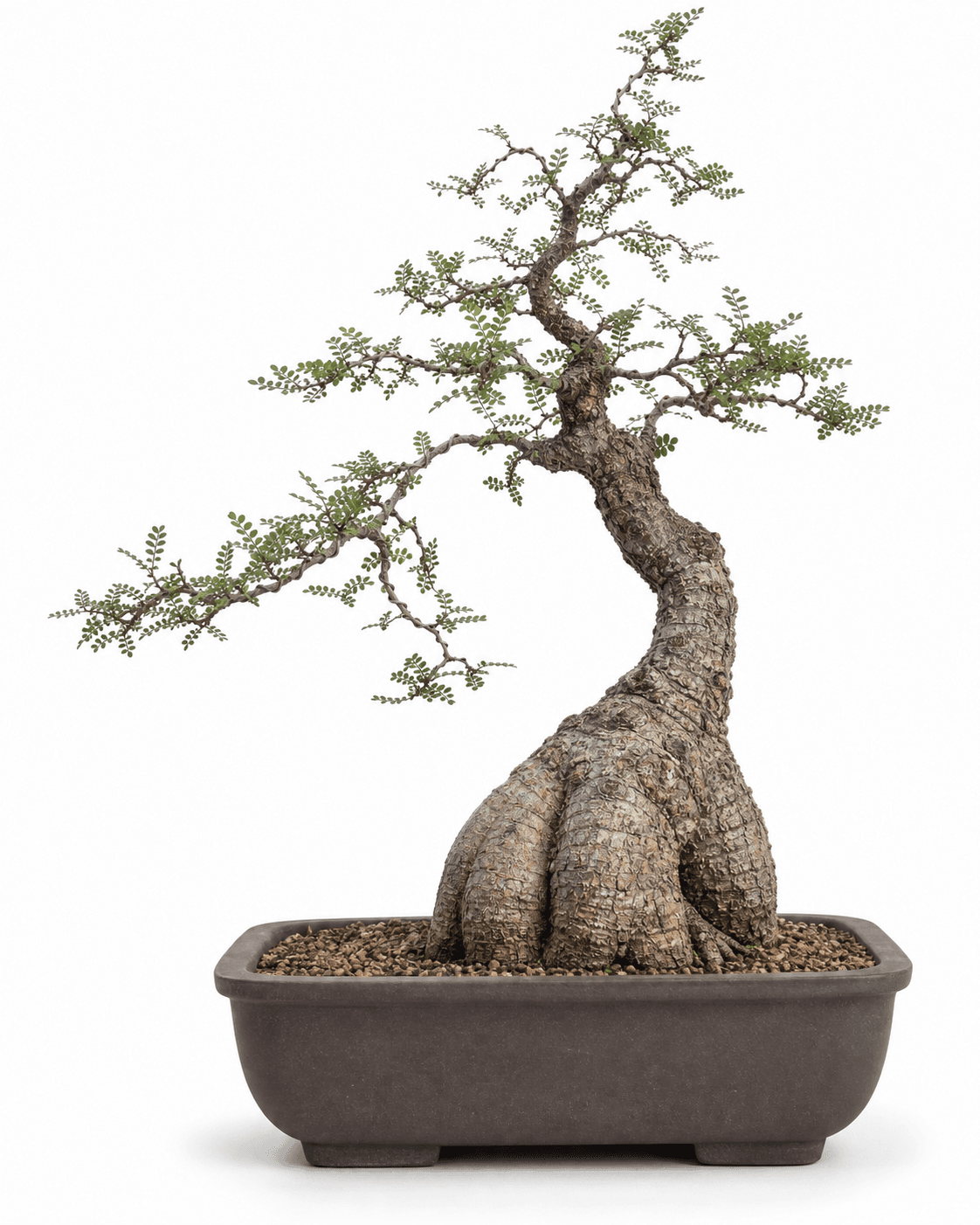
The bonsai value is unusually direct: small compound leaves, swollen roots, thick trunk texture, zig-zag branch character, and dry-country proportions that already read like a miniature tree before heavy styling. World of Succulents: Elephant treeWorld of Succulents: Operculicarya pachypus
In the EntGrove taxonomy, Operculicarya belongs to Broadleaf > Succulent. That means the work calendar follows warm active growth, mineral drainage, stored water, and dry winter rest rather than a temperate deciduous calendar. Bonsai Mirai LibraryKew POWO: Operculicarya pachypus
Keep the label clean. Elephant bush usually means Portulacaria afra in beginner bonsai culture, but O. pachypus may also be sold under that common name. Verify Operculicarya before applying this page. World of Succulents: Operculicarya pachypusKew POWO
Habitat
Dry Madagascar ecology explains the caudex, tiny leaves, and winter restraint.
Kew places O. decaryi in a seasonally dry tropical biome and O. pachypus in desert or dry shrubland. The Adansonia revision describes Operculicarya as a group of xerophytic species centered in Madagascar and the Comoros. Kew POWO: Operculicarya decaryiKew POWO: Operculicarya pachypusAdansonia: Operculicarya revision
For care, translate that ecology into full sun when acclimated, fast drainage, warm recovery, and long dry intervals whenever the tree is leafless or cold. Drought tolerance in habitat does not protect roots trapped in wet bonsai soil. World of Succulents: Elephant treeBonsai Mirai Library
For design, let the dry-forest form lead. Swollen roots, bumpy bark, small leaflets, angled twigs, and sparse negative space create age better than dense pads or constant trimming. World of Succulents: Elephant treeBonsai Mirai / Asymmetry
Reading the tree
Read caudex firmness, leaf demand, and twig activity before every cut.
A strong Operculicarya has a firm base, active fine leaves, new twig extension, a pot that dries predictably, and no sour smell or softness around the swollen roots. World of Succulents: Elephant treeBonsai Mirai Library
Development is base-first. Let young material build root swelling, trunk texture, and useful primary bends before forcing it into a shallow pot or repeated silhouette pruning. World of Succulents: Elephant treeBonsai Mirai / Asymmetry
Refinement is quieter. Once the base and trunk are convincing, shorten twiggy growth, open windows to the trunk, preserve live tips, and avoid stacking pruning, root work, and wiring into one recovery period. Bonsai Mirai LibraryBonsai Mirai / Asymmetry
Pruning
Trim for line, light, and twig clarity during warm active growth.
World of Succulents recommends trimming interlocking or twiggy branches on O. decaryi. For bonsai, make those cuts while the tree is warm, active, and able to replace foliage. World of Succulents: Elephant tree
Cut back long shoots to visible buds or useful junctions, then let replacement growth harden. Avoid stripping the entire crown from a weak or leafless tree because the foliage powers new roots after work. Bonsai Mirai LibraryWorld of Succulents: Elephant tree
Use pruning to reveal the swollen base and zig-zag structure. The best Operculicarya images usually need less foliage mass than the grower expects. Bonsai Mirai / AsymmetryWorld of Succulents: Operculicarya pachypus
Roots
Repot as the tree wakes, then protect the swollen roots from wet cold.
Mirai succulent repotting method emphasizes granular media, clean cuts, gentle handling of fleshy roots, firm tie-downs, and restrained chopsticking. Operculicarya adds hidden swollen roots that may only be discovered during repotting. Bonsai Mirai LibraryWorld of Succulents: Elephant treeWorld of Succulents: Operculicarya pachypus
Use spring or early summer warmth as dormancy breaks. World of Succulents specifically places root-piece propagation in spring or early summer while the plant is waking, which is also the safer bonsai root-work logic. World of Succulents: Elephant treeBonsai Mirai Library
After root work, anchor the base firmly and manage water by demand. A first thorough watering can settle mineral soil, but regular watering should resume only as heat, leaves, and drying speed show recovery. Bonsai Mirai LibraryWorld of Succulents: Elephant tree
Soil and pot
Use mineral drainage and a pot that respects the caudex.
World of Succulents recommends fast-draining soil for caudiciform Operculicarya and avoiding peat where possible. Top Tropicals also recommends well-draining cactus or succulent mix for O. decaryi. World of Succulents: Elephant treeTop Tropicals: Operculicarya decaryi
A 1:1:1 akadama:pumice:lava mix is a conservative development baseline when watering is attentive. In cool indoor winter sites, increase durable aggregate and reduce water-retentive organic material. Bonsai Mirai Library
Pot choice should stabilize the swollen base and leave enough visual quiet around it. Warm unglazed, deeper oval, round, or rugged containers often support the dry-forest image better than a tiny shallow tray too early. Bonsai Mirai / AsymmetryWorld of Succulents: Elephant tree
Climate
Frost avoidance is the hard rule; watering changes with leaf demand.
O. decaryi is listed by Top Tropicals around Zones 9-11, while World of Succulents lists O. pachypus around Zones 10b-11b. Both public horticultural sources warn against freezing conditions. Top Tropicals: Operculicarya decaryiWorld of Succulents: Operculicarya pachypus
In cold regions, use a bright indoor, greenhouse, or conservatory winter plan. Keep roots drier through cool rest and return outdoor sun gradually after frost risk passes. World of Succulents: Elephant treeBonsai Mirai Library
In hot dry regions, water can increase during active growth if the soil drains fast. In humid or cool regions, root oxygen is the adjustment: more mineral structure, less standing wetness, and no routine winter watering. World of Succulents: Operculicarya pachypusBonsai Mirai Library
Pests
Most bonsai problems begin with wet roots, weak light, or indoor pests.
The most dangerous disease pattern is root rot from cold wet media. Sources repeatedly tie Operculicarya to dry or harsh conditions, fast-draining soil, and no water during dormancy. World of Succulents: Elephant treeWorld of Succulents: Operculicarya pachypusBonsai Mirai Library
Inspect indoor or greenhouse trees for scale, mealybugs, mites, and aphids on tender growth. Treat pests as a culture signal too: low light, stagnant air, and crowded twigging usually make them worse. Bonsai Mirai Library
If foliage drops, diagnose temperature and soil before reaching for fertilizer. Seasonal or cold-triggered leaf drop is very different from a soft base, sour soil, or roots kept wet while dormant. World of Succulents: Operculicarya pachypusWorld of Succulents: Elephant tree
Wiring
Wire young shoots briefly, then let pruning build most of the design.
Operculicarya branch value often comes from natural zig-zagging and short twig sections. Heavy wiring can quickly make the tree look generic and can mark thin branches. World of Succulents: Operculicarya pachypusBonsai Mirai / Asymmetry
Use small aluminum wire on flexible shoots during active growth, support the outside of each bend, and check often. Dry brittle shoots are better shortened or regrown than forced. Bonsai Mirai Library
For large changes, choose a new leader, rotate the front, or expose a better root angle over time. The caudex and trunk texture should carry more of the composition than wire geometry. Bonsai Mirai / AsymmetryWorld of Succulents: Elephant tree
Propagation
Seed gives the best bases, but seed usually requires both sexes.
World of Succulents describes O. decaryi as dioecious, meaning male and female plants are needed for seed. That matters for collectors because a single plant may never produce viable seed. World of Succulents: Elephant tree
O. decaryi can be propagated from cuttings or seed, with tuberous root pieces described as a practical caudiciform method in spring or early summer. Seed-grown plants tend to make the best exposed roots. World of Succulents: Elephant tree
Mirai succulent propagation method adds the aftercare: let succulent cuts skin over where appropriate, keep the rooting medium oxygen-rich, and avoid cold wet conditions while roots initiate. Bonsai Mirai Library
Air-layering and grafting are specialist choices for this genus. For most growers, cultivated seed, documented cuttings, and patient base development are cleaner than complex propagation. Bonsai Mirai / AsymmetryAdansonia: Operculicarya revision
Buying
Buy identified, cultivated plants with firm bases and honest roots.
Start with the label: Operculicarya decaryi and O. pachypus are accepted separate species, and O. pachypus is the smaller, rarer, more compact subject in the public succulent literature. Kew POWO: Operculicarya decaryiKew POWO: Operculicarya pachypusWorld of Succulents: Operculicarya pachypus
Inspect for firm swollen roots, no soft black areas, active leaf buds, clean twigging, fast drainage, and a pot that does not smell sour. A dramatic caudex in wet peat is a horticultural project before it is styling material. World of Succulents: Elephant treeBonsai Mirai Library
Favor cultivated nursery stock, seed-grown material, or clearly documented cuttings. Kew and the Adansonia revision show a narrow Madagascar genus context, so vague wild-origin claims deserve caution. Kew POWO: Operculicarya pachypusAdansonia: Operculicarya revision
Choose the base before the crown. Lower trunk texture, root swelling, useful asymmetry, and a believable front are harder to create later than a clean set of new twigs. Bonsai Mirai / AsymmetryWorld of Succulents: Elephant tree
Troubleshooting
Diagnose from base firmness, soil drying, leaf status, and recent cold.
Leaves drop in winter: check temperature, light, and whether the soil is dry. Operculicarya can be more deciduous in cold winters, and dormancy needs much less water. World of Succulents: Operculicarya pachypusWorld of Succulents: Elephant tree
Base or roots soften: treat it as root-rot risk. Stop watering, move warmer and brighter, improve airflow, check drainage, and delay all styling until firmness and growth return. Bonsai Mirai LibraryWorld of Succulents: Elephant tree
Shoots are long and weak: increase light gradually, reduce nitrogen, and let the next warm flush harden before pruning back. Top Tropicals: Operculicarya decaryiBonsai Mirai Library
Tree rocks after repotting: re-anchor immediately. A moving caudex breaks new roots, and Mirai succulent method makes firm but gentle tie-downs part of the repot. Bonsai Mirai Library
No seed appears after flowering: verify that you have both male and female plants. Dioecious flowering makes seed availability a population question, not a single-tree care failure. World of Succulents: Elephant tree
Design
Design around the swollen root, bumpy trunk, tiny leaves, and empty space.
Start with base, trunk line, defining branch, and apex. With Operculicarya, the base and trunk texture usually decide the front before the branch pattern does. Bonsai Mirai / AsymmetryWorld of Succulents: Elephant tree
Let the tree stay sparse enough that the caudex reads clearly. Tiny leaflets allow scale, while twig density can hide the most valuable features if every shoot is kept. World of Succulents: Operculicarya pachypusBonsai Mirai / Asymmetry
O. decaryi can support a larger rugged dry-forest tree image. O. pachypus often suits a compact collector image with a conical trunk, contorted swollen roots, and small leaves. Top Tropicals: Operculicarya decaryiWorld of Succulents: Operculicarya pachypus
Good styles include informal upright, exposed-root, caudex study, literati, clump from seedlings, and small dry-forest tree. Avoid conifer pads and maple density. Bonsai Mirai / AsymmetryWorld of Succulents: Elephant tree
Forms
The practical split is decaryi versus pachypus.
O. decaryi is the more common elephant tree, described by Kew as a tree from Madagascar and by Top Tropicals as a slow succulent shrub or small tree with a thickened caudex. Kew POWO: Operculicarya decaryiTop Tropicals: Operculicarya decaryi
O. pachypus is accepted by Kew as a semisucculent shrub from southwestern Madagascar. World of Succulents describes it as smaller and more compact than O. decaryi, with a conical trunk and swollen contorted roots. Kew POWO: Operculicarya pachypusWorld of Succulents: Operculicarya pachypus
Other Operculicarya species exist in the Adansonia revision, but bonsai trade labels usually resolve first to decaryi or pachypus. Confirm species before transferring hardiness, size, or rarity claims. Adansonia: Operculicarya revisionKew POWO: Operculicarya decaryiKew POWO: Operculicarya pachypus
History
Operculicarya is a collector caudiciform that naturally overlaps bonsai.
The genus was revisited in a 2006 Adansonia treatment by Randrianasolo and Lowry, which recognized eight species and discussed their eco-geographic features and conservation assessments. Adansonia: Operculicarya revision
In bonsai culture, Operculicarya usually enters through caudiciform and succulent collecting rather than through traditional temperate bonsai channels. That explains the uneven source base and the need to separate horticultural facts from bonsai method transfer. World of Succulents: Elephant treeBonsai Mirai Library
The strongest trees look intentional without much ornament: firm swollen base, clear trunk texture, small leaflets, sparse twigging, mineral soil, and a pot that gives the dry Madagascar character room to breathe. Bonsai Mirai / AsymmetryWorld of Succulents: Operculicarya pachypus
Species questions
Answer the beginner questions before styling.
Can Operculicarya be grown as bonsai?
Yes. Operculicarya decaryi and O. pachypus both have small leaves, swollen roots, trunk texture, and dry-country proportions that work well for caudex-forward bonsai or bonsai-adjacent container trees.
What is the difference between Operculicarya decaryi and Operculicarya pachypus?
O. decaryi is the more common elephant tree and can become a larger shrub or small tree. O. pachypus is a smaller semisucculent shrub from southwestern Madagascar with compact bonsai-like proportions and a conical swollen base.
Is Operculicarya the same as elephant bush?
Sometimes O. pachypus is called elephant bush, but the common bonsai elephant bush is usually Portulacaria afra. Check the botanical name before applying care advice.
Can Operculicarya bonsai live indoors?
Yes, if indoors means bright, warm, and frost-free. A sunny window, greenhouse, conservatory, or strong grow light works better than a dim shelf, and winter watering must be sparse.
How much sun does Operculicarya need?
Use full sun or very bright light once the plant is acclimated and actively rooted. Recently repotted or indoor-grown plants should move back into strong sun gradually.
How often should I water Operculicarya bonsai?
Water during warm active growth after the mix dries, then let oxygen return to the roots. During cool dormancy or leafless winter rest, water very sparingly.
What soil should I use for Operculicarya bonsai?
Use a sharply draining mineral or cactus-succulent bonsai mix. Avoid peat-heavy media in shallow pots because wet organic soil during cold rest is the main rot risk.
When should Operculicarya be repotted?
Repot in spring or early summer warmth as the plant wakes from winter rest. Keep swollen roots stable, avoid rough chopsticking, and resume watering by demand rather than habit.
Can Operculicarya be propagated from cuttings?
O. decaryi can be propagated from cuttings, seed, and pieces of tuberous root, with spring or early summer timing preferred. Seed requires both male and female plants because the species is dioecious.
Why did my Operculicarya drop its leaves?
Leaf drop can follow cool winter rest, cold exposure, low light, drought, or stress. If the base is firm and the soil is dry, wait for warmth. If the base is soft or the soil is wet, suspect root rot.
Sources
Species advice needs source discipline.
Next decisions
Plan the operation before copying the calendar.
A good care note for Operculicarya records the tree's stage, the work done, and the aftercare used. That record matters more than a month-name rule.
Related species
Compare nearby trees before transferring advice.
Dwarf jade / elephant bush
Portulacaria afra
Jade plant
Crassula ovata
Madagascar palm
Pachypodium lamerei
Desert rose
Adenium obesum
Boojum tree
Fouquieria columnaris