
Species guide
Jade Plant Bonsai Care
Crassula ovata
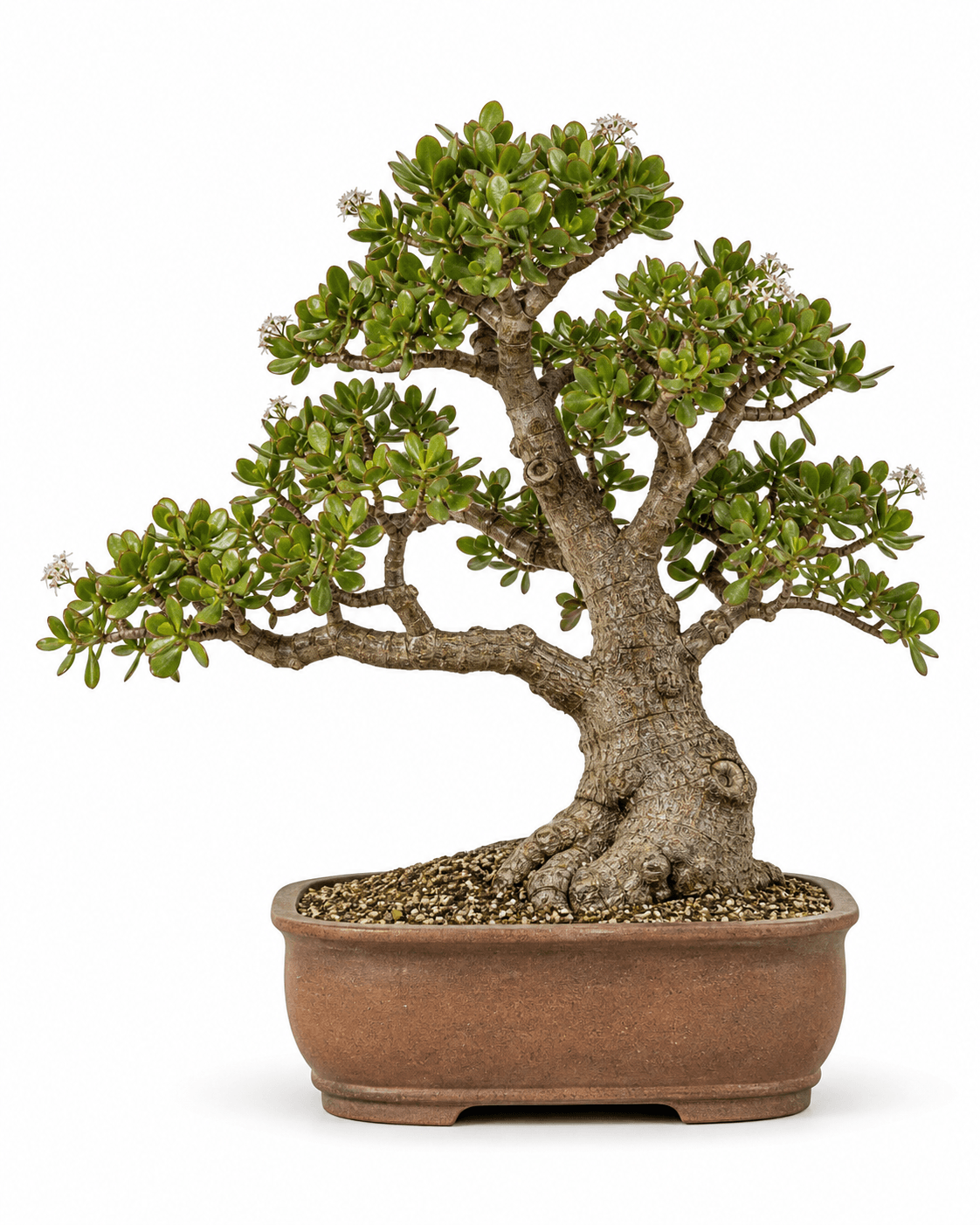
Jade plant bonsai care starts with identity: this page covers Crassula ovata, the true jade plant, money plant, lucky plant, or jade tree. Keep it separate from dwarf jade, Portulacaria afra, which has smaller leaves and stronger bonsai popularity.
Grow jade plant as a Broadleaf > Succulent bonsai. Give it bright light, fast drainage, full watering followed by real dry-back, warm recovery after root work, and clip-and-grow pruning before relying on wire.
The local Mirai corpus has no dedicated Crassula ovata class, but it has strong succulent bonsai method in succulent-repotting, succulent-kusamono, live Q&A, watering, soil, repotting, wiring, energy, and design files. Species facts here are grounded in NC State, Clemson, and Kew POWO accepted-name workflow.
Updated June 12, 2026. Written by EntGrove Editorial. Last verified June 12, 2026.
Care fingerprint
Read the species through its shared care pattern.
Err on mineral drainage, warm recovery, and conservative watering; many tolerate pruning but not cold wet roots. Use this as the starting point before local conditions and tree strength refine the calendar.
Read the foliage first
Broadleaf stress usually shows in leaf color, leaf size, wilt, scorch, or delayed hardening before it becomes a branch problem.
Match work to dormancy
Deciduous, evergreen, tropical, succulent, and flowering broadleaf trees recover on different calendars.
Protect fine roots
Root work should preserve enough active fine roots for the tree to rehydrate quickly after the operation.
Care cadence
The calendar starts with the tree's seasonal state.
Placement
Timing: Use the brightest stable site available: sunny indoor window, strong grow light, or warm outdoor bench after frost risk passes.
Watch for: Leggy internodes, leaves clustered only at the tips, sudden sunburn after an indoor-to-outdoor move, and cold window glass in winter.
NC State ExtensionClemson Extension HGICBonsai Mirai LibraryWatering
Timing: During spring and summer, water thoroughly when the mix has dried. From fall through late winter, extend the dry interval and water only for active need.
Watch for: Soft yellow leaves, leaf fall from wet roots, wrinkled leaves from drought, water standing in a saucer, and dense soil that stays damp.
Clemson Extension HGICNC State ExtensionBonsai Mirai LibraryFeeding
Timing: Feed lightly during active warm growth. Clemson suggests fertilizing jade plants every 3-4 months and waiting four months after repotting before feeding.
Watch for: Fertilizer on a newly repotted plant, weak low-light growth, salt buildup, and coarse soft extension that cannot support bonsai structure.
Clemson Extension HGICBonsai Mirai LibraryPruning
Timing: Prune during active growth, then let new buds extend and harden before the next cut. Use clip-and-grow to shorten internodes and keep heavy branches from pulling down.
Watch for: Removing all leaves from a weak branch, wet fresh cuts, top-heavy shoots, and repeated pruning in low light.
Bonsai Mirai LibraryNC State ExtensionRepotting
Timing: Repot as new growth starts or during reliable warm recovery. Keep the tree stable, use granular soil, and resume water slowly after the first post-work dry-back.
Watch for: Root work in cold weather, fresh cuts kept wet, unanchored heavy tops, and crushed fleshy roots from rough chopsticking.
Clemson Extension HGICBonsai Mirai LibraryWiring
Timing: Wire only flexible young shoots, or use guy wires and pruning. Check often because succulent stems can mark before they look woody.
Watch for: Snapped brittle stems, wire bite hidden by leaves, bending after a heavy watering, and trying to make sharp conifer-like movement.
Bonsai Mirai LibraryNC State ExtensionPropagation
Timing: Use stem or leaf cuttings during warm active growth. Let succulent cut surfaces skin over before setting them into a low-water, high-oxygen medium.
Watch for: Wet rooting media, cold benches, buried leaves, and cuttings watered before callus and root initials can form.
NC State ExtensionBonsai Mirai LibraryWinter protection
Timing: Keep above freezing, bright, and on the dry side. Move outdoor trees inside before cold nights and keep foliage away from icy glass.
Watch for: Drafts, cold panes, wet soil with low light, spider mites, mealybugs, and root rot during short days.
Clemson Extension HGICNC State ExtensionPests and disease
Timing: Inspect indoor trees through winter and any plant recently moved from retail houseplant production into bonsai training.
Watch for: Mealybugs, scale, aphids, spider mites, leaf fall from overwatering, and root rot from slow-draining mixes.
NC State ExtensionClemson Extension HGICSpecies guide
Apply the species profile before copying another tree's calendar.
At a glance
Jade plant is a succulent shrub bonsai, not the same plant as dwarf jade.
Use Crassula ovata for true jade plant, jade tree, money plant, and lucky plant labels. NC State also lists baby jade, Chinese rubber plant, dwarf rubber plant, and Japanese rubber plant, so retail tags need careful reading. NC State Extension
The species sits in Crassulaceae and in EntGrove Broadleaf > Succulent. That placement matters because the calendar follows stored water, fast drainage, warm recovery, and a long winter dry interval. NC State ExtensionBonsai Mirai Library
The bonsai strength is its miniature-tree silhouette: thick trunklike stems, glossy oval leaves, steady container life, and easy propagation. The limitation is scale: leaves are larger than dwarf jade, and small trees can look heavy unless pruning and pot choice are restrained. Clemson Extension HGICNC State ExtensionBonsai Mirai / Asymmetry
Apply this page to Crassula ovata. Dwarf jade, Portulacaria afra, money tree, Pachira aquatica, silver jade, Crassula arborescens, Kalanchoe, and Sedum require separate identification before advice transfers. NC State ExtensionKew POWO
Habitat
South African succulent ecology explains the dry-back rhythm.
NC State gives South Africa as the species origin and describes jade plant as a subtropical broadleaf evergreen succulent shrub. Clemson frames the houseplant version as a container succulent that likes the warm, dry conditions found in many homes. NC State ExtensionClemson Extension HGIC
For care, translate that ecology into a shallow pot that drains fast, stores little excess water, and returns oxygen to the roots after each full watering. A landscape drought-tolerant plant can still fail in bonsai if the root zone stays wet. Bonsai Mirai LibraryClemson Extension HGIC
For design, read the plant as a water-storing shrub that gradually becomes tree-like. Rounded leaves, thick brittle stems, ringed bark scars, and a heavy crown ask for quiet broadleaf styling rather than pine-pad geometry. NC State ExtensionBonsai Mirai / Asymmetry
Reading the tree
Read light, stored water, and recovery speed before every cut.
A strong jade plant has firm leaves, compact internodes, active tip growth, and a root zone that dries after full watering. Weak light creates long soft shoots that cannot become convincing bonsai branches. NC State ExtensionClemson Extension HGIC
Development is about trunk mass and branch placement. Let selected shoots extend in bright growth, then cut back to build directional changes and secondary shoots. Bonsai Mirai LibraryBonsai Mirai / Asymmetry
Refinement is about restraint. Once the silhouette is set, reduce feeding, shorten extensions after they harden, keep leaves exposed to light, and avoid stacking pruning, repotting, and wiring into the same recovery window. Bonsai Mirai Library
Pruning
Use clip-and-grow as the main branch-building technique.
Jade plant can be pruned to keep a compact miniature tree image, but pruning should happen when light and warmth can produce replacement growth. Cuts in dim winter rooms usually lead to weak response and bare tips. Clemson Extension HGICBonsai Mirai Library
Cut back to a visible node or leaf pair, then let new shoots extend before pruning again. This builds angular movement and ramification without forcing brittle succulent branches into sharp bends. Bonsai Mirai LibraryNC State Extension
Do not treat large fresh cuts like hardwood bonsai scars. Keep the plant warm, bright, and dry enough that succulent tissue can seal instead of staying wet around damaged cells. Bonsai Mirai LibraryClemson Extension HGIC
Roots
Repot when new growth can restart the root system.
Clemson says jade plants can live happily root-bound for years and should be repotted, when needed, as new growth starts. That fits bonsai practice: repot for percolation, root congestion, soil failure, or design need, not from habit. Clemson Extension HGIC
Mirai succulent repotting method emphasizes gentle handling of fleshy roots, clean cuts, granular media, firm tie-downs, and avoiding excess chopstick damage. The root mass should be lowered in one deliberate setting rather than lifted repeatedly. Bonsai Mirai Library
After root work, protect the plant from cold and excess water. Mirai succulent guidance uses a first thorough watering, then a real drying period before regular watering resumes; Clemson likewise says to allow soil to become dry after repotting. Bonsai Mirai LibraryClemson Extension HGIC
Soil and pot
Choose a stable pot and a soil column that dries cleanly.
Clemson says jade plants need a very well-drained soil mix to prevent root rot, and NC State lists good drainage plus occasionally dry to very dry soil. In bonsai, a mineral succulent mix is safer than peat-heavy houseplant soil. Clemson Extension HGICNC State Extension
Mirai succulent method supports a granular inorganic substrate, often with smaller interior particles than growers expect, because fine roots still need contact, moisture rhythm, and oxygen. A 1:1:1 akadama:pumice:lava development mix is a conservative bonsai baseline where watering is attentive. Bonsai Mirai Library
Pot selection should respect the plant weight. Older jade plants become top-heavy, and Clemson recommends moving older plants to a large heavy pot to prevent tipping. Bonsai pots need strong tie-downs and enough visual mass to hold the succulent crown. Clemson Extension HGICBonsai Mirai / Asymmetry
Climate
Bright warmth makes jade easy; cold wet roots make it fragile.
In frost-free or near-frost-free climates, jade plant can grow outdoors with bright light, strong drainage, and protection from prolonged cold rain. In colder regions, treat it as a bright indoor or protected winter bonsai. NC State ExtensionClemson Extension HGIC
NC State lists Zones 11a to 12b for the plant record. A bonsai pot is less forgiving than a landscape bed, so freezing root balls and cold wet soil need earlier protection. NC State ExtensionBonsai Mirai Library
Indoor winter care should be cool-to-average, bright, and dry between waterings. Clemson gives daytime temperatures of 65-75 F and nighttime temperatures of 50-55 F, with protection from drafts and windowpanes. Clemson Extension HGIC
Pests
Most jade pest and disease issues follow indoor stress or wet soil.
NC State lists aphids, scale, spider mites, and mealybugs as occasional problems, and Clemson says mealybugs are the most common insect pest of jade plants in the home. NC State ExtensionClemson Extension HGIC
Root rot is the main disease pattern. NC State ties leaf fall and root rot to overwatering, while Clemson says root rot usually results from soil that does not drain quickly or from overly frequent watering. NC State ExtensionClemson Extension HGIC
The bonsai prevention stack is cultural: bright light, airflow, quarantine new plants, fast drainage, dry winter rhythm, clean tools, and no saucers holding water under the pot. Bonsai Mirai LibraryClemson Extension HGIC
Wiring
Wire less than you prune, and move stems while they are young.
Jade stems are fleshy and brittle before they appear fully woody. Wire only young growth that can bend without cracking, and use pruning to create most directional changes. NC State ExtensionBonsai Mirai Library
Use aluminum, low tension, and short setting periods. Succulent bark and stems can mark quickly, and wire bite is more distracting on smooth glossy stems than on rough conifer bark. Bonsai Mirai Library
Avoid wiring immediately after a heavy watering or repot. Hydrated succulent tissue can snap, while a newly worked root system needs stability more than styling stress. Bonsai Mirai Library
Propagation
Stem and leaf cuttings are the practical propagation routes.
NC State lists leaf cutting and stem cutting as recommended propagation strategies, and Clemson says new plants can be started from stem cuttings. NC State ExtensionClemson Extension HGIC
Mirai succulent method adds the bonsai aftercare: let fresh succulent cuts skin over before rooting, then use a substrate with high oxygen and low excess water to prevent rot. Bonsai Mirai Library
For bonsai, stem cuttings are usually more useful than leaves because they preserve a starting branch line. Leaf propagation is good for stock production, cultivar backup, and learning the species rhythm. NC State ExtensionBonsai Mirai / Asymmetry
Air-layering and grafting are unusual for ordinary jade plant bonsai. Use cuttings, hard pruning, or rebuilding from lower shoots before considering advanced propagation work. Bonsai Mirai Library
Buying
Buy trunk character, compact growth, and clean roots.
The best candidates are older houseplants, sun-grown nursery succulents, compact cultivars, and plants with low branching already close to the trunk. A tall soft cutting with leaves only at the top needs years before it reads as bonsai. Clemson Extension HGICBonsai Mirai / Asymmetry
Inspect the lower trunk, branch exits, root flare, soil smell, drainage, leaf firmness, mealybug hiding spots, scale, and any black soft tissue near the root crown. NC State ExtensionClemson Extension HGIC
Reject plants in sour wet media, plants with collapsing stems, and plants that rely on a single straight cane with no low buds. A larger cheap houseplant can be better material than a tiny bonsai-labeled pot. Clemson Extension HGICBonsai Mirai Library
Confirm the label. Baby jade may mean Crassula ovata in NC State common names, while dwarf jade usually means Portulacaria afra in bonsai trade. The care is similar at a high level, but the scale and response are different. NC State ExtensionWisconsin Horticulture
Troubleshooting
Translate symptoms through water, light, and cold first.
Leaves yellow, soften, or drop while soil stays wet: suspect overwatering, slow drainage, root rot, or a cold low-light window. Dry the root zone, improve light, and delay repotting until recovery conditions are warm. NC State ExtensionClemson Extension HGIC
Leaves wrinkle or drop after long neglect: water thoroughly, confirm the soil accepts water, and restore the plant gradually. Clemson notes that extreme drought can cause dwarfing, foliage spotting, leaf drop, and death. Clemson Extension HGIC
Long weak growth and oversized leaves: increase light, rotate the tree, reduce fertilizer, and prune only when the plant is growing strongly enough to replace leaves. NC State ExtensionBonsai Mirai Library
White cottony clusters or dusty speckled foliage: inspect for mealybugs or spider mites. Isolate the tree and correct indoor stress before treating. Clemson Extension HGICNC State Extension
Tree rocks after repotting: re-secure the trunk and root mass. Heavy succulent crowns tear new roots when the plant can move in the pot. Bonsai Mirai Library
Design
Design around mass, rounded leaves, and a quiet succulent trunk.
Start with the base, trunk line, first branch, and apex. Jade plant often has a strong houseplant crown, so the first design decision is which heavy shoots create age and which ones only create bulk. Bonsai Mirai / Asymmetry
Use clip-and-grow to create short angular changes, then keep branch tips exposed to light. Dense outer leaves can shade the interior and push the tree back toward a houseplant silhouette. Bonsai Mirai LibraryNC State Extension
The best designs accept the species: thick water-storing stems, simple glossy leaves, a rounded crown, and modest flower potential. Avoid fine conifer pad imitation, heavy deadwood drama, and undersized pots that make the crown look unstable. NC State ExtensionBonsai Mirai / Asymmetry
Trunk thickening is slow once the roots are confined. Build mass in a larger container first, then move into a bonsai pot after the primary line is already convincing. Bonsai Mirai LibraryClemson Extension HGIC
Forms
Cultivar choice changes leaf scale, color, and bonsai difficulty.
NC State lists Botany Bay, Crosby's Compact, Gollum, Gollum Variegata, Hobbit, Hummel's Sunset, Minima, Pink Beauty, Red Coral, Skinny Fingers, and Variegata. NC State Extension
Clemson adds Bronze Beauty, Sunset, Hobbit, California Red Tip, silver jade or Blue Bird jade, and Tricolor in its jade plant cultivar discussion. Some of these names point to related Crassula taxa or forms, so verify before applying exact scale claims. Clemson Extension HGIC
For bonsai, compact forms such as Crosby's Compact, Minima, Hobbit, Gollum, and Pink Beauty can help with scale. Variegated and bright-color forms may be slower or less forgiving in weak light. NC State ExtensionClemson Extension HGIC
Keep silver jade, Crassula arborescens, and dwarf jade, Portulacaria afra, separate from Crassula ovata decisions. They may look similar in retail photos but differ in leaf size, vigor, and mature silhouette. NC State ExtensionKew POWO
History
Jade plant entered bonsai through houseplant culture and succulent training.
Clemson calls jade plants tough, easy-to-grow succulents that have an appealing bonsai quality because their stout brown trunks support glossy green leaves. Clemson Extension HGIC
That houseplant history is useful and limiting. Old indoor specimens can have real trunk character, but many have weak light history, top-heavy structure, and organic soil that needs staged conversion. Clemson Extension HGICBonsai Mirai Library
In exhibition-quality bonsai, jade plant is less canonical than Portulacaria afra because leaf scale is larger. It remains valuable as a teaching tree for dry-back watering, succulent root work, cutting propagation, and indoor-light honesty. Bonsai Mirai LibraryWisconsin Horticulture
A good jade bonsai should look mature before it looks decorative: thick base, stable crown, compact leaves from strong light, deliberate branch exits, and a pot that visually balances the stored-water mass. Bonsai Mirai / AsymmetryNC State Extension
Species questions
Answer the beginner questions before styling.
Can jade plant be grown as bonsai?
Yes. Crassula ovata can be trained as a succulent bonsai when it has bright light, fast drainage, careful dry-back watering, warm recovery after root work, and pruning that respects its larger leaf scale.
Is jade plant the same as dwarf jade?
They are different plants. Jade plant is Crassula ovata. Dwarf jade is Portulacaria afra, often called elephant bush or spekboom, and usually has smaller leaves for bonsai scale.
Can jade bonsai live indoors?
Yes, if the indoor site is bright enough. A sunny window or strong grow light is usually necessary. Dim shelves create weak shoots, large gaps between leaves, and wet-root problems.
How often should I water jade plant bonsai?
Water by soil condition and season. During active growth, water thoroughly when the mix dries. From fall through late winter, water much less often and keep the root zone from staying wet.
What soil is best for jade plant bonsai?
Use a sharply draining succulent or bonsai mix. A granular mineral blend such as akadama, pumice, and lava can work when watering is attentive. Dense peat-heavy soil is the common failure point.
When should jade plant bonsai be repotted?
Repot when new growth is starting and the plant can recover in warmth and bright light. Repot for root congestion, poor drainage, stale soil, or design need rather than on a fixed yearly schedule.
Can I wire jade plant bonsai?
Wire sparingly. Young stems can be guided, but succulent branches snap and mark easily. Clip-and-grow is usually the safer way to build shape and branch division.
Why is my jade bonsai dropping leaves?
Common causes are wet roots, low light, sudden cold, severe drought, or pest stress. Check drainage and soil moisture first, then light, temperature, and mealybugs or mites.
How do I propagate jade plant for bonsai?
Use stem cuttings for bonsai structure and leaf cuttings for stock. Let cut surfaces callus, then root them in a low-water, high-oxygen medium under warm bright conditions.
Which jade cultivars are best for bonsai?
Compact forms such as Crosby's Compact, Minima, Hobbit, Gollum, and Pink Beauty are useful because leaf and internode scale can be easier to manage than on the standard large-leaf form.
Sources
Species advice needs source discipline.
Next decisions
Plan the operation before copying the calendar.
A good care note for Jade plant records the tree's stage, the work done, and the aftercare used. That record matters more than a month-name rule.
Related species
Compare nearby trees before transferring advice.
Dwarf jade / elephant bush
Portulacaria afra
Madagascar palm
Pachypodium lamerei
Desert rose
Adenium obesum
Operculicarya
Operculicarya decaryi, Operculicarya pachypus
Boojum tree
Fouquieria columnaris