
Species guide
Dogwood Bonsai Care
Cornus florida, Cornus kousa
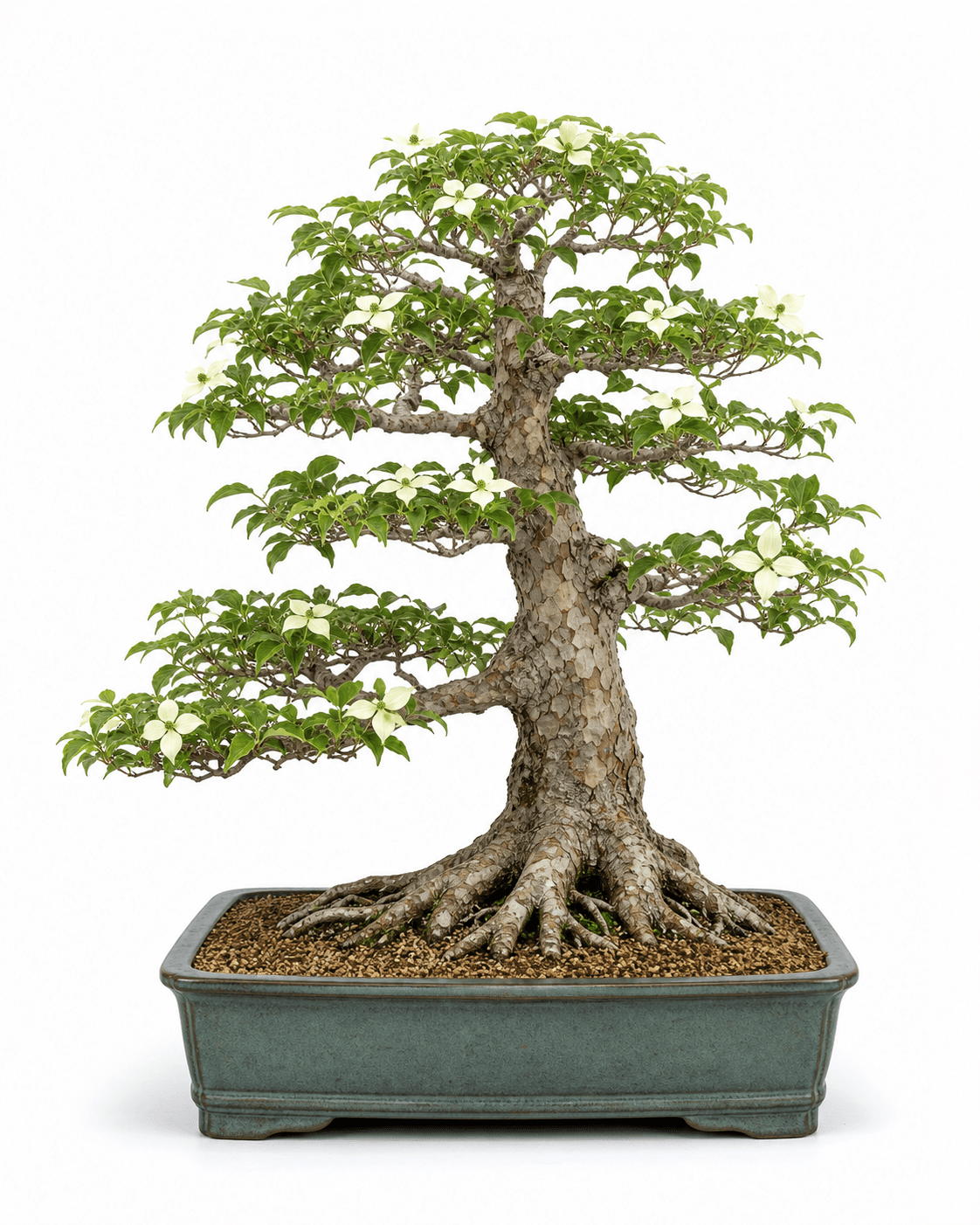
Dogwood bonsai should be grown outdoors as a medium or larger deciduous flowering tree, with steady root moisture, strong air movement, and pruning that protects the short shoots used for bract display. This page covers Cornus florida and Cornus kousa because those two big-bracted dogwoods are the common bonsai and nursery labels beginners encounter.
Kew accepts both species in Cornaceae: Cornus florida ranges from southeastern Canada to eastern Mexico, while Cornus kousa ranges from Sikkim and China to temperate East Asia. In bonsai terms, Kousa dogwood is usually the safer first candidate where anthracnose pressure is high; flowering dogwood asks for cleaner culture and closer disease inspection.
The local Mirai corpus has scattered direct Dogwood mentions but no dedicated Cornus file. This guide uses Mirai flowering, deciduous, watering, soil, repotting, pruning, wiring, propagation, and design method as transferred bonsai logic, then grounds identity, hardiness, disease, and cultivar details in Kew, NC State, Virginia Cooperative Extension, UNH Extension, and USDA sources.
Updated June 17, 2026. Written by EntGrove Editorial. Last verified June 17, 2026.
Care fingerprint
Read the species through its shared care pattern.
Repot and structural prune around dormant-to-active transitions; protect new leaves; time refinement work after growth hardens. Use this as the starting point before local conditions and tree strength refine the calendar.
Note: Shared parent page for flowering dogwood and kousa dogwood; verify exact species and cultivar before promising flower timing, disease resistance, fruit scale, or hardiness.
Read the foliage first
Broadleaf stress usually shows in leaf color, leaf size, wilt, scorch, or delayed hardening before it becomes a branch problem.
Match work to dormancy
Deciduous, evergreen, tropical, succulent, and flowering broadleaf trees recover on different calendars.
Protect fine roots
Root work should preserve enough active fine roots for the tree to rehydrate quickly after the operation.
Care cadence
The calendar starts with the tree's seasonal state.
Placement
Timing: Keep outdoors year-round with winter dormancy, open air, and root protection during hard freezes once the tree is in a shallow container.
Watch for: Warm indoor storage, stagnant corners, bark kept wet at the base, cultivar hardiness mismatch, and dry winter wind around a shallow pot.
Kew POWO: Cornus floridaKew POWO: Cornus kousaVirginia Cooperative ExtensionBonsai Mirai LibraryLight requirement
Timing: Give full sun to partial shade. Use morning sun with afternoon shade when summer heat, reflected light, or small pots push leaf temperature beyond root supply.
Watch for: Weak flowering in deep shade, leaf scorch in hot sun, wet foliage in still air, and flower display that improves only after light and root health stabilize.
NC State Extension: Cornus floridaNC State Extension: Cornus kousaBonsai Mirai LibraryWatering
Timing: Water when surface particles begin to dry, then saturate the whole pot until water exits the drain holes. Keep the root mass moist with oxygen, especially in spring and hot wind.
Watch for: Dry nursery cores, waterlogged organic soil, leaf-edge scorch, drooping after hot wind, and a pot that stays wet because roots have weakened.
Bonsai Mirai LibraryVirginia Cooperative ExtensionNC State Extension: Cornus kousaFertilizer
Timing: Feed after growth is active and roots are functioning. Use stronger nutrition in development, then reduce after first-flush hardening when flower buds, internode length, and disease-sensitive soft growth matter.
Watch for: High nitrogen producing lush disease-prone shoots, starvation after pruning, fertilizer on recently reduced roots, and late soft growth before frost.
Bonsai Mirai LibraryUNH Extension anthracnose fact sheetPruning
Timing: Separate development from display. Let selected shoots extend for structure, prune after flowering when bract display matters, and use post-flush pruning after leaves harden for refinement.
Watch for: Removing flower-bearing short shoots, dense humid interiors, cuts made during heavy water mobility, bar branches from opposite buds, and branch ends that all stop at one outline.
Bonsai Mirai LibraryNC State Extension: Cornus floridaNC State Extension: Cornus kousaWiring
Timing: Wire young flexible shoots during leafless or early fall windows, then inspect frequently during spring thickening. Use guy wires, clip-and-grow, and pruning for older stiff branches.
Watch for: Smooth young bark, swelling branch collars, wire bite on flower-bearing twigs, brittle older wood, and bends that erase natural layered branching.
Bonsai Mirai LibraryNC State Extension: Cornus floridaNC State Extension: Cornus kousaRepotting
Timing: Inspect in early spring as buds swell. Work before active growth depends on the full root system, and stage nursery-core transition instead of bare-rooting weak flowering dogwood material.
Watch for: Low transplant tolerance, drying exposed fine roots, weak tie-downs, old mud cores, hot wind after repotting, and combining major root work with heavy top reduction.
Bonsai Mirai LibraryVirginia Cooperative ExtensionPest and disease checks
Timing: Inspect during spring leaf-out, wet bloom periods, summer humidity, after pruning, and before winter storage. Keep foliage and branches able to dry quickly.
Watch for: Anthracnose leaf spots, lower-crown dieback moving upward, twig cankers, powdery mildew, borers, scale, aphids, caterpillars, wet bark, and trunk wounds.
UNH Extension anthracnose fact sheetVirginia Cooperative ExtensionNC State Extension: Cornus floridaSpecies guide
Apply the species profile before copying another tree's calendar.
At a glance
Dogwood is an outdoor flowering deciduous bonsai for medium and larger designs.
The plant target is Cornus florida or Cornus kousa, both accepted by Kew in Cornaceae. Common labels include flowering dogwood for Cornus florida, plus Kousa dogwood, Chinese dogwood, and Japanese dogwood for Cornus kousa. Kew POWO: Cornus floridaKew POWO: Cornus kousaNC State Extension: Cornus kousa
The horticultural profile is outdoor, deciduous, medium growth, full sun to partial shade, moist but well-drained acidic to neutral soil, spring bracts, red fruit or drupes, autumn color, and a repot rhythm driven by root evidence rather than a fixed annual routine. NC State Extension: Cornus floridaNC State Extension: Cornus kousaBonsai Mirai Library
The best audience is an outdoor grower who wants seasonal display and patient branch building. Kousa is usually easier where dogwood anthracnose is common, while flowering dogwood remains compelling for native eastern North American material with clean culture. UNH Extension anthracnose fact sheetVirginia Cooperative ExtensionBonsai Mirai / Asymmetry
Wild habitat
Temperate woodland origins explain the moisture, shade, and disease discipline.
Kew gives Cornus florida a native range from southeastern Canada to eastern Mexico. USDA Silvics describes flowering dogwood as an understory tree with shallow-root dry-site limits, bracted spring display, red fruit, and temperate forest ecology. Kew POWO: Cornus floridaUSDA Forest Service Silvics
Kew gives Cornus kousa a native range from Sikkim and China to temperate East Asia. NC State describes Kousa as slower-growing, tolerant of open areas, better in sunny sites than native dogwoods, and able to develop horizontal branching, mottled bark, and showy fall fruit with age. Kew POWO: Cornus kousaNC State Extension: Cornus kousa
The care implication is steady moisture without stale saturation. A shallow bonsai pot removes the buffering of woodland soil, so water thoroughly, preserve oxygen, shade the pot during heat, and avoid wet stagnant foliage that favors fungal pressure. Bonsai Mirai LibraryNC State Extension: Cornus floridaNC State Extension: Cornus kousaUNH Extension anthracnose fact sheet
The design implication is a layered flowering broadleaf. Flowering dogwood gives horizontal branching and blocky mature bark; Kousa gives later flowers, peeling bark patches, and wide-spreading age. Design from that tree character, not from compact evergreen pad logic. NC State Extension: Cornus floridaNC State Extension: Cornus kousaBonsai Mirai / Asymmetry
Reading the tree
Separate flower display, branch building, and disease control before cutting.
Mirai flowering-bonsai method separates two value systems: a tree grown mainly to show flowers and a refined tree form that happens to flower. Dogwood belongs in the second group once it is a bonsai, because branch architecture must carry the image after the bracts finish. Bonsai Mirai LibraryBonsai Mirai / Asymmetry
Read vigor through leaf size, internodes, flower-bud density, root moisture, and twig dieback. A tree in development may need long extensions and strong feeding; a refined display tree may need shorter post-flush pruning and fewer flowers to protect recovery. Bonsai Mirai LibraryNC State Extension: Cornus florida
Opposite leaves and horizontal branch habit make structure legible early. Select one dominant branch from crowded junctions, protect interior shoots that can become future flowering wood, and avoid letting every branch end at the same outline. NC State Extension: Cornus floridaNC State Extension: Cornus kousaBonsai Mirai Library
Disease reading is part of design reading on Cornus florida. Lower-crown dieback, spots with purple borders, twig cankers, and weak water sprouts should change the styling plan before the tree is asked to carry flowers or wire. UNH Extension anthracnose fact sheetVirginia Cooperative Extension
Pruning
Prune around bloom, then refine after the first flush hardens.
Use post-bloom pruning when flower display is the goal. Remove spent flowers or fruit selectively on weaker trees, shorten long shoots after they have done their job, and keep enough short wood to set the next display. Bonsai Mirai LibraryNC State Extension: Cornus floridaNC State Extension: Cornus kousa
For structure, follow deciduous timing. Low-risk branch selection can happen leafless if the tree is not bleeding; larger cuts on water-mobile trees should wait until the first flush hardens and recovery energy is present. Bonsai Mirai Library
Partial leaf reduction belongs only on strong refined zones after hardening. The Mirai deciduous method uses partial defoliation to stimulate controlled second growth on large-leaf species, but Dogwood flower and disease goals make whole-tree routine defoliation a poor default. Bonsai Mirai LibraryUNH Extension anthracnose fact sheet
Keep pruning hygienic. UNH recommends removing diseased twigs and attached leaves in disease management, and Virginia Cooperative Extension ties stress and bark injury to higher insect and disease vulnerability. UNH Extension anthracnose fact sheetVirginia Cooperative Extension
Repotting
Repot in spring with conservative root work and careful aftercare.
Mirai beginner repotting method sets the default window in spring as buds swell, before active growth depends on the full root system. For Dogwood, make that window conservative because Virginia Cooperative Extension describes flowering dogwood as having relatively low transplant success. Bonsai Mirai LibraryVirginia Cooperative Extension
Repot because the tree needs it: dense roots block water entry, soil particles have broken down, planting angle must change, or a nursery core must be transitioned. Avoid using the calendar alone on an old flowering dogwood with disease or drought history. Bonsai Mirai LibraryVirginia Cooperative Extension
Preserve fine roots and keep them damp during the work. Tease out dense soil gradually, secure the tree firmly, chopstick the new substrate thoroughly, and water until the pot drains cleanly. Bonsai Mirai Library
Aftercare should combine bright shade or morning sun, free air movement, even moisture, and no heavy fertilizer until growth confirms recovery. Flower display can be reduced the year after serious root work if vigor is uncertain. Bonsai Mirai LibraryVirginia Cooperative Extension
Soil and pot
Use moisture-retentive aggregate soil and a pot that respects flowering scale.
Mirai soil fundamentals give the framework: akadama holds water and nutrients, pumice stores and releases water, and lava preserves oxygen and structure. Dogwood should lean moisture-retentive without closing the air spaces roots need. Bonsai Mirai Library
A practical development mix is 2:1:1 akadama:pumice:lava, adjusted finer for smaller pots and warmer benches. Refined trees under reliable watering can move more akadama-forward, while hot or disease-prone sites may need extra pumice or lava to preserve oxygen. Bonsai Mirai LibraryNC State Extension: Cornus kousa
Pot choice should respect bracts, leaves, and horizontal branch spread. Use medium-depth ovals, rectangles with softened corners, or quiet unglazed containers for woodland trees; reserve brighter glazed choices for restrained flowering displays with clean trunks. Bonsai Mirai / AsymmetryNC State Extension: Cornus floridaNC State Extension: Cornus kousa
Avoid leaving a dense organic nursery core inside a free-draining outer ring. That hidden core can stay wet, starve roots of oxygen, and still dry unevenly during heat, which makes Dogwood stress and disease harder to read. Bonsai Mirai LibraryVirginia Cooperative Extension
Climate
Match the species and cultivar to local heat, disease, and winter root risk.
Cold-climate growers should distinguish landscape hardiness from container hardiness. Cornus florida may be hardy in Zone 5 landscapes, but a shallow bonsai container exposes roots to freeze, thaw, and drying wind that ground soil would buffer. NC State Extension: Cornus floridaVirginia Cooperative ExtensionBonsai Mirai Library
Hot inland growers should treat Dogwood as a protected broadleaf. Morning sun, afternoon shade, cool benches, and fast watering response are more valuable than forcing full-sun exposure that repeatedly scorches leaves. NC State Extension: Cornus kousaVirginia Cooperative Extension
Humid eastern growers should privilege airflow and disease resistance. UNH Extension recommends Kousa dogwood as tolerant of Discula anthracnose where native flowering dogwoods have been killed, and several C. florida x C. kousa hybrids have strong disease resistance. UNH Extension anthracnose fact sheet
Warm-winter regions should watch dormancy quality. A Dogwood kept too warm can push weak growth early, then lose flowers or branches after late cold. Protect from extreme cold, but avoid heated indoor storage. Kew POWO: Cornus floridaKew POWO: Cornus kousaBonsai Mirai Library
Pests and diseases
Anthracnose, stress, and trunk injury drive most serious Dogwood problems.
UNH Extension describes dogwood anthracnose as starting with lower-crown dieback, tan leaf spots with purple borders or tan blotches, spotted bracts after wet spring weather, infection moving into twigs, and cankers that can girdle branches. UNH Extension anthracnose fact sheet
The bonsai prevention package is cultural first: open the canopy, water roots rather than foliage when possible, remove diseased leaves and twigs, avoid high-nitrogen soft growth, and keep benches ventilated so foliage dries quickly after rain. UNH Extension anthracnose fact sheetBonsai Mirai Library
Virginia Cooperative Extension ties stress, drought, wet bark, and trunk injury to higher insect and disease susceptibility. In bonsai, rough wire, tight tie-downs, dirty cuts, and wet moss against the trunk can create the same stress profile. Virginia Cooperative ExtensionBonsai Mirai Library
Other problems to watch include powdery mildew, spot anthracnose, canker, borers, scale, aphids, caterpillars, and root decline from stale soil. Correct water, light, oxygen, and hygiene before treating every symptom as a standalone pest event. Virginia Cooperative ExtensionNC State Extension: Cornus floridaUNH Extension anthracnose fact sheet
Wiring
Wire young wood lightly and let pruning carry older branch changes.
Mirai deciduous method favors wiring when branches are flexible and about to add vascular tissue that can lock in shape. Early fall is especially useful for structure, while leafless periods make branch exits and crossing lines easier to see. Bonsai Mirai Library
Dogwood branches should be set with shallow movement, not sharp bends. NC State describes horizontal branching on Cornus florida and broader, wide-spreading habit on mature Kousa, so wiring should amplify layered broadleaf movement. NC State Extension: Cornus floridaNC State Extension: Cornus kousaBonsai Mirai / Asymmetry
Inspect wire frequently after spring growth begins. Young bark marks easily, flower-bearing twigs can be compromised by pressure, and older stiff branches are safer with guy wires, staged pruning, or replacement shoots. Bonsai Mirai LibraryVirginia Cooperative Extension
Propagation
Use seed for species work, cuttings and layers for selected material, and grafts for cultivar traits.
Seed is useful for forests, clumps, and local adaptation, but seedling dogwoods vary in bract quality, disease response, and internode behavior. Use seed when long development and selection are part of the plan. Kew POWO: Cornus floridaKew POWO: Cornus kousaBonsai Mirai Library
Softwood cuttings and air layers are the practical bonsai propagation tools when a branch, cultivar, or trunk line is worth preserving. Mirai propagation method emphasizes warm active conditions, oxygen around the base, humidity control, and enough leaf reduction to keep transpiration in balance. Bonsai Mirai LibraryNC State Extension: Cornus kousa
Grafting is common in cultivar production and useful when bract color, disease resistance, or tree form is the reason for the plant. Inspect graft unions before buying because a visible, swelling, or poorly placed graft can dominate the future bonsai. Virginia Cooperative ExtensionNC State Extension: Cornus kousa
Collected or urban-yamadori material needs legal permission, fine-root retention, and gentle aftercare. The local Mirai urban-yamadori file mentions dogwood, but flowering dogwood transplant sensitivity makes extraction a high-risk choice unless roots and aftercare are excellent. Bonsai Mirai LibraryVirginia Cooperative Extension
Buying and sourcing
Buy clean roots, disease resistance, and branch layout before flower color.
For a first Dogwood bonsai, Kousa or a disease-resistant hybrid is often safer than a stressed Cornus florida landscape plant. UNH recommends Kousa as tolerant of Discula anthracnose, while Virginia Cooperative Extension highlights cultivar differences in disease resistance. UNH Extension anthracnose fact sheetVirginia Cooperative Extension
Inspect the base, visible roots, graft union, branch exits, leaf size, bark injuries, dead twigs, cankers, mildew, and the old soil core. A clean plain tree with usable roots beats a famous flower cultivar with a bad graft and dieback. Virginia Cooperative ExtensionUNH Extension anthracnose fact sheetBonsai Mirai Library
Nursery stock should already suggest a layered broadleaf image. Look for a defining branch, future apex, low branch options, and enough trunk movement to remain interesting when the bracts are gone. Bonsai Mirai / AsymmetryNC State Extension: Cornus floridaNC State Extension: Cornus kousa
Native flowering dogwood collected from the wild or old landscapes should be approached with restraint. Legal permission, local disease pressure, root retention, and recovery space matter more than the romance of an old trunk. USDA Forest Service SilvicsVirginia Cooperative ExtensionBonsai Mirai Library
Troubleshooting
Diagnose Dogwood through roots, heat, disease, and flower-load decisions.
Scorched leaf edges usually point to hot wind, reflected heat, dry roots, or recent root work. Move the tree to morning sun or open shade, stabilize watering, and cool the pot before changing the pruning plan. NC State Extension: Cornus kousaVirginia Cooperative ExtensionBonsai Mirai Library
Weak twigs with wet soil suggest oxygen failure or old nursery media. Check drainage, core condition, root smell, and whether the tree has enough fine root to support its leaf mass. Bonsai Mirai LibraryNC State Extension: Cornus kousa
Spotted leaves, twig cankers, and lower-crown dieback should be treated as anthracnose warnings on flowering dogwood until proven otherwise. Remove diseased tissue, improve airflow, and reduce soft growth. UNH Extension anthracnose fact sheet
Few flowers usually trace to shade, pruning away short flowering wood, youth, weak roots, or a development year where structure is the priority. Improve light and vigor before chasing bloom with fertilizer. NC State Extension: Cornus floridaNC State Extension: Cornus kousaBonsai Mirai Library
A flat, generic canopy usually means the tree has been pruned like a hedge. Rebuild by choosing one defining branch, reopening negative space, and letting some shoots extend for future layered structure. Bonsai Mirai / AsymmetryBonsai Mirai Library
Design
Design Dogwood as a layered flowering broadleaf with quiet seasonal drama.
Start with Mirai design fundamentals: base, trunk line, defining branch, apex, and asymmetry. On Dogwood, the defining branch is often a horizontal or gently rising layer that gives the tree its woodland identity. Bonsai Mirai / AsymmetryNC State Extension: Cornus florida
Flowering dogwood works well as informal upright, slanting, twin-trunk, clump, or small forest material. Mature bark blocks, red fruit, and red-purple fall color are part of the design, but the tree still needs convincing branch structure after spring. NC State Extension: Cornus floridaUSDA Forest Service SilvicsBonsai Mirai / Asymmetry
Kousa dogwood can carry wider late-spring display, raspberry-like fruit, mottled peeling bark, and broader mature branching. Let those features guide container color, branch spacing, and the decision to keep a larger scale. NC State Extension: Cornus kousaBonsai Mirai / Asymmetry
Deadwood is minor on Dogwood. Broadleaf flowering design is stronger through live line, bark, branch layers, flowers, fruit, and autumn color than through permanent jin or shari. Bonsai Mirai / AsymmetryBonsai Mirai Library
Cultivars
Disease resistance and growth habit matter more than bract color.
Virginia Cooperative Extension notes more than 100 flowering dogwood cultivars that vary in bracts, leaves, size, vigor, form, and resistance to Discula, spot anthracnose, canker, and powdery mildew. Appalachian Spring, Cherokee Princess, and Cloud 9 are named examples. Virginia Cooperative Extension
NC State lists Kousa selections such as Gold Cup, Summer Fun, Greensleeves, Angustata, and Variegata. For bonsai, evaluate internodes, roots, bark, grafts, and branch placement before treating any cultivar name as a shortcut. NC State Extension: Cornus kousa
Hybrid dogwoods can be excellent candidates where disease resistance and flower display are priorities, but they should be identified clearly. A hybrid page may eventually be warranted if search demand separates it from Cornus florida and Cornus kousa. UNH Extension anthracnose fact sheetVirginia Cooperative Extension
History
Dogwood is best understood through native-plant value, ornamental breeding, and modern broadleaf method.
Cornus florida is a culturally familiar eastern North American flowering tree, valued for spring bracts, red fruit, fall color, and wildlife use. USDA Silvics and NC State both frame it as a small understory or specimen tree with strong seasonal identity. USDA Forest Service SilvicsNC State Extension: Cornus florida
Kousa dogwood entered western horticulture as an East Asian dogwood with later bloom, showy fruit, and peeling bark. Its anthracnose tolerance gives it practical value for bonsai growers in regions where flowering dogwood struggles. Kew POWO: Cornus kousaNC State Extension: Cornus kousaUNH Extension anthracnose fact sheet
The local Mirai corpus gives Dogwood only scattered direct mentions, which is useful humility. The strongest page is a careful synthesis: verified Cornus botany and disease evidence, then transferred bonsai method from flowering, deciduous, water, soil, root, wiring, and design files. Bonsai Mirai LibraryBonsai Mirai / AsymmetryKew POWO: Cornus floridaKew POWO: Cornus kousa
A serious Dogwood bonsai should be judged by root health, clean structure, believable horizontal branching, seasonal restraint, and disease-free vigor. Flowers are the reward for good culture, not the only point of the tree. Bonsai Mirai / AsymmetryVirginia Cooperative Extension
Species questions
Answer the beginner questions before styling.
Is dogwood a good beginner bonsai?
Yes, for an outdoor grower who wants a medium or larger flowering deciduous tree and can manage moisture, airflow, and disease checks. Kousa dogwood is usually easier than flowering dogwood where anthracnose pressure is common.
Can dogwood bonsai live indoors?
Grow Cornus florida and Cornus kousa outdoors. They are temperate deciduous trees that need seasonal light, airflow, winter dormancy, and weather cues.
Which dogwood is better for bonsai, Cornus florida or Cornus kousa?
Kousa dogwood is often the safer first choice because it handles open sites well and is more tolerant of dogwood anthracnose. Flowering dogwood is valuable for native North American work and needs more disease discipline.
How much sun does dogwood bonsai need?
Use full sun to partial shade. Give enough light for flowers, but add midday or afternoon shade in hot weeks if the pot heats hard or leaves scorch.
How often should I water dogwood bonsai?
Water when the surface particles begin to dry, then saturate the whole pot. The target is steady moisture with oxygen, especially during spring growth and summer heat.
When should I prune dogwood bonsai?
Prune after flowering when display matters, and use post-flush pruning after leaves harden for refinement. Avoid combining major branch removal with major root work on weak trees.
When should I repot dogwood bonsai?
Inspect in early spring as buds swell. Repot when roots are dense, drainage slows, soil breaks down, or a nursery core needs staged transition.
What disease is most important on flowering dogwood bonsai?
Dogwood anthracnose is the major disease to respect. Watch for leaf spots, twig dieback, cankers, and lower-crown decline, especially after wet weather or stress.
What soil mix works for dogwood bonsai?
Use an aggregate mix that holds moisture while draining cleanly. A 2:1:1 akadama:pumice:lava mix is a practical development starting point, adjusted for pot size, climate, and watering skill.
Can dogwood bonsai be defoliated?
Use only partial leaf reduction on strong refined zones after the first flush hardens. Routine whole-tree defoliation is too risky for a flowering, disease-sensitive broadleaf.
What styles suit dogwood bonsai?
Layered informal upright, slanting, twin-trunk, clump, small forest, and natural broadleaf styles suit Dogwood. Let spring bracts, fruit, bark, and autumn color support the design.
Sources
Species advice needs source discipline.
Next decisions
Plan the operation before copying the calendar.
A good care note for Dogwood records the tree's stage, the work done, and the aftercare used. That record matters more than a month-name rule.
Related species
Compare nearby trees before transferring advice.
Japanese maple
Acer palmatum
Trident maple
Acer buergerianum
Amur maple
Acer tataricum subsp. ginnala
Field maple
Acer campestre
Korean hornbeam
Carpinus turczaninovii