
Species guide
Dwarf Umbrella Tree Bonsai Care
Heptapleurum arboricola
Dwarf umbrella tree bonsai care starts with identity, light, and root oxygen. The accepted botanical name is Heptapleurum arboricola, while Schefflera arboricola remains the familiar bonsai and houseplant trade name.
Treat dwarf umbrella tree as Broadleaf > Tropical in EntGrove. It tolerates indoor holding better than many bonsai subjects, yet real development still depends on bright filtered light, warm roots, clean drainage, repeated pruning, and enough humidity to support aerial-root behavior.
The local Mirai corpus has a dedicated Schefflera file with species-specific guidance on leaf reduction, aerial-root induction, petiole handling, root-bound behavior, cuttings, wiring priority, and the small-leaf Luseane form. Kew, NC State, and Missouri Botanical Garden ground the accepted name, native range, hardiness, light, watering, pests, toxicity, and cultivar facts.
Updated June 14, 2026. Written by EntGrove Editorial. Last verified June 14, 2026.
Care fingerprint
Read the species through its shared care pattern.
Treat indoor culture as a light-management problem first; prune and repot when the tree is actively growing and warm enough to recover. Use this as the starting point before local conditions and tree strength refine the calendar.
Note: Kew accepts Heptapleurum arboricola and lists Schefflera arboricola as synonym data; the local Mirai corpus uses Schefflera. Verify against Heptapleurum actinophyllum and ficus when applying care.
Read the foliage first
Broadleaf stress usually shows in leaf color, leaf size, wilt, scorch, or delayed hardening before it becomes a branch problem.
Match work to dormancy
Deciduous, evergreen, tropical, succulent, and flowering broadleaf trees recover on different calendars.
Protect fine roots
Root work should preserve enough active fine roots for the tree to rehydrate quickly after the operation.
Care cadence
The calendar starts with the tree's seasonal state.
Placement
Timing: Hold in bright filtered indoor light or move outdoors only after nights are reliably above 60 F / 16 C and the tree has been acclimated.
Watch for: Cold glass, air-conditioner drafts, dark rooms, abrupt outdoor sun, and midday UV in hot climates.
NC State ExtensionMissouri Botanical GardenBonsai Mirai LibraryWatering
Timing: Water deeply when the upper particles dry and the interior still carries slight moisture. Reduce frequency in cool, dim, or recently defoliated conditions.
Watch for: Leaf drop, stale wet soil, dry peat cores, water standing in a saucer, and a root ball drying hard above heaters.
NC State ExtensionMissouri Botanical GardenBonsai Mirai LibraryHumidity and aerial roots
Timing: Increase humidity during active warm growth when aerial roots are desired. Combine humidity with airflow and wound caution.
Watch for: Dry rooms, mites, sealed stagnant cases, wet wounds, and humidity trays that leave the pot sitting in water.
Bonsai Mirai LibraryNC State ExtensionMissouri Botanical GardenFeeding
Timing: Feed during active warm growth after roots are functioning. Use lighter feed during weak indoor winter holding or immediately after repotting.
Watch for: Coarse extension, salt buildup, fertilizer on dry roots, and feeding a tree that is only surviving in dim light.
Bonsai Mirai LibraryPruning
Timing: Let growth extend enough to feed the branch, then cut back to useful direction. Preserve petioles on leaf cuts unless the leaf has already yellowed and abscised.
Watch for: Pinching tips without enough leaf removal to stimulate back-budding, cutting every shoot weak, and leaving large wet wounds in humid conditions.
Bonsai Mirai LibraryLeaf reduction
Timing: Use full cutback plus defoliation only on very healthy trees at a moment when leaf replacement is already underway or imminent.
Watch for: Defoliating weak indoor trees, expecting simple-leaf scale, and losing future small leaves by letting internodes run long after cutback.
Bonsai Mirai LibraryWiring
Timing: Wire only young flexible shoots when a directional correction matters. Set primary structure first, then let pruning rebuild secondary and tertiary detail.
Watch for: Brittle older branches, wire bite hidden by foliage, and repeated wiring on branches that will be cut back later.
Bonsai Mirai LibraryBonsai Mirai / AsymmetryRepotting
Timing: Repot in reliable warmth when percolation, root density, or design demands it. Keep foliage and enough root mass to maintain water movement.
Watch for: Bare-rooting a leafy tree, stale organic cores, a rocking trunk, cold aftercare, and combining heavy root reduction with hard top work.
Bonsai Mirai LibraryPropagation
Timing: Take partially hardened stem cuttings in warmth. Perlite, mist, and steady humidity are enough; Mirai says rooting hormone is optional for this species.
Watch for: Fully green cuttings, saturated media, blast watering that shifts perlite, direct sun before roots form, and unlabeled cultivar batches.
Bonsai Mirai LibraryNC State ExtensionWinter protection
Timing: Keep bright, warm, and draft-free through winter. Major pruning, defoliation, and root work wait for stronger light and warmer root activity.
Watch for: Cold windows, dry forced air, mite pressure, low-light survival mode, and watering as though the tree were in summer growth.
Bonsai Mirai LibraryMissouri Botanical GardenSpecies guide
Apply the species profile before copying another tree's calendar.
At a glance
Dwarf umbrella tree is the forgiving indoor tropical that still wants real bonsai care.
Use this page for Heptapleurum arboricola, accepted by Kew, and for older Schefflera arboricola labels in bonsai shops, garden centers, and houseplant collections. Kew POWONC State Extension
It belongs in Broadleaf > Tropical. Warm roots, active growth, light, humidity, and recovery capacity are the timing cues. Bonsai Mirai LibraryKew POWO
The practical care profile is bright filtered light, full watering with clean drainage, humidity without wet feet, pruning-first structure, careful young-shoot wiring, warm repotting, and frost-free protection. Bonsai Mirai LibraryNC State ExtensionMissouri Botanical Garden
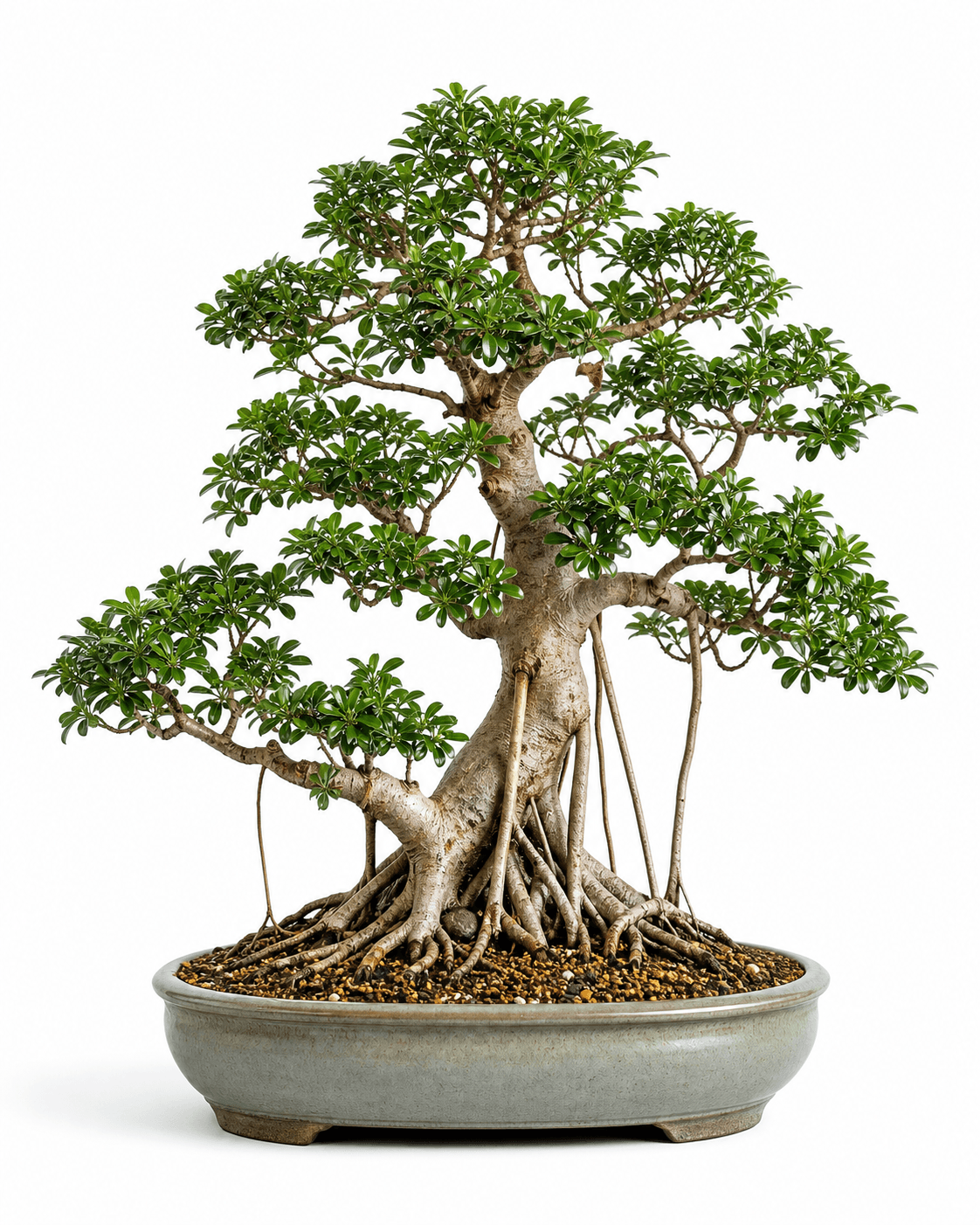
Its bonsai ceiling is distinctive and tropical. Compound leaves, whorled growth, smooth bark, and aerial roots make banyan, clump, informal upright, forest, and exposed-root designs stronger than rigid conifer silhouettes. Bonsai Mirai / AsymmetryBonsai Mirai Library
Habitat
The wild signal is warm wet-tropical shrub growth from Hainan and Taiwan.
Kew places Heptapleurum arboricola in Hainan and Taiwan and describes it as a scrambling shrub of the wet tropical biome. Kew POWO
NC State and Missouri describe a tropical evergreen shrub or small tree, with landscape height around 10-25 ft and container height commonly around 3-6 ft. Kew POWOMissouri Botanical GardenNC State Extension
The Hawaiian umbrella name is trade language. Native-range facts point back to Hainan and Taiwan, while the bonsai design language points toward tropical shrub, banyan, and aerial-root character. Kew POWOBonsai Mirai / Asymmetry
Translate that ecology into care: avoid freeze exposure, dry winter dormancy, dark desk development, and stagnant organic soil. The tree wants warmth, filtered brightness, available moisture, and oxygen in the root zone. Bonsai Mirai LibraryNC State ExtensionMissouri Botanical Garden
Reading
Read dwarf umbrella by extension, leaf size, root pressure, and aerial-root response.
A strong tree extends repeatedly, makes firm glossy leaves, responds after pruning, drains cleanly, and can become root-bound fast enough that root management becomes part of the yearly observation loop. Bonsai Mirai LibraryNC State Extension
A weak tree stretches, holds oversized leaves, stops asking for pruning, drops leaves after water swings, or sits green for months without enough surplus to build bonsai structure. Bonsai Mirai LibraryNC State ExtensionMissouri Botanical Garden
Development means roots, trunk base, whorled primary branch placement, and any aerial-root framework. Refinement means smaller leaves, short internodes, repeated cutback, and enough interior foliage to keep the branch system alive. Bonsai Mirai LibraryBonsai Mirai / Asymmetry
Root pressure is useful information. Mirai notes that controlled root-bound conditions, paired with foliage and humidity, can encourage aerial roots, while regular repotting and drier conditions suppress them. Bonsai Mirai Library
Pruning
Use pruning, petiole care, and humidity to create scale.
Mirai treats dwarf umbrella as pruning-first material. Leaves and internodes get coarser as branches extend outward, so repeated extension and cutback under good light is the work that creates usable scale. Bonsai Mirai Library
When cutting leaves, leave the petiole unless the leaf has already yellowed and separated naturally. Mirai frames the petiole as a temporary seal that reduces dieback and pathogen entry at the leaf base. Bonsai Mirai Library
Back-budding is species-specific. Mirai tropical styling says Schefflera divides and back-buds after full cutback paired with full defoliation; partial defoliation alone gives a weaker secondary growth response. Bonsai Mirai Library
Use that tool sparingly. Full defoliation belongs on very healthy material in warmth, often when old leaves are already ready to be replaced, with water, light, humidity, and feeding aligned for recovery. Bonsai Mirai Library
Aerial roots need heat and humidity. Controlled root-bound stress with foliage intact, drinking-straw microclimates under selected branches, or very regular misting can trigger roots, while open wounds should stay drier until they close. Bonsai Mirai Library
Repotting
Repot in warmth, and preserve enough roots and foliage to keep water moving.
Mirai notes that Schefflera in containers can become pot-bound rapidly, sometimes within the first year. Use rapid root fill as a prompt for inspection before scheduling work. Bonsai Mirai Library
Repot when percolation falls, old organic soil turns sour, roots circle densely, or the design requires a new angle or container. Warm active growth gives the safest recovery window. Bonsai Mirai Library
Avoid bare-rooting a leafy tropical. Mirai tropical repotting preserves part of the root mass so foliage can remain hydrated while new roots colonize the fresh soil. Bonsai Mirai Library
After repotting, tie the tree firmly, settle particles with complete watering, use bright gentle light, and wait for new extension before returning to heavy pruning or stronger feed. Bonsai Mirai Library
Soil and pot
Choose a tropical bonsai mix that holds moisture without suffocating roots.
NC State recommends a well-drained medium rich in organic matter, and Missouri recommends peaty well-drained container mix for houseplant culture. Bonsai culture sharpens that into structure: water retention with reliable air return. NC State ExtensionMissouri Botanical Garden
A practical bonsai development mix can start with akadama, pumice, lava, or comparable particles, with retention adjusted by pot size, indoor light, humidity, and how quickly the tree uses water. Bonsai Mirai Library
Avoid dense unbroken peat cores in shallow pots. Mirai tropical repotting identifies decomposed fine organic soil as a sign of oxygen-starved roots and a reason to stage the tree into aggregate soil. Bonsai Mirai Library
Pot choice should support the stage. Use deeper training pots for development, moisture stability, and aerial-root projects; use shallower or quieter glazed containers only after roots and branch structure are mature enough. Bonsai Mirai / AsymmetryBonsai Mirai Library
Climate
Adapt care by light, night temperature, humidity, and winter shelter.
In warm humid climates, dwarf umbrella can develop outside for much of the year. Protect from harsh midday UV if leaves fold, scorch, or soften under intense heat. Bonsai Mirai LibraryMissouri Botanical Garden
In temperate regions, use outdoor summer growth only after nights are consistently warm. Mirai tropical method uses roughly 60 F / 16 C as the threshold for moving tropicals into safer outdoor work and growth. Bonsai Mirai LibraryNC State Extension
In cold-winter homes, use the brightest window or grow-light setup available, protect from cold glass, maintain humidity with airflow, and water less often as metabolism slows. Bonsai Mirai LibraryMissouri Botanical Garden
A bonsai pot changes hardiness. Landscape sources list warm-zone outdoor use. A small container loses heat and moisture faster than the ground. NC State ExtensionMissouri Botanical Garden
Pests and diseases
Most problems trace back to dry indoor air, water imbalance, or soft new growth.
NC State lists red spider mites, mealybugs, and scale as serious problems. Missouri adds aphids and thrips, with spider mites especially likely in dry indoor conditions. NC State ExtensionMissouri Botanical Garden
Mirai Schefflera notes that aphids primarily target soft new growth before the cuticle hardens. Inspect flushes early, before distorted leaves mature. Bonsai Mirai Library
Leaf drop is a symptom with several possible causes. NC State and Missouri both connect it with soil that becomes too wet or too dry, so inspect moisture, drainage, light, temperature, pests, and recent moves together. NC State ExtensionMissouri Botanical Garden
Open wounds close faster in drier conditions. When using humidity to create aerial roots, keep large fresh cuts out of constantly wet air until they have stabilized. Bonsai Mirai Library
Wiring
Wire primary structure early and refine mostly by pruning.
Mirai Schefflera guidance prioritizes wiring the primary structure. Secondary and tertiary branches are reworked repeatedly, especially after cutback, so they rarely justify heavy fixed wiring. Bonsai Mirai LibraryBonsai Mirai / Asymmetry
Wire young flexible shoots while they can move, and remove wire early. Older branches are better redirected by pruning to new shoots, leader changes, approach grafts, or aerial-root design. Bonsai Mirai Library
Protect the smooth bark and inspect through the foliage. Wire scars can become the most visible evidence of rushed styling on an otherwise clean tropical trunk. Bonsai Mirai / Asymmetry
For old or brittle material, design around what the tree gives: trunk line, grouped stems, aerial roots, and pruning-generated branch direction. Bonsai Mirai / AsymmetryBonsai Mirai Library
Propagation
Stem cuttings are the practical propagation route.
Mirai calls Schefflera propagation straightforward. Stem cuttings root readily, and air-layering is usually unnecessary for making new plants. Bonsai Mirai Library
Cuttings root better from partially hardened material with cream-colored bark than from very soft green growth. Keep them moist with mist and oxygen-rich media such as perlite. Bonsai Mirai Library
Rooting hormone is optional in Mirai guidance for this species. The larger controls are warmth, humidity, clean media, and avoiding heavy hose watering that shifts perlite or saturates the cutting base. Bonsai Mirai Library
NC State also lists seed and stem cutting as propagation strategies. Seed is less useful for preserving a chosen bonsai form or compact cultivar. NC State ExtensionBonsai Mirai Library
Buying
Buy for compact foliage, visible structure, and a clean root system.
The best starter material has short internodes, compact green foliage, a visible trunk base, low branches or multiple stems, and a container that drains evenly. Bonsai Mirai / AsymmetryNC State Extension
Avoid leggy houseplants that have lived in dim light, plants with sour peat cores, sticky pest residue, hard water crust, or trunks made from several weak cuttings with no useful base. NC State ExtensionMissouri Botanical GardenBonsai Mirai Library
Variegated forms can be attractive. Compact green vigor is usually better for bonsai. Variegation often reduces visual density and can show stress faster under indoor light limits. NC State ExtensionBonsai Mirai Library
Plan placement before buying. NC State says all parts are seriously toxic to dogs and cats, so households with chewing pets need a safe location or a different species. NC State Extension
Troubleshooting
Fix light, water, warmth, pests, and timing before adding more technique.
Leaves drop: check soil moisture, drainage, recent moves, cold drafts, dry heat, light level, mites, mealybugs, and scale. Wet and dry roots can produce the same visible symptom. NC State ExtensionMissouri Botanical Garden
Leaves get larger and internodes stretch: increase filtered light gradually, avoid excess feed, let roots mature, and cut back after shoots have produced energy. Bonsai Mirai Library
No aerial roots form: increase warmth and humidity, consider controlled root-bound pressure, and use local humid microclimates under selected branches. Bonsai Mirai Library
Cutback only makes a new tip whorl: combine full cutback with the correct defoliation timing on a strong tree, then keep subsequent internodes short. Bonsai Mirai Library
Roots smell sour or water drains slowly: move toward aggregate soil, improve air return, reduce watering frequency in dim conditions, and schedule warm repotting when recovery is likely. Bonsai Mirai Library
New growth carries aphids: inspect soft flushes early, rinse or treat promptly, improve airflow, and avoid overfeeding weak indoor trees. Bonsai Mirai LibraryMissouri Botanical Garden
Design
Design around whorled tropical growth, aerial roots, and compound leaves.
Mirai describes Schefflera as stylistically flexible: single trunk, multi-trunk, banyan, forest, and twin-apex designs can all work when they match the source material. Bonsai Mirai / AsymmetryBonsai Mirai Library
Start with the base, trunk line, aerial-root plan, defining branch, and apex. Shape the canopy to support those decisions and avoid a clipped ball of compound leaves. Bonsai Mirai / Asymmetry
Leaf scale is managed through light, root maturation, short internodes, and repeated pruning. Mirai notes that the first small leaves after hard cutback can set the branch scale if later internodes remain tight. Bonsai Mirai Library
Deadwood is usually secondary. Dwarf umbrella reads best through clean tropical bark, root columns, grouped stems, and a healthy glossy canopy. Bonsai Mirai / AsymmetryNC State Extension
Forms
Small-leaf green forms are the best bonsai starting point.
Mirai identifies the small-leaf Luseane variety as easier to reduce and better for bonsai scale than standard Schefflera arboricola when both are available. Bonsai Mirai Library
NC State lists Compacta, Dazzle, Dwarf, Gold Capella, Trinette, and Variegata as cultivars or varieties. Evaluate each by vigor, internode length, leaf size, and branch placement before color. NC State Extension
Missouri describes glossy palmately compound leaves with 7-9 leaflets, orange drupes maturing darker, and rare indoor flowers. These traits keep the species visually tropical even when the tree is small. Missouri Botanical Garden
Keep labels clear. Heptapleurum actinophyllum is a different umbrella tree, and ficus advice belongs in ficus care even though both species can make aerial roots. NC State ExtensionBonsai Mirai Library
History
The species is a modern indoor-bonsai staple built from houseplant availability and tropical technique.
Kew records Heptapleurum arboricola as first published by Hayata in 1916 and currently accepted, with Schefflera arboricola retained as synonym data. Kew POWO
Missouri notes that the old Schefflera genus name honors J. C. Scheffler, while the specific epithet means tree-like. Missouri Botanical Garden
Its bonsai relevance comes from availability, warmth tolerance, aerial-root potential, cutting propagation, and the ability to reduce leaf size through patient tropical method. Bonsai Mirai LibraryNC State Extension
Public exhibition canon is thinner than for ficus, pine, maple, or juniper. EntGrove treats dwarf umbrella as a serious indoor-tolerant training species whose best examples depend on source material, light, and long pruning rhythm. Bonsai Mirai / AsymmetryBonsai Mirai Library
Species questions
Answer the beginner questions before styling.
Is dwarf umbrella tree a good beginner bonsai?
Yes. It is one of the better beginner indoor-tolerant bonsai choices because it accepts warm protected culture, roots from cuttings, and responds to pruning. It still needs bright filtered light, careful watering, humidity support, and protection from cold drafts.
Is the correct name Schefflera arboricola or Heptapleurum arboricola?
Heptapleurum arboricola is the accepted botanical name used here. Schefflera arboricola remains the familiar synonym on bonsai and houseplant labels.
Can dwarf umbrella bonsai live indoors all year?
Yes, if indoor care provides enough light, warmth, humidity, airflow, and water discipline. It develops faster outdoors in warm weather after acclimation, then returns to protected frost-free care before cold nights.
How much light does dwarf umbrella bonsai need?
Use bright filtered light. NC State and Missouri recommend filtered east, west, or south exposure for about 3-4 hours daily indoors. Outdoor summer light should be introduced gradually.
How often should I water dwarf umbrella bonsai?
Let the root zone set the interval. Water thoroughly when the upper particles are drying and the interior still carries slight moisture, then let drainage and oxygen return.
Why is my dwarf umbrella bonsai dropping leaves?
Common causes include roots that are too wet, roots that are too dry, cold drafts, low light, dry heated air, pests, or a recent move. Inspect moisture and placement before fertilizing or pruning.
Can I make aerial roots on dwarf umbrella bonsai?
Yes. Aerial roots need heat, humidity, foliage, and often controlled root-bound pressure. Local humid microclimates under branches can help. Keep fresh wounds drier until they close.
Can I wire a dwarf umbrella bonsai?
Wire young flexible shoots only when direction matters. Build most structure through pruning, leader changes, and regrowth because older branches can be brittle and scars are conspicuous.
When should I repot dwarf umbrella bonsai?
Repot in reliable warmth when roots, percolation, soil condition, or design justify it. Inspect annually because the species can become pot-bound quickly. Weak indoor trees need recovery before fixed-calendar root work.
How do I propagate dwarf umbrella tree bonsai?
Use stem cuttings from partially hardened growth. Keep them warm, humid, and in oxygen-rich media such as perlite. Mirai guidance treats rooting hormone as optional for Schefflera cuttings.
Sources
Species advice needs source discipline.
Next decisions
Plan the operation before copying the calendar.
A good care note for Dwarf umbrella tree / Hawaiian umbrella records the tree's stage, the work done, and the aftercare used. That record matters more than a month-name rule.
Related species
Compare nearby trees before transferring advice.
Ficus retusa / Indian laurel
Ficus microcarpa
Tigerbark ficus
Ficus microcarpa 'Tigerbark'
Willow-leaf ficus
Ficus salicaria
Benjamin fig
Ficus benjamina
Ginseng ficus
Ficus microcarpa 'Ginseng'