
Species guide
European Beech Bonsai Care
Fagus sylvatica
European beech bonsai care starts with treating Fagus sylvatica as a cool-temperate outdoor deciduous tree. Give it winter dormancy, strong spring light, summer heat moderation, even moisture, and a root system that drains fast enough to stay oxygenated.
The local Mirai corpus gives direct European beech forest, deciduous post-flush pruning, whitefly, wiring, repotting, watering, and design support. The practical method is specific: protect the smooth bark, preserve roots during timing-sensitive work, prune after leaves harden or at leaf drop, and design from woodland beech character with soft deciduous movement.
The main failure points are warm indoor culture, hot dry wind, stale nursery soil, overwatering after root work, spring bleeding on some trees, permanent tool or wire scars, whitefly pressure, beech bark disease, and beech leaf disease in affected North American regions.
Updated June 17, 2026. Written by EntGrove Editorial. Last verified June 17, 2026.
Care fingerprint
Read the species through its shared care pattern.
Repot and structural prune around dormant-to-active transitions; protect new leaves; time refinement work after growth hardens. Use this as the starting point before local conditions and tree strength refine the calendar.
Note: Copper, purple, weeping, fern-leaved, and variegated beech labels are usually Fagus sylvatica forms or cultivars; verify grafts and leaf scale before treating them as bonsai upgrades.
Read the foliage first
Broadleaf stress usually shows in leaf color, leaf size, wilt, scorch, or delayed hardening before it becomes a branch problem.
Match work to dormancy
Deciduous, evergreen, tropical, succulent, and flowering broadleaf trees recover on different calendars.
Protect fine roots
Root work should preserve enough active fine roots for the tree to rehydrate quickly after the operation.
Care cadence
The calendar starts with the tree's seasonal state.
Placement
Timing: Grow outdoors with seasonal temperature change, air movement, rain, and winter dormancy. Use a mulch bed, cold frame, or unheated shelter when shallow containers face hard freezes or drying winter wind.
Watch for: Warm indoor storage, frozen exposed roots, dry winter wind, and assuming landscape Zone 4 hardiness fully protects roots in a bonsai pot.
NC State ExtensionOregon State Landscape PlantsRHSBonsai Mirai LibraryLight and heat
Timing: Use strong spring and autumn light, then add afternoon shade or wind moderation during hot dry weather, after repotting, or when leaf edges show the roots cannot refill the canopy fast enough.
Watch for: Scorched margins, limp leaves in dry wind, long internodes in heavy shade, and upper leaves shading lower branches.
NC State ExtensionEuropean Atlas of Forest Tree SpeciesBonsai Mirai LibraryWatering
Timing: Water when the surface begins to dry while the interior still holds moisture. Thorough watering should be followed by oxygen return, especially in old nursery cores and akadama-heavy refinement soils.
Watch for: Hydrophobic old soil, sour wet cores, dry summer edges, chlorosis, and a pot that stays wet because roots have stopped pulling water.
European Atlas of Forest Tree SpeciesBonsai Mirai LibraryNC State ExtensionFertilizer
Timing: Feed by stage during active growth. Development trees can take stronger organic feeding to rebuild roots and branches; refined trees need enough nutrition to recover from cutback without forcing coarse internodes.
Watch for: Coarse extension, late soft growth before frost, weak pale foliage, and fertilizing before a newly repotted tree has restored root function.
Bonsai Mirai LibraryPruning and leaf work
Timing: Use fall leaf-drop pruning on healthy refined trees, spring pre-flush pruning when fall was missed, and post-flush cutback or leaf-size reduction only after leaves harden.
Watch for: Constant soft pinching, cuts below viable buds, weak second flush, top-heavy extension, and sudden sun exposure after canopy thinning.
Bonsai Mirai LibraryWiring
Timing: Wire healthy young branches when the tree can recover, then inspect early. Use aluminum, padding, guy wires, pruning, and directional shoot selection for larger or smooth-barked branches.
Watch for: Permanent wire scars, fast spring thickening, brittle older wood, rubbed bark, and wiring immediately after heavy root work.
Bonsai Mirai LibraryBonsai Mirai / AsymmetryRepotting
Timing: Repot at visible spring bud swell or just before bud break. Correct compacted edges and bottoms first, preserve useful root sheen, and avoid stacking severe top work in the same recovery window.
Watch for: Slow drainage, sour roots, dry pockets, circling nursery roots, reduced extension, and a tree that leafs out weakly after overaggressive work.
Bonsai Mirai LibraryPest and disease checks
Timing: Inspect tender growth, leaf undersides, shaded interiors, smooth bark, old wounds, and trees weakened by drought, root work, crowded foliage, or poor airflow.
Watch for: Whitefly, aphids, scale, mildew, caterpillars, root rot, wire wounds, cankers, beech bark disease, and beech leaf disease in affected regions.
Bonsai Mirai LibraryNC State Extension beech bark diseaseCornell IPM beech leaf diseaseRHSSpecies guide
Apply the species profile before copying another tree's calendar.
At a glance
European beech is a cool-temperate outdoor Fagus with smooth bark, large leaves, and forest-scale grace.
Botanical target: Fagus sylvatica L., family Fagaceae. Common labels include European beech, common beech, copper beech, purple beech, fern-leaved beech, weeping beech, tricolor beech, and variegated beech forms. Kew POWORHSMorton Arboretum beech collection
Care summary: Broadleaf > Deciduous, outdoor dormancy, full sun to partial shade, summer heat moderation, evenly moist but oxygenated roots, spring bud-swell root work, post-harden or fall leaf-drop pruning, and careful bark-protective wiring. Bonsai Mirai LibraryNC State ExtensionRHS
Plant features: a large deciduous forest tree with smooth grey bark, alternate simple leaves, spring flowers, autumn beechnuts, strong winter buds, copper autumn color on many trees, and a canopy that suits medium, large, forest, clump, broom, and naturalistic upright bonsai. NC State ExtensionOregon State Landscape PlantsEuropean Atlas of Forest Tree Species
Wild habitat
Its European forest ecology explains the shade tolerance, moisture need, and restrained design language.
Kew places Fagus sylvatica across much of Europe and into the Caucasus and Iran. Oregon State summarizes the origin as Europe, and the European Atlas treats it as one of the defining European forest trees. Kew POWOOregon State Landscape PlantsEuropean Atlas of Forest Tree Species
The European Atlas describes common beech as adapted to a humid atmosphere and sensitive to intense summer drought. In a bonsai pot, that translates to even moisture, wind moderation, summer shade when heat rises, and soil that re-wets evenly while keeping oxygen in the root zone. European Atlas of Forest Tree SpeciesBonsai Mirai Library
Design implication: draw from woodland canopies, smooth pale bark, old broad trunks, gentle branch movement, leaf-mass silhouettes, and winter architecture. Mirai beech forest work favors soft canopy rhythm and believable group relationships with limited conifer-style compression. Bonsai Mirai LibraryBonsai Mirai / AsymmetryEuropean Atlas of Forest Tree Species
Reading the tree
Read European beech through root supply, flush strength, bark condition, and leaf scale.
A strong European beech pushes one clean spring flush, hardens leaves, sets visible buds, and keeps lower branches alive after the top is managed. A stressed tree shows scorched leaf edges, weak lower buds, sparse second growth, a sour root smell, or a canopy that wilts before the soil appears fully dry. Bonsai Mirai Library
Mirai post-flush deciduous guidance treats beech as a tree that usually gives one flush and, in strong conditions, may produce a second. That rhythm makes premature soft pinching expensive: wait for the first flush to harden before detailed cutback or leaf-size reduction. Bonsai Mirai Library
The bark is part of the design asset. Smooth grey beech bark records tool marks, wire bite, trunk scrubbing, and tie-down pressure for years. Read bark condition before styling, and use pruning, guying, padding, or young-shoot wiring when direct wire would mark the image. Bonsai Mirai LibraryNC State ExtensionEuropean Atlas of Forest Tree Species
Pruning
Prune European beech after leaves harden or at leaf drop, then use leaf work sparingly.
Use growth state as the trigger. For refinement, fall leaf-drop pruning gives a clear view of buds and structure. If that window is missed, spring pre-flush pruning is the fallback, and post-flush cutback becomes available only after leaves harden and the tree has rebuilt energy. Bonsai Mirai Library
Mirai beech post-flush work reduces large leaves by folding and cutting the leaf at an angle, preserving petiole function and reducing the shade cast by the top. Use that tool on vigorous trees with a clear purpose: interior light, leaf scale, or balancing stronger regions. Bonsai Mirai Library
Avoid repeated soft-tip pinching as the main refinement strategy. Beech has fewer reliable flushes than an elm or trident maple, so the tree needs enough leaf area to feed buds, roots, and wound response before the next operation. Bonsai Mirai Library
Watch sun exposure after canopy opening. Mirai deciduous post-flush guidance warns that thin-barked broadleaf trees can sun-scald when shaded branches are suddenly exposed. Open the canopy in stages, especially on older smooth bark or trees moving into hotter benches. Bonsai Mirai Library
Repotting
Repot at spring bud swell and preserve the live root system that drives the canopy.
Use visible spring bud movement or the moment just before bud break as the default repotting window. Mirai beech forest work shows beech can tolerate substantial root reduction when the tree is vigorous and timing is aligned, but that strength should not become a habit of annual disturbance. Bonsai Mirai Library
Start with soil function. Correct compacted nursery edges, circling roots, dry pockets, and sour bottoms before chasing perfect fine-root combing under the trunk. On older deciduous bonsai, preserving a working root sheen near the base can matter more than making every root look clean in one session. Bonsai Mirai Library
Aftercare should be quiet: tie the tree firmly, protect from dry wind, water by soil response, and wait for leaves to harden before heavy pruning or structural wiring. A tree that was rootbound in organic nursery soil may need staged transitions across multiple repots. Bonsai Mirai Library
Repot interval should be inspection based. Young developing trees may need checks every 2 to 3 years, while refined older trees can wait longer when water enters evenly, oxygen returns, extension is predictable, and the tree has no sour core or root-crowding symptoms. Bonsai Mirai Library
Soil and pot
Use a moisture-retentive aggregate soil and a pot that supports woodland beech character.
European beech wants moisture and oxygen together. Oregon State describes the landscape tree as best in deep, rich, moist, well-drained soil, and NC State lists moist and well-drained conditions among its tolerances. In bonsai, translate that to aggregate soil that holds water between particles and then drains cleanly. Oregon State Landscape PlantsNC State ExtensionBonsai Mirai Library
A practical development mix can be akadama, pumice, and lava when the tree is being transitioned from nursery soil. A refined beech in dependable hands can move toward high akadama or 100 percent akadama, matching Mirai deciduous refinement practice, because akadama gives water retention, root ramification, and predictable repot cues. Bonsai Mirai Library
Pot choice should reinforce age and quiet breadth. Unglazed or softly glazed ovals, rectangles with softened corners, shallow forest slabs, and muted earth colors work better for European beech than highly ornate containers. Avoid very shallow pots until the root system and summer-water response are proven. Bonsai Mirai / AsymmetryEuropean Atlas of Forest Tree Species
Climate adaptation
Cold-hardy wood still needs container-root protection, and hot summers need shade strategy.
In cold regions, keep the tree dormant and protect the pot before exposed roots face deep freeze, thaw cycles, or drying wind. NC State lists USDA Zones 4a to 7b and Oregon State lists Zone 4, but those ratings describe landscape roots in the ground. NC State ExtensionOregon State Landscape PlantsBonsai Mirai Library
In hot summer regions, use morning sun, afternoon shade, wind moderation, and enough soil volume to keep the root ball from cycling between hard dry and saturated. The European Atlas drought-sensitivity note matters more in a shallow container than it does in woodland ground. European Atlas of Forest Tree SpeciesBonsai Mirai Library
In mild-winter regions, preserve a real rest period. European beech can survive protected cold, but it still needs seasonal dormancy. Heated indoor winter storage creates weak spring growth and breaks the timing assumptions behind pruning, repotting, and energy balancing. Bonsai Mirai LibraryRHS
In wet or humid regions, airflow matters. Dense beech foliage can shade interiors, slow drying, and support whitefly, aphids, mildew, or fungal pressure. Thin in stages during strong periods. Bonsai Mirai LibraryRHS
In alkaline-water regions, investigate chlorosis through roots and water before adding fertilizer. NC State notes sensitivity to compaction, and Mirai watering and soil method makes root oxygen the first diagnostic when yellow foliage follows poor drainage. NC State ExtensionBonsai Mirai Library
Pests and diseases
Separate ordinary bonsai pests from beech bark disease and beech leaf disease.
Mirai whitefly material specifically names Fagus sylvatica as a susceptible host and places establishment pressure around early summer in many cases. Inspect undersides of leaves, shaded interiors, nearby reservoir plants, and soft overfed shoots before the population builds. Bonsai Mirai Library
NC State Extension describes beech bark disease as a disease complex involving beech scale and Neonectria fungi. Bonsai prevention is practical: avoid bark wounds, inspect smooth trunks and branch bases, isolate suspect material, and confirm regional disease risk before collecting or buying beech. NC State Extension beech bark diseaseBonsai Mirai Library
Cornell IPM describes beech leaf disease as a serious disease associated with a nematode and notes that European beech is among susceptible beech hosts. In affected regions, watch for dark interveinal banding, thickened or distorted leaves, reduced buds, canopy thinning, and decline that cannot be explained by watering alone. Cornell IPM beech leaf disease
RHS lists additional problems for Fagus sylvatica, including aphids, woolly beech aphid, scale insects, honey fungus, Phytophthora root rot, and powdery mildews. A bonsai tree with clean roots, airflow, and correctly timed pruning resists many secondary issues better than a stale, shaded, overfed tree. RHSBonsai Mirai Library
Wiring
Wire European beech only where smooth bark, wood age, and recovery strength allow it.
Mirai structural wiring guidance favors aluminum on deciduous material and species-appropriate movement. For European beech, that means soft, subtle, low-angularity bends that preserve broadleaf character and avoid the sharp compression associated with many conifers. Bonsai Mirai LibraryBonsai Mirai / Asymmetry
Use wire when the branch is young, healthy, and still flexible. Pad contact points on valuable bark, avoid crossing old scars, remove wire early during thickening periods, and shift older limbs with guy wires or staged pruning when direct wrapping would mark the trunk. Bonsai Mirai Library
Wire after the tree has enough root strength to heal and hold the change. Skip major wiring immediately after heavy root work, and keep tips oriented so water movement continues through the branch. Detail refinement should increasingly come from cutback, bud selection, and replacement shoots. Bonsai Mirai LibraryBonsai Mirai / Asymmetry
Propagation
Seed, cuttings, layers, and grafts are possible, but bonsai growers usually buy or collect for structure.
RHS lists propagation from seed and grafting for Fagus sylvatica, and horticultural collections show many named forms. For bonsai, seed is useful for forests and matched batches, but it takes years to build bark, trunk base, and branch hierarchy. RHSMorton Arboretum beech collection
Mirai propagation and grafting method gives the practical bonsai rule: layers and grafts work best while the tree is vigorous, before small-pot refinement reduces energy. Use them to improve roots, add a missing branch, or create a new tree from a useful cultivar or trunk section. Bonsai Mirai Library
Air-layer decisions should be rooted in design. A layer can rescue a good trunk above poor roots, but the new root ring has to support a species that dislikes severe summer drought. Separate only when roots are radial, firm, and timed for recovery. Bonsai Mirai LibraryEuropean Atlas of Forest Tree Species
Sourcing
Buy European beech for confirmed identity, roots, bark, low buds, and believable scale.
Confirm Fagus sylvatica before applying this page. Common beech, European beech, copper beech, purple beech, fern-leaved beech, weeping beech, and tricolor beech can all appear in nursery trade, while Japanese beech and American beech belong on separate species pages. Kew POWORHSMorton Arboretum beech collection
Inspect the base before the cultivar label. Good bonsai candidates have a visible root flare, smooth bark without deep scars, a trunk line that already reads as deciduous, low branch options, live interior buds, and a root core that can be transitioned without losing all strength. Bonsai Mirai LibraryBonsai Mirai / Asymmetry
Forest and group material can come from seedlings, young nursery liners, or field-grown batches. Mirai beech forest work emphasizes believable spacing, trunk relationship, and soft canopy rhythm, so matching vigor and scale often outrank rare cultivar value. Bonsai Mirai Library
Walk away from material with severe wire scars, a graft bulge that defines the base, a compacted wet field core, no usable low growth, or a trunk that only works if old limbs are forced into one-session bends. Smooth bark and slow healing make early defects expensive. Bonsai Mirai LibraryNC State Extension
Troubleshooting
Diagnose European beech by symptom, cause, and season.
Scorched leaf edges usually mean water demand exceeded root supply: hot wind, shallow soil volume, dry pockets, weak new roots, or too much sun after leaf work. Move to gentler light, water thoroughly, and correct soil structure at the next safe root window. European Atlas of Forest Tree SpeciesBonsai Mirai Library
Weak lower branches usually mean upper growth is taking too much energy or shade has closed the interior. Reduce strong top regions after hardening or at leaf drop, preserve weak lower buds, and open the canopy gradually to avoid bark scorch. Bonsai Mirai Library
Yellow leaves can come from alkaline water, soil compaction, stale wet roots, nutrient imbalance, or pests. Check drainage, root smell, water quality, undersides of leaves, and recent repot history before adding fertilizer. NC State ExtensionBonsai Mirai LibraryRHS
Twig dieback after pruning usually points to cuts made past viable buds, work done when the tree lacked energy, or spring bleeding on a sensitive individual. Cut to living buds, time structural pruning carefully, and leave enough foliage for recovery. Bonsai Mirai Library
Whitefly, aphid, or scale pressure often appears first on shaded interiors or soft overfed growth. Clean physically where practical, treat reservoir plants nearby, restore airflow, and adjust feeding and light so pest control becomes one part of the intervention. Bonsai Mirai LibraryRHS
Dark interveinal leaf bands, distorted foliage, reduced buds, or unexplained canopy thinning in affected regions deserves beech leaf disease investigation. Bark cankers, scale on the trunk, and Neonectria symptoms point toward the separate beech bark disease complex. Cornell IPM beech leaf diseaseNC State Extension beech bark disease
Design
Let smooth bark, broad canopy, and woodland origin shape the composition.
Start with base, trunk line, defining branch, and apex. Mirai design fundamentals use those anchors to decide whether the tree should read as calm, dynamic, aged, or forest-grown; European beech usually rewards quiet breadth and winter-readable branch hierarchy. Bonsai Mirai / AsymmetryBonsai Mirai Library
Beech movement should feel broadleaf and old. Use gentle bends, branch replacement, cutback to side shoots, and canopy layering. Let the tree show smooth bark, subtle taper, strong winter buds, branch relationships, and open deciduous layers. Bonsai Mirai LibraryEuropean Atlas of Forest Tree Species
Forests are especially strong for European beech. Mirai beech forest creation emphasizes trunk relationships, root work, and a soft undulating canopy. Vary trunk thickness and spacing, keep the canopy coherent, and make the group feel like one woodland moment with varied relationships. Bonsai Mirai Library
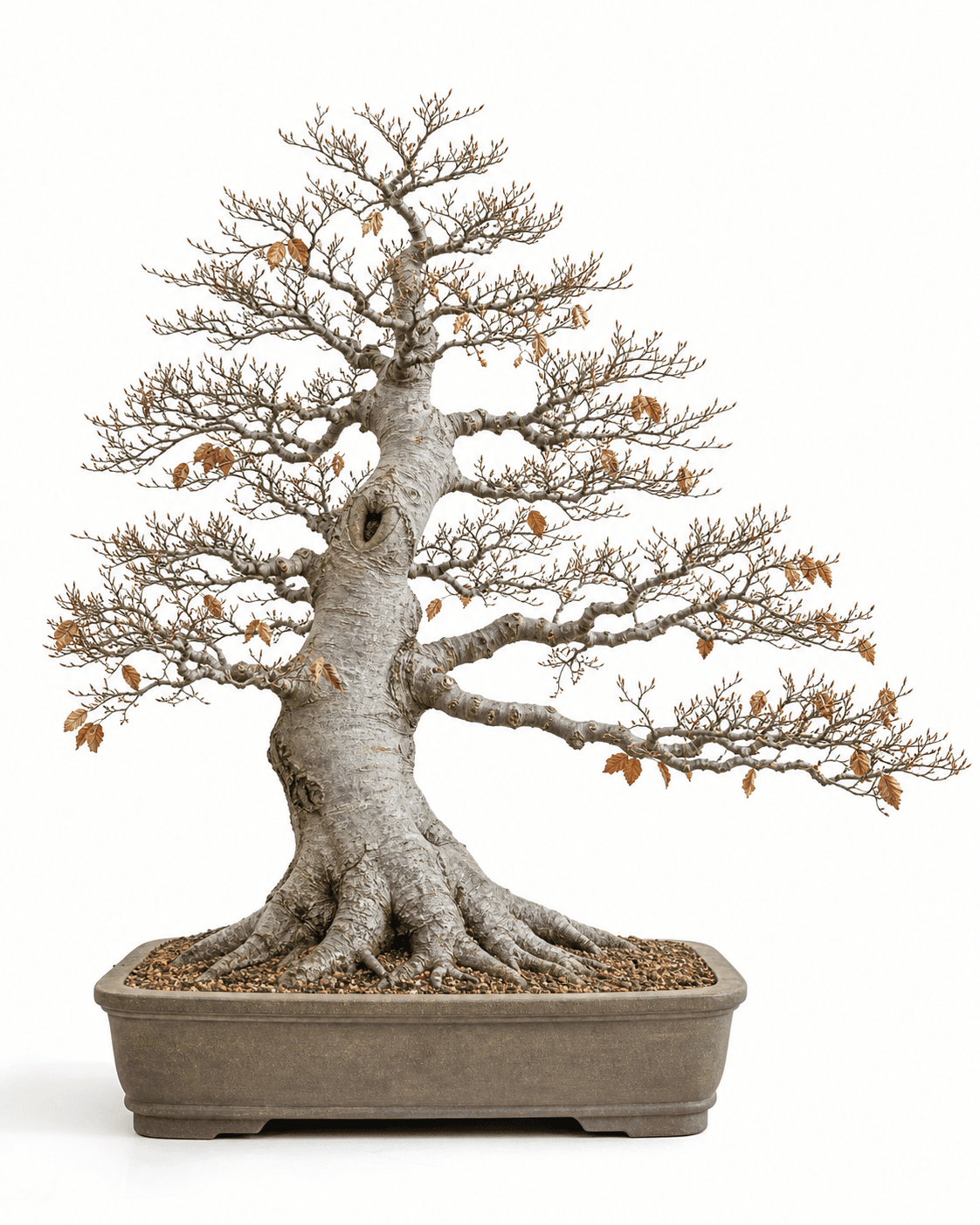
Deadwood should stay restrained. Beech can show scars, hollows, and old cuts, but large jin and shari rarely match its ecology. Age is more convincing through bark, roots, taper, branch hierarchy, leaf mass, autumn color, and winter silhouette. Bonsai Mirai / AsymmetryEuropean Atlas of Forest Tree Species
Forms
Cultivar labels affect sourcing, color, and silhouette more than the core care calendar.
Morton Arboretum highlights European beech cultivar groups such as purple-leaved, fern-leaved, weeping, and variegated beeches. RHS also maintains cultivar entries under Fagus sylvatica, which helps decode nursery labels. Morton Arboretum beech collectionRHS
Copper and purple forms can add seasonal color, fern-leaved forms can refine texture, and weeping forms can suggest unusual silhouettes. Judge each one by graft visibility, root base, branch placement, vigor, and whether the form still supports a believable bonsai design. Morton Arboretum beech collectionBonsai Mirai / Asymmetry
Treat cultivar names as design clues. Confirm the species first, then decide from the individual plant: leaf size, internode length, bark quality, graft location, trunk movement, nebari, and recovery strength. Kew POWOBonsai Mirai Library
History
European beech brings European woodland and estate-tree associations into bonsai.
Kew records Fagus sylvatica as the accepted Linnaean name, and RHS treats common beech or European beech as a standard garden tree with a Europe-to-Iran range. That long horticultural presence explains its association with woodland, hedging, estates, parks, and large-scale landscape plantings. Kew POWORHSEuropean Atlas of Forest Tree Species
Oregon State notes that trees may not flower until 30 to 80 years in landscape settings, which fits the bonsai reality: the most persuasive European beech bonsai are usually sold by roots, bark, trunk, branch age, and seasonal silhouette, with fruit display as a secondary bonus. Oregon State Landscape PlantsBonsai Mirai / Asymmetry
Exhibition-quality European beech should read across the year: credible roots, clean smooth bark, controlled scars, a coherent winter branch structure, leaves scaled to the tree size, autumn color where the cultivar allows it, and a canopy that still feels like beech after leaf fall. Bonsai Mirai LibraryBonsai Mirai / AsymmetryEuropean Atlas of Forest Tree Species
Species questions
Answer the beginner questions before styling.
Is European beech a good beginner bonsai?
Yes, for an outdoor grower who wants slow deciduous refinement, medium or larger scale, and careful seasonal timing. It needs more patience than many beginner tropical or fast-growing deciduous trees.
Can European beech bonsai live indoors?
Keep European beech outdoors. It needs seasonal light, air movement, winter dormancy, and root protection during severe container freezes.
What is the correct scientific name for European beech bonsai?
EntGrove uses Fagus sylvatica L., accepted by Kew. Common beech and European beech are common-name labels for this species.
Which European beech nursery labels matter for bonsai?
Common beech, copper beech, purple beech, weeping beech, fern-leaved beech, tricolor beech, and variegated beech may appear on labels. Confirm Fagus sylvatica first, then judge the individual trunk, roots, bark, graft, and branch placement.
How is European beech different from hornbeam?
European beech is Fagus sylvatica in Fagaceae, while hornbeams are Carpinus species in Betulaceae. Both are outdoor deciduous bonsai, yet beech has different buds, smoother bark, larger leaf-mass design, and its own disease concerns.
How much sun does European beech bonsai need?
Use bright outdoor light, with partial shade or afternoon protection in hot dry weather. The tree tolerates shade, but refined bonsai still need enough light to harden buds and keep interior growth alive.
How often should I water European beech bonsai?
Water when the surface begins to dry while the interior still holds moisture. The root zone should stay evenly moist and well aerated, never hard dry or stale wet.
When should I prune European beech bonsai?
Use fall leaf-drop pruning on healthy refined trees, spring pre-flush pruning when fall was missed, and post-flush cutback only after leaves harden.
When should I repot European beech bonsai?
Repot at spring bud swell or just before bud break when roots, drainage, or soil age justify the work. Older refined trees can wait longer when drainage, oxygen return, and extension remain strong.
Should I defoliate European beech bonsai?
Use selective leaf reduction only on vigorous trees after the first flush hardens. Reduce oversized leaves to improve light and scale while preserving enough foliage for root, bud, and wound recovery.
What soil is best for European beech bonsai?
Use aggregate soil that holds moisture and drains freely. Development trees can use akadama, pumice, and lava; refined trees may use akadama-heavy soil when watering skill and repot timing are dependable.
What are the main European beech disease risks?
Watch ordinary bonsai pests such as whitefly, aphids, scale, mildew, and root problems. In affected regions, also distinguish beech bark disease from beech leaf disease because their symptoms and regional implications differ.
Sources
Species advice needs source discipline.
Next decisions
Plan the operation before copying the calendar.
A good care note for European beech records the tree's stage, the work done, and the aftercare used. That record matters more than a month-name rule.
Related species
Compare nearby trees before transferring advice.
Japanese maple
Acer palmatum
Trident maple
Acer buergerianum
Amur maple
Acer tataricum subsp. ginnala
Field maple
Acer campestre
Korean hornbeam
Carpinus turczaninovii