
Species guide
European Hornbeam Bonsai Care
Carpinus betulus
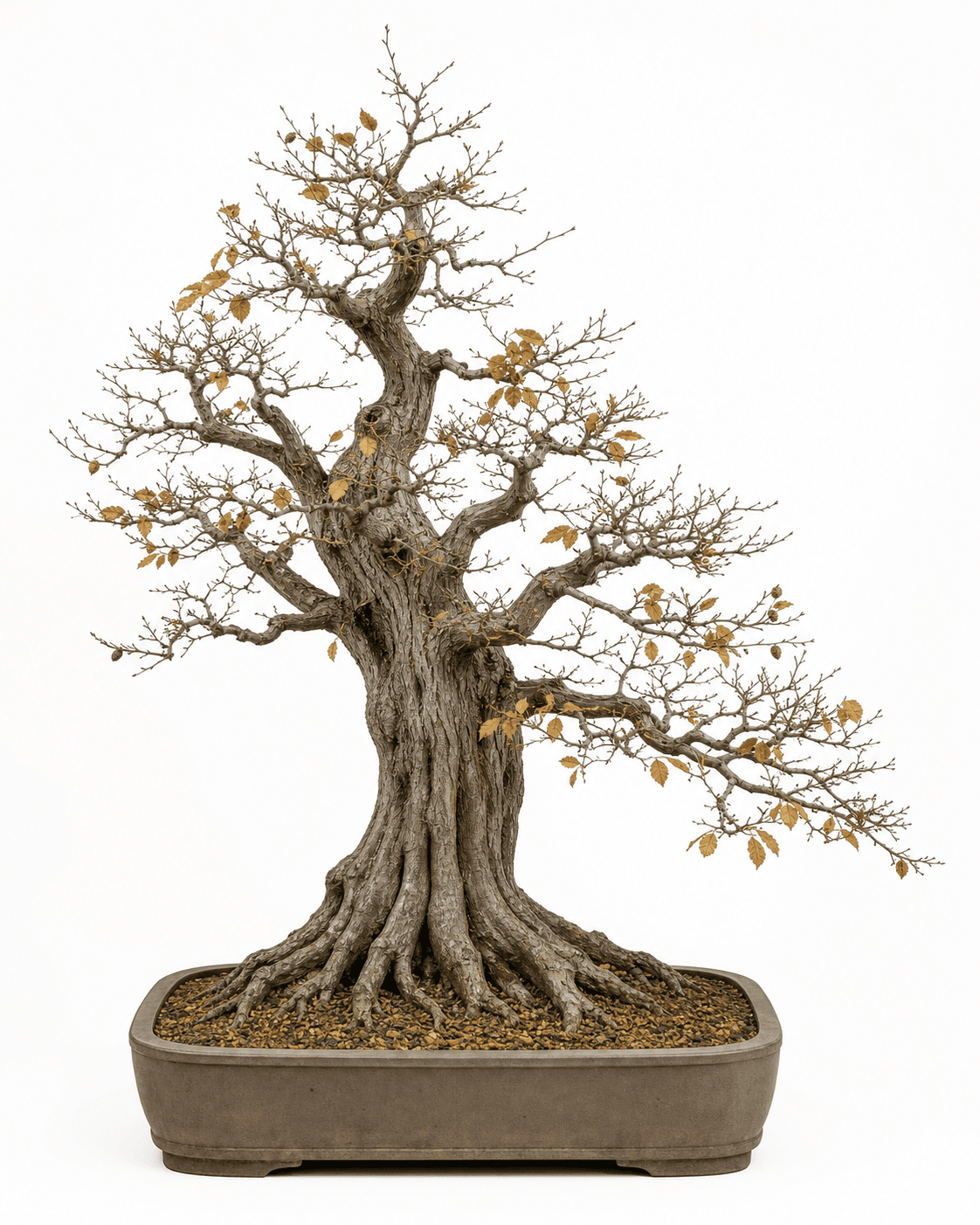
European hornbeam is an outdoor deciduous bonsai for growers who can keep roots evenly moist, preserve winter dormancy, and build ramification by seasonal cutback. It is forgiving as hedge or nursery material, but its larger leaves and smooth bark make medium, large, broom, forest, and old hedge-derived designs more convincing than tiny shohin work.
Use the accepted botanical name Carpinus betulus. Kew accepts Carpinus betulus L. in Betulaceae, and RHS lists common hornbeam, European hornbeam, horn beech, white beech, and yoke elm among the common-name labels attached to the same species.
The Mirai-first method transfers from Carpinus, hornbeam, and low-to-moderate water mobility deciduous files: preserve the root sheen, repot at spring bud movement, prune by fall leaf drop or post-flush hardening, monitor wire early, and let the tree express angular broadleaf character rather than conifer-style pads.
Updated June 17, 2026. Written by EntGrove Editorial. Last verified June 17, 2026.
Care fingerprint
Read the species through its shared care pattern.
Repot and structural prune around dormant-to-active transitions; protect new leaves; time refinement work after growth hardens. Use this as the starting point before local conditions and tree strength refine the calendar.
Read the foliage first
Broadleaf stress usually shows in leaf color, leaf size, wilt, scorch, or delayed hardening before it becomes a branch problem.
Match work to dormancy
Deciduous, evergreen, tropical, succulent, and flowering broadleaf trees recover on different calendars.
Protect fine roots
Root work should preserve enough active fine roots for the tree to rehydrate quickly after the operation.
Care cadence
The calendar starts with the tree's seasonal state.
Placement
Timing: Grow outdoors through the full deciduous cycle. Use a mulch bed, cold frame, unheated shelter, or protected bench when refined pots face hard freezes, drying wind, or sudden cold before dormancy completes.
Watch for: Warm indoor storage, exposed frozen roots, dry winter wind, and assuming landscape Zone 4 to 8 hardiness fully protects roots in a shallow bonsai container.
NC State ExtensionRHSBonsai Mirai LibraryLight requirement
Timing: Use strong spring and autumn light when water supply is steady. Shift to afternoon shade during hot, dry weather, after root work, or when the pot dries faster than the roots can safely refill the canopy.
Watch for: Long internodes in heavy shade, leaf-edge scorch during heat, dense upper growth shading lower branches, and using forest shade tolerance as an excuse for weak bench light.
NC State ExtensionOregon State Landscape PlantsEuropean Atlas of Forest Tree SpeciesBonsai Mirai LibraryWatering
Timing: Water when the surface begins to dry while the interior still holds moisture. Thorough watering should be followed by oxygen return, especially in older nursery or sheen-based root cores.
Watch for: Dry leaf edges, hydrophobic old soil, sour wet cores, chlorosis in alkaline conditions, and a pot that stays wet because roots have stopped pulling water.
European Atlas of Forest Tree SpeciesNC State ExtensionBonsai Mirai LibraryFertilizer
Timing: Feed by stage. Development trees can take stronger organic feeding to build trunk, roots, and primary branches; refined trees should receive enough food to recover from cutback without pushing coarse unchecked extension.
Watch for: Coarse internodes from excess spring nitrogen, pale foliage from root or pH trouble, late soft growth before frost, and fertilizing before a newly repotted tree has rebuilt roots.
Bonsai Mirai LibraryPruning
Timing: Use fall leaf-drop pruning on healthy refined trees. Use spring pre-flush pruning if fall was missed, or post-flush pruning after leaves harden when the tree is energy positive.
Watch for: Cuts below viable nodes, constant soft-tip pinching, hard reductions on weak lower branches, excessive top strength, and large cuts made when roots are already compromised.
Bonsai Mirai LibraryPartial defoliation
Timing: After the first flush hardens on a vigorous tree, reduce oversized leaves by roughly two-thirds and keep petioles intact. Use this to manage scale, not as a routine stress on weak material.
Watch for: Whole-leaf plucking, weak second flush, tiny immature basal leaves with no viable buds, late-season leaf work, and using defoliation to compensate for poor light or coarse structure.
Bonsai Mirai LibraryRepotting
Timing: Repot at visible spring bud swell, or from winter solstice onward only when reliable aftercare protection is available. Preserve the root sheen under the trunk and correct compacted sides and bottoms first.
Watch for: Slow drainage, sour roots, dry pockets, circling nursery roots, declining extension, and stacking major root work with heavy pruning or major wiring on a refined tree.
Bonsai Mirai LibraryWiring
Timing: Wire healthy branches when seasonal flexibility and tree strength align. Early fall is useful for structural setting, while spring or post-hardened work can handle selected secondary placement.
Watch for: Wire getting tight, smooth-bark scars, brittle older wood, downward-held branch tips, and wiring immediately after major root work.
Bonsai Mirai LibraryBonsai Mirai / AsymmetryPropagation and grafting
Timing: Sow seed, take softwood cuttings, layer, or graft while the tree is vigorous in development. Use grafts and layers to solve roots or missing branches before small-pot refinement slows callus.
Watch for: Layers attempted on weak old material, grafts without immobilization, cuttings from tired stock, and separating layers before radial roots harden.
RHSNC State ExtensionBonsai Mirai LibraryPest and disease checks
Timing: Inspect tender spring growth, shaded interiors, old wire sites, wounds, and trees recovering from drought, root work, cold wet weather, or heavy pruning.
Watch for: Aphids, caterpillars, powdery mildew, coral spot, honey fungus, leaf spots, bark stripping, chlorosis, stale-root symptoms, and pests on soft overfed growth.
RHSNC State ExtensionBonsai Mirai LibrarySpecies guide
Apply the species profile before copying another tree's calendar.
At a glance
European hornbeam is a hardy outdoor Carpinus with larger-leaf scale and strong hedge-stock potential.
Botanical target: Carpinus betulus L., family Betulaceae. Common labels include European hornbeam, common hornbeam, horn beech, horse beech, white beech, yoke elm, charmille, and upright hornbeam. Kew POWORHSMorton Arboretum
Care summary: Broadleaf > Deciduous, outdoor dormancy, full sun to partial shade, evenly moist but oxygenated roots, spring bud-swell root work, fall leaf-drop or post-flush pruning, bark-sensitive wiring, and container-root protection in hard freezes. Bonsai Mirai LibraryNC State ExtensionRHS
Plant features: a 40 to 60 foot landscape tree with alternate doubly serrate leaves, spring catkins, small nutlets with three-lobed bracts, yellow autumn color, dense twigging, and smooth to fluted grey bark. In bonsai, those traits point to medium and larger deciduous designs with strong winter silhouette. NC State ExtensionOregon State Landscape PlantsMorton Arboretum
Wild habitat
Its European forest ecology explains the shade tolerance, moisture need, and fluted-bark design.
Kew and RHS place Carpinus betulus across Europe into Iran. Oregon State summarizes the native range as Europe, Asia Minor, and southeast England, and NC State gives the origin as Europe to Iran. Kew POWORHSOregon State Landscape PlantsNC State Extension
The European Atlas describes common hornbeam as a strongly shade-tolerant forest tree that favors fairly abundant moisture and deep well-drained soils, while tolerating a wider soil range. It also notes winter leaf retention and smooth steel-grey bark with a muscled character. European Atlas of Forest Tree Species
Care implication: keep the bonsai container moist without suffocating the roots, and use shade as heat management rather than permanent low-light culture. Design implication: draw from woodland trunks, old hedges, fluted bark, yellow autumn leaves, winter marcescence, and angular branch redirections. Bonsai Mirai LibraryBonsai Mirai / AsymmetryEuropean Atlas of Forest Tree Species
Reading the tree
Read European hornbeam through root supply, bud strength, and leaf scale.
A strong tree pushes evenly, hardens leaves cleanly, sets visible buds, and keeps lower branches active after upper growth is reduced. A weak tree shows scorched edges, shrinking extension, sparse lower buds, sour soil smell, or only a few strong areas pushing while the rest stalls. Bonsai Mirai Library
Mirai Carpinus guidance treats hornbeam as angular and irregular. Let the tree tell you where the future structure already exists: fluted base, natural bends, a defining branch, active interior buds, and side branches that can create direction through pruning. Bonsai Mirai LibraryBonsai Mirai / Asymmetry
Leaf scale is the main design constraint. Public sources document leaves around 5 to 13 cm or 2 to 5 inches, so European hornbeam usually reads best as a medium, large, forest, broom, informal upright, or old hedge-derived bonsai. Korean hornbeam remains the better comparison when very small leaf scale is the main goal. Oregon State Landscape PlantsMorton ArboretumBonsai Mirai Library
Pruning
Use fall leaf-drop pruning, post-flush cutback, and selective leaf reduction.
For refined deciduous trees, Mirai gives fall leaf-drop pruning the highest value because stored resources are redistributing across remaining buds. That timing helps reduce strong upper growth and send the following spring response toward weaker lower and interior buds. Bonsai Mirai Library
If the fall window was missed, spring pre-flush work is the fallback for low-water-mobility hornbeam. After spring growth hardens, cut back to viable nodes and useful direction. Avoid cuts below a node because hornbeam and similar deciduous species can die back to the parent branch. Bonsai Mirai Library
Use partial defoliation only on vigorous material after the first flush hardens. Mirai Carpinus guidance reduces larger hornbeam leaves to about one-third their size to stimulate a finer second response, while preserving petioles and avoiding whole-leaf plucking. Bonsai Mirai Library
Development pruning is simpler: choose the branches that already have believable diameter, direction, and placement, then allow enough extension to build strength. Mirai deciduous structural guidance warns that a bonsai pot slows thickening dramatically, so finish primary girth before asking for fine refinement. Bonsai Mirai Library
Repotting
Preserve the root sheen and repot at bud movement before decline is visible.
Mirai hornbeam and low-water-mobility deciduous guidance preserves the deep root mass under the trunk. Treat European hornbeam like a root-sheen tree unless a specific tree proves otherwise; do not flatten it into a plate-root maple approach during the first transition. Bonsai Mirai Library
Repot at visible spring bud swell, or earlier from the winter solstice onward only when protected aftercare is available. Clean the compacted sides and bottom, preserve the functional core, tie the tree securely, and keep the first recovery weeks evenly moist and wind protected. Bonsai Mirai Library
Refined deciduous trees commonly move on a 3 to 4 year inspection rhythm, but the correct signal is drainage and vigor. Repot when water stops entering and exiting evenly, the old core stays sour, or extension declines. Leave a healthy older tree longer when drainage and growth remain strong. Bonsai Mirai Library
Separate root recovery from dramatic styling on refined trees. Mirai deciduous guidance reserves combined heavy root and top work for exceptionally vigorous material; weak or refined hornbeam should rebuild roots first, then take structural work in a later window. Bonsai Mirai Library
Soil and pot
Use retentive aggregate soil and a pot deep enough to support the root column.
European hornbeam tolerates a wide soil range in the ground. NC State lists clay, loam, sand, acid, neutral, alkaline, good drainage, moist, occasionally dry, and occasionally wet conditions; Oregon State still says it prefers well-drained soil. A bonsai pot narrows that tolerance to moisture plus oxygen. NC State ExtensionOregon State Landscape Plants
A practical development mix is akadama-forward with pumice and lava for structure, often around 2:1:1 when water retention and oxygen both matter. Refined hornbeam can move toward higher akadama when watering discipline is strong and the goal is finer root and twig behavior. Bonsai Mirai Library
Pot depth should match the tree stage. Mirai sheen-based guidance warns that most hornbeams and elms need enough depth for the root column to function; very shallow trays can create a two-to-three-year decline pattern in vigor and ramification. Use shallow pots only after the roots and design can support them. Bonsai Mirai Library
Pot pairing works best when it reinforces the species character: quiet oval or rectangle for broom and informal upright, deeper forest tray for groups, and unglazed browns, greys, or muted earth tones that support yellow fall color and grey bark. Bonsai Mirai / AsymmetryMorton Arboretum
Climate adaptation
Hardy wood does not remove container-root risk.
In cold regions, protect the pot before deep freezes and drying wind threaten the exposed root system. NC State lists USDA Zones 4a to 8b, Oregon State lists Zone 4, Morton lists Zones 4 to 8, and RHS rates the species H7, but those landscape ratings assume roots in the ground. NC State ExtensionOregon State Landscape PlantsMorton ArboretumRHS
In warm summer regions, use morning sun, afternoon shade, wind moderation, and larger soil volume before leaf edges scorch. The European Atlas moisture note matters in a pot: a shade-tolerant tree can still fail when the root ball dries hard during hot wind. European Atlas of Forest Tree SpeciesBonsai Mirai Library
In mild-winter regions, keep dormancy real. The tree needs cool seasonal cues even where the container never freezes. Heated indoor storage through winter creates weak spring growth and disrupts the deciduous timing that pruning, repotting, and energy balance depend on. Bonsai Mirai LibraryRHS
Pests and diseases
Most pest pressure follows weak light, crowded interiors, or stale roots.
RHS lists caterpillars, aphids, powdery mildews, coral spot, and sometimes honey fungus as possible problems. NC State reports no serious insect or disease problems in landscape use, while noting fungal leaf spots and bark stripping by gray squirrels. RHSNC State Extension
Bonsai prevention starts with airflow, clean pruning, a healthy root zone, and correct seasonal timing. Aphids and caterpillars often show first on soft new growth, mildew follows dense or shaded foliage, and coral spot or fungal pressure is more likely after weak, wet, poorly sealed cuts. Bonsai Mirai LibraryRHS
Chlorosis deserves root and water investigation before fertilizer escalation. European hornbeam can tolerate alkaline landscape sites, yet a bonsai in old compacted soil or high-pH water can show yellowing because roots cannot access nutrients even when fertilizer is present. NC State ExtensionMorton ArboretumBonsai Mirai Library
Wiring
Wire structural branches with intent, then let pruning make the fine silhouette.
Mirai Carpinus files describe hornbeam as brittle but workable when movement is decisive and supported. Use wire to set primary and secondary structure, then create tertiary ramification with cutback, directional buds, and side-branch transitions. Bonsai Mirai LibraryBonsai Mirai / Asymmetry
Early fall is a strong structural window because deciduous branches are still flexible before the vascular thickening phase. Inspect wire quickly during that period; Mirai fall-work guidance treats wire getting tight as the removal signal, especially on smooth-bark deciduous material. Bonsai Mirai Library
Guy wires are useful for older straight branches that need gradual repositioning. Keep branch tips high enough to maintain water movement, avoid repeated bending on brittle wood, and skip major wiring during the same season as heavy root correction unless the tree is exceptionally vigorous. Bonsai Mirai LibraryBonsai Mirai / Asymmetry
Propagation
Seed, cuttings, layers, and grafts all need vigor and a root-quality goal.
RHS lists seed, softwood cuttings, and grafting. NC State also lists seed, stem cuttings, and grafting, while warning that seed and cuttings have been reported as difficult and grafting may be the best option for named forms. RHSNC State Extension
For bonsai, propagation should solve a design problem: better roots, a missing low branch, a clone of a desirable form, or a forest batch with matching leaf scale. Mirai root-grafting and air-layer guidance favors doing this work while the tree is vigorous in a grow box or development container. Bonsai Mirai LibraryBonsai Mirai / Asymmetry
Air layers on hornbeam-type material need patience because root quality matters more than speed. Keep the layer vigorous, wait for radial roots to harden, and separate with enough season left for recovery. Grafts should be immobilized and allowed at least a full growing season before heavy reliance. Bonsai Mirai Library
Sourcing
Buy for confirmed identity, roots, bark, and scale.
European hornbeam is common in landscape use, hedging, screens, and urban plantings, which makes nursery and hedge material realistic sources. Morton describes use in groupings, screens, hedges, and windbreaks, while NC State notes heavy pruning tolerance for hedge use. Morton ArboretumNC State Extension
Inspect the base before the cultivar label. Good bonsai material has a credible nebari, fluted trunk interest, useful low branches, active interior buds, manageable leaf scale, and a root core that can be transitioned without losing the sheen. Walk away from sour roots, severe wire scars, awkward graft unions, or a columnar trunk with no lower branch options. Bonsai Mirai LibraryMorton Arboretum
Collected hedge material can carry old bark, taper, and scar history, but it also carries root risk. Reduce the canopy and root mass in stages, leave enough foliage to rebuild strength, and design from the old trunk character instead of forcing young nursery movement onto mature wood. Bonsai Mirai LibraryBonsai Mirai / Asymmetry
Troubleshooting
Diagnose European hornbeam by symptom, cause, and timing.
Scorched leaf edges usually mean water demand exceeded root supply: hot wind, a shallow pot, dry pockets, compacted old soil, or a canopy larger than the roots can support. Move to gentler light, water thoroughly, and fix root-zone structure at the next safe window. European Atlas of Forest Tree SpeciesBonsai Mirai Library
Weak lower branches usually mean the top is taking too much energy or branch tips have been held downward. Reduce dominant upper growth at fall leaf drop or after hardening, preserve weak lower buds, and wire broadleaf branches up and out so their tips regain strength. Bonsai Mirai LibraryBonsai Mirai / Asymmetry
Persistent yellowing can come from alkaline water, stale roots, chronic saturation, nutrient imbalance, or pest pressure. Check drainage, root smell, water quality, and leaf undersides before increasing fertilizer. NC State ExtensionMorton ArboretumBonsai Mirai Library
Twig dieback after pruning usually means cuts were made past viable nodes, after leaf drop, or on weak tissue. Cut to living nodes, protect meaningful wounds, and time structural reductions for fall leaf drop, spring pre-flush, or post-flush recovery windows. Bonsai Mirai Library
Wire scars mean the check interval was too long. Remove tight wire before bark pressure appears, rewire with a better gauge or guy wire if movement is still needed, and let pruning hide minor marks over time rather than carving them into conifer-style deadwood. Bonsai Mirai LibraryBonsai Mirai / Asymmetry
Design
Let fluted bark, angular Carpinus branching, and old hedge history shape the design.
Start with base, trunk line, defining branch, and apex. Mirai design fundamentals use those anchors to set harmony, tension, or dynamic movement; European hornbeam usually benefits from a natural deciduous image with visible branch hierarchy and winter-readable structure. Bonsai Mirai / AsymmetryBonsai Mirai Library
Carpinus character is angular and irregular. Build direction by cutting to side branches, preserving useful old primary branches, and allowing the canopy to become layered and three-dimensional instead of a flat rounded outline. Bonsai Mirai Library
Deadwood should stay restrained. Mirai broadleaf guidance treats deciduous deadwood as temporary compared with conifer deadwood. European hornbeam can show age through fluting, old pruning scars, hollowed wounds, bark texture, winter buds, and branch hierarchy without large jin or shari. Bonsai Mirai LibraryMorton ArboretumEuropean Atlas of Forest Tree Species
Forms
Most named forms affect sourcing and silhouette more than the care calendar.
NC State lists forms and cultivars including Asplenifolia, Columnaris, Columnar Nana, Fastigiata, Fran's Fontaine, Globosa, Horizontalis, Incisa, Pendula, Purpurea, Pyramidalis, and Vienna Weeping. Morton highlights Emerald Avenue, Frans Fontaine, and Fastigiata. NC State ExtensionMorton Arboretum
Columnar and fastigiate forms can help formal upright, forest, or narrow old-hedge designs, but they can also lack low usable branches. Weeping and dwarf forms may offer silhouette novelty while complicating branch selection, graft inspection, and root transition. Bonsai Mirai LibraryNC State Extension
Treat cultivar labels as design clues rather than care calendars. Confirm the species, then judge the individual tree: leaf size, internode length, trunk flare, graft location, bark character, and whether the branch structure can become a believable deciduous bonsai. Kew POWOBonsai Mirai / Asymmetry
History
European hornbeam carries hedge, woodland, and old European garden associations into bonsai.
Kew records Carpinus betulus as the accepted Linnaean species name, and RHS treats common hornbeam as native to Britain and Ireland with a range from Europe to Iran. That long horticultural presence is why hedge, avenue, and pleached-hornbeam associations are so strong. Kew POWORHS
Morton describes European hornbeam as useful around large buildings and as screens, hedges, and windbreak trees. In bonsai, that translates well to forest plantings, clipped old hedge trunks, broom forms, and quiet broadleaf compositions rather than dramatic conifer movement. Morton ArboretumBonsai Mirai / Asymmetry
Exhibition-quality European hornbeam should read through seasonal change: clean roots, a fluted or muscled trunk, yellow autumn leaves, retained winter leaves where present, fine twigging, controlled scars, and a silhouette that remains convincing after leaf fall. European Atlas of Forest Tree SpeciesMorton ArboretumBonsai Mirai Library
Species questions
Answer the beginner questions before styling.
Is European hornbeam a good beginner bonsai?
Yes, for an outdoor grower who can water consistently, protect the pot in winter, and accept medium or larger scale. Indoor growers should choose a tropical species instead.
Can European hornbeam bonsai live indoors?
Keep European hornbeam outdoors. It needs air movement, seasonal light, winter dormancy, and container-root protection during hard freezes.
What is the correct scientific name for European hornbeam?
EntGrove uses Carpinus betulus L., the accepted name in Kew. Common hornbeam, European hornbeam, horn beech, white beech, and yoke elm are common-name labels.
How is European hornbeam different from Korean hornbeam?
European hornbeam is easier to source as hedge or landscape material in many Western regions and usually has larger leaves. Korean hornbeam is favored for smaller refined bonsai because its leaf scale and fine twigging are easier to miniaturize.
How much sun does European hornbeam bonsai need?
Use strong spring light, then partial afternoon shade during hot dry periods. The species tolerates shade in forests, but bonsai ramification still needs enough light to harden shoots and keep interior buds alive.
How often should I water European hornbeam bonsai?
Water when the surface begins to dry while the interior still holds moisture. The goal is an evenly moist root ball with oxygen returning after each watering.
When should I prune European hornbeam bonsai?
Use fall leaf-drop pruning for refined trees when possible. Spring pre-flush work is the fallback, and post-flush cutback is useful after leaves harden.
When should I repot European hornbeam bonsai?
Repot at spring bud swell, preserving the root sheen under the trunk. Developing trees may need earlier core correction; older refined trees can wait longer when drainage and vigor remain strong.
Should I defoliate European hornbeam?
Use selective partial defoliation only on vigorous trees after the first flush hardens. Reduce oversized leaves by roughly two-thirds and preserve petioles; weak trees should recover with full foliage.
What soil mix is best for European hornbeam bonsai?
Use a moisture-retentive aggregate mix with good oxygen. An akadama-forward mix with pumice and lava works for development, and higher akadama can be used in refinement when watering is dependable.
Why are my European hornbeam leaves turning yellow?
Check drainage, old compacted soil, water pH, root smell, and pests before adding fertilizer. Yellowing can come from chlorosis, stale roots, chronic saturation, nutrient imbalance, or weak light.
Sources
Species advice needs source discipline.
Next decisions
Plan the operation before copying the calendar.
A good care note for European hornbeam records the tree's stage, the work done, and the aftercare used. That record matters more than a month-name rule.
Related species
Compare nearby trees before transferring advice.
Japanese maple
Acer palmatum
Trident maple
Acer buergerianum
Amur maple
Acer tataricum subsp. ginnala
Field maple
Acer campestre
Korean hornbeam
Carpinus turczaninovii