
Species guide
Japanese Hornbeam Bonsai Care
Carpinus japonica
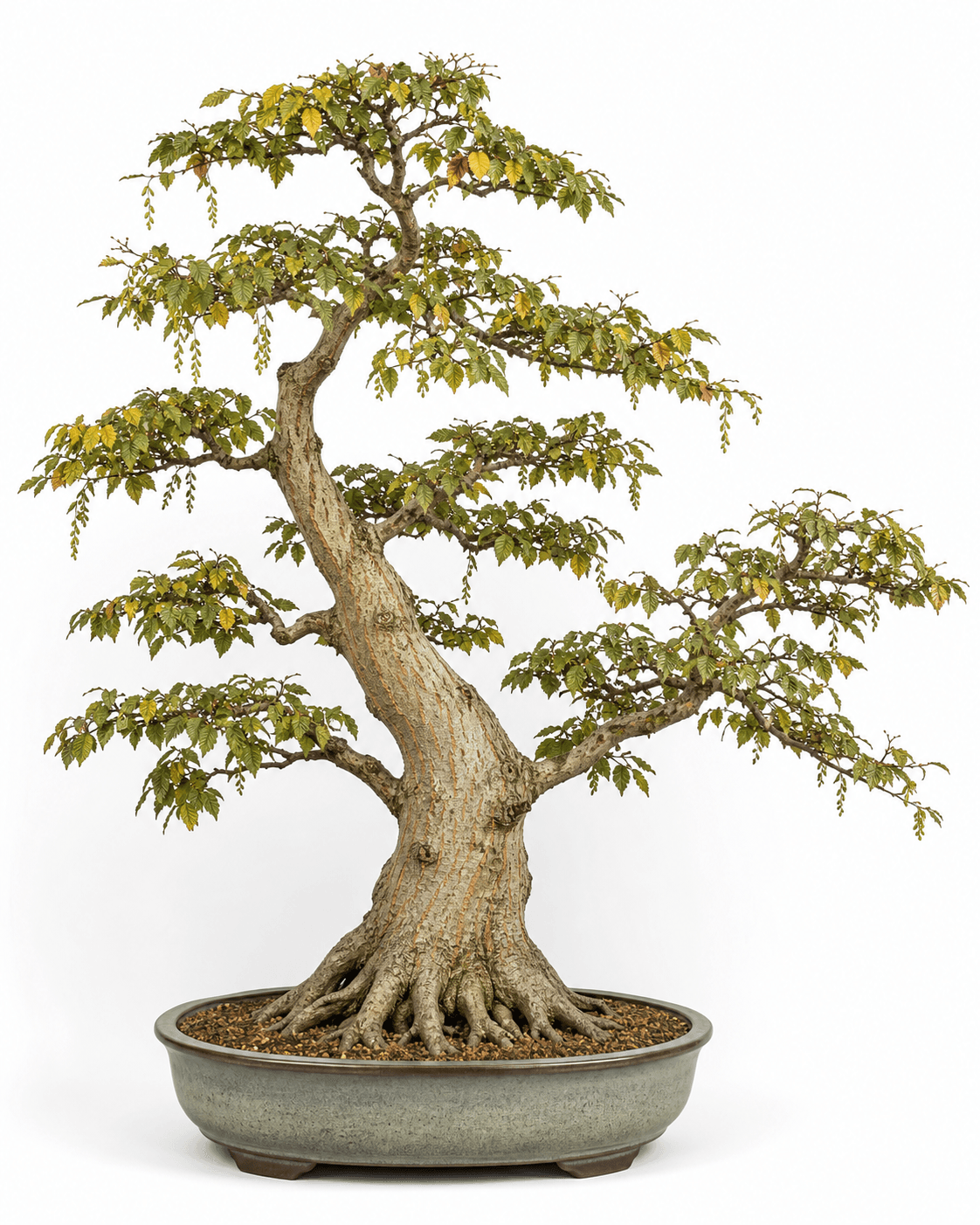
Japanese hornbeam bonsai is an outdoor deciduous tree for growers who can provide spring sun, summer heat moderation, even moisture, and a cold dormant season. Its strongest bonsai traits are quilted leaves, hanging catkins, winter twigging, pale bark with age, and an angular hornbeam branch habit.
Use Carpinus japonica Blume as the working name. Kew accepts that name in Betulaceae and gives the native range as central and southern Japan; older tags can read Carpinus distegocarpus, Distegocarpus carpinus, or Carpinus carpinoides.
The bonsai method here is Mirai-first and transferred from direct Carpinus, hornbeam, and deciduous corpus files, with Eisei-en used for Japanese hornbeam-specific seasonal detail. The main risks are dry-summer stress, sour old soil, fall pruning that pushes tender growth, over-aggressive defoliation, and wire scars on visible bark.
Updated June 17, 2026. Written by EntGrove Editorial. Last verified June 17, 2026.
Care fingerprint
Read the species through its shared care pattern.
Repot and structural prune around dormant-to-active transitions; protect new leaves; time refinement work after growth hardens. Use this as the starting point before local conditions and tree strength refine the calendar.
Read the foliage first
Broadleaf stress usually shows in leaf color, leaf size, wilt, scorch, or delayed hardening before it becomes a branch problem.
Match work to dormancy
Deciduous, evergreen, tropical, succulent, and flowering broadleaf trees recover on different calendars.
Protect fine roots
Root work should preserve enough active fine roots for the tree to rehydrate quickly after the operation.
Care cadence
The calendar starts with the tree's seasonal state.
Placement
Timing: Grow outdoors year-round with a cold dormancy period. Use spring sun, summer heat moderation, fall exposure for sugar loading, and winter root protection when the pot can freeze hard or dry in wind.
Watch for: Weak indoor extension, leaf scorch from hot dry benches, frozen shallow pots, and refined twigging exposed below about 25 F without ground contact or shelter.
Eisei-enNC State ExtensionBonsai Mirai LibraryLight requirement
Timing: Give full sun while spring growth is extending, then shift to partial shade or 30 to 40 percent shade cloth during sustained summer heat.
Watch for: Long internodes from excessive shade, crisp margins in dry heat, and strong exterior leaves shading interior buds.
Eisei-enNC State ExtensionWatering
Timing: Water when the surface begins to dry and continue until water exits the drainage holes. During active growth, check daily and expect twice-daily checks in hot, windy, shallow-pot, or high-leaf-mass conditions.
Watch for: Dry leaf edges, hydrophobic old soil, stale wet cores, evening oxygen loss from chronic saturation, and misting foliage in sun.
Eisei-enBonsai Mirai LibraryFertilizer
Timing: Feed to match the training stage. Develop trunks and primary branches with stronger spring and summer feeding; delay and lighten fertilizer on refined trees until the first flush hardens.
Watch for: Oversized first leaves, coarse internodes, weak recovery after repeated cutback, and soft late growth caused by feeding too deep into fall.
Eisei-enBonsai Mirai LibraryPruning
Timing: Let spring shoots extend and harden, then cut back to 2 or 3 leaves or buds. Eisei-en describes 6 to 8 leaves by May in the Northern Hemisphere, followed by another 6 to 8 week extension before repeat cutback.
Watch for: Cutting soft leaves, over-pruning weak lower branches, coarse apical extension, and removing terminal buds too late for the tree to reload before dormancy.
Eisei-enBonsai Mirai LibraryLeaf work
Timing: Use leaf cutting on the strong exterior canopy when needed for light penetration. For large-leaf Carpinus in development, Mirai supports reducing leaves to about one-third size to trigger a finer response; Eisei-en warns against full defoliation on Japanese hornbeam.
Watch for: Whole-leaf removal, damaged petioles, unbalanced second flushes, twig dieback, and sudden sun exposure on formerly shaded interior leaves.
Bonsai Mirai LibraryEisei-enWiring
Timing: Wire after leaf drop, in late fall while branches are flexible, or after spring leaves harden. Use one decisive structural placement on brittle branches, then remove or adjust wire before active thickening scars the bark.
Watch for: Wire getting tight, hairline splits, old branches forced against their natural curves, heavy winter bends, and wiring in the same season as a major root reduction.
Bonsai Mirai LibraryEisei-enRepotting
Timing: Repot in early spring at visible bud swell. Use a moisture-retentive aggregate mix, preserve fine functional roots, and avoid stacking aggressive root work with heavy structural canopy work unless the tree is very vigorous.
Watch for: Slow drainage, decomposed akadama, dry pockets, sour organic cores, weak post-repot extension, and loss of the fine root sheen under older material.
Bonsai Mirai LibraryEisei-enFall refinement
Timing: After natural leaf abscission begins, use the short fall window to balance strong upper growth, preserve weak lower branches, clean dead stubs, and direct next spring growth through bud selection.
Watch for: Forcing leaves off before they detach cleanly, heavy work after full dormancy, cuts inside the compartmentalization shoulder, and missing winter protection after late-dormancy pruning.
Bonsai Mirai LibraryBonsai Mirai / AsymmetryPest and disease checks
Timing: Inspect new spring growth, shaded interiors, wire sites, and trees stressed by dry roots or poor airflow.
Watch for: Aphids, scale, caterpillars, powdery mildew, leaf spot, cankers, twig blight, coral spot, honey fungus, chlorosis, and root rot.
NC State ExtensionRHSEisei-enSpecies guide
Apply the species profile before copying another tree's calendar.
At a glance
Japanese hornbeam rewards patient outdoor deciduous care.
Japanese hornbeam is Carpinus japonica Blume, a deciduous Betulaceae tree from central and southern Japan. It is best grown as an outdoor bonsai with spring sun, summer heat moderation, steady water, spring bud-swell root work, and winter protection for the container. Kew POWONC State ExtensionEisei-en
Plan for medium and larger bonsai, moderate growth, visible seasonal rhythm, and careful scar control. NC State describes a slow-growing understory tree with 2 to 4.5 inch quilted leaves, ornamental catkins, gray-brown shallow-furrowed bark, and yellow fall color; Oregon State gives similar 5 to 11 cm leaves with 20 to 24 deeply impressed vein pairs. NC State ExtensionOregon State Landscape Plants
The practical care spec is straightforward: full spring sun, partial summer shade, slightly moist but oxygenated roots, akadama-forward soil, repotting at bud swell, harden-and-cutback pruning, restrained leaf cutting instead of full defoliation, short wire-retention windows, and a protected dormant winter. Bonsai Mirai LibraryEisei-en
Wild habitat
Its Japanese understory origin explains the shade, water, and design choices.
Kew gives the native range as central and southern Japan and places Japanese hornbeam in the temperate biome. NC State describes a slow-growing deciduous understory tree that tolerates heavy shade in the landscape, while Oregon State notes sun-to-shade exposure and best growth in moist, well-drained soil. Kew POWONC State ExtensionOregon State Landscape Plants
For care, that habitat points to a cool-root broadleaf that appreciates water without stagnation. The container version needs more watering attention than the landscape tree because leaf mass, shallow pot volume, sun, wind, and humidity change the water/oxygen balance by the hour. Bonsai Mirai LibraryEisei-en
For design, the wild reading is quiet and deciduous: layered branch structure, a rounded crown, bark and catkins as seasonal signals, and up-and-out broadleaf movement. Mirai hornbeam claims emphasize irregular, angular Carpinus branching and warn against forcing hornbeam into uniform conifer pad structure. Bonsai Mirai LibraryBonsai Mirai / Asymmetry
Reading the tree
Separate development strength from refinement restraint.
Japanese hornbeam progress depends on the tree stage. In development, preserve leaf mass long enough to thicken primaries, heal wounds, build roots, and load vascular tissue. In refinement, prune after the first flush hardens so energy shifts into shorter internodes and finer bifurcation. Bonsai Mirai LibraryBonsai Mirai / Asymmetry
Read vigor from extension, leaf firmness, bud size, and interior bud activity. Mirai post-flush pruning guidance uses darkened, firm leaves and slowing elongation as hardening-off signals; Korean hornbeam progression files also treat plump terminal buds after fall as evidence that storage and recovery are returning. Bonsai Mirai LibraryBonsai Mirai / Asymmetry
Japanese hornbeam is less naturally small-scaled than Korean hornbeam. Mirai specifically notes that Japanese and American hornbeams share hornbeam character with larger, harder-to-reduce foliage, so plan the design size and pruning rhythm around what the tree can carry with dignity. Bonsai Mirai LibraryNC State Extension
Pruning
Use harden-and-cutback pruning, with conservative leaf cutting.
Let spring shoots extend and harden before pruning. Eisei-en describes a May timing in the Northern Hemisphere after shoots reach 6 to 8 leaves, then cutting each shoot back to 2 or 3 leaves. Mirai post-flush deciduous pruning uses the same energy logic: work after the first flush becomes firm, dark, and energy-positive. Eisei-enBonsai Mirai Library
Repeat cutback only after the next flush has extended and hardened. Eisei-en gives a 6 to 8 week repeat interval and stops by late summer; Mirai warns that late-season canopy reduction without time to rebuild sugar and starch can weaken the following spring push. Eisei-enBonsai Mirai Library
For leaf work, use restraint. Eisei-en recommends leaf cutting in May on the external canopy to admit light to weaker interior areas and cautions against defoliation or partial defoliation on Japanese hornbeam. Broader Mirai Carpinus guidance allows leaf reduction on larger-leaved hornbeams in development, cutting leaves down to about one-third size while preserving petioles. Eisei-enBonsai Mirai Library
Strong tops need firmer control than weak lower branches. Mirai fall refinement guidance says to reduce dominant upper growth and leave weak lower branches with more length and buds so they can rebuild. That is especially relevant on hornbeam because weakened lower branches can decline after heavy root or canopy work. Bonsai Mirai LibraryBonsai Mirai / Asymmetry
Repotting
Repot at bud swell and protect the fine root sheen.
The safest repotting window is early spring at bud swell. Mirai beginner repotting places deciduous root work in spring as buds swell before active growth, and Eisei-en identifies the same early-spring window for Japanese hornbeam and beech, usually March in the Northern Hemisphere. Bonsai Mirai LibraryEisei-en
Work to restore water entry, oxygen, and reliable drainage without over-cleaning old, functioning tissue. Mirai hornbeam repotting files treat hornbeam, elm, and ginkgo as lower-to-moderate water-mobility deciduous trees where fine root sheen should be respected; the root system below old material can be part of the tree health, not just debris. Bonsai Mirai LibraryBonsai Mirai / Asymmetry
Eisei-en says healthy Japanese hornbeam and beech can tolerate original-soil removal and up to 50 percent root reduction. Apply that only to vigorous trees with strong aftercare: shade, wind moderation, consistent moisture, and no major structural styling in the same recovery window. Eisei-enBonsai Mirai Library
Repot for need as well as calendar. Water that sits on the surface, decomposed akadama, hydrophobic pockets, weak extension after watering, and a dense sour core all justify repotting. A refined, well-draining tree can wait longer than a young tree in collapsing soil. Bonsai Mirai LibraryEisei-en
Soil and pot
Use a retentive aggregate soil and enough pot depth for deciduous function.
Japanese hornbeam wants moisture retention and oxygen together. Eisei-en gives akadama, lava, and pumice at 2:1:1 as a more water-retentive mix for Japanese hornbeam and beech, with about 3/16 inch, or 4 mm, particles for medium and large trees and slightly smaller particles for shohin. Eisei-en
Mirai soil method explains why the mix works: akadama holds nutrients and water, pumice stores and releases moisture, and lava preserves oxygen movement. For refined deciduous work, Mirai also uses solid akadama where fine ramification and nutrient exchange matter more than rapid drying. Bonsai Mirai Library
Pot choice should respect the slower, broadleaf image. Medium-depth glazed or understated containers work well for refined trees, especially when the tree carries fall color, catkins, and pale bark. Very shallow pots can hold more perched water and reduce gravity-driven drainage, so they need careful climate and soil matching. Bonsai Mirai LibraryBonsai Mirai / Asymmetry
Climate
Adjust the bench by heat, winter exposure, and pot volume.
In cool maritime climates, Japanese hornbeam can take more sun and a slower dry-down. In hot inland climates, use spring sun for strength and smaller leaves, then add afternoon shade, shade cloth, or a cooler bench before the tree spends water only to cool foliage. Eisei-enBonsai Mirai Library
In cold regions, protect the container roots before deep hard freezes and especially after late pruning or late-dormancy work. Mirai leaf-drop pruning guidance treats about 25 F as a practical threshold for refined deciduous containers, with pots moved to ground contact or shelter as temperatures drop. Bonsai Mirai LibraryRHS
In mild-winter regions, keep dormancy real. The tree still needs seasonal cooling and shorter days, even if the pot never freezes. Warm protected storage through winter should be a temporary freeze strategy, not a substitute for outdoor deciduous culture. Kew POWOBonsai Mirai Library
Pests and diseases
Most pest pressure follows weak light, stale soil, or poor airflow.
NC State reports no serious pest or disease issues in landscape use, while still listing caterpillars, aphids, powdery mildew, leaf spots, cankers, and twig blight. RHS adds susceptibility to caterpillars, aphids, powdery mildews, coral spot, and honey fungus. NC State ExtensionRHS
Eisei-en lists aphids and scale among Japanese hornbeam and beech pests, with canker, blight, and leaf spot as common disease concerns. In bonsai, those problems usually intensify when the canopy is too dense, the root core stays sour, or summer shade is paired with poor airflow. Eisei-enBonsai Mirai Library
Treat symptoms and culture together. Aphids on soft spring growth may need washing or a targeted control, but repeated outbreaks point to over-soft growth and excess nitrogen. Leaf spots and mildew need foliage dryness, spacing, and airflow as much as product intervention. NC State ExtensionEisei-en
Wiring
Wire for structure, then let clip-and-grow do the fine work.
Mirai deciduous wiring guidance says structural wire should solve the branch backbone and stop before naturally shaped sections. Hornbeam is brittle, so use a gauge that gives control in one planned movement, bend along existing curves, and rely on clip-and-grow for most tertiary refinement. Bonsai Mirai LibraryBonsai Mirai / Asymmetry
Eisei-en prefers winter after leaf fall or late spring after leaves harden, and expects wire removal within 1 to 2 months. Mirai fall-work claims add that early fall can be a strong structural wiring window because deciduous branches are flexible before the fall vascular thickening phase. Eisei-enBonsai Mirai Library
Protect the bark and the branch shoulder. Mirai hornbeam claims favor decisive, well-supported bends, upward branch tips that maintain strength, wire routed from the underside when raising a branch, and guy wires for older brittle branches that need repositioning with less direct pressure. Bonsai Mirai LibraryBonsai Mirai / Asymmetry
Propagation
Seed, cuttings, layers, and grafts all work better before refinement slows the tree.
Public horticultural sources support seed, softwood cuttings, and grafting for Carpinus japonica. NC State lists grafting, seed, and stem cutting, while RHS lists seed, softwood cuttings, and grafting. NC State ExtensionRHS
For bonsai, propagation has to produce usable roots and low structure. Mirai deciduous root-grafting guidance favors work at bud swell, small young scions, strong immobilization, and at least one full growing season before separation or severing. Bonsai Mirai LibraryBonsai Mirai / Asymmetry
Air layers and grafts are easier while a tree is vigorous in a grow box or field container. Once Japanese hornbeam moves into a small bonsai pot, growth is intentionally suppressed, wound closure slows, and propagation timelines lengthen. Bonsai Mirai Library
Sourcing
Buy for confirmed identity, bark, roots, and branch placement.
Start with the label. Kew accepts Carpinus japonica and lists Carpinus distegocarpus, Distegocarpus carpinus, and Carpinus carpinoides among synonyms; NC State lists the same older-name group. Confirm Japanese hornbeam before applying this page to Korean, European, American, loose-flowered, or Oriental hornbeam. Kew POWONC State Extension
Good material has a credible base, a trunk that already carries deciduous character, interior buds, usable low branches, and leaf scale that suits the intended size. Eisei-en notes vertical orange striping on Japanese hornbeam bark, while NC State describes attractive foliage, catkins, and shallow-furrowed bark. Eisei-enNC State Extension
RHS lists Carpinus japonica with an Award of Garden Merit and describes a spreading deciduous tree with glossy veined leaves and showy catkins. That supports the species as a serious ornamental source, though nursery stock still needs bonsai inspection for roots, grafts, scars, and branch placement. RHSOregon State Landscape Plants
Troubleshooting
Diagnose Japanese hornbeam by symptom, cause, and timing.
Scorched leaf edges usually mean water demand exceeded root supply: heat, wind, shallow pot volume, dry pockets, or a dense old core. Move to gentler light, water thoroughly, and fix the root-zone problem at the next safe window. Eisei-enBonsai Mirai Library
Weak lower branches usually mean the top is taking too much energy or branch tips have been held downward. Reduce dominant upper growth at the correct seasonal window, preserve weak lower buds, and wire broadleaf branches up-and-out so their tips can regain strength. Bonsai Mirai LibraryBonsai Mirai / Asymmetry
Unbalanced second flush or twig dieback after leaf work points to excessive defoliation, weak tree energy, or late timing. Return to full-leaf recovery, then use shoot cutback and selective leaf cutting rather than whole-canopy stripping. Eisei-enBonsai Mirai Library
Blackened tips after pruning usually mean cuts were poorly timed, made past the compartmentalization shoulder, or applied to weak tissue. Cut back to living cambium only when the tree is ready, seal meaningful wounds, and leave active buds near large reductions. Bonsai Mirai LibraryBonsai Mirai / Asymmetry
Persistent yellowing can come from root oxygen loss, chronic saturation, nutrient imbalance, or pest pressure. Check drainage and root smell first, then inspect undersides of leaves and shaded interiors before adding fertilizer. NC State ExtensionRHSBonsai Mirai Library
Design
Let Carpinus angularity and seasonal detail lead the composition.
Mirai describes Carpinus as an irregular, angular, zigzagging genus. Japanese hornbeam should show that character through directional pruning, uneven branch lengths, branch transitions at side shoots, and a canopy that feels layered rather than uniformly rounded. Bonsai Mirai Library
Start design decisions with base, trunk line, defining branch, and apex. Mirai design fundamentals use those three visual anchors to set harmony, tension, or dynamic movement; on Japanese hornbeam, a quiet harmonious or lightly tensioned broadleaf image usually serves the bark, catkins, and winter twigging well. Bonsai Mirai LibraryBonsai Mirai / Asymmetry
Deadwood should be restrained. Mirai deciduous wiring guidance treats broadleaf deadwood as more temporary than conifer deadwood, so avoid sacrificing a healthy branch for jin or shari. Old wounds, hollowing, bark texture, and callus history can carry age without turning the tree into a conifer image. Bonsai Mirai Library
Forms
Named forms are less important than exact species identity.
Japanese hornbeam is usually sourced as species material rather than a cultivar-driven bonsai subject. RHS and NC State list the species profile without a cultivar roster, and Oregon State presents it as a species tree within the Carpinus genus. RHSNC State ExtensionOregon State Landscape Plants
The useful distinctions are between hornbeam species and source types. Korean hornbeam is prized for smaller foliage and compact ramification, Japanese hornbeam for quilted leaves, catkins, and pale bark, European hornbeam for Western landscape availability, and American hornbeam for native North American character. Bonsai Mirai LibraryNC State Extension
When buying expensive material, treat old labels as clues rather than proof. Carpinus distegocarpus and Distegocarpus carpinus should resolve to Carpinus japonica; vague hornbeam, ironwood, or beech labels need a leaf, fruit, bark, and bud check before care assumptions are made. Kew POWONC State Extension
History
Japanese hornbeam sits in the slow, refined side of Japanese deciduous bonsai.
Kew records Carpinus japonica as first published by Blume in 1851, and NC State notes introduction in 1895. In bonsai, it belongs to the native Japanese deciduous material set valued for seasonal change, bark, catkins, and winter structure. Kew POWONC State ExtensionEisei-en
Eisei-en groups Japanese hornbeam with Japanese beech as native Japanese bonsai material that takes many years to develop properly. That slow pace shapes the exhibition standard: clean roots, age-appropriate branches, restrained wire history, balanced seasonal display, and a winter silhouette that still reads without leaves. Eisei-enBonsai Mirai Library
The best trees tend to look grown rather than manufactured. Mirai deciduous method favors preserving species character, building secondary branches early, then using clip-and-grow, selective wiring, and seasonal cutback to create age over time. Bonsai Mirai LibraryBonsai Mirai / Asymmetry
Species questions
Answer the beginner questions before styling.
Is Japanese hornbeam a good beginner bonsai?
Yes, for an outdoor grower who can water consistently, provide summer heat moderation, and accept slow refinement. It gives clear seasonal signals, but it is a patient deciduous tree rather than a quick indoor starter.
Can Japanese hornbeam bonsai live indoors?
No. Treat Japanese hornbeam as an outdoor deciduous tree with dormancy, air movement, spring sun, summer moderation, and container-root winter protection.
What is the correct scientific name for Japanese hornbeam?
EntGrove uses Carpinus japonica Blume, the accepted name in Kew. Older labels can include Carpinus distegocarpus, Distegocarpus carpinus, and Carpinus carpinoides.
How is Japanese hornbeam different from Korean hornbeam?
Japanese hornbeam usually has larger, strongly veined leaves, hanging catkins, and distinctive pale bark character. Korean hornbeam is often favored for smaller leaves and finer scale in small bonsai.
How much sun does Japanese hornbeam bonsai need?
Use full sun in cool spring weather, then partial shade during hot summer periods. Eisei-en uses 30 to 40 percent shade cloth in summer for Japanese hornbeam and beech.
How often should I water Japanese hornbeam bonsai?
Water when the soil surface begins to dry and keep the root ball slightly moist. During active growth, daily checks are normal and hot shallow pots may need water twice per day.
When should I prune Japanese hornbeam bonsai?
Let spring shoots harden, then cut them back to 2 or 3 leaves. Repeat after the next flush extends, but avoid fall pruning that can trigger tender growth before frost.
When should I repot Japanese hornbeam bonsai?
Repot in early spring as buds swell and before leaves open. Use a moisture-retentive aggregate mix and avoid combining major root reduction with heavy structural styling unless the tree is very vigorous.
Should I defoliate Japanese hornbeam?
Avoid full defoliation as a routine technique. Eisei-en recommends leaf cutting during May cutback, and Mirai Carpinus guidance supports selective leaf reduction on larger-leaved hornbeam only when the tree is vigorous and the goal is a finer response.
What soil mix is best for Japanese hornbeam bonsai?
Use a retentive aggregate mix with dependable oxygen. Eisei-en gives akadama, lava, and pumice at 2:1:1, while Mirai deciduous method supports akadama-heavy refinement soils where fine ramification is the goal.
Why are lower branches weakening on my Japanese hornbeam?
Common causes are dominant upper growth, downward-held branch tips, poor interior light, stale soil, or recovery after root work. Preserve weak lower buds, reduce strong upper growth at the right window, and restore root health before major redesign.
Sources
Species advice needs source discipline.
Next decisions
Plan the operation before copying the calendar.
A good care note for Japanese hornbeam records the tree's stage, the work done, and the aftercare used. That record matters more than a month-name rule.
Related species
Compare nearby trees before transferring advice.
Japanese maple
Acer palmatum
Trident maple
Acer buergerianum
Amur maple
Acer tataricum subsp. ginnala
Field maple
Acer campestre
Korean hornbeam
Carpinus turczaninovii