
Species guide
Hackberry Bonsai Care
Celtis occidentalis, Celtis sinensis
Hackberry bonsai should be grown as an outdoor deciduous broadleaf with high water movement, fast recovery, and real dieback risk when pruning or root work is timed poorly. The best beginner fit is an outdoor grower who can water evenly, prune by energy stage, seal larger cuts, and accept a medium-scale tree before chasing tiny leaves.
This page covers two labels growers meet most often: common or American hackberry, Celtis occidentalis, and Chinese or Japanese hackberry, Celtis sinensis. Kew accepts both in Cannabaceae, but American hackberry is colder and rougher barked while Chinese hackberry is warmer-zone material with a smoother East Asian profile.
The local Mirai corpus includes a dedicated air-layered Celtis design file, so the bonsai method here is Celtis-first rather than copied from generic public care guides. Kew, NC State, UMN Extension, USDA Silvics, and USDA NRCS ground identity, hardiness, habitat, fruit, propagation, and pest context.
Updated June 17, 2026. Written by EntGrove Editorial. Last verified June 17, 2026.
Care fingerprint
Read the species through its shared care pattern.
Repot and structural prune around dormant-to-active transitions; protect new leaves; time refinement work after growth hardens. Use this as the starting point before local conditions and tree strength refine the calendar.
Note: Shared parent page for common/American hackberry and Chinese/Japanese hackberry; verify exact Celtis species before applying hardiness or indoor-protection advice.
Read the foliage first
Broadleaf stress usually shows in leaf color, leaf size, wilt, scorch, or delayed hardening before it becomes a branch problem.
Match work to dormancy
Deciduous, evergreen, tropical, succulent, and flowering broadleaf trees recover on different calendars.
Protect fine roots
Root work should preserve enough active fine roots for the tree to rehydrate quickly after the operation.
Care cadence
The calendar starts with the tree's seasonal state.
Placement
Timing: Grow outdoors with seasonal change. Give C. occidentalis normal temperate dormancy, and protect C. sinensis or recently repotted trees when local cold exceeds the root system and container.
Watch for: Warm indoor storage, early greenhouse bud break, cold wind on a shallow pot, and applying American hackberry hardiness to Chinese hackberry stock.
Kew POWO: Celtis occidentalisKew POWO: Celtis sinensisNC State Extension: Celtis occidentalisNC State Extension: Celtis sinensisBonsai Mirai LibraryLight requirement
Timing: Use full sun to strong light where the pot stays evenly moist. Add afternoon protection during hot wind, recent root work, or small-pot summer stress.
Watch for: Long internodes, weak interior buds, dry-pot leaf scorch, and shade-softened Chinese hackberry wood going into winter.
NC State Extension: Celtis occidentalisNC State Extension: Celtis sinensisBonsai Mirai LibraryWatering
Timing: Water when surface particles begin to dry, then saturate the whole root mass. Increase frequency with leaf mass, small containers, heat, wind, and fast akadama scaling.
Watch for: Hot-day wilt, a dry old core inside new soil, water that runs around the root ball, stale wet organic pockets, and treating landscape drought tolerance as pot tolerance.
Bonsai Mirai LibraryUSDA NRCS plant guideUSDA Forest Service SilvicsFertilizer
Timing: Feed by stage. Use stronger balanced organic feeding during primary and secondary development, then lighten after first-flush hardening when short internodes and controlled response matter.
Watch for: Continuous soft extension, late nitrogen before frost, weak response after repeated cuts, and feeding hard before a repotted tree has resumed root function.
Bonsai Mirai LibraryPruning
Timing: For structure, let selected shoots extend and thicken, then thin junctions before swelling locks in. For refinement, prune after the first flush hardens and keep interior tissue alive.
Watch for: Three or more shoots at one point, dieback behind cuts, bleeding or dark wet cuts before hardening, shaded inner twigs, and unsealed larger wounds.
Bonsai Mirai LibraryWiring
Timing: Wire when the tree is vigorous and the branch is flexible. Use initial structural wiring to create direction, then rely on pruning and later aluminum or guy-wire refinement.
Watch for: Bends at deadwood, brittle tissue after thinning, wire bite during rapid thickening, and repeated abrasion on smoother Asian Celtis bark.
Bonsai Mirai LibraryRepotting
Timing: Inspect at spring bud swell. Work the root ball when drainage, soil breakdown, planting angle, or nursery-core transition demands it, then give protected moisture and no hard styling.
Watch for: Loose tie-downs, crushed wet akadama, dry root work, oversized post-layer boxes, heavy top work in the same window, and re-repotting before recovery capacity returns.
Bonsai Mirai LibraryPest and disease checks
Timing: Inspect at leaf-out, after pruning, through hot dry weather, and before winter storage. Most visible problems are worse on trees already stressed by roots, shade, or drought.
Watch for: Witches broom, nipple gall, powdery mildew, leaf spot, lacebugs, scale, aphids, root rot, wood rot, and cosmetic galls being mistaken for the main cultural problem.
NC State Extension: Celtis occidentalisNC State Extension: Celtis sinensisBonsai Mirai LibrarySpecies guide
Apply the species profile before copying another tree's calendar.
At a glance
Hackberry is a fast, outdoor Celtis bonsai for growers who can manage water and dieback.
The botanical targets are Celtis occidentalis and Celtis sinensis in Cannabaceae. Common labels include common hackberry, American hackberry, false elm, nettle tree, Chinese hackberry, and Japanese hackberry. Kew POWO: Celtis occidentalisKew POWO: Celtis sinensisNC State Extension: Celtis occidentalisNC State Extension: Celtis sinensis
The practical spec is outdoor deciduous culture, full sun to partial shade, steady moisture with oxygen, spring bud-swell root work, repeated post-flush pruning, careful wound sealing, and medium to larger design scale. C. occidentalis is the cold-hardy rough-bark North American path; C. sinensis is the warmer East Asian path. Bonsai Mirai LibraryNC State Extension: Celtis occidentalisNC State Extension: Celtis sinensis
Difficulty is intermediate beginner. The species gives useful feedback through vigorous shoots, fruit, bark, and branch response, but a dry pot, airless soil, unsealed cuts, or a misread winter plan can erase that advantage quickly. Bonsai Mirai LibraryUMN ExtensionUSDA Forest Service Silvics
Wild habitat
Hackberry design starts with bottomland toughness and species-specific bark.
Kew places C. occidentalis from central and eastern Canada through much of the United States, while USDA Silvics describes a wide climatic range, valley soils, limestone influence, slopes, bluffs, protected ravines, and tolerance of periodic flooding. Mature landscape toughness comes from a root system with far more volume than any bonsai pot can provide. Kew POWO: Celtis occidentalisUSDA Forest Service SilvicsUSDA NRCS plant guide
Kew places C. sinensis from Arunachal Pradesh through temperate East Asia and Indo-China, and NC State describes a full-sun, hot-summer tree that tolerates drought, wind, urban conditions, and varied soils. In bonsai, that becomes a full-light tree when the pot can stay hydrated, with warmer winter expectations than American hackberry. Kew POWO: Celtis sinensisNC State Extension: Celtis sinensis
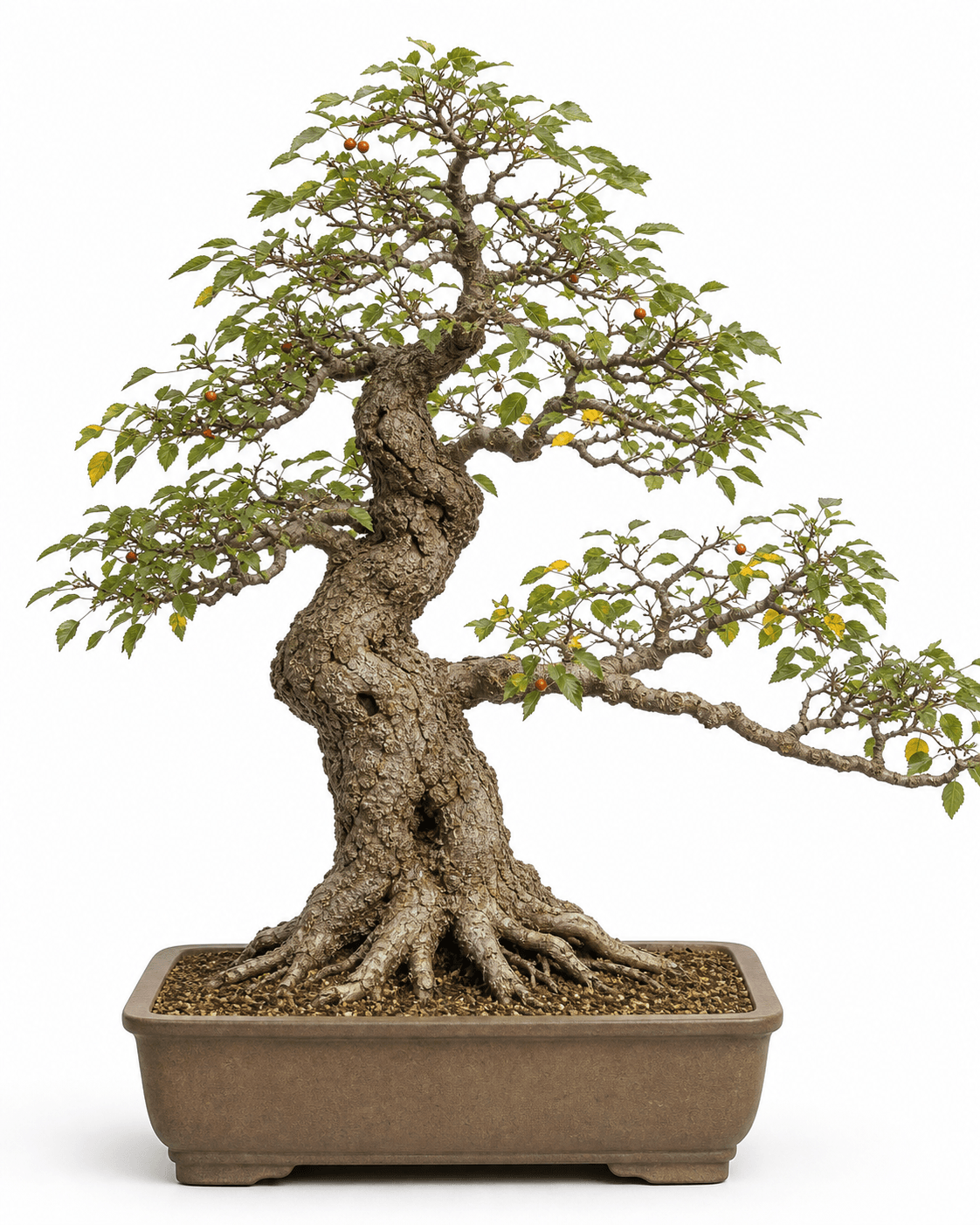
Mirai design method reads habitat and bark as design evidence. North American hackberry can become rugged, warty, and angular, while Asian Celtis tends to stay smoother and finer. A good Hackberry bonsai should look like a broadleaf tree that survived weather and pruning. Bonsai Mirai / AsymmetryBonsai Mirai LibraryNC State Extension: Celtis occidentalis
Reading the tree
Hackberry tells you whether it is in development or refinement by its shoot response.
Mirai places hackberry among high-water-mobility broadleaves with rapid growth, easy dieback, and weak compartmentalization. That combination rewards attentive growers and punishes autopilot work: strong shoots can thicken and heal, while poorly placed cuts can abandon tissue behind them. Bonsai Mirai Library
In development, prioritize elongation, thickening, wound healing, foliar expansion, and root regeneration. Keep enough branch options to let the tree reveal which lines are strongest, then thin to avoid inverse swelling before fall vascular growth locks the junctions in place. Bonsai Mirai Library
In refinement, wait for the first flush to harden, then prune by node, leaf mass, and direction. Large-leaf deciduous work may include partial leaf reduction on strong refined zones, but whole-tree defoliation is a recovery tax that only healthy, established trees can pay. Bonsai Mirai Library
Pruning
Prune Hackberry by water movement and growth stage.
For structural work, choose the live line first, then cut with the species physiology in mind. Mirai advises cutting easy-dieback broadleaves back to collars with at least two viable nodes between the cut and the adjacent live structure so water conductivity remains intact. Bonsai Mirai Library
Unchecked vigorous growth can become a liability. Mirai warns that easy-dieback species such as Celtis can lose branches by leaf drop when growth shades and starves interior tissue. Periodic pruning and partial leaf work maintain branch viability. Bonsai Mirai Library
At every junction, reduce competing shoots before they become a knob. Mirai deciduous-development method keeps a main line plus one secondary where possible, favors narrow-angle branching for natural broadleaf structure, and reserves finer shoot selection for later refinement. Bonsai Mirai Library
Seal larger cuts immediately. Mirai calls for putty cut paste on heavy structural cuts in dieback-prone broadleaves because sealing protects moisture, conductivity, and callus potential. If a cut has dried out, refresh to live green-and-white tissue before pasting. Bonsai Mirai Library
Repotting and roots
Repot Hackberry at spring bud swell and protect the root-to-water balance.
Mirai repotting method puts the safest deciduous window at spring bud swell before active growth depends on the full root system. For Hackberry, use that window to correct drainage, root density, old soil, planting angle, and the transition from nursery or air-layer media. Bonsai Mirai Library
A Hackberry root ball should be worked enough to restore oxygen without destroying recovery capacity. Mirai warns against slip-potting without root integration, crushing wet akadama while chopsticking, and moving a tree again inside roughly two years after meaningful root work. Bonsai Mirai Library
Air-layered Celtis needs special restraint. Mirai notes that substantial broadleaf layers may require rewounding and a second growing season for radial roots, then a container proportional to the new root mass so soft roots do not sit in a cold, wet, oversized box. Bonsai Mirai Library
Aftercare is deliberately plain: tie the tree firmly, water thoroughly, shelter from drying wind and freezing temperatures, delay fertilizer until growth confirms function, and postpone heavy pruning or wiring until the tree has rebuilt strength. Bonsai Mirai Library
Soil and pot
Use more water retention in development and cleaner akadama logic in refinement.
Mirai gives moisture-loving developmental material such as hackberry a 70 percent organic and 30 percent aggregate blend, using peat, sand, pine bark, pumice, or perlite as examples. That kind of mix can build vigor in training containers, but it must be watched as organic particles break down. Bonsai Mirai Library
Refined deciduous bonsai can move toward 100 percent solid akadama or an akadama-forward mix when the grower can water reliably. Mirai soil method values akadama because active root growth scales the particle, producing finer roots, shorter internodes, and smaller leaves over time. Bonsai Mirai Library
Pot depth should respect water demand. Mirai watering method notes that shallow containers retain water longer than intuition suggests, yet high leaf mass and summer wind can still dry the root zone rapidly. For Hackberry, avoid a pot so shallow that hydration becomes impossible during active growth. Bonsai Mirai Library
Container choice should reinforce the species. Rugged C. occidentalis can carry quieter earth-toned ovals, soft rectangles, or understated unglazed pots that echo rough bark. Smoother C. sinensis can use lighter, finer containers once ramification is persuasive. Bonsai Mirai / AsymmetryBonsai Mirai Library
Climate
Match the Hackberry species to the winter and heat on your bench.
American hackberry gives colder-climate growers more margin. NC State lists C. occidentalis for USDA Zones 3a to 9b, and USDA NRCS gives common hackberry Zones 2 to 9. A bonsai root system still needs protection from hard freeze, freeze-thaw cycling, and drying wind. NC State Extension: Celtis occidentalisUSDA NRCS plant guideBonsai Mirai Library
Chinese hackberry is the warmer-zone path. NC State lists C. sinensis for USDA Zones 7a to 11b, full sun, hot-summer performance, and moist amended well-drained soil. In cold regions, treat it as a protected temperate tree rather than a fully exposed northern bench tree. NC State Extension: Celtis sinensis
Dry-country growers should read landscape drought tolerance carefully. USDA Silvics documents drought survival in mature C. occidentalis, but bonsai pots lack the deep root reserve behind that survival. Shade cloth, larger training containers, and careful top dressing can be better adaptations than reducing water. USDA Forest Service SilvicsBonsai Mirai Library
Humid growers should prioritize air and wound hygiene. Hackberry tolerates wet periods better than many trees, yet NC State lists powdery mildew, leaf spot, root rot, and witches broom on C. occidentalis. Stagnant wet benches make small cultural problems larger. NC State Extension: Celtis occidentalisBonsai Mirai Library
Pests and diseases
Most Hackberry pest pressure is manageable when roots and cuts are clean.
NC State lists Asian woolly hackberry aphid, lace bugs, scale, witches broom, nipple gall, powdery mildew, leaf spot, and root rot for C. occidentalis. Galls and witches broom can look dramatic, but many are more disfiguring than fatal on otherwise strong trees. NC State Extension: Celtis occidentalis
NC State lists witches broom as common in some areas on C. sinensis and notes fruit litter and naturalizing by seed. In bonsai, remove unwanted fruit on weak or developing trees and keep fallen fruit from rotting into the soil surface. NC State Extension: Celtis sinensisBonsai Mirai Library
Root rot is usually a water and oxygen problem before it becomes a named pathogen problem. Mirai watering and soil method frame overwatering as oxygen exhaustion in the substrate; diagnose drainage, old organic media, pot depth, and root smell before treating foliage symptoms in isolation. Bonsai Mirai Library
Wood injury deserves attention because NC State notes wood rot after damage on C. sinensis, and Mirai warns that broken branches and large wounds on high-water-mobility broadleaves need immediate sealing. Clean tools, sealed cuts, and stable tie-downs are preventive care. NC State Extension: Celtis sinensisBonsai Mirai Library
Wiring
Use structural wire early, then let directional pruning refine the branch line.
Mirai deciduous wiring method preserves species character. Wire the trunk and primary branches only where shape change is needed, then stop before naturally useful sections. Hackberry should keep a broadleaf rhythm rather than a fully wired conifer-pad architecture. Bonsai Mirai Library
For first structural bends on broadleaf deciduous trees, Mirai favors copper because it work-hardens and holds against strong phototropic and vascular forces. For later work, aluminum is acceptable once the branch has tissue memory and the design needs less force. Bonsai Mirai Library
Protect bark and deadwood. Mirai recommends paper-wrapping larger copper gauges, avoiding heavy bends at existing deadwood, and using stronger gauges on brittle species so the bend happens over a shorter, safer distance. Bonsai Mirai Library
Timing matters. Vigorous growth signals a tree can tolerate wiring, while reduced sap flow and weakness make branches brittle. Early fall is a useful structural window for deciduous material because branches remain flexible and vascular growth is about to thicken the set. Bonsai Mirai Library
Propagation
Seed, cuttings, and air layers all have a role, but air layers are the bonsai shortcut.
Seed is useful for forests, clumps, local adaptation, and long selection. NC State lists seed for C. occidentalis and seed plus stem cutting for C. sinensis; USDA Silvics notes common hackberry seed is dispersed mainly by birds and small mammals and can remain viable after overwintering. NC State Extension: Celtis occidentalisNC State Extension: Celtis sinensisUSDA Forest Service Silvics
Stem cuttings are more plausible for C. sinensis than for rough collected American material. Mirai propagation method emphasizes clean cuts, correct lignification stage, reduced leaf mass, perlite-like oxygen, mist rather than saturated media, and up-potting gradually after roots show. NC State Extension: Celtis sinensisBonsai Mirai Library
Air layers are powerful on Hackberry because they can move the root system to the widest part of a flawed trunk. Mirai advises placing the layer at the best base, expecting large layers to need a second season for radial roots, and separating when new roots can support the leaf mass. Bonsai Mirai Library
Grafting is rarely the first Hackberry bonsai propagation choice. Reserve it for root correction, cultivar preservation, or branch placement when a cutting, layer, or seedling will not solve the design problem cleanly. Bonsai Mirai Library
Buying and sourcing
Buy for species identity, root promise, bark, and branch junctions.
Start by reading the tag. Celtis occidentalis, Celtis sinensis, and vague Celtis labels carry different winter, bark, and design expectations. NC State also notes C. occidentalis is often confused with sugarberry and related Celtis species, so regional native material deserves closer identification. NC State Extension: Celtis occidentalisKew POWO: Celtis occidentalisKew POWO: Celtis sinensis
For American hackberry, look for roughening bark, trunk movement, a base that can support a medium tree, and roots that can transition from field or nursery soil. Landscape availability is a benefit, but large 2 to 5 inch leaves and coarse roots make small bonsai harder. NC State Extension: Celtis occidentalisUSDA Forest Service SilvicsBonsai Mirai Library
For Chinese hackberry, look for finer branch density, usable lower branches, clean fruiting growth, and warmth compatibility. NC State lists Green Cascade as a weeping cultivar, which may be useful for unusual material but should be judged by graft, roots, and branch placement first. NC State Extension: Celtis sinensisBonsai Mirai / Asymmetry
Reject material with a dry hydrophobic core, sour wet soil, severe root damage, swollen clusters at every junction, weak branch crotches, unhealed rot pockets, or a graft or layer scar that cannot become part of the design. Bonsai Mirai LibraryNC State Extension: Celtis sinensis
Troubleshooting
Diagnose Hackberry through roots, water movement, pruning response, and identity.
Leaves wilt during hot sun: check surface dryness, the old core, pot temperature, and wind exposure. Water thoroughly in multiple passes, shade the pot temporarily, and avoid pruning until the tree rehydrates and stabilizes. Bonsai Mirai LibraryUSDA NRCS plant guide
Leaves yellow across the whole crown while soil stays wet: suspect root oxygen failure. Mirai treats uniform weakness as a root issue first, so inspect drainage, particle breakdown, organic pockets, root smell, and tie-down stability. Bonsai Mirai Library
A branch dies back behind a pruning cut: the cut likely ignored conductivity, timing, or wound sealing. Reassess live buds, cut back to viable tissue with node insurance, paste larger wounds, and stop pruning if fresh cuts darken with excessive water movement. Bonsai Mirai Library
A junction swells after successful pruning: too many response shoots stayed in one place. Reduce to a main line plus one useful secondary early, then rebuild ramification from better-spaced nodes. Bonsai Mirai Library
Bumps, galls, or witches broom appear: confirm vigor before panic. NC State notes nipple gall and witches broom on hackberry; they can disfigure leaves and twigs, but roots, water, light, and airflow still decide whether the tree declines. NC State Extension: Celtis occidentalisNC State Extension: Celtis sinensis
Design
Design Hackberry as an angular deciduous broadleaf with either rugged bark or fine smooth movement.
Begin with Mirai design fundamentals: base, trunk line, defining branch, apex, and asymmetry. On Hackberry, the defining branch should usually feel like a natural broadleaf extension from the trunk movement. Bonsai Mirai / AsymmetryBonsai Mirai Library
Mirai identifies hackberry, tamarisk, and elm as angular broadleaf material where sustained character comes from initial branch movement followed by years of directional pruning. Wire primary movement into thin branches, then let thickening soften the bends. Bonsai Mirai Library
C. occidentalis can support rugged informal upright, clump, twin-trunk, and hollow-trunk images because rough bark and warty ridges carry age. Mirai notes natural hollow work on high-water broadleaves can be started gently through rot encouragement rather than aggressive carving. Bonsai Mirai LibraryNC State Extension: Celtis occidentalis
C. sinensis usually asks for finer twigging, smoother bark, yellow autumn color, and small red-brown drupes as seasonal punctuation. Use the species identity to decide whether the tree should feel rugged, elegant, tense, or quiet. NC State Extension: Celtis sinensisBonsai Mirai / Asymmetry
Cultivars and forms
Treat Celtis labels as identity clues, then judge the actual bonsai material.
This page covers C. occidentalis and C. sinensis because they are the likely beginner search labels. Mirai also mentions C. laevigata and C. reticulata in the dedicated Celtis file, which confirms that hackberry is a genus-level bonsai conversation rather than one uniform care target. Bonsai Mirai LibraryKew POWO: Celtis occidentalisKew POWO: Celtis sinensis
North American hackberry selection is usually about bark, age, trunk movement, and native availability rather than named bonsai cultivars. Pronounced warty bark is valuable, but it needs enough trunk size and branch structure to remain convincing when leaves are large. Bonsai Mirai LibraryNC State Extension: Celtis occidentalis
Chinese hackberry has a named weeping form, Green Cascade, in the NC State profile. Use cultivar names as secondary evidence only; roots, graft quality, internodes, health, and winter fit matter more than a label. NC State Extension: Celtis sinensisBonsai Mirai / Asymmetry
History
Hackberry sits between native-tree experimentation and East Asian Celtis refinement.
American hackberry is a familiar North American urban and wildlife tree. UMN highlights its tolerance of heat, drought, salt, wind, flooding, and urban environments, while NC State notes wildlife fruit value and distinctive corky bark. UMN ExtensionNC State Extension: Celtis occidentalis
USDA Silvics gives the larger ecological frame: common hackberry spans broad precipitation, temperature, valley, floodplain, limestone, slope, and ravine conditions. Bonsai should translate that resilience into believable deciduous structure. USDA Forest Service SilvicsBonsai Mirai / Asymmetry
Chinese hackberry connects the page to warmer East Asian Celtis practice, with smoother bark, glossy leaves, small drupes, and a more compact ornamental profile. It remains a separate winter and sourcing decision from common hackberry. Kew POWO: Celtis sinensisNC State Extension: Celtis sinensis
A strong Hackberry bonsai should be judged by base, root transition, bark or smoothness appropriate to species, managed dieback, convincing branch angles, and a crown that still reads as deciduous when the leaves have fallen. Bonsai Mirai / AsymmetryBonsai Mirai Library
Species questions
Answer the beginner questions before styling.
Is hackberry a good beginner bonsai?
Yes, for an outdoor grower who can water consistently, prune by growth stage, and protect cuts from dieback. It is better for medium and larger designs than tiny shohin work.
Can hackberry bonsai live indoors?
Grow hackberry outdoors. Both covered species are temperate trees, and bonsai health depends on sun, air, seasonal cues, and dormancy. Protected winter storage is different from indoor living-room culture.
Which hackberry is used for bonsai?
Chinese hackberry, Celtis sinensis, and American hackberry, Celtis occidentalis, are the main targets here. Chinese hackberry is warmer and smoother; American hackberry is colder and rougher barked.
How much sun does hackberry bonsai need?
Use full sun to strong outdoor light where the pot can stay hydrated. Add afternoon protection during heat waves, recent root work, or small-pot stress.
How often should I water hackberry bonsai?
Water when the surface particles begin to dry, then saturate the whole pot. Frequency changes with leaf mass, pot size, wind, heat, and soil composition.
When should I prune hackberry bonsai?
Use structural pruning only when the tree has energy and viable buds to support the cut. For refinement, prune after the first flush hardens, then reduce crowded junctions before swelling forms.
When should I repot hackberry bonsai?
Inspect in spring as buds swell. Repot when drainage slows, soil breaks down, roots fill the pot, or an old nursery core needs staged transition.
What soil mix works for hackberry bonsai?
Use a moisture-retentive but oxygenated mix. Development can use more organic material, while refined deciduous work can move toward akadama-heavy or 100 percent akadama culture under reliable watering.
Why do hackberry branches die back after pruning?
Hackberry is a high-water-mobility, easy-dieback broadleaf. Cuts need viable nodes, good timing, clean tissue, and wound sealing. Stop pruning if fresh cuts darken or the tree is weak.
Why are there bumps or galls on hackberry leaves?
Nipple gall and witches broom are common hackberry issues and can be mostly cosmetic on strong trees. Correct roots, water, light, and airflow before treating leaf blemishes as the main cause.
Can hackberry be air layered?
Yes. Air layering can create better roots at the widest part of the trunk. Large Celtis layers may need a second season before separation, and the new root mass should not be over-potted.
Sources
Species advice needs source discipline.
Next decisions
Plan the operation before copying the calendar.
A good care note for Hackberry records the tree's stage, the work done, and the aftercare used. That record matters more than a month-name rule.
Related species
Compare nearby trees before transferring advice.
Japanese maple
Acer palmatum
Trident maple
Acer buergerianum
Amur maple
Acer tataricum subsp. ginnala
Field maple
Acer campestre
Korean hornbeam
Carpinus turczaninovii