
Species guide
Japanese Flowering Quince Bonsai Care
Chaenomeles japonica, Chaenomeles speciosa
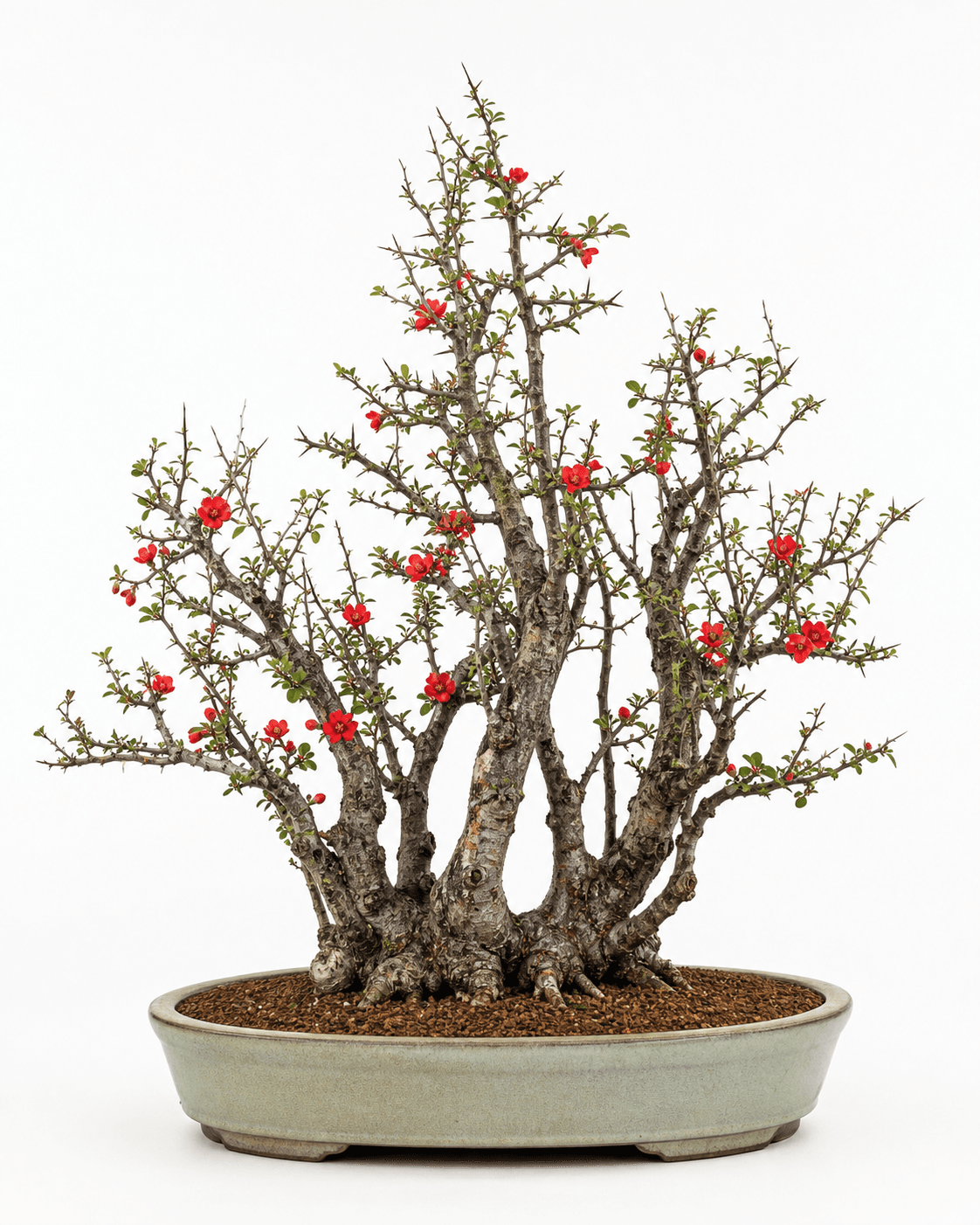
Japanese flowering quince bonsai are outdoor deciduous flowering shrubs. They need strong light, a moist oxygenated root zone, seasonal cold, and pruning that respects flower wood.
Most bonsai labels should be read as a Chaenomeles group: C. japonica, C. speciosa, Chojubai, Toyo Nishiki, or C. x superba hybrids. The shared method is basally dominant deciduous care, with Chojubai and other dwarf forms handled as clump-form flowering bonsai before they are treated as miniature trees.
The Mirai-first calendar favors fall repotting, post-flower pruning, post-flush hardened refinement work, padded wiring, and deliberate fruit removal. This is a rewarding beginner flowering bonsai only for growers who can keep it outdoors and delay display when structure or recovery matters more.
Updated June 15, 2026. Written by EntGrove Editorial. Last verified June 15, 2026.
Care fingerprint
Read the species through its shared care pattern.
Repot and structural prune around dormant-to-active transitions; protect new leaves; time refinement work after growth hardens. Use this as the starting point before local conditions and tree strength refine the calendar.
Note: Bonsai and nursery material may be C. japonica, C. speciosa, Chojubai, or C. x superba hybrids; identify cultivar and growth habit before assuming vigor.
Read the foliage first
Broadleaf stress usually shows in leaf color, leaf size, wilt, scorch, or delayed hardening before it becomes a branch problem.
Match work to dormancy
Deciduous, evergreen, tropical, succulent, and flowering broadleaf trees recover on different calendars.
Protect fine roots
Root work should preserve enough active fine roots for the tree to rehydrate quickly after the operation.
Care cadence
The calendar starts with the tree's seasonal state.
Placement
Timing: Grow outdoors in full sun to bright partial shade with moving air. Use afternoon relief for small pots in severe heat.
Watch for: Shaded trees that refuse to flower, warm indoor growth, fungal pressure in stagnant shelter, and flower buds pushed early against a warm wall.
NC State ExtensionNC State ExtensionBonsai Clubs InternationalWatering
Timing: Water thoroughly when the surface begins to dry, then let oxygen return to the root zone. Reduce water in cold dormancy without letting the root ball become dust dry.
Watch for: Cold wet sourness, drought during flower or fruit set, hydrophobic old akadama, and container walls packed with roots.
Bonsai Clubs InternationalBonsai Mirai LibraryFertilizing
Timing: Feed strongly after flowering through active growth, especially during development. Refined trees still need nutrition because flowers and fruit are expensive.
Watch for: Fruit load consuming reserves, weak flower buds after lean feeding, alkaline water suppressing micronutrient availability, and coarse shoots on already refined branches.
Bonsai Mirai LibraryBonsai Clubs InternationalPost-flower pruning
Timing: Prune after the main flower display and before or during early leaf emergence when the goal is structure, branch selection, or next-year flower wood management.
Watch for: Cutting off all old-wood bloom sites, weakening the central trunk in a clump, and pruning every branch equally when vigor is uneven.
Bonsai Mirai LibraryNC State ExtensionNC State ExtensionPost-flush refinement
Timing: After 3-5 internodes harden, usually late spring to early summer, cut back to active leaves and reduce large leaf surface by about 70 percent where ramification is the goal.
Watch for: Soft new shoots that still snap at the base, dormant buds that will not push after hard cutback, and outer clump trunks stealing strength from the central line.
Bonsai Mirai LibraryFlowers and fruit
Timing: Enjoy the flower display on strong trees, then remove spent flowers before fruit set unless a limited fruit display is the deliberate goal.
Watch for: Chojubai fruit draining ramification, flowers appearing at odd times, and young development trees spending strength on display instead of branches.
Bonsai Mirai LibraryBonsai Clubs InternationalBonsai Tonight summer workRepotting
Timing: Favor fall after peak heat and well before freezing. Keep the top intact after root work and avoid pairing repotting with heavy pruning or fruit display.
Watch for: Root-knot nematode galls, matted root walls, spring wounds in nematode-prone conditions, and old central trunks weakening after stacked work.
Bonsai Mirai LibraryBonsai Clubs InternationalWiring
Timing: Wire hardened young growth, often with padded copper for initial structural work. Check active-growth wire within 6-8 weeks.
Watch for: Wire scars that will not heal cleanly, brittle shoot attachments, loops, repeated curves, and wire systems stacked over older deciduous wire.
Bonsai Mirai LibraryPests and disease
Timing: Scout during watering, after wet spring weather, and during protected winter storage. Use drainage, airflow, sanitation, and root inspection as prevention.
Watch for: Aphids, scale, mites, fungal leaf spot, scab, fire blight, chlorosis in high-pH media, root-knot nematode galls, and debris caught in thorny stems.
NC State ExtensionNC State ExtensionBonsai Mirai LibrarySpecies guide
Apply the species profile before copying another tree's calendar.
At a glance
Japanese flowering quince is a deciduous Chaenomeles bonsai built around flowers, clump strength, and fall roots.
The bonsai label covers a practical group. Kew accepts C. japonica and C. speciosa as separate Rosaceae shrubs, and BCI documents the old trade confusion among C. japonica, C. speciosa, and C. x superba hybrids. Kew POWOKew POWOBonsai Clubs International
For a grower, the working specification is outdoor dormancy, full sun, generous but oxygenated water, 100 percent akadama in refinement, fall-first repotting, flower-aware pruning, and scar-preventing wiring. Mirai treats the species as basally dominant, which means the lower and younger parts often stay stronger than the apex or old central trunk. Bonsai Mirai Library
Choose it for clumps, small flowering shrubs, Toyo Nishiki color, Chojubai scale, thorny winter line, and fruit only when the tree is strong enough. Beginners can grow it well outdoors, but refined flowers and durable structure require patience. Bonsai Mirai LibraryBonsai Mirai / Asymmetry
Wild habitat
Read the wild shrub before forcing a tree silhouette onto it.
Kew places C. japonica in south-central Korea and Japan, and C. speciosa in China. NC State describes both as woody deciduous shrubs, with C. japonica open and spreading and C. speciosa denser, thorny, and multi-stemmed. Kew POWOKew POWO
For care, that habitat signal points toward sun, seasonal cold, moisture with drainage, and tolerance for pruning after the display. NC State lists C. japonica across several soil textures, while C. speciosa dislikes alkaline soil and flowers best in sun. NC State ExtensionNC State Extension
For design, the wild signal is shrub-first: basal shoots, multiple trunks, tangled twigging, flowers on bare stems, thorns, and fruit. The best bonsai usually clarify that habit instead of hiding it inside maple-like tiers. Oregon State Landscape PlantsBonsai Mirai / Asymmetry
Reading the tree
Start every decision by reading basal dominance and stage.
Mirai names Japanese quince as basally dominant. Strength gathers in young basal growth, suckers, and lower trunks, while the older central trunk or apex can weaken if the grower keeps reducing it or lets outer shoots run unchecked. Bonsai Mirai Library
A development tree may sacrifice flowers for pruning, wiring, and branch distribution. A refinement tree protects short internodes, old flower wood, and interior ramification. A recovery tree keeps more foliage, skips fruit, and avoids stacked root and top work. Bonsai Mirai LibraryBonsai Mirai / Asymmetry
Look at the actual growth before cutting. Mirai warns against cutting basally dominant species back to dormant interior buds with no active leaves; build interior growth first, then cut back to it in a later cycle. Bonsai Mirai Library
Pruning
Prune for one goal at a time: structure, next-year flowers, or fruit display.
The horticultural baseline is flower-aware pruning. NC State says C. japonica blooms on old wood and should be pruned after flowering, while C. speciosa flowers on old growth and needs moderation if fruit is desired. NC State ExtensionNC State Extension
Mirai gives two bonsai windows. The first is immediately after flowering and before foliage fully takes over. The second comes after the first flush has hardened, often June in temperate climates, when 3-5 internodes and firm darker leaves show the shoot can support pruning and partial defoliation. Bonsai Mirai Library
Fruit should be rare and intentional. Mirai notes that Chojubai can lose significant ramification when allowed to carry heavy fruit, and BCI also warns that fruiting and flowering can drain young bonsai. Bonsai Mirai LibraryBonsai Clubs International
Basal shoots are design material only when the composition needs them. Remove suckers that drain an old trunk or clutter the base; keep selected basal shoots when building a clump, replacing an aging trunk, or distributing scale. Bonsai Mirai LibraryNC State Extension
Repotting
Use fall as the default root window and protect the old center of the clump.
Mirai favors fall repotting for Japanese quince after peak heat and before freezing, with root-knot nematode risk as a key reason. BCI independently lists Chaenomeles among the few bonsai species that prefer autumn repotting. Bonsai Mirai LibraryBonsai Clubs International
This page resolves the source conflict by making fall the default when aftercare is available. Spring work remains an emergency or advanced exception for strong trees, local pest pressure, or show-timing choices, and it should happen before leaves impose heavy water demand. Bonsai Mirai LibraryBonsai Clubs International
The old center of a clump is the danger zone. Mirai notes that outward basal expansion can move the active root mass away from the central trunk, so root work should preserve the central line with foliage, avoid severe simultaneous top reduction, and keep the soil oxygenated. Bonsai Mirai Library
If galled roots appear, treat the tree as a pest-and-root problem rather than a styling project. Remove compromised roots conservatively, isolate the plant, clean tools, and rebuild in fresh mineral media with follow-up inspection. Bonsai Mirai Library
Soil and pot
Give flowering quince moisture, oxygen, nutrition, and a pot that suits a shrub.
Mirai specifies 100 percent akadama for Japanese quince refinement. The fine roots fracture akadama over time, increasing water retention and nutrient-holding capacity in proportion to the tree demand. Bonsai Mirai Library
Development material can start in a slightly more open akadama-heavy mineral mix when heat, watering habits, or root recovery demand extra drainage. The goal is never a dry cactus mix; BCI describes generous water and rich but well-drained soil. Bonsai Mirai LibraryBonsai Clubs International
Pot choice should respect scale and display season. Use shallow, stable containers for clumps and exposed-root forms, deeper training pots for recovery, and restrained glazed colors only when they support the flower color rather than competing with it. Bonsai Mirai / AsymmetryOmiya Bonsai Art Museum
Chojubai has unusual tolerance for stone or slab presentation among deciduous broadleaf bonsai, according to Mirai, but the planting still needs disciplined akadama, thin sphagnum walling where used, and consistent moisture. Bonsai Mirai Library
Climate
Adapt the same deciduous calendar to cold roots, hot pots, and local pest pressure.
Cold-climate growers should respect the landscape zones but protect bonsai roots earlier. NC State lists C. japonica down to Zone 5a and C. speciosa down to Zone 4a; a shallow bonsai pot still needs protection from freeze-dry wind and prolonged solid root freeze. NC State ExtensionNC State Extension
Hot-climate growers should keep the light high while managing pot temperature. BCI recommends partial shade in very hot midsummer areas, which is best read as root and container protection after the tree has received enough light to set flower wood. Bonsai Clubs InternationalNC State Extension
Wet-spring regions should prioritize airflow and sanitation because NC State flags fungal leaf spot after heavy rainfall and scab or fire blight on C. speciosa. Warm regions with nematode pressure should take Mirai fall-repot guidance seriously. NC State ExtensionNC State ExtensionBonsai Mirai Library
Pests and disease
Keep the thorn framework clean and the root system inspected.
NC State lists fungal leaf spot after heavy rainfall, aphids on new growth, and occasional scale and mites for C. japonica. It also notes the thorny framework can collect debris, which matters in bonsai because debris holds moisture against bark and buds. NC State Extension
For C. speciosa, NC State flags aphids, fire blight, scab susceptibility, and chlorosis in high-pH soil. The bonsai response is not constant spraying; it starts with sun, airflow, clean cuts, correct water, and soil chemistry that does not lock up iron. NC State ExtensionBonsai Mirai Library
Root-knot nematode risk is the species-specific root warning in the Mirai corpus. Galls, weak water movement, and poor recovery after spring root work should trigger root inspection, isolation, and a fall-centered reset plan. Bonsai Mirai Library
Flowers and fruit are also sanitation issues. Avoid wetting open flowers unnecessarily, remove spent flowers when fruit has no display purpose, and keep fallen petals and fruit out of the pot. Bonsai Clubs InternationalBonsai Mirai Library
Wiring
Wire only when the shoot can hold the bend and the bark can survive it.
Mirai treats quince wiring as scar-sensitive work. Use padded copper for heavier initial movement on thin or smooth bark, and check active-growth wire within roughly 6-8 weeks because scars do not resolve cleanly. Bonsai Mirai Library
Let new shoots harden before wiring. The deciduous fall-work corpus warns that quince new growth can snap where it joins older wood, so wire after the attachment has strengthened rather than when the shoot is soft and tempting. Bonsai Mirai Library
Build movement in three dimensions. The Japanese quince styling corpus emphasizes vertical and horizontal plane changes, irregular lines, and branch rotation as ways to avoid brittle bends and repetitive loops. Bonsai Mirai Library
Separate wiring systems on deciduous trees. Mirai warns against stacking secondary wire over older structural wire because the older wire may need removal first, leaving the newer wire dependent on a system that must be unwound. Bonsai Mirai Library
Propagation
Propagate Chojubai and related quince with timing that matches wood maturity.
NC State lists stem cuttings as a propagation strategy for both C. japonica and C. speciosa. Mirai narrows the bonsai window for Chojubai: semi-hardwood cuttings after the first flush hardens are the most reliable, with secondary windows just before bud break and after summer heat. NC State ExtensionNC State ExtensionBonsai Mirai Library
BCI adds the broader options: seed with cold treatment, slow-rooting cuttings, division of clumps, and grafting for named hybrids. In bonsai, seed is useful for roots and future trunks, while it rarely preserves exact flower color or dwarf habit. Bonsai Clubs InternationalBonsai Mirai Library
Air-layer only young wood when you need roots in a specific place. Mirai warns that older basally dominant pieces conduct water less efficiently and rarely layer well. Bonsai Mirai Library
Grafting is common where cultivar identity matters. Use grafts for flower color, weak branch replacement, or clump renewal, but keep the graft low, clean, and compatible with the final trunk line. Bonsai Clubs InternationalBonsai Mirai / Asymmetry
Buying
Buy the structure, not only the bloom.
A flowering nursery plant can hide poor bonsai traits. Inspect root spread, sucker placement, trunk hierarchy, thorn density, internodes, grafts, branch attachments, and whether the label points to C. japonica, C. speciosa, Toyo Nishiki, Chojubai, or a hybrid. Bonsai Clubs InternationalOregon State Landscape Plants
For Chojubai, scale is the draw. Favor own-root cuttings or divided clumps with short internodes, many usable basal trunks, and flowers only as proof of identity. Bonsai Tonight documents Chojubai pruning decisions around target size, from shohin to larger trees. Bonsai Tonight Chojubai developmentBonsai Mirai Library
For Toyo Nishiki and C. speciosa forms, buy with enough scale for the plant. Oregon State describes Toyo-nishiki as an upright 6-foot shrub with white, pink, and red flowers on the same branch; it often needs a larger bonsai image than Chojubai. Oregon State Landscape PlantsBonsai Mirai Library
Avoid material with swollen root galls, long unbranched thorny canes, grafts above the intended base, or a flower display on a weak root system. Those flaws become the actual work after the petals fall. Bonsai Mirai LibraryNC State Extension
Troubleshooting
Diagnose flowering quince by bloom wood, basal strength, roots, and scars.
No flowers: likely weak sun, late pruning, repeated development work, poor feeding, a young cutting, or a cultivar that has not settled. NC State and Oregon State both tie future bloom to old or new growth that must be kept long enough to set flower sites. NC State ExtensionOregon State Landscape Plants
Central trunk weakens in a clump: outer basal shoots and younger trunks may be taking the energy. Leave more foliage on the central line, reduce outer vigor, and avoid heavy root work plus top pruning in the same cycle. Bonsai Mirai Library
Wire scars: remove wire earlier next time and use padded copper or aluminum according to bark and branch size. Mirai treats quince scars as persistent, so prevention is the real repair. Bonsai Mirai Library
Yellow leaves in otherwise moist soil: suspect high pH or exhausted, poorly breathing media. NC State flags chlorosis for C. speciosa in high-pH soils, and Mirai links alkaline water to reduced iron availability in flowering and fruiting trees. NC State ExtensionBonsai Mirai Library
Flowers but weak branches: remove fruit, feed after flowering, keep more leaves during recovery, and shift the tree out of display mode for a year. Bonsai Mirai LibraryBonsai Clubs International
Root galls or poor post-repot recovery: inspect for root-knot nematode damage, isolate the tree, refresh the soil, and use a fall-centered repot strategy going forward. Bonsai Mirai Library
Design
Design flowering quince as a shrub-form bonsai where flowers accent a sound structure.
Mirai flowering-bonsai critique gives the standard: the highest expression is a refined tree or shrub form that happens to flower, rather than a weak structure grown only for bloom count. Bonsai Mirai / AsymmetryBonsai Mirai Library
Chojubai makes that standard important because flowers appear reliably but unpredictably across the canopy. Mirai notes that flower placement cannot be controlled the way it can on Ume, so the design must stand without flowers. Bonsai Mirai Library
For clumps, vary trunk thickness, height, spacing, and plane. Preserve basal connective bridges where trunks share tissue, and use rotation or front changes to reveal depth instead of forcing every trunk into one plane. Bonsai Mirai Library
For branch design, distribute billows and negative space rather than conifer pads. The goal is an old thorny flowering shrub with enough open winter structure for flowers to read clearly. Bonsai Mirai LibraryOmiya Bonsai Art Museum
Cultivars
Chojubai, Toyo Nishiki, and C. x superba labels change scale more than the core calendar.
Chojubai is the bonsai favorite for dwarf scale, clump character, and small flowers. The Omiya Bonsai Art Museum identifies a Chojubai collection tree as C. japonica Chojubai and records its cascade presentation. Omiya Bonsai Art Museum
Toyo Nishiki is the color-shifting trade star. Oregon State lists Toyo-nishiki with white, pink, and red flowers on the same branch, while Mirai notes textured knotty bark and multi-color bloom as distinguishing features on Toyo Nishiki material. Oregon State Landscape PlantsBonsai Mirai Library
C. speciosa and C. x superba forms stay important for larger flowering bonsai. NC State lists Orange Storm, Pink Storm, Rubra, Scarlet Storm, and Toyo-Nishiki; Oregon State also lists Cameo, Jet Trail, Nivalis, Orange Delight, and Texas Scarlet. NC State ExtensionOregon State Landscape Plants
Treat cultivar names as clues, then verify the plant. BCI explains that C. japonica and C. speciosa hybridize readily, making cultivar derivation difficult, and many nursery labels reduce the plant to Chaenomeles plus a cultivar name. Bonsai Clubs International
History
Flowering quince sits between horticultural shrub, bonsai clump, and winter-flower display.
The naming history is tangled. Kew lists older Cydonia and Pyrus synonyms for C. japonica, while BCI summarizes the historical confusion among pears, quinces, false-quince, and Chaenomeles hybrids. Kew POWOBonsai Clubs International
In bonsai culture, Chojubai is the emblematic form because small flowers and clump growth make convincing small bonsai possible. Bonsai Tonight documents development choices around future shohin, kifu, and chuhin scale. Bonsai Tonight Chojubai developmentOmiya Bonsai Art Museum
The Omiya Bonsai Art Museum collection shows Chojubai can be read as more than a novelty flower. Its cascade example demonstrates how sparse old structure and seasonal bloom can coexist in a mature display tree. Omiya Bonsai Art Museum
For EntGrove care guidance, the historical lesson is practical: do not let a beautiful bloom season excuse weak structure, scarred branches, exhausted roots, or an unbalanced clump. Bonsai Mirai / AsymmetryBonsai Mirai Library
Species questions
Answer the beginner questions before styling.
Is Japanese flowering quince a good beginner bonsai?
Yes for an outdoor grower who can provide sun, dormancy, and careful timing. It is a poor fit for indoor culture or for growers who want to shear whenever the canopy looks untidy.
Can Japanese flowering quince bonsai live indoors?
Keep it outdoors. Flowering quince needs seasonal light, dormancy, moving air, and winter pot protection rather than warm indoor conditions.
Why did my flowering quince bonsai not flower?
Common causes include weak sun, pruning away old or prior-season flowering wood, underfeeding, repeated development pruning, a young cutting, or a cultivar that has not settled.
When should I prune Japanese flowering quince bonsai?
Prune after flowering when preserving the display calendar matters. For refinement, use the post-flush hardened window after 3-5 internodes mature, then cut only to active growth.
When should I repot Japanese flowering quince bonsai?
Use fall as the default Mirai-first window, after peak heat and before freezing. Early spring is a narrower exception for strong trees and local conditions that support recovery.
Is Chojubai the same as Japanese flowering quince?
Chojubai is a dwarf Chaenomeles form used heavily in bonsai. Treat it inside the Japanese flowering quince group, then adjust for smaller scale, clump habit, and irregular flower placement.
Should I let flowering quince bonsai fruit?
Only on a strong tree where fruit is the deliberate display. Remove spent flowers and fruitlets from developing, weak, recently repotted, or Chojubai trees that need ramification.
Can I wire Japanese flowering quince bonsai?
Yes. Wire hardened young growth, use padding for heavy copper on scar-sensitive bark, and check active-growth wire within about 6-8 weeks.
What soil is best for Japanese flowering quince bonsai?
Mirai specifies 100 percent akadama for refined Japanese quince. Development trees can use an akadama-heavy mineral mix, but the root zone should stay moist, draining, and oxygenated.
What is the difference between Chojubai and Toyo Nishiki?
Chojubai is valued for dwarf scale and clump-form bonsai. Toyo Nishiki is larger and known for white, pink, and red flowers on the same plant or branch.
Sources
Species advice needs source discipline.
Next decisions
Plan the operation before copying the calendar.
A good care note for Japanese flowering quince records the tree's stage, the work done, and the aftercare used. That record matters more than a month-name rule.
Related species
Compare nearby trees before transferring advice.
Japanese maple
Acer palmatum
Trident maple
Acer buergerianum
Amur maple
Acer tataricum subsp. ginnala
Field maple
Acer campestre
Korean hornbeam
Carpinus turczaninovii