
Species guide
Japanese Winterberry Bonsai Care
Ilex serrata
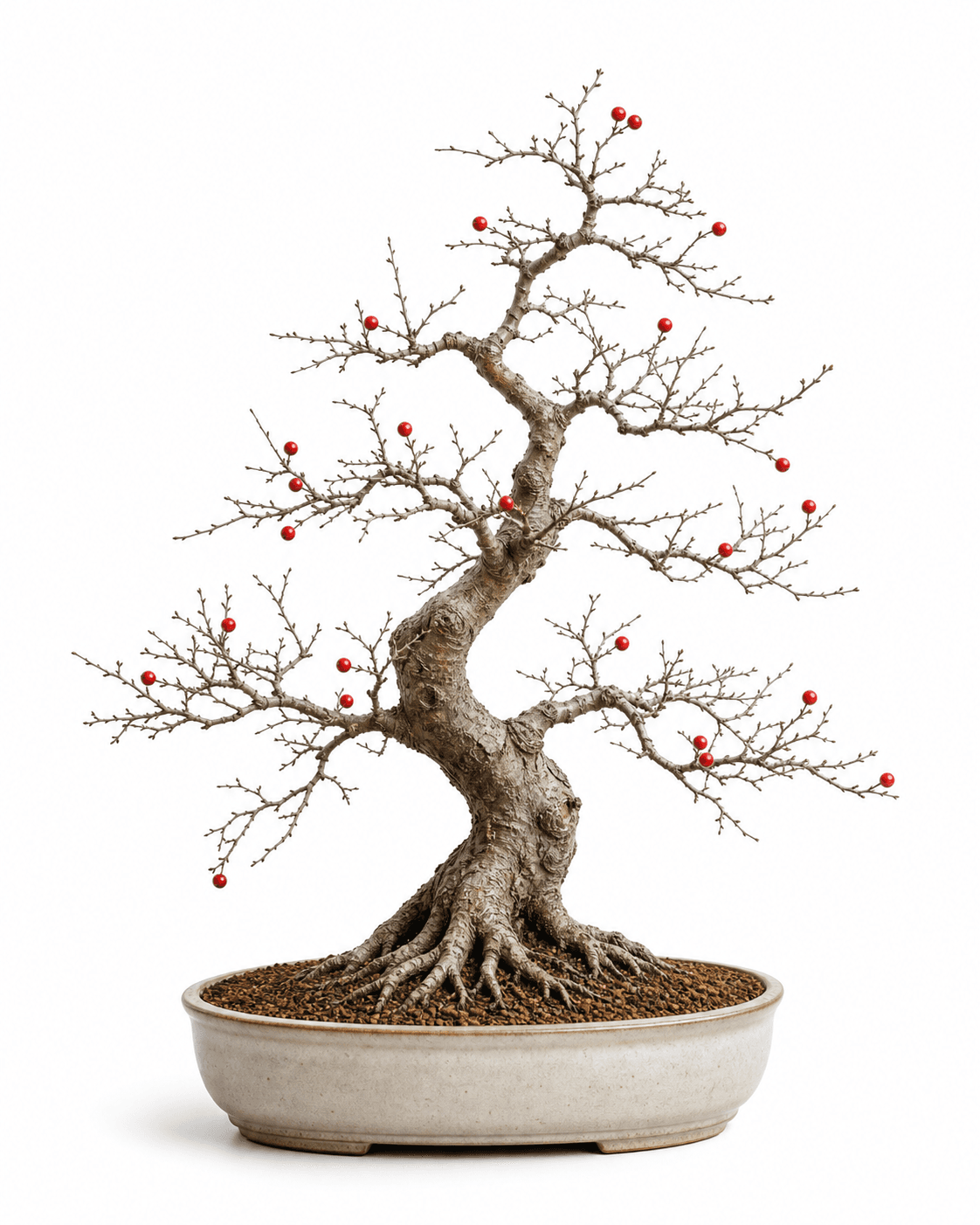
Japanese winterberry bonsai is an outdoor deciduous holly grown for fine zigzag twigs and a winter display of small berries after leaf drop. The tree can be forgiving about pruning, but fruiting depends on known female material, compatible male pollen, steady moisture, outdoor dormancy, and careful timing around flowers and berries.
The local Bonsai Mirai distilled corpus has thin direct Ilex serrata coverage, with one winter-display claim and Umemodoki references, so this guide transfers high-confidence Ilex, fruiting broadleaf, deciduous, watering, soil, repotting, wiring, propagation, energy, and design method. Species identity, range, hardiness, habit, fruit forms, and pollination facts are grounded in Kew, Dawes Arboretum, and Trees and Shrubs Online.
The practical beginner answer is yes for an outdoor grower who likes observation and can manage water. Choose Japanese winterberry for an outdoor bench, a small fruiting winter image, and a pollination setup you can actually track.
Updated June 16, 2026. Written by EntGrove Editorial. Last verified June 16, 2026.
Care fingerprint
Read the species through its shared care pattern.
Repot and structural prune around dormant-to-active transitions; protect new leaves; time refinement work after growth hardens. Use this as the starting point before local conditions and tree strength refine the calendar.
Note: Deciduous holly; fruiting display requires compatible male and female plants flowering at the same time.
Read the foliage first
Broadleaf stress usually shows in leaf color, leaf size, wilt, scorch, or delayed hardening before it becomes a branch problem.
Match work to dormancy
Deciduous, evergreen, tropical, succulent, and flowering broadleaf trees recover on different calendars.
Protect fine roots
Root work should preserve enough active fine roots for the tree to rehydrate quickly after the operation.
Care cadence
The calendar starts with the tree's seasonal state.
Placement
Timing: Grow outdoors year-round. Give winter dormancy, spring light for flowering, summer airflow, and root protection during deep freezes or drying wind.
Watch for: Warm indoor storage, frozen exposed pots, late frost after buds move, and berries shriveling on a pot that dried in winter wind.
Dawes ArboretumBonsai Mirai LibraryLight requirement
Timing: Use bright outdoor light during spring and autumn. Shift to afternoon shade during severe heat if the pot cannot stay evenly moist.
Watch for: Long internodes in shade, poor berry set, scorched leaves in hot wind, and moving the tree indoors to avoid summer stress.
Bonsai EmpireBonsai Mirai LibraryWatering
Timing: Water when the upper particles begin to dry while the root mass still carries moisture. Saturate the pot, then let oxygen return before the next cycle.
Watch for: Berry drop, wilted leaves, a dry core below a damp surface, sour compact soil, and shallow pots that dry suddenly after fruit set.
Dawes ArboretumBonsai Mirai LibraryFertilizer
Timing: Feed strongly only during development and recovery. Refined fruiting trees need moderate nutrition after growth is active, then restraint once berry display is the priority.
Watch for: Coarse shoots, weak interior buds, excessive nitrogen late in the season, and starving a tree that has just carried fruit.
Bonsai Mirai LibraryBonsai EmpireBonsai4Me Ilex guidePruning
Timing: In development, let shoots extend and harden before cutting back to useful interior growth. In refinement, prune after the first flush hardens and keep enough leaves to fund fruit.
Watch for: Pruning off flower or berry wood, full defoliation, cutting weak branches, and allowing one extension to shade out fine interior twigging.
Bonsai Mirai LibraryBonsai EmpirePollination and fruit
Timing: Keep a known female near compatible male pollen during the same spring flowering window. Protect ripening fruit from birds if winter display matters.
Watch for: Single female plants, mismatched bloom timing, different microclimates for male and female plants, birds removing fruit, and heavy fruit on a weak tree.
Dawes ArboretumBonsai EmpireBonsai4Me Ilex guideRepotting
Timing: Repot in spring as buds swell or begin to extend, before the canopy demands full water flow. Use root density and drainage to choose the amount of work.
Watch for: Heavy root reduction after a full berry crop, stale organic cores, broken-down akadama, roots drying during work, and a tree that rocks after tying.
Bonsai Mirai LibraryBonsai EmpireBonsai4Me Ilex guideWiring
Timing: Wire mainly at leaf drop, during dormancy, or before spring leaf expansion when the structure is visible. Use aluminum and inspect frequently.
Watch for: Brittle older twigs, wire scars on smooth bark, leaves knocked off during handling, and forcing a berry branch to move after it has stiffened.
Bonsai Mirai LibraryBonsai EmpireBonsai4Me Ilex guidePest and disease checks
Timing: Inspect during spring flush, humid summer growth, and berry ripening. Correct roots and airflow before repeated sprays on a weak tree.
Watch for: Aphids on soft shoots, scale on twigs, sooty residue, leaf spots, sour soil, root stress, birds, and rodents drawn by fruit.
Bonsai EmpireBonsai4Me Ilex guideBonsai Mirai LibrarySpecies guide
Apply the species profile before copying another tree's calendar.
At a glance
Japanese winterberry is a deciduous holly for outdoor winter berry display.
Ilex serrata sits in Aquifoliaceae and in the EntGrove Broadleaf > Deciduous group. Kew accepts the name, Dawes lists Japanese winterberry and finetooth holly, and bonsai circles also use Umemodoki for the winter-fruiting Japanese display plant. Kew POWODawes ArboretumBonsai Mirai Library
The essential care profile is bright outdoor culture, true dormancy, evenly moist mineral soil, spring root work, active-season pruning after growth hardens, and restraint while flowers and berries are forming. The fruit display requires female material plus compatible male pollen during the same spring window. Dawes ArboretumBonsai Mirai Library
The best bonsai use fine twigs, modest fruit, and an open winter silhouette. Shohin and small trees are common because the berries and leaves read well at that scale, but the structure still has to be built before the fruit is asked to carry the image. Bonsai EmpireBonsai Mirai / Asymmetry
Wild habitat
Its range and habit point to moist roots, temperate dormancy, and delicate winter design.
Kew gives the native range as southeast China to Sichuan and central to southern Japan, with Korea listed as introduced. Trees and Shrubs Online describes the species as native to Japan and China, and Dawes summarizes the same China and Japan distribution for cultivated collections. Kew POWOTrees and Shrubs OnlineDawes Arboretum
Dawes describes an upright to arching deciduous shrub with zigzag horizontal young stems, spring bronze-red leaves that mature green, bright red berries into winter, and tolerance of wet soil. Trees and Shrubs Online emphasizes spreading branches, fine teeth, inconspicuous flowers, and small red fruit. Dawes ArboretumTrees and Shrubs Online
For care, that means moisture is part of the identity, but stagnant bonsai soil remains dangerous. For design, the natural image is a fine deciduous shrub with visible winter twigs and fruit, so the tree should read from twig spacing and negative space before it reads from berry color. Dawes ArboretumBonsai Mirai / Asymmetry
Reading the tree
Read the tree by stage before deciding whether fruit belongs this year.
Mirai method separates primary structure, secondary scaffolding, and tertiary refinement. A young Japanese winterberry should build roots, trunk, primary branches, and interior buds before the grower protects every flower and berry. Bonsai Mirai Library
Fruiting is a cost. Mirai fruiting-tree method says fruit should be removed from unhealthy or still-developing trees because fruit drains energy that could be used for roots, branch building, and wound response. Apply that directly to winterberry if the tree is weak, recently repotted, collected, or still structural. Bonsai Mirai Library
A refined tree can carry fruit when the branch structure is already credible. Mirai notes Ilex serrata as a winter display tree whose persistent berries define exhibition value, so fruit protection matters most after the tree is strong enough to afford the display. Bonsai Mirai Library
The source-depth caveat is important. Local Mirai coverage is thin for Ilex serrata specifically, so species facts come from Kew, Dawes, and Trees and Shrubs Online, while bonsai technique transfers from Ilex, fruiting deciduous, broadleaf, watering, soil, repotting, wiring, and design files. Bonsai Mirai LibraryKew POWODawes Arboretum
Pruning and fruit
Prune for twigging first, then preserve the flower and berry cycle on refined branches.
During development, let shoots extend enough to feed the branch and make wood, then cut back after hardening to useful interior buds. Mirai post-flush deciduous method uses hardened leaves, darker color, and slowing extension as signs that the tree is energy-positive enough for pruning. Bonsai Mirai Library
During refinement, avoid full defoliation. Mirai holly method says foliage should remain on every stem so the tree keeps the photosynthetic engine needed for predictable budback, and public Japanese-winterberry bonsai sources warn that leaves power fruit production. Bonsai Mirai LibraryBonsai Empire
Pollination belongs in the pruning calendar. Dawes says both male and female plants are required for fruiting, and the bonsai-specific sources add that male and female flowers need overlapping timing. Keep male plants healthy, watered, and in similar spring conditions so bloom overlaps. Dawes ArboretumBonsai EmpireBonsai4Me Ilex guide
A strong tree can be pruned around display goals: preserve enough short flowering wood, remove overly coarse extensions after they harden, and thin enough that light reaches interior buds. A developing tree should often have fruit removed so energy returns to roots and structure. Bonsai Mirai Library
Roots
Repot in spring, then protect the fine root system from both drought and airless soil.
Repot as buds swell or begin to extend in spring. The operation is justified by root density, slowed drainage, broken-down soil, a stale nursery core, or a planned container transition, rather than by a fixed calendar alone. Bonsai Mirai LibraryBonsai EmpireBonsai4Me Ilex guide
Mirai repotting method puts the water-oxygen balance at the center of root work. Dense roots and decomposed substrate block water movement and reduce oxygen, so repotting should restore percolation and intimate contact between new soil and fine roots. Bonsai Mirai Library
For Japanese winterberry, be conservative after a heavy fruit year. Remove dead, circling, and congested roots, integrate old and new soil, tie the tree firmly, water thoroughly, and protect from heat and wind until new growth confirms recovery. Bonsai Mirai Library
Shohin and small fruiting trees can need more frequent inspection because small pots fill fast and dry fast. Older refined trees with good drainage can usually wait until roots, water movement, or vigor asks for work. Bonsai Mirai LibraryBonsai EmpireBonsai4Me Ilex guide
Soil and pot
Use a moist, oxygenated deciduous mix and a pot with enough depth for fruiting health.
Dawes notes wet-soil tolerance, but bonsai roots still need air. Mirai watering and soil method says healthy bonsai soil must hold water and nutrients while preserving oxygen and structure, with overwatering becoming dangerous when the root zone turns anaerobic. Dawes ArboretumBonsai Mirai Library
A practical training mix is akadama-led with pumice for stored moisture and lava or similar hard particle for air space. For refined winterberry, more solid akadama can support fine roots and smaller internodes if the grower controls water well. Bonsai Mirai LibraryBonsai Empire
Pot depth matters. Mirai broadleaf deciduous guidance treats flowering and fruiting species as sheen-based trees that decline in overly shallow containers because water and oxygen movement become unstable. Use deeper ovals, soft rectangles, and quiet winter-display pots before chasing shallow exhibition drama. Bonsai Mirai LibraryBonsai Mirai / Asymmetry
Pot color should recede. Warm browns, muted clay, soft gray, quiet ochre, and unglazed textures leave room for red, white, or yellow fruit. Bright glaze usually competes with the winter image unless the tree is exceptionally restrained. Bonsai Mirai / AsymmetryTrees and Shrubs Online
Climate
Adapt the same outdoor calendar to cold roots, hot summers, and spring bloom timing.
In cold regions, use Dawes Zone 5 as landscape context, then protect the bonsai pot from hard wind and repeated freeze-thaw cycles. A cold frame, mulch bed, or sheltered bench should stay cold enough for dormancy while preventing root desiccation. Dawes ArboretumBonsai Mirai Library
In hot regions, the main adjustment is root-zone cooling. Use morning sun, afternoon shade, larger training pots, topdressing, and careful watering so the tree stays bright enough to fruit without drying the small root reservoir. Bonsai Mirai LibraryBonsai Empire
In wet or humid regions, treat wet-soil tolerance as moisture tolerance rather than stale-soil permission. Keep the canopy thinned enough for airflow, use a durable particle structure, and avoid water sitting against trunk scars or deadwood. Dawes ArboretumBonsai Mirai Library
For fruiting, match microclimates between male and female plants. A male held warmer, colder, drier, or more shaded can flower out of sync, making an otherwise healthy female fail to set berries. Dawes ArboretumBonsai Empire
Pests and diseases
Inspect soft shoots, twig interiors, and root oxygen before pests distort the fine structure.
The bonsai-specific public sources both flag aphids, and Bonsai4Me also notes scale on Ilex. In practice, aphids gather on soft spring shoots, while scale hides on twigs and can create sticky residue and sooty surfaces. Bonsai EmpireBonsai4Me Ilex guide
Birds are part of the pest calendar for display. Bonsai Empire notes that birds may take berries as they color, so a winter show tree may need a protected bench, discreet cage, or planned short display window. Bonsai Empire
Root problems often look like foliage problems. Yellowing, weak extension, berry drop, or sour smell after wet weather points toward compact soil, low oxygen, or a dry hydrophobic core that is never fully rehydrated. Bonsai Mirai Library
Prevention is cultural: keep light inside the canopy, remove fallen leaves and shriveled fruit, correct watering before applying fertilizer, and separate weak material from heavily infested trees until recovery is clear. Bonsai Mirai LibraryBonsai4Me Ilex guide
Wiring
Wire fine structure when the branch can move, then remove wire before scars become permanent.
Mirai structural wiring method applies: use wire for a specific design purpose, keep a 55 to 60 degree coil angle, maintain even spacing, and keep continuous contact without constricting growth. Bonsai Mirai Library
Use aluminum as the default on this deciduous holly. Mirai wiring guidance favors aluminum on deciduous species because it is smoother on thin bark, while holly-primer method warns that older Ilex branches can be brittle and are often better handled by clip-and-grow. Bonsai Mirai Library
Leafless or reduced-leaf periods make structure visible and reduce handling damage. If wiring while leaves or berries are present, protect the display, support the branch while bending, and avoid repeated corrections at one point. Bonsai Mirai LibraryBonsai Empire
Wire removal is as important as wire application. Smooth twigs thicken quickly during active growth, and spiraling scars can remain visible for years on a winter-display tree. Bonsai Mirai Library
Propagation
Seed, cuttings, air layers, and grafts serve different winterberry goals.
Seed can produce young material for forests, clumps, and root training, but seedlings need years before trunk, twigging, and fruiting sex are useful. Seed also leaves the grower waiting to learn whether the plant is male or female. Dawes ArboretumBonsai Mirai Library
Cuttings and layers are more useful when the parent plant is a known female with good fruit or a known male that reliably overlaps bloom. They preserve the role of the plant in a pollination setup, which matters more than a generic species label. Bonsai4Me Ilex guideBonsai Mirai Library
Air layers are realistic for fixing a poor base, creating shohin material, or saving a useful branch line. Mirai air-layer method emphasizes enough leaf mass, careful aftercare, and incremental container sizing after separation so the new root system stays balanced. Bonsai Mirai Library
Grafting is mainly a problem-solving tool: adding a branch, improving rootage, or pairing a valuable fruiting top with a better base. Keep grafts clean and low-profile because winter silhouettes make technical scars easy to see. Bonsai Mirai LibraryTrees and Shrubs Online
Buying and sourcing
Buy known sex, fine twigging, healthy roots, and a winter image in progress.
The best first purchase is a known female that has fruited, plus access to a compatible male plant. Dawes says both sexes are required for fruiting, so an unsexed plant is a growth project before it is a reliable berry-display tree. Dawes Arboretum
Inspect roots before berries. Avoid stale nursery cores, loose trunks, dry root balls under a fruiting top, heavy scars near the base, and branch structures that require hard bending of mature wood. Bonsai Mirai Library
Look for short internodes, zigzag twigging, low branch choices, and fruit in scale. Trees and Shrubs Online says Ilex serrata resembles Ilex verticillata but has smaller, less bright fruit; that smaller scale can be an advantage for bonsai. Trees and Shrubs OnlineBonsai Mirai / Asymmetry
Collected or landscape material should be legal, vigorous, and root-aware. Because branch scars and deadwood show in winter, choose material whose existing cuts can become part of the design or close cleanly over time. Bonsai Mirai LibraryBonsai Mirai / Asymmetry
Troubleshooting
Most problems trace to indoor culture, water stress, pollination gaps, or fruit load.
No berries usually means the tree is male, the female lacked compatible pollen, bloom timing missed, light was weak, pruning removed flowering wood, birds took fruit early, or the tree was too young or weak to carry fruit. Dawes ArboretumBonsai EmpireBonsai4Me Ilex guide
Wilting or berry drop during summer points first to a dry root ball, hot shallow pot, hydrophobic nursery core, or recent root work. Water in repeated passes, cool the root zone, and delay pruning until recovery is obvious. Bonsai Mirai LibraryDawes Arboretum
Yellowing with wet soil suggests poor oxygen. Check drainage, soil smell, particle breakdown, pot depth, and whether roots are packed tightly enough that water cannot move through the center. Bonsai Mirai Library
Weak interior twigging usually comes from shade and overlong exterior shoots. Thin crowded zones, shorten hardened extensions, rotate the tree, and keep enough leaves to restore interior strength. Bonsai Mirai Library
Aphids, scale, and sooty residue should trigger a health audit alongside treatment. Improve airflow, wash or treat pests appropriately, and correct water and fertilizer habits that keep soft stressed growth vulnerable. Bonsai EmpireBonsai4Me Ilex guideBonsai Mirai Library
Design
Style Japanese winterberry as a quiet winter shrub with visible branch rhythm.
Mirai design method starts from habitat and material. Japanese winterberry brings arching shrub habit, zigzag young shoots, fine deciduous twigs, inconspicuous flowers, and winter fruit, so the design should feel light, seasonal, and open. Dawes ArboretumTrees and Shrubs OnlineBonsai Mirai / Asymmetry
Good styles include informal upright, slanting, clump, twin-trunk, raft, small broom-influenced deciduous, and shohin display trees. Avoid heavy conifer pad language; the foliage and fruit need a deciduous framework. Bonsai Mirai / AsymmetryBonsai Mirai Library
The defining branch should create winter movement without hiding the trunk. Fruit belongs as punctuation on a legible structure, ideally in small clusters that expose negative space rather than making the tree read as a berry crop. Bonsai Mirai / AsymmetryBonsai Mirai Library
Deadwood and carving should be restrained. Holly-primer method warns that older Ilex wounds close slowly and wet trunk areas can rot, so old cuts should be designed thoughtfully rather than expanded into decorative carving by default. Bonsai Mirai Library
Forms
Fruit color forms are real, but sex and scale matter more than novelty.
Trees and Shrubs Online documents f. leucocarpa with white fruit and f. xanthocarpa with yellow fruit. Kew also lists those form names among synonyms or infraspecific names tied to fruit color. Trees and Shrubs OnlineKew POWO
Red-fruited plants remain the common display standard, but white and yellow fruit can be powerful in a quiet pot. The same horticultural rules apply: known female material, compatible male pollen, healthy roots, and restrained fruit load. Trees and Shrubs OnlineDawes Arboretum
Separate Ilex serrata from Ilex crenata. Ilex crenata is evergreen Japanese holly with black fruit in many forms, while Japanese winterberry is grown for deciduous bare-twig fruit display. Mixing the labels creates bad timing advice. Bonsai4Me Ilex guideKew POWO
Hybrid and related winterberry labels should be verified before applying this calendar. Ilex verticillata, Ilex serrata hybrids, and other deciduous hollies can share broad fruiting method while differing in hardiness, fruit size, leaf scale, and regional behavior. Trees and Shrubs OnlineDawes ArboretumBonsai Mirai Library
History
The species has a long winter-display role, which explains its bonsai appeal.
Trees and Shrubs Online records that leafless branches were sold in large quantities in Tokyo for house decoration because the berries hang on and hold color for a long time. That cut-branch tradition maps naturally to bonsai winter display. Trees and Shrubs Online
Mirai notes Ilex serrata as a winter display tree valued for persistent berries. For bonsai, that means the highest standard is seasonal completeness: branch structure visible, berries protected, pot quiet, and health strong enough for the tree to repeat the cycle. Bonsai Mirai LibraryBonsai Mirai / Asymmetry
The plant also carries a taxonomic history in horticulture. Kew lists multiple historical names and forms, while Trees and Shrubs Online traces introduction to Kew from Yokohama in 1893 and earlier United States awareness around 1866. Kew POWOTrees and Shrubs Online
A notable Japanese winterberry bonsai should look good without berries and exceptional with them. The exhibition tree is a refined deciduous shrub first, then a fruiting winter image after pollination, pruning, and bird protection have done their work. Bonsai Mirai / AsymmetryBonsai Mirai Library
Species questions
Answer the beginner questions before styling.
Is Japanese winterberry a good beginner bonsai?
Yes, for an outdoor beginner who can water consistently and understands pollination. It becomes intermediate when the goal is reliable winter berries, shohin refinement, or exhibition timing.
Can Japanese winterberry bonsai live indoors?
Keep it outdoors. Japanese winterberry is a deciduous temperate holly that needs outdoor light, airflow, leaf drop, winter dormancy, and spring flowering cues.
Do I need male and female Japanese winterberry plants?
Yes, if berries are the goal. Female plants need compatible male pollen, and both plants need overlapping spring bloom under similar conditions.
Why did my Japanese winterberry not make berries?
Common causes include a male plant, no nearby compatible male, mismatched bloom timing, weak light, pruning off flower wood, dry roots, poor vigor, or birds taking fruit as it colors.
How much sun does Japanese winterberry bonsai need?
Use bright outdoor light for compact twigs and fruiting. In hot weather, morning sun with afternoon shade is often safer than all-day exposure in a shallow pot.
How often should I water Japanese winterberry bonsai?
Water when the upper soil particles begin to dry, then saturate the whole pot. Keep the root mass evenly moist and oxygenated, especially during flowering, fruit set, heat, and post-repot recovery.
When should I repot Japanese winterberry bonsai?
Repot in spring as buds swell or begin to extend. Inspect small and young trees annually, then do root work only when drainage, root density, soil condition, or container stage calls for it.
When should I prune Japanese winterberry bonsai?
For development, let shoots extend and harden before cutting back. For refinement, prune after the first flush hardens while preserving enough leaves and short flowering wood to support the berry cycle.
Should I fully defoliate Japanese winterberry?
Avoid full defoliation as routine care. Use selective thinning and partial leaf reduction only on strong refined zones, because leaves power roots, buds, flowers, and fruit.
What styles suit Japanese winterberry bonsai?
Shohin, small informal upright, slanting, clump, twin-trunk, raft, and quiet deciduous winter-display styles suit it best. The strongest trees show good structure before berries are considered.
Sources
Species advice needs source discipline.
Next decisions
Plan the operation before copying the calendar.
A good care note for Japanese winterberry records the tree's stage, the work done, and the aftercare used. That record matters more than a month-name rule.
Related species
Compare nearby trees before transferring advice.
Japanese maple
Acer palmatum
Trident maple
Acer buergerianum
Amur maple
Acer tataricum subsp. ginnala
Field maple
Acer campestre
Korean hornbeam
Carpinus turczaninovii