
Species guide
Japanese White Birch Bonsai Care
Betula pendula subsp. mandshurica
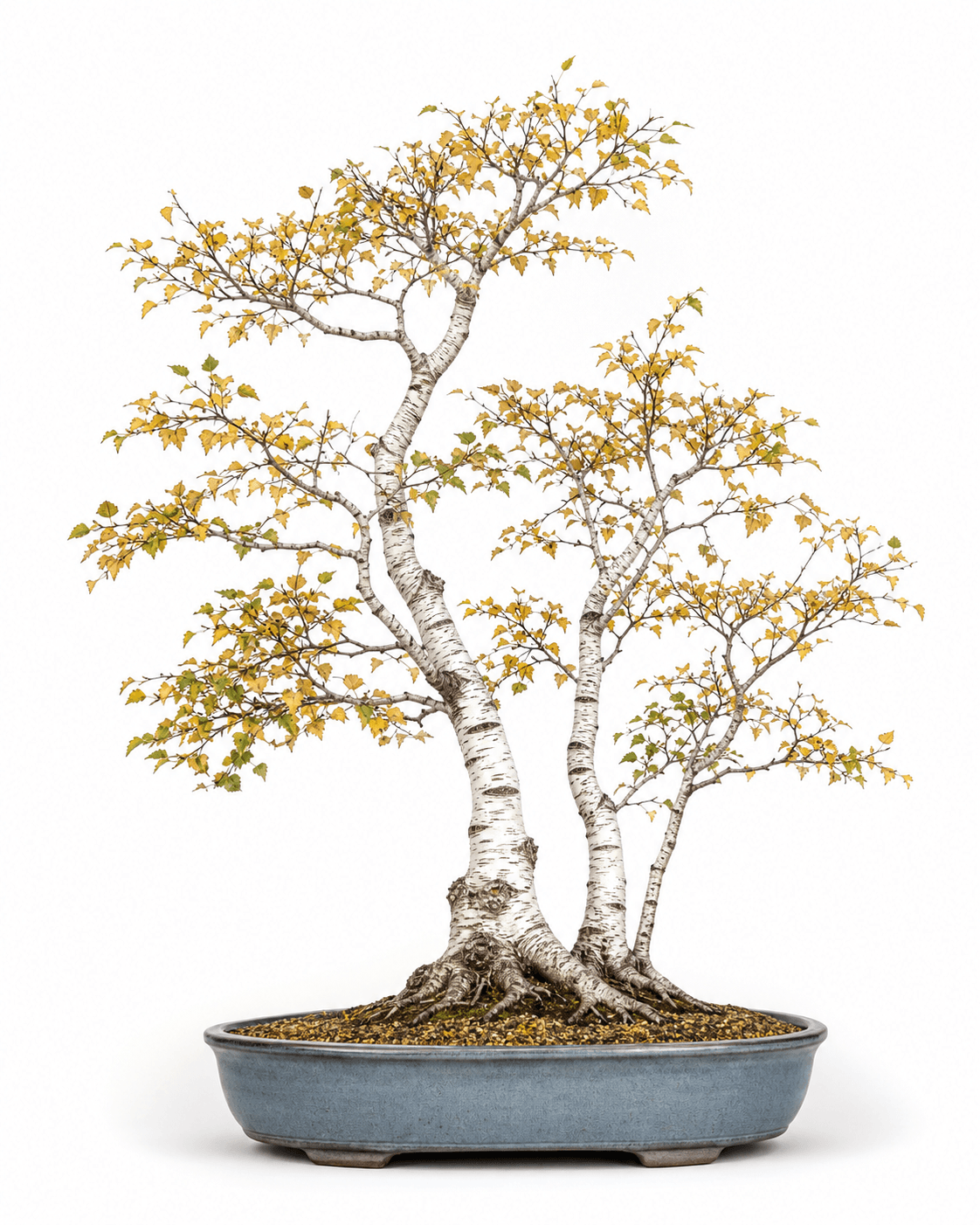
Japanese white birch bonsai is a cool-climate outdoor deciduous tree grown for white bark, light branching, yellow autumn color, and naturalistic group or informal-upright images. Success depends on bright air, cool moist roots, oxygenated soil, frequent active-season pruning, and careful wound management.
The local Bonsai Mirai distilled corpus has direct Betula and birch-method support at the genus level, especially for dieback-prone high-water-mobility deciduous work, river-birch shohin design, pruning cadence, root handling, wiring, and design. This guide applies those Mirai methods to the accepted Japanese white birch identity and horticulture documented by Kew, NC State, UConn, Missouri Botanical Garden, Oregon State, and Oregon Department of Forestry.
The practical beginner answer is selective. Choose Japanese white birch when you can keep a tree outdoors, protect the pot from severe heat and winter wind, water consistently, and design around possible dieback. Warm indoor growing, hot exposed balconies, and material that needs one large trunk chop are poor matches.
Updated June 16, 2026. Written by EntGrove Editorial. Last verified June 16, 2026.
Care fingerprint
Read the species through its shared care pattern.
Repot and structural prune around dormant-to-active transitions; protect new leaves; time refinement work after growth hardens. Use this as the starting point before local conditions and tree strength refine the calendar.
Note: Kew accepts Betula pendula subsp. mandshurica and treats Betula platyphylla as a synonym; horticultural and bonsai sources still commonly use Betula platyphylla.
Read the foliage first
Broadleaf stress usually shows in leaf color, leaf size, wilt, scorch, or delayed hardening before it becomes a branch problem.
Match work to dormancy
Deciduous, evergreen, tropical, succulent, and flowering broadleaf trees recover on different calendars.
Protect fine roots
Root work should preserve enough active fine roots for the tree to rehydrate quickly after the operation.
Care cadence
The calendar starts with the tree's seasonal state.
Placement
Timing: Grow outdoors year-round. Give bright air, rain exposure when useful, winter dormancy, and pot protection during severe freezes, drying wind, or repeated thaw-freeze cycles.
Watch for: Warm indoor storage, hot pavement, frozen shallow pots, root balls drying in winter wind, and assuming landscape hardiness equals container hardiness.
Missouri Botanical GardenNC State ExtensionBonsai Mirai LibraryLight requirement
Timing: Use full sun during cool weather and mild summers. Shift to afternoon shade, a cooler bench, or a larger training container when heat pushes the pot beyond the root system capacity.
Watch for: Weak shaded interior branches, summer leaf scorch, dry white bark on the sun side of the pot, and delayed white-bark character from growing trunks in deep shade.
UConn Plant DatabaseMissouri Botanical GardenBonsai Mirai LibraryWatering
Timing: Water thoroughly whenever the upper particles begin to dry during active growth. Saturate the root mass, then allow oxygen to return through the soil column before the next pass.
Watch for: A dry core below a wet surface, top dieback after drought, sour stale soil, and hot afternoons when foliar mass outruns the small root reservoir.
NC State ExtensionMissouri Botanical GardenBonsai Mirai LibraryFertilizer
Timing: Feed according to stage. Build trees can receive steady organic nutrition after growth is active; refined trees get moderate feeding after the first flush hardens and light fertilizer after repotting recovery is visible.
Watch for: Coarse vertical shoots, strong tips with weak interiors, fertilizer on freshly cut roots, and late soft growth entering winter.
Bonsai Mirai LibraryPruning
Timing: For dieback-prone birch, prune new shoots after they harden and before they run unchecked. Repeat short cutbacks through active growth to keep interior buds and branches alive.
Watch for: Large unsealed cuts, spring sap bleeding, one long leader stealing all vigor, interior yellowing, and losing a critical branch after a single severe reduction.
Bonsai Mirai LibraryNC State ExtensionUConn Plant DatabasePost-flush refinement
Timing: After the first flush hardens, prune back to useful nodes and partially reduce the largest leaves only on strong refinement zones. Keep enough leaf surface to power recovery and roots.
Watch for: Full defoliation on a weak tree, removing all shade from bark during heat, and treating interior yellowing as autumn color.
Bonsai Mirai LibraryRepotting
Timing: Repot in spring as buds swell or start to extend and before the canopy demands full summer water. Use the interval as an inspection rhythm, with actual root work justified by drainage, density, and vigor.
Watch for: Broken-down akadama, compacted field soil, root reduction paired with hard top reduction, exposed roots drying during work, and a tree that can move in the pot afterward.
Bonsai Mirai LibraryWiring
Timing: Wire committed young branches while they are hydrated and flexible, often at bud movement or fall leaf drop. Inspect often because birch thickens quickly when healthy.
Watch for: Wire bite, weak branches dying after bending, leaf undersides turned toward the sun after wiring in leaf, and heavy bends near old dieback.
Bonsai Mirai LibraryPest and disease checks
Timing: Inspect during spring flush, summer heat, and any period of drought stress. Keep top dieback, crown thinning, aphids, leaf miners, skeletonizer, leaf spot, and bronze birch borer on the checklist.
Watch for: D-shaped borer exit holes, galleries under bark, thinning upper canopy, drought-like dieback, stale roots, and the false comfort of a borer-resistant nursery claim.
NC State ExtensionUConn Plant DatabaseOregon Department of ForestryOregon State Landscape PlantsSpecies guide
Apply the species profile before copying another tree's calendar.
At a glance
Japanese white birch is an outdoor broadleaf deciduous tree for cool benches and bark-first designs.
Betula pendula subsp. mandshurica sits in Betulaceae and in the EntGrove Broadleaf > Deciduous group. Kew accepts the subspecies and lists Betula platyphylla among its synonyms, while nursery and older horticultural sources still use Japanese white birch, Asian white birch, Manchurian birch, and Betula platyphylla. Kew POWONC State ExtensionOregon State Landscape Plants
The bonsai appeal is immediate: white bark, fine branch tracery, yellow autumn color, and a northern woodland feeling. The tradeoff is equally clear. UConn says Asian white birch dislikes excessive summer heat, NC State emphasizes consistently moist cool roots, and Oregon Department of Forestry links bronze birch borer damage to drought-like stress. UConn Plant DatabaseNC State ExtensionOregon Department of Forestry
Use full sun in cool weather, afternoon shade in heat, free-draining moisture-retentive soil, spring root work, active-season pruning, careful wiring, and winter pot protection. Best styles are informal upright, clump, twin-trunk, raft, forest, and slender shohin from material built for small scale. Missouri Botanical GardenNC State ExtensionBonsai Mirai LibraryBonsai Mirai / Asymmetry
Wild habitat
The wild and landscape notes point to cool roots, open light, and white-bark character.
Kew gives a broad accepted-range picture from Central Siberia to Japan and Alaska to Canada. Landscape profiles under Betula platyphylla narrow the familiar Japanese white birch image around Manchuria, Korea, Japan, central and eastern Siberia, and related cool-temperate regions. Kew POWOMissouri Botanical GardenOregon State Landscape Plants
Missouri Botanical Garden says the tree performs best in cool northern climates where summer temperatures rarely exceed 75 F and root zones are snow-covered in winter. In bonsai terms, that means summer root-zone management matters as much as branch technique. Missouri Botanical Garden
Design should start from that ecology: pale bark, slender trunks, open crown, light shade, early bud break, and seasonal dormancy. A convincing birch bonsai often reads as a grove edge, a cool upland tree, or a young forest composition rather than a heavy old oak image. Oregon State Landscape PlantsUConn Plant DatabaseBonsai Mirai / Asymmetry
Reading the tree
Read birch as a high-water-mobility, dieback-prone deciduous tree.
Mirai identifies birch as a high-water-mobility deciduous species and repeatedly groups it with trees that can die back after large cuts or unchecked growth. Once a branch loses water conductivity, the tree can abandon that tissue rather than heal it cleanly. Bonsai Mirai Library
Development trees need extension, leaf mass, and root growth to build trunk, bark, and primary branches. Refinement trees need earlier decisions: branch selection, repeated cutback, partial leaf reduction on strong zones, and wire removal before thickening bites. Bonsai Mirai Library
Interior yellowing in midsummer deserves context. Mirai notes birch can shed shaded interior leaves through ethylene-driven abscission during summer. Treat that as a warning to improve light distribution and pruning cadence before interior branches are lost. Bonsai Mirai Library
Pruning
Prune often enough that birch never has to recover from one brutal cut.
The Mirai method for easy-dieback deciduous species is frequent short pruning. Let a shoot extend to roughly three to five internodes, wait until leaves harden, then cut back to useful interior nodes before the branch monopolizes resources. Bonsai Mirai Library
For structural reductions, leave a stub beyond the final line and preserve live growth near the cut. Mirai describes staged cutback over time for high-water-mobility species so living tissue can maintain conductivity, compartmentalize, and close without a dead dry strip running farther than intended. Bonsai Mirai Library
Spring bleeding changes timing. NC State and UConn warn against pruning during sap flow, and Mirai says bleeding broadleaf deciduous cuts should stop work until the tree is safer to prune. Use active-season cutback after hardening for vigor control, and reserve fall leaf-drop work for balanced structural refinement when local climate allows healing before hard freezes. NC State ExtensionUConn Plant DatabaseBonsai Mirai Library
Use partial defoliation as a refinement tool on strong zones after hardening. Reduce the largest outer leaves to rebalance light and vigor, while keeping enough leaf surface for root work, wound healing, and heat tolerance. Bonsai Mirai Library
Roots
Repot in spring and protect the water supply from the first cut.
Mirai places birch with high-water-mobility deciduous species that tolerate flat root work and shallow containers once the root system is dense and healthy. The root pad still has to be built deliberately so it can move water fast and evenly. Bonsai Mirai Library
Repot in spring as buds swell or start to extend, before full leaf demand arrives. Choose the operation because roots are dense, water no longer penetrates evenly, old field soil holds a stale core, or the tree is ready for a stage change from nursery container to training pot or from training pot to bonsai container. Bonsai Mirai Library
Keep roots damp during the work, remove dead and circling roots cleanly, integrate old and new soil so water crosses the whole root mass, and tie the tree firmly. A birch that rocks after repotting breaks new roots and then shows the problem as leaf scorch or top dieback weeks later. Bonsai Mirai LibraryNC State Extension
Avoid stacking operations. A collected or field-grown birch that needs structural cuts and root correction should usually receive those operations in separate years unless vigor is exceptional. The root system has to fund compartmentalization after each cut. Bonsai Mirai Library
Soil and pot
Use mineral soil that stays moist without suffocating the fine roots.
The horticultural sources agree on moisture. NC State recommends moist acidic sandy, rocky, or well-drained loams; Missouri recommends medium to wet well-drained soil and cool moist roots; UConn says moist soil is needed for good growth. NC State ExtensionMissouri Botanical GardenUConn Plant Database
The bonsai translation is moisture with oxygen. Akadama-led deciduous mixes suit refinement because they support fine root division and nutrient exchange; pumice or a coarser mineral blend can help development trees and collected material recover while preserving air space. Bonsai Mirai Library
Pot choice is a horticultural decision before it is a display decision. Development trees need deeper or wider containers for water reserve and heat buffering. Refined trees can move shallower after the root pad is dense enough to keep leaves firm through summer. Bonsai Mirai LibraryMissouri Botanical Garden
For display, quiet unglazed or muted glazed ovals, shallow rectangles, and slab or tray settings can support the white bark and autumn yellow. A warm yellow glaze can echo fall color, but the pot should recede behind the bark line and branch spacing. Bonsai Mirai / Asymmetry
Climate
Cool-climate growers start ahead; warm-region growers must manage the root zone.
In cool northern regions, Japanese white birch can receive more sun and a longer development push. Winter protection still matters because a pot lacks the thermal buffer and snow cover assumed in landscape hardiness ranges. Missouri Botanical GardenOregon State Landscape PlantsBonsai Mirai Library
In hot summer regions, use morning sun, afternoon shade, a pale or shaded pot, bench spacing with airflow, and a container large enough to keep roots cool. Missouri specifically recommends afternoon shade and root-zone cooling in St. Louis, where heat and humidity shorten performance. Missouri Botanical GardenNC State Extension
In dry regions, the root ball can dry faster than the surface suggests. Water in multiple passes, check the weight of the container, and avoid placing a thirsty birch where hot wind strips moisture every afternoon. Bonsai Mirai LibraryOregon Department of Forestry
In humid regions, watch leaf spots, mildew, and weak interior growth. Keep the canopy open enough for light and air, and avoid confusing summer interior yellowing with a harmless seasonal color change. NC State ExtensionBonsai Mirai Library
Pests and diseases
Bronze birch borer is the pest that changes the whole care plan.
NC State lists bronze birch borer as a serious pest and also names aphids, leaf miner, birch skeletonizer, and leaf spot. UConn also flags bronze birch borer, ice and snow damage, and heat or drought intolerance. NC State ExtensionUConn Plant Database
Oregon Department of Forestry explains why stress prevention is pest prevention: bronze birch borer larvae feed under bark, reducing food movement to roots and causing top dieback. Drought-like conditions, too much direct sun, root damage, compaction, and lack of moisture all raise susceptibility. Oregon Department of Forestry
The bonsai prevention pattern is cultural first: cool moist roots, full hydration before heat, no stale anaerobic soil, no repeated severe cuts, quick wound sealing, and fast action when the upper canopy thins. D-shaped exit holes, galleries under bark, and progressive topkill deserve urgent diagnosis. Oregon Department of ForestryBonsai Mirai Library
Leaf pests and fungal issues should still be handled through fundamentals: airflow, clean benches, removal of fallen leaves, enough light inside the canopy, and root-zone correction before repeated sprays on a weak tree. NC State ExtensionBonsai Mirai Library
Wiring
Wire the structure early, then let clip-and-grow carry refinement.
Mirai birch shohin work supports copper wire on birch because the bark can tolerate firm holding power better than very delicate smooth-bark species. Use that permission carefully: young hydrated branches move best, and visible wire pressure should trigger removal before swelling scars the bark. Bonsai Mirai Library
Structural wiring belongs on branches already chosen for the design. Avoid wiring weak interior shoots simply because they are available; a slow branch can be kept alive by light and pruning rhythm before it is asked to hold a bend. Bonsai Mirai Library
Wire angle, spacing, and contact still follow the fundamentals: roughly 55 to 60 degrees, even spacing, continuous contact without constriction, and enough gauge to hold the bend in one application. Under-gauged wire invites repeated corrections that damage deciduous tissue. Bonsai Mirai Library
When wiring in leaf, rotate branches so leaves face upward after the bend. Mirai warns that leaf undersides can burn when suddenly exposed to direct sun, and birch already has little margin for extra summer stress. Bonsai Mirai Library
Propagation
Seed, cuttings, grafts, clump division, and air layers all have a place.
Seed is available from late-summer catkins, but seedlings need years of trunk and bark development. Seed-grown material is useful for forests, clumps, local adaptation, and root work because young birch grows quickly and can be selected early. NC State ExtensionMissouri Botanical GardenBonsai Mirai Library
NC State lists stem cuttings as a propagation strategy, and UConn says propagation is by cuttings with cultivars grafted on seedlings. Cuttings preserve a known plant, while grafts can introduce a cultivar and also introduce a graft union that may be unacceptable for bonsai. NC State ExtensionUConn Plant Database
Mirai birch shohin work notes that established birch clump seedlings can be separated into individuals or composed as forests, with earlier separation producing better long-term results. That makes young clump material especially useful for growers who want a forest without collecting old trunks. Bonsai Mirai Library
Air layers are realistic for better bases, shohin starts, and branch material with movement. Mirai air-layer method stresses leaf mass, correct container sizing after separation, and incremental up-potting so new fleshy roots keep water and oxygen in balance. Bonsai Mirai Library
Buying and sourcing
Buy cool-grown roots, low branch options, and a verified label.
A good Japanese white birch candidate has a healthy root ball, white or developing bark in proportion to the design, low live buds or branches, visible interior growth, and a trunk that can become a bonsai without one drastic chop. Bonsai Mirai / AsymmetryBonsai Mirai Library
Avoid upper-crown thinning, D-shaped exit holes, bark galleries, root damage, stale organic field cores, and nursery stock kept on hot pavement. Oregon Department of Forestry links borer susceptibility with drought-like stress, direct sun, root damage, and compaction. Oregon Department of ForestryNC State Extension
Verify cultivar and species labels. Dakota Pinnacle can be useful cold-climate columnar stock, but the columnar habit still needs branch selection. Whitespire is especially confusing because Oregon State treats it as Betula populifolia rather than Betula platyphylla. UConn Plant DatabaseOregon State Landscape Plants
Collected or field-grown birch should be legal, vigorous, and root-aware. Choose material with enough fine roots near the trunk and enough foliage to recover. A large trunk with no low growth and a distant root system is a high-risk recovery project. Bonsai Mirai Library
Troubleshooting
Symptoms usually trace back to heat, water, roots, timing, or borers.
Top dieback points first to drought stress, heat, root damage, compacted soil, severe cuts, or bronze birch borer. Check watering history, root-zone temperature, drainage, D-shaped exit holes, and whether dieback begins in the upper canopy. Oregon Department of ForestryNC State ExtensionBonsai Mirai Library
Midsummer interior yellowing can be shade-driven abscission in birch. Open the canopy, prune strong exterior shoots after hardening, and restore light to interior buds before those branches are abandoned. Bonsai Mirai Library
Leaves wilting despite wet soil usually means root oxygen is failing or the core is hydrophobic and only the surface is wet. Water in multiple passes, check percolation, and plan a spring repot if the root ball has a stale center. Bonsai Mirai LibraryNC State Extension
Bleeding from cuts means the timing is wrong for that branch. Stop pruning, seal appropriate wounds, let the first flush harden, and resume with smaller cuts only when the tree has recovered. NC State ExtensionUConn Plant DatabaseBonsai Mirai Library
Weak lower branches usually reflect shade, excessive upper vigor, poor branch selection, or a bend that damaged conductivity. Reduce strong leaders, restore light, and keep spare branches until the design proves which lines remain viable. Bonsai Mirai Library
Design
Let bark, spacing, and cool-forest character do the visual work.
Mirai design method starts with where the tree lives. For Japanese white birch, the defining image is pale bark, fine twigging, light canopy, vertical or slightly leaning trunks, and seasonal openness. Bonsai Mirai / AsymmetryUConn Plant DatabaseOregon State Landscape Plants
Strong design options include informal upright, twin trunk, clump, forest, raft, exposed-root from young material, and shohin built from air layers or young clumps. A single massive trunk usually asks for more reduction than birch wound behavior comfortably supports. Bonsai Mirai LibraryBonsai Mirai / Asymmetry
Branch placement should stay deciduous: upward and outward, with billowy mass above the branch structure and asymmetry created by spacing, height, and trunk rhythm. Pine-style downward pads fight the natural birch image. Bonsai Mirai LibraryBonsai Mirai / Asymmetry
Deadwood is rarely the centerpiece. Birch decay and dieback behavior make large carved features risky, while white bark and trunk spacing already provide age cues. If carving exists on old material, keep it subordinate and make health the priority. Bonsai Mirai Library
Cultivars and forms
The white-barked birch label often hides a different plant.
Fargo, sold as Dakota Pinnacle, appears in UConn and Oregon State notes as a narrow hardy selection. It can be useful where a vertical forest or slender informal upright is desired, but its natural columnar habit still needs bonsai branch construction. UConn Plant DatabaseOregon State Landscape Plants
Whitespire deserves caution. UConn discusses it under Betula platyphylla, while Oregon State says Whitespire was once thought to be Betula platyphylla var. japonica and is now considered a selection of Betula populifolia. Treat Whitespire as a separate identity question before applying this calendar. UConn Plant DatabaseOregon State Landscape Plants
Crimson Forest appears in NC State as a cultivar or variety entry. Purple or unusual foliage can be attractive, but bonsai value still depends on internodes, roots, branch placement, bark, and long-term vigor. NC State ExtensionBonsai Mirai / Asymmetry
Other birches such as river birch, paper birch, European white birch, and Himalayan birch can share broad method but differ in heat tolerance, bark, borer susceptibility, leaf scale, and hardiness. Confirm the species before setting winter and pest assumptions. Oregon State Landscape PlantsOregon Department of Forestry
History
Birch bonsai is strongest when it leans into seasonal northern character.
Japanese white birch entered horticultural writing under Betula platyphylla and related names before Kew accepted the current subspecies treatment. The continued trade use of Betula platyphylla is a practical reminder that bonsai labels often lag taxonomy. Kew POWOOregon State Landscape Plants
As a landscape tree, the species is valued for smooth white bark, early bud break, an open crown, spring catkins, and yellow fall color. Those traits transfer directly to bonsai display: winter bark, spring movement, summer lightness, and autumn color. NC State ExtensionUConn Plant DatabaseMissouri Botanical Garden
Notable birch bonsai tend to succeed through forest feeling, clump rhythm, bark contrast, and refined proportion rather than extreme age. A clean small forest with varied trunk diameter can tell the story better than an over-reduced single trunk. Bonsai Mirai / AsymmetryBonsai Mirai Library
The exhibition standard is restraint: a quiet pot, open winter silhouette, white bark visible through the branch structure, and enough negative space for the species to read as birch before it reads as technique. Bonsai Mirai / Asymmetry
Species questions
Answer the beginner questions before styling.
Is Japanese white birch a good beginner bonsai?
It is a reasonable beginner project for an outdoor grower in a cool or well-managed climate. Chinese elm, ficus, and dwarf jade are easier first trees because Japanese white birch reacts strongly to heat, drought, pruning wounds, and branch dieback.
What is the correct scientific name for Japanese white birch?
Kew accepts Betula pendula subsp. mandshurica and lists Betula platyphylla as a synonym. Many nursery and bonsai sources still use Betula platyphylla, Asian white birch, or Manchurian birch.
Can Japanese white birch bonsai live indoors?
Keep Japanese white birch outdoors. It needs bright light, air movement, seasonal leaf drop, winter dormancy, and cool root conditions that a normal indoor room cannot provide.
How much sun does Japanese white birch bonsai need?
Use full sun in cool weather and mild summers. In hot regions, give morning sun and afternoon shade or a cooler bench while keeping the tree outside.
How often should I water Japanese white birch bonsai?
Water whenever the upper particles start to dry during active growth. The goal is evenly moist, well-aerated soil, with water moving through the whole root mass and oxygen returning afterward.
When should I prune Japanese white birch bonsai?
Prune new shoots after they harden, often multiple times during active growth. Avoid heavy cuts during spring sap flow, seal larger wounds, and leave enough nearby live growth to support compartmentalization.
When should I repot Japanese white birch bonsai?
Repot in spring as buds swell or begin to extend, usually every 2 years in refinement and every 2 to 3 years in vigorous development when drainage or root density justifies the work.
Why do birch bonsai branches die back?
Dieback can follow broken water conductivity, hard pruning, unchecked tip vigor, weak roots, heat, drought, stale soil, bending damage, or bronze birch borer. Keep spare branch options until the design proves itself.
Should I fully defoliate Japanese white birch?
Use partial leaf reduction on strong refinement zones after the spring flush hardens. Full defoliation is too much stress for many birch trees, especially after repotting, heat, drought, or recent structural work.
What styles suit Japanese white birch bonsai best?
Informal upright, twin trunk, clump, raft, forest, slender literati, and shohin from young or layered material suit Japanese white birch best. The strongest designs emphasize pale bark, open spacing, and seasonal lightness.
Sources
Species advice needs source discipline.
Next decisions
Plan the operation before copying the calendar.
A good care note for Japanese white birch / Asian white birch records the tree's stage, the work done, and the aftercare used. That record matters more than a month-name rule.
Related species
Compare nearby trees before transferring advice.
Japanese maple
Acer palmatum
Trident maple
Acer buergerianum
Amur maple
Acer tataricum subsp. ginnala
Field maple
Acer campestre
Korean hornbeam
Carpinus turczaninovii