
Species guide
Littleleaf Linden Bonsai Care
Tilia cordata
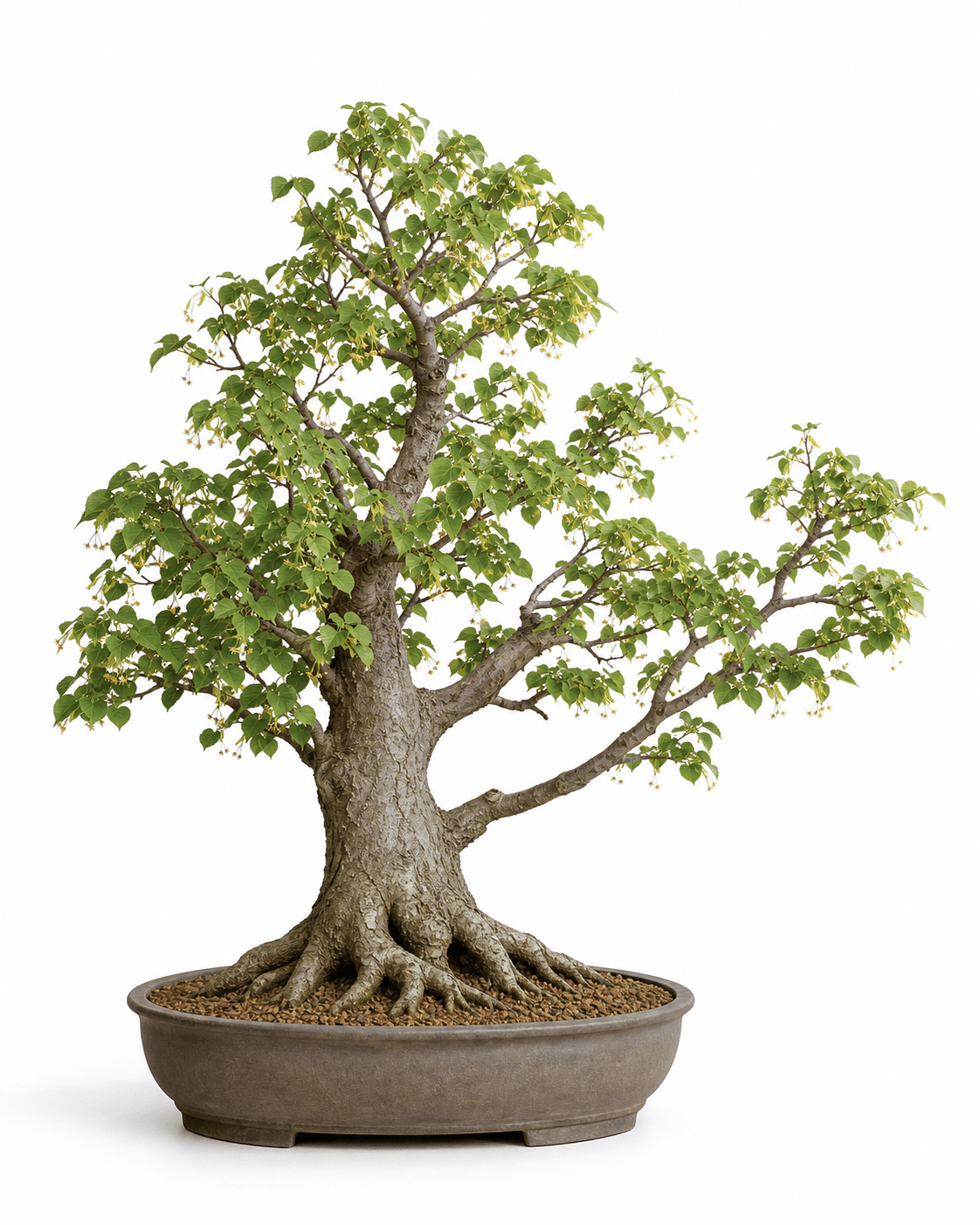
Littleleaf linden bonsai should be grown outdoors as a temperate deciduous broadleaf with strong water movement, soft bark, large leaves that reduce through pruning, and a natural habit that moves up and outward. It rewards growers who can water generously, prune by growth stage, and protect tender bark and roots in seasonal transitions.
This page covers Tilia cordata, also sold as littleleaf linden, little-leaf linden, small-leaved lime, small leaf lime tree, or little basswood. Kew accepts Tilia cordata Mill. in Malvaceae, with a native range from Europe to Central Siberia and northern Iran.
The local Mirai corpus has direct linden coverage in refinement, fall styling, secondary structure, deciduous styling, deciduous structure, and clump design files. Kew, NC State, Oregon State, Purdue, and EUFORGEN ground taxonomy, habitat, hardiness, leaves, flowers, pests, and cultivar context.
Updated June 17, 2026. Written by EntGrove Editorial. Last verified June 17, 2026.
Care fingerprint
Read the species through its shared care pattern.
Repot and structural prune around dormant-to-active transitions; protect new leaves; time refinement work after growth hardens. Use this as the starting point before local conditions and tree strength refine the calendar.
Note: Outdoor deciduous Tilia page; small-leaved lime/linden labels usually point here, but cultivar and graft status should be checked before applying bonsai-size advice.
Read the foliage first
Broadleaf stress usually shows in leaf color, leaf size, wilt, scorch, or delayed hardening before it becomes a branch problem.
Match work to dormancy
Deciduous, evergreen, tropical, succulent, and flowering broadleaf trees recover on different calendars.
Protect fine roots
Root work should preserve enough active fine roots for the tree to rehydrate quickly after the operation.
Care cadence
The calendar starts with the tree's seasonal state.
Placement
Timing: Grow outdoors through a full temperate season. Use cold-frame, mulch, or sheltered bench protection when refined roots, recent work, small pots, or local lows make the root ball less hardy than a landscape tree.
Watch for: Warm indoor storage, early greenhouse bud break, winter wind across shallow pots, and assuming USDA landscape zones protect refined bonsai roots.
Bonsai Mirai LibraryNC State ExtensionPurdue ArboretumOregon State Landscape PlantsLight requirement
Timing: Use full sun to partial shade. Push light when watering can keep pace, then add afternoon protection during hot wind, recent root work, or small-pot stress.
Watch for: Long internodes in shade, leaf scorch from dry roots, sun on newly exposed soft bark after structural pruning, and interior buds shaded by a dense crown.
NC State ExtensionPurdue ArboretumBonsai Mirai LibraryWatering
Timing: Water when surface particles begin to dry, then saturate the whole pot. Increase frequency with full spring leaf mass, hot wind, shallow containers, and akadama-heavy refinement soil.
Watch for: Hot-day wilt, dry old nursery cores, water that runs around the root ball, stale wet pockets, root rot, and confusing landscape drought tolerance with bonsai-pot safety.
Bonsai Mirai LibraryNC State ExtensionEUFORGENFertilizer
Timing: Feed by stage. Build trunks, wound closure, and primary branches with stronger active-season nutrition, then moderate feeding after first-flush hardening when shorter internodes and smaller leaves matter.
Watch for: Coarse internodes on refined trees, late soft growth before frost, weak response after repeated cuts, and fertilizer pushed before a repotted tree resumes root function.
Bonsai Mirai LibraryPruning
Timing: For refined deciduous work, prune at natural leaf drop once enough leaves have released and finish inside the 2 to 3 week post-drop window. For development, allow recovery extension after major cuts, then select response growth.
Watch for: Spring pruning that strengthens already-strong shoots, late pruning after the redistribution window closes, cutting back before collars form, and crowded junctions that swell into knobs.
Bonsai Mirai LibraryLeaf work
Timing: On strong established zones, prune shoots to two leaves, then reduce the remaining leaf area by roughly two-thirds. Leave selected branches fully leafed when thickening or wound closure still matters.
Watch for: Whole-tree defoliation on weak material, leaf work right after repotting, summer heat shutting down the expected second flush, and removing the leaves needed to heal large cuts.
Bonsai Mirai LibraryWiring
Timing: Use padded copper for structural moves on fleshy linden wood and aluminum for finer secondary work. Check wire from first-flush hardening onward, usually May to June in the northern hemisphere.
Watch for: Wire bite on soft bark, rewiring over the same contact point, stretch marks during bends, brittle young shoot junctions, and heavy movement before the tree has recovered from root or structural work.
Bonsai Mirai LibraryRepotting
Timing: Repot around spring bud movement or after winter solstice behavior has shifted toward root productivity. Use 2-year inspection for young or shallow-pot trees, with 3 years possible when drainage and vigor stay strong.
Watch for: Slow drainage, compacted field clay, root work after leaf expansion, combining major root work with major styling, and keeping refined linden in stale soil because the top still looks vigorous.
Bonsai Mirai LibraryPest and disease checks
Timing: Inspect during spring flush, hot dry weather, humid leaf-spot weather, summer Japanese beetle season where present, and after any period of weak roots or weak light.
Watch for: Aphids, scale, leaf miners, lace bugs, caterpillars, Japanese beetles, spider mites, powdery mildew, anthracnose, leaf spots, canker, Verticillium wilt, and root rot.
NC State ExtensionPurdue ArboretumBonsai Mirai LibrarySpecies guide
Apply the species profile before copying another tree's calendar.
At a glance
Littleleaf linden is a vigorous outdoor deciduous bonsai with generous water demand and soft bark.
Botanical target: Tilia cordata Mill., family Malvaceae. Use this page for littleleaf linden, little-leaf linden, small-leaved lime, small leaf lime tree, and little basswood labels when the plant is confirmed as Tilia cordata. Kew POWONC State ExtensionOregon State Landscape Plants
Care summary: outdoor deciduous culture, full sun to partial shade, moist oxygenated roots, spring root work, fall leaf-drop pruning for refinement, careful padded wiring, and medium to large bonsai scale. NC State lists USDA Zones 3b to 7b, while a refined bonsai pot still deserves winter root protection. NC State ExtensionPurdue ArboretumOregon State Landscape PlantsBonsai Mirai Library
Best fit: an outdoor grower who enjoys repeated pruning, water checks, and staged deciduous design. The species can be forgiving during first root transition, but old wounds, bark scars, and coarse growth become permanent when the work is rushed. Bonsai Mirai LibraryBonsai Mirai / Asymmetry
Wild habitat
Read littleleaf linden as a cool-moist forest tree with broadleaf upward movement.
Kew gives Tilia cordata a native range from Europe to Central Siberia and northern Iran. EUFORGEN narrows the ecological picture: small-leaved lime is a long-lived deciduous tree native to Europe, with a distribution strongly influenced by temperature and a northern limit in Finland and Norway. Kew POWOEUFORGEN
The habitat implication is steady root moisture with drainage. EUFORGEN says the tree thrives in well-drained fertile loamy sites and cool moist environments, while NC State says it prefers loamy, moist, well-drained soils and needs watering during dry spells. EUFORGENNC State Extension
The design implication is equally important. Mirai linden files describe an acutely up-and-out growth habit, tight basal internodes, bright red new growth that hardens through orange and gray, and yellow fall color. Let the tree read as an old broadleaf with rising branches and billowing density, not as a conifer pad system. Bonsai Mirai LibraryBonsai Mirai / Asymmetry
Reading the tree
Separate development from refinement before you prune.
In development, linden wants one clear structural direction at a time. Mirai broadleaf method gives field-grown deciduous material a first recovery phase after repotting, then a decisive structural cutback while roots and vigor can still support wound closure and adventitious buds. Bonsai Mirai Library
In refinement, keep cuts small and purposeful. Mirai linden refinement replaces coarse exterior tips with shorter interior pieces, preserves bifurcation by cutting back to two viable shoots, and avoids cutting back to bare wood unless the tree is being reset into development. Bonsai Mirai Library
Energy signals are visible. Green late-autumn buds mean sugar and starch movement is still underway; buds bronze or redden as storage caps, then green again before spring push. That timing matters more than calendar habit. Bonsai Mirai Library
Weakness on linden often shows as water stress, shaded interiors, stale wounds, or bark damage rather than mysterious species difficulty. Read roots, leaf mass, bud distribution, and wound status before deciding the next operation. Bonsai Mirai LibraryNC State Extension
Pruning
Use fall leaf-drop pruning for balance, then use active-season leaf work only on strong zones.
Mirai linden refinement makes fall leaf-drop pruning the core refinement window. Wait until the tree has naturally released enough leaves to return resources to storage, then finish pruning inside the short post-drop window so spring energy is evenly distributed across the remaining buds. Bonsai Mirai Library
Development cuts follow a different rule. On large reductions, leave a stub, allow a collar or shoulder to form, then reduce the stub later. Cutting soft pithy linden wood too flush before compartmentalization risks dieback and stalled wound closure. Bonsai Mirai Library
For refinement leaf work, Mirai gives a linden-specific pattern: prune back to two leaves per shoot, then reduce remaining leaf area by about two-thirds. Leave fully leafed branches where thickening or wound healing still has priority. Bonsai Mirai Library
Avoid constant hedge clipping. Linden can make multiple flushes, but quality improves when each cut has a purpose: shorten coarse tips, reduce crowded junctions, preserve inner buds, or redirect vigor into better ramification. Bonsai Mirai Library
Repotting
Make the first root transition decisive, then let later repots refine the pad.
Mirai describes linden as robust and adaptable enough to tolerate aggressive first repots, including root washing and major field-soil removal, when the tree is in the right strength and timing. That first field-to-pot transition is the best time to correct structural roots. Bonsai Mirai Library
Later repots should refine secondary and tertiary roots rather than repeatedly attacking the primary structure. Mirai gives a 2-year rhythm as reasonable for broadleaf deciduous bonsai in development or shallow containers, with a third year sometimes acceptable on linden when drainage and vigor remain strong. Bonsai Mirai Library
Spring bud movement is the standard root-work moment. Fall repotting is generally poor linden timing in Mirai method because the productive repotting window reopens only after the winter solstice shift and the coming spring root cycle. Bonsai Mirai Library
After root work, protect moisture and oxygen equally. Firm the tree in the pot, water thoroughly, avoid drying wind, delay heavy feeding until growth resumes, and keep major branch work out of the same recovery window unless the tree was prepared for that combined stress. Bonsai Mirai LibraryNC State Extension
Soil and pot
Use akadama-led refinement soil and enough pot volume for a thirsty broadleaf.
Mirai specifies solid akadama sieved from 1/16 to 1/4 inch for repotting littleleaf linden. That choice supports fine root distribution and moisture retention under skilled watering. Bonsai Mirai Library
For earlier development or hot climates, the bonsai goal stays the same even if the mix changes: water must enter the old core, oxygen must remain in the root zone, and the pot cannot run dry before the grower can respond. NC State and EUFORGEN both reinforce the preference for moist, well-drained loamy or fertile sites. Bonsai Mirai LibraryNC State ExtensionEUFORGEN
Pot choice should reflect linden character. Medium to larger ovals, soft rectangles, and quiet unglazed containers suit old deciduous images; a slightly deeper pot can be smarter than a show-shallow pot while primary branches, wounds, and leaf mass are still being built. Bonsai Mirai / AsymmetryBonsai Mirai Library
Soil pH claims need restraint. Purdue notes a preference for fertile alkaline soils, while NC State lists neutral to alkaline tolerance. In bonsai, track chlorosis, leaf quality, root growth, and water source rather than forcing an extreme pH target. Purdue ArboretumNC State ExtensionBonsai Mirai Library
Climate
Cold is manageable; hot dry root stress is the daily risk.
Littleleaf linden has serious landscape cold tolerance. NC State lists Zones 3b to 7b, Purdue lists Zone 3, and Oregon State gives Zone (3) 4. Bonsai culture changes the math because roots sit above ground in a much smaller volume. NC State ExtensionPurdue ArboretumOregon State Landscape Plants
For refined trees, Mirai broadleaf guidance uses winter shelter around a 25 F floor when dense roots, fine ramification, and shallow containers have lowered cold tolerance. Developmental trees in larger boxes can often tolerate more exposure than show-ready trees. Bonsai Mirai Library
In hot-summer regions, the limiting factor is water movement through leaves and roots. Mirai notes that full spring foliage can make linden drink voraciously, and extreme summer heat can shut down a second flush even when ordinary warmth would increase vigor. Bonsai Mirai Library
In mild Mediterranean or subtropical climates, watch dormancy quality. Mirai spring fundamentals warn that temperate species such as linden can decline where the annual dormancy reset never arrives, so protected cold and seasonal timing may matter more than simple frost avoidance. Bonsai Mirai Library
Pests and disease
Treat pests as stress amplifiers, then fix roots, air, and water.
NC State lists Japanese beetles as the standout insect risk and also names borers, scale, leaf miners, lace bugs, caterpillars, aphids, and spider mites. Purdue also flags Japanese beetle feeding. NC State ExtensionPurdue Arboretum
Disease pressure includes powdery mildew, leaf spots, canker, and occasional Verticillium wilt according to NC State. Mirai deciduous focus adds anthracnose as a disease that can affect littleleaf linden in the Pacific Northwest. NC State ExtensionBonsai Mirai Library
Mirai disease method is practical: fungicides protect clean tissue, while infected tissue and the underlying cause still need correction. Weak roots, dense shade, poor airflow, and imbalanced fertilization often decide whether a leaf disease becomes a tree problem. Bonsai Mirai Library
Bonsai prevention starts before spraying. Keep the crown open enough for interior light, water before drought collapse, avoid stale wet cores, clean fallen infected leaves, and quarantine nursery stock with beetle or scale pressure. Bonsai Mirai LibraryNC State Extension
Wiring
Wire linden slowly, pad the bark, and inspect before the first flush thickens.
Mirai linden fall styling groups linden with fleshy, soft-wooded deciduous species. Use padded copper for structural movement and aluminum for finer work where holding power demands are lower. Bonsai Mirai Library
The bend should be distributed over a longer span. Mirai warns that linden tissue tears through once a visible stretch mark appears, so slow pressure, branch rotation, and tactile feedback matter more than force. Bonsai Mirai Library
Rewiring needs new contact points. Mirai secondary-structure work warns that using the same path on soft-bark linden can re-embed the wire and create permanent scars. Bonsai Mirai Library
Timing is part of bark protection. Check deciduous wire from first-flush hardening onward, often May to June in the northern hemisphere, because thickening accelerates once leaves begin repaying energy. Bonsai Mirai Library
Propagation
Use seed and cuttings for material, grafting for specific corrections, and layers for better roots.
NC State lists grafting as the recommended propagation strategy for Tilia cordata. In bonsai, grafting is most useful for root correction, branch placement, or preserving a cultivar that has proven bonsai value. NC State ExtensionBonsai Mirai Library
Mirai linden files say the species accepts grafts readily, while the coarse tissue makes a clean graft scar harder to blend. Thread grafting is less attractive on coarse-budded linden because the drilled channel must be wider and the success probability falls. Bonsai Mirai Library
Seed can create forests, clumps, and local adaptation, but it is slow and variable. Cuttings and layers are more useful when the grower already has a trunk, low branch, or root problem worth preserving. Bonsai Mirai LibraryEUFORGEN
Air layering follows the general broadleaf rule: layer where the future base belongs, keep leaf mass proportionate to new roots, and separate only after radial roots can support the top. The new container should protect water and oxygen rather than drowning a small new root pad. Bonsai Mirai Library
Buying and sourcing
Buy for base, low branches, roots, and soft-bark condition before cultivar names.
Start with identity. Tilia cordata, Tilia platyphyllos, Tilia x europaea, Tilia americana, and vague linden or lime labels can differ in leaf scale, hardiness, vigor, and availability. This page is for confirmed Tilia cordata. Kew POWONC State ExtensionOregon State Landscape Plants
Nursery material can work well because linden tolerates strong early root and structural work. Inspect for a base that can support a medium tree, low shoots, taper, soft bark without sunscald, and a root system that can transition from field or container soil. Bonsai Mirai LibraryNC State Extension
Reject material with reverse taper from street-tree heading, swollen junctions at every branch, deep wire scars, a dry hydrophobic core, sour wet soil, old rot pockets in large cuts, severe graft mismatch, or a tall clean trunk with no believable branch options. Bonsai Mirai Library
Urban collection can be possible where legal, but linden roots and bark deserve care. Preserve enough fine roots, avoid hot exposed trunks after canopy removal, and give the first season to recovery before aesthetic refinement. Bonsai Mirai Library
Troubleshooting
Diagnose linden by water movement, wound status, bark, and timing.
Leaves wilt or scorch in sun: check pot moisture, dry old cores, wind, and pot temperature. Water in repeated passes, shade the pot temporarily, and pause pruning until the tree rehydrates. Bonsai Mirai LibraryNC State Extension
Leaves yellow while the soil stays wet: suspect root oxygen failure, stale organic pockets, or compacted field soil. Lift only when the season and tree strength support root work; otherwise stabilize watering and airflow first. Bonsai Mirai LibraryNC State Extension
A large cut stops rolling: linden pith can dehydrate and rot behind callus. Mirai recommends reopening softened tissue, creating clean concavity, and using appropriate sealing or epoxy support so callus can continue across stable wood. Bonsai Mirai Library
A wired branch scars: remove wire immediately, avoid the same contact path next time, and flatten severe divots when appropriate so the groove does not become permanent as the branch expands. Bonsai Mirai Library
New growth is coarse after pruning: the cut was developmental in scale, the tree was fed heavily, or too many response shoots were kept. Thin to usable bifurcation early and let refinement cuts stay small. Bonsai Mirai Library
Design
Design linden as an old broadleaf with rising movement and uneven billow.
Start with base, trunk line, defining branch, and apex. Mirai linden styling begins from the lower structure and reconciles gaps before upper refinement, because lower branches set the age and direction of the tree. Bonsai Mirai / AsymmetryBonsai Mirai Library
Mirai warns that linden branches pulled downward to fill a conifer-like space look unnatural. Let primaries move outward and slightly upward, then build secondary and tertiary structure into an informal deciduous billow. Bonsai Mirai Library
Branch hierarchy matters more than instant fullness. Preserve primary, secondary, and tertiary order, use lateral secondary placement to create space, and avoid using structural branches as filler twigs. Bonsai Mirai Library
Clump and grove designs suit the species because linden can hold soft-bark trunk hierarchy and multiple flushes. Mirai clump guidance keeps one dominant trunk, then uses subordinate trunks to create depth and age. Bonsai Mirai LibraryBonsai Mirai / Asymmetry
Cultivars
Greenspire is common, but bonsai value still comes from the individual tree.
NC State calls Greenspire the most common cultivar and lists Bailey, Chancellor, Corzam, Fairview, Glenleven, Greenspire, and Halka. Oregon State also lists Greenspire Littleleaf Linden separately from the straight species. NC State ExtensionOregon State Landscape Plants
Purdue lists related littleleaf linden cultivar names including Corzam, Glenleven, Greenspire, and Olympic. These landscape selections may bring compactness, branch density, or urban tolerance, but bonsai selection still starts with roots, taper, internodes, bark, and branch options. Purdue ArboretumBonsai Mirai / Asymmetry
Small-leaved lime should also be separated from larger-leaved Tilia species, North American basswoods, and hybrid common limes. Those may become bonsai, but this page should not transfer precise hardiness, leaf-size, or pruning expectations without confirming the plant. Kew POWONC State Extension
History
Littleleaf linden carries old European forest, coppice, and city-tree history into bonsai.
EUFORGEN describes small-leaved lime as long lived, important to pollinators, capable of surviving more than 1,000 years in coppice-managed forests, and useful for carving, fodder, rope material, firewood, amenity planting, shelterbelts, gardens, and recreation forestry. EUFORGEN
NC State notes the tree has been widely planted in the United States as an ornamental shade tree and that European use includes trimming into hedges or screens. That pruning tolerance is part of why linden translates into bonsai. NC State Extension
Mirai linden material shows the modern bonsai lesson: old broadleaf character depends on branch hierarchy, natural upward movement, selective density, wound management, and timing. Leaf reduction alone does not make the tree feel old. Bonsai Mirai LibraryBonsai Mirai / Asymmetry
A serious littleleaf linden bonsai should be judged by root transition, trunk age, soft-bark quality, clean wound history, believable broadleaf branching, and seasonal rhythm from red spring growth to yellow autumn foliage. Bonsai Mirai / AsymmetryBonsai Mirai LibraryNC State Extension
Species questions
Answer the beginner questions before styling.
Is littleleaf linden a good beginner bonsai?
Yes, for an outdoor grower who can water consistently and prune by growth stage. It is vigorous and responsive, while bark scars, dry pots, and coarse unchecked growth punish careless timing.
Can littleleaf linden bonsai live indoors?
Grow littleleaf linden outdoors. It is a temperate deciduous tree, and Mirai spring fundamentals warn that linden declines when climate or storage prevents a real dormancy cycle.
Is small-leaved lime the same as littleleaf linden?
For this page, yes. NC State lists littleleaf linden, little-leaf linden, small leaf lime tree, and small-leaved lime for Tilia cordata. Confirm the plant because other Tilia species and hybrids can share linden or lime labels.
How much sun does littleleaf linden bonsai need?
Use full sun to partial shade. Full sun helps compact growth when the pot stays moist; afternoon shade is useful during heat, wind, recent root work, or small-pot stress.
How often should I water littleleaf linden bonsai?
Water when surface particles begin to dry, then saturate the whole pot. Mirai describes linden as high-water-mobility material that tolerates little drying, especially after spring leaf mass expands.
When should I prune littleleaf linden bonsai?
For refined deciduous work, prune at natural leaf drop inside the short post-drop window. For active-season refinement, prune strong shoots after extension and use partial leaf reduction only on healthy established zones.
When should I repot littleleaf linden bonsai?
Repot around spring bud movement. Mirai gives a 2-year inspection rhythm for young or shallow-pot broadleaf deciduous bonsai, with a third year sometimes possible on linden when drainage and vigor stay strong.
Can littleleaf linden leaves reduce?
Yes. Mirai linden secondary-structure work uses pruning to two leaves and reducing remaining leaf area by roughly two-thirds on strong zones. Medium and larger designs still suit the natural leaf scale best.
What soil mix works for littleleaf linden bonsai?
For refined linden, Mirai specifies solid akadama sieved from 1/16 to 1/4 inch. In development, keep the same priorities: even wetting, clean drainage, enough pot volume, and no stale nursery core.
Why do linden wounds stop closing?
Linden has pithy, succulent tissue. Large cuts can dehydrate or rot behind callus, so stalled wounds may need softened tissue removed, clean concavity, and renewed sealing support.
What styles suit littleleaf linden bonsai?
Natural deciduous upright, informal upright, broom, clump, twin-trunk, grove, and larger old broadleaf images suit the species. Let branches rise and billow rather than pulling them into conifer pads.
Sources
Species advice needs source discipline.
Next decisions
Plan the operation before copying the calendar.
A good care note for Littleleaf linden records the tree's stage, the work done, and the aftercare used. That record matters more than a month-name rule.
Related species
Compare nearby trees before transferring advice.
Japanese maple
Acer palmatum
Trident maple
Acer buergerianum
Amur maple
Acer tataricum subsp. ginnala
Field maple
Acer campestre
Korean hornbeam
Carpinus turczaninovii