
Species guide
Mulberry Bonsai Care
Morus alba
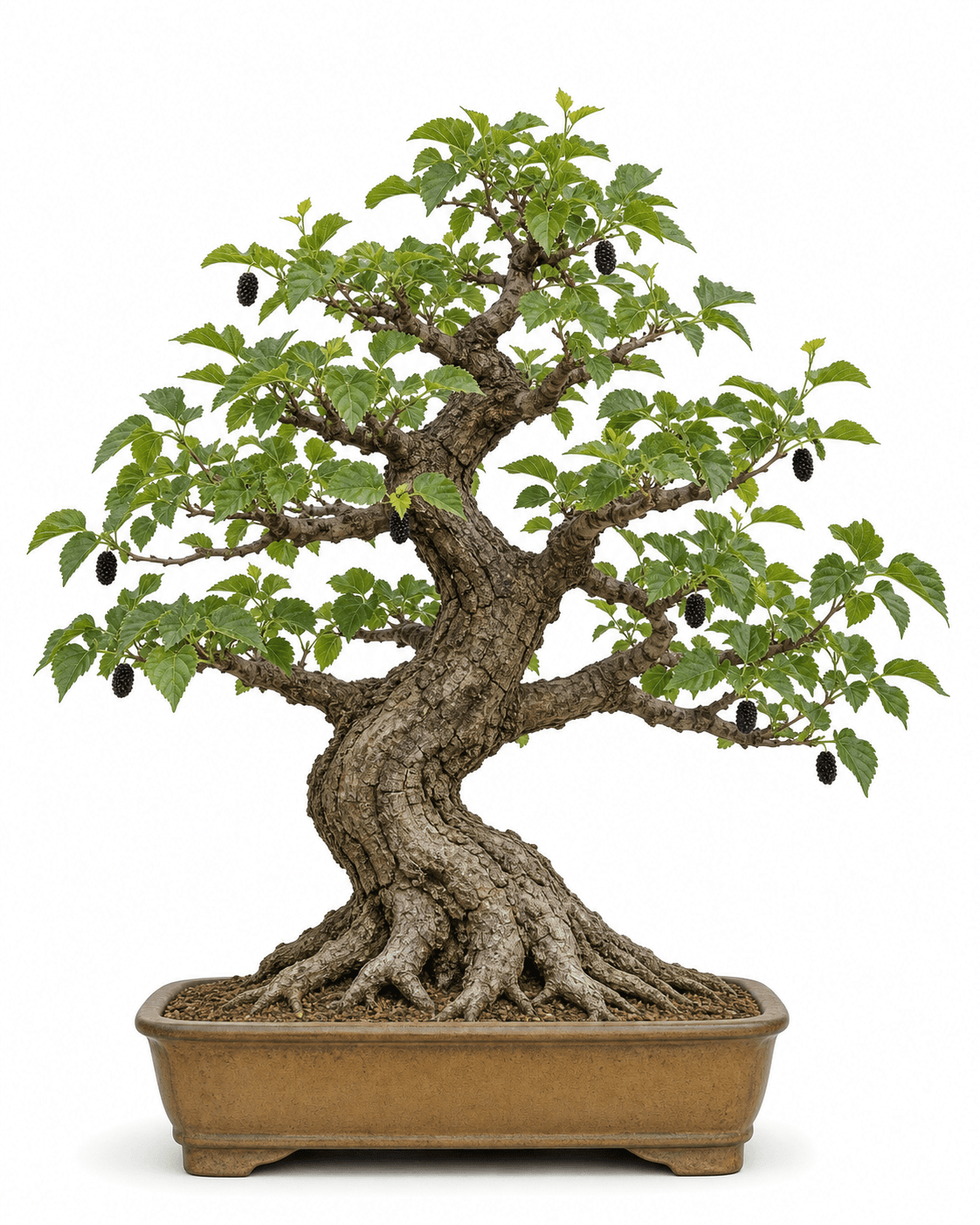
Mulberry bonsai, usually Morus alba, is a vigorous outdoor deciduous tree for growers who can give full sun, steady summer water, winter dormancy, and repeated pruning. Its strengths are fast trunk and branch building, rough aging bark, strong back budding, and seasonal fruit when the tree is mature enough to carry it.
Kew accepts Morus alba in Moraceae and gives Central China as the native range. North American extension sources use white mulberry, common mulberry, silkworm mulberry, Russian mulberry, and related labels, while USDA and state sources warn that the species can naturalize, hybridize with native red mulberry, and be discouraged or restricted in some regions.
The local Mirai corpus has no dedicated Morus lesson, so this guide transfers high-confidence deciduous, fruiting, watering, soil, repotting, pruning, wiring, propagation, and design method, then grounds identity, hardiness, fruit, cultivars, pests, and regional risk in Kew, university, arboretum, USDA, and conservation sources.
Updated June 16, 2026. Written by EntGrove Editorial. Last verified June 16, 2026.
Care fingerprint
Read the species through its shared care pattern.
Repot and structural prune around dormant-to-active transitions; protect new leaves; time refinement work after growth hardens. Use this as the starting point before local conditions and tree strength refine the calendar.
Note: Morus alba is invasive or discouraged in some regions; fruitless forms may be more responsible where seed spread is a concern.
Read the foliage first
Broadleaf stress usually shows in leaf color, leaf size, wilt, scorch, or delayed hardening before it becomes a branch problem.
Match work to dormancy
Deciduous, evergreen, tropical, succulent, and flowering broadleaf trees recover on different calendars.
Protect fine roots
Root work should preserve enough active fine roots for the tree to rehydrate quickly after the operation.
Care cadence
The calendar starts with the tree's seasonal state.
Placement
Timing: Grow outdoors year-round in sun and moving air. Protect the container during repeated freeze-thaw, drying winter wind, and hard root-zone cold.
Watch for: Warm indoor winter storage, root freeze in shallow pots, weak shade growth, fruit stains under benches, and seed spread where Morus alba is discouraged.
NC State ExtensionOregon State Landscape PlantsMorton ArboretumMissouri Department of ConservationLight requirement
Timing: Use full sun as the default. Temporary afternoon shade is aftercare for severe heat, recent root work, or a tree that cannot keep up with water demand.
Watch for: Long internodes in shade, weak fruiting, scorched post-repot leaves, and using shade to compensate for missed watering.
NC State ExtensionOregon State Landscape PlantsMorton ArboretumBonsai Mirai LibraryWatering
Timing: Water thoroughly when the upper soil begins to dry. Large leaves, fast summer growth, fruit load, wind, and shallow containers increase demand.
Watch for: Complete dry-down in heat, sour waterlogged soil, foliage wilt on a fruiting tree, compacted nursery soil, and water beading around a dry root core.
USDA NRCS plant guideOregon State Landscape PlantsBonsai Mirai LibraryFertilizer
Timing: Feed through active growth when building trunk, branches, and roots. Ease late-season nitrogen so new growth can harden before winter.
Watch for: Coarse internodes from overfeeding, weak recovery after repeated pruning, heavy fruit on underfed roots, and soft late growth before cold weather.
Bonsai Mirai LibraryPruning
Timing: Use dormant or late-fall windows for heavier cuts, and use growing-season cutback after extension has fed the branch. Avoid major cuts while sap flow is high.
Watch for: Bleeding cuts, four or more shoots swelling one junction, fruit using energy needed for structure, sunburn after hard thinning, and late cuts before first freeze.
USDA NRCS plant guideBonsai Mirai LibraryWiring
Timing: Wire young flexible shoots for direction, often after extension hardens or in fall while the tree is leafless. Remove wire before fast thickening leaves a mark.
Watch for: Wire hidden under broad leaves, bite during fall vascular swelling, brittle older wood, and trying to force movement that a replacement shoot could provide.
Bonsai Mirai LibraryRepotting
Timing: Repot around spring bud swell when drainage, root density, soil collapse, or container transition justify the work. Preserve fine roots and anchor the tree firmly.
Watch for: Brittle roots, torn root pads, heavy root reduction on weak material, stale nursery peat, fruit left on after root work, and poor tie-down stability.
Bonsai Mirai LibraryUSDA NRCS plant guideFruit and containment
Timing: Let only strong, established trees carry fruit. Remove fruit on developing trees and prevent seed movement where white mulberry is invasive, noxious, or locally discouraged.
Watch for: Bird-dispersed seedlings, stained benches, branch sag, excess energy spent on crop, and buying female fruiting stock where a fruitless cultivar is more responsible.
NC State ExtensionOregon State Landscape PlantsUSDA NRCS plant guideMissouri Department of ConservationSpecies guide
Apply the species profile before copying another tree's calendar.
At a glance
Mulberry is a fast outdoor deciduous bonsai with real regional responsibility.
This page covers Morus alba, the white mulberry most often encountered under broad mulberry bonsai labels. Kew accepts Morus alba L. in Moraceae and gives Central China as its native range, while Oregon State and USDA NRCS list common labels including white, common, silkworm, and Russian mulberry. Kew POWOOregon State Landscape PlantsUSDA NRCS plant guide
In the EntGrove taxonomy, mulberry belongs in Broadleaf > Deciduous. The bonsai calendar is outdoor and temperate: spring root work, extension and cutback through active growth, possible fruit on strong trees, leaf drop, dormant or fall structural decisions, and winter container protection. NC State ExtensionMorton ArboretumBonsai Mirai Library
The appeal is speed. NC State calls the growth rate rapid, Morton Arboretum calls it fast, and both sources describe a medium to large landscape tree. In a bonsai pot, that vigor can build a trunk, close wounds, and create replacement shoots quickly, provided junctions and fruit load are managed before they overwhelm the design. NC State ExtensionMorton ArboretumBonsai Mirai Library
Wild habitat
Warm, bright, disturbed-site adaptability explains both the care and the caution.
Kew describes Morus alba as a temperate tree native to Central China. USDA FEIS says white mulberry was introduced to North America in the 1600s, has established outside cultivation in many areas, and is widely distributed across North America outside Alaska and Nevada in its 2009 review. Kew POWOUSDA Forest Service FEIS
The care implication is direct outdoor culture with water and oxygen. USDA NRCS says the species prefers warm, moist, well-drained loam in a sunny position while tolerating drought after establishment, salt, and wind. Oregon State says it adapts to sun or light shade but grows best in moist, well-drained, fertile soil. USDA NRCS plant guideOregon State Landscape Plants
The design implication is an old, quick-growing fruit tree with rugged seasonal character. Work with the rough bark, crooked trunk potential, fast shoot renewal, and seasonal fruit, then keep the canopy open enough that branch hierarchy remains visible after leaf drop. NC State ExtensionMorton ArboretumBonsai Mirai / Asymmetry
Reading the tree
Read development stage before fruit, leaf size, or outline.
Mirai deciduous method separates primary, secondary, and refinement work. A developing mulberry should be allowed to extend enough to make wood, close wounds, and regenerate roots, then cut back before strong junctions swell into permanent knobs. Bonsai Mirai Library
Mirai fruiting-tree method treats flowers and fruit as a display privilege after structure is credible. On mulberry, fruit is additionally messy and regionally sensitive. A young tree is usually better with fruit removed so energy returns to roots, branch selection, and wound closure. Bonsai Mirai LibraryMorton ArboretumUSDA NRCS plant guide
The source-depth caveat matters. The local Mirai corpus has no dedicated Morus or mulberry file, so the recommendations transfer only high-confidence broadleaf deciduous, fruiting, watering, soil, repotting, pruning, wiring, propagation, and design principles. Species-specific facts come from Kew, extension, arboretum, USDA, and conservation sources. Bonsai Mirai LibraryKew POWONC State ExtensionUSDA Forest Service FEIS
Pruning and fruit
Prune for structure first, then let fruit appear on trees that can afford it.
USDA NRCS gives the species-specific pruning warning: mulberries have brittle roots, should be pruned in winter when fully dormant, and bleed when cut during sap flow. NC State gives the same practical timing by recommending late fall or winter pruning to avoid bleeding milky sap. USDA NRCS plant guideNC State Extension
Mirai deciduous timing adds nuance. High-water-mobility deciduous trees that bleed in spring should have major chops delayed until after the first flush hardens, while fall leaf color and leaf drop windows can support structural choices on a strong tree with enough recovery time before winter. Bonsai Mirai Library
Use extension first, then response. If a cut darkens and stays wet, stop structural pruning and wait until the first flush hardens. If a developing branch pushes four shoots from one point, thin to a leader plus one useful side branch before inverse swelling becomes the feature. Bonsai Mirai Library
Fruit belongs on strong, established trees. NC State says fertilized female flowers produce edible blackberry-like fruit that matures in June, while Missouri records fruit from June to August. Remove fruit from developing bonsai or where seed dispersal creates local risk. NC State ExtensionMissouri Department of ConservationUSDA NRCS plant guide
Repotting
Repot at spring bud swell and handle the roots gently.
Use the standard Mirai spring window: repot as buds swell and before active growth commits the tree to leaves. For a deciduous mulberry, the first visible spring movement is the public-safe timing because stored energy can move quickly into new roots and foliage after the operation. Bonsai Mirai Library
Repot by condition. Slow percolation, decomposed soil, a dense root pad, circling nursery roots, a required planting-angle change, or a stale organic core all justify work. A vigorous young tree may need inspection every 2 to 3 years; older refined material can wait until water movement or root density asks for it. Bonsai Mirai Library
USDA NRCS warns that mulberries have brittle roots and need careful handling when planted. In bonsai work, loosen roots in stages, keep exposed roots moist, cut ragged ends cleanly, avoid tearing the core, and anchor the tree so wind cannot move new roots before they harden. USDA NRCS plant guideBonsai Mirai Library
After significant root work, remove fruit and reduce other energy demands. Give bright protection from harsh wind, water by actual moisture and oxygen, and wait for active recovery before strong feeding or another major structural operation. Bonsai Mirai LibraryUSDA NRCS plant guide
Soil and pot
Use a moisture-retentive granular mix and enough pot volume for summer demand.
The horticultural sources agree on the root target. USDA NRCS says warm, moist, well-drained loam; Oregon State says moist, well-drained, fertile soil; Morton Arboretum says moist, well-drained soil with moderate drought tolerance. A bonsai mix should translate that into water retention plus fast oxygen return. USDA NRCS plant guideOregon State Landscape PlantsMorton Arboretum
Mirai soil method gives the container logic: akadama stores water and nutrients, pumice stores and releases moisture, and lava preserves air space. A training mulberry can use a balanced granular deciduous mix; a refined tree can move toward more akadama when roots, watering, and climate support it. Bonsai Mirai Library
Pot choice should respect leaf size, fruit, and water demand. Medium and larger ovals, rectangles, and soft-cornered containers are more forgiving than tiny shallow pots. Deeper pots can drain faster than shallow pots while still offering reservoir volume, a useful point for fast deciduous trees in heat. Bonsai Mirai LibraryMorton Arboretum
Pot pairing can lean rustic. Rough bark, crooked trunk movement, contorted cultivars, and fruit often look strongest in quiet unglazed browns, gray-browns, muted ochres, and soft rectangles that support an old orchard or field-edge image. Bonsai Mirai / AsymmetryNC State Extension
Climate
Landscape toughness still needs bonsai root protection and regional checks.
Hardiness numbers are landscape-root numbers. NC State lists Zones 4a to 8b, Oregon State lists Zone (4) 5, and Morton Arboretum lists Zones 4 to 9. In a bonsai container, protect roots from repeated freeze-thaw, drying wind, and bench exposure even when the top is hardy. NC State ExtensionOregon State Landscape PlantsMorton Arboretum
Cold-region care should keep the tree dormant and buffered. Place the pot on the ground, mulch around the container, use an unheated cold frame, or group with other hardy deciduous trees. Warm indoor storage breaks the seasonal rhythm and often leads to weak light-starved shoots. Bonsai Mirai LibraryNC State Extension
Hot-region care should preserve full outdoor light while managing container heat. Morning water discipline, appropriate pot volume, top dressing, and temporary afternoon relief after repotting are better than permanent shade that stretches shoots and reduces fruiting strength. NC State ExtensionOregon State Landscape PlantsBonsai Mirai Library
Regional responsibility is part of care. USDA NRCS says white mulberry may become weedy or invasive in some regions; Missouri Department of Conservation says it is a noxious weed there and advises against planting it; Morton Arboretum advises checking local and state guidelines before purchase or planting. USDA NRCS plant guideMissouri Department of ConservationMorton Arboretum
Pests and diseases
Watch dense foliage, sap wounds, borers, whiteflies, and cankers.
NC State lists no serious insect or disease problems as the broad landscape baseline, then names borers, whiteflies, bacterial blight, and coral spot cankers as possible issues. In bonsai, small root volume and repeated pruning make early inspection more important than the phrase no serious problems suggests. NC State Extension
Borers and cankers matter most because bonsai value lives in trunk, roots, and old branch structure. Inspect milky-sap wounds, old pruning scars, wire marks, lower trunk areas, and weak branch bases. Cut with clean tools and avoid large wet-season wounds when the tree is already stressed. NC State ExtensionBonsai Mirai Library
Whiteflies, aphids, scale-like insects, mites, and caterpillars are managed first by culture: full sun, open branch structure, clean leaf litter, no chronic wet foliage, and enough vigor to replace damaged leaves. Use local extension guidance for treatment timing and legal products. NC State ExtensionBonsai Mirai Library
Root disease usually starts with stale soil, compacted cores, or poor oxygen return. Mirai watering and soil method frames root health as water balanced with oxygen. If the tree wilts in wet soil, inspect drainage, soil breakdown, the center of the root pad, and post-repot tie-down stability before adding fertilizer. Bonsai Mirai LibraryOregon State Landscape Plants
Wiring
Wire young branches for direction, then rely on pruning and replacement growth.
Mirai structural wiring method applies well to young mulberry shoots: wire for a specific trunk or branch role, size the wire to hold the bend, keep a 55 to 60 degree coil angle, maintain even spacing, and keep contact without constriction. Bonsai Mirai Library
Fast growth raises the scar risk. Broad leaves can hide wire bite, and Mirai deciduous fall-work notes that fall vascular growth can lock in branch position and tighten wire quickly. Check wired shoots frequently through summer and fall. Bonsai Mirai Library
Older or brittle branches often respond best to rebuilding. Use clip-and-grow, a replacement shoot, a guy wire, or a staged pruning transition when a heavy bend would concentrate force on one point. Bonsai Mirai Library
Propagation
Seed, cuttings, layers, and grafts each create a different mulberry bonsai.
USDA NRCS says fresh seed can be sown when ripe, with cold stratification improving germination for seed with dormancy or hard coats. Seed-grown material is useful for roots, trunk movement, and long development, while cultivar traits and fruit behavior can vary. USDA NRCS plant guide
USDA NRCS also describes cuttings taken at pruning time, June and July as an optimum rooting period, and IBA-treated mid-July cuttings in sand producing heavy root systems in about three weeks. Mirai propagation method adds the bonsai handling: clean razor cuts, oxygenated medium, moisture control, and patience until roots can support foliage. USDA NRCS plant guideBonsai Mirai Library
Air layers can be useful when an existing branch has movement, bark, or cultivar identity worth preserving. Treat them as advanced work: choose a vigorous branch, protect the layer from drying, wait for adequate root mass, and avoid separating too early. Bonsai Mirai Library
Grafting is mainly a cultivar and repair tool for bonsai. It can preserve a fruitless or contorted form, add a branch, or rebuild roots, but a swollen graft union near the trunk line can become the first thing a viewer sees. Bonsai Mirai LibraryNC State ExtensionUSDA NRCS plant guide
Buying and sourcing
Buy for base, branches, local legality, and seed containment before berries.
Good material has a visible base, low branch options, strong buds, clean bark, roots that can be transitioned, and a cultivar or species label that makes regional sense. A nursery tree covered in fruit can still be poor bonsai stock if it is straight, high-branched, or rooted in a stale organic core. Bonsai Mirai / AsymmetryMorton Arboretum
Check the local status before buying Morus alba. USDA NRCS, Missouri Department of Conservation, and Morton Arboretum all warn growers to check state or local guidance because white mulberry can be invasive, noxious, or discouraged. A bonsai pot reduces spread only if fruit and seedlings are managed. USDA NRCS plant guideMissouri Department of ConservationMorton Arboretum
Separate white mulberry from native red mulberry where that matters. USDA FEIS says the two hybridize and are frequently confused; Missouri gives leaf and fruit differences. Local native material may be a better ecological choice in some regions, but care and hardiness should be verified to the species in front of you. USDA Forest Service FEISMissouri Department of Conservation
Collected or volunteer material should be handled cautiously. Dig during dormancy or early spring movement, retain fine roots, reduce top and root work in stages, and avoid moving seed-producing volunteers from restricted areas into new gardens. USDA NRCS plant guideBonsai Mirai Library
Troubleshooting
Most failures come from indoor culture, unmanaged vigor, fruit load, roots, or regional spread.
Weak long shoots usually point to shade, warm indoor storage, excess nitrogen, or missed cutback after a growth phase. Restore outdoor light and choose whether each branch is building structure or entering refinement before clipping again. NC State ExtensionBonsai Mirai Library
Bleeding cuts point to timing. Shift major pruning into late fall or winter dormancy, or wait until the first flush hardens if spring bleeding appears. Seal large wounds and preserve shoulder tissue so callus can roll evenly. USDA NRCS plant guideNC State ExtensionBonsai Mirai Library
Yellowing or wilt after repotting points to root damage, poor tie-down, dry exposed roots during the operation, or stale soil that no longer moves water and oxygen. Stabilize aftercare before adding another operation. USDA NRCS plant guideBonsai Mirai Library
Seedlings under benches point to fruit management failure. Remove fruit before birds and mammals move it where white mulberry is restricted, invasive, or locally discouraged. USDA NRCS plant guideOregon State Landscape PlantsMissouri Department of Conservation
Design and styling
Design for an old field-edge fruit tree with strong branch decisions.
Mirai design fundamentals start with base, trunk line, defining branch, and apex. Mulberry adds a species filter: fast growth, broad leaves, rugged bark, possible fruit, and strong replacement shoots are more believable than a delicate tiny-tree image. Bonsai Mirai LibraryBonsai Mirai / Asymmetry
Use the fast growth to solve structure. Pick a trunk line, keep one dominant branch at each key junction, remove extra competing shoots early, and use sacrifice growth deliberately so thickening happens where the design needs it. Bonsai Mirai Library
Strong styles include informal upright, slanting, broom, raft, clump, twin-trunk, and broad orchard-tree forms. Weeping cultivars can make strong cascade or semi-cascade studies when the branch habit supports the final image. NC State ExtensionOregon State Landscape PlantsBonsai Mirai / Asymmetry
Deadwood should stay restrained. Mulberry age usually reads through bark, old pruning scars, trunk movement, hollow-compatible wounds, fruit restraint, and winter branch structure. Bonsai Mirai / AsymmetryBonsai Mirai Library
Cultivars and forms
Cultivar choice changes movement, fruit, scale, and responsibility.
NC State lists Chaparral, Itoguwa Nuclear Blast, Pendula, and Unryu. Oregon State lists Chaparral, Kingens, Pendula, Striblingii, var. tatarica, and Unryu. USDA NRCS lists Chaparral, Pendula, Teas, Bellaire, and Lingan. NC State ExtensionOregon State Landscape PlantsUSDA NRCS plant guide
Unryu and other contorted forms can give movement early, which is useful for bonsai. Weeping forms such as Pendula and Chaparral can create distinctive images, although every branch wants to fall. Fruitless selections such as Itoguwa Nuclear Blast or Chaparral can reduce mess and spread risk. NC State ExtensionUSDA NRCS plant guide
A cultivar name still needs inspection. Look for graft unions, root quality, internode length, branch distribution, and whether the cultivar habit supports the intended size. A named form cannot compensate for a poor base or unusable lower trunk. Bonsai Mirai / AsymmetryMorton Arboretum
History and context
Mulberry carries silk, food, wildlife, and invasion history into the pot.
USDA NRCS and USDA FEIS both connect white mulberry to sericulture, the use of leaves for silkworm culture. FEIS records early North American promotion of white mulberry for a silk industry, including 1600s Virginia plantings and the later mulberry mania period in the eastern United States. USDA NRCS plant guideUSDA Forest Service FEIS
The same history explains why the species appears in many places outside its native range. Fruit is eaten and moved by birds and mammals, while USDA FEIS documents hybridization with native red mulberry in North America. A bonsai grower should treat fruit as both display and stewardship. USDA Forest Service FEISNC State Extension
For exhibition, the best mulberry image usually shows restraint: a credible old trunk, clean wound management, branch hierarchy, controlled vigor, and only enough fruit to support the season. A full crop on a weak or unfinished tree tells the wrong story. Bonsai Mirai LibraryBonsai Mirai / Asymmetry
Species questions
Answer the beginner questions before styling.
Is mulberry a good beginner bonsai?
Yes, for an outdoor beginner who can manage fast growth, summer water, pruning, fruit cleanup, and local spread rules. It is less suitable for tiny bonsai or indoor growing.
Can mulberry bonsai live indoors?
Mulberry belongs outdoors. It needs direct light, air movement, seasonal leaf drop, and winter dormancy, with the pot protected during severe cold rather than warmed inside.
How much sun does mulberry bonsai need?
Use full sun as the default, meaning roughly 6 or more hours of direct sun. Temporary afternoon shade is useful after root work, during severe heat, or on weak trees.
How often should I water mulberry bonsai?
Water when the upper soil begins to dry, then water thoroughly until the whole root mass is moist and air can return through the drainage system. Expect high demand in summer and during fruiting.
When should I repot mulberry bonsai?
Repot around spring bud swell when drainage, root density, soil breakdown, or container transition justifies it. Handle brittle roots carefully and remove fruit after significant root work.
When should I prune mulberry bonsai?
Use late fall or winter dormancy for heavier cuts to reduce bleeding risk, then use active-season cutback after shoots extend and harden. Stop spring pruning if fresh cuts bleed heavily.
Can I wire mulberry bonsai?
Yes. Wire young flexible shoots, keep a 55 to 60 degree coil angle, check often, and remove wire before fast thickening marks the bark. Older structure is often better built by pruning and replacement growth.
Should I let my mulberry bonsai fruit?
Only on a strong established tree where fruit supports the design and seed spread is controlled. Remove fruit from young, weak, recently repotted, or regionally risky trees.
Is white mulberry invasive?
It can be. USDA NRCS warns that white mulberry may become weedy or invasive in some regions, and Missouri lists it as a noxious weed. Check local guidance before buying or allowing fruit to seed.
What pests and diseases affect mulberry bonsai?
Watch for borers, whiteflies, bacterial blight, coral spot cankers, leaf-feeding insects, and root problems from stale wet soil. Good sun, airflow, drainage, sanitation, and local extension guidance are the first controls.
Sources
Species advice needs source discipline.
Next decisions
Plan the operation before copying the calendar.
A good care note for Mulberry records the tree's stage, the work done, and the aftercare used. That record matters more than a month-name rule.
Related species
Compare nearby trees before transferring advice.
Japanese maple
Acer palmatum
Trident maple
Acer buergerianum
Amur maple
Acer tataricum subsp. ginnala
Field maple
Acer campestre
Korean hornbeam
Carpinus turczaninovii