
Species guide
Needle Juniper Bonsai Care
Juniperus rigida
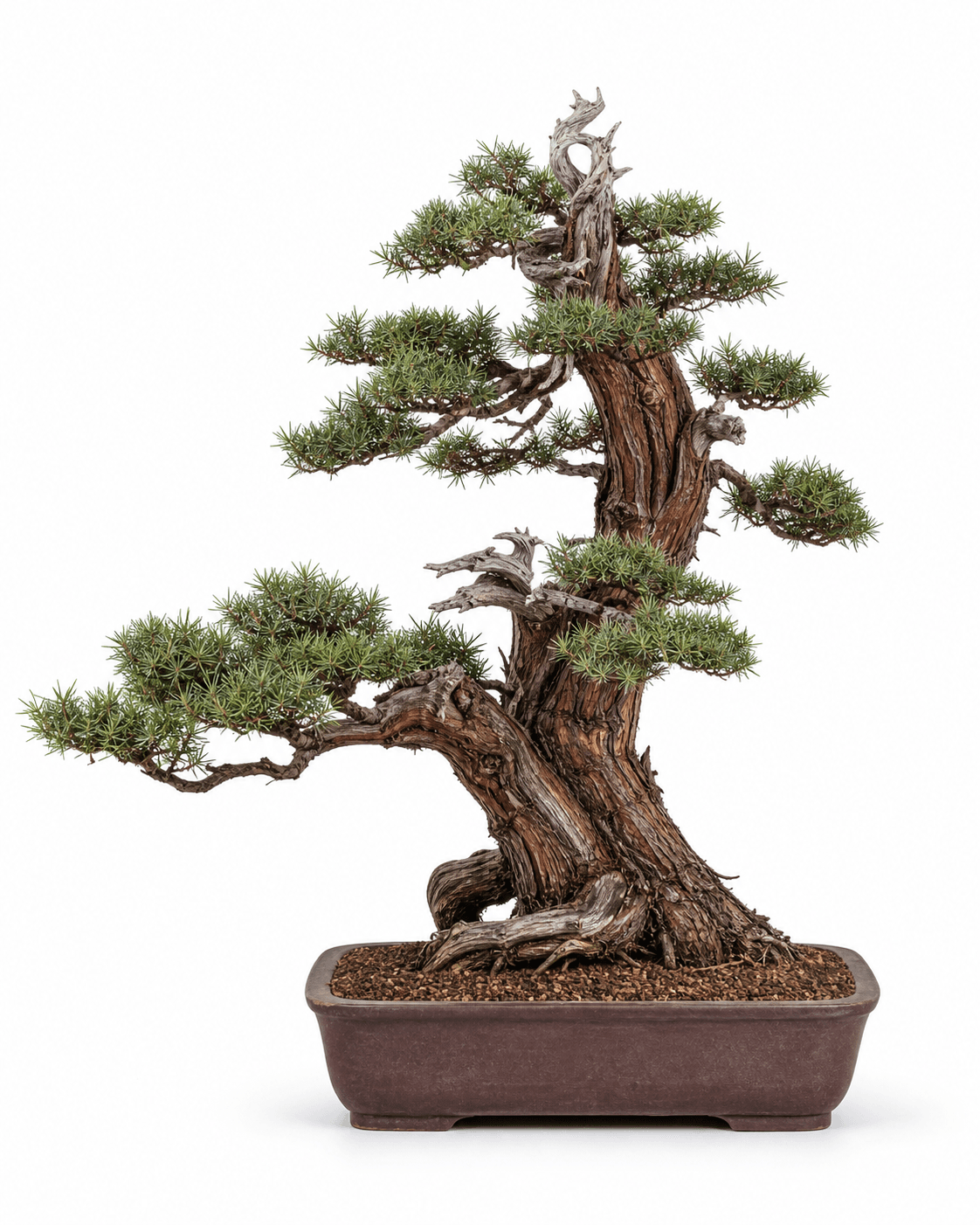
Needle juniper, or tosho, is a true needle-foliage juniper: confirmed Juniperus rigida stays in sharp needle foliage for life and should be handled on its own timing. The core bonsai rule is simple and strict: grow strength first, repot very late after new shoots elongate, do refinement work in summer heat, and avoid pinching active spring growth.
This guide is grounded in dedicated Mirai needle-juniper repotting and summer-maintenance files, then checked against Kew, Flora of China, Oregon State, Missouri Botanical Garden, American Conifer Society, and UC IPM for accepted name, range, morphology, hardiness, dry-site culture, and pest context.
Updated June 9, 2026. Written by EntGrove Editorial. Last verified June 9, 2026.
Care fingerprint
Read the species through its shared care pattern.
Avoid scale-juniper pinching assumptions; cut back to viable growth and protect dense, sharp foliage from interior dieback. Use this as the starting point before local conditions and tree strength refine the calendar.
Keep foliage strong
Junipers recover through active foliage, so styling choices should leave enough healthy tips to power the tree.
Protect live veins
Old junipers often depend on narrow live veins between roots and foliage; root work and carving should respect that path.
Do not stack major work
Heavy bending, major foliage reduction, carving, and repotting belong in a staged plan rather than the same weekend.
Care cadence
The calendar starts with the tree's seasonal state.
Placement
Timing: Keep established trees outdoors in full sun with strong airflow. Use afternoon protection only for fresh repots, severe heat after major work, or weak root systems.
Watch for: Indoor display beyond a brief show window, shaded benches, small hot pots after repotting, and cold wind on newly worked roots.
Oregon State Landscape PlantsMissouri Botanical GardenBonsai Mirai LibraryWatering
Timing: Water when the upper quarter to half inch dries, then soak the whole rootball. Strong needle junipers are high water users during active growth.
Watch for: Hydrophobic old cores, water running around the root mass, weak trees kept wet, and dry needles before color change appears.
Bonsai Mirai LibraryFeeding
Timing: Feed healthy, non-repotted trees as buds move and during active growth. Hold fertilizer 4 to 6 weeks after repotting so fine new roots are not burned by ionic load.
Watch for: Force-feeding a weak tree, heavy organic fertilizer on clogged soil, and strong spring feed before refinement pruning decisions.
Bonsai Mirai LibraryRepotting
Timing: Repot after new shoots have physically elongated with visible internodes and multiple shoots. Needle junipers are among the last conifers repotted in the season.
Watch for: Bud-swell repotting, weak foliar mass, dry interior cores, rootball movement, and cascading branches drooping below horizontal after root work.
Bonsai Mirai LibrarySummer pruning
Timing: Do the main refinement pass in July through early August in many temperate climates, with some flexibility later. Let new growth elongate and harden first.
Watch for: Pinching soft tips, cutting needles accidentally, over-thinning useful interior buds, and leaving dense old needles that block air and light.
Bonsai Mirai LibraryInterior cleaning
Timing: Use tweezers in summer to remove large old interior needles, then use scissors for elongated shoots. Keep tip needles unless they spoil the image.
Watch for: Brown needle tips two to three weeks after sloppy scissor work, disease pressure inside dense pads, and loss of interior ramification.
Bonsai Mirai LibraryWiring
Timing: Wire and style healthy needle junipers in peak summer heat when water movement supports tissue repair. Adjust timing earlier in very hot, dry Mediterranean climates.
Watch for: Wedge-cut bending, unsupported branch rotation, wire biting into fast-thickening shoots, and heavy bends on under-hydrated trees.
Bonsai Mirai LibraryDeadwood and live veins
Timing: Trace live veins before carving. Live-vein cleaning is optional on needle juniper because bark can contribute age and borer pressure is lower than on many scaled junipers.
Watch for: Spring bark slip, carved areas that ignore sap-flow fissures, over-bright lime sulfur, and live-tissue exposure before heat or freeze events.
Bonsai Mirai LibraryPropagation
Timing: Take cuttings after the first spring flush has hardened and nighttime temperatures stay above 60 F. Root in perlite under mist and reduced light.
Watch for: Cuttings with too much foliage, compacted perlite, fertilizer during rooting, and moving rooted cuttings before the 30 to 90 day establishment window.
Bonsai Mirai LibraryWinter protection
Timing: Protect potted roots around 25 F by moving trees off benches, grouping pots, and insulating the root zone. Keep dormant trees cold and outdoors.
Watch for: Warm indoor overwintering, freeze-dry wind, small containers, recent repots, and wet soil during hard freezes.
Bonsai Mirai LibraryOregon State Landscape PlantsMissouri Botanical GardenSpecies guide
Apply the species profile before copying another tree's calendar.
At a glance
Needle juniper is a true needle-foliage juniper with late root timing and summer refinement.
Kew accepts Juniperus rigida Siebold & Zucc. as an East Asian Cupressaceae species native from eastern Qinghai to Sakhalin and the Nansei-shoto. Oregon State and Missouri Botanical Garden use the common names needle juniper and temple juniper in landscape culture. Kew POWOKew POWO general informationOregon State Landscape PlantsMissouri Botanical Garden
The bonsai distinction is physiological. Mirai separates true needle junipers, including rigida, communis, and oxycedrus, from scale junipers that only show juvenile needle foliage under stress or youth. Bonsai Mirai Library
A good needle juniper routine starts with full sun, complete watering, an akadama-heavy mineral mix, late repotting after shoot elongation, and summer scissors work after growth becomes energy-positive. Bonsai Mirai LibraryOregon State Landscape Plants
Habitat
Read the species from dry mountains, open sun, sharp needles, and pendulous old branchlets.
Missouri Botanical Garden describes needle juniper as native to dry mountain areas in northern China, Korea, and Japan. Oregon State adds Japan, Korea, northeastern China, and southeastern Russia, with hot, dry landscape tolerance once established. Missouri Botanical GardenOregon State Landscape Plants
Kew broadens the mapped range into eastern Qinghai, Sakhalin, and the Nansei-shoto and places the species in the temperate biome. Flora of China describes linear needlelike leaves in whorls of three, rigid points, and globose seed cones. Kew POWO general informationFlora of China
Care follows that ecology with one important container correction. The species tolerates dry exposed landscapes after establishment, yet a bonsai pot has a shallow fine-root system that must be fully hydrated and then allowed to breathe. Bonsai Mirai LibraryMissouri Botanical Garden
Design should preserve the tree character: open trunk movement, drooping or rugged branchlets, sharp green texture, exposed aged bark, restrained deadwood, and a seasonal rhythm that feels like a mountain juniper rather than a clipped hedge. Oregon State Landscape PlantsBonsai Mirai / Asymmetry
Reading the tree
Judge strength from shoot elongation, needle texture, root permeability, and interior light.
Mirai frames juniper strength as foliage-led. The foliage creates the resources that rebuild roots, so every major decision on needle juniper starts with foliar mass, shoot vigor, and whether the interior still has living needles. Bonsai Mirai Library
Repot readiness is visible. Wait until new shoots have elongated, internodes can be seen, and multiple shoots are moving. Bud swell alone is an early signal for many conifers, while true needle junipers need a later proof of water movement. Bonsai Mirai Library
Shoot pruning readiness is also visible. New growth has yellow, softer, fleshy tissue at the shoot base while hardened growth behind it is woody. Cut after the shoot has hardened enough to replenish the tree. Bonsai Mirai Library
Decline often appears before color changes. Dry, sandpapery foliage texture, water that sheets around a compacted core, and interior branches shaded by old needles all call for culture correction before styling. Bonsai Mirai Library
Needle work
Let spring growth harden, then clean old needles and cut shoots with narrow scissors.
The main refinement pass belongs in peak summer heat for healthy trees. Mirai places wiring, styling, and interior cleanout for Juniperus rigida in July through early August in many temperate climates, with climate adjustment as needed. Bonsai Mirai Library
Use tweezers to remove large old interior needles so air, light, oxygen, and carbon dioxide reach inner branching. Then shorten elongated shoots with scissors, leaving only a small base of new yellow growth where compactness is needed. Bonsai Mirai Library
Keep scissor blades barely open and slide them into the foliage. Accidentally cut needles brown later and make fine work look careless. Bonsai Mirai Library
Avoid the old habit of aggressive spring pinching. Mirai ties early pinching on needle juniper to random branch dieback because soft new growth is still consuming energy rather than returning it to the tree. Bonsai Mirai Library
A single light spring pinch can reduce summer workload on strong refined trees, yet the safer default is to let the first push extend, harden, and then prune in summer. Weak or developing trees should grow before detail work. Bonsai Mirai Library
Roots
Repot very late, correct compacted cores, and protect the fine root system during aftercare.
True needle junipers are among the last species repotted because their needles have limited surface area, weaker photosynthetic efficiency, and lower transpirational pull than scale junipers. Repotting too early can lead to spring dieback or summer fade. Bonsai Mirai Library
Do root work only when the tree has robust foliar mass. An underdeveloped canopy lacks the metabolic capacity to compartmentalize wounds and form new roots after reduction. Bonsai Mirai Library
Use a chopstick rather than a rake, but work decisively through compacted surface, side, and bottom roots. A dry core wrapped in a wet exterior indicates water is bypassing the rootball and the tree is already in danger. Bonsai Mirai Library
After repotting, give morning sun, afternoon shade, wind protection, and light foliar misting once or twice daily for 7 to 10 days. Severe root loss may require 80 to 90 percent relative humidity with airflow until new roots form. Bonsai Mirai Library
Delay fertilizer 4 to 6 weeks after root work. Fine new roots are easily damaged while healing, and liquid feed should be used cautiously if introduced before organic pellets. Bonsai Mirai Library
Soil and pot
Use small-particle mineral soil that holds water without suffocating fine roots.
Mirai gives a rigida soil target of two parts akadama, one part lava, and one part pumice, screened from roughly 1/16 to 1/4 in. The added akadama supports the fine roots and water demand of healthy needle juniper. Bonsai Mirai Library
In humid, rainy, or cool-wet climates, pull the mix toward 1:1:1 akadama:pumice:lava or remove the finest particles so oxygen returns faster after watering. Bonsai Mirai Library
Pot choice should respect the sharp texture and open habit. Unglazed, restrained, slightly rugged containers usually fit better than glossy or overly ornate pots. Cascades need enough mass and tie-down strength to hold the visual weight. Bonsai Mirai / AsymmetryBonsai Mirai Library
Cascade root work has an extra constraint: keep the cascading branch from drooping below horizontal after repotting, because loss of phototropic orientation can accelerate dieback on an already strained foliage type. Bonsai Mirai Library
Climate
Treat rigida as a sun-loving outdoor tree, then adjust timing for heat, humidity, and root-zone cold.
Oregon State lists full sun, well-drained soil, hot and dry landscape tolerance, and USDA Zone 5 hardiness. Missouri lists full sun, dry to medium water, intolerance of wet soil, and Zones 6 to 7. Oregon State Landscape PlantsMissouri Botanical Garden
In hot dry regions, protect recently worked trees from late-summer desiccation and wire earlier if dry winds arrive before the usual peak-summer window. In maritime or humid regions, watch for slow soil drying and use a more oxygen-forward soil. Bonsai Mirai Library
In cold regions, foliage hardiness exceeds root hardiness in containers. Move pots off benches and insulate roots when temperatures approach 25 F, especially after repotting or structural work. Bonsai Mirai Library
Indoor winter storage is a common failure path. Keep the tree cold, bright, and dormant outdoors or in an unheated protected space that does not break dormancy. Bonsai Mirai Library
Pests and disease
Keep the canopy open and treat general juniper pests before dense pads hide symptoms.
Mirai notes limited observed fungal or boring-beetle pressure on rigida in the covered material, while still flagging cypress scale risk on needle junipers. That is a source-depth note, not a guarantee of immunity. Bonsai Mirai Library
UC IPM lists common juniper problems including bark beetles, borers, scales, spider mites, twig blights, Phytophthora, rusts, cankers, scorch, nutrient disorders, water stress, and wet-soil risk. UC IPM Juniper
Dense needle pads create their own disease pressure by blocking airflow and light. Summer interior cleaning is preventive horticulture, because it keeps interior ramification alive and reduces damp, dark pockets. Bonsai Mirai LibraryUC IPM Juniper Twig Blights
For twig blight, UC IPM emphasizes removing infected shoots, disposing of debris, keeping foliage drier, improving airflow, and avoiding overfertilization. Those actions fit bonsai scale better than blanket chemical routines. UC IPM Juniper Twig Blights
Wiring
Wire in summer on hydrated trees and use rotation instead of wedge cuts.
Needle juniper wiring fits the summer work window because active water movement supports tissue repair. Work on a fully hydrated tree, then provide aftercare that matches the amount of bending and foliage reduction. Bonsai Mirai Library
Juniper bending depends on live-vein awareness. Trace vertical bark fissures, support branch bases, and rotate branches gradually so force distributes through a length of tissue. Bonsai Mirai Library
For heavy bends, use raffia as a flat strap and bend while the fibers are wet. A wire spine or guy wire can carry force through a split or crotch when the design requires compaction. Bonsai Mirai Library
Avoid wedge-cut bending on junipers. Mirai marks wedge cuts as unsuitable for needle juniper and other junipers because the technique does not respect the live-vein structure. Bonsai Mirai Library
Propagation
Use seed or cuttings, then plan for a long development curve.
Oregon State describes dioecious plants and seed cones that ripen in the second year. Seed propagation therefore depends on female plants, compatible pollen, and patience. Oregon State Landscape Plants
Mirai propagation guidance for junipers uses cuttings after the first spring flush has been cut back, hardened, and started to push fresh juvenile growth. Sustained nighttime temperatures above 60 F help rooting. Bonsai Mirai Library
Take the cut near the transition from green elongation to caramel-brown hardened tissue, reduce excess foliage, set the cutting in perlite, and rely on overhead mist after the initial watering. Bonsai Mirai Library
Hold cuttings around 30 percent light and skip fertilizer while roots form. Typical rooting trays stay in perlite for 30 to 90 days before transplanting. Bonsai Mirai Library
Sourcing
Buy verified Juniperus rigida with strong foliage, clean roots, and enough interior growth to refine.
Confirm the Latin name. Needle juniper should be Juniperus rigida, while common juniper, shore juniper, procumbens, squamata, San Jose juniper, eastern red cedar, and juvenile scale junipers follow different rules. Kew POWOBonsai Mirai Library
Good material has sharp permanent needle foliage, a stable rootball, visible interior shoots, healthy bark, no hydrophobic core, and enough extension to prove strength before repotting or styling. Bonsai Mirai LibraryOregon State Landscape Plants
Red flags include recent import stress, weak sparse foliage, soft tips already pinched off, roots packed in old compacted soil, browning interior shoots, scale insects, and labels that say generic juniper or tosho without a botanical name. Bonsai Mirai LibraryUC IPM Juniper
Older Japanese-form material can be valuable, but the first question is horticultural. A famous-looking trunk with a failing root core is a recovery project before it is a styling project. Bonsai Mirai Library
Troubleshooting
Diagnose needle juniper problems by timing, root function, and whether the canopy can still power recovery.
Symptom: branch dieback in spring or summer after repotting. Likely cause: root work was done before shoot elongation or on weak foliar mass. Fix: stabilize water, shade from afternoon heat, mist lightly, and avoid more work until new growth proves recovery. Bonsai Mirai Library
Symptom: random branch loss after spring work. Likely cause: soft active shoots were pinched before they became energy-positive. Fix: stop pinching, let the tree extend, and move refinement pruning to the summer hardening window. Bonsai Mirai Library
Symptom: water runs around the rootball while the center stays dry. Likely cause: compacted root sheen or hydrophobic old core. Fix: restore surface percolation now and plan a correctly timed repot with decisive chopstick work. Bonsai Mirai Library
Symptom: interior needles brown and pads become hollow. Likely cause: density blocked light and gas exchange. Fix: summer tweezer cleaning, careful shoot reduction, and light rebalancing before the interior is abandoned. Bonsai Mirai Library
Symptom: brown shoot tips after wet weather. Likely cause: juniper twig blight or dense wet foliage. Fix: remove infected tips, dispose of debris, increase airflow, and keep needles drier. UC IPM Juniper Twig Blights
Symptom: sticky or stippled foliage. Likely cause: scale, mites, or other general juniper pests. Fix: inspect closely, improve vigor and airflow, and use pest-specific treatment based on identification. UC IPM JuniperBonsai Mirai Library
Design
Let sharp texture, bark, old branch angle, and restrained deadwood carry the image.
Mirai design starts with base, trunk line, defining branch, and apex. On needle juniper, those decisions should also account for how much foliage the tree must keep to remain strong. Bonsai Mirai / AsymmetryBonsai Mirai Library
The defining branch sets the tone. A heavy lower branch can make a temple-juniper image feel grounded, while a sparse descending branch can push the design toward cascade or mountain literati. Bonsai Mirai / AsymmetryBonsai Mirai Library
Deadwood should be restrained and species-aware. Live-vein cleaning is optional on needle juniper, and bark can be an important age signal, so stripping every vein can make the tree less believable. Bonsai Mirai Library
Refinement is won through repetition. The best needle junipers are built from many small summer passes: clean old needles, shorten hardened shoots, preserve useful interior buds, and keep the silhouette open enough to breathe. Bonsai Mirai Library
Forms and labels
Separate tosho, temple juniper, Pendula, common juniper, and juvenile scale-juniper labels.
Kew accepts Juniperus rigida as the species and records needle juniper among common names. Oregon State lists temple juniper and needle juniper, and notes its cultivation around temples and gardens in Japan. Kew POWO general informationOregon State Landscape Plants
The American Conifer Society records additional common names including temple juniper, needle juniper, Japanese Nezu or Nezumi sashi, and Chinese du song. Bonsai labels often use tosho. American Conifer Society
Pendulous forms may be sold as weeping needle juniper or Juniperus rigida Pendula. Treat them as cultivar or form decisions inside the same species unless the tag points to another Juniperus. Oregon State Landscape PlantsMissouri Botanical Garden
Common juniper and Juniperus oxycedrus are also true needle junipers in Mirai method, yet their soil and climate preferences can differ. Procumbens, squamata, San Jose, eastern red cedar, and shimpaku-style material should not inherit rigida timing by name alone. Bonsai Mirai Library
History
Tosho is a classic Japanese bonsai subject whose difficulty is mostly horticultural timing.
Oregon State notes that temple juniper is widely cultivated in temples and gardens in Japan for bright foliage and weeping habit. That cultural association explains the tosho label many bonsai growers know. Oregon State Landscape Plants
The species has long bonsai relevance because it can carry sharp mature texture, rugged bark, and old-tree line without needing grafted scale foliage. The same texture also makes refinement labor-intensive. Bonsai Mirai LibraryBonsai Mirai / Asymmetry
Mirai positions needle juniper as a species where old inherited practices, especially spring pinching, should be reconsidered through physiology. Summer pruning after hardening gives a stronger tree with more reliable branches. Bonsai Mirai Library
For exhibition-quality work, the standard is clean needle texture without dead brown tips, open interior density, secure branch setting, and a design that makes the needles feel intentional rather than merely prickly. Bonsai Mirai LibraryBonsai Mirai / Asymmetry
Species questions
Answer the beginner questions before styling.
Can needle juniper be grown as bonsai?
Yes. Juniperus rigida is a classic outdoor bonsai species when it receives full sun, careful watering, late repotting, summer refinement pruning, and protection from early pinching.
Can needle juniper bonsai live indoors?
No. Needle juniper needs outdoor sun, airflow, seasonal temperature change, and winter dormancy. Indoor display should be brief.
When should needle juniper be repotted?
Repot very late for a conifer, after new shoots have elongated and visible internodes prove that water movement and photosynthesis are active.
What soil is best for Juniperus rigida bonsai?
A good starting mix is two parts akadama, one part lava, and one part pumice, screened around 1/16 to 1/4 in. Shift toward 1:1:1 in wet climates.
Should needle juniper be pinched?
Avoid aggressive spring pinching. Let shoots elongate and harden, then shorten them with scissors during the summer refinement window.
Why did my needle juniper lose a branch after repotting?
Common causes are repotting before shoot elongation, working a tree with too little foliage mass, leaving a hydrophobic root core, or exposing fresh roots to heat and wind.
Is needle juniper the same as procumbens juniper?
No. Juniperus rigida is a true needle juniper with permanent needle foliage. Procumbens can carry juvenile needle foliage but is not handled under the rigida timing rule set.
How do I clean needle juniper foliage?
In summer, use tweezers to remove large old interior needles and narrow scissors to shorten hardened shoots. Keep tip needles unless they disrupt the image.
Is tosho the same as needle juniper?
In bonsai usage, tosho usually means Juniperus rigida, the needle or temple juniper. Confirm the Latin name before applying rigida-specific care.
Is needle juniper beginner friendly?
It is better for intermediate to advanced growers. The tree is durable when strong, but its repot timing, summer needle work, and branch-dieback risk leave little room for generic juniper habits.
Sources
Species advice needs source discipline.
Next decisions
Plan the operation before copying the calendar.
A good care note for Needle juniper / tosho records the tree's stage, the work done, and the aftercare used. That record matters more than a month-name rule.
Related species
Compare nearby trees before transferring advice.
Common juniper
Juniperus communis
Himalayan / flaky juniper
Juniperus squamata