
Species guide
Eastern Red Cedar Bonsai Care
Juniperus virginiana
Eastern red cedar is an outdoor North American scale juniper whose common name often collides with Thuja and Cedrus labels. Treat confirmed Juniperus virginiana as a running juniper: preserve foliage mass, avoid pinching, prune after growth hardens, and expect juvenile foliage when the tree is overworked or weak.
The local Mirai corpus has no dedicated Eastern red cedar episode, but it names the species in running-juniper, Rocky Mountain juniper, needle-juniper, and Thuja contrast files. Kew, Flora of North America, USDA FEIS and Silvics, NC State Extension, NC State cedar-apple rust guidance, and UF/IFAS ground the taxonomy, range, foliage, hardiness, coarse roots, cultivar labels, and rust-host risk.
Updated June 9, 2026. Written by EntGrove Editorial. Last verified June 9, 2026.
Care fingerprint
Read the species through its shared care pattern.
Protect old collected root systems, preserve live veins, and avoid combining major styling with aggressive root work. Use this as the starting point before local conditions and tree strength refine the calendar.
Note: Eastern North American running scale juniper with indirect Mirai coverage through Rocky Mountain / running-juniper and Thuja contrast files; verify against Rocky Mountain juniper, southern redcedar, Ashe juniper, Thuja, and true Cedrus labels before applying care.
Keep foliage strong
Junipers recover through active foliage, so styling choices should leave enough healthy tips to power the tree.
Protect live veins
Old junipers often depend on narrow live veins between roots and foliage; root work and carving should respect that path.
Do not stack major work
Heavy bending, major foliage reduction, carving, and repotting belong in a staged plan rather than the same weekend.
Care cadence
The calendar starts with the tree's seasonal state.
Placement
Timing: Grow outdoors in full sun with open airflow. Give partial afternoon protection only after repotting, collecting, or heavy structural work.
Watch for: Indoor display, deep shade, weak interior shoots, hot benches after root work, and stagnant humid corners that worsen rust or twig-blight pressure.
NC State ExtensionBonsai Mirai LibraryNC State Extension: Cedar Apple RustWatering
Timing: Water when the upper quarter to half inch of substrate dries. Soak the whole rootball, then let oxygen return before the next watering.
Watch for: Dry old field cores, water running around compacted roots, over-irrigated organic nursery soil, and drought-tolerance assumptions applied to a shallow pot.
Bonsai Mirai LibraryUF/IFAS ExtensionFeeding
Timing: Feed moderately during active growth once the tree is healthy. After repotting or heavy pruning, restart lightly only after new growth confirms recovery.
Watch for: Heavy fertilizer after spring pruning, weak trees being force-fed, organic cakes clogging fine juniper soil, and overfeeding that creates coarse extension.
Bonsai Mirai LibraryPruning
Timing: For refinement, prune after the first flush hardens in late spring to early summer. For development, let runners extend until interior density forms, then cut to live laterals.
Watch for: Pinching active tips, pruning during spring energy draw, cutting to bare wood, and removing interior foliage before replacements exist.
Bonsai Mirai LibraryRepotting
Timing: Repot in spring as a scale juniper. Secure the rootball firmly, preserve enough foliage to drive root recovery, and avoid bare-rooting.
Watch for: Using true needle-juniper late timing, combining major styling with root work, coarse roots torn from the pot, and fresh work exposed below 28 F.
Bonsai Mirai LibraryUF/IFAS ExtensionWiring
Timing: Wire once shoots have hardened and the tree is hydrated. Watch wire frequently because vigorous nursery or field-grown material can thicken fast.
Watch for: Wire bite under shaggy bark, branch rolling, live-vein tearing, brittle old branches, and detail wire placed on juvenile stress foliage.
Bonsai Mirai LibraryRust inspection
Timing: Inspect dormant and spring shoots for cedar-apple rust galls, especially if apples, crabapples, hawthorns, or quince grow nearby.
Watch for: Brown dimpled galls in dormancy, orange gelatinous horns in spring rains, nearby susceptible Rosaceae hosts, and wet foliage held in dense pads.
NC State Extension: Cedar Apple RustPropagation
Timing: Seed is common, and cuttings are possible in horticulture. For bonsai, seedlings and young nursery plants are safer than freshly dug old trees.
Watch for: Unverified roadside seedlings, regulated collection sites, southern redcedar label confusion, and young material kept too wet in organic soil.
USDA Forest Service FEISUF/IFAS ExtensionKew POWOWinter protection
Timing: Landscape hardiness is high, but protect potted roots when temperatures fall near 25 F or after late-winter pruning.
Watch for: Small pots, wind exposure, freeze-thaw cycles, fresh root work, and foliage reduction before a hard freeze.
Bonsai Mirai LibraryNC State ExtensionSpecies guide
Apply the species profile before copying another tree's calendar.
At a glance
Eastern red cedar is a tough eastern North American tree, but bonsai care follows running-juniper rules.
Kew accepts Juniperus virginiana L. as a Cupressaceae tree native from southeastern Canada through central and eastern United States into Coahuila, Mexico. FNA gives Eastern redcedar as the common name and describes a dioecious tree with scale foliage, whip leaves, and one-year berry-like cones. Kew POWOFlora of North America
For bonsai, the cedar name should not decide the technique. Mirai states that Juniperus virginiana should be handled as a true juniper and grouped with Rocky Mountain style running-juniper technique rather than Thuja technique. Bonsai Mirai Library
The source-depth caveat is important. Mirai coverage is contrast and category coverage, not a dedicated Eastern red cedar species episode, so this profile transfers running-juniper method and uses public sources for identity, range, hardiness, rust, and landscape behavior. Bonsai Mirai LibraryNC State Extension: Cedar Apple Rust
Habitat
Read the species from old fields, open woods, rocky ground, coastal exposure, and fire-suppressed grassland.
USDA FEIS describes Eastern redcedar as both pioneer and invader, able to colonize exposed dry ground, abandoned pastures, cultivated fields, eroded areas, and open woods. Fire exclusion has allowed expansion into prairie grasslands. USDA Forest Service FEIS
NC State lists clay, loam, sand, shallow rocky soil, acidic through alkaline pH, good drainage, occasional dryness, occasional wetness, drought resistance, poor-soil resistance, and salt resistance. UF/IFAS also emphasizes full sun, well-drained soils, high drought tolerance, and high aerosol salt tolerance. NC State ExtensionUF/IFAS Extension
The bonsai implication is broad adaptability paired with root-zone discipline. A landscape tree can survive poor soil and drought, while a container tree still needs complete watering, oxygen, mineral structure, and careful recovery after root disturbance. Bonsai Mirai LibraryUF/IFAS Extension
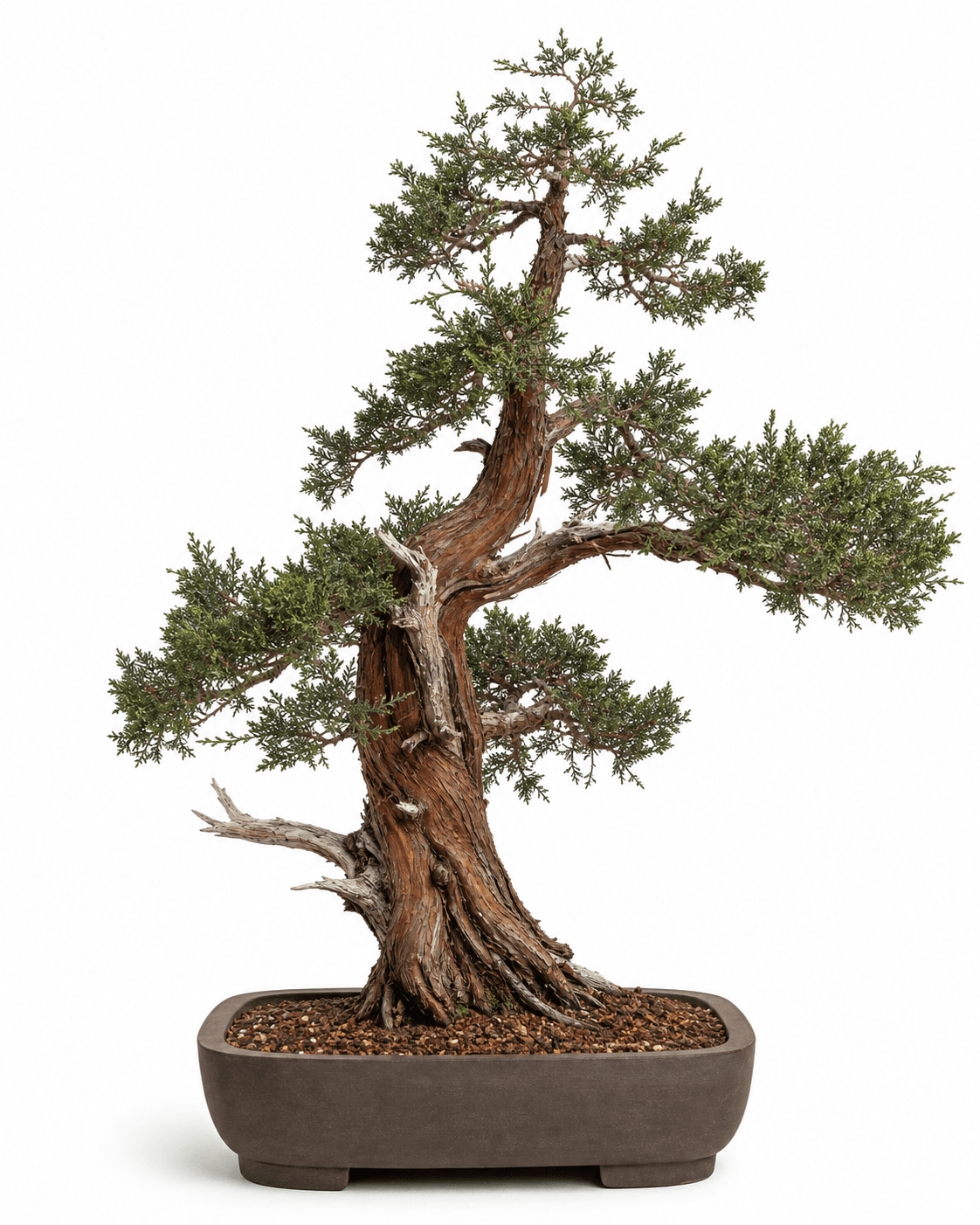
The design implication is a rugged, exposed, old-field or woodland-edge image: upright trunks, red-brown shredding bark, sparse older branches, small blue cones on female plants, and live foliage set against dead or weathered wood. NC State ExtensionBonsai Mirai / Asymmetry
Reading the tree
Start with foliage quality, root stability, and whether the tree is holding mature scale growth.
Mirai juniper physiology places strength in foliage. If the tree is weak, newly collected, or showing stress foliage, let it grow before pruning, wiring, grafting, or repotting. Bonsai Mirai Library
Eastern red cedar needs a stricter reading than many landscape junipers because Mirai flags the species as prone to juvenile-foliage reversion and less reliable in cultivation than Rocky Mountain juniper. Strong scale foliage, expanding runners, and interior shoots are the green lights. Bonsai Mirai Library
FNA and NC State help with identification. Mature foliage is scale-like, while young or stress foliage can be awl-shaped and prickly. Cones are small, glaucous, blue to blue-black, and mature in the first year. Flora of North AmericaNC State Extension
Separate Eastern red cedar from Rocky Mountain juniper, southern redcedar, redberry juniper, Ashe juniper, Thuja occidentalis, Thuja plicata, and true Cedrus before applying any species-specific advice. Kew POWOUSDA Forest Service FEISBonsai Mirai Library
Foliage work
Let running growth mature, then prune cleanly to live laterals.
Mirai places Eastern red cedar with running junipers. Running junipers elongate first, then build density at the base of the shoot, so the refinement move is to wait for post-harden growth and prune back to viable lateral shoots. Bonsai Mirai Library
Pinching is the wrong maintenance signal for scale junipers. Removing active tips weakens roots, tears tissue, and can produce juvenile foliage. Use sharp scissors and directional pruning instead. Bonsai Mirai Library
Do not cut to bare wood expecting reliable back-budding. Preserve interior shoots, manage exterior runners before they shade the inside, and rebuild density from living lateral growth. Bonsai Mirai Library
Heavy spring reduction can be useful for redevelopment on strong material, but it usually produces coarse response. Hold fertilizer after large spring cuts and plan a later corrective pass once the growth hardens. Bonsai Mirai Library
Roots
Repot as a scale juniper and respect the species coarse transplant behavior.
Mirai specifically says Juniperus virginiana is a scale juniper that can revert to juvenile foliage, so the late repot timing for true needle junipers does not apply. Use a spring scale-juniper recovery window instead. Bonsai Mirai Library
UF/IFAS warns that landscape plants are difficult to transplant because of a coarse root system except when quite small. That supports a conservative bonsai approach: favor seedlings, young nursery stock, or collected material with proven aftercare over freshly dug old field trees. UF/IFAS Extension
For established bonsai, secure the rootball firmly, preserve foliage mass, avoid bare-rooting, keep the old core from becoming hydrophobic, and stage dense or native soil removal over multiple repots. Bonsai Mirai Library
After root work, protect from intense sun, wind, and hard freezes until new root function is evident. Juniper foliage can look unchanged while roots are still behind, so aftercare should be measured in weeks rather than days. Bonsai Mirai Library
Soil and pot
Use mineral soil that favors oxygen without letting fine juniper roots dry hard.
Mirai juniper method starts near 1:1:1 akadama:pumice:lava. A 2:1:1 akadama:pumice:lava blend can be used when a vigorous refined tree needs more water and nutrient retention, while cool wet climates should lean back toward oxygen. Bonsai Mirai Library
Public horticulture sources describe Eastern red cedar as tolerant of clay, sand, loam, alkaline soil, acidic soil, drought, and salt. Bonsai soil should translate that adaptability into stable pore space, not into heavy organic potting soil. NC State ExtensionUF/IFAS Extension
Pot choice should follow material character. Old-field trunks and native-collected forms suit unglazed rectangles, softened ovals, dry earth tones, slabs, and quiet containers that let bark, live vein, and foliage carry the composition. Bonsai Mirai / Asymmetry
Climate
The species is hardy and heat-tolerant, but container roots narrow the margin.
NC State and UF/IFAS both list hardiness across Zones 2 to 9. In bonsai, that landscape range should be read through pot size, recent work, wind exposure, and the reduced cold durability of confined juniper roots. NC State ExtensionUF/IFAS ExtensionBonsai Mirai Library
In cold regions, set pots on the ground and insulate around hard freezes, especially after late-winter pruning or spring repotting. Mirai juniper guidance uses 25 F as a practical root-protection threshold and 28 F as a post-work hard-freeze caution. Bonsai Mirai Library
In humid eastern climates, prioritize airflow and avoid keeping dense foliage wet. Cedar-apple rust, twig blights, and root oxygen problems become more important than drought survival. NC State Extension: Cedar Apple RustUC IPM Juniper Twig BlightsBonsai Mirai Library
In hot exposed climates, established trees tolerate heat well, but freshly worked roots need afternoon protection. Adjust by root condition rather than by the species reputation for toughness. Bonsai Mirai LibraryUF/IFAS Extension
Pests and diseases
Cedar-apple rust is the signature risk, with ordinary juniper pests close behind.
NC State Extension describes cedar-apple rust as caused by Gymnosporangium juniperi-virginianae and requiring two hosts: apples plus red cedars or ornamental junipers. On juniper, dormant brown galls swell during spring rains and produce orange gelatinous horns. NC State Extension: Cedar Apple Rust
For bonsai, remove reachable galls during dormancy, keep foliage open, avoid overhead wetting where possible, and be especially cautious when Malus, crabapple, hawthorn, or quince are nearby. NC State Extension: Cedar Apple Rust
UC IPM lists general juniper problems including bark beetles, borers, scales, spider mites, twig blights, Phytophthora, rusts, cankers, scorch, nutrient disorders, and water stress. Bonsai prevention starts with sun, airflow, balanced water and oxygen, and clean cuts. UC IPM JuniperUC IPM Juniper Twig BlightsBonsai Mirai Library
NC State notes low toxicity if eaten and identifies volatile oils including thujone. Treat fruit, foliage, and clippings as unsuitable for casual ingestion by people or pets. NC State Extension
Wiring
Wire after hardening, anchor well, and watch for reversion after stress.
Use standard juniper wiring principles: good hydration, a stable rootball, continuous contact, no gaps, and wire sized to hold the branch without crushing live tissue. Detail wiring should support the foliage rather than twist it loose from the branch. Bonsai Mirai Library
Eastern red cedar can carry mature scale foliage and juvenile awl foliage on the same tree. If wiring or reduction causes juvenile reversion, stop pushing the design and rebuild strength before the next step. Bonsai Mirai LibraryNC State Extension
Older bark is shreddy and textured, so wire bite can hide until removal. Check more often on vigorous nursery stock and after strong fall feeding when vascular tissue thickens. NC State ExtensionBonsai Mirai Library
Propagation
Seedlings, young nursery plants, and selected cuttings are safer than older field digs.
FNA describes one-year seed cones with 1 to 2, rarely 3, seeds. USDA FEIS describes the species as bird-dispersed and able to colonize old fields, eroded ground, open woods, and grasslands where fire has been removed. Flora of North AmericaUSDA Forest Service FEIS
UF/IFAS notes that birds spread the fruit along fences and abandoned fields, and also warns that larger plants are difficult to transplant. For bonsai, young volunteer or nursery material is usually a more responsible starting point than old roadside collection. UF/IFAS Extension
Cuttings are possible in junipers, but cultivar, timing, humidity, and foliage condition matter. Grafting should be reserved for vigorous material whose trunk merits finer or more stable foliage. Bonsai Mirai Library
Sourcing
Buy for identity, roots, interior foliage, and stable mature scale growth.
Confirm the label as Juniperus virginiana. Ask whether the plant is typical Eastern redcedar, southern redcedar, Rocky Mountain juniper, Ashe juniper, Thuja, or a cultivar selection such as Taylor, Brodie, Canaertii, Grey Owl, Manhattan Blue, or Glauca Compacta. Kew POWONC State Extension
Good material has a stable rootball, active scale foliage, interior shoots, trunk movement near the base, healthy bark, and no rust galls. Young nursery plants can be developed patiently; older field material needs recovery records. Bonsai Mirai LibraryNC State Extension: Cedar Apple Rust
Red flags include recent digging, sparse gray foliage, all juvenile foliage after styling, hydrophobic old soil, no interior shoots, branch dieback after wiring, rust galls, and sellers using cedar labels without a Latin name. Bonsai Mirai LibraryUF/IFAS Extension
Collect only where legal and ethical. Eastern red cedar may be abundant or weedy in parts of its range, but that never substitutes for permission, aftercare planning, and the restraint to leave weak trees in the ground. USDA Forest Service FEISBonsai Mirai Library
Troubleshooting
Diagnose by symptom, cause, and the correction that restores foliage-powered strength.
Symptom: mature scale foliage reverts to prickly juvenile growth. Likely cause: over-reduction, weak roots, wiring damage, or poorly timed work. Fix: stop pruning, stabilize water and oxygen, and grow strength before refinement. Bonsai Mirai Library
Symptom: interior foliage browns while exterior runners grow. Likely cause: shade-out from unmanaged running growth. Fix: prune after hardening to preserve interior laterals and rebuild density. Bonsai Mirai Library
Symptom: water sheets off the surface or drains around the rootball. Likely cause: compacted organic soil, hydrophobic native core, or dense surface roots. Fix: restore surface percolation now and plan staged root work in spring. Bonsai Mirai Library
Symptom: brown galls produce orange horns in wet spring weather. Likely cause: cedar-apple rust. Fix: remove galls where practical, improve airflow, avoid prolonged wet foliage, and manage nearby susceptible apple-family hosts. NC State Extension: Cedar Apple Rust
Symptom: shoot tips brown after wet weather or pruning. Likely cause: juniper twig blight. Fix: remove infected tissue, dispose of debris, increase airflow, keep foliage drier, and avoid excess fertilizer. UC IPM Juniper Twig Blights
Symptom: old foliage dulls and roots smell sour. Likely cause: oxygen-starved substrate or root disease. Fix: correct watering, drainage, and soil structure before adding more fertilizer. Bonsai Mirai LibraryUC IPM Juniper
Design
Use running-juniper structure, old-field ecology, and live foliage against deadwood.
Mirai design fundamentals start with the trunk line, defining branch, and apex. On Eastern red cedar, use those elements to decide whether the tree should read as rugged field edge, weathered upright, sparse literati, or compact native juniper. Bonsai Mirai LibraryBonsai Mirai / Asymmetry
Because Eastern red cedar can throw juvenile foliage under stress, the best design is often slower and more horticultural than the first styling suggests. Let the tree prove mature foliage stability before finalizing small pads. Bonsai Mirai Library
Live-vein and deadwood work can support the image, but do not carve beyond the tree story. Shredding bark, red-brown trunk color, older lower limbs, small cones, and open-field austerity are more honest than imported shimpaku pad styling. NC State ExtensionBonsai Mirai / Asymmetry
Grafting can be justified when the trunk has age and movement but the native foliage is too coarse, too unstable, or too poorly placed. Make that decision only after the root system and native foliage mass are strong. Bonsai Mirai Library
Forms and labels
Track the Latin name, coastal variety, and landscape cultivar before applying care.
Kew accepts two infraspecifics: Juniperus virginiana var. virginiana and Juniperus virginiana var. silicicola. It also lists Sabina virginiana and Juniperus foetida var. virginiana as homotypic synonyms. Kew POWO
USDA FEIS treats southern redcedar as a variety within Eastern redcedar while noting that some authors have treated it separately. Record coastal or southern provenance when you can, because climate and foliage behavior may differ. USDA Forest Service FEIS
NC State image and cultivar references include Taylor, Brodie, Canaertii, Grey Owl, Manhattan Blue, and Glauca Compacta. Landscape cultivars can be useful bonsai starters, but habit, graft status, foliage color, and mature size need individual inspection. NC State Extension
Plain red cedar labels need verification. In North American horticulture they can point toward Juniperus, Thuja, or true Cedrus depending on region and seller. Bonsai Mirai Library
History
Eastern red cedar is a familiar native tree with a complicated bonsai reputation.
USDA Silvics describes Eastern redcedar as common through the eastern half of the United States, with increasing numbers and valued durable, workable, aromatic wood. USDA Forest Service Silvics
USDA FEIS documents wildlife value from berry-like cones eaten by many birds and small mammals, especially in winter. NC State also notes songbirds, small mammals, moths, butterflies, pollinators, shelter, and nesting value. USDA Forest Service FEISNC State Extension
The species also carries land-management baggage. USDA FEIS describes prairie and grassland expansion tied to fire exclusion, and NC State marks the plant as weedy and highly flammable. USDA Forest Service FEISNC State Extension
In bonsai, the value proposition is native familiarity, toughness, bark, cone color, and access. The constraint is reliability: juvenile foliage and weaker high-end track record mean the best Eastern red cedar bonsai are built with patience, strong culture, and clear species identity. Bonsai Mirai LibraryBonsai Mirai / Asymmetry
Species questions
Answer the beginner questions before styling.
Can Eastern red cedar be grown as bonsai?
Yes. Eastern red cedar can be bonsai when it is grown outdoors, kept in mineral soil, pruned as a running juniper, and allowed to build enough foliage before major work.
Can Eastern red cedar bonsai live indoors?
No. Eastern red cedar needs outdoor sun, airflow, seasonal temperature change, and winter dormancy. Indoor display should be brief.
Is Eastern red cedar a cedar or a juniper?
Eastern red cedar is Juniperus virginiana, a juniper in Cupressaceae. Use Juniperus handling rather than Thuja, Cedrus, or houseplant care.
Should Eastern red cedar bonsai be pinched?
Use scissors instead of pinching. Let runners harden, then prune to live lateral growth so the tree keeps enough mature foliage to power roots.
Why did my Eastern red cedar produce prickly juvenile foliage?
Juvenile foliage usually follows stress, over-reduction, weak roots, or wiring damage. Stabilize culture, stop pruning, and rebuild mature scale foliage through strong growth.
When should Eastern red cedar be repotted?
Repot in spring as a scale juniper. Preserve foliage mass, secure the rootball, avoid bare-rooting, and protect from heat, wind, and hard freezes after root work.
What soil is best for Eastern red cedar bonsai?
Use oxygen-rich mineral soil. A 1:1:1 akadama:pumice:lava mix is a conservative starting point, with more akadama only for vigorous trees that need added water retention.
Does Eastern red cedar carry cedar-apple rust?
Yes. It can host cedar-apple rust. Inspect for galls, remove them where practical, keep pads airy, and be careful near apples, crabapples, hawthorns, or quince.
Is Eastern red cedar the same as Rocky Mountain juniper?
They are separate species, Juniperus virginiana and Juniperus scopulorum. Their running-juniper handling overlaps, and hybrid zones exist, so verified labels matter.
Is Eastern red cedar good beginner bonsai material?
Young nursery or seedling material can teach outdoor juniper care. Older collected trees and refinement projects are harder because of coarse roots, juvenile-foliage reversion, and rust-host risk.
Sources
Species advice needs source discipline.
Next decisions
Plan the operation before copying the calendar.
A good care note for Eastern red cedar records the tree's stage, the work done, and the aftercare used. That record matters more than a month-name rule.
Related species
Compare nearby trees before transferring advice.
California juniper
Juniperus californica
Sierra juniper / Western juniper
Juniperus grandis
Western juniper
Juniperus occidentalis
Rocky Mountain juniper
Juniperus scopulorum
Utah juniper
Juniperus osteosperma