
Species guide
Noble Fir Bonsai Care
Abies procera
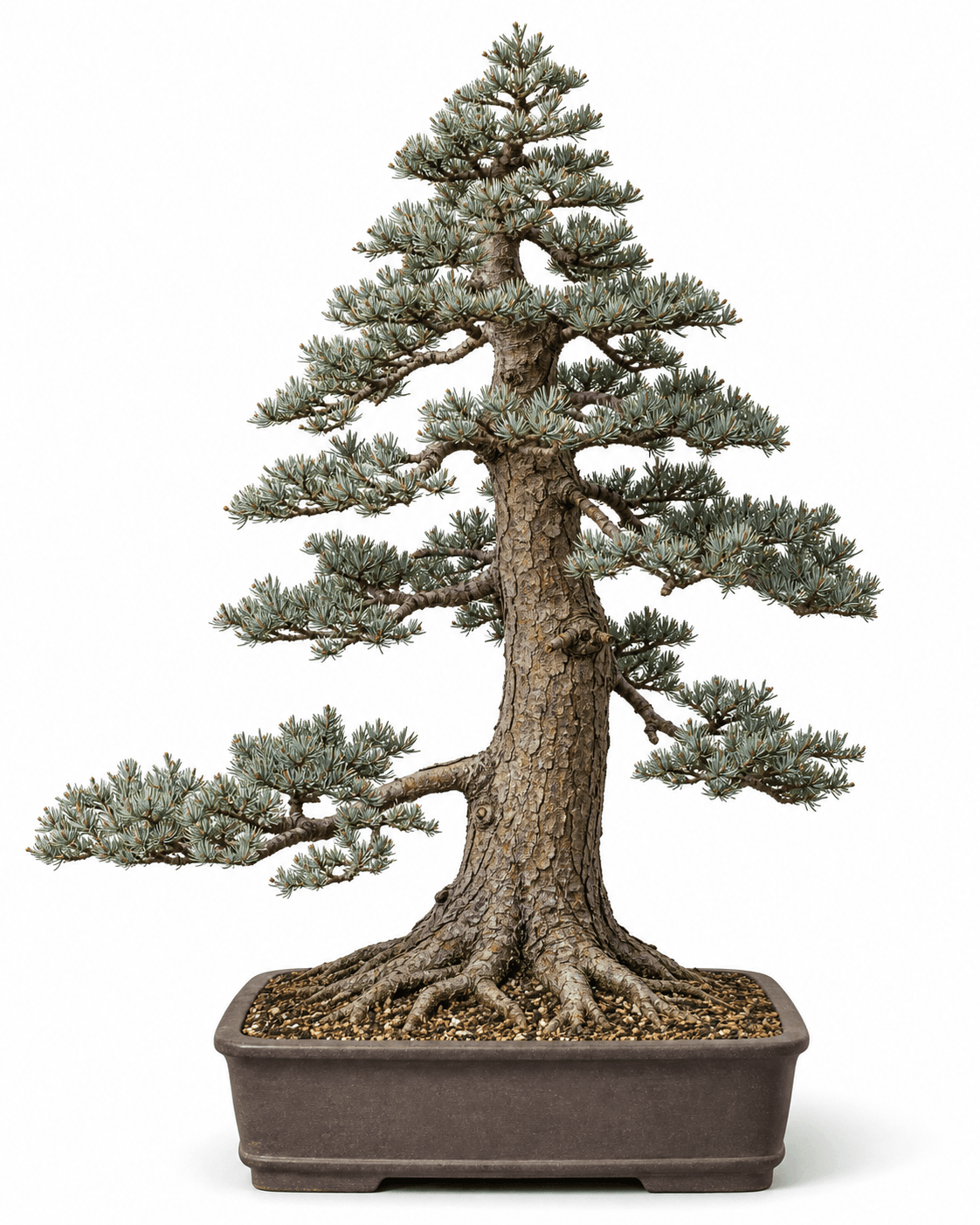
Noble fir bonsai, Abies procera, should be treated as a cool-rooted Pacific Northwest true fir. It belongs outdoors, wants bright air and reliable moisture, and should be worked from buds, recovery, and staged nursery-stock conversion rather than from a finished-tree schedule.
The practical care rule is sequence. Correct the oversized nursery root mass first, keep enough foliage to rebuild roots, then style only after the tree proves water uptake and bud strength.
The local Bonsai Mirai corpus has direct Noble fir nursery-stock coverage but no dedicated Noble fir refinement file. This guide is therefore source-depth-aware: Mirai supplies nursery-stock, Abies, elongating-conifer, watering, soil, repotting, wiring, and design method, while Kew, NC State, Oregon State, and USDA sources ground identity, range, hardiness, ecology, and pest context.
Updated July 4, 2026. Written by EntGrove Editorial. Last verified July 4, 2026.
Care fingerprint
Read the species through its shared care pattern.
Strong light, cool-root management, conservative root work, and post-extension pruning dominate the care calendar. Use this as the starting point before local conditions and tree strength refine the calendar.
Do not prune like a pine
Elongating conifers extend from buds and shoots, so candle-cutting assumptions can remove the exact growth the tree needs.
Preserve interior growth
Spruce, fir, hemlock, cedar, redwood, cypress, and larch all become harder to design when interior buds are shaded out.
Keep recovery cool and steady
Many elongating conifers respond best when roots stay evenly moist, oxygenated, and protected from hot dry swings.
Care cadence
The calendar starts with the tree's seasonal state.
Placement
Timing: Grow outside year-round. Use full sun where roots stay cool, and shift to morning sun or filtered light when summer heat and lowland benches push beyond the tree maritime mountain pattern.
Watch for: Hot containers, dry afternoon wind, weak shaded interior buds, pale tips after heat spikes, and benches that stay warm after sunset.
NC State ExtensionOregon State Landscape PlantsBonsai Mirai LibraryWatering
Timing: Water deeply when the upper aggregate begins to dry while the inner root mass still carries moisture. Newly converted nursery stock often needs slower checks because retained field or potting soil dries unevenly.
Watch for: Water bypassing a dense core, peat staying wet after the surface dries, dull needles, root sourness, and reduced foliage mass after styling lowering water use.
Bonsai Mirai LibraryUSDA Forest Service SilvicsFertilizer
Timing: Feed during active growth on established material. Keep fertilizer moderate after root work and taper before winter hardening so late growth does not enter cold weather soft.
Watch for: Coarse apical extension, weak lower buds, fertilizer on freshly cut roots, and pushing a tree that has not proved post-repot recovery.
Bonsai Mirai LibraryRepotting
Timing: Use spring bud movement as the default root-work window. For raw nursery trees, reduce the root mass before heavy styling whenever the soil volume is oversized and water-retentive.
Watch for: Bare-rooting a conifer, reducing foliage first while roots remain in a large wet container, weak tie-downs, and deep buried trunk bases.
Bonsai Mirai LibraryPruning
Timing: In refinement, shorten strong elongating tips only when a replacement bud or side shoot is visible behind the cut. Use post-harden or early fall cuts for larger structural decisions.
Watch for: Pinching every tip, cutting beyond the last bud, flattening the whole silhouette at once, and removing too much lower foliage during development.
Bonsai Mirai LibraryWiring
Timing: Wire healthy established trees in spring or early fall. Use enough gauge to hold the primary line, then inspect frequently because smooth young bark marks under pressure.
Watch for: Needle crush, wire hidden in dense foliage, old stiff branches forced too far, and wire left through fall swelling.
Bonsai Mirai LibraryPest checks
Timing: Inspect during spring push, after heat stress, and before winter storage. Pests often follow root stress, drought, or root disease rather than appearing on vigorous trees first.
Watch for: Noble fir bark beetle on weakened trees, dwarf mistletoe, boring dust, resin stress, mite stippling, scale, aphids, and root rot in wet cores.
NC State ExtensionUSDA Forest Service SilvicsWinter protection
Timing: Keep dormant and cold, but protect the pot from exposed freeze-thaw and drying wind. Snow, mulch beds, cold frames, or ground contact are safer than warm indoor storage.
Watch for: Warm storage, dry frozen roots, pots elevated in wind, rodents, and thawed roots followed by hard freezes.
Bonsai Mirai LibraryNC State ExtensionSpecies guide
Apply the species profile before copying another tree's calendar.
At a glance
Noble fir is a Pacific Northwest true fir for staged outdoor work.
Abies procera is a large needled evergreen in Pinaceae, known for blue-green foliage, upright cones, upswept branches, wind tolerance, and Christmas-tree use. NC State lists full sun to partial shade, moist well-drained acidic loam, and USDA Zones 5a-6b. NC State Extension
In bonsai, treat Noble fir as an alpine elongating conifer with a nursery-stock bias. Its most available material is often holiday or landscape stock, so the first serious work is usually root discovery, soil-volume correction, and preserving enough foliage to recover. Bonsai Mirai LibraryOregon State Landscape Plants
The local Mirai corpus includes direct Noble fir nursery-stock coverage and rootbound nursery-stock method, then transfers Abies spring pinching and elongating-conifer timing. That source mix supports a practical guide, with transparent limits on species-specific refinement depth. Bonsai Mirai LibraryBonsai Mirai / Asymmetry
Wild range
Its native climate is cool, wet, maritime, and mountain-bound.
USDA Silvics describes Noble fir as limited to the Pacific Northwest Cascade and Coast Range mountains. Its core range is northern Oregon and Washington, mostly on western Cascade slopes and crests, with isolated Oregon Coast Range and southwestern Washington populations. USDA Forest Service Silvics
The native climate is moist and maritime. USDA Silvics gives cool average annual temperatures, winter-dominant precipitation, and deep snowpack, while FEIS places the growing season in the Pacific silver fir zone at roughly 40-50 days. USDA Forest Service SilvicsUSDA Forest Service FEIS
Water supply matters more than perfect soil. USDA sources describe volcanic parent materials, Inceptisols, Spodosols, and steep mountain terrain, but repeatedly tie success to ample moisture. A bonsai pot should mirror that with fast water movement, oxygen, and root cooling. USDA Forest Service SilvicsUSDA Forest Service FEISBonsai Mirai Library
The design implication is a clean mountain conifer: upright line, compact crown, blue foliage, self-pruned lower trunk character, and horizontal to upswept branches. The tree should read as a high-elevation fir rather than a generic nursery cone. USDA Forest Service FEISBonsai Mirai / Asymmetry
Reading the tree
Start by reading roots, trunk base, and useful primary lines.
Mirai nursery-stock selection starts with three priorities: a stable expanding base, non-repetitive trunk movement, and one distinguishing feature. With Noble fir, that means digging below the apparent nursery soil line before judging the material. Bonsai Mirai Library
Do not confuse a healthy green cone with a bonsai-ready tree. A Noble fir can carry attractive foliage while the root ball is still too deep, too organic, or too wet for a shallow container. Bonsai Mirai Library
Development material should keep enough foliage to rebuild roots and generate buds. Refinement begins only after the tree dries and rewets predictably, stays anchored, and shows useful interior bud options. Bonsai Mirai Library
USDA Silvics describes slow early seedling growth and limited vegetative reproduction. In bonsai terms, lost roots and lost lower branches are expensive, so preservation during early conversion matters more than speed. USDA Forest Service SilvicsBonsai Mirai Library
Pruning
Use Abies bud logic, then build structure in stages.
Abies spring pinching should be reserved for refined, healthy shoots with visible replacement buds or smaller interior shoots. The pinched tip is being sacrificed, so the grower must know what carries the branch afterward. Bonsai Mirai Library
Raw nursery stock needs branch selection more than silhouette pinching. Clean weak bottoms and obvious interior clutter first, reveal the trunk, choose primary lines, and keep surplus foliage until the root system is stable. Bonsai Mirai Library
Post-harden pruning can reduce extension once the new growth has matured. Cut to visible buds or smaller shoots and vary cut positions over time so branch ends do not become repeated swollen knobs. Bonsai Mirai Library
Early fall is useful for established elongating conifers because vascular production supports wound response and wiring. Avoid major late-fall cuts where winter protection is uncertain. Bonsai Mirai Library
Roots
Repot before heavy styling when the nursery core is the main problem.
Mirai rootbound nursery-stock guidance works the point of greatest limitation in sequence: first bottom depth, then sides, then the core beneath the trunk in later repottings. That is especially relevant for Christmas-tree and landscape Noble fir stock. Bonsai Mirai Library
Conifers should retain some native root mass. The goal is staged conversion, not a one-session bare-root wash. Preserve enough fine roots and microbial continuity to keep the foliage hydrated after root work. Bonsai Mirai Library
When styling and repotting both need to happen, Mirai generally prefers repotting conifer nursery stock first, then styling after one recovery cycle. Large foliage reduction in an oversized wet container can leave the root zone anaerobic. Bonsai Mirai Library
After repotting, tie the tree down firmly, water thoroughly once, then let oxygen return before watering again. USDA sources describe moisture-sensitive establishment, so aftercare should prevent both dry pockets and stagnant saturated cores. Bonsai Mirai LibraryUSDA Forest Service Silvics
Soil and pot
Use a functional conifer pot before choosing a show pot.
A practical transition mix is akadama, pumice, and lava, adjusted by climate. Increase moisture retention where wind and summer dry-down are intense; increase pumice or lava where cool humid weather leaves the pot wet too long. Bonsai Mirai Library
Oregon State notes that Noble fir is difficult under lowland conditions unless soil is cool, moist, and well drained. A bonsai pot must supply the same contradiction: enough water to protect fine roots, enough oxygen to prevent decline. Oregon State Landscape PlantsBonsai Mirai Library
Use a training container with adequate depth during conversion. A shallow display pot can come later, after the root pad is lateral, fine, evenly watered, and strong enough to hold the tree through summer. Bonsai Mirai Library
Pot aesthetics should stay quiet: unglazed rectangles, ovals, and rugged mountain containers usually support the conifer identity. Blue foliage can carry a restrained clay body better than a colorful glaze. Bonsai Mirai / Asymmetry
Climate
Lowland heat is the main adaptation problem.
Noble fir is best within or near its native Pacific Northwest climate. NC State says it is best grown within the Pacific Northwest native range, and Oregon State warns about lowland difficulty without cool moist drainage. NC State ExtensionOregon State Landscape Plants
In maritime climates, full sun can work when the pot stays cool and water moves well. In inland or hotter regions, use morning sun, afternoon shade, pot shading, mulch beds, and airflow. Bonsai Mirai LibraryUSDA Forest Service Silvics
In cold regions, maintain real dormancy while protecting the container root system. A landscape Zone 5 rating does not mean a shallow bonsai pot can sit exposed through repeated hard freezes and drying wind. NC State ExtensionBonsai Mirai Library
In warm-winter regions with no cold rest, choose another species. The care calendar for Noble fir depends on dormancy, spring bud movement, post-harden growth, and a cool fall vascular window. Bonsai Mirai LibraryUSDA Forest Service FEIS
Pests
Pests usually show up after root or climate stress.
NC State reports no major pest losses but flags Noble fir bark beetle on root-diseased trees and dwarf mistletoe in some areas. In bonsai, both are signals to inspect root health and sourcing history. NC State Extension
USDA Silvics discusses disturbance from insects and diseases in the forest context, including stress-related problems that become more serious when trees are weakened. USDA Forest Service Silvics
Common container diagnostics are simpler: sour soil, poor drainage, drying tips, weak interior buds, mite stippling, aphids, scale, boring dust, resin stress, and dieback after heat. Bonsai Mirai LibraryNC State Extension
Correct the cultural cause before chasing sprays. Improve watering, root oxygen, shade, airflow, quarantine, and pest identification, then use locally labeled treatment if an extension source confirms the pest. Bonsai Mirai LibraryNC State Extension
Wiring
Wire to set primary structure, then let the tree recover.
Initial nursery-stock styling is about primary lines: trunk, defining branch, apex, and a few branch directions. Mirai warns against over-bending every branch into compact curves to fake a finished tree. Bonsai Mirai Library
Use enough wire to hold the bend without repeated cranking. Protect needles, support branch shoulders with the off hand, and keep force near the wire rather than pulling from the tip. Bonsai Mirai Library
Noble fir branches can be stiff as they age. Use younger shoots for structural replacement where possible, and use guy wires or staged bends when a single wrapped wire asks too much. Bonsai Mirai LibraryBonsai Mirai / Asymmetry
Inspect wire often during active growth and early fall thickening. Smooth young bark and dense foliage can hide bite until it is already visible. Bonsai Mirai Library
Propagation
Seed and nursery stock are realistic; vegetative shortcuts are limited.
USDA Silvics says Noble fir may begin bearing cones around 20 years, with commercial seed bearing around 50 years. Seed quality is often poor, and natural seedlings grow slowly at first. USDA Forest Service Silvics
Noble fir is not known for vegetative reproduction in the USDA Silvics account. For bonsai growers, purchased seedlings, small nursery trees, and legal landscape or Christmas-tree stock are more realistic than cuttings. USDA Forest Service SilvicsBonsai Mirai Library
Air layering is not the default Noble fir path. Mirai conifer air-layer guidance distinguishes species carefully, and there is no Noble fir-specific evidence in the local corpus that would make layering a beginner recommendation. Bonsai Mirai Library
Grafted blue or dwarf cultivars can be interesting, but inspect the graft union before committing to exposed-root, literati, or clean-trunk designs. The union may remain visually stronger than the rest of the tree. Oregon State Landscape PlantsBonsai Mirai / Asymmetry
Buying
Choose the odd tree with a usable base, not the perfect cone.
Mirai nursery-stock selection favors the abnormal outlier with base character, trunk movement, exposed roots, or another distinctive feature. Uniform triangular Christmas-tree stock often has little bonsai value beyond practice. Bonsai Mirai Library
Excavate the soil surface before buying if the nursery allows it. The true root flare may sit inches below the apparent soil line, and whorled branches can hide inverse swelling that becomes impossible to correct later. Bonsai Mirai Library
Reject trees with sour soil, weak roots, severe root circling, bark beetle signs, dried interior foliage, no low branches, or a perfectly straight trunk with no usable movement. Bonsai Mirai LibraryNC State Extension
Oregon State lists Glauca, Sherwoodi, Blaue Hexe, Jeddeloh, and Glauca Prostrata type forms, while warning that some apparent dwarfs from side branches can later develop a leader. Record cultivar history before styling. Oregon State Landscape Plants
Troubleshooting
Most failures trace to sequence, water, heat, or hidden roots.
Symptom: tips dry after first styling. Likely causes: too much foliage removed while the tree remained in a large wet root mass, dry wind, or weak root recovery. Fix: stabilize water, shade the pot, stop styling, and wait for new buds. Bonsai Mirai Library
Symptom: soil surface dries but the tree still declines. Likely cause: a dense nursery core that stays wet or dry independently of the new outer soil. Fix: stage root correction at the next safe spring window. Bonsai Mirai Library
Symptom: no interior response after pinching. Likely cause: the shoot was shortened before replacement buds were present. Fix: rebuild strength and reduce only to visible buds or side shoots. Bonsai Mirai Library
Symptom: boring dust, resin stress, or sudden branch collapse. Likely causes: bark beetle activity, root disease, or severe stress. Fix: isolate, identify, inspect roots, and use extension-backed treatment where appropriate. NC State ExtensionUSDA Forest Service Silvics
Symptom: a perfect cone that never becomes bonsai. Likely cause: the tree was bought for density rather than base, trunk, and branch options. Fix: redesign around one useful feature or restart with better material. Bonsai Mirai LibraryBonsai Mirai / Asymmetry
Design
Let Noble fir read as a cool mountain true fir.
Start with the base, trunk line, defining branch, and apex. Noble fir can carry strong verticality, but a bonsai still needs asymmetry, varied internode spacing, and branch placement that shows age rather than nursery repetition. Bonsai Mirai LibraryBonsai Mirai / Asymmetry
A formal upright can work when the trunk is clean and the branch rhythm is varied. USDA FEIS describes mature trees with a self-pruning trunk and short horizontal branches, which fits a restrained high-conifer image. USDA Forest Service FEISBonsai Mirai / Asymmetry
Exposed-root nursery stock can be valuable when roots vary in thickness, direction, and spacing. Mirai holiday nursery-stock guidance treats odd exposed-root material as a design feature rather than a defect to remove. Bonsai Mirai Library
Deadwood should stay understated. True fir can show aged wounds and broken tops, but bright carved juniper-style deadwood rarely fits the soft, moist, maritime forest character. Bonsai Mirai / AsymmetryUSDA Forest Service Silvics
Cultivars
Blue and dwarf forms need label discipline.
NC State lists Glauca, and Oregon State lists Glauca, Sherwoodi, Blaue Hexe, Jeddeloh, and Glauca Prostrata style forms. Blue foliage can be useful, but growth habit and graft quality matter more than color. NC State ExtensionOregon State Landscape Plants
Oregon State notes that some side-branch derived apparent dwarf forms may later develop a leader and grow out of dwarf scale. Treat dwarf labels as observations to verify, not permanent bonsai guarantees. Oregon State Landscape Plants
Keep white fir labels separate. USDA Silvics lists white fir as an alternate common name for Noble fir, but Abies concolor is also commonly called white fir and has a different range and care profile. USDA Forest Service SilvicsKew POWO
Noble fir can also be confused with California red fir and Shasta red fir in southern parts of the fir complex. Keep provenance and nursery labels in the tree record. USDA Forest Service Silvics
History
The bonsai story starts with Christmas trees and Pacific Northwest forests.
Noble fir is one of the largest true firs. USDA FEIS says mature trees can reach 230 feet, while USDA Silvics records exceptionally large trees above 270 feet and notes major timber volume in suitable stands. USDA Forest Service FEISUSDA Forest Service Silvics
The species is familiar because of Christmas-tree culture. NC State and Oregon State both note Christmas-tree use, which also explains why inexpensive young material sometimes reaches bonsai growers. NC State ExtensionOregon State Landscape Plants
Mirai nursery-stock material uses Noble fir as a lesson in turning seasonal or affordable stock into bonsai through selection, root correction, staged work, and primary-line design. Bonsai Mirai Library
A credible Noble fir bonsai should show health first: firm blue-green needles, secure roots, visible buds, no active wire bite, no sour soil, and a design that makes its cool Pacific Northwest source legible. Bonsai Mirai / AsymmetryBonsai Mirai Library
Species questions
Answer the beginner questions before styling.
Can Noble fir be grown as bonsai?
Yes. Abies procera can be trained as bonsai when it is grown outdoors, protected from heat, kept in moist oxygenated soil, and converted from nursery stock in stages.
Can Noble fir bonsai live indoors?
No. Noble fir is an outdoor true fir that needs cold dormancy, moving air, bright outdoor light, and seasonal temperature change.
When should I repot Noble fir bonsai?
Use spring bud movement as the normal repotting window. For raw nursery stock, correct the deep root mass before heavy styling whenever the original soil is oversized or water-retentive.
Should I style or repot a Noble fir first?
If the root ball is too large or wet, repot first and style after recovery. Mirai nursery-stock guidance generally gives conifer roots a recovery cycle before major styling.
How often should I water Noble fir bonsai?
Water when the upper aggregate begins to dry while the inner root mass still carries moisture. Avoid both dry pockets and sour wet nursery cores.
Can I pinch Noble fir like spruce?
Use Abies logic. Shorten only strong refined shoots when visible replacement buds or side shoots exist behind the cut.
Is a Christmas-tree Noble fir good bonsai material?
Sometimes. Choose the odd tree with a usable root flare, movement, low branches, and a healthy recoverable root mass rather than the densest uniform cone.
What pests affect Noble fir bonsai?
Watch for bark beetle symptoms on stressed trees, dwarf mistletoe in sourced material, mites, aphids, scale, root rot, and general dieback after heat or poor drainage.
What styles suit Noble fir bonsai?
Formal upright, informal upright, forest, clump, exposed-root, slab, and restrained high-mountain conifer designs suit Noble fir best.
Is Noble fir the same as white fir?
Noble fir is Abies procera. Some sources list white fir as a common name, but Abies concolor is also widely called white fir, so verify the botanical label before applying care advice.
Sources
Species advice needs source discipline.
Next decisions
Plan the operation before copying the calendar.
A good care note for Noble fir records the tree's stage, the work done, and the aftercare used. That record matters more than a month-name rule.
Related species
Compare nearby trees before transferring advice.
Subalpine fir
Abies lasiocarpa
Balsam fir
Abies balsamea
White fir
Abies concolor
Mountain hemlock
Tsuga mertensiana
Eastern hemlock
Tsuga canadensis