
Species guide
Subalpine Fir Bonsai Care
Abies lasiocarpa
Subalpine fir bonsai should be treated as a cool-rooted alpine elongating conifer. Give Abies lasiocarpa strong light, high oxygen, reliable water, real winter chill, and protection from hot dry summer conditions that a shallow container amplifies.
The pruning rule is narrow and important: Abies tips do not behave like spruce. Pinch only strong elongating shoots when interior replacement buds are visible, and make reduction cuts back to a physical bud or smaller shoot.
The local Bonsai Mirai corpus has unusually strong subalpine fir coverage, including dedicated Abies lasiocarpa styling, Olympic subalpine forest observation, Abies spring pinching, and elongating-conifer fall work. Public taxonomy and ecology facts here are grounded in Kew, Oregon State, USDA Silvics, FEIS, and USDA NRCS sources.
Updated June 3, 2026. Written by EntGrove Editorial. Last verified June 3, 2026.
Care fingerprint
Read the species through its shared care pattern.
Strong light, cool-root management, conservative root work, and post-extension pruning dominate the care calendar. Use this as the starting point before local conditions and tree strength refine the calendar.
Note: Kew accepts Abies lasiocarpa and recognizes var. lasiocarpa plus var. arizonica. Oregon State and USDA sources use subalpine fir, alpine fir, Rocky Mountain fir, western balsam fir, white balsam, and corkbark fir labels; verify exact Abies species before applying this page to balsam fir or white fir trade labels.
Do not prune like a pine
Elongating conifers extend from buds and shoots, so candle-cutting assumptions can remove the exact growth the tree needs.
Preserve interior growth
Spruce, fir, hemlock, cedar, redwood, cypress, and larch all become harder to design when interior buds are shaded out.
Keep recovery cool and steady
Many elongating conifers respond best when roots stay evenly moist, oxygenated, and protected from hot dry swings.
Care cadence
The calendar starts with the tree's seasonal state.
Placement
Timing: Grow outside year-round. Use full morning to filtered all-day sun where summers are hot, and keep roots cool through bench placement, shade cloth, pot protection, and airflow.
Watch for: Hot black pots, afternoon dry wind, pale weak interior buds from too much shade, and sudden needle drying during heat events.
Oregon State Landscape PlantsUSDA Forest Service SilvicsBonsai Mirai LibraryWatering
Timing: Water deeply when the upper particles start to dry while the interior still carries moisture. In summer, expect frequent checks because flat fir needles dry faster than pine needles.
Watch for: Dull needles, dry tips, a hydrophobic root pocket, water bypassing an old collected core, or a pot that stays sour after watering.
Bonsai Mirai LibraryUSDA Forest Service SilvicsFertilizer
Timing: Feed established trees through active growth, then taper as refinement and winter hardening matter. After major root work, keep fertilizer light until growth proves recovery.
Watch for: Coarse apical extension, weak interior buds, fertilizer on recently cut roots, and lush late growth heading into cold weather.
Bonsai Mirai LibrarySpring pinching
Timing: In refinement, pinch only strong elongating tips after confirming interior buds or shorter replacement shoots behind them. Start with the most dominant shoots.
Watch for: Pinching weak shoots, sacrificing a tip with no replacement bud, stripping all new growth, or treating Abies like spruce.
Bonsai Mirai LibraryPost-harden pruning
Timing: After the flush hardens, make structural corrections and reduce extensions back to visible buds or smaller shoots. Vary cut positions to avoid bulbous whorls.
Watch for: Cuts beyond the last bud, repeated cuts at the same base point, and removal of lower foliage while the tree is still developing.
Bonsai Mirai LibraryFall structural work
Timing: Early fall is a strong window for established elongating conifers because vascular production supports wiring, pruning, and wound response.
Watch for: Work too deep into fall, tight wire before trunk swelling, and styling recently collected material before root recovery is proven.
Bonsai Mirai LibraryRepotting
Timing: Repot as buds begin to move in spring, or follow expert yamadori timing in maritime fall only when the tree and climate support it. Secure the tree firmly.
Watch for: Bare-rooting old collected cores, isolating root pockets that cannot be watered, weak anchoring, and heavy top work during root recovery.
Bonsai Mirai LibraryUSDA Forest Service SilvicsWiring
Timing: Wire in spring or early fall on strong established trees. Keep needles on fir and spruce, loosen wire where it crosses needle mass, and use guy wires for trunk movement.
Watch for: Crushed needles, hidden wire bite during fall swelling, over-wired soft tips, and conifer pads made too flat or too round.
Bonsai Mirai LibraryPests and disease
Timing: Inspect during spring extension, after heat stress, and before winter protection. Adelgids and bark beetle pressure are more serious when the tree is warm, dry, or weakened.
Watch for: Woolly adelgid material, swollen terminal knuckles, tip decline, boring dust, resin stress, broom rust, heart rot, and root decline.
Bonsai Mirai LibraryUSDA Forest Service SilvicsUSDA Forest Service FEISWinter protection
Timing: Give real cold dormancy while protecting the pot from extreme root-zone freezes and dry winter wind. Snow cover is useful insulation when it is clean and stable.
Watch for: Warm winter storage, dry frozen roots, unprotected shallow pots, late fertilizer, and lack of winter chill followed by disease-prone weak growth.
Bonsai Mirai LibraryUSDA Forest Service SilvicsSpecies guide
Apply the species profile before copying another tree's calendar.
At a glance
Subalpine fir is a cold-adapted true fir with a narrow working calendar.
Abies lasiocarpa is an outdoor evergreen conifer in Pinaceae, native from Alaska and western Canada into the high western United States and New Mexico. In bonsai it belongs with alpine elongating species, so care revolves around bud extension, post-harden pruning, cool moist roots, and winter chill. Kew POWOUSDA Forest Service SilvicsBonsai Mirai Library
The species naturally carries a narrow conical crown, soft flat needles, flexible tissue, and a strong tendency to push apical growth. Oregon State lists sun or partial shade and USDA Zone 4 landscape hardiness, while USDA Silvics places the tree in cold humid sites where cool summers and snowpack shape survival. Oregon State Landscape PlantsUSDA Forest Service Silvics
For bonsai, the practical definition is direct: strong light, protection from dry heat, water before the pot goes hard dry, oxygenated aggregate, conservative root work, spring pinching only with interior buds, and early fall structural work on established trees. Bonsai Mirai LibraryBonsai Mirai / Asymmetry
Wild habitat
Design and care should start from timberline, snowpack, wind, and wet roots.
USDA Silvics describes subalpine fir as a tree of the coolest and wettest forested continental areas in the western United States. It grows in high-elevation spruce-fir forests, near timberline, on cold stream bottoms, on lava flows, and on severe sites where layering can help it colonize terrain. USDA Forest Service SilvicsUSDA NRCS Plant Guide
The same ecology explains the container problem. Shallow pots warm and dry much faster than alpine soil under snowpack, so the grower must provide water mobility, oxygen, shade from extreme afternoon heat, and winter root insulation without turning the root zone stagnant. Bonsai Mirai LibraryUSDA Forest Service Silvics
Mirai field observation emphasizes that subalpine fir can form skirted, low, broad, or multi-apex shapes where exposure, snow, rock, and low soil volume reshape the tree. A convincing bonsai can preserve that ecological story instead of forcing a generic conifer triangle. Bonsai Mirai / AsymmetryBonsai Mirai Library
Deadwood should also follow habitat. Mirai notes that subalpine fir lacks the durable resinous heartwood of junipers, redwoods, cedar, Douglas fir, and thuja. Its core tends to rot from the inside, so deadwood on a bonsai should look temporary, soft, and weathered rather than permanent and bleached. Bonsai Mirai Library
Reading
Read bud position, apical dominance, root recovery, and moisture stress before work.
Subalpine fir is strongly apically dominant. In cultivation with ample water and fertilizer, the top can elongate disproportionately while interior structure weakens. Refinement starts by reading which shoots are extending beyond the silhouette and which interior buds can take over. Bonsai Mirai Library
On Abies, buds commonly sit at the base of the new growth. That makes every reduction decision physical: cut back to a visible bud or smaller branch, preserve enough foliage to keep the branch alive, and avoid assuming the cut site will produce a new whorl. Bonsai Mirai Library
Visible top growth is an incomplete recovery signal on elongating conifers. Mirai cautions that spruce, hemlock, and Abies can produce foliage while roots remain underdeveloped, so post-collection and post-repot trees need at least a full growing season and old-wood budding before styling. Bonsai Mirai Library
Moisture stress shows first in texture and tip response. Flat thin-cuticled fir needles have less drought buffer than pine needles, and hot dry benches can outpace the root system even when the tree looked strong in spring. Bonsai Mirai LibraryUSDA Forest Service Silvics
Pruning
Pinch Abies only when the replacement bud already exists.
Abies spring pinching is a refinement technique, not a development reflex. Pinch the dominant terminal shoot only when the branch has reached useful length and has interior dormant buds or shorter replacement shoots behind the point being sacrificed. Bonsai Mirai Library
The strongest top and apical shoots are handled first because they hold the most energy. Weaker buds are usually left intact so they can elongate, feed their branch, and become future structure. Bonsai Mirai Library
Never strip the entire tip. Mirai emphasizes leaving some new growth so the branch keeps photosynthetic material and design options. The first spring pinch is often minimal, with later passes becoming heavier as more shoots extend. Bonsai Mirai Library
After growth hardens, reduction and branch selection become safer. Cut back to visible buds, vary cut positions across seasons to prevent bulbous knots, and keep bottom foliage on development trees until the root system and container have enough constraint for refinement. Bonsai Mirai Library
Roots
Repot for water and oxygen continuity, then prove recovery before styling.
Subalpine fir is water-loving, but water only helps when roots can also breathe. Old collected cores, slab pockets, and compact organic soil can create dry islands or saturated islands inside one planting. The repotting goal is one continuous root environment that can be irrigated evenly. Bonsai Mirai LibraryUSDA Forest Service Silvics
For established bonsai, inspect every 3-5 years and repot when the root ball, drainage, or design sequence justifies the work. Trees in development, slab plantings, and recently collected material should be judged by root evidence and strength instead of a fixed calendar. Bonsai Mirai Library
Spring bud movement is the default repotting window for container work. Mirai also documents fall collection potential for subalpine fir in maritime conditions after growth hardens, but that is yamadori timing for experienced collectors, not a casual root-work invitation. Bonsai Mirai Library
After major root work, shade lightly, protect from wind, keep watering precise, and use only light fertilizer until the tree demonstrates new root function. Secure the trunk and every slab or rock contact so new roots are not torn by movement. Bonsai Mirai Library
Soil and pot
Use a cool, oxygen-rich mix and a container that tells the alpine story.
A practical subalpine fir mix starts with akadama for fine-root development and moisture buffering, plus pumice and lava for structure and air. In wet or cool climates, increase structural particles. In dry inland climates, keep more moisture buffer while preserving fast drainage. Bonsai Mirai Library
USDA Silvics records naturally acidic subalpine soils, often around pH 4.5-5.9 in portions of the range, plus establishment on severe, rocky, and sometimes wet or dry sites. Bonsai soil should respect the range of adaptation without trapping roots in decomposed organic muck. USDA Forest Service Silvics
Pot choice should keep roots cool and visually support the tree. Slabs, shallow ovals, understated rectangles, and rock plantings can all work when they provide enough soil volume for water demand. Bonsai Mirai / AsymmetryBonsai Mirai Library
Avoid overly warm dark pots in hot regions and tiny containers before refinement. A narrow alpine image still needs enough root volume to buffer heat, maintain fine roots, and hold water between checks. Bonsai Mirai LibraryUSDA Forest Service Silvics
Climate
Cool summers and cold winters are advantages, not obstacles.
In maritime Pacific Northwest gardens, subalpine fir can often grow with strong light, careful summer watering, and winter protection focused on wind and pot freeze. In hotter inland gardens, root-zone cooling and afternoon protection become central parts of the design. Oregon State Landscape PlantsBonsai Mirai Library
USDA Silvics ties the species to cool summers, cold winters, and deep winter snowpacks. Mirai adds the bonsai implication: insufficient winter chilling may leave the tree alive but chronically more vulnerable to disease. USDA Forest Service SilvicsBonsai Mirai Library
In warm climates, choose the coolest bench position, use morning sun, protect from reflected heat, and consider whether another elongating conifer is a better long-term subject. Repeated summer stress will erase interior buds faster than a single missed pruning pass. Bonsai Mirai LibraryUSDA Forest Service Silvics
Winter storage should preserve dormancy. Cold frames, sheltered benches, snow cover, mulch around pots, and wind protection all work better than warm indoor storage. Bonsai Mirai LibraryUSDA Forest Service Silvics
Pests
Adelgids, bark beetles, broom rust, and rot are the main checks.
Mirai identifies fir adelgids as a major Abies lasiocarpa pest, especially as warm or dry microclimates stress the tree. Watch for woolly material, swelling terminal tips, knuckle-like growth, and tips that stop producing usable extension. Bonsai Mirai Library
USDA Silvics lists western spruce budworm and western balsam bark beetle among important insect pests in spruce-fir forests, with balsam woolly adelgid described as destructive in parts of the Cascades. USDA Forest Service SilvicsUSDA Forest Service FEIS
Disease pressure includes fir broom rust, wood-rotting fungi, root and butt rots, and heartrot. For bonsai, the prevention lens is practical: keep the tree strong, avoid stagnant roots, protect wounds, and avoid storing the tree warm and dim through winter. USDA Forest Service SilvicsBonsai Mirai Library
Because subalpine fir has soft tissue and less durable deadwood than juniper, carved areas and natural dead zones need close inspection. Let natural weathering lead, keep live veins healthy, and avoid making deadwood the main feature on weak material. Bonsai Mirai Library
Wiring
Use the species flexibility, but keep needles and fall swelling in view.
Subalpine fir tissue is unusually flexible. Mirai documents dramatic bending potential, which makes guy wires, trunk-to-trunk anchoring, and staged branch placement effective on strong recovered trees. Bonsai Mirai Library
Do not strip needles before wiring fir and spruce. Loosen wire where it crosses needle mass so it contacts without crushing, then keep the branch orientation consistent with the species habit. Bonsai Mirai Library
Spring and early fall are the main structural windows. Fall work aligns with vascular production, but that same swelling can hide wire bite. Check wire frequently as the trunk and branches thicken. Bonsai Mirai Library
Selective wiring is usually better than wiring every tip. Leaving some peripheral and tip foliage unwired preserves the softness and randomness that make old subalpine fir feel distinct. Bonsai Mirai / AsymmetryBonsai Mirai Library
Propagation
Seed, layering, grafting, and collection all have different bonsai uses.
USDA Silvics reports cone production beginning on some trees once they are about 4-5 feet tall and around 20 years old, with dominant mature trees producing the strongest crops. Seed is realistic for long-term growers who can provide cold stratification and patience. USDA Forest Service SilvicsUSDA NRCS Plant Guide
Natural layering is species-relevant. USDA Silvics and Mirai both describe subalpine fir layering where low branches contact duff, snow, or severe terrain. Bonsai growers can read this as support for raft, clump, and skirted compositions more than as an easy nursery propagation shortcut. USDA Forest Service SilvicsBonsai Mirai Library
Cuttings are not the standard route for serious Abies lasiocarpa bonsai. Nursery cultivars are often grafted or propagated by specialist methods, and graft unions should be inspected because they may conflict with alpine deadwood or slab aesthetics. Oregon State Landscape PlantsBonsai Mirai / Asymmetry
Collected material can make the most convincing bonsai, but collection requires permits, species knowledge, aftercare, and restraint. Mirai notes subalpine fir can produce roots well after collection, yet styling should wait until recovery is demonstrated. Bonsai Mirai Library
Buying
Buy provenance, compact buds, and root recovery before dramatic shape.
Good subalpine fir material usually comes from legal collected stock, specialty conifer nurseries, seedlings, dwarf cultivars, or established pre-bonsai. Look for compact buds near the trunk, a useful base, flexible live branches, and a root system already moving into workable aggregate. Bonsai Mirai LibraryOregon State Landscape Plants
Ask where the tree came from. Mirai notes provenance can change needle fineness and coarseness, while USDA Silvics notes population variation across elevation and latitude is likely for growth, phenology, dormancy, heat, and cold resistance. Bonsai Mirai LibraryUSDA Forest Service Silvics
Inspect for adelgid symptoms, bark beetle stress, weak root anchoring, old field soil, buried trunk bases, dry pockets, and deadwood that already smells soft or sour. A dramatic trunk is less valuable if the root system cannot keep needles hydrated through summer. Bonsai Mirai LibraryUSDA Forest Service Silvics
Corkbark fir and compact forms can be attractive, but labels need care. Kew and USDA sources treat var. arizonica as a recognized infraspecific corkbark form, and Oregon State notes Compacta as a common cultivar. Kew POWOOregon State Landscape PlantsUSDA Forest Service Silvics
Troubleshooting
Most failures trace to heat, dry roots, weak buds, or rushed work.
Symptom: tips dry or needles dull during summer. Likely cause: hot roots, dry wind, insufficient water mobility, or a dry pocket inside old soil. Fix: cool the pot, water thoroughly, improve airflow, and inspect the root ball at the next safe window. Bonsai Mirai LibraryUSDA Forest Service Silvics
Symptom: no interior response after pinching. Likely cause: the tip was pinched without interior buds or replacement shoots. Fix: stop pinching that branch, rebuild strength, and reduce only to visible buds after new structure appears. Bonsai Mirai Library
Symptom: bulbous knots at branch tips. Likely cause: repeated cuts back to the same base point season after season. Fix: vary cut positions, thin competing shoots, and prune to different buds as the branch matures. Bonsai Mirai Library
Symptom: strong spring growth followed by post-styling decline. Likely cause: top growth masked weak roots after collection or repotting. Fix: postpone styling, stabilize water and oxygen, and wait for old-wood buds plus a full recovery cycle. Bonsai Mirai Library
Symptom: swollen woolly terminals or stopped tips. Likely cause: fir adelgid pressure. Fix: isolate, identify the pest, improve cool-root aftercare, and use locally labeled treatment through extension guidance. Bonsai Mirai LibraryUSDA Forest Service Silvics
Symptom: rot in carved or dead areas. Likely cause: soft Abies wood and moisture, especially when deadwood is overemphasized. Fix: reduce moisture trapping, preserve live veins, and design deadwood as aging evidence rather than permanent sculpture. Bonsai Mirai LibraryUSDA Forest Service Silvics
Design
Let subalpine fir read as alpine, flexible, skirted, and old.
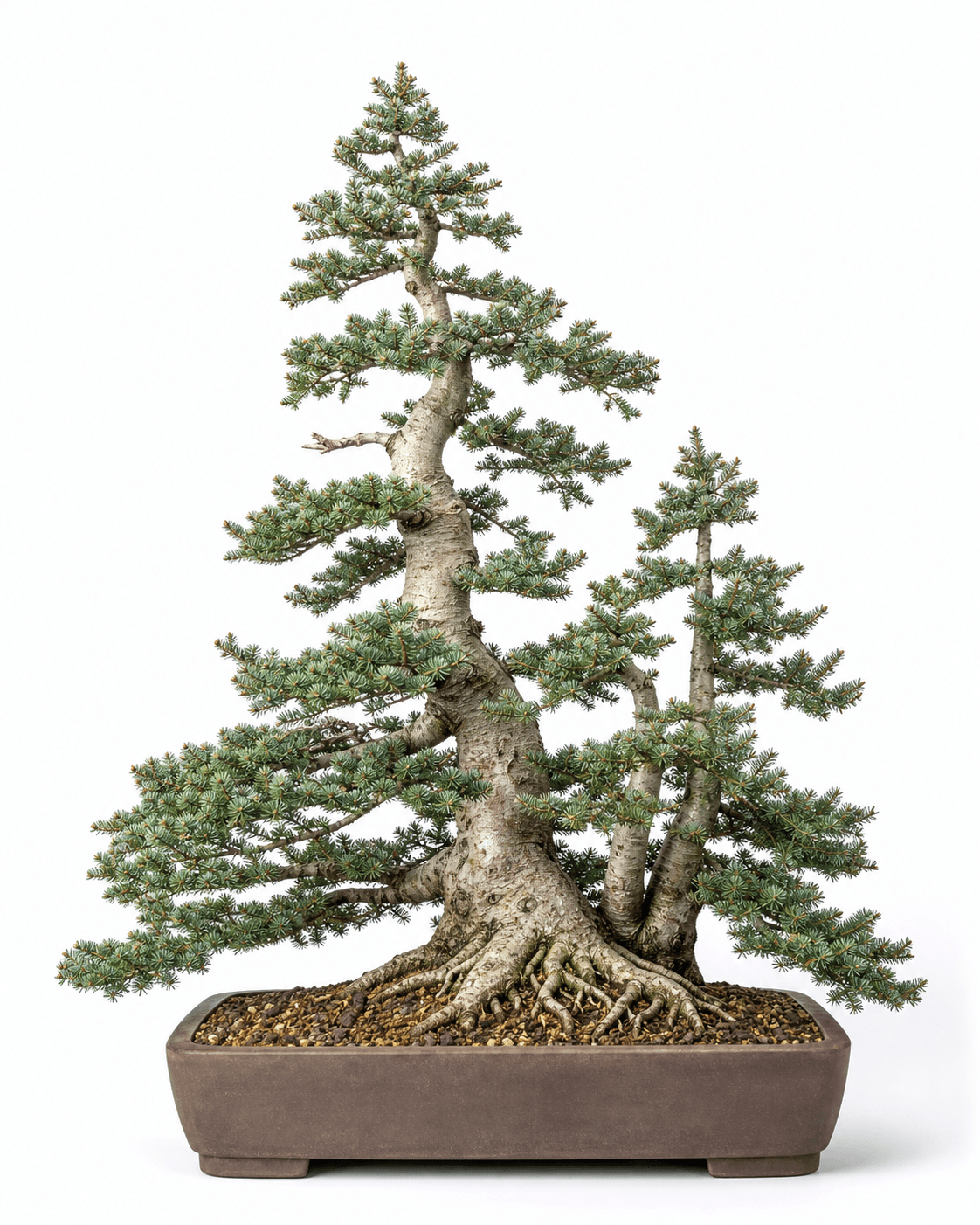
Start with the base, trunk line, defining branch, and apex, then ask what environment the tree should imply. Subalpine fir can read as a narrow spire, a multi-trunk alpine group, a skirted timberline survivor, or a slab composition rooted in rock and thin soil. Bonsai Mirai / AsymmetryBonsai Mirai Library
Old-growth subalpine fir often carries contorted movement, multiple apices, and branches that mature into sub-trunks. Preserve useful randomness instead of flattening every branch into a uniform pad. Bonsai Mirai Library
The apex should usually stay conical, triangular, and snow-shedding. Mirai warns against compressing alpine elongating species into a rounded black-pine-style dome because the form loses the environmental logic. Bonsai Mirai Library
Use deadwood sparingly and honestly. A subalpine fir with living soft bark, gentle dead transitions, and flexible branch movement often feels more credible than one carrying bright permanent deadwood that belongs to juniper. Bonsai Mirai LibraryBonsai Mirai / Asymmetry
Cultivars
Corkbark and compact forms are useful, but provenance still matters.
Kew recognizes Abies lasiocarpa var. arizonica and var. lasiocarpa. USDA Silvics describes corkbark fir as a southwestern Rocky Mountain form with distinctive whitish corky bark. Kew POWOUSDA Forest Service Silvics
Oregon State notes Compacta as a common cultivar, sometimes tied to Arizonica Compacta labels. Compact forms can help smaller bonsai, but the root and heat requirements remain true-fir alpine requirements. Oregon State Landscape PlantsBonsai Mirai Library
Mirai notes that northern Pacific Northwest subalpine fir may carry finer foliage than southern or Rocky Mountain populations. Treat that as a provenance clue, then verify by observing needle length, bud spacing, and summer tolerance in your climate. Bonsai Mirai LibraryUSDA Forest Service Silvics
Keep the exact label with the tree record. Common names such as balsam fir, white fir, alpine fir, Rocky Mountain fir, and corkbark fir can overlap with other Abies species in trade and field conversation. USDA NRCS Plant GuideUSDA Forest Service SilvicsKew POWO
History
Subalpine fir bonsai is strongest when it preserves North American alpine character.
Subalpine fir is a western North American species with ecological importance in cold high-elevation forests. USDA NRCS describes it as a pioneer on severe and disturbed sites that helps protect watersheds and rehabilitate landscapes. USDA NRCS Plant GuideUSDA Forest Service Silvics
Its bonsai value comes from the same ecology: narrow spires, skirted lower growth, snow and wind flexibility, subtle bark, soft needles, and the possibility of multi-trunk compositions that feel rooted in alpine forest observation. Bonsai Mirai / AsymmetryBonsai Mirai Library
Mirai has multiple pieces centered on Abies lasiocarpa, including a multi-trunk slab composition and an Olympic subalpine forest study. That makes subalpine fir unusually well documented compared with many North American native conifers in public bonsai education. Bonsai Mirai Library
A strong exhibition subalpine fir should show health first: hydrated needles, clean buds, secure potting, no active adelgid pressure, wire-free bark where swelling is active, and a design that reads from environment rather than from formula. Bonsai Mirai / AsymmetryBonsai Mirai Library
Species questions
Answer the beginner questions before styling.
Can subalpine fir be grown as bonsai?
Yes. Abies lasiocarpa can be trained as bonsai when it receives outdoor cold dormancy, cool roots, reliable water, oxygenated soil, and pruning timed to visible buds.
Can subalpine fir bonsai live indoors?
No. Subalpine fir is an outdoor alpine conifer. It needs winter chill, moving air, strong light, and seasonal timing that indoor rooms cannot provide.
How often should I water subalpine fir bonsai?
Water when the upper soil particles begin to dry while the interior still holds moisture. In summer, check often because subalpine fir has high water demand and thin flat needles.
When should I repot subalpine fir bonsai?
Use spring bud movement as the normal container repot window. Established trees often need only a 3-5 year inspection rhythm, and recent yamadori should prove root recovery before styling.
Should I pinch subalpine fir like spruce?
No. Abies does not reliably make buds at the pinched tip. Pinch only strong shoots in refinement when interior buds or shorter replacement shoots are already visible.
When is the best time to style subalpine fir?
Spring and early fall are the main windows for structural wiring and pruning on strong established trees. Early fall works well because vascular production supports wound response.
Why is my subalpine fir losing older needles after styling?
Some loss of one to two years of older needles can follow collection, acclimation, or styling. Watch whether current buds remain strong and whether water, roots, and heat are stable.
What pests attack subalpine fir bonsai?
Fir adelgids are the key bonsai pest to watch for, especially on warm or dry benches. USDA sources also list western spruce budworm, western balsam bark beetle, balsam woolly adelgid, rusts, and rots.
Is corkbark fir the same as subalpine fir?
Corkbark fir is Abies lasiocarpa var. arizonica, a recognized infraspecific form in Kew and USDA sources. Keep the var. arizonica label because bark, provenance, and climate response can differ.
What styles suit subalpine fir bonsai?
Alpine upright, multiple trunk, clump, slab, rock, skirted timberline, and wind-influenced designs suit the species. The best designs preserve narrow spires, flexible movement, and ecological restraint.
Sources
Species advice needs source discipline.
Next decisions
Plan the operation before copying the calendar.
A good care note for Subalpine fir records the tree's stage, the work done, and the aftercare used. That record matters more than a month-name rule.
Related species
Compare nearby trees before transferring advice.
Balsam fir
Abies balsamea
White fir
Abies concolor
Noble fir
Abies procera
Mountain hemlock
Tsuga mertensiana
Eastern hemlock
Tsuga canadensis