
Species guide
White Fir Bonsai Care
Abies concolor
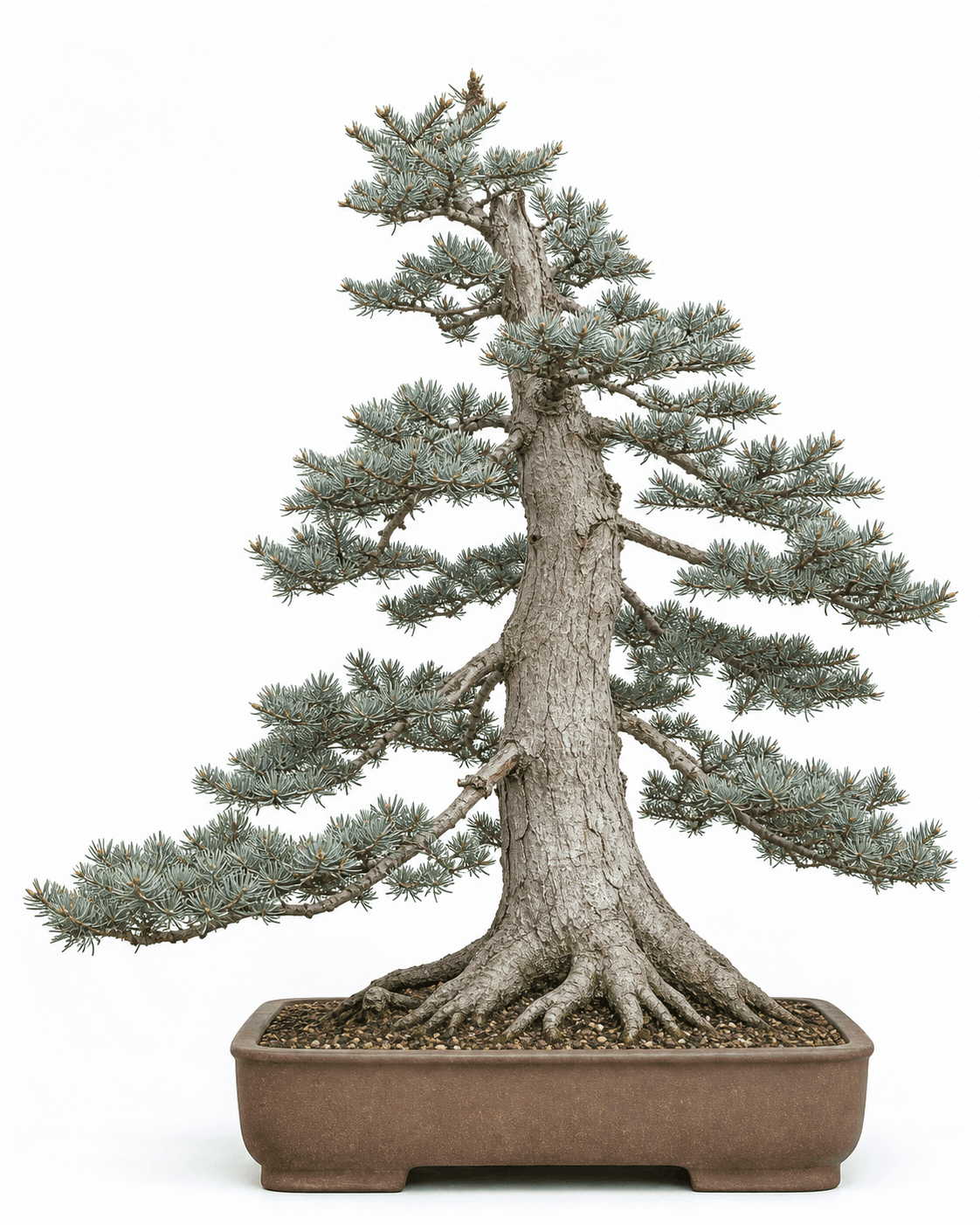
White fir bonsai, Abies concolor, should be treated as an outdoor western true fir with better heat and drought tolerance than many Abies species, while still needing cool, oxygenated roots in a shallow pot.
The practical care rule is bud-first restraint. Let development shoots extend, pinch only strong refined shoots with interior replacement buds, and make every reduction cut to a visible bud or smaller shoot.
The local Bonsai Mirai corpus has no dedicated White fir file and only scattered species-name coverage. This guide transfers Mirai Abies, elongating-conifer, nursery-stock, watering, soil, repotting, wiring, and design method, while Kew, Flora of North America, NC State, Oregon State, and USDA sources ground identity, range, hardiness, ecology, and pest context.
Updated July 4, 2026. Written by EntGrove Editorial. Last verified July 4, 2026.
Care fingerprint
Read the species through its shared care pattern.
Strong light, cool-root management, conservative root work, and post-extension pruning dominate the care calendar. Use this as the starting point before local conditions and tree strength refine the calendar.
Note: Source-depth-aware page published 2026-07-04. FNA treats Picea concolor as basionym and discusses Abies lowiana treatment; USDA Silvics discusses var. concolor and var. lowiana; Oregon State notes Abies concolor x grandis hybrid context in Oregon forests. Verify exact Abies label before applying this page to Noble fir, Subalpine fir, Grand fir, or generic white fir trade labels.
Do not prune like a pine
Elongating conifers extend from buds and shoots, so candle-cutting assumptions can remove the exact growth the tree needs.
Preserve interior growth
Spruce, fir, hemlock, cedar, redwood, cypress, and larch all become harder to design when interior buds are shaded out.
Keep recovery cool and steady
Many elongating conifers respond best when roots stay evenly moist, oxygenated, and protected from hot dry swings.
Care cadence
The calendar starts with the tree's seasonal state.
Placement
Timing: Grow outside year-round. Use full sun where roots stay cool, then add afternoon shade, pot shading, and airflow in hot inland summers.
Watch for: Hot containers, dry wind, weak interior buds from excessive shade, frost on early-broken buds, and southeastern heat-humidity stress.
NC State ExtensionOregon State Landscape PlantsBonsai Mirai LibraryWatering
Timing: Water thoroughly when the upper aggregate begins to dry and the inner root mass still carries moisture. Let oxygen return between passes.
Watch for: Hydrophobic nursery peat, water bypassing the core, sour wet pockets, crisping tips after hot wind, and a pot that stays wet after foliage reduction.
Bonsai Mirai LibraryUSDA Forest Service SilvicsFertilizer
Timing: Feed development trees through active growth. In refinement, use lighter feeding after the first flush so needles and extensions stay proportional.
Watch for: Coarse apical whorls, weak lower branches, fertilizer on newly cut roots, and lush late growth heading into frost.
Bonsai Mirai LibraryUSDA Forest Service SilvicsSpring pinching
Timing: In refinement, pinch only strong elongating tips after confirming an interior bud or shorter replacement shoot behind the sacrificed tip.
Watch for: Pinching weak shoots, stripping all new growth, copying spruce response, and removing a tip with no replacement point.
Bonsai Mirai LibraryPost-harden pruning
Timing: After growth hardens, reduce extensions back to visible buds or smaller shoots. Vary cuts across the branch to avoid swollen repeated collars.
Watch for: Cuts past the last viable bud, branch ends that become knuckles, and over-cleaning lower foliage while the tree is still in development.
Bonsai Mirai LibraryRepotting
Timing: Use spring bud movement as the normal container repot window. Convert nursery roots in stages and keep enough foliage to drive new root growth.
Watch for: Bare-rooting old conifer cores, weak tie-downs, heavy styling immediately after root work, and oversized wet soil after branch removal.
Bonsai Mirai LibraryUSDA Forest Service SilvicsFall structural work
Timing: Early fall is a strong window for established elongating conifers because vascular production supports pruning, wiring, and wound response.
Watch for: Work too close to hard freeze, wire bite during fall swelling, and styling recently repotted material before recovery is obvious.
Bonsai Mirai LibraryPest checks
Timing: Inspect in spring, after heat stress, and before winter storage. White fir pests often become serious when vigor has already dropped.
Watch for: Fir engraver beetle signs, budworm damage, tussock moth defoliation, needleminer branch kill, root rot, drought stress, and dwarf mistletoe in collected material.
USDA Forest Service SilvicsUSDA Forest Service FEISWinter protection
Timing: Keep the tree dormant and cold while protecting the pot from repeated root freeze-thaw and dry winter wind.
Watch for: Warm indoor storage, dry frozen roots, late nitrogen, rodent damage, and early spring frost after buds begin moving.
NC State ExtensionUSDA Forest Service SilvicsSpecies guide
Apply the species profile before copying another tree's calendar.
At a glance
White fir is a western true fir with stronger heat tolerance and strict bud rules.
Abies concolor is an outdoor evergreen conifer in Pinaceae, native to western North American mountain forests. In bonsai it belongs with alpine elongating species, where care depends on bud movement, root oxygen, post-harden pruning, and winter dormancy. Flora of North AmericaUSDA Forest Service SilvicsBonsai Mirai Library
Compared with Balsam fir and Subalpine fir, White fir is better adapted to heat and summer-dry western conditions. That advantage helps on benches, but shallow containers still magnify root heat, dry wind, and drainage failures. Oregon State Landscape PlantsUSDA Forest Service Silvics
The page is intentionally source-depth-aware. Mirai supplies Abies and elongating-conifer method, while public sources supply White fir identity, range, hardiness, morphology, cultivar names, and pest risks. Bonsai Mirai LibraryKew POWOFlora of North America
Wild range
Read White fir from snowpack, mixed conifer forests, and dry-season adaptation.
USDA Silvics describes a broad western range from mountainous Pacific Coast regions to central Colorado, and from central Oregon and southeastern Idaho to northern Mexico. FEIS adds the practical mixed-conifer picture: white fir appears with Douglas-fir, ponderosa pine, incense cedar, oaks, spruce, aspen, and subalpine fir depending on elevation and region. USDA Forest Service SilvicsUSDA Forest Service FEIS
Climate differs across the range. Rocky Mountain white fir grows with long winters, moderate to heavy snowpacks, short growing seasons, and about 20-35 inches of annual precipitation, while California white fir can grow from cold high elevations into warmer lower elevations with winter-dominant precipitation. USDA Forest Service Silvics
The container translation is nuanced. White fir can handle more heat and drought than many firs, yet its best growth still comes from moisture availability, moderate temperature, and well-drained root conditions. The bonsai version needs both water and air. Oregon State Landscape PlantsUSDA Forest Service SilvicsBonsai Mirai Library
Design should carry that western mixed-conifer story. A convincing White fir can read as a tall spire, a rugged high-mountain survivor, a forest component, or nursery-stock material made credible through root correction and asymmetry. Bonsai Mirai / AsymmetryUSDA Forest Service FEIS
Reading the tree
Separate development, refinement, and root recovery before pruning.
Development trees need foliage mass and branch options. Let useful shoots extend and harden, especially on lower and interior branches, so roots and vascular tissue gain strength before the tree is asked for density. Bonsai Mirai Library
Refinement begins when the tree has interior buds and enough secondary structure to shorten growth safely. Mirai Abies guidance pinches strong tips only when there is already a bud or smaller shoot behind the tip being sacrificed. Bonsai Mirai Library
Visible spring growth can overstate recovery on elongating conifers. Mirai cautions that spruce, hemlock, and Abies can push foliage while roots remain underdeveloped, so recent repots and collected trees should be judged by water uptake, old-wood buds, and full-season stability. Bonsai Mirai Library
Read branch whorls early. NC State notes whorled branches of four or five, and USDA Silvics describes crown and branch variation across the species complex. Whorls can create useful structure, but repeated branch collars can also swell if they are left unmanaged. NC State ExtensionUSDA Forest Service Silvics
Pinching
Use Abies pinching only after the replacement point is visible.
The Abies rule is physical: a pinched tip should be considered spent. Before shortening a strong tip, confirm that a shorter side shoot, an interior bud, or a smaller branch can carry the line afterward. Bonsai Mirai Library
Start with dominant apical and upper shoots because those tips receive the strongest energy. Leave weak tips and branch-building tips alone until they have done their job. Bonsai Mirai Library
Structural pruning belongs after the flush hardens or in early fall on established trees. Every cut should end at a visible bud or smaller shoot because cuts beyond the last viable bud can kill the remaining tip. Bonsai Mirai Library
For raw nursery stock, clean bottom growth, weak interior pieces, and obvious crossings first, then let the trunk line and defining branch decide what stays. A uniform Christmas-tree cone is a starting point, not the finished design. Bonsai Mirai LibraryNC State Extension
Roots
Correct roots before heavy styling changes the water demand.
Spring bud movement is the normal container repotting window. Prepare soil, tie-downs, aftercare shade, and wind protection before starting, then secure the tree firmly so new root tips are not rocked loose. Bonsai Mirai Library
White fir root systems are adaptable in forests: deep and intensive where soil permits, shallow and widespread where rocks or water tables limit depth. In a pot, that means roots should be corrected in stages until the whole core can be watered evenly. USDA Forest Service Silvics
Mirai nursery-stock method gives conifers a root-first sequence when the original soil volume is too large. Keep enough foliage to move water, shift the tree into a smaller oxygenated container, and style after recovery is visible. Bonsai Mirai Library
Avoid the two common failures: a wet nursery core with too little foliage to pull water, and aggressive root removal followed by full structural wiring. Either sequence can outpace the tree recovery capacity. Bonsai Mirai LibraryUSDA Forest Service Silvics
Soil and pot
Use mineral structure with enough moisture buffer for western fir roots.
A practical development mix is akadama, pumice, and lava adjusted by climate. Use more moisture buffer in hot dry summers, more structure and drainage in cool wet regions, and a consistent particle size so water moves through the whole pot. Bonsai Mirai Library
USDA Silvics says White fir grows on many parent materials and soil orders, and appears more limited by moisture availability and temperature than by soil series. It grows best on moderately deep, well-drained sandy-loam to clay-loam soils. USDA Forest Service Silvics
Pot choice should match the stage. Development trees benefit from enough depth for moisture stability and tie-down strength; refined uprights, forests, and exposed-root compositions can move gradually into quieter unglazed or muted containers. Bonsai Mirai / AsymmetryBonsai Mirai Library
Because White fir foliage can be blue-green and soft, avoid containers that make the tree look ornamental before the branch structure is credible. Let root line, trunk movement, and negative space carry the first read. Oregon State Landscape PlantsBonsai Mirai / Asymmetry
Climate
White fir tolerates heat better than many firs, but pots still overheat.
In the Pacific Northwest, Sierra Nevada, Rockies, and interior mountain climates, White fir can be a strong outdoor conifer if the pot drains well, buds harden before deep winter, and summer wind does not dry the root pad. USDA Forest Service SilvicsOregon State Landscape Plants
In hot inland climates, shade the pot, use morning sun or filtered afternoon protection during heat events, and water before dry wind turns the root zone hydrophobic. White fir tolerance is helpful, but bonsai roots still have little thermal mass. Oregon State Landscape PlantsBonsai Mirai Library
In the eastern and Midwestern United States, Oregon State calls White fir a good fir for the East and Midwest, while NC State notes it is poorly suited to the southeastern United States. Airflow and drainage matter in humid summers. Oregon State Landscape PlantsNC State Extension
Winter protection should preserve dormancy rather than warm the tree. Use mulch beds, ground contact, or cold frames where root freeze-thaw is severe, and protect from dry wind after sunny winter days. NC State ExtensionBonsai Mirai Library
Pests
Fir engraver, budworm, tussock moth, and rot usually follow stress.
USDA Silvics names fir engraver beetle as the most damaging White fir pest. It attacks stressed trees, especially those weakened by root rot, defoliation, drought, fire, Cytospora, or mistletoe. USDA Forest Service Silvics
Western spruce budworm can defoliate true firs severely, and Douglas-fir tussock moth is another important defoliator. On bonsai, early signs are chewed new growth, missing buds, webbing, frass, and a sudden loss of fine branch strength. USDA Forest Service Silvics
White fir needleminer can cause branch kill that predisposes trees to bark beetle attack. Inspect dense interiors, older needles, and shaded branches before assuming discoloration is only water stress. USDA Forest Service Silvics
Rot and decay deserve the same respect as insects. USDA Silvics describes major decay in old grand fir and white fir stands, and root diseases contribute to poor windfirmness. In bonsai, stale wet soil and unnecessary carving create the small-container version of that risk. USDA Forest Service SilvicsBonsai Mirai Library
Wiring
Wire enough for structure, then let pruning refine the fir character.
Young White fir shoots and branches can be shaped, but the species should retain a natural western conifer softness. Set trunk line, primary branches, and open negative space first. Bonsai Mirai / AsymmetryBonsai Mirai Library
When wiring fine conifers, Mirai warns against crushing needles under the wire. Pre-shape the wire, slide between needle masses, and keep turns firm enough to hold without smothering foliage. Bonsai Mirai Library
Whorls need discipline. Remove or reduce repeated same-level branches gradually so inverse swelling does not dominate the trunk, and use guy wires where branch shoulders need leverage with less bark pressure. NC State ExtensionBonsai Mirai Library
Check wire frequently in spring and fall because elongating conifers swell during vascular production. Remove or unwind before scars interrupt the pale bark and clean branch line. Bonsai Mirai LibraryUSDA Forest Service Silvics
Propagation
Seedlings, cuttings from juvenile material, and nursery stock are realistic.
NC State lists seed as the recommended propagation strategy. USDA Silvics says heavy cone crops may occur every 3-9 years, with adequate to good crops more often every 2-5 years. NC State ExtensionUSDA Forest Service Silvics
USDA Silvics says White fir lacks natural sprouting or layering tendency. Cuttings from juvenile material can root with or without hormone, which can preserve compact or blue selections when specialist propagation is available. USDA Forest Service Silvics
Seedlings offer the cleanest long-term nebari and trunk development. Expect years of trunk building, whorl selection, and root correction before the tree is ready for refinement. Bonsai Mirai LibraryUSDA Forest Service Silvics
Collected material requires permission and restrained aftercare. Even if a collected fir pushes new growth, style only after water uptake, old-wood buds, and at least one full recovery cycle prove root function. Bonsai Mirai Library
Buying
Choose roots, interior buds, and odd character over a perfect cone.
Good candidates come from seedlings, regional conifer nurseries, compact cultivars, legal collected stock, and seasonal nursery material. Look for a stable root flare, low branches, interior buds, and trunk movement that can survive the first design. Bonsai Mirai LibraryOregon State Landscape Plants
Mirai nursery-stock selection favors the abnormal plant with exposed roots, non-repetitive movement, an unusual base, or a feature the landscape buyer overlooks. White fir can be useful when it has that character and a recoverable root mass. Bonsai Mirai Library
Inspect the soil before buying. A peat-heavy can, circling roots, buried trunk base, or compacted field core should be treated as a multi-year horticultural project before major styling. Bonsai Mirai LibraryUSDA Forest Service Silvics
Keep labels exact. White fir overlaps in conversation with western white fir, Rocky Mountain white fir, concolor fir, California white fir, Abies lowiana, Grand fir hybrids, Noble fir trade labels, and Subalpine fir common-name confusion. NC State ExtensionOregon State Landscape PlantsUSDA Forest Service Silvics
Troubleshooting
Most failures trace to hot roots, weak buds, wet cores, or stressed pests.
Symptom: tips brown after hot wind while the pot feels damp. Likely cause: hot root zone, stale wet core, or dry pockets around active roots. Fix: cool the container, improve airflow, inspect moisture below the surface, and plan staged root correction. Bonsai Mirai LibraryUSDA Forest Service Silvics
Symptom: a pinched branch stalls. Likely cause: the tip was removed before a replacement bud or side shoot existed. Fix: stop pinching that branch, rebuild vigor, and prune only to visible buds later. Bonsai Mirai Library
Symptom: top growth stays strong while lower branches weaken. Likely cause: apical dominance, over-cleaning lower foliage, shade, or repeated top whorls. Fix: protect lower foliage, improve light, and manage the top first during refinement. Bonsai Mirai LibraryNC State Extension
Symptom: boring dust, top decline, or sudden dieback after stress. Likely cause: fir engraver or related bark beetle pressure. Fix: isolate, confirm the insect, improve root and water conditions, and follow local extension treatment guidance. USDA Forest Service Silvics
Symptom: old wounds soften or smell sour. Likely cause: decay entering stressed tissue, often helped by stagnant moisture. Fix: protect live tissue, improve drainage and airflow, and keep deadwood restrained unless the tree is demonstrably strong. USDA Forest Service SilvicsBonsai Mirai / Asymmetry
Symptom: early spring buds are damaged by cold. Likely cause: White fir breaks bud early and the pot warmed before frost risk passed. Fix: protect during late freezes and stage spring moves under cloudy, mild conditions. NC State ExtensionBonsai Mirai Library
Design
Let White fir read as western, upright, cool-rooted, and asymmetrical.
Start with base, trunk line, defining branch, and apex. Young White fir naturally gives a narrow pyramidal image, so the bonsai task is to add believable asymmetry without erasing the species upright character. NC State ExtensionBonsai Mirai / Asymmetry
Forests and clumps suit the species because White fir is a major mixed-conifer forest member across the West. Vary trunk spacing, heights, lean, and crown density so the composition feels like a stand rather than repeated nursery trees. USDA Forest Service FEISBonsai Mirai / Asymmetry
For single trees, use branch whorls selectively. One branch can become the defining branch, another can become depth, and the rest should be reduced over time so collars do not build a stack of identical spokes. NC State ExtensionBonsai Mirai Library
Deadwood should be modest and ecology-led. White fir can carry old scars and broken tops, but durable sculptural deadwood belongs more naturally to juniper, cedar, and some collected mountain pines. USDA Forest Service SilvicsBonsai Mirai / Asymmetry
Cultivars
Blue selections and compact forms are useful only after the roots work.
USDA Silvics discusses two varieties within the White fir complex: var. concolor, often called Rocky Mountain white fir, and var. lowiana, California white fir. Flora of North America notes that many authors treat A. lowiana as a synonym or infraspecific rank under A. concolor. USDA Forest Service SilvicsFlora of North America
NC State lists Blue Cloak, Candicans, and Compacta. Oregon State also lists Blue Cloak and Candicans, with Blue Cloak described as powder blue and Candicans as bright silver-blue. NC State ExtensionOregon State Landscape Plants
Compacta can help smaller bonsai, but dwarf labels do not replace horticulture. Check graft union quality, root congestion, bud density, and whether the compact habit holds under your feeding and light conditions. NC State ExtensionBonsai Mirai Library
Oregon State notes apparent Oregon forest Abies concolor may represent Abies concolor x grandis hybrids. Keep provenance in the tree record because Grand fir influence can change foliage, heat response, and design scale. Oregon State Landscape PlantsUSDA Forest Service Silvics
History
White fir brings western mixed-conifer ecology into bonsai.
USDA Silvics says White fir was long considered undesirable for timber but is now recognized as a productive and valuable tree species. Its best development occurs in the central Sierra Nevada, with exceptional old trees far beyond bonsai scale. USDA Forest Service Silvics
The species is familiar in horticulture and Christmas-tree culture. NC State notes good young Christmas-tree shape and needle retention, which explains why nursery material can appear tempting to bonsai growers. NC State Extension
A strong White fir bonsai should preserve the species identity: blue-green flexible needles, whorled branches edited into asymmetry, cool-root health, and a design that suggests western mountain forest rather than generic conifer padding. Flora of North AmericaBonsai Mirai / Asymmetry
The exhibition standard starts with health. Firm buds, hydrated needles, secure roots, no active wire bite, no bark beetle signs, and a root system that can move water through summer matter more than an instant dramatic silhouette. Bonsai Mirai LibraryUSDA Forest Service Silvics
Species questions
Answer the beginner questions before styling.
Can White fir be grown as bonsai?
Yes. Abies concolor can be trained as bonsai when it is grown outdoors, kept in moist oxygenated soil, protected from root overheating, and pruned to visible buds.
Can White fir bonsai live indoors?
White fir belongs outdoors. It needs winter dormancy, moving air, bright outdoor light, and seasonal temperature change to keep buds and roots synchronized.
When should I repot White fir bonsai?
Use spring bud movement as the normal repotting window. Convert nursery stock in stages and avoid combining major root work with heavy styling.
How often should I water White fir bonsai?
Water when the upper aggregate begins to dry while the inner root mass still holds moisture. Avoid both dry pockets and stagnant wet nursery cores.
Should I pinch White fir like spruce?
Use Abies rules. Pinch only strong refined shoots when an interior bud or shorter replacement shoot is already visible behind the tip.
Is White fir easier than Balsam fir?
White fir tolerates heat and drought better than many firs, but bonsai still requires cool roots, oxygenated soil, bud-aware pruning, and pest checks.
What pests affect White fir bonsai?
Fir engraver beetle, western spruce budworm, Douglas-fir tussock moth, needleminer, root rot, and stress-related bark beetles are the main problems to know.
Can I use a Christmas-tree White fir for bonsai?
Sometimes. Choose material with a useful root flare, low branches, interior buds, recoverable soil, and asymmetry rather than a dense uniform cone.
What soil does White fir bonsai need?
Use a free-draining aggregate conifer mix that holds some moisture. Akadama, pumice, and lava can be adjusted for local heat, rain, and pot depth.
What styles suit White fir bonsai?
Formal upright, informal upright, forest, clump, exposed-root, and larger western mixed-conifer designs suit White fir best.
Sources
Species advice needs source discipline.
Next decisions
Plan the operation before copying the calendar.
A good care note for White fir records the tree's stage, the work done, and the aftercare used. That record matters more than a month-name rule.
Related species
Compare nearby trees before transferring advice.
Subalpine fir
Abies lasiocarpa
Balsam fir
Abies balsamea
Noble fir
Abies procera
Mountain hemlock
Tsuga mertensiana
Eastern hemlock
Tsuga canadensis