
Species guide
Eastern Hemlock Bonsai Care
Tsuga canadensis
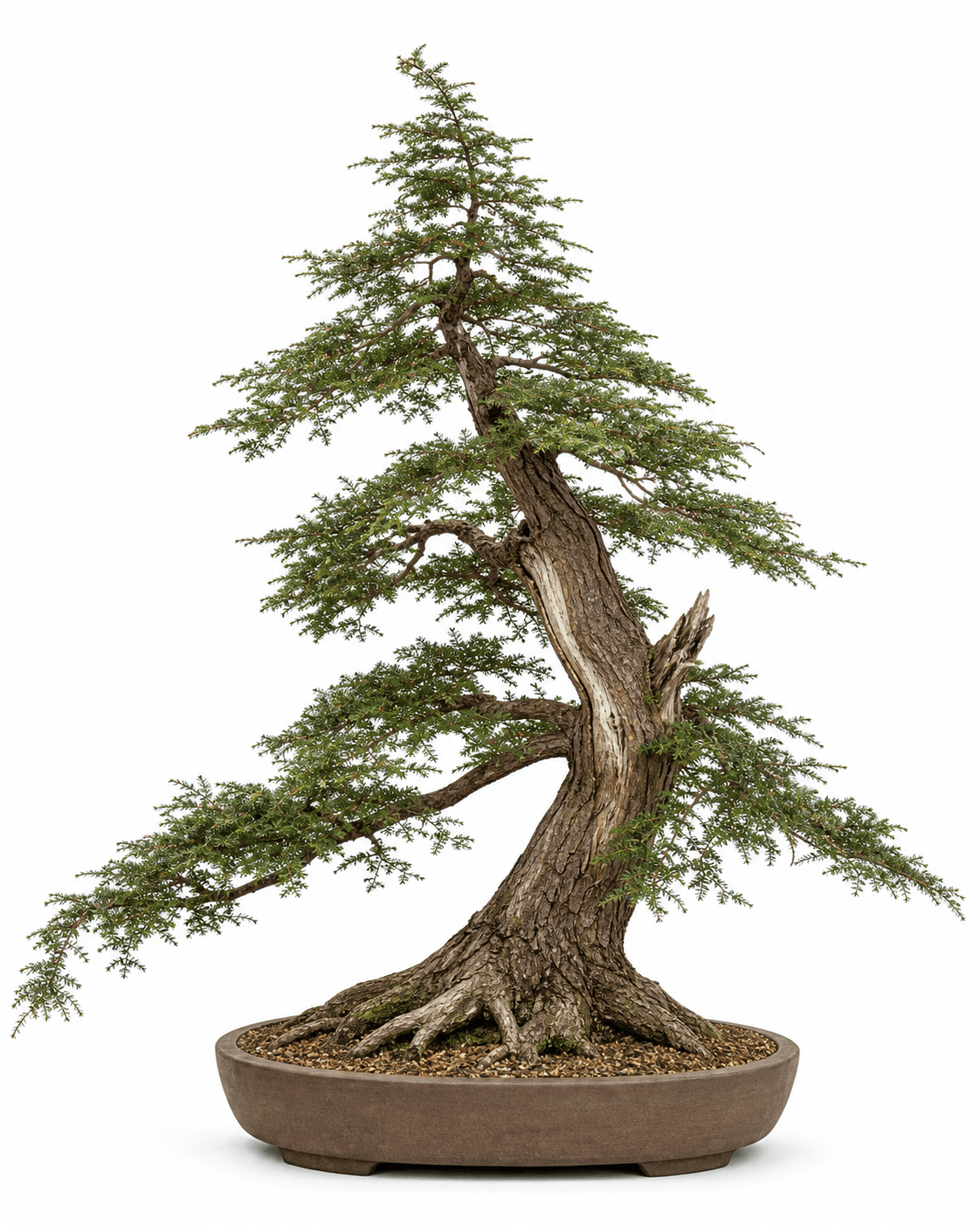
Eastern hemlock bonsai is an outdoor, cool-rooted Tsuga for growers who can provide moisture, shade discipline, and real winter dormancy. Tsuga canadensis tolerates shade better than most conifers, but bonsai refinement still needs enough light to keep interior buds alive.
The species behaves as a softer, weaker hemlock than mountain hemlock. It wants fall pruning on established trees, spring repotting at green bud movement, water-retentive aggregate, careful wiring, and protection from heat, dry wind, and hemlock woolly adelgid.
This guide uses the local Bonsai Mirai hemlock and elongating-conifer corpus, including direct Tsuga canadensis mentions in mountain-hemlock and nursery-stock files, then grounds taxonomy, range, hardiness, site ecology, and pest pressure in Kew, NC State, USDA Silvics, USDA FEIS, and extension adelgid sources.
Updated June 3, 2026. Written by EntGrove Editorial. Last verified June 3, 2026.
Care fingerprint
Read the species through its shared care pattern.
Strong light, cool-root management, conservative root work, and post-extension pruning dominate the care calendar. Use this as the starting point before local conditions and tree strength refine the calendar.
Note: Kew accepts Tsuga canadensis and lists older Pinus, Picea, Abies, and Tsuga americana synonym labels. NC State, USDA Silvics, and USDA FEIS use eastern hemlock, Canada hemlock, Canadian hemlock, hemlock spruce, and spruce pine labels; inspect for hemlock woolly adelgid before sourcing material in infested regions.
Do not prune like a pine
Elongating conifers extend from buds and shoots, so candle-cutting assumptions can remove the exact growth the tree needs.
Preserve interior growth
Spruce, fir, hemlock, cedar, redwood, cypress, and larch all become harder to design when interior buds are shaded out.
Keep recovery cool and steady
Many elongating conifers respond best when roots stay evenly moist, oxygenated, and protected from hot dry swings.
Care cadence
The calendar starts with the tree's seasonal state.
Placement
Timing: Grow outside year-round. Use morning sun, bright shade, or dappled light, then cool the pot and add wind protection during hot or dry periods.
Watch for: Warm nights, afternoon sun on shallow pots, dry wind, pale weak interior buds from excessive shade, and summer dulling before needle drop.
NC State ExtensionBonsai Mirai LibraryWatering
Timing: Water deeply before the root mass dries hard. Let water percolate through the whole container and keep a visible rim so repeated watering reaches the core.
Watch for: Hydrophobic old nursery soil, water bypassing the center, sour wet pockets, dry needle tips, and reduced uptake after heavy foliar pruning.
Bonsai Mirai LibraryUSDA Forest Service FEISFertilizer
Timing: Feed development trees enough to build trunk, branches, and roots. In refinement, use lighter feeding so shoots stay compact and wire can hold.
Watch for: Coarse apical extension, weak lower branches, fertilizer on a recently repotted root system, and rank growth in shade.
Bonsai Mirai LibrarySpring pinching
Timing: Pinch only soft spring growth on dense, healthy refined trees. Use it to prevent strong tips from thickening pads beyond scale, then stop once growth hardens.
Watch for: Pinching a weak tree, pinching in development, tearing hardened shoots, and stripping too much foliage from shaded interiors.
Bonsai Mirai LibraryFall pruning
Timing: Use early fall, after the worst summer heat breaks, as the primary corrective pruning window. Cut back to visible buds, small red node bumps, or chosen shoots.
Watch for: Hedging, cuts past the last bud, exposed bark sunburn from summer pruning, and rounded pads that hide the branch line.
Bonsai Mirai LibraryRepotting
Timing: Repot in spring as buds begin to show green. Prepare soil, tie-downs, drainage screens, and aftercare before opening the root ball.
Watch for: Late root work, bare-rooting, weak tie-downs, heavy top pruning in the same session, and wet peat left under the trunk.
Bonsai Mirai LibraryWiring
Timing: Wire strong established trees before spring push or in early fall. Use enough gauge to hold flexible branches and check frequently during vascular swelling.
Watch for: Needle crush, bark slipping in spring, under-gauged wire, branch memory, hidden wire bite, and heavy bends during hot weather.
Bonsai Mirai LibraryPest inspection
Timing: Inspect new purchases, spring extension, and stressed summer foliage for hemlock woolly adelgid, elongate hemlock scale, mites, borers, and needle diseases.
Watch for: White cotton at needle bases, gray thinning foliage, sticky residue, scale on undersides, branch dieback, cankers, and roots weakened by drought or heat.
NC State ExtensionNC State Extension HWAUSDA Forest Service Coweeta HWAWinter protection
Timing: Keep the tree dormant and cold, with the pot protected from hard freeze-thaw cycles and dry wind. Snow cover, mulch beds, cold frames, or ground contact work well.
Watch for: Warm indoor storage, dry frozen roots, exposed shallow pots, late nitrogen, and spring work before buds confirm timing.
NC State ExtensionBonsai Mirai LibrarySpecies guide
Apply the species profile before copying another tree's calendar.
At a glance
Eastern hemlock is a shade-tolerant outdoor conifer with narrow timing windows.
Tsuga canadensis is an evergreen Pinaceae species native to eastern Canada and the north-central and eastern United States. It is famous for shade tolerance, fine texture, small cones, and long forest life. Kew POWOUSDA Forest Service SilvicsNC State Extension
As bonsai, it belongs with elongating conifers. The practical care pattern is cool roots, steady moisture, oxygenated aggregate, spring repotting at green bud movement, soft spring pinching only on refined trees, and early fall corrective pruning. Bonsai Mirai Library
Eastern hemlock is more delicate than mountain hemlock in Mirai comparison. It tends toward softer, sparser, more pendulous growth, so the design should preserve wispy character and avoid dense rounded pom-poms. Bonsai Mirai LibraryBonsai Mirai / Asymmetry
Wild range
Care should start from cool ravines, acidic soil, shade, and moving water.
USDA FEIS places eastern hemlock on moist cool valleys, flats, northern and eastern slopes, coves, benches, ravines, swamp borders, and protected rocky ledges. It favors moist to very moist acidic soils with good drainage. USDA Forest Service FEIS
USDA Silvics describes a slow-growing, long-lived species that can mature over centuries and grow under deep shade. The bonsai lesson is patience: long life comes from stable roots and steady foliage, not constant heavy intervention. USDA Forest Service Silvics
NC State gives the horticultural translation: moist but well-drained somewhat acidic soil, sun to part shade, cool summers, and drought intolerance. In a bonsai pot, the same tree dries faster, heats faster, and needs a more deliberate water-oxygen balance. NC State ExtensionBonsai Mirai Library
Design should read from that environment. Eastern hemlock can carry soft shade-forest tiers, ravine movement, exposed-root streambank references, or windswept collected material with a narrow pointed apex and airy branch tips. Bonsai Mirai / AsymmetryBonsai Mirai Library
Reading
Judge strength by buds, roots, lower branches, and water movement.
A development tree needs foliar mass and root correction before refinement. Let useful shoots extend, feed the root system, and preserve lower branches until the tree proves it can maintain interior buds. Bonsai Mirai Library
A refined tree is read by bud placement. Hemlock can be reduced to weak interior buds or small node buds when healthy, but bare old wood is unreliable, so every useful inner bud deserves light and protection. Bonsai Mirai Library
Eastern hemlock should also be read against other Tsuga. Mirai notes that western and canadensis hemlock are softer and lose lower strength faster than mountain hemlock, so strong apex and shade imbalance need earlier correction. Bonsai Mirai Library
Top growth can mislead. The elongating-conifer corpus warns that hemlock, spruce, and Abies can produce foliage while roots remain underdeveloped, so recent collection or repotting should be followed by a recovery season before major styling. Bonsai Mirai Library
Pruning
Pinch only soft refined growth, then rely on fall cutback to buds.
Spring pinching is a refinement tool for dense, healthy trees. Pinch soft shoots before the vascular bundle hardens when a pad needs restraint, then leave the tree alone after the flush hardens so it can rebuild reserves. Bonsai Mirai Library
Development trees should usually grow first. Pinching early can prevent the foliar expansion that builds vascular strength and interior buds, so raw nursery or collected material benefits more from extension, light, and later selection. Bonsai Mirai Library
Early fall is the main pruning window. Cut each shoot to a visible bud, smaller shoot, or node bump, and make the strongest top growth carry less length than the lower and interior branches you are trying to preserve. Bonsai Mirai Library
Avoid hedge shearing. Hemlock pruning should clarify branch lines, thin under-hanging pieces, and build pointed directional pads. Exterior shearing creates chunky tips and shaded hollow interiors. Bonsai Mirai Library
Roots
Repot at green bud movement and protect the old root core.
Mirai hemlock repotting centers on bud movement. Repot when buds begin to show green, because the tree can support root regeneration at that moment and becomes more root-sensitive once the flush is active. Bonsai Mirai Library
Keep some original root mass intact. The corpus repeats the conifer rule against bare-rooting, especially for collected or nursery trees with old soil that still holds active roots. Bonsai Mirai Library
Work the root problem in stages: bottom depth first, side width second, then the dense core under the trunk across later repots. Eastern hemlock decline often follows a stale wet core or dry island that cannot be watered evenly. Bonsai Mirai LibraryUSDA Forest Service FEIS
After repotting, secure the tree hard enough that wind cannot rock new roots, keep foliage intact, provide shade and wind protection, and delay heavy styling until uptake and bud response are clear. Bonsai Mirai Library
Soil and pot
Build a moist, acidic, oxygenated root zone.
Eastern hemlock naturally favors acidic soils with moisture and drainage. Bonsai soil should preserve that balance: water should remain available while oxygen can still enter after each watering. NC State ExtensionUSDA Forest Service FEIS
For established hemlock, the Mirai benchmark is 3 parts akadama, 1 part pumice, and 1 part lava. Akadama holds water and nutrients; pumice buffers moisture; lava keeps the structure open through longer conifer repot cycles. Bonsai Mirai Library
Adjust by climate. Hot or windy gardens may need a deeper pot, more water-retentive top dressing, and shade on the container. Cool humid gardens may need larger particles, more airflow, and stricter watering judgment. Bonsai Mirai Library
Pot choice should fit the image. Forests and informal uprights suit quiet oval or rectangle containers, while collected, raft, cascade, or exposed-root material can use deeper or more rugged containers that preserve water and anchoring. Bonsai Mirai / AsymmetryBonsai Mirai Library
Climate
Cool roots matter more than the map alone.
The landscape range suggests broad cold tolerance, but container culture moves the limit to root temperature, wind, and summer nights. NC State lists cool-summer preference and drought sensitivity, which are the two main constraints outside the natural range. NC State Extension
In cool maritime or mountain climates, eastern hemlock can take more light if the root system stays moist and the pot does not heat. In continental heat, give morning sun, afternoon shade, a windbreak, and container shading before stress appears. Bonsai Mirai LibraryUSDA Forest Service FEIS
In the southeastern United States and lowland warm-night regions, survival depends on cool root strategies. Use dappled shade, airflow, a protected bench, and no unnecessary summer work. Bonsai Mirai LibraryUSDA Forest Service Coweeta HWA
Winter care should stay cold and dormant. Protect the pot from freeze-thaw exposure and dry wind while avoiding warm indoor storage that breaks dormancy and weakens spring timing. Bonsai Mirai LibraryNC State Extension
Pests
Hemlock woolly adelgid is the pest that changes the buying decision.
NC State flags hemlock woolly adelgid as a major pest, and extension material describes it as extremely damaging. At bonsai scale, inspect the base of needles for white cottony masses before buying or accepting collected material. NC State ExtensionNC State Extension HWA
USDA Coweeta research frames HWA as a non-native invasive pest of eastern and Carolina hemlock. A bonsai grower should treat regional adelgid pressure as a care requirement, not a distant forest issue. USDA Forest Service Coweeta HWA
NC State also lists elongate hemlock scale, hemlock borer, flat-headed borer, looper, rust mite, sawfly, bagworms, spider mites, gypsy moths, spruce budworm, and grape scale as possible insect problems. NC State Extension
Disease and environmental issues include needle blight, cankers, blister and needle rusts, sapwood rot, sun scorch, and drought sensitivity. Prevention starts with cool placement, water movement, airflow, and avoiding repeated stress before pest treatment is needed. NC State ExtensionUSDA Forest Service Silvics
Wiring
Use flexible branches gently and watch for spring slip and fall bite.
Hemlock branches are flexible, but they have memory. Mirai recommends heavier-than-instinct wire on structural branches because under-gauged wire lets the branch drift back as vascular tissue sets. Bonsai Mirai Library
Spring wiring should account for wet slipping cambium. Use a supporting hand close to each bend, move the wire rather than twisting bark, and avoid aggressive cranking when the branch is hydrated. Bonsai Mirai Library
Early fall wiring can set structure well, but that same vascular phase can mark bark and branches. Inspect frequently, especially inside dense pads where wire disappears quickly. Bonsai Mirai Library
Raffia is rarely the main answer on hemlock because branches already flex and raffia can hide stress points. Use guy wires, smaller bends, and branch selection to solve structure with less damage. Bonsai Mirai Library
Propagation
Seed, cuttings, layering, and nursery selections all work at different speeds.
NC State lists propagation from seed, with cones gathered as they begin to open and moist chilling for 100 days before planting. Seedlings are slow, but they give the cleanest root work for future bonsai. NC State Extension
Cuttings and layers are common in cultivar production, especially for dwarf or weeping forms. For bonsai, use them when the cultivar supplies compact foliage or a useful pendulous habit that seedling material lacks. NC State ExtensionKew POWO
Air-layering can rescue a better trunk line above poor nursery roots, but the tree must stay leafy enough to feed the forming roots. Do not combine a layer with aggressive top reduction. Bonsai Mirai Library
Collected material requires permission and pest inspection. In HWA regions, collection ethics include not moving infested material and not assuming forest decline makes material available. NC State Extension HWAUSDA Forest Service Coweeta HWA
Buying
Buy compact buds, clean roots, and pest-free foliage before shape.
Good eastern hemlock material has low buds, a trunk line with movement, branch options that are not all in one whorl, a visible root flare, and foliage that is green through the interior. Bonsai Mirai LibraryNC State Extension
Nursery stock is practical. Dig down carefully to find the real root flare, reject severe inverse swelling from whorls, and prefer material with one distinctive feature rather than a perfect landscape cone. Bonsai Mirai Library
Inspect for HWA before buying. White cotton at needle bases, gray cast, thinning tips, and unexplained branch decline should pause the purchase until the pest status and local treatment path are clear. NC State ExtensionNC State Extension HWA
Labels need care. Eastern hemlock, Canadian hemlock, hemlock spruce, Carolina hemlock, mountain hemlock, western hemlock, Japanese hemlock, yew, and dwarf cultivar names can be confused in trade conversation. Kew POWONC State ExtensionBonsai Mirai Library
Troubleshooting
Most failures trace to heat, stale roots, lost interior buds, or adelgid pressure.
Symptom: tips dull, gray, or dry in summer. Likely cause: hot roots, dry wind, too much afternoon sun, or a dry pocket in the core. Fix: cool the pot, shift to shade, water thoroughly, and inspect the core at the next safe repot. Bonsai Mirai LibraryNC State Extension
Symptom: foliage grows after collection but the tree weakens after styling. Likely cause: top growth masked a weak root system. Fix: stop styling, stabilize water and oxygen, and wait for interior bud response. Bonsai Mirai Library
Symptom: lower branches fade each year. Likely cause: apex dominance, interior shade, or too much refinement on weak lower foliage. Fix: reduce the top, open light paths, and let lower shoots feed themselves. Bonsai Mirai Library
Symptom: white cottony tufts at needle bases. Likely cause: hemlock woolly adelgid. Fix: isolate, confirm identification, reduce heat and drought stress, and follow local extension treatment guidance. NC State Extension HWAUSDA Forest Service Coweeta HWA
Symptom: branch tips become chunky and the silhouette turns round. Likely cause: hedge pruning. Fix: return to branch-by-branch fall pruning, cut to visible buds, and rebuild pointed directional pads. Bonsai Mirai Library
Symptom: wire scars appear quickly in dense pads. Likely cause: fall vascular swelling or hidden wire left too long. Fix: unwind before scars deepen, then reset structure with lighter selective wiring. Bonsai Mirai Library
Design
Let eastern hemlock read as soft, shaded, pointed, and old.
Start with base, trunk line, defining branch, and apex. Eastern hemlock usually looks strongest when the design preserves a quiet shade-forest character rather than forcing a rigid pine silhouette. Bonsai Mirai / AsymmetryBonsai Mirai Library
Hemlock apices should be narrow and pointed. Mirai treats the pointed conifer apex and wispy branch tips as core hemlock character, especially when a design suggests exposure, altitude, or age. Bonsai Mirai Library
Use asymmetry to create scale. A short powerful trunk may read larger when the apex rises and changes direction, while a dominant branch can be elongated and split into smaller foliage masses. Bonsai Mirai / Asymmetry
Deadwood should stay restrained. Hemlock deadwood is softer than juniper deadwood, so broken tips, bark-preserving jin, small hollows, and snow-rounded features are more credible than deep bright carving. Bonsai Mirai Library
Cultivars
Dwarf and weeping forms can help, but the species rules remain.
NC State lists cultivars and forms including Curly, Gentsch White, Gracilis, Jeddeloh, Pendula, and Sargentii. These are useful search and nursery labels for compact or weeping material. NC State Extension
Pendulous material can produce convincing literati, cascade, and ravine images, but the branch placement still has to show structure. Let the trunk and defining branch carry the image before styling every tip. Bonsai Mirai / AsymmetryBonsai Mirai Library
Dwarf forms help small bonsai because internodes and foliage mass are easier to scale. They still need outdoor dormancy, cool roots, and careful adelgid inspection. NC State ExtensionNC State Extension HWA
Kew lists many older synonym and form names. Keep the purchase label in your records, but resolve care back to Tsuga canadensis only after the foliage, cones, and source nursery label agree. Kew POWONC State Extension
History
Eastern hemlock carries an eastern North American forest story.
USDA Silvics describes eastern hemlock as a slow-growing, long-lived shade tree that once supplied bark tannin and later wood for pulp and paper. It also forms important cool forest habitat. USDA Forest Service Silvics
The species is now culturally tied to hemlock woolly adelgid decline across eastern forests. A bonsai page should treat pest awareness as part of responsible sourcing, not a small afterthought. USDA Forest Service Coweeta HWANC State Extension HWA
In bonsai, eastern hemlock is most compelling when it keeps its native identity: shade, ravines, cool water, fine needles, small cones, soft tiering, and an apex that narrows rather than balloons. Bonsai Mirai / AsymmetryBonsai Mirai Library
A credible exhibition tree should show pest-free foliage, cool-root vigor, visible interior detail, clean wire removal, branch hierarchy, and a design that feels like hemlock rather than a generic conifer. Bonsai Mirai LibraryUSDA Forest Service Silvics
Species questions
Answer the beginner questions before styling.
Can eastern hemlock be grown as bonsai?
Yes. Tsuga canadensis can be trained as bonsai when it is grown outdoors with cold dormancy, cool roots, even moisture, oxygenated soil, and pruning timed to visible buds.
Can eastern hemlock bonsai live indoors?
No. Eastern hemlock needs outdoor dormancy, moving air, seasonal light, and cool root temperatures. Indoor rooms are too warm and too dim for long-term health.
How much sun does eastern hemlock bonsai need?
Use morning sun, dappled light, or bright shade. In cool climates it can take more sun, but in warm climates the pot and foliage should be protected from afternoon heat.
How often should I water eastern hemlock bonsai?
Water before the root mass dries hard. The soil should stay evenly moist while still draining freely enough that roots receive oxygen after each watering.
When should I repot eastern hemlock bonsai?
Repot in spring as buds begin to show green. Prepare aftercare before starting, keep some original root mass intact, and avoid heavy top work in the same session.
Should I pinch eastern hemlock?
Pinch soft spring growth only on healthy refined trees. Development trees should usually extend first so the foliage can build strength and interior buds.
What soil mix works for eastern hemlock bonsai?
A practical mature-tree mix is 3 parts akadama, 1 part pumice, and 1 part lava, adjusted by climate. The goal is moisture retention with stable oxygen spaces.
What is the biggest pest risk for eastern hemlock bonsai?
Hemlock woolly adelgid is the major pest to know. Inspect the base of needles for white cottony masses, especially on new purchases or material from infested regions.
Does eastern hemlock back-bud on old wood?
Do not rely on bare old wood. Healthy hemlock can be reduced to visible buds within needled zones, so preserving interior buds is more reliable than forcing old-wood response.
What styles suit eastern hemlock bonsai?
Informal upright, forest, raft, literati, exposed-root, cascade, semi-cascade, and windswept designs suit eastern hemlock when they preserve soft branch tips and a narrow pointed apex.
Sources
Species advice needs source discipline.
Next decisions
Plan the operation before copying the calendar.
A good care note for Eastern hemlock records the tree's stage, the work done, and the aftercare used. That record matters more than a month-name rule.
Related species
Compare nearby trees before transferring advice.
Subalpine fir
Abies lasiocarpa
Balsam fir
Abies balsamea
White fir
Abies concolor
Noble fir
Abies procera
Mountain hemlock
Tsuga mertensiana