
Species guide
Ornamental Cherry Bonsai Care
Prunus serrulata, Prunus incisa 'Kojo-no-mai'
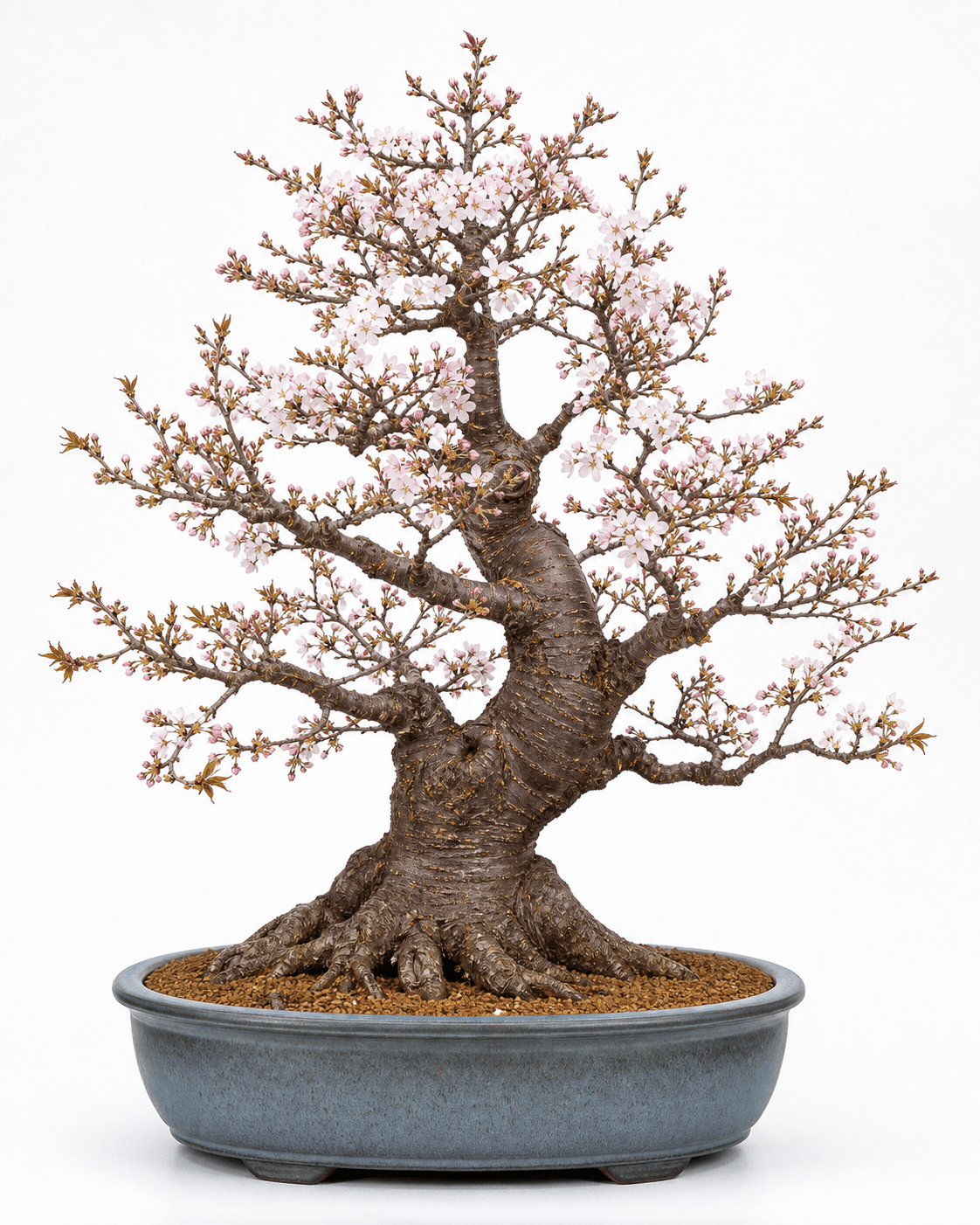
Ornamental cherry bonsai is an outdoor deciduous Prunus grown for spring bloom, fine seasonal timing, and an old-tree image that still reads after the flowers fall. It needs cold dormancy, full outdoor light, steady water with oxygen, and pruning that protects next season flower buds.
This guide covers the main search cluster around Prunus serrulata, Japanese flowering cherry, cherry blossom, sakura, and compact Prunus incisa forms such as Kojo-no-mai. Kew and extension sources ground the plant identity, while Mirai flowering, fruiting, deciduous, Prunus, repotting, wiring, and design method shape the bonsai recommendations.
The best beginner answer is conditional: choose small-scale, healthy outdoor material, inspect graft unions, grow for structure before display, and treat flowers as a seasonal reward rather than the whole design. A cherry can be deeply rewarding, but it asks the grower to respect timing more than clipping impulse.
Updated June 16, 2026. Written by EntGrove Editorial. Last verified June 16, 2026.
Care fingerprint
Read the species through its shared care pattern.
Repot and structural prune around dormant-to-active transitions; protect new leaves; time refinement work after growth hardens. Use this as the starting point before local conditions and tree strength refine the calendar.
Read the foliage first
Broadleaf stress usually shows in leaf color, leaf size, wilt, scorch, or delayed hardening before it becomes a branch problem.
Match work to dormancy
Deciduous, evergreen, tropical, succulent, and flowering broadleaf trees recover on different calendars.
Protect fine roots
Root work should preserve enough active fine roots for the tree to rehydrate quickly after the operation.
Care cadence
The calendar starts with the tree's seasonal state.
Placement
Timing: Grow outdoors all year in sun and air, then protect the container during severe cold, drying wind, and repeated freeze-thaw cycles.
Watch for: Warm indoor winter storage, late frost after flower buds swell, stagnant air, hot walls, and treating landscape hardiness as root-zone hardiness in a shallow pot.
NC State ExtensionOregon State Landscape PlantsDuke Gardens Kojo-no-mai profileLight requirement
Timing: Use full sun for bloom, short internodes, and strong recovery. Add afternoon relief only during severe heat, after root work, or while a weak tree rebuilds roots.
Watch for: Sparse bloom in shade, long internodes, scorched leaves after repotting, and permanent shade used to compensate for missed watering.
NC State ExtensionClemson Extension ornamental PrunusBonsai Mirai LibraryWatering
Timing: Water thoroughly when the upper soil starts to dry. Keep moisture steadier during bloom, early fruit, summer heat, and post-repot recovery while ensuring water exits the pot quickly.
Watch for: Flower collapse after dry-downs, leaf scorch on hot benches, stale wet soil, sour nursery peat, and weak drainage hidden under moss.
Clemson Extension ornamental PrunusNC State ExtensionBonsai Mirai LibraryFertilizer
Timing: Feed through active growth. Development trees need stronger feeding to build branch structure; refined flowering trees need enough strength for buds without forcing coarse late extension.
Watch for: Fruit set on weak trees, heavy nitrogen that creates coarse shoots, pale leaves from alkaline-water micronutrient lockup, and starving the tree after bloom.
Bonsai Mirai LibraryPruning
Timing: Remove dead, diseased, crossing, or awkward branches right after flowering. Use early-summer Prunus pruning on strong growth, and reserve heavier deciduous structural choices for fall or a dry, disease-safe window.
Watch for: Cutting off late-summer flower buds, pruning to weak undeveloped buds, wet-spring wound infection, long bloom-only branches, and dieback after cuts that leave poor vascular support.
Clemson Extension ornamental PrunusBonsai Mirai LibraryWiring
Timing: Wire young flexible branches while they can still move, often in leafless fall or after growth has hardened. Use aluminum, paper-wrapped copper only where holding power clearly earns the bark risk, and remove before swelling marks.
Watch for: Thin damaged bark, brittle old Prunus wood, wire hidden by leaves, spring swelling, and repeat bends at previous wire-pressure points.
NC State ExtensionBonsai Mirai LibraryRepotting
Timing: Repot around spring bud swell, or after flowering and before leaf expansion when the tree blooms first. Work by root density, drainage, and recovery history rather than calendar habit.
Watch for: Heavy root work paired with full flower display, old woody roots cut too aggressively, wet fine soil, unanchored trees, and abrupt soil-system changes.
Bonsai Mirai LibraryPests and diseases
Timing: Inspect from bud swell through leaf drop, especially after wet springs and on stressed roots or lower trunks. Keep the canopy open enough to dry.
Watch for: Aphids, borers, scale, spider mites, caterpillars, Japanese beetles, shot-hole symptoms, black knot, cankers, brown rot, gummosis, Phytophthora root rot, and Verticillium wilt.
NC State ExtensionUniversity of Maryland ExtensionSpecies guide
Apply the species profile before copying another tree's calendar.
At a glance
Ornamental cherry is an outdoor flowering Prunus for timing-conscious growers.
The page covers Prunus serrulata as the main Japanese flowering cherry target and Prunus incisa Kojo-no-mai as the compact dwarf Fuji cherry search companion. Kew accepts both species, with Prunus serrulata in Rosaceae and a temperate native range from eastern and southern China to North Korea, and Prunus incisa native to Japan. Kew POWO: Prunus serrulataKew POWO: Prunus incisa
In the EntGrove care taxonomy, ornamental cherry belongs in Broadleaf > Deciduous. It needs outdoor sun, cold dormancy, air movement, moist but drained roots, spring root timing, and pruning that respects flowering rather than only outline. NC State ExtensionClemson Extension ornamental PrunusBonsai Mirai Library
The bonsai appeal is spring bloom, reddish-brown lenticelled bark, seasonal leaf color, and graceful old flowering-tree structure. NC State records thin bark, double white flowers from mid March to May, and small black drupes in late summer; Oregon State records many cultivar forms and grafting practices. NC State ExtensionOregon State Landscape Plants
Wild habitat
Temperate cherry ecology points to sun, winter rest, and disease-aware airflow.
Kew describes Prunus serrulata as a tree of the temperate biome. The wild species and the garden cultivars sold as Japanese flowering cherry are linked by deciduous growth, spring bloom, a winter rest period, and Prunus wood that dislikes stagnant wet conditions. Kew POWO: Prunus serrulataNC State Extension
The care implication is direct: keep the tree outdoors, bright, and ventilated. NC State says Japanese cherry flowers best in full sun, prefers moist well-drained loamy soil, and benefits from good air circulation. Clemson adds full sun and fast-draining, well-aerated soil as the landscape baseline. NC State ExtensionClemson Extension ornamental Prunus
The design implication is a seasonal flowering tree rather than a foliage pad tree. Cherry images should read with bare winter branches, budded spring tips, brief bloom, summer leaves, autumn color, and old bark or trunk movement that keeps the tree valuable after petals drop. Bonsai Mirai / AsymmetryBonsai Mirai Library
Reading the tree
Decide whether the tree is building structure or earning flowers.
Mirai flowering and fruiting method separates tree development from seasonal display. Primary and secondary stages prioritize extension, thickening, wound closure, bud production, and root regeneration. Flowers and fruit spend stored energy, so a young cherry should often sacrifice display to build the tree that will carry future bloom. Bonsai Mirai Library
A refined cherry can be treated differently. Once interior branch structure is established, the grower can preserve flowering wood, prune around the bloom cycle, feed enough to rebuild reserves, and let the spring display become an accent on a complete tree form. Bonsai Mirai LibraryClemson Extension ornamental Prunus
The source-depth caveat is important. The local Mirai corpus has scattered cherry and Prunus support rather than a dedicated Prunus serrulata species lesson, so this page transfers high-confidence flowering, fruiting, deciduous, Prunus, root, wiring, and design principles, then grounds taxonomy, hardiness, pests, flower timing, bark, and cultivar facts in Kew and extension sources. Bonsai Mirai LibraryKew POWO: Prunus serrulataNC State ExtensionUniversity of Maryland Extension
Pruning and flowers
Prune after bloom and protect the buds that make next spring possible.
Clemson gives the most useful public rule for ornamental Prunus: prune crossing or rubbing branches immediately after flowering so the next flower display is preserved. In bonsai, this becomes post-bloom branch selection, flower cleanup, and removal of branches that damage the silhouette or create disease-prone congestion. Clemson Extension ornamental Prunus
Mirai Prunus method adds a second layer: avoid large structural cuts during cool wet spring weather because vascular pathogens can enter Prunus wounds, and use the solstice-window pruning and partial-defoliation method broadly on spring-flowering Prunus, including cherry, after growth has had time to extend. Bonsai Mirai Library
Do not build the tree by shearing every shoot at first extension. Let chosen shoots run long enough to thicken and create usable buds, then cut back to a node that supports direction and future branching. A cherry branch with no useful leaf bud below the cut is a dieback candidate. Bonsai Mirai Library
Fruit should usually be removed on developing bonsai. Mirai fruiting-tree guidance treats fruit set as expensive, and ornamental cherries grown for flowers rarely need drupes to complete the design. Removing fruit helps preserve energy for roots, buds, and branch work. Bonsai Mirai LibraryNC State Extension
Repotting
Repot during spring movement, then reduce display pressure.
The broad bonsai window is spring as buds swell and before the tree has committed fully to leaves. Mirai also notes that species that flower before leafing out, including cherry, can typically be repotted after flowering and before leaf expansion when climate and tree strength support that choice. Bonsai Mirai Library
For most growers, the conservative recommendation is root work around bud swell on a healthy tree, then removal or reduction of flowers and fruit if the operation was significant. Recovery matters more than a single spring display. Bonsai Mirai Library
The actual work should restore oxygen and drainage without destroying the functioning core. Comb out the surface, sides, and bottom, remove circling or dead roots, keep fine roots moist while exposed, cut cleanly, settle new soil into the roots, and anchor the tree so new roots are not torn by wind or handling. Bonsai Mirai Library
Repot intervals come from the tree in front of you. Fast young nursery stock in old peat may need staged conversion sooner; an older refined cherry in stable akadama may need only inspection and surface work. Drainage speed, root density, recovery history, and vigor are better signals than a fixed annual habit. Bonsai Mirai LibraryBonsai EmpireBonsai4Me
Soil and pot
Choose moisture retention with air, then choose a pot that fits blossom scale.
Clemson describes flowering cherries as preferring moist, fast-draining, well-aerated soil. NC State says Japanese cherry prefers moist well-drained loam and poorly drained soil is a problem. In a bonsai pot, that means a granular mix that holds enough water for bloom and heat without collapsing into stale mud. Clemson Extension ornamental PrunusNC State Extension
Mirai soil method supports solid akadama or akadama-heavy mixes for mature temperate broadleaf refinement because akadama slows growth, scales roots, and helps reduce internodes. During nursery conversion, blend soil systems gradually instead of creating a sharp interface between old peat and new mineral soil. Bonsai Mirai Library
Use pot depth as horticulture, not only display. A recently collected or grafted cherry, a tree with coarse nursery roots, or a flowering specimen in a hot climate may need a deeper oval, rectangle, or training container before a shallow exhibition pot is responsible. Bonsai Mirai LibraryOregon State Landscape Plants
Pot pairing should stay quiet. Unglazed warm browns, muted gray, soft cream, and restrained glazed earth tones let spring flowers carry the moment. Large double flowers usually need a larger tree and a calmer pot than compact Kojo-no-mai material. Duke Gardens Kojo-no-mai profileBonsai Mirai / Asymmetry
Climate
Translate Zone 5 to 8 landscape guidance into container protection.
NC State lists Prunus serrulata for USDA Zones 5a to 8b, Oregon State says hardy to USDA Zone 5, and Duke Gardens lists Kojo-no-mai for Zones 5 to 8. Those numbers describe landscape roots with more soil insulation than a bonsai pot provides. NC State ExtensionOregon State Landscape PlantsDuke Gardens Kojo-no-mai profile
Cold-region care should keep the tree dormant and buffered. Set the pot on the ground, mulch around it, use an unheated cold frame, or protect from desiccating wind. A heated room interrupts dormancy and can pull buds open before light and weather can support them. Bonsai Mirai Library
Hot-region care should preserve sun while reducing root-zone stress. Increase pot volume, water early enough that the root mass is charged before heat, protect recently repotted trees, and use temporary afternoon shade during severe heat. Permanent shade usually weakens bloom and extends internodes. NC State ExtensionClemson Extension ornamental PrunusBonsai Mirai Library
Wet maritime regions need special wound discipline. Mirai Prunus guidance avoids large cool-wet spring cuts because pathogens such as verticillium and pseudomonas can enter open wounds. Use drier windows, seal cuts, and remove diseased tissue promptly. Bonsai Mirai LibraryUniversity of Maryland Extension
Pests and diseases
Prunus health depends on airflow, clean roots, and fast diagnosis.
NC State lists aphids, borers, scales, spider mites, leafhoppers, caterpillars, Japanese beetles, and tent caterpillars, plus dieback, leaf curl, root rot, fire blight, leaf spot, twig cankers, black knot, galls, and powdery mildew. Maryland Extension adds the practical stress list: drought, compacted or poorly drained soil, trunk damage, winter injury, and weak planting stock. NC State ExtensionUniversity of Maryland Extension
Shot-hole symptoms are common after wet springs. Maryland describes small round holes about 1/8 in across, yellowing leaves, and premature leaf drop. On bonsai, remove infected leaves, improve airflow, avoid overhead wetting when possible, and follow local extension timing if chemical control is needed. University of Maryland Extension
Cankers, black knot, brown rot, and lower-trunk stress are more serious because they can damage the bonsai structure itself. Maryland recommends pruning out black knot below visible damage and notes cankers often enter through insect feeding, mower wounds, frost cracks, or hail damage. For bonsai, also inspect wire scars, graft unions, trunk splits, and exposed roots. University of Maryland ExtensionNC State Extension
Prevention is mostly cultural: full sun, airflow, fast drainage, clean pruning tools, sealed or protected wounds where appropriate, no stale soil, no standing water, and enough feeding to restore energy after flowering. Clemson Extension ornamental PrunusNC State ExtensionBonsai Mirai Library
Wiring
Wire early, inspect often, and respect thin cherry bark.
NC State notes that Japanese cherry bark is thin and easily damaged. Mirai deciduous wiring guidance treats visible wire bite on smooth bark as a permanent scar, so the removal signal is wire getting tight, before it bites. NC State ExtensionBonsai Mirai Library
Use Mirai structural wiring fundamentals: wire for a specific trunk or branch role, choose enough gauge to hold the bend, keep 55 to 60 degree coil angle, keep spacing even, and keep contact without crushing bark. On young deciduous cherry, aluminum often gives enough control with less bark risk than repeated copper applications. Bonsai Mirai Library
Older Prunus wood should move through pruning, grafts, guy wires, props, or replacement shoots more often than forceful bends. Mirai deciduous method notes thicker deciduous wood is more brittle than conifer wood, and repeat wiring tears more easily at old pressure points or previous bends. Bonsai Mirai Library
Propagation
Seed, cuttings, air layers, and grafts each solve a different problem.
Seed can build roots and trunk character over time, but seed-grown ornamental cherry will not reliably reproduce a named cultivar. It is useful for long projects, rootstock, or naturally scaled material rather than quick cultivar fidelity. Oregon State Landscape PlantsKew POWO: Prunus serrulata
Cuttings and air layers are useful when a branch already has the scale, movement, or cultivar identity you want. Mirai propagation method emphasizes clean cuts, correct wood stage, oxygenated medium, humidity control, and patience until new roots can support foliage. Bonsai Mirai Library
Grafting is central to ornamental cherry sourcing. Oregon State says cultivars are often grafted onto Prunus avium or Prunus serrula. In bonsai, grafting can preserve a flower cultivar, renew interior branching, or create roots, but a high or swollen graft union can ruin the future trunk line. Oregon State Landscape PlantsBonsai Mirai Library
Buying and sourcing
Buy trunk, roots, health, and scale before buying a spring flower photo.
Good stock has a believable base, low branch options, visible buds, healthy bark, no major cankers, no buried graft defect, and soil that can be transitioned. A nursery tree in bloom can still be a poor bonsai if the first useful branch begins above the future design. Oregon State Landscape PlantsUniversity of Maryland ExtensionBonsai Mirai / Asymmetry
Inspect grafts directly. Oregon State documents grafted flowering cherry cultivars, and bonsai material with a tall landscape graft may create a permanent swelling or bark mismatch at the exact point where a bonsai viewer studies the trunk. Oregon State Landscape PlantsBonsai Mirai / Asymmetry
Choose scale deliberately. Oregon State lists large landscape cultivars such as Kanzan, Mt. Fuji, Royal Burgundy, Shiro-fugen, Shogetsu, and Ukon; Duke Gardens describes Kojo-no-mai as compact with twisting branches. Large double flowers usually suit medium or larger bonsai, while compact Prunus incisa material can support smaller images. Oregon State Landscape PlantsDuke Gardens Kojo-no-mai profile
Collected or garden-dug Prunus should be handled as advanced material. Rebuild roots in stages, protect fresh wounds, reduce flower load, and avoid importing disease or borers into the collection. Bonsai Mirai LibraryUniversity of Maryland Extension
Troubleshooting
Most failures come from indoor culture, mistimed cuts, weak roots, or disease pressure.
No flowers usually points to shade, juvenile or weak material, pruning after flower buds formed, heavy development work, winter storage that interrupted dormancy, or lack of post-bloom energy recovery. Restore full outdoor culture first, then adjust pruning and feeding. Clemson Extension ornamental PrunusBonsai Mirai Library
Leaf holes and early yellowing after wet spring weather point toward shot-hole symptoms. Remove infected leaves, improve airflow, check watering practices, and use local extension guidance for treatment timing. University of Maryland Extension
Gumming, sunken bark, branch dieback, or dark swollen knots deserve fast action. Inspect for cankers, black knot, borers, trunk cracks, wire damage, and root stress before deciding the tree only needs fertilizer. University of Maryland ExtensionNC State Extension
Wilting with wet soil points toward poor drainage, compacted nursery substrate, root rot, or recent root damage. Wilting with dry soil points toward shallow-pot heat, missed watering, or a tree carrying more bloom and foliage than roots can support. Clemson Extension ornamental PrunusBonsai Mirai Library
Design and styling
Design a tree that is worth seeing after bloom ends.
Mirai flowering-bonsai critique separates two value systems: a tree designed mainly to display flowers and a fully refined bonsai form that also carries flowers. Ornamental cherry is strongest when the flowers accent a credible trunk, branch structure, and seasonal silhouette. Bonsai Mirai Library
A cherry design should make winter structure legible: trunk movement, a defining branch, secondary branches that emerge from useful angles, and an apex that looks natural after leaf drop. Mirai deciduous design favors varied up-and-out branch angles over uniform conifer-like downward pads. Bonsai Mirai LibraryBonsai Mirai / Asymmetry
Flower placement is a design tool. Bloom on long coarse branches can hide weak structure for one week and expose it for the rest of the year. Bloom on compact ramified twigs makes the tree feel mature, controlled, and seasonal. Bonsai Mirai Library
Deadwood is usually restrained on ornamental cherry. Prunus can carry aged bark, hollows, and scars, but exposed deadwood should serve the story of an old flowering tree rather than imitate juniper shari. Bonsai Mirai / AsymmetryBonsai Mirai Library
Cultivars and forms
Cultivar identity affects flower scale, habit, grafts, and cold response.
Oregon State notes that many Prunus serrulata cultivars apparently originated from hybridization between two or more wild species, then lists common forms such as Kanzan, Mt. Fuji, Royal Burgundy, Shiro-fugen, Shogetsu, and Ukon. Treat cultivar labels as horticultural clues, not proof that every cherry shares one growth habit. Oregon State Landscape Plants
Kanzan and other large double-flowered cherries can be spectacular on medium and large bonsai, but flower scale can overwhelm very small trees. Shiro-fugen, Shogetsu, Ukon, and related forms need the same scale check: leaf, flower, internode, and graft all have to fit the final image. Oregon State Landscape PlantsBonsai Mirai / Asymmetry
Kojo-no-mai belongs on the page because many growers search for it as a cherry bonsai. Duke Gardens identifies Prunus incisa Kojo-no-mai as dwarf Fuji cherry with compact twisting branches, Japan as native range, USDA Zones 5 to 8, and flowers at eye level in the garden. Duke Gardens Kojo-no-mai profileKew POWO: Prunus incisa
History and notable trees
Cherry carries cultural weight, so the bonsai needs restraint.
Japanese flowering cherry is inseparable from sakura and hanami imagery, but a bonsai still has to function as a tree. Use that cultural association as seasonal context, then let the trunk, branch structure, and pot choice stay disciplined. Oregon State Landscape PlantsBonsai Mirai / Asymmetry
Oregon State describes a cultivar-rich landscape history and grafted nursery practice, while Duke Gardens presents Kojo-no-mai as a compact garden plant valued for low eye-level bloom and autumn color. Those public-horticulture histories explain why bonsai growers encounter many cherry labels with different scale and graft behavior. Oregon State Landscape PlantsDuke Gardens Kojo-no-mai profile
For exhibition, the highest standard is timing plus structure. A cherry shown just before peak bloom can be moving, but the tree should still have aged bark, organized branching, clean wounds, and a pot that lets the flower moment breathe. Bonsai Mirai LibraryBonsai Mirai / Asymmetry
Species questions
Answer the beginner questions before styling.
Is ornamental cherry a good beginner bonsai?
It is a good beginner tree only for someone with outdoor space and patience for timing. Elm, ficus, and dwarf jade are more forgiving; ornamental cherry rewards growers who can manage dormancy, flower-bud pruning, water, and disease prevention.
Can ornamental cherry bonsai live indoors?
No. Ornamental cherry is an outdoor deciduous tree that needs sun, air, seasonal change, and cold dormancy. Protect the pot in winter rather than moving it into a warm room.
How much sun does ornamental cherry bonsai need?
Use full sun as the default for flowering and compact growth. Temporary afternoon shade can help during severe heat, after repotting, or while weak roots recover.
How often should I water ornamental cherry bonsai?
Water when the upper soil begins to dry, and keep moisture steadier during bloom, early fruit, hot weather, and post-repot recovery. The pot must drain freely because stale wet soil invites root disease.
When should I prune ornamental cherry bonsai?
Do branch selection and cleanup immediately after flowering, then let selected shoots extend before cutting back. Avoid removing flower buds later in the season unless development is more important than next spring bloom.
When should I repot ornamental cherry bonsai?
Repot around spring bud swell, or after flowering and before leaf expansion on strong trees that bloom before leafing out. Adjust the interval by root density, drainage, vigor, and recovery history.
Can I wire ornamental cherry bonsai?
Yes, but wire young flexible branches and check often. The bark is thin, older wood is brittle, and spring or fall thickening can mark branches quickly.
Is Kojo-no-mai the same as Japanese flowering cherry?
Kojo-no-mai is a compact cultivar of Prunus incisa, often called dwarf Fuji cherry. Japanese flowering cherry usually refers to Prunus serrulata cultivars, so care overlaps but identity and scale differ.
Why did my ornamental cherry bonsai stop flowering?
Common causes are shade, weak roots, warm winter storage, pruning after flower buds formed, heavy development work, or a tree too young or stressed to carry bloom.
What are the common pests and diseases on ornamental cherry bonsai?
Watch for aphids, borers, scale, mites, caterpillars, Japanese beetles, shot-hole disease, black knot, cankers, brown rot, gummosis, Phytophthora root rot, and Verticillium wilt.
Sources
Species advice needs source discipline.
Next decisions
Plan the operation before copying the calendar.
A good care note for Ornamental cherry / Japanese flowering cherry records the tree's stage, the work done, and the aftercare used. That record matters more than a month-name rule.
Related species
Compare nearby trees before transferring advice.
Japanese maple
Acer palmatum
Trident maple
Acer buergerianum
Amur maple
Acer tataricum subsp. ginnala
Field maple
Acer campestre
Korean hornbeam
Carpinus turczaninovii