
Species guide
Pfitzer Juniper Bonsai Care
Juniperus x pfitzeriana
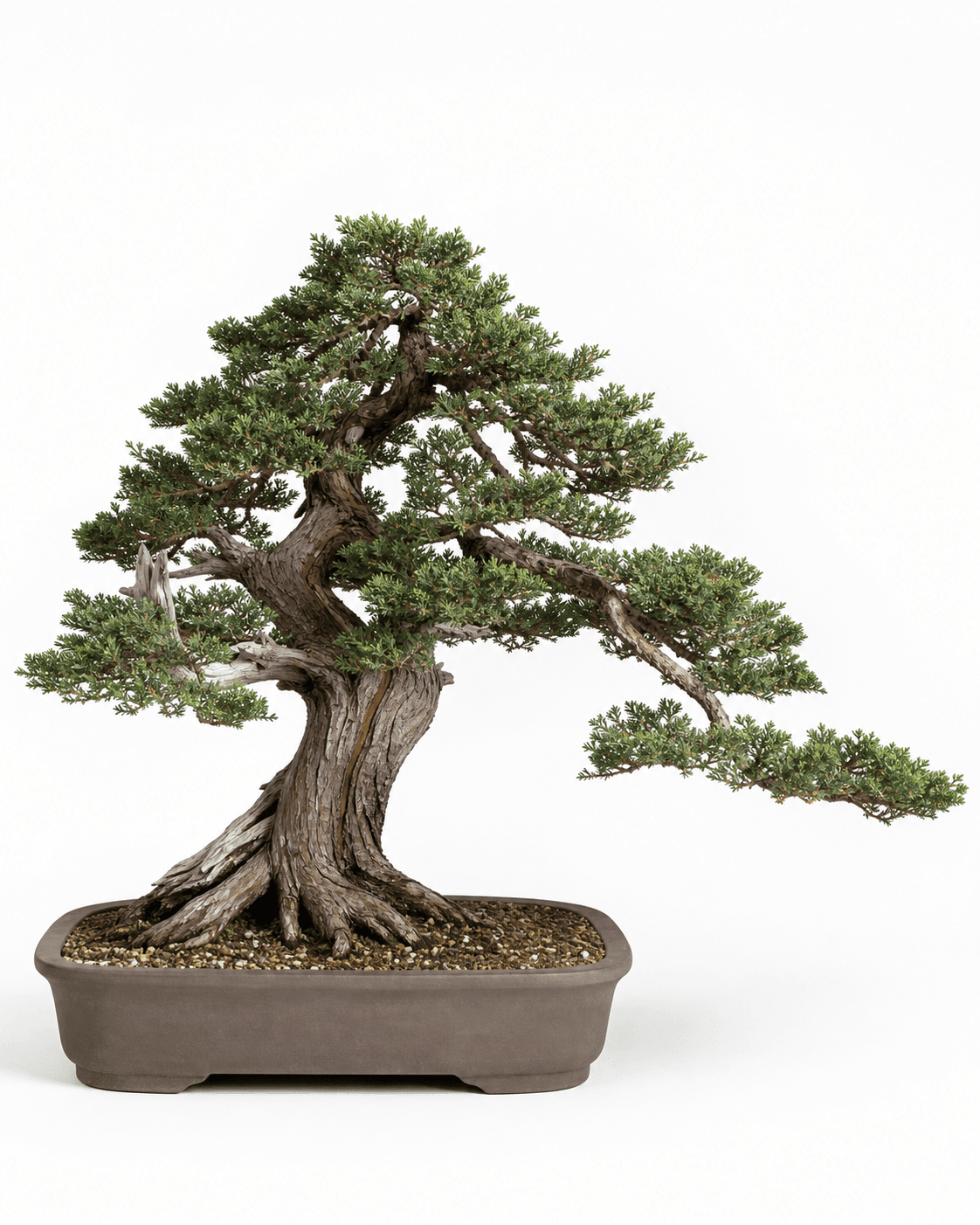
Pfitzer juniper, Juniperus x pfitzeriana, is a hybrid landscape juniper used for bonsai when nursery stock offers a wide base, sweeping branches, and vigorous scale foliage. Grow it outdoors in full sun, open mineral soil, and winter dormancy, then prune with scissors after growth hardens.
The local Mirai corpus names Pfitzer directly in professional Rocky Mountain juniper and juniper-over-stone design files, and it names Old Gold in a second-repotting context. There is no dedicated Pfitzer file, so this guide transfers running-juniper, nursery-stock, refinement, root, live-vein, wiring, and design method while using NC State, Kew, and The Gymnosperm Database for public identity facts.
Separate Pfitzer, Pfitzeriana, Juniperus x media, Old Gold, Gold Coast, Sea Green, Hetzii, and Wilhelm Pfitzer labels from species-level Savin, Tam, Parsons, procumbens, Blue rug, Andorra, Hollywood, San Jose, eastern red cedar, and generic Chinese juniper before copying timing or pricing.
Updated June 11, 2026. Written by EntGrove Editorial. Last verified June 11, 2026.
Care fingerprint
Read the species through its shared care pattern.
Use the running habit instead of fighting it; branch selection, live foliage preservation, and gradual styling are the main constraints. Use this as the starting point before local conditions and tree strength refine the calendar.
Note: Hybrid Chinese-juniper and Savin-juniper landscape group with direct local Mirai Pfitzer and Old Gold mentions but no dedicated Pfitzer file; verify against Savin, Tam, Parsons, procumbens, Blue rug, Andorra, Hollywood, San Jose, eastern red cedar, and generic Chinese juniper before copying timing.
Keep foliage strong
Junipers recover through active foliage, so styling choices should leave enough healthy tips to power the tree.
Protect live veins
Old junipers often depend on narrow live veins between roots and foliage; root work and carving should respect that path.
Do not stack major work
Heavy bending, major foliage reduction, carving, and repotting belong in a staged plan rather than the same weekend.
Care cadence
The calendar starts with the tree's seasonal state.
Placement
Timing: Grow outdoors year round in full sun and airflow. Use temporary shade only after root work, during extreme heat, or while recovering from a heavy styling.
Watch for: Indoor display, crowded nursery benches, hot reflective walls, shaded patios, and weak interior foliage hidden under the outer shell.
NC State Extension: Juniperus x pfitzerianaBonsai Mirai LibraryWatering
Timing: Water in repeated passes until the whole rootball drains, then wait for the upper root zone to begin drying before watering again.
Watch for: Runoff around hydrophobic peat, sour organic cores, wet cold soil, low foliage mass after styling, and sudden water needs after hot wind.
NC State Extension: Juniperus x pfitzerianaBonsai Mirai LibraryFeeding
Timing: Feed development trees from active growth through early summer. For refinement, delay heavy feeding until after the first flush hardens and pruning response is controlled.
Watch for: Overfertilization, coarse runners, repeated pruning needs, spring pest pressure, and fertilizer on weak roots.
Bonsai Mirai LibraryPruning
Timing: Let new growth harden, then prune strong extensions with scissors to healthy interior side growth. Running-habit plants usually need the earlier post-harden window.
Watch for: Pinching, hedge-shearing, cutting to weak interior tufts, removing too much productive foliage, and copying mounding-juniper timing blindly.
Bonsai Mirai LibraryStructural work
Timing: Style in early fall for vigorous nursery stock, or early spring before visible tip movement when spring work is safer in your climate.
Watch for: Cambium slip after tips move, heavy summer work in heat and humidity, deep-dormancy bending, and styling immediately after major root work.
Bonsai Mirai LibraryRepotting
Timing: Repot in spring before active extension. Convert old nursery soil over staged cycles and keep enough foliage to power new roots.
Watch for: Bare-rooting, loose tie-downs, severe root and foliage reduction together, compact peat, and repotting after spring growth has partly hardened.
Bonsai Mirai LibraryWiring
Timing: Wire hydrated branches with enough support to hold broad, arching limbs and prevent hidden wire bite inside dense sprays.
Watch for: Torn crotches, crushed scale foliage, wire scars hidden under foliage, and dry deadwood wired as if it will hold permanent shape.
Bonsai Mirai LibraryPests and disease
Timing: Inspect during wet spring weather, hot dry mite periods, winter shelter, and the year after major nursery-stock reduction.
Watch for: Aphids, bagworms, webworms, scale, spider mites, tip and needle blights, cedar-apple rust, root rot, canker, and wet-soil decline.
NC State Extension: Juniperus x pfitzerianaClemson Extension juniper pestsUC IPM JuniperWinter protection
Timing: Keep dormant outdoors. Protect shallow pots before repeated hard freeze, drying wind, or prolonged wet shelter conditions.
Watch for: Warm indoor overwintering, frozen dry roots, wet unventilated frames, and fresh root work exposed to sudden cold.
NC State Extension: Juniperus x pfitzerianaBonsai Mirai LibrarySpecies guide
Apply the species profile before copying another tree's calendar.
At a glance
Pfitzer is a durable hybrid juniper with broad nursery-stock potential.
NC State identifies Juniperus x pfitzeriana as Pfitzer Group or Pfitzer juniper and lists Juniperus x media as a previous name. It describes a wide-spreading evergreen shrub in Cupressaceae with scale-like fragrant foliage. NC State Extension: Juniperus x pfitzeriana
For bonsai, the useful traits are vigor, low cost, arching branches, recoverable scale foliage, and enough branch mass for practice design. The limiting traits are dense outer foliage, old nursery cores, possible juvenile response after reduction, and labels that can overlap with several other landscape junipers. NC State Extension: Juniperus x pfitzerianaBonsai Mirai LibraryBonsai Mirai juniper identification
The short care spec is outdoor full sun, thorough watering, oxygen-rich mineral soil, spring root work, post-harden scissor pruning, no pinching, staged nursery-core conversion, and frequent pest checks inside dense foliage. NC State Extension: Juniperus x pfitzerianaBonsai Mirai Library
Wild context
Pfitzer is cultivated hybrid material, so parent ecology guides the care read.
The Gymnosperm Database treats Juniperus x pfitzeriana as a tetraploid hybrid of Juniperus chinensis and Juniperus sabina. NC State also frames the group as crosses between those two species. The Gymnosperm DatabaseNC State Extension: Juniperus x pfitzeriana
Kew supplies the parent anchors: Juniperus chinensis for East Asian Chinese juniper context and Juniperus sabina for the cold Eurasian Savin side. In bonsai, that means the tree should be read as a cultivated landscape hybrid rather than as a collected wild-species image. Kew POWOKew POWO
Care follows the hybrid and landscape-shrub reality. Give Pfitzer sun, air, drainage, and seasonal rest, but judge water and pruning from the observed root core, foliage mass, and cultivar habit in front of you. NC State Extension: Juniperus x pfitzerianaBonsai Mirai Library
Reading the tree
Read the label, growth habit, root core, and foliage age before styling.
Start with identity. Pfitzer, Pfitzeriana, Juniperus x media, Old Gold, Gold Coast, Sea Green, Hetzii, Savin, Tam, Parsons, procumbens, Blue rug, Andorra, Hollywood, San Jose, and generic Chinese juniper labels can overlap in beginner nursery contexts. NC State Extension: Juniperus x pfitzerianaThe Gymnosperm DatabaseBonsai Mirai juniper identification
Then read the habit. A strong wide Pfitzer that elongates first can use running-juniper post-harden timing. A compact arching cultivar needs more mounding-style restraint, with interior growth preserved for future replacement. NC State Extension: Juniperus x pfitzerianaBonsai Mirai Library
Finally read the roots. Mirai method places juniper strength in foliage mass because foliage powers root regeneration. Heavy root work should wait until the canopy is strong enough to rebuild below the soil line. Bonsai Mirai Library
Foliage work
Use scissors after hardening and protect active interior tips.
Avoid pinching. Mirai ties pinching to torn tissue, stress response, juvenile foliage, and root weakness. Use sharp scissors and cut back to active side growth with multiple healthy tips. Bonsai Mirai Library
For running-habit Pfitzer, prune after the first flush hardens while energy is near neutral. The diagnostic cue is firm new growth with a formed cuticle rather than soft snappy tips. Bonsai Mirai Library
For dense nursery stock, clean in layers. Remove dead interior debris, shaded underside growth, and unusable crotch congestion, while keeping enough productive foliage to power roots and protect winter hardiness. Bonsai Mirai LibraryNC State Extension: Juniperus x pfitzeriana
Roots
Spring root work depends on foliage mass and staged nursery-core conversion.
Repot in spring as winter color returns to active green and before visible new growth pushes. Mirai warns that repotting after spring growth has already pushed and partly hardened gives a poor chance of success. Bonsai Mirai Library
With nursery Pfitzer, repot first with foliage intact when the old root core is the limiting factor. Heavy styling before root conversion leaves a large wet soil mass with too little transpiring foliage. Bonsai Mirai Library
Do the conversion over staged cycles. Preserve enough old root continuity, anchor the tree firmly, and finish the work in one committed pass so fragile juniper roots are not repeatedly disturbed. Bonsai Mirai Library
Soil and pot
Use oxygen-rich mineral soil and a pot that supports the spread.
A practical nursery-conversion mix is 1:1:1 akadama:pumice:lava with fines removed. For refined vigorous trees in drier care, 2:1:1 akadama:pumice:lava can hold more moisture while preserving oxygen. Bonsai Mirai Library
NC State says Pfitzer prefers average medium moisture, well-drained soil, and full sun, and that it tolerates drought, dry shallow-rocky soil, clay, erosion, pollution, and seaside conditions. It is intolerant of wet soils. NC State Extension: Juniperus x pfitzeriana
Low ovals, rectangles with softened corners, slabs, and semi-cascade containers can all work. Choose the pot after the base, trunk spread, defining branch, and final front become clear. Bonsai Mirai / AsymmetryBonsai Mirai Library
Climate
Landscape hardiness is broad, while bonsai roots still need local protection.
NC State lists USDA Zones 4a through 9b for Juniperus x pfitzeriana. In bonsai, shallow roots experience colder, drier, and wetter extremes than landscape roots. NC State Extension: Juniperus x pfitzerianaBonsai Mirai Library
In cold regions, keep the tree dormant and protect the pot from repeated hard freeze, drying wind, and freeze-thaw cycling. Good protection preserves root moisture without trapping stale wet air. Bonsai Mirai Library
In hot humid regions, avoid major summer work, preserve foliage for cooling, and inspect for mites and blight. In hot dry regions, cool the container and watch for mite pressure while maintaining full sun on healthy foliage. Bonsai Mirai LibraryClemson Extension juniper pestsUC IPM Juniper
Pests and disease
Dense Pfitzer foliage hides pest and blight signals until decline is advanced.
NC State lists occasional aphids, bagworms, webworms, and scale, along with tip and needle blights, cedar-apple rust relatives, root rot in wet soil, and canker on bark or main stems. NC State Extension: Juniperus x pfitzeriana
Clemson and UC IPM give the practical bonsai prevention pattern: airflow, dry foliage before night where possible, sanitation, stress reduction, drainage, and removal of infected tips when twig blight is confirmed. Clemson Extension juniper pestsUC IPM Juniper Twig Blights
Spider mites need active inspection. Use the white-paper tap test, wash foliage where climate allows, and adjust watering so mite management does not keep the substrate saturated. Bonsai Mirai LibraryUC IPM Juniper
Wiring
Wire broad arching branches with support and frequent scar checks.
NC State describes branches standing at about 45 degrees from the trunk. In bonsai, that gives useful sweeping lines, but long arching branches need careful support to avoid tearing at the crotch. NC State Extension: Juniperus x pfitzerianaBonsai Mirai Library
Hydrate before wiring, protect live veins, and use guy wires or structural wire when a branch needs more than a small positional correction. Hidden wire bite is likely inside dense scale foliage. Bonsai Mirai Library
For large bends, distribute force with wire spines, raffia, and planned movement. Dry deadwood wired into shape will often spring back after freeze, thaw, wet, and dry cycles, so permanent deadwood movement needs different technique. Bonsai Mirai Library
Propagation
Use clonal methods when the cultivar label matters.
Named Pfitzer cultivars such as Old Gold, Gold Coast, Sea Green, Hetzii, and Wilhelm Pfitzer should be propagated clonally if the label matters. Seedlings from either parent do not preserve a named cultivar identity. NC State Extension: Juniperus x pfitzeriana
Cuttings are the most practical route for cultivar preservation. Take them only from healthy, pest-free growth, then keep the foliage turgid and the medium airy while roots form. Bonsai Mirai LibraryNC State Extension: Juniperus x pfitzeriana
Air layers and grafts are design tools as much as propagation tools. Record clone, rootstock, scion, date, union position, and aftercare because hybrid, Savin, Chinese-juniper, and shimpaku records change future interpretation. Bonsai Mirai Library
Buying
Buy the base, roots, interior growth, and label clarity.
Good Pfitzer material has credible Juniperus x pfitzeriana or Juniperus x media labeling, a visible base, firm scale foliage, usable trunk spread, healthy interior tips, and a rootball that can be converted over staged cycles. NC State Extension: Juniperus x pfitzerianaBonsai Mirai Library
NC State lists many cultivars in the group. Gold Coast and Old Gold usually attract attention for color, Sea Green for arching mounded density, and Wilhelm Pfitzer for large green growth, so inspect the actual plant rather than buying by name alone. NC State Extension: Juniperus x pfitzeriana
Red flags include generic low-juniper tags, sour peat, hydrophobic roots, dead shaded interiors, recent hedge shearing, mite stippling, scale, bagworm cases, wire hidden in foliage, and no credible path from base to apex. NC State Extension: Juniperus x pfitzerianaUC IPM JuniperBonsai Mirai Library
Troubleshooting
Diagnose Pfitzer by recent work, root oxygen, foliage response, and label fit.
Symptom: green foliage sheds from random areas after winter. Likely cause: water and oxygen imbalance in the roots, often from compact old nursery soil. Fix: stabilize watering and plan spring root work if strength allows. Bonsai Mirai Library
Symptom: dense outer foliage is green while the interior browns. Likely cause: shade, normal old foliage shed, mites, scale, twig blight, or wet dense foliage. Fix: inspect first, then clean gradually. Bonsai Mirai LibraryUC IPM JuniperUC IPM Juniper Twig Blights
Symptom: juvenile or prickly growth appears after styling. Likely cause: stress, sudden reduction, over-stimulation, or strong root response. Fix: stop pruning, keep the tree healthy, and let mature growth return over time. Bonsai Mirai LibraryBonsai Mirai juniper identification
Symptom: the tree does not match the Pfitzer label. Likely cause: Savin, Tam, Parsons, Blue rug, Andorra, Hollywood, San Jose, procumbens, or generic Chinese-juniper material. Fix: care for observed roots and foliage, then relabel only with evidence. NC State Extension: Juniperus x pfitzerianaBonsai Mirai juniper identification
Design
Use Pfitzer as honest landscape juniper material with strong movement and restraint.
Begin with base, trunk line, live vein, defining branch, and negative space. Mirai design method puts those structural cues before pad layout because they determine age, direction, and hierarchy. Bonsai Mirai / AsymmetryBonsai Mirai Library
Pfitzer rarely needs a high mountain yamadori story. Its best designs often use a broad base, sweeping branch angle, clump or raft movement, low informal posture, over-stone grip, or semi-cascade line from the nursery habit. NC State Extension: Juniperus x pfitzerianaBonsai Mirai Library
Deadwood can improve age, but young vigorous nursery stock should keep enough live tissue to keep the tree strong. Let live and dead tissue contrast serve the design rather than carving every unused branch. Bonsai Mirai Library
Cultivars
Old Gold, Gold Coast, Sea Green, Hetzii, and Wilhelm Pfitzer belong under one careful parent page for now.
NC State lists Blue and Gold, Daubs Frosted, Glauca, Gold Coast, Hetzii, Old Gold, Pfitzeriana Aurea, Pfitzeriana Compacta, Sea Green, and Wilhelm Pfitzer under Juniperus x pfitzeriana. NC State Extension: Juniperus x pfitzeriana
Old Gold is described as a popular medium spreading shrub with gold foliage year-round. Gold Coast is tied to golden needles, Sea Green to a dwarf mounding, arching, weeping form, and Wilhelm Pfitzer to large spreading growth with mixed adult and juvenile foliage. NC State Extension: Juniperus x pfitzeriana
Keep cultivar records exact. A gold Pfitzer, a gold Chinese juniper, and a gold creeping juniper can ask for similar outdoor culture while carrying different habit, value, and design expectations. NC State Extension: Juniperus x pfitzerianaBonsai Mirai juniper identification
History
Pfitzer is best understood as practical nursery material, not a famous old-tree category.
The Pfitzer group matters because it has been widely available in landscape nurseries, not because it carries a narrow exhibition lineage. That availability makes it useful for learning juniper roots, pruning, wiring, and design judgment. NC State Extension: Juniperus x pfitzeriana
The local Mirai corpus uses Pfitzer as a comparison point inside broader juniper design and reduction discussions. That makes the page useful as a source-depth-aware bridge between inexpensive landscape material and higher-value collected or grafted junipers. Bonsai Mirai Library
For long-term records, track the exact label, cultivar if known, nursery source, first root work, soil conversion, major reductions, juvenile foliage episodes, pest history, wiring dates, and any graft or air-layer decisions. Bonsai Mirai LibraryNC State Extension: Juniperus x pfitzeriana
Species questions
Answer the beginner questions before styling.
Can Pfitzer juniper be used for bonsai?
Yes. Pfitzer juniper can be good outdoor bonsai practice material when it has a visible base, healthy foliage, usable branch movement, and enough interior growth for staged pruning and root conversion.
Can Pfitzer juniper live indoors?
Pfitzer juniper needs outdoor sun, airflow, seasonal change, and winter dormancy. Indoor display should be brief.
Is Pfitzer juniper the same as Juniperus x media?
NC State lists Juniperus x media as a previous name for Juniperus x pfitzeriana. Record both labels, then care for the observed plant.
When should Pfitzer juniper be repotted?
Repot in spring before active growth, with strong foliage mass left on the tree. Established bonsai are usually inspected every 3 to 5 years.
What soil is best for Pfitzer juniper bonsai?
Start with open mineral soil such as 1:1:1 akadama:pumice:lava for nursery conversion. Use more akadama only when the tree has enough foliage and fine roots to use the added water retention.
Should Pfitzer juniper be pinched?
Avoid pinching. Let new growth harden, then prune with sharp scissors to active side growth while preserving enough foliage to power roots.
How is Pfitzer different from Savin or Tam juniper?
Pfitzer is hybrid material involving Chinese juniper and Savin juniper parentage. Tam is a named Savin selection, and Savin is the species Juniperus sabina. Keep the records separate.
Is Old Gold juniper a Pfitzer juniper?
NC State lists Old Gold under Juniperus x pfitzeriana and describes it as a medium spreading shrub with gold foliage year-round. Verify the tag before treating any gold juniper as Old Gold.
Why is my Pfitzer juniper browning inside?
Interior browning can come from shade, normal old foliage shed, mites, scale, twig blight, stale wet soil, or excessive density. Inspect before cutting and clean gradually.
Is Pfitzer juniper good beginner material?
It can be good beginner practice material for outdoor growers because it is common, vigorous, and forgiving enough for staged work. Beginners should focus on water, sun, roots, and timing before heavy carving.
Sources
Species advice needs source discipline.
Next decisions
Plan the operation before copying the calendar.
A good care note for Pfitzer juniper records the tree's stage, the work done, and the aftercare used. That record matters more than a month-name rule.
Related species
Compare nearby trees before transferring advice.
Hollywood juniper
Juniperus chinensis 'Torulosa'
Blue rug juniper
Juniperus horizontalis 'Wiltonii'
Andorra juniper
Juniperus horizontalis 'Plumosa'
Parsons juniper
Juniperus davurica 'Parsonii'
Savin juniper
Juniperus sabina