
Species guide
San Jose Juniper Bonsai Care
Juniperus chinensis 'San Jose'
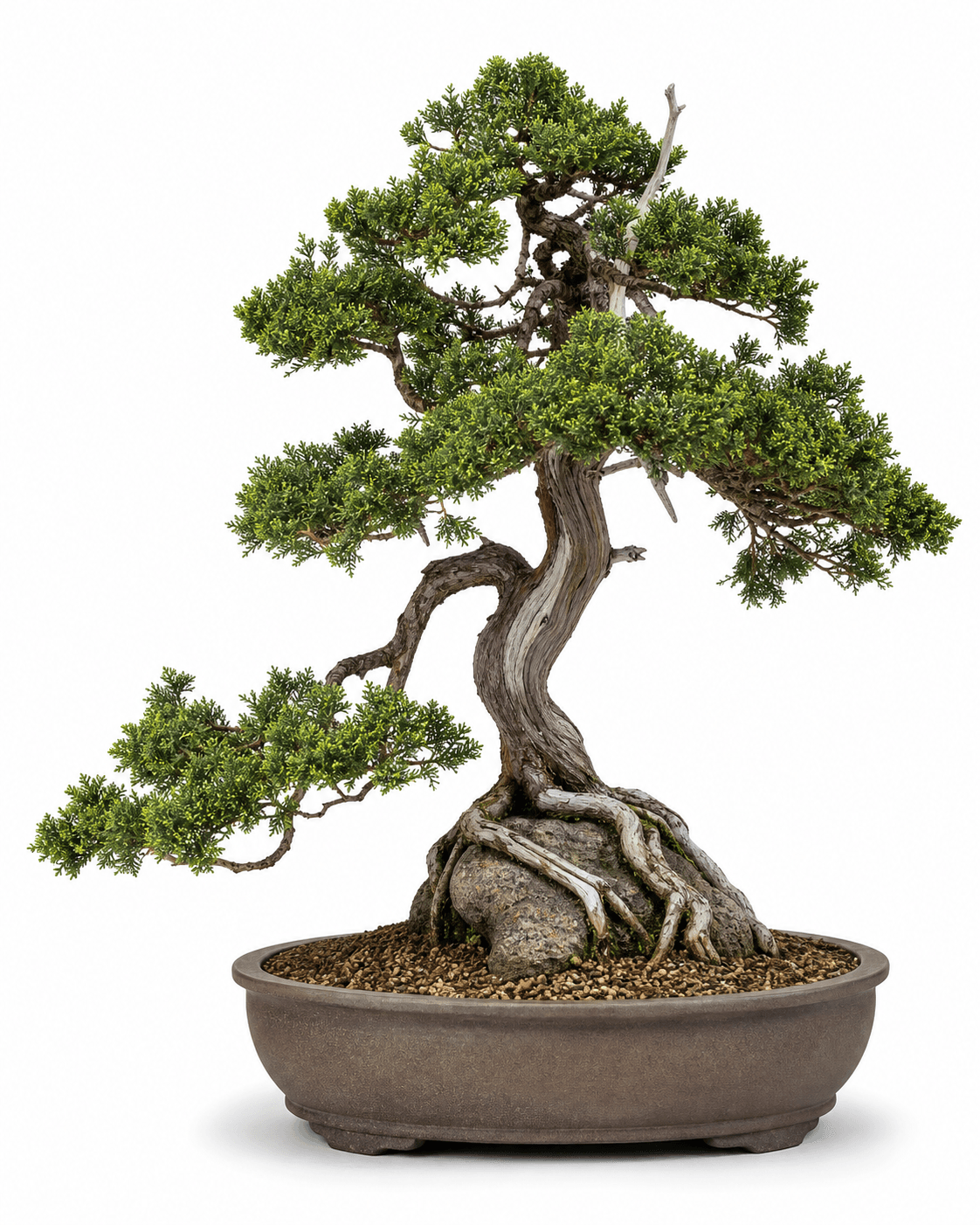
San Jose juniper is a Juniperus chinensis cultivar used in bonsai for outdoor scale-juniper training, root grafts, rock plantings, and durable nursery material. Its care belongs with Chinese juniper, while its foliage and reversion behavior remain separate from Itoigawa, Kishu, Toyama, and generic Shimpaku.
The reviewed Mirai corpus gives San Jose several direct mentions, especially around root grafting, scale-juniper repot timing, juvenile foliage after heavy reduction, and reduction tolerance on younger cultivated junipers. The reliable care plan is full outdoor sun, open mineral soil, strong foliage before root work, scissor pruning instead of pinching, and patience after major cutback.
The main San Jose risk is juvenile reversion. Significant reduction can reliably push prickly juvenile foliage, so refinement should be staged around strong adult scale growth, interior light, and recovery time.
Updated June 10, 2026. Written by EntGrove Editorial. Last verified June 10, 2026.
Care fingerprint
Read the species through its shared care pattern.
Maintain strong scale foliage, preserve interior light, and avoid overcleaning or pinching weak tips. Use this as the starting point before local conditions and tree strength refine the calendar.
Note: Cultivated Juniperus chinensis selection used for bonsai, nursery stock, root grafts, and rock plantings; separate from Itoigawa, Kishu, Toyama, Tohoku, Hokkaido, generic Shimpaku, Foemina, Blaauw, procumbens, and eastern red cedar before applying refinement or pricing assumptions.
Keep foliage strong
Junipers recover through active foliage, so styling choices should leave enough healthy tips to power the tree.
Protect live veins
Old junipers often depend on narrow live veins between roots and foliage; root work and carving should respect that path.
Do not stack major work
Heavy bending, major foliage reduction, carving, and repotting belong in a staged plan rather than the same weekend.
Care cadence
The calendar starts with the tree's seasonal state.
Placement
Timing: Keep outdoors all year with sun, airflow, and dormancy. Shift to partial afternoon protection after repotting, grafting, heavy reduction, or high-heat spells.
Watch for: Indoor culture, weak pale tips, overheated shallow pots, winter wind on recently worked roots, and green foliage masking root decline.
Bonsai Mirai LibraryNC State ExtensionWatering
Timing: Check the upper 1/4 to 1/2 in of soil, then water in repeated gentle passes until the full rootball drains. Recheck old nursery cores because water can bypass them.
Watch for: Hydrophobic peat, compacted akadama, foliage reduction that lowers water use for 3 to 4 days, and small root-graft containers drying ahead of the main pot.
Bonsai Mirai LibraryFeeding
Timing: Feed healthy development trees during active growth, then use lighter feeding in refinement after the post-harden prune. Fall feeding is important for vascular strength and winter hardiness.
Watch for: Fertilizing sick trees, salt stress in peak heat, coarse growth on refined pads, and feeding inside the first 4 to 6 weeks after root work.
Bonsai Mirai LibraryFoliage maintenance
Timing: Let scale foliage mature and produce strong extension before pruning. Use sharp scissors, clean bottoms and crotches, and avoid constant tip pinching.
Watch for: Prickly juvenile foliage after hard reduction, cutting to weak interiors, overcleaning dense pads, and repeated minor pinches that keep the tree stressed.
Bonsai Mirai LibraryRepotting
Timing: Repot during spring movement before the spring flush partly hardens. Preserve a functioning old core where needed, tie down firmly, and keep enough foliage to power new roots.
Watch for: Repotting after partial hardening, reducing foliage and roots together, dry exposed roots, unstable tie-downs, and aggressive root work on weak juvenile foliage.
Bonsai Mirai LibraryWiring
Timing: Wire vigorous trees after growth hardens and cambium re-adheres. Detail wiring can follow cleaning if foliage removal stays conservative.
Watch for: Spring bark slip, wire buried inside dense pads, bends that strain a graft union, and heavy work immediately after juvenile reversion appears.
Bonsai Mirai LibraryRoot grafting
Timing: Use vigorous San Jose whips when a juniper has excellent trunk and deadwood but poor basal roots. Spring active growth gives the strongest vascular push, although attached root grafts have broader timing tolerance.
Watch for: Grafts placed near a live-vein margin, gaps wider than about 1 in, protruding scions, putty in the cambial contact line, and weak scion foliage.
Bonsai Mirai LibraryPests and disease
Timing: Inspect dense foliage, inner crotches, and protected winter storage regularly. Open the canopy enough for light and air, then treat actual pests rather than pruning blindly.
Watch for: Spider mites, scale, aphids, bagworms, webworms, borers, cedar-apple rust, twig blights, Phytophthora, root rot, and scorch from poor water-oxygen balance.
UC IPM JuniperUC IPM Juniper Twig BlightsBonsai Mirai LibraryWinter protection
Timing: Keep dormant outdoors, then insulate roots when hard freezes, dry wind, or recent root work raise risk. Refined healthy junipers tolerate more cold than weak or recently worked trees.
Watch for: Warm indoor storage, frozen dry roots, fresh root graft containers left exposed, and heavy winter styling without aftercare shelter.
Bonsai Mirai LibraryNC State ExtensionSpecies guide
Apply the species profile before copying another tree's calendar.
At a glance
San Jose is a useful Chinese juniper, with a juvenile-foliage warning label.
San Jose juniper is best treated as Juniperus chinensis 'San Jose', a cultivated Chinese juniper selection used in bonsai because it roots strongly, handles container culture, and can make workable scale-juniper material. It belongs near the Japanese Junipers group in EntGrove because the care logic is Chinese-juniper and scale-foliage based. Bonsai Mirai LibraryNC State Extension
This page treats San Jose as a practical Chinese juniper cultivar profile. Mirai names Itoigawa, Kishu, and Toyama as clonal shimpaku selections with specific foliage traits, while San Jose appears as a vigorous cultivar, a root-graft option, a scale juniper, and a plant prone to juvenile reversion after major reduction. Bonsai Mirai LibraryBonsai Mirai juniper identification
The care target is outdoor scale-juniper culture: strong light, moving air, open mineral soil, active foliage before root work, scissor pruning instead of pinching, and staged refinement after stress. Bonsai Mirai LibraryNC State Extension
Habitat
Use Chinese juniper ecology, then adjust for nursery-cultivar behavior.
San Jose is a cultivated selection, so it does not have a wild San Jose habitat to imitate. Kew places the related Sargent juniper shimpaku complex in the Russian Far East, North Korea, and Japan, growing as subshrubs or shrubs in a temperate biome. Kew POWO
That parent signal still matters: sun, airflow, seasonal dormancy, lean mineral root zones, and exposed conditions are safer assumptions than shade, warm indoor display, or rich potting soil. Kew POWONC State Extension
For care, translate the ecology into a bench plan. Give the tree full outdoor light, then water thoroughly and let oxygen return to the root zone. Avoid old nursery cores that stay wet in the center while the outside dries. Bonsai Mirai Library
For design, San Jose can support rugged juniper stories, root-over-rock compositions, and younger cultivated trunks. It usually needs more honest foliage-scale decisions than Kishu or Itoigawa because juvenile reversion and coarser growth can interrupt a fine-pad design. Bonsai Mirai / AsymmetryBonsai Mirai Library
Reading the tree
Read San Jose through adult scale, juvenile reversion, roots, and timing.
Mirai frames junipers as foliage-powered conifers. More healthy foliage means more photosynthetic capacity to rebuild roots, support grafts, heal bends, and recover from pruning. Bonsai Mirai Library
San Jose produces scale foliage and is explicitly excluded from the true needle-juniper rule set in the Mirai needle-juniper repotting file. It should not be repotted late like Juniperus rigida or common juniper simply because some shoots look prickly. Bonsai Mirai Library
Juvenile foliage is the key diagnostic. Mirai notes that San Jose and prostrata junipers reliably revert after significant reduction work, while juvenile growth from stressed crotches and undersides usually means the tree needs stability, not more cutting. Bonsai Mirai Library
Before styling, look for adult scale density, active tips, water penetration, root anchorage, pest pressure, and whether the plant is own-root, grafted, or root-grafted. That reading matters more than the nursery label. Bonsai Mirai LibraryUC IPM Juniper
Foliage work
Prune with scissors, then let adult scale return after stress.
Avoid constant tip pinching. Mirai repeatedly ties juniper pinching to torn tissue, stress response, and juvenile foliage, while clean scissor pruning gives the tree a clearer compartmentalizable wound. Bonsai Mirai Library
For routine maintenance, remove downward-facing foliage, competing crotch shoots, and weak shaded interiors only after the tree has enough active adult scale to recover. Cut elongating tips back to strong secondary or tertiary growth rather than shearing the surface. Bonsai Mirai Library
If significant cutback produces juvenile foliage, hold the next refinement cycle. Improve light, water, oxygen, and feeding, then wait for mature scale to compress again before wiring or pruning for detail. Bonsai Mirai Library
Development trees can carry sacrifice growth longer to build strength and branch size. Refined trees need smaller, cleaner interventions timed after growth hardens, with minimal feeding afterward so the canopy does not become coarse. Bonsai Mirai Library
Roots
Repot San Jose like a scale juniper, and keep foliage working.
Repot during spring movement before the spring flush has partly hardened. Mirai calls late repotting after growth elongation a true needle-juniper rule, and specifically says San Jose should not be treated that way. Bonsai Mirai Library
The most important root rule is continuity. Junipers regenerate roots from active foliage, so reducing foliage and roots in the same operation can break the water and carbohydrate system the tree needs for recovery. Bonsai Mirai Library
Old nursery material often hides a compact organic core. Work in stages when percolation is poor, preserve enough functioning roots to keep the canopy active, and tie the tree down so new roots are not torn by wind or watering. Bonsai Mirai Library
San Jose is also useful for root grafting. Mirai lists it with Kishu, Itoigawa, Toyama, and Prostrata as aggressive-rooting juniper scion stock when a trunk has strong deadwood and movement but poor basal roots. Bonsai Mirai Library
In root grafting, place grafts inside the live vein with a safety buffer from the margins. Gaps wider than about 1 in call for another graft, and a successful transition can take about two years before grafted roots carry the design. Bonsai Mirai Library
Soil and pot
Use a mineral mix that protects oxygen first.
A 1:1:1 akadama:pumice:lava mix is the safest default for San Jose in bonsai culture. Akadama contributes water and nutrient retention, pumice buffers moisture, and lava keeps air moving through the root zone. Bonsai Mirai Library
For established refined trees with enough foliage mass, an akadama-heavier juniper mix such as 2:1:1 akadama:lava:pumice can hold more water and nutrition. Use it only where drainage, watering skill, and root health support the added retention. Bonsai Mirai Library
Root-graft containers should be small and matched to the scion root mass, often with the same 1:1:1 mineral substrate in 1/16 to 1/4 in particle size. Oversized wet graft pockets slow oxygen return. Bonsai Mirai Library
Pot choice should follow the tree. Rugged trunks, live veins, and deadwood can carry unglazed, textured, or stone-adjacent containers; young nursery-stock designs usually look better in quiet training containers until branch structure matures. Bonsai Mirai / AsymmetryBonsai Mirai Library
Climate
San Jose is adaptable, but bonsai pots narrow the margin.
NC State describes Chinese juniper Shimpaku as full-sun, well-drained, drought-resistant, salt-resistant, and hardy across Zones 4a to 9b. Use that as a landscape durability signal, then adjust for shallow container roots. NC State Extension
In hot dry climates, protect recent work from afternoon heat and wind until water uptake stabilizes. Trees in small pots can overheat far faster than landscape junipers, especially after foliage reduction. Bonsai Mirai Library
In humid climates, airflow and foliage spacing matter more because spider mites, twig blights, and poor interior light can build inside dense pads. Avoid wet foliage late in the day when disease pressure is high. UC IPM JuniperUC IPM Juniper Twig Blights
In cold climates, keep the tree dormant outdoors but protect the pot when roots may freeze dry. Recently repotted trees, fresh root grafts, and weak juvenile foliage deserve more winter shelter than established healthy specimens. Bonsai Mirai LibraryNC State Extension
Pests
Dense scale foliage needs regular inspection, not blind thinning.
UC IPM lists common juniper problems including spider mites, scale, aphids, bagworms, webworms, borers, cedar-apple rust, cankers, Phytophthora, root rot, scorch, and stress from poor water or drainage. UC IPM Juniper
Twig blights often show as dying tips, black fruiting bodies, and browning foliage. UC IPM emphasizes pruning infected tips, sanitation, airflow, dry foliage, and avoiding excess fertilizer that pushes soft vulnerable growth. UC IPM Juniper Twig Blights
Spider mites are easy to miss inside San Jose foliage. Look for stippling, dusty interiors, and weak bronzed growth, then confirm with a white-paper tap test before choosing a control. UC IPM Juniper
Root problems usually show as dull foliage, weak tips, water that runs around the rootball, sour wet soil, or branch dieback after work. Restore water penetration and oxygen before feeding or pruning. Bonsai Mirai LibraryUC IPM Juniper
Wiring
Wire after strength, and protect scale foliage from stress cycling.
Wire San Jose when the tree is vigorous and the current growth has hardened enough that cambium is less prone to slipping. Fall can be good for major conifer bending if aftercare prevents desiccation. Bonsai Mirai Library
Structural wiring should support the branch from the base through the bend, while detail wiring should stop before the foliage tuft so the dense end cloud stays intact. After elongation, clean and prune the cloud instead of rewiring every tip. Bonsai Mirai Library
Watch wire closely inside dense San Jose pads. Strong cultivated junipers can swell quickly after feeding or recovery, and wire scars can hide until the pad is opened. Bonsai Mirai Library
If a tree has just reverted to juvenile foliage after hard reduction, delay fine wiring. Let adult scale rebuild first so the next work cycle does not lock the tree into repeated stress response. Bonsai Mirai Library
Propagation
Cuttings, layers, and grafts are the honest San Jose pathways.
Named cultivars should be propagated vegetatively. Cuttings preserve the San Jose clone better than seedlings, which produce variable Juniperus chinensis offspring rather than a true cultivar copy. Bonsai Mirai Library
Mirai places Juniperus chinensis cultivars among junipers that root, layer, and graft readily because they have adventitious sites along the bark. That makes San Jose useful where growers need material for roots, grafts, or training stock. Bonsai Mirai Library
For root grafting, use vigorous rooted scions with roots close to the graft point. Keep the scion foliage elongating freely, fertilize healthy graft systems strongly, and expect a multi-season transition before removing reliance on the old roots. Bonsai Mirai Library
Approach grafting foliage onto a different trunk should solve a design problem. If the goal is maximum fine foliage, Kishu or Itoigawa may be better choices; San Jose is more defensible for roots, stock vigor, or designs that can use its foliage character. Bonsai Mirai Library
Buying
Buy from visible quality and documented identity.
San Jose can appear as landscape nursery material, pre-bonsai, rooted cuttings, root-graft stock, and older bonsai. Inspect foliage type, rootball, graft history, trunk movement, and old pruning scars before paying premium prices. Bonsai Mirai LibraryNC State Extension
Good material has adult scale foliage, active tips, firm roots, clean drainage, useful low branches, and branch structure that can be opened without removing most of the canopy. Bonsai Mirai Library
Red flags include a generic Chinese juniper sold as Shimpaku, heavy juvenile foliage after recent pruning, dry compact peat inside a bonsai pot, mite stippling, dead shaded interiors, and no clarity about grafts or root grafts. Bonsai Mirai LibraryUC IPM Juniper
Compare San Jose honestly with Toyama, Hokkaido, Tohoku, Kishu, Itoigawa, Foemina, Blaauw, procumbens, and eastern red cedar. Similar green foliage can hide different timing, reversion risk, pest behavior, and design ceiling. Bonsai Mirai LibraryBonsai Mirai juniper identification
Troubleshooting
Diagnose San Jose through stress, roots, pests, and label confusion.
Symptom: prickly juvenile foliage appears after cutback. Likely cause: significant reduction, pinching, root stress, heavy bending, or recovery physiology. Fix: stop refinement, improve light and root oxygen, and wait for adult scale to return. Bonsai Mirai Library
Symptom: water runs around the rootball. Likely cause: hydrophobic nursery core, compacted akadama, or a root mat that no longer percolates. Fix: refresh the surface, test for intact particles, and plan staged spring repotting if percolation is gone. Bonsai Mirai Library
Symptom: interior browning. Likely cause: shade, mites, twig blight, spent weak shoots, or stale wet roots. Fix: inspect before pruning, clean gradually, improve airflow, and treat confirmed pests or disease. Bonsai Mirai LibraryUC IPM JuniperUC IPM Juniper Twig Blights
Symptom: branch dies after repotting. Likely cause: root-to-foliage disruption, dry fine roots, unstable tie-down, or foliage reduction during root recovery. Fix: shelter, stabilize, and delay styling for a full recovery cycle. Bonsai Mirai Library
Symptom: a root graft stays alive but does not thicken. Likely cause: poor cambial contact, graft placement too close to a live-vein margin, or weak scion foliage. Fix: keep foliage strong, protect the graft, and regraft if the union never builds. Bonsai Mirai Library
Symptom: the tree does not match the San Jose label. Likely cause: generic Chinese juniper, Pfitzer-type material, Foemina, Blaauw, procumbens, Shimpaku, or another nursery cultivar. Fix: care for the observed foliage and roots first, then relabel only with evidence. Bonsai Mirai juniper identificationBonsai Mirai Library
Design
Use San Jose where vigor and structure matter more than ultra-fine pads.
Begin with base, trunk line, defining branch, apex, and the path of live vein. San Jose should support that design logic rather than imitate Itoigawa or Kishu if the foliage does not match. Bonsai Mirai / AsymmetryBonsai Mirai Library
San Jose can be persuasive on informal upright, slanting, cascade, and rock compositions where the design accepts visible strength, movement, and slightly coarser scale foliage. Bonsai Mirai Library
For very fine exhibition pads, test the foliage response first. If hard pruning repeatedly brings juvenile growth, the design may need broader pads, longer recovery windows, or a different scion choice. Bonsai Mirai Library
Live-vein work should follow confirmed dead tissue toward living tissue in small passes. Stop when the live boundary is uncertain, then let the tree clarify the edge over future seasons. Bonsai Mirai Library
Root-over-rock and clinging-to-stone designs are plausible because Mirai notes younger cultivated junipers such as San Jose can tolerate more reduction than ancient collected material. That tolerance still depends on active foliage and controlled aftercare. Bonsai Mirai LibraryBonsai Mirai / Asymmetry
Cultivars
Separate San Jose from shimpaku, Foemina, Blaauw, procumbens, and Pfitzer labels.
San Jose belongs under cultivated Juniperus chinensis language. Keep it separate from Shimpaku, Itoigawa, Kishu, Toyama, Tohoku, and Hokkaido because each label carries different foliage expectations and price signals. Bonsai Mirai LibraryBonsai Mirai juniper identification
Itoigawa is the fine-foliage benchmark. Kishu is the compact durable benchmark in Mirai notes. Toyama has slightly longer, deeper-green foliage and works where larger trunks need more visual scale. Bonsai Mirai Library
San Jose is more important in the reviewed corpus as vigorous Chinese-juniper stock, root-graft material, scale-juniper timing evidence, and a juvenile-reversion caution. Price and design it from those realities. Bonsai Mirai Library
Foemina, Blaauw, procumbens, squamata, eastern red cedar, and Pfitzer-type junipers can look superficially similar to beginners. Verify the label before applying pruning windows, repot timing, disease expectations, or grafting assumptions. Bonsai Mirai juniper identificationBonsai Mirai Library
History
San Jose sits in the practical nursery-stock side of juniper bonsai history.
The shimpaku tradition centers on compact foliage, live veins, deadwood, and collected or grafted old juniper trunks. San Jose is adjacent to that story as a cultivated Chinese juniper rather than the headline premium foliage clone. Bonsai Mirai LibraryBonsai Mirai / Asymmetry
Mirai references San Jose in practical contexts: winter care examples, root grafting, scale-juniper classification, juvenile reversion after reduction, and younger cultivated junipers used in stone compositions. Bonsai Mirai Library
That practical identity is useful. A good San Jose bonsai can teach timing, water-oxygen balance, scissor pruning, root grafts, and live-vein reading without pretending to be Itoigawa or Kishu. Bonsai Mirai Library
The strongest San Jose designs are honest about the foliage. They use movement, trunk character, rock relationship, root correction, and branch placement to make the tree coherent at its own scale. Bonsai Mirai / AsymmetryBonsai Mirai Library
Species questions
Answer the beginner questions before styling.
Is San Jose juniper good for bonsai?
Yes. San Jose juniper can be useful bonsai material when grown outdoors with sun, airflow, mineral soil, and careful pruning. It is especially useful as nursery stock, root-graft material, and training material. Compare it with Itoigawa, Kishu, and Toyama before pricing or refining it like shimpaku.
Can San Jose juniper live indoors?
No. San Jose needs outdoor light, air movement, seasonal temperature change, and winter dormancy. Indoor display should be brief, then the tree should return to outdoor growing conditions.
Is San Jose juniper a shimpaku?
Treat San Jose as a Juniperus chinensis cultivar with scale-juniper care logic. Its foliage behavior and juvenile reversion risk differ from Itoigawa, Kishu, Toyama, and generic Shimpaku.
Why is my San Jose juniper making prickly juvenile foliage?
Mirai notes that San Jose can reliably revert to juvenile foliage after significant reduction. Heavy pruning, pinching, root work, bending, low light, or stress can trigger it. Stabilize the tree and wait for adult scale to return.
Should San Jose juniper be pinched?
Avoid constant tip pinching. Let foliage mature and use sharp scissors to prune elongating growth back to strong secondary or tertiary growth.
When should San Jose juniper be repotted?
Repot during spring movement before the spring flush partly hardens. San Jose is a scale juniper and should not be delayed into the very late true needle-juniper repotting window.
What soil works for San Jose juniper?
Use open mineral soil, commonly 1:1:1 akadama:pumice:lava in 1/16 to 1/4 in particle size. Strong refined trees may use an akadama-heavier mix if drainage and watering are reliable.
Can San Jose juniper be used for root grafts?
Yes. Mirai lists San Jose among aggressive-rooting junipers suitable for root-graft scion stock. The scion must stay vigorous, the cambium contact must be clean, and the transition can take about two years.
What pests affect San Jose juniper bonsai?
Watch for spider mites, scale, aphids, bagworms, webworms, twig blights, cedar-apple rust, borers, root rot, and stress from poor drainage or drought. Dense foliage should be inspected regularly.
How is San Jose different from Kishu or Itoigawa?
Kishu and Itoigawa are shimpaku selections valued for compact refined foliage, with Kishu noted by Mirai for durability. San Jose is better framed as vigorous Chinese-juniper stock with stronger juvenile reversion risk after hard reduction.
Sources
Species advice needs source discipline.
Next decisions
Plan the operation before copying the calendar.
A good care note for San Jose juniper records the tree's stage, the work done, and the aftercare used. That record matters more than a month-name rule.
Related species
Compare nearby trees before transferring advice.
Shimpaku
Juniperus chinensis var. sargentii
Itoigawa shimpaku
Juniperus chinensis 'Itoigawa'
Kishu shimpaku
Juniperus chinensis 'Kishu'
Tohoku shimpaku
Juniperus chinensis 'Tohoku'
Hokkaido shimpaku
Juniperus chinensis 'Hokkaido'