
Species guide
Red Maple Bonsai Care
Acer rubrum
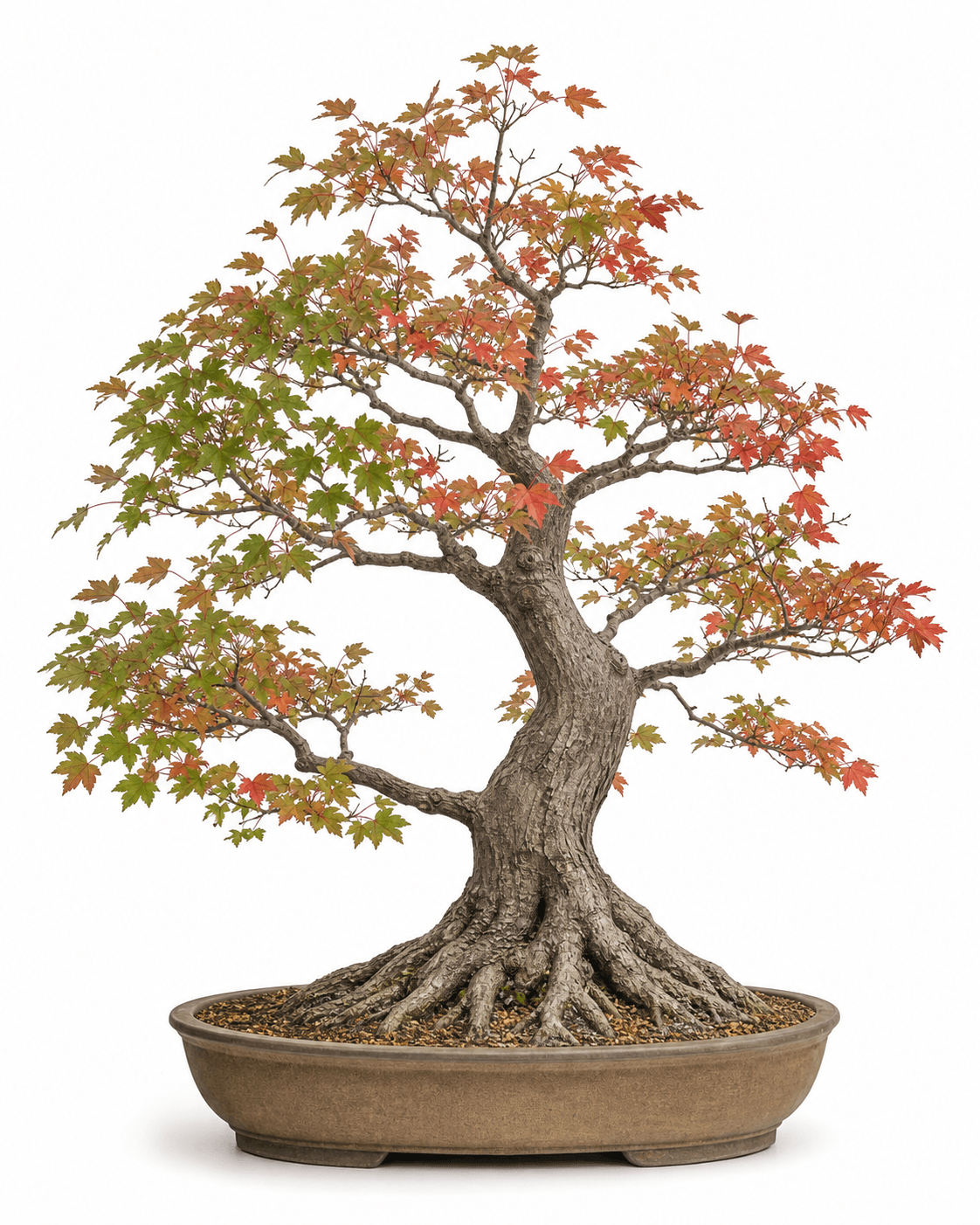
Red maple bonsai is an outdoor deciduous maple for medium and larger designs, with reliable seasonal color, early flowers, and a real need for moisture with oxygen. The leaves, petioles, and spring extension are naturally coarse, so refinement depends on timing, light, branch selection, and years of ramification.
The local Bonsai Mirai distilled corpus has maple-specific and deciduous-method coverage rather than a dedicated Acer rubrum lesson. This guide applies those Mirai maple, deciduous, watering, soil, repotting, wiring, propagation, and design principles to red-maple identity and ecology from Kew, NC State, UMN, USDA Forest Service, and USDA NRCS.
The practical beginner answer is yes for an outdoor grower with space, consistent watering, and patience for a larger native tree. Choose red maple when the goal is a credible North American deciduous image, spring-to-fall observation, and a broadleaf training tree that teaches timing quickly.
Updated June 16, 2026. Written by EntGrove Editorial. Last verified June 16, 2026.
Care fingerprint
Read the species through its shared care pattern.
Repot and structural prune around dormant-to-active transitions; protect new leaves; time refinement work after growth hardens. Use this as the starting point before local conditions and tree strength refine the calendar.
Note: Native North American maple; best for medium and larger bonsai because leaves and internodes need active control.
Read the foliage first
Broadleaf stress usually shows in leaf color, leaf size, wilt, scorch, or delayed hardening before it becomes a branch problem.
Match work to dormancy
Deciduous, evergreen, tropical, succulent, and flowering broadleaf trees recover on different calendars.
Protect fine roots
Root work should preserve enough active fine roots for the tree to rehydrate quickly after the operation.
Care cadence
The calendar starts with the tree's seasonal state.
Placement
Timing: Grow outdoors year-round. Use strong light, air movement, rain exposure when useful, and true winter dormancy, with pot protection during severe freezes and drying wind.
Watch for: Warm indoor storage, winter desiccation, frozen pots in wind, and root damage hidden by a hardy-looking trunk.
UMN ExtensionBonsai Mirai LibraryLight requirement
Timing: Use full sun in mild climates and seasons, then add afternoon shade during severe heat or after root work. Rotate often in spring so all sides receive light.
Watch for: Long internodes in shade, scorched margins in hot wind, weak interior buds, and one-sided growth from a bench position that never changes.
NC State ExtensionBonsai Mirai LibraryWatering
Timing: Water when the upper particles begin to dry while the interior still carries moisture. Saturate the whole root mass, then allow air to return through the soil column.
Watch for: Dry margins, afternoon wilt, sour compacted soil, over-shallow pots, and copying swamp-maple habitat into stagnant bonsai soil.
USDA Forest Service SilvicsBonsai Mirai LibraryFertilizer
Timing: Feed heavily only while building trunk, primary branches, or recovery. Feed moderately in secondary development and lightly after the first flush has spent stored energy in refinement.
Watch for: Long coarse internodes, salts after repotting, strong apex with weak lower branches, and late growth that enters winter soft.
Bonsai Mirai LibraryPruning
Timing: Pinch only strong refined shoots as the central stem becomes visible between paired leaves. For development, let shoots extend, harden, and build strength before cutting back.
Watch for: Using pinching to build primary structure, pruning weak shoots, opposite-bud swelling, and spring structural cuts that bleed or invite dieback.
Bonsai Mirai LibraryPost-flush refinement
Timing: After the spring flush hardens, prune back to useful interior nodes and partially reduce large leaves on strong refinement zones when a second flush is desirable.
Watch for: Full defoliation as routine care, treating every branch the same, cutting weak development branches, and repeating defoliation when heat or water quality already stresses leaves.
Bonsai Mirai LibraryRepotting
Timing: Repot in spring as buds swell and before the canopy demands full water flow. Preserve a functional plate-style maple root pad, clean damaged roots, and tie the tree firmly.
Watch for: Root work after leaf expansion, dry exposed roots, slip-potting without integration, broken-down akadama, and a tree moving in the pot after work.
Bonsai Mirai LibraryWiring
Timing: Wire young hydrated branches while they can still bend. Fall leaf drop is the safer structural window for maples; inspect wire daily in mid to late spring once thickening accelerates.
Watch for: Wire bite, scuffed bark, brittle old wood, bends concentrated at one point, and carrying a branch across the trunk to fill space.
Bonsai Mirai LibraryPest and disease checks
Timing: Inspect during spring flush, humid leaf expansion, and hot midsummer stress. Keep fallen leaves and weak twigs out of the pot and diagnose roots before treating foliage.
Watch for: Aphids, scale, borers, leaf spots, cankers, root rot, yellow foliage from high pH, and dieback that follows stale wet soil.
NC State ExtensionUMN ExtensionUSDA NRCS fact sheetBonsai Mirai LibrarySpecies guide
Apply the species profile before copying another tree's calendar.
At a glance
Red maple is a broadleaf deciduous outdoor maple for larger native-style bonsai.
Acer rubrum belongs in Broadleaf > Deciduous. It is hardy in much of North America, needs outdoor dormancy, grows quickly, carries opposite leaves and buds, flowers before the leaves, sets paired samaras in spring, and can show strong orange-red autumn color. Kew POWONC State ExtensionUMN Extension
The honest limitation is leaf and petiole scale. NC State lists 2 to 6 inch leaves, which pushes red maple toward medium, large, clump, twin-trunk, forest, root-over-rock, and broad-crowned images where the foliage reads naturally. NC State ExtensionBonsai Mirai / Asymmetry
Core care is straightforward: bright outdoor placement, consistent water, acidic to mildly acidic soil chemistry, spring root work, active-season branch management, and winter root protection. Refinement is slower because internodes, opposite buds, and coarse spring flushes need deliberate control. UMN ExtensionBonsai Mirai Library
Wild habitat
Its native range explains the water demand and the design scale.
USDA NRCS gives a broad native range from Florida to the Canadian Maritimes and west to Texas and Minnesota. USDA Forest Service describes red maple across dry ridges, southwest slopes, peat bogs, swamps, and many intermediate sites. USDA NRCS fact sheetUSDA Forest Service Silvics
That range can mislead bonsai growers. A landscape tree can reach deep and lateral water reserves, while a bonsai tree depends on a small root column. Treat red maple as a high-water-mobility deciduous tree that should stay moist but aerobic. USDA Forest Service SilvicsBonsai Mirai Library
For design, the source image is a fast-growing native maple of wet edges, open woods, and broad crowns. It ages more convincingly as a larger deciduous tree with upward branching, seasonal openness, and controlled asymmetry than as a tiny copy of Japanese maple. USDA Forest Service SilvicsBonsai Mirai / Asymmetry
Reading the tree
Separate development, refinement, and recovery before choosing a technique.
A developing red maple should spend energy on trunk, root plate, wound closure, and primary branches. Mirai deciduous method leaves growth intact until it has strengthened the branch, then cuts to usable laterals so the tree keeps bifurcating rather than forming blunt knobs. Bonsai Mirai Library
A refined red maple can use pinching and post-flush pruning, but only when bud push is even and the tree has enough stored strength. Pinching redirects energy from the tip to interior buds; it does not shorten an internode that has already been programmed by prior-season energy. Bonsai Mirai Library
Recovery overrides styling. Winter dieback, yellow leaves, weak uneven buds, sour soil, or fresh root work all call for leaf mass, water-oxygen stability, and restraint. Mirai method assumes health first; technique belongs after the root system can pay for it. Bonsai Mirai LibraryUMN Extension
Pruning
Control opposite buds early and save pinching for refinement.
Red maple has opposite buds and opposite leaves. NC State documents that arrangement, and Mirai maple method treats opposing-bud junctions as swelling risks: keep a main line plus one useful side branch, or remove one side early when a fork would create bar growth. NC State ExtensionBonsai Mirai Library
In primary and secondary development, allow shoots to extend, harden, and feed the branch before cutting back to a lateral. This builds vascular tissue, heals wounds, and creates the future short nodes that refinement can later use. Bonsai Mirai Library
In refinement, pinch strong balanced shoots when the paired leaves can be separated and the central elongating stem is visible. Work strongest areas first, skip weak shoots, and stop when the tree stops responding with interior buds. Bonsai Mirai Library
After the spring flush hardens, prune back to useful interior nodes. If leaves are large and the branch is in refinement, reduce remaining leaf surface rather than stripping the tree. Mirai partial-defoliation method keeps residual leaf surface active while triggering finer growth. Bonsai Mirai Library
Major spring cuts deserve caution on maples because rising sap can reduce productivity and wet spring wounds can invite problems. Favor fall leaf-drop work for structural maple decisions, or wait for the first flush to harden before larger active-season cuts. Bonsai Mirai Library
Roots
Repot as a high-water maple with a plate-style root system.
Mirai separates deciduous roots into broad models, and maples sit with the high-water, plate-base species. The goal is a flat, radial, fine root pad that can move water fast enough to support thin leaves, summer transpiration, and post-flush refinement. Bonsai Mirai Library
Repot in spring as buds swell and before full leaf demand begins. Repot because water no longer penetrates, roots are dense, soil particles have broken down, or the tree is ready for a new container stage. Aesthetic pot changes still need a horticultural reason. Bonsai Mirai Library
Hydrate before the operation, keep exposed roots damp, cut torn roots cleanly, sever circling roots, and tie the tree so it cannot move. A tree that shifts after repotting breaks the new root tips it is trying to form. Bonsai Mirai Library
Avoid pairing severe root reduction with aggressive canopy reduction, full defoliation, or major wiring. After root work, wait for recovery signals: stable water use, firm buds, extension, and leaves that harden normally. Bonsai Mirai Library
Soil and pot
Use a moisture-retentive mineral soil and a pot that supports summer water movement.
Healthy bonsai soil balances water retention, oxygen availability, and structural durability. For deciduous maples, Mirai method often weights the mix toward solid akadama because high water mobility scales the container and rewards fine root division. Bonsai Mirai Library
Red maple also brings a chemistry warning. UMN gives a preferred pH range of 4.5 to 6.5 and warns that pH above 6.5 can create manganese deficiency, chlorotic leaves, stunting, and possible death. Yellow foliage should trigger water, soil, and pH checks before fertilizer escalation. UMN Extension
Pot choice should follow stage. Development trees need room for root growth, trunk work, and heat buffering. Refined trees can move shallower only after the root pad is dense, water enters evenly, and summer foliage stays functional. Bonsai Mirai Library
Pot pairing should be quiet: unglazed or muted earth-toned ovals, soft rectangles, and deeper training containers usually support the native deciduous image better than bright shallow display pots. Autumn color is already the accent. Bonsai Mirai / Asymmetry
Climate
Adapt light, winter protection, and water to your region.
In cold regions, the top may be hardy while the pot remains vulnerable. NC State and UMN give broad landscape hardiness, but bonsai roots sit above ground. Mulch the pot, heel it into a protected bed, or use a cold frame that stays cold enough for dormancy. NC State ExtensionUMN ExtensionBonsai Mirai Library
In hot dry regions, afternoon shade and water quality matter more than forcing all-day sun. Mirai maple method ties crisp leaves to environmental stress plus mineral-heavy water, and UMN warns that high pH can block manganese uptake. Bonsai Mirai LibraryUMN Extension
In humid regions, keep air moving and avoid dense unthinned canopies. Leaf spot, root rot, canker, and weak interior twigging all become easier to miss when a coarse spring flush forms a green shell. NC State ExtensionBonsai Mirai Library
Native-range sourcing deserves attention. Red maple is variable across its range; material from a local or similar climate usually gives a safer dormancy, heat, and hardiness profile than a cultivar selected for a different landscape region. USDA Forest Service SilvicsUMN Extension
Pests and diseases
Most serious trouble starts with root stress, wounds, or dense foliage.
NC State lists aphids, borers, caterpillars, leafhoppers, scale, fungal leaf spots, cankers, stem rots, root rots, tar spot, verticillium wilt, and leaf scorch among red-maple concerns. In bonsai, stress and density make these easier to miss. NC State Extension
USDA NRCS says few pests are usually serious but flags Asian longhorned beetle as a major threat to maples. The bonsai-level lesson is quarantine, inspect trunks and exit holes, and avoid moving suspect nursery or collected material between regions. USDA NRCS fact sheet
Root problems usually precede canopy symptoms. Mirai maple and trident-maple method links fine tertiary dieback to root-zone water and oxygen imbalance, often involving soft root-tip pathogens such as Phytophthora or Pythium. Bonsai Mirai Library
Wounds deserve clean timing and collar discipline. USDA Forest Service notes red maple is susceptible to stem and butt rots after fire or logging injuries, while Mirai wound-care method warns that cutting past the collar can cause dieback into the trunk. USDA Forest Service SilvicsBonsai Mirai Library
Wiring
Wire young hydrated branches, then remove wire before spring thickening bites.
Maple wire work belongs on hydrated, committed branches. Mirai structural-wiring method uses a 55 to 60 degree coil angle, continuous contact, and bends distributed along the branch rather than concentrated at one point. Bonsai Mirai Library
Thin-barked maples mark quickly. Mirai maple-secondary work recommends fall leaf-drop bending for maples when structural movement is required, and warns that wire must be watched closely once spring thickening begins. Bonsai Mirai Library
Use wire to establish primary and secondary direction, then let pruning build most tertiary structure. Clip-and-grow is slower, but it avoids bark scars and respects the upward branch habit of broadleaf deciduous trees. Bonsai Mirai LibraryBonsai Mirai / Asymmetry
If a branch must bend, roll it along its long axis as pressure is applied. Mirai brittle-deciduous method uses rotation to distribute force and reduce snapping, with callus paste and compression reserved for partial breaks. Bonsai Mirai Library
Propagation
Use seed, air layers, and selected cuttings with clear expectations.
NC State lists root cutting, seed, and stem cutting as propagation strategies, while USDA NRCS describes direct seeding and transplanting bare-root or balled-and-burlapped stock. For bonsai, every route should preserve a clear record of origin and traits. NC State ExtensionUSDA NRCS fact sheet
Seedlings are useful for forests, clumps, root work, and native-local selection. They vary in leaf size, color, vigor, and branching, so grow many and keep only the individuals with compact nodes, strong roots, and usable movement. USDA NRCS fact sheetBonsai Mirai / Asymmetry
Air layering can create a better base above poor nursery roots or capture a usable trunk section. Mirai air-layer method favors even sphagnum thickness around the wound so roots form radially rather than on one side. Bonsai Mirai Library
Cuttings are possible but should be treated as experimental unless the source tree is worth preserving. Mirai propagation method emphasizes wood stage, humidity with oxygen, pre-opened planting holes, and avoiding overwatering before roots form. Bonsai Mirai Library
Grafting is mainly useful for roots, branches, or cultivar preservation. A grafted landscape cultivar can still make bonsai, but the graft union must be low, clean, and compatible with the future trunk line. UMN ExtensionBonsai Mirai Library
Buying
Buy for base, internodes, climate fit, and local identity.
Select deciduous stock while out of leaf when possible. Mirai nursery-selection method starts by exposing the base, reading the trunk and branches, and choosing material whose structure already expresses the species in miniature. Bonsai Mirai Library
Look for radial roots, a trunk base that matches the intended size, low usable branches, short internodes, healthy buds, clean bark, and soil that can be transitioned. A bright autumn cultivar with a poor base is still poor bonsai material. Bonsai Mirai LibraryUMN Extension
Verify the label before applying this page. Swamp maple, scarlet maple, soft maple, Carolina maple, Florida maple, Drummond red maple, and water maple can all refer to Acer rubrum in source literature, while silver maple, sugar maple, bigleaf maple, and Japanese maple need separate care records. NC State ExtensionUSDA Forest Service SilvicsUSDA NRCS fact sheet
For collected native material, prioritize legality, permission, local ecology, and aftercare. Retain fine roots, reduce operations to tree strength, and avoid taking weak wetland or roadside seedlings whose roots cannot be recovered cleanly. USDA NRCS fact sheetBonsai Mirai Library
Troubleshooting
Diagnose water, pH, light, roots, timing, and scale before adding more technique.
Yellow leaves with greenish veins can point to alkaline substrate or water. UMN warns that pH above 6.5 can cause manganese deficiency, chlorosis, stunting, and possible death, so test pH before treating the symptom as simple hunger. UMN Extension
Crispy margins usually point to heat, wind, low humidity, mineral-heavy water, or a root mass that cannot keep up with leaf demand. Move to afternoon shade, stabilize watering, and check whether the soil still accepts water evenly. Bonsai Mirai LibraryUMN Extension
Weak interior buds often come from shade, dense outer foliage, over-refinement, or missed post-flush pruning. Open the canopy gradually and leave weak zones enough leaf mass to rebuild before another reduction. Bonsai Mirai Library
Bleeding cuts indicate timing pressure. Shift large structural cuts to the leaf-drop window or after first-flush hardening, preserve the collar, and seal important wounds cleanly. Bonsai Mirai Library
Wire scars come from fast spring thickening. Remove wire at the first sign of tightness, especially after leaf-out, and rebuild missed movement with pruning or a new shoot. Bonsai Mirai Library
Tiny-tree disappointment is often a design problem. A healthy red maple can still look coarse if the pot, trunk size, and silhouette are too small for 2 to 6 inch leaves. NC State ExtensionBonsai Mirai / Asymmetry
Design
Design red maple as a native broadleaf tree with room for leaves.
Start with base, trunk line, defining branch, and apex. Mirai design method uses those elements to choose harmony, tension, or dynamic movement. Red maple usually wants a broadleaf-deciduous image: upward branch shoulders, fine outer twigs, and a crown that reads through winter. Bonsai Mirai / AsymmetryBonsai Mirai Library
Avoid conifer-style pads. Mirai trident and maple method emphasizes upward and outward deciduous branch language, with exterior length and interior compactness. Downward primary branches can make a maple read like a pine with large leaves. Bonsai Mirai Library
Leaf size should shape style decisions from the start. Forests, clumps, rafts, larger informal uprights, and root-over-rock compositions can absorb coarse foliage while still showing seasonal character. Very small bonsai expose every long petiole. NC State ExtensionBonsai Mirai / Asymmetry
Deadwood should stay restrained. Broadleaf deciduous wounds usually express age through hollows, collars, scars, bark, and healed transitions rather than durable white jin or shari. Bonsai Mirai Library
Cultivars
Cultivars change color, habit, seed, and regional fit more than bonsai scale.
UMN lists landscape cultivars including Autumn Radiance, Autumn Spire, Brandywine, Northwood, Red Rocket, Red Sunset, and Scarlet Jewel. Many were selected for cold tolerance, fall color, form, or seed behavior rather than small leaves. UMN Extension
Brandywine is a seedless cultivar in UMN material, which can reduce samara cleanup. Red Sunset and other upright landscape forms may offer color or habit, but the bonsai decision still starts with base, internodes, branch placement, and graft quality. UMN ExtensionBonsai Mirai Library
Regional forms also matter. USDA Forest Service and USDA NRCS record names such as Florida maple, Drummond red maple, water maple, and swamp maple. These labels can reflect provenance, local adaptation, or older usage, so keep collection records precise. USDA Forest Service SilvicsUSDA NRCS fact sheet
If a cultivar or local seedling has smaller leaves, shorter internodes, or unusually good fall color, propagate it before hard styling. Cuttings, layers, or grafts can preserve the trait while the parent tree remains in training. NC State ExtensionBonsai Mirai Library
History
Red maple is common, native, and underused as bonsai because scale demands honesty.
Red maple is one of the familiar native maples of eastern North America, valued in landscapes for shade, fast establishment, early flowers, and autumn color. USDA NRCS also notes wildlife value and the use of red-maple cultivars in restoration and landscape settings. USDA NRCS fact sheetUMN Extension
Common material can still become serious bonsai when identity is respected. Mirai deciduous selection method rewards trees with a visible base, species-iconic branching, existing structural branch hierarchy, and enough scale to carry the leaf. Bonsai Mirai Library
The exhibition standard should be seasonal restraint: a credible winter branch structure, clean wounds, a functioning root pad, controlled spring extension, and autumn color on a tree large enough for the foliage. The species should read as red maple first. Bonsai Mirai / AsymmetryNC State Extension
Species questions
Answer the beginner questions before styling.
Is red maple a good beginner bonsai?
Yes, for an outdoor beginner who accepts a medium or larger design, consistent summer watering, and years of branch refinement. It is a poor fit for indoor culture or tiny-leaf expectations.
Can red maple bonsai live indoors?
No as normal culture. Red maple needs outdoor light, air movement, seasonal leaf drop, and winter dormancy. Indoor display should be brief.
How much sun does red maple bonsai need?
Use full sun to partial shade. NC State defines full sun as 6 or more hours and partial shade as 2 to 6 hours; use afternoon shade in hot regions or after root work.
How often should I water red maple bonsai?
Water when the upper soil begins to dry while the interior still has moisture. Saturate the whole pot, then let oxygen return through the substrate.
When should I repot red maple bonsai?
Repot in spring as buds swell and before full leaf demand begins. Inspect every 2 to 4 years, using root density, drainage, and soil breakdown to set the actual interval.
When should I prune red maple bonsai?
Use active-season shoot control after growth hardens for development and refinement. Put major structural maple work in the leaf-drop window or after first-flush hardening.
Can I wire red maple bonsai?
Yes. Wire young hydrated branches, use clean 55 to 60 degree coils, and check frequently once spring thickening begins. Pruning should do much of the fine design work.
Why are my red maple bonsai leaves yellow?
Check water, roots, pests, light, and pH. UMN warns that pH above 6.5 can cause manganese deficiency, chlorotic leaves, stunting, and possible death.
Can red maple leaves be reduced?
They can be reduced somewhat through light, ramification, careful feeding, post-flush pruning, and partial defoliation on strong refined zones. The natural 2 to 6 inch leaf size still favors larger bonsai.
What soil is best for red maple bonsai?
Use a moisture-retentive mineral deciduous mix, often akadama-heavy, that drains cleanly and stays acidic to mildly acidic. Avoid stale organic cores and alkaline water problems.
Is red maple the same as swamp maple?
Usually yes. NC State and USDA sources use swamp maple, scarlet maple, soft maple, Carolina maple, Florida maple, Drummond red maple, and water maple as labels associated with Acer rubrum.
Sources
Species advice needs source discipline.
Next decisions
Plan the operation before copying the calendar.
A good care note for Red maple records the tree's stage, the work done, and the aftercare used. That record matters more than a month-name rule.
Related species
Compare nearby trees before transferring advice.
Japanese maple
Acer palmatum
Trident maple
Acer buergerianum
Amur maple
Acer tataricum subsp. ginnala
Field maple
Acer campestre
Korean hornbeam
Carpinus turczaninovii