
Species guide
Rubber Fig Bonsai Care
Ficus elastica
Rubber fig bonsai, Ficus elastica, is a large-leaf tropical fig that can be trained as bonsai only when the design accepts its scale. It is better as a medium to large indoor tropical, banyan-style trunk, clump, or experimental houseplant conversion than as a tiny refined tree.
Treat rubber fig as Broadleaf > Tropical in the EntGrove taxonomy. NC State describes it as a broadleaf evergreen tree in Moraceae, grown indoors for glossy foot-long leaves, kept to roughly 2 to 10 feet with training, and hardy in USDA Zones 9a to 12b.
The local Bonsai Mirai corpus has no dedicated Ficus elastica transcript, so this guide transfers Ficus and tropical broadleaf methods transparently. The practical answer is bright stable warmth, strong root oxygen, restraint with leaf work, warm-season repotting, and a design that uses large leaves rather than fighting them.
Updated July 4, 2026. Written by EntGrove Editorial. Last verified July 4, 2026.
Care fingerprint
Read the species through its shared care pattern.
Treat indoor culture as a light-management problem first; prune and repot when the tree is actively growing and warm enough to recover. Use this as the starting point before local conditions and tree strength refine the calendar.
Note: Large-leaf tropical Ficus best treated as scale-aware houseplant-to-bonsai material, not as a tiny refined ficus.
Read the foliage first
Broadleaf stress usually shows in leaf color, leaf size, wilt, scorch, or delayed hardening before it becomes a branch problem.
Match work to dormancy
Deciduous, evergreen, tropical, succulent, and flowering broadleaf trees recover on different calendars.
Protect fine roots
Root work should preserve enough active fine roots for the tree to rehydrate quickly after the operation.
Care cadence
The calendar starts with the tree's seasonal state.
Placement
Timing: Keep the tree in bright stable warmth. Move outdoors only after nights stay near 60 F / 16 C or warmer, and acclimate the existing leaves gradually.
Watch for: Cold windows, air-conditioning drafts, heater blasts, sudden afternoon sun, and the plant being rotated or moved every few days.
Bonsai Mirai LibraryClemson HGICNC State ExtensionWatering
Timing: Water thoroughly when the upper soil is drying and the root ball still has slight internal moisture. Reduce water in cool rooms, low light, or after leaf loss.
Watch for: Wet saucers, yellowing lower leaves, sour soil, dry shrinkage at the pot edge, and a heavy cachepot hiding drainage problems.
Clemson HGICNC State ExtensionBonsai Mirai LibraryFertilizer
Timing: Feed during active spring and summer growth. Clemson suggests regular soluble fertilizer during active growth, with less fertilizer for lower-light plants.
Watch for: Fertilizing a cold wet tree, coarse weak extension in low light, salt buildup, and pushing new growth before the root system is stable.
Clemson HGICBonsai Mirai LibraryPruning
Timing: Prune during warm active growth, preferably after the tree is extending. Use main-branch pruning to force a bushier structure, then let shoots regain strength.
Watch for: Latex flow, removing too much leaf mass at once, cutting back before useful buds exist, and repeated tip pruning that leaves no branch options.
Clemson HGICBonsai Mirai LibraryLeaf work
Timing: Use selective leaf reduction on vigorous trees. Full defoliation belongs only on mature ficus in strong tropical conditions, and rubber fig usually benefits more from design scale than repeated leaf removal.
Watch for: A leafless tree watered like a full canopy, cold nights after leaf work, and large leaves that are actually a low-light symptom.
Bonsai Mirai LibraryRepotting
Timing: Repot in warm active growth when nights are near 60 F / 16 C or warmer. Late winter or early spring houseplant repotting advice should be adapted to local indoor warmth.
Watch for: Dense nursery peat, slow percolation, circling roots, top-heavy instability, and bare-rooting a full leafy tree in cool aftercare.
Bonsai Mirai LibraryClemson HGICWiring
Timing: Wire only branches thick enough to justify it, then inspect often during active growth. Use clip-and-grow for fine branch placement.
Watch for: Latex during bending, wire bite on smooth bark, branch cracks, and forcing stiff old stems instead of growing a replacement shoot.
Bonsai Mirai LibraryPest checks
Timing: Inspect year-round indoors, especially in winter and after outdoor summer growth. Clean dusty leaves so mites and scale are visible.
Watch for: Mealybugs, scale, spider mites, thrips, sticky residue, dull leaves, and pests building in warm still rooms.
NC State ExtensionClemson HGICSpecies guide
Apply the species profile before copying another tree's calendar.
At a glance
Rubber fig is a large-leaf tropical ficus for scale-aware bonsai.
Ficus elastica is a broadleaf evergreen fig with thick glossy leaves, milky latex, aerial roots, and the ability to become a large tree in frost-free ground. NC State notes wild trees can reach 100 feet, while indoor plants are usually kept to 2 to 10 feet with support or pruning. NC State Extension
The bonsai limitation is leaf scale. NC State lists leaves to 17 inches long and 6 inches wide, and Clemson describes common indoor leaves around 8 to 12 inches long. A credible bonsai image needs a larger frame, a strong trunk, or a banyan-style composition that can carry that foliage. NC State ExtensionClemson HGIC
The care pattern is tropical ficus: strong light, warm roots, thorough watering with oxygen return, and major work only when the tree can replace roots and leaves. This profile uses Mirai ficus method at genus level because the local corpus has no rubber-fig-specific transcript. Bonsai Mirai LibraryBonsai Mirai / Asymmetry
Wild habit
Its wild form explains the aerial roots, heavy crown, and large-tree bias.
FNA describes Ficus elastica as an evergreen tree, epiphytic when young, with abundant aerial roots, gray bark, large leathery leaves, paired figs, and disturbed-site habitat at low elevations in the introduced flora. Flora of North America
NC State gives the broader origin as Southeast Asia from Nepal to China and western Malesia and notes aerial roots plus an initially epiphytic habit. Those traits point toward banyan, clump, and exposed-root designs more than small upright miniature trees. NC State ExtensionBonsai Mirai / Asymmetry
For care, treat the pot as an artificial tropical root pocket. The plant likes warmth and humidity, but a shallow container still needs drainage and oxygen. Water moves through the system, then air returns before the next full watering. Clemson HGICBonsai Mirai Library
Reading the tree
Judge the tree by leaf quality, drying rhythm, and branch options.
A healthy rubber fig has firm glossy leaves, active tips, and a pot that dries predictably. Weak light makes long internodes and oversized leaves worse, while cold wet roots can drop leaves even when the canopy looks green. Clemson HGICNC State ExtensionBonsai Mirai Library
Development comes first. Build a trunk, base, primary branches, and a reliable root system before asking for short internodes or smaller leaves. Mirai ficus guidance ties wound healing and back budding to foliar mass and active warm growth. Bonsai Mirai Library
Refinement is realistic only on material with enough scale. A 4-inch pot and 10-inch leaves will always look mismatched. A larger pot, lower trunk, aerial roots, and broad canopy can turn the same leaf size into a coherent tropical image. Bonsai Mirai LibraryBonsai Mirai / Asymmetry
Pruning
Use pruning to build branching, then let scale decide the image.
Clemson says rubber plants can be pruned in spring to rejuvenate or reduce size, and NC State notes pruning main branches encourages a bushier habit. In bonsai, make those reductions during warm active growth so new buds can replace the lost foliage. Clemson HGICNC State ExtensionBonsai Mirai Library
Avoid constant tip clipping. Let shoots extend enough to thicken and feed the branch, then cut back to a useful node. Mirai ficus method uses active leaves to drive wound closure, branch division, and back budding. Bonsai Mirai Library
Leaf reduction should be selective. On ficus, Mirai leaves the petiole when cutting a leaf blade and limits full defoliation to mature trees in strong conditions. Rubber fig leaves are so large that repeated defoliation can spend energy without making the tree look small enough. Bonsai Mirai Library
Latex is normal after cuts. Mist fresh ficus cuts with water to slow bleeding, keep cuts clean, and avoid pruning more because latex appears. A clean cut and warm recovery matter more than repeated wound handling. Bonsai Mirai Library
Roots
Repot for drainage, stability, and root oxygen.
Mirai tropical guidance puts ficus repotting in warm active growth, usually when nights are near 60 F / 16 C or warmer. Clemson houseplant guidance says late winter or early spring can be used when needed, but bonsai root work still needs warmth for recovery. Bonsai Mirai LibraryClemson HGIC
Rubber fig often starts as a top-heavy houseplant in dense organic mix. Repot because the plant is unstable, drainage has slowed, the roots circle hard, or the soil stays wet longer than the foliage can use it. Clemson HGICNC State Extension
Preserve some working root mass on a leafy tree. Mirai ficus method avoids pairing severe root reduction with severe canopy reduction outside truly tropical recovery conditions. The leaves pull water and power new root growth. Bonsai Mirai Library
After repotting, tie the plant firmly, water through the whole soil column, keep it warm and bright, and hold strong fertilizer until fresh growth confirms root activity. Bonsai Mirai LibraryClemson HGIC
Soil and pot
Choose a pot that can hold a large tropical image.
A practical bonsai transition mix is equal parts akadama, pumice, and lava for warm bright culture. If the room is cool, humid, or low light, increase pumice or lava so water leaves and oxygen returns faster. Bonsai Mirai Library
Clemson emphasizes a well-drained mix and drainage holes, with saucers emptied after watering. That houseplant rule becomes more important in a shallow bonsai container, where stale water can quickly remove oxygen from the roots. Clemson HGIC
Use a training pot with enough volume while building the trunk and branch framework. A shallow display container belongs later, after the root system is dense, the top is reduced, and the leaf scale fits the silhouette. Bonsai Mirai LibraryBonsai Mirai / Asymmetry
Glazed containers usually suit rubber fig better than rugged unglazed mountain pots. Muted green, cream, warm gray, or dark earth glazes can support the glossy foliage and tropical houseplant history. Bonsai Mirai / Asymmetry
Climate
Indoor survival is possible; bonsai growth needs warmth.
NC State lists Zones 9a-12b for landscape hardiness and Clemson warns against temperatures below 55 F / 13 C. In a pot, protect earlier because roots, young tips, and recently worked branches have less buffer. NC State ExtensionClemson HGIC
Mirai tropical guidance says ficus growth is strongest when nights stay above about 18 C and slows sharply near 12-13 C. Use that as the work filter: warm growth for pruning, wiring, repotting, propagation, and leaf work. Bonsai Mirai Library
In cold-winter regions, use a bright window plus grow light, warm root zone, and reduced winter watering. Keep the tree away from cold glass and heat vents, then move it outdoors only after nights stabilize. Bonsai Mirai LibraryClemson HGIC
In frost-free climates, the challenge shifts to scale, water, and sun acclimation. A rubber fig can grow quickly outdoors, so plan pruning and wiring before branches thicken beyond the design. NC State ExtensionBonsai Mirai Library
Pests and disease
Most problems start with water, cold, weak light, or indoor pests.
NC State lists mealybugs, banded greenhouse thrips, Cuban laurel thrips, fern scale, and spider mites as problems. Clemson also flags mealybugs and mites as common indoor issues. NC State ExtensionClemson HGIC
Inspect leaf undersides, stipule bases, branch forks, and the trunk base. Sticky residue, cottony clusters, bronzed leaves, webbing, and raised brown shells all deserve a close look before pruning or fertilizing. NC State ExtensionClemson HGIC
Root rot follows poor drainage or overly frequent watering. Clemson names root rot as a problem when the soil mix drains slowly or watering is too frequent; NC State links overwatering, cold drafts, and temperature drops to leaf loss. Clemson HGICNC State Extension
Milky sap can irritate skin and is a pet concern. NC State marks the plant as a problem for cats, dogs, and horses, and Clemson warns that the sticky white sap may irritate skin or the stomach if eaten. NC State ExtensionClemson HGIC
Wiring
Wire structure early and check smooth bark often.
Mirai ficus guidance favors aluminum wire close to the diameter of the branch being shaped because fast tropical swelling can make small wire bite before it holds. Rubber fig branches should be checked often during warm growth. Bonsai Mirai Library
Use wiring for young structural branches, trunk-support decisions, and branch plane. Use clip-and-grow for fine branching because large leaves and thick petioles will hide delicate twig wiring anyway. Bonsai Mirai LibraryBonsai Mirai / Asymmetry
Latex during a bend is the stop signal. Mirai treats latex appearing during bending as evidence that the branch is at its structural limit. Back off and rebuild the line with future growth. Bonsai Mirai Library
Do not chase tiny branch movement on a tree whose leaves need a broad frame. Set the primary lines, let the tree grow, and return with pruning once the structure has energy. Bonsai Mirai LibraryBonsai Mirai / Asymmetry
Propagation
Cuttings and air layers are useful, especially for oversized houseplants.
Clemson lists stem cuttings, tip cuttings, and air layering for rubber plant propagation. NC State lists layering, root cutting, and seed, although seed is rarely practical indoors because ficus pollination depends on specific wasps. Clemson HGICNC State ExtensionFlora of North America
Mirai ficus propagation favors cuttings because latex-bearing ficus root readily in warm humid conditions. Use clean cuts, airy media such as perlite or a gritty cutting mix, and enough warmth to prevent rot. Bonsai Mirai Library
Air layering is often the best bonsai reset on a tall rubber plant. Layer above an ugly bare trunk, create a new root base closer to the canopy, and use the separated top as a better-scaled project. Clemson HGICBonsai Mirai Library
Grafting can add roots or branches, but rubber fig usually offers easier routes: prune for low buds, air-layer a better trunk section, or restart with cuttings from compact growth. Bonsai Mirai Library
Buying
Buy for trunk potential, short internodes, and clean roots.
Most rubber fig bonsai starts as a houseplant. Look for a visible base, low branch options, active tips, short internodes, smaller leaves for the cultivar, and a pot with drainage you can inspect. NC State ExtensionClemson HGIC
Avoid plants with a buried trunk, no lower buds, sticky pest residue, scale on the midrib, sour soil, water trapped in a decorative cachepot, or severe lean from weak indoor light. Clemson HGICNC State Extension
Variegated and dark-leaved cultivars are attractive, but leaf color can come with slower growth or higher light demands. Buy the cultivar only after checking whether the structure supports bonsai work. NC State ExtensionClemson HGIC
For a first ficus bonsai, Tigerbark, Ficus microcarpa, willow-leaf ficus, or mistletoe fig is usually easier. Rubber fig is worth choosing when the large tropical character is the goal. Bonsai Mirai LibraryNC State Extension
Troubleshooting
Start with light, warmth, water, and scale.
Symptom: lower leaves yellow and drop. Likely causes: overwatering, cold drafts, sudden temperature drops, or normal older-leaf shedding. Fix: check drainage, warm the root zone, stabilize placement, and water only after oxygen returns. NC State ExtensionClemson HGIC
Symptom: very large soft leaves and long internodes. Likely causes: weak light, heavy fertilizer in low light, or development growth left unchecked. Fix: increase light gradually, reduce feeding intensity, and prune after the shoot hardens. Bonsai Mirai LibraryClemson HGIC
Symptom: brown edges after moving outdoors. Likely causes: sudden sun, dry wind, or a root system that cannot keep up. Fix: move to bright shade, water thoroughly, and acclimate over several days. Bonsai Mirai LibraryClemson HGIC
Symptom: sticky leaves, webbing, cottony pockets, or raised shells. Likely causes: scale, mealybugs, mites, or thrips. Fix: isolate the plant, identify the pest, clean leaves, prune dense pockets, and correct weak light or wet soil. NC State ExtensionClemson HGIC
Symptom: branch cracks or latex appears while bending. Likely cause: the bend exceeded the branch limit. Fix: stop bending, support the branch, and rebuild the line with pruning or a younger replacement shoot. Bonsai Mirai Library
Symptom: the tree never looks like bonsai. Likely cause: the image is too small for the foliage. Fix: grow a larger frame, air-layer a better base, choose a banyan or clump design, or switch to a smaller-leaf ficus. Bonsai Mirai / AsymmetryNC State Extension
Design
Lean into tropical mass instead of forcing miniature refinement.
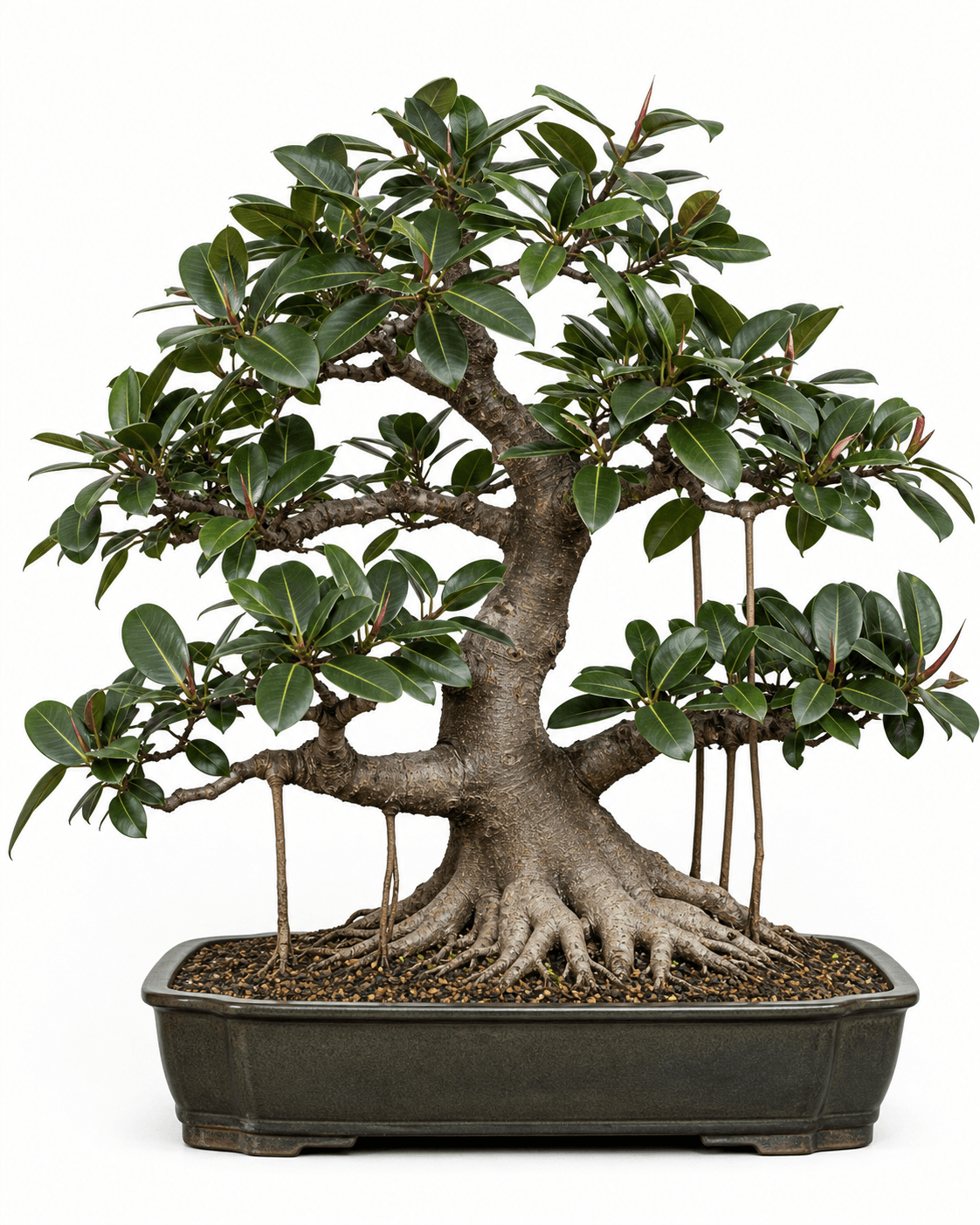
Begin with base, trunk movement, canopy width, and leaf scale. A rubber fig with a broad trunk and aerial roots can look powerful, while the same plant in a tiny pot will look like a houseplant cutting. Bonsai Mirai / AsymmetryNC State Extension
Banyan logic suits the species. Mirai ficus design treats banyan as a width-to-height relationship, with aerial roots reading as vertical support lines and branches spreading broadly above them. Bonsai Mirai Library
Root-over-rock and exposed-root designs can work if roots are allowed to grip and thicken undisturbed. Mirai cautions root-over-rock ficus growers to leave roots alone for years so adhesion develops. Bonsai Mirai Library
A good rubber fig bonsai can stay quiet: a low heavy trunk, a broad rounded canopy, a few aerial roots, and clean glossy leaves. The design reads as tropical architecture rather than tiny deciduous ramification. Bonsai Mirai / Asymmetry
Forms
Cultivar choice changes leaf color, vigor, and usable scale.
NC State lists Abdijan, Belize, Burgundy, Decora, Doescheri, Melany, Red Ruby, Robusta, Tineke, Tricolor, Variegata, and Yellow Gem. Clemson lists Decora, Doescheri, Foliis Aureo-marginata, Robusta, Rubra, and Tricolor. NC State ExtensionClemson HGIC
Robusta and Decora are common strong green forms. Burgundy, Rubra, and Abdijan bring darker leaves. Tineke, Tricolor, Belize, Variegata, and Yellow Gem are variegated or brightly marked and usually need stronger light to stay clean. NC State ExtensionClemson HGIC
Melany is especially worth inspecting for bonsai because NC State describes it as dense, smaller-leaved, and bronze-green. The plant still needs scale-aware design, but compact growth is a better starting point. NC State Extension
Do not confuse rubber fig with mistletoe rubber plant, Ficus deltoidea, or with Ficus microcarpa retail ficus. The care group overlaps, but leaf size, growth rate, fruiting habit, and design scale differ. NC State Extension
History
Its history is houseplant, rubber source, and living-root architecture.
The species name points to latex. NC State notes that the milky sap was once used to produce rubber, and Clemson warns that the sticky white sap can irritate skin or the stomach if eaten. NC State ExtensionClemson HGIC
FNA records Ficus elastica as published in 1819 by Roxburgh ex Hornemann, with the common name India rubber plant. Its presence in the North American flora is introduced rather than native. Flora of North America
As bonsai, rubber fig is more niche than Ficus microcarpa, Tigerbark, willow-leaf ficus, or Benjamin fig because the leaf scale is large. Its best examples usually borrow from tropical banyan, houseplant conversion, and root architecture rather than classic small-tree miniaturization. Bonsai Mirai LibraryBonsai Mirai / Asymmetry
Records matter. Track light, winter placement, pruning dates, repotting, pest checks, and leaf response because rubber fig changes slowly indoors and quickly outdoors. The pattern tells you when the tree is strong enough for the next operation. Bonsai Mirai Library
Species questions
Answer the beginner questions before styling.
Can Ficus elastica be a bonsai?
Yes, but it needs a scale-aware design. Rubber fig has very large leaves, so it is better for medium to large tropical bonsai, banyan-style work, clumps, exposed roots, or houseplant conversion projects than for tiny refined bonsai.
Is rubber fig a good indoor bonsai?
It can live indoors with bright stable light, warmth, drainage, and careful watering. It is easier as a houseplant than as refined bonsai because leaf scale and branching take time to control.
How often should I water rubber fig bonsai?
Water when the upper soil begins to dry and the root ball still holds slight moisture. Empty saucers, avoid waterlogged soil, and reduce watering in cool or low-light winter rooms.
When should I repot rubber fig bonsai?
Repot during warm active growth, ideally when nights are near 60 F / 16 C or warmer. Repot for poor drainage, compact soil, circling roots, instability, or a design change.
Can I defoliate Ficus elastica?
Use selective leaf reduction rather than routine full defoliation. Mirai reserves full ficus defoliation for mature trees in strong conditions, and rubber fig usually needs design scale more than repeated leaf removal.
Why is my rubber fig dropping leaves?
Common causes are overwatering, cold drafts, sudden temperature drops, weak light, or a recent move. Stabilize placement, improve drainage, and water by soil condition rather than schedule.
What pests affect rubber fig bonsai?
Watch for mealybugs, scale, spider mites, and thrips. Check leaf undersides, midribs, branch forks, and the trunk base, especially on indoor trees in winter.
Can rubber fig grow aerial roots?
Yes. NC State and FNA describe aerial roots, and Mirai ficus method uses humidity and warmth to support aerial-root development. Most indoor homes need added humidity for reliable aerial roots.
Which rubber plant cultivar is best for bonsai?
Choose the compact plant with the shortest internodes and healthiest base rather than the rarest color. Melany is worth inspecting for denser, smaller growth, while variegated forms need stronger light.
Is rubber fig safe for pets?
NC State flags Ficus elastica as a problem plant for cats, dogs, and horses, and Clemson warns that the sap can irritate skin or the stomach if eaten. Keep pets away from the plant and pruning waste.
Sources
Species advice needs source discipline.
Next decisions
Plan the operation before copying the calendar.
A good care note for Rubber fig records the tree's stage, the work done, and the aftercare used. That record matters more than a month-name rule.
Related species
Compare nearby trees before transferring advice.
Ficus retusa / Indian laurel
Ficus microcarpa
Tigerbark ficus
Ficus microcarpa 'Tigerbark'
Willow-leaf ficus
Ficus salicaria
Benjamin fig
Ficus benjamina
Ginseng ficus
Ficus microcarpa 'Ginseng'