
Species guide
Stewartia Bonsai Care
Stewartia monadelpha, Stewartia pseudocamellia
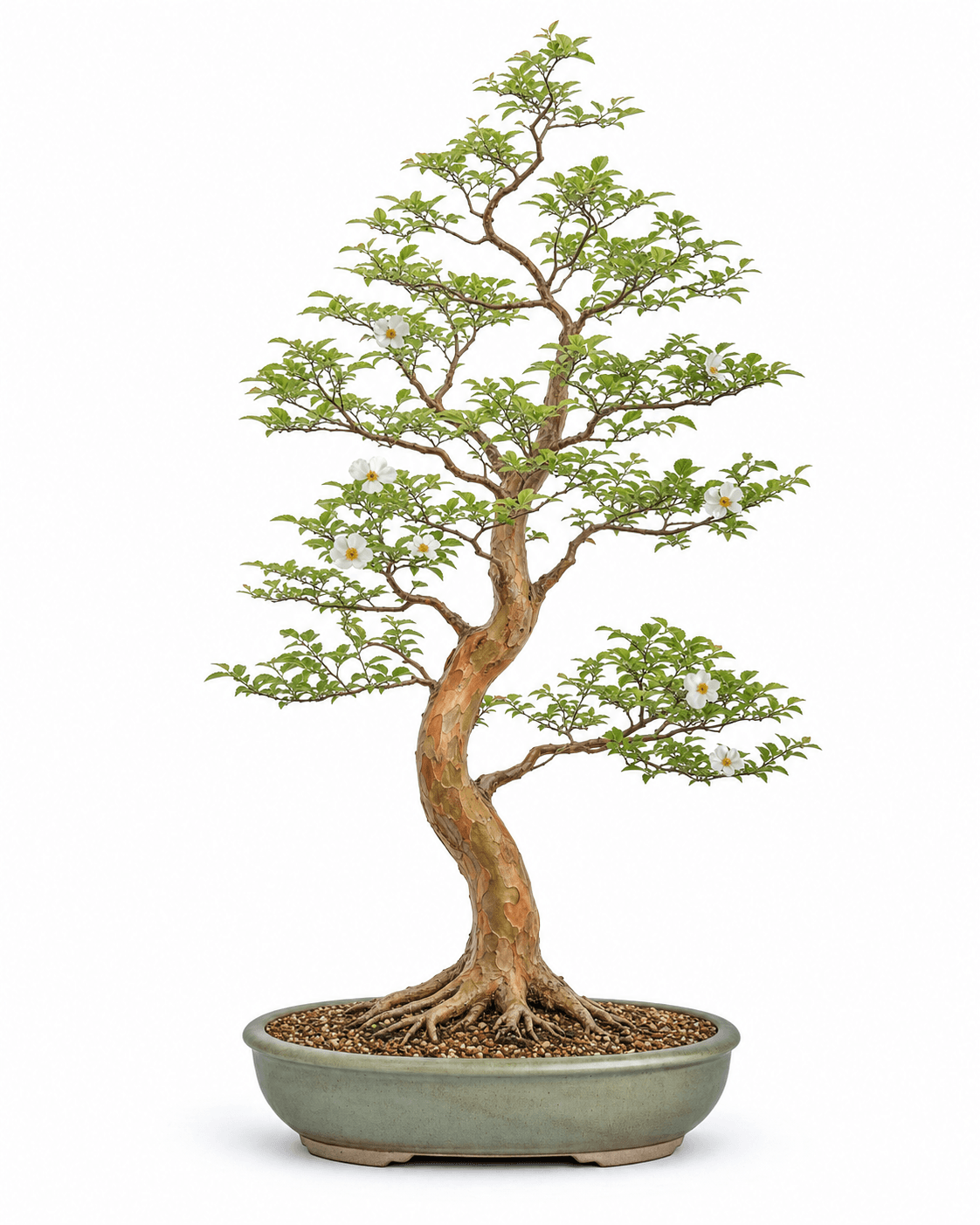
Stewartia bonsai are outdoor deciduous trees for growers who can keep a cool, evenly moist, well-aerated root system and protect smooth bark from scars. The reward is a refined tree with summer flowers, clean branching, autumn color, and bark that becomes a main design feature.
Use this page for confirmed Stewartia pseudocamellia and Stewartia monadelpha material. Kew accepts both names in Theaceae; S. pseudocamellia is native to South Korea and central to southern Japan, while S. monadelpha is native to south-central and southern Japan.
The care priority is water with oxygen. Mirai treats Stewartia as a water-loving, cool-forest deciduous tree, so drought, hot afternoon exposure, stale wet nursery soil, and aggressive first-year root work are the usual failure points.
Updated June 18, 2026. Written by EntGrove Editorial. Last verified June 18, 2026.
Care fingerprint
Read the species through its shared care pattern.
Repot and structural prune around dormant-to-active transitions; protect new leaves; time refinement work after growth hardens. Use this as the starting point before local conditions and tree strength refine the calendar.
Note: This parent page covers the two Stewartia species most often named in bonsai sources. Verify whether material is S. pseudocamellia or S. monadelpha before applying hardiness, heat, drought, flower-size, or bark-color details.
Read the foliage first
Broadleaf stress usually shows in leaf color, leaf size, wilt, scorch, or delayed hardening before it becomes a branch problem.
Match work to dormancy
Deciduous, evergreen, tropical, succulent, and flowering broadleaf trees recover on different calendars.
Protect fine roots
Root work should preserve enough active fine roots for the tree to rehydrate quickly after the operation.
Care cadence
The calendar starts with the tree's seasonal state.
Placement
Timing: Grow outside year-round. Use a cool, airy bench through active growth and cold protected storage when container roots approach freezing injury.
Watch for: Heated indoor wintering, hot walls, dry wind, shallow pots in afternoon sun, and species labels that only say Stewartia.
Bonsai Mirai LibraryKew POWO: Stewartia pseudocamelliaKew POWO: Stewartia monadelphaLight
Timing: Give morning sun or filtered full sun in moderate weather. Shift toward afternoon shade during hot spells, after heavy styling, after repotting, or when leaf color shifts early from heat.
Watch for: Scorched margins, premature red foliage in summer, weak interior buds from too much shade, and hot reflected surfaces near the pot.
Bonsai Mirai LibraryOregon State Landscape Plants: Stewartia pseudocamelliaOregon State Landscape Plants: Stewartia monadelphaUConn Plant Database: Stewartia pseudocamelliaWatering
Timing: Water thoroughly whenever the upper mix moves toward dry, and water sooner on hot days when the tree is carrying a full canopy. The goal is moist roots with air returning between waterings.
Watch for: Crisp leaf edges, droop after wind, hydrophobic dry pockets, a compact wet nursery core, poor drainage, and watering by calendar instead of canopy and weather.
Bonsai Mirai LibraryUConn Plant Database: Stewartia pseudocamelliaOregon State Landscape Plants: Stewartia pseudocamelliaFeeding
Timing: Feed after spring growth is moving and roots are functional. Development trees can take steadier nutrition; refined flowering trees need measured feeding so internodes, leaf size, and flower display stay balanced.
Watch for: Long soft shoots, reduced flowering, weak lower branches, fertilizer on recently cut roots, and late growth that fails to harden before cold.
Bonsai Mirai LibraryPruning
Timing: Use spring or early growth only for structural decisions that match tree strength. If flowers matter, wait until the late-spring or early-summer bloom window passes before shortening new spring shoots.
Watch for: Removing the whole flower display, flush cuts past the branch collar, lower branch weakness, and repeated pinching on a tree that needs extension.
Bonsai Mirai LibraryNC State Extension: Stewartia pseudocamelliaNC State Extension: Stewartia monadelphaLeaf work
Timing: Use selective partial leaf reduction only on strong trees when light or energy balancing calls for it. Cut leaves or petioles cleanly instead of plucking whole leaves from tight buds.
Watch for: Full defoliation on a weak tree, tearing buds, exposing thin bark to hard sun, and leaf reduction before roots have recovered.
Bonsai Mirai LibraryWiring
Timing: Wire hydrated, strong trees with padded aluminum or very careful light-gauge work on young branches. Inspect frequently and remove wire before bark swelling creates marks.
Watch for: Wire bite, bark abrasion, bends on dry branches, old branches that crack instead of move, and wiring immediately after heavy root work.
Bonsai Mirai LibraryNC State Extension: Stewartia pseudocamelliaNC State Extension: Stewartia monadelphaRepotting
Timing: Favor spring bud swell for root work. Repot for water penetration, soil decay, root correction, or pot fit, then protect from wind and hard afternoon sun while new roots form.
Watch for: Old nursery cores, weak establishment, wobble after repotting, drying after root reduction, and trying to flatten a field-grown root mass in one session.
Bonsai Mirai LibraryUConn Plant Database: Stewartia pseudocamelliaBoone County Arboretum: Stewartia monadelphaPest and disease checks
Timing: Inspect through active growth and after humid weather, heat stress, or watering trouble. Public horticultural sources report few serious landscape pests, but bonsai stress can invite mites, scale, leaf spots, and root problems.
Watch for: Fine stippling, sticky leaves, scale bumps, red or black leaf spotting, mildew-like film, sour soil smell, and bark moss held against smooth living tissue.
Bonsai Mirai LibraryBoone County Arboretum: Stewartia monadelphaNC State Extension: Stewartia pseudocamelliaWinter protection
Timing: Keep the tree dormant, but protect the pot when roots face hard freezes. Watch local minimums rather than relying only on landscape USDA zone ranges.
Watch for: Repeated freeze-thaw in shallow pots, dry winter wind, warm storage that breaks dormancy early, and buds swelling before aftercare space is ready.
Bonsai Mirai LibraryNC State Extension: Stewartia pseudocamelliaNC State Extension: Stewartia monadelphaBoone County Arboretum: Stewartia monadelphaSpecies guide
Apply the species profile before copying another tree's calendar.
At a glance
Stewartia is a water-loving, smooth-bark deciduous tree for protected outdoor culture.
The two main bonsai targets on this page are Stewartia pseudocamellia and Stewartia monadelpha. Both are accepted Theaceae species in Kew, both are temperate deciduous trees, and both need outdoor dormancy rather than indoor houseplant treatment. Kew POWO: Stewartia pseudocamelliaKew POWO: Stewartia monadelphaBonsai Mirai Library
The care spec is consistent: bright outdoor light with heat moderation, a moist but oxygenated aggregate mix, conservative spring root work, careful post-flush pruning, padded wiring, and bark protection. The tree is best in medium or larger scale unless the material already has compact leaves and close buds. Bonsai Mirai LibraryOregon State Landscape Plants: Stewartia pseudocamelliaUConn Plant Database: Stewartia pseudocamellia
The beginner fit is selective. Stewartia teaches refined deciduous practice well, but it gives a small margin for drought, hot benches, careless wire, and rough transplanting. A strong young tree in a deeper training pot is a better starting point than an expensive shallow-potted specimen with unknown roots. Bonsai Mirai LibraryUConn Plant Database: Stewartia pseudocamelliaBoone County Arboretum: Stewartia monadelpha
Wild habitat
Its native image is cool temperate forest, filtered light, summer flowers, and living bark.
Kew places S. pseudocamellia in South Korea and central to southern Japan, and S. monadelpha in south-central and southern Japan. Oregon State describes Japanese stewartia as a broadleaf tree that prefers light shade in the hottest summer period and moist, cool, humus-rich, slightly acidic, well-drained soil. Kew POWO: Stewartia pseudocamelliaKew POWO: Stewartia monadelphaOregon State Landscape Plants: Stewartia pseudocamellia
Mirai describes Stewartia as a cool, moist temperate forest tree from roughly 1,000-3,000 feet of elevation, sharing a climate vocabulary with beech and Japanese maple. That explains why the bonsai version likes water and light, but suffers when hot afternoon exposure strips moisture from leaves and roots faster than the pot can supply it. Bonsai Mirai LibraryBonsai Mirai / Asymmetry
Care follows the place. Use enough sun to build strong buds and short internodes, then provide shade or shelter when heat, wind, or recent work reduces the ability of the tree to cool itself through transpiration. Bonsai Mirai LibraryUConn Plant Database: Stewartia pseudocamellia
Design also follows the place. Mirai frames Stewartia with upward, acute branch angles and a narrow flame-like canopy, reflecting a tree that grows in temperate forest light rather than a snow-loaded conifer or a broad pasture oak. Bonsai Mirai LibraryBonsai Mirai / Asymmetry
Reading the tree
Read Stewartia by water demand, bark value, branch angles, and stage of development.
A development Stewartia needs extension, root recovery, and primary branch decisions before refinement. A refined Stewartia needs leaf-size management, branch-angle consistency, wire-scar prevention, and enough foliage left in place to maintain water flow. Bonsai Mirai Library
Water demand is the first diagnostic. Mirai specifically says to water Stewartia while the soil is still damp on hot days because the species is water-loving. In practice, a hot day with a full canopy can demand water earlier than a normal dry-surface rule would suggest. Bonsai Mirai Library
Bark changes the work order. NC State and UConn both emphasize exfoliating smooth bark, and Mirai adds that mature Stewartia bark can be cleaned and polished for a coppery sheen. Styling decisions should preserve that surface rather than treating scars as acceptable collateral damage. Bonsai Mirai LibraryNC State Extension: Stewartia pseudocamelliaUConn Plant Database: Stewartia pseudocamellia
Branch angle is an identity clue. Mirai nursery-stock selection describes Stewartia by tight, acute branch-to-trunk angles repeated through the hierarchy. Material that already has that rhythm is easier to refine than a trunk with random landscape branching and no low options. Bonsai Mirai Library
Pruning
Prune after reading the flowers, the branch collar, and the recovery reserve.
Stewartia flowers on new spring growth, so Mirai advises preserving new shoots until after the late-spring or early-summer flowering window if bloom is part of the design. The same source notes that flowering can alternate between heavier and lighter years. Bonsai Mirai LibraryNC State Extension: Stewartia pseudocamelliaNC State Extension: Stewartia monadelpha
For structural cuts, protect the branch collar and stage large reductions. The dedicated Mirai Stewartia file emphasizes cutting outside the collar, cleaning crushed wound tissue with a sharp blade, and reducing large stubs gradually so compartmentalization can keep ahead of dieback. Bonsai Mirai Library
For shoot management, let extensions harden enough to feed the tree, then shorten to useful buds or lines. Repeated soft pinching can weaken the lower tree and remove the foliage needed to build roots and heal wounds. Bonsai Mirai Library
Leaf work should be selective. Mirai allows partial leaf reduction on coarse Stewartia monadelpha where energy needs to move into older clump structure, and also warns that plucking whole leaves on Stewartia can tear buds or bark. Cut leaves or petioles cleanly and shade exposed interior foliage afterward. Bonsai Mirai Library
Roots
Make roots a staged project, especially on field-grown and expensive nursery material.
Spring bud swell is the conservative repotting window for temperate deciduous bonsai. Mirai general repotting guidance links root work to bud swelling before active growth, and UConn and Boone County both warn that Stewartia can be difficult to establish or transplant. Bonsai Mirai LibraryUConn Plant Database: Stewartia pseudocamelliaBoone County Arboretum: Stewartia monadelpha
The first repot should answer horticultural questions before show-pot questions. Check whether water penetrates the whole root mass, whether a nursery core remains airless, whether tie-downs can stabilize the tree, and whether enough fine root can remain to support the summer canopy. Bonsai Mirai LibraryUConn Plant Database: Stewartia pseudocamellia
Stewartia is a higher-water deciduous tree, so root reduction should be matched to aftercare. Avoid stacking a severe root cut with heavy branch removal, full leaf reduction, or exposed hot benches. If a field root mass needs flattening, stage that correction across repots. Bonsai Mirai Library
After repotting, secure the trunk, water thoroughly, and shelter from wind and hard afternoon sun while new roots form. Fertilizer should wait until the tree shows a reliable push, not merely calendar time. Bonsai Mirai Library
Soil and pot
Use moisture-retentive aggregate soil and a pot that supports the refined deciduous image.
A Stewartia mix should hold water while preserving oxygen. For development, use aggregate with enough akadama or similar water-holding particle to support a full deciduous canopy. For refinement, move toward an akadama-led deciduous mix only after watering skill, root density, and tree strength are stable. Bonsai Mirai LibraryOregon State Landscape Plants: Stewartia pseudocamelliaUConn Plant Database: Stewartia pseudocamellia
Kanuma should not be the routine answer. Mirai soil claims specifically say Stewartia roots rapidly destroy kanuma particles, so reserve acid-soil thinking for water quality and substrate chemistry rather than using a soft azalea soil by default. Bonsai Mirai LibraryBoone County Arboretum: Stewartia monadelpha
Pot depth should respect water demand. A very shallow refined container increases heat and dry-down risk; a slightly deeper oval or round container often fits the feminine deciduous image while leaving enough root volume for summer. Bonsai Mirai LibraryBonsai Mirai / Asymmetry
Container choice should remain quiet. Mirai design guidance supports glazed or colored containers for deciduous trees, but Stewartia bark and fall color already carry seasonal interest. Muted oval, round, or soft rectangle choices usually serve the tree better than a loud glaze. Bonsai Mirai LibraryBonsai Mirai / Asymmetry
Climate
Adapt Stewartia care around heat, root cold, and species identity.
In cool maritime or mountain-influenced climates, Stewartia can take bright light when water is reliable. In hot inland climates, move the pot away from afternoon heat before leaf scorch, premature red foliage, or root dry-down becomes the dominant pattern. Bonsai Mirai LibraryOregon State Landscape Plants: Stewartia pseudocamelliaUConn Plant Database: Stewartia pseudocamellia
S. monadelpha appears to carry a better heat margin in several horticultural sources. Oregon State says it seems to have excellent heat tolerance, NC State tags it for heat and drought resistance, and Boone County still says it is not drought-tolerant and needs moist, acidic, well-drained soil. Treat that as better heat performance, with bonsai watering still required. Oregon State Landscape Plants: Stewartia monadelphaNC State Extension: Stewartia monadelphaBoone County Arboretum: Stewartia monadelpha
S. pseudocamellia needs more protection from intense heat and establishment stress. UConn explicitly notes afternoon-sun shelter, establishment difficulty, and dislike of intense heat and drought; Oregon State recommends light shade in the hottest summer period. UConn Plant Database: Stewartia pseudocamelliaOregon State Landscape Plants: Stewartia pseudocamellia
Winter protection should keep dormancy intact. Landscape hardiness ranges are useful starting points, but Mirai hardiness guidance for moderately hardy bonsai points to protection decisions around actual low temperatures, root exposure, wind, and pot depth. Bonsai Mirai LibraryNC State Extension: Stewartia pseudocamelliaNC State Extension: Stewartia monadelpha
Pests and diseases
Most problems begin as stress, then show as leaves, roots, bark, or spotting.
Public horticultural sources do not frame Stewartia as a high-pest landscape tree. Boone County lists no serious pests or diseases for S. monadelpha, and NC State presents both species as specimen trees with cultural needs centered on moisture, drainage, and light. Boone County Arboretum: Stewartia monadelphaNC State Extension: Stewartia pseudocamelliaNC State Extension: Stewartia monadelpha
Bonsai stress narrows the margin. Watch aphids on soft shoots, scale on bark and twigs, spider mites during hot dry weather, leaf-spot patterns in humid conditions, and root rot when old organic soil or broken-down particles stay airless. Bonsai Mirai LibraryUConn Plant Database: Stewartia pseudocamellia
Mirai specifically calls out red-spot and black-spot disease pressure on Stewartia and connects susceptibility to tree strength. The practical response is cultural first: airflow, clean fallen leaves, proper watering, and local extension diagnosis before using any pesticide or fungicide. Bonsai Mirai Library
Smooth bark needs maintenance. Moss can accumulate in humid benches and hold moisture against living bark; Mirai bark-cleaning guidance favors gentle nylon tools on smooth bark and warns against metal bristles that abrade thin tissue. Bonsai Mirai Library
Wiring
Wire Stewartia only when hydration, bark protection, and branch flexibility all line up.
Mirai uses padded wire on Stewartia because the smooth bark marks easily. Paper-wrapped aluminum spreads pressure and delays wire bite, while rubber tubing can help on guy wires or specific contact points. Bonsai Mirai Library
Hydrate the tree before wiring. Mirai rejects the old habit of drying deciduous trees before bending because turgid cells stretch better and dehydrated cells tear more easily. Bonsai Mirai Library
Wire young branches for direction, then remove early. Mature branches with established bark should often be guided by pruning, guy wires, or small directional changes rather than forced bends. Bonsai Mirai LibraryNC State Extension: Stewartia pseudocamelliaNC State Extension: Stewartia monadelpha
Late-summer structural styling can work in temperate maritime climates when the tree is strong and shade follows, according to Mirai. In hotter or drier regions, separate heavy wiring from heat stress and root work. Bonsai Mirai Library
Propagation
Seed and cuttings are documented, while air-layering and thread grafting need stronger material.
NC State lists seed and stem cuttings for both Stewartia species, and UConn lists seed and cuttings for S. pseudocamellia. Seedlings give the best chance to build roots and branch angles early, but they require patience. NC State Extension: Stewartia pseudocamelliaNC State Extension: Stewartia monadelphaUConn Plant Database: Stewartia pseudocamellia
Cuttings preserve a selected clone but can be slow and uneven. Start more than one, grow them for strength before styling, and judge young plants by root base, internode length, branch angle, and bark promise rather than the label alone. UConn Plant Database: Stewartia pseudocamelliaBonsai Mirai Library
Mirai cautions that Stewartia thread grafts and air layers are difficult because the species adds tissue slowly, especially S. monadelpha. Success is more likely on a vigorous tree with an untouched canopy than on a weak tree already recovering from heavy work. Bonsai Mirai Library
Grafting is mostly a repair, branch-placement, or cultivar-production tool. Inspect any grafted nursery plant for union swelling, bark mismatch, and root flare because those features remain visible in a smooth-bark bonsai. Bonsai Mirai LibraryNC State Extension: Stewartia pseudocamelliaNC State Extension: Stewartia monadelpha
Sourcing
Buy species certainty, clean bark, branch angle, and recoverable roots before age claims.
The tag matters first. S. pseudocamellia can appear as Japanese, Korean, common, or Natsu-tsubaki stewartia, with older Stewartia grandiflora and Stewartia koreana names in Kew synonymy. S. monadelpha can appear as tall, orangebark, or Hime-syara stewartia, with Stewartia sericea in synonymy. Kew POWO: Stewartia pseudocamelliaKew POWO: Stewartia monadelphaNC State Extension: Stewartia pseudocamelliaNC State Extension: Stewartia monadelpha
Mirai nursery selection values scarless smooth trunks and tight acute branch angles in Stewartia. That makes a younger tree with clean bark, low usable branches, and root potential more valuable than an older trunk already carrying wire scars or awkward branch departures. Bonsai Mirai Library
Inspect roots before paying for bark. Reject material with a sour nursery core, severe circling roots, a buried graft, poor tie-down prospects, active drought damage, scale on the trunk, or a canopy that leaves no low branches for future design. Bonsai Mirai LibraryUConn Plant Database: Stewartia pseudocamelliaBoone County Arboretum: Stewartia monadelpha
Collected or field-grown Stewartia should be treated as a recovery project first. Preserve enough roots and foliage to reestablish water flow before styling the tree for exhibition. Bonsai Mirai Library
Troubleshooting
Diagnose Stewartia by moisture, heat, roots, bark, and the last operation.
Symptom: wilting or crisp brown leaf edges on a hot day. Likely cause: the canopy is transpiring faster than the pot can supply water, or the root core has dry pockets. Fix: water thoroughly, check the whole root mass, move to afternoon shade, and improve root-zone uniformity at the next repot. Bonsai Mirai LibraryUConn Plant Database: Stewartia pseudocamellia
Symptom: early red foliage in summer while the tree is otherwise turgid. Likely cause: intense sun and heat triggering protective pigment. Fix: reduce afternoon exposure and monitor water demand rather than assuming the tree is finished for the season. Bonsai Mirai Library
Symptom: weak push after repotting. Likely cause: too much root reduction, poor tie-down, cold wet soil, or premature fertilizer. Fix: stabilize the tree, restore careful wet-dry cycling, protect from wind and heat, and delay styling until growth resumes. Bonsai Mirai LibraryUConn Plant Database: Stewartia pseudocamelliaBoone County Arboretum: Stewartia monadelpha
Symptom: visible wire tracks on smooth bark. Likely cause: wire left through a swelling period or applied without padding. Fix: remove wire early, shift to padded wire or guy wires next time, and use pruning to redirect older branches. Bonsai Mirai LibraryNC State Extension: Stewartia pseudocamelliaNC State Extension: Stewartia monadelpha
Symptom: red or black spotting on leaves. Likely cause: leaf-spot disease pressure on a stressed or humid tree. Fix: improve airflow, remove fallen infected leaves, avoid wet foliage late in the day, and confirm treatment with local extension if the problem spreads. Bonsai Mirai Library
Symptom: moss or algae on living bark. Likely cause: humid shade and frequent wetting. Fix: improve airflow, reduce bark wetness, and clean smooth bark gently during dormant maintenance with non-metal tools. Bonsai Mirai Library
Symptom: long internodes and coarse leaves. Likely cause: development-stage vigor, too much shade, too few growing points, or excessive feeding. Fix: build more branch density, improve light, and use selective leaf work only after the tree is strong. Bonsai Mirai Library
Design
Style Stewartia as a refined temperate deciduous tree with upward movement and quiet bark.
Start with base, trunk, bark, and branch angle. Mirai design reading treats those features as the value hierarchy before deciding whether the tree should become upright, twin-trunk, clump, or forest material. Bonsai Mirai LibraryBonsai Mirai / Asymmetry
The classic Stewartia silhouette is narrow and upward, broad at the bottom and tapering toward the apex. Lower branches should rise and move outward with acute angles; a flat-topped or strongly drooping conifer silhouette fights the species. Bonsai Mirai Library
Feminine deciduous design often fits Stewartia: slender trunk movement, many smaller pads, softer asymmetry, and vertical elegance. Stronger S. monadelpha clumps can also support multi-trunk images where partial leaf work pushes light into older interior structure. Bonsai Mirai LibraryBonsai Mirai / Asymmetry
Bark is the long-term feature. Mirai describes cleaning and polishing mature Stewartia bark to reveal copper tones, while NC State and UConn document smooth exfoliating bark as a key species feature. Avoid jins, shari, and rough bark treatments that belong to a different tree vocabulary. Bonsai Mirai LibraryNC State Extension: Stewartia pseudocamelliaUConn Plant Database: Stewartia pseudocamellia
The pot should be quiet and supportive. Oval and round containers often match a slender upward tree; a slightly deeper container can be the right horticultural choice while the canopy and roots are still being built. Bonsai Mirai LibraryBonsai Mirai / Asymmetry
Cultivars and forms
Cultivar names are useful only after the root base, bark, and graft are inspected.
NC State lists S. pseudocamellia cultivars including Ballet, Cascade, Harold Hillier, Julia, Milk and Honey, Mint Frills, Pilar Bella, and Pink Form. UConn also mentions Ballet, Cascade, Milk and Honey, and Pink Form, mostly for flower, habit, and bark differences. NC State Extension: Stewartia pseudocamelliaUConn Plant Database: Stewartia pseudocamellia
For S. monadelpha, NC State lists Black Dog for purple fall foliage, and Boone County records the straight species as tall or orangebark stewartia. Oregon State notes that S. monadelpha is sometimes used in bonsai. NC State Extension: Stewartia monadelphaBoone County Arboretum: Stewartia monadelphaOregon State Landscape Plants: Stewartia monadelpha
Cultivar traits can help, but landscape selections are not automatically better bonsai. Inspect internode length, leaf size, branch angle, graft union, bark transition, and whether the inherited habit supports the design you want. Bonsai Mirai LibraryNC State Extension: Stewartia pseudocamelliaNC State Extension: Stewartia monadelpha
Separate Stewartia from lookalikes before borrowing care. Camellia shares the family and flower reference, Japanese maple shares refined deciduous handling, and beech shares cool-root sensitivity, but none of those labels replace confirmed Stewartia identity. Kew POWO: Stewartia pseudocamelliaKew POWO: Stewartia monadelphaBonsai Mirai Library
History
The bonsai value is old-bark quietness, summer flower detail, and refined branch architecture.
Stewartia entered western horticulture as a four-season specimen tree, valued for flowers, fall color, fruit capsules, and exfoliating bark. UConn recommends placing Japanese stewartia where it can be viewed all year, which is exactly the bonsai appeal. UConn Plant Database: Stewartia pseudocamelliaOregon State Landscape Plants: Stewartia pseudocamellia
Boone County notes that S. monadelpha has been cultivated since 1903 and can live for several hundred years, with older trees becoming more open and horizontally branched. The bonsai translation is age through bark, branch hierarchy, and restraint rather than quick spectacle. Boone County Arboretum: Stewartia monadelphaBonsai Mirai Library
Mirai uses Stewartia as a teaching species for orthodox refined deciduous design: soft bark, acute branch angles, controlled silhouette, and branch reduction that respects vascular flow. A finished tree should look accumulated through seasonal work. Bonsai Mirai LibraryBonsai Mirai / Asymmetry
Species questions
Answer the beginner questions before styling.
Is Stewartia a good beginner bonsai?
Stewartia is better as a second or third outdoor deciduous bonsai. It rewards careful watering, root timing, bark protection, and seasonal pruning, but it gives less margin than Chinese elm or trident maple.
Can Stewartia bonsai live indoors?
Long-term indoor culture fails because Stewartia is a temperate deciduous tree. It needs outdoor light, airflow, seasonal change, and winter dormancy.
Which Stewartia species is used for bonsai?
The common bonsai targets are Stewartia pseudocamellia and Stewartia monadelpha. Confirm the label because S. pseudocamellia, S. monadelpha, and their trade names differ in flower size, bark color, heat tolerance, and hardiness.
How much sun does Stewartia bonsai need?
Use bright outdoor light with morning sun or filtered full sun. In hot climates, afternoon shade protects the leaves, bark, and root system.
How often should I water Stewartia bonsai?
Water when the upper mix begins to dry, and water sooner on hot days when the canopy is full. Stewartia prefers moist roots with oxygen, so avoid both dry pockets and stagnant wet soil.
When should I prune Stewartia bonsai?
Prune structural branches with branch-collar care, and shorten new growth after flowering if flowers matter. Avoid repeated soft pinching on weak trees because Stewartia needs foliage to drive roots and healing.
Should I defoliate Stewartia bonsai?
Use selective partial leaf reduction only on strong trees. Cut leaves or petioles cleanly rather than plucking whole leaves, which can tear buds or bark.
When should I repot Stewartia bonsai?
Spring bud swell is the conservative window. Repot for water penetration, soil decay, root correction, or container fit, then protect the tree from wind and hot afternoon sun while roots recover.
Why are my Stewartia leaves turning red in summer?
Early red color can come from intense sun and heat rather than autumn timing. Move the tree toward afternoon shade, check water through the whole root mass, and avoid heavy work until growth is stable.
Why is Stewartia wiring risky?
The smooth exfoliating bark marks easily, and those scars stay visible. Wire hydrated branches with padding, inspect often, and use pruning or guy wires on older branches when bark is already a design feature.
Sources
Species advice needs source discipline.
Next decisions
Plan the operation before copying the calendar.
A good care note for Stewartia records the tree's stage, the work done, and the aftercare used. That record matters more than a month-name rule.
Related species
Compare nearby trees before transferring advice.
Japanese maple
Acer palmatum
Trident maple
Acer buergerianum
Amur maple
Acer tataricum subsp. ginnala
Field maple
Acer campestre
Korean hornbeam
Carpinus turczaninovii