
Species guide
Sweetgum Bonsai Care
Liquidambar styraciflua
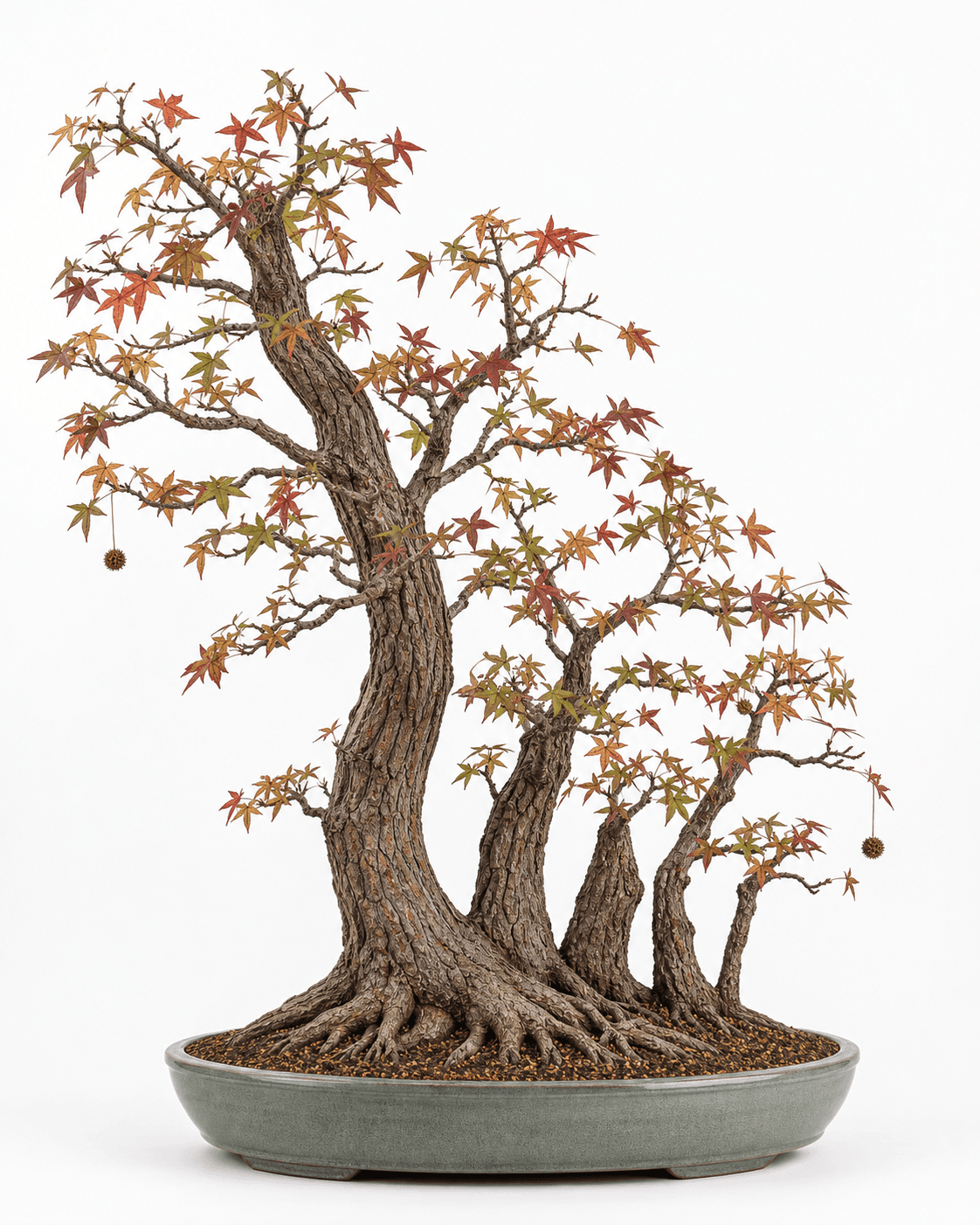
Sweetgum is an outdoor deciduous bonsai for growers who want star-shaped foliage, corky winged bark, reliable fall color, and vigorous response to refinement work. It needs full seasonal dormancy, steady root-zone moisture with oxygen, and pruning timed around active growth rather than a generic maple calendar.
Treat sweetgum as Broadleaf > Deciduous in the EntGrove taxonomy. Kew accepts Liquidambar styraciflua in Altingiaceae and gives its native range as central and eastern United States to Central America, while NC State describes American sweetgum as a deciduous tree found from wet bottoms to drier uplands.
The Mirai Liquidambar corpus makes the page more specific: bud-swell spring root work, partial defoliation after the first flush hardens, careful wiring around fragile bark wings, and disease diagnosis through water and oxygen balance are the core care decisions.
Updated June 16, 2026. Written by EntGrove Editorial. Last verified June 16, 2026.
Care fingerprint
Read the species through its shared care pattern.
Repot and structural prune around dormant-to-active transitions; protect new leaves; time refinement work after growth hardens. Use this as the starting point before local conditions and tree strength refine the calendar.
Note: Outdoor deciduous broadleaf valued for star-shaped leaves, corky bark, and fall color; coarse growth and vigorous roots make timing and apical control important.
Read the foliage first
Broadleaf stress usually shows in leaf color, leaf size, wilt, scorch, or delayed hardening before it becomes a branch problem.
Match work to dormancy
Deciduous, evergreen, tropical, succulent, and flowering broadleaf trees recover on different calendars.
Protect fine roots
Root work should preserve enough active fine roots for the tree to rehydrate quickly after the operation.
Care cadence
The calendar starts with the tree's seasonal state.
Placement
Timing: Grow outdoors year-round with full dormancy. Use full sun where watering can keep pace, and protect the container from hard root freezes, drying winter wind, and late cold after buds move.
Watch for: Warm indoor storage, exposed frozen root balls, hot pavement under shallow pots, weak fall color from shade, and assuming landscape Zone 5 hardiness equals unprotected bonsai-root hardiness.
Kew POWONC State ExtensionVirginia Cooperative ExtensionWatering
Timing: Water by foliar mass, pot volume, sun, wind, temperature, and soil moisture. Sweetgum can use a lot of water while carrying large leaves, but the mix still needs oxygen between waterings.
Watch for: Wilting in dry wind, leaf scorch, sour compacted nursery cores, dry pockets after repotting, yellowing from high-pH water, and wet roots with weak shoot extension.
Bonsai Mirai LibraryNC State ExtensionVirginia Cooperative ExtensionFertilizer
Timing: Feed according to stage. Use balanced organic nutrition for development, withhold or reduce first-flush fertilizer in refinement to keep internodes shorter, then feed lightly after partial defoliation to support the next flush.
Watch for: Chemical or aggressive feeding that drives unsustainable elongation, coarse leaves on refined branches, starvation after defoliation, fertilizer on freshly reduced roots, and late soft growth entering winter.
Bonsai Mirai LibraryPruning
Timing: Let the first flush harden, then prune and partially defoliate refined zones. Use leaf-drop pruning to redirect energy from dominant tips into interior adventitious buds when the tree is strong.
Watch for: Apical shoots stealing strength, cutting refined branches while more than about 30 percent of the tree is still in development, large cuts across winged bark, and removing the interior growth a clump needs for scale.
Bonsai Mirai LibraryPartial defoliation
Timing: In refinement, remove at least two-thirds of total leaf area after the flush hardens to trigger a second flush. Strong Liquidambar can accept two to three partial-defoliation and prune cycles per growing season with calibrated feeding.
Watch for: Defoliating weak trees, defoliating while roots are recovering, leaving too much leaf area to trigger response, repeated cycles without nutrition, and expecting small leaves before the tree is in a bonsai container.
Bonsai Mirai LibraryWiring
Timing: Wire young growth early enough to guide future bark formation, or wire at leaf drop in mild maritime climates. In harsh continental winters, prune at leaf drop and wire in early spring before bud push.
Watch for: Crushed corky wings, wire crossing bark ridges, bite on fast-thickening shoots, old wire reducing water conduction, and greenhousing a wired deciduous tree into weak early growth.
Bonsai Mirai LibraryRepotting
Timing: Repot or collect at spring bud swell. Vigorous Liquidambar can tolerate heavy root reduction, but mature specimens with a developed shin need staged maintenance rather than aggressive central-root removal.
Watch for: Dry exposed roots, unstable tie-downs, removing too much mature shin, dense nursery soil, poor soil contact after chopsticking, and styling plus repotting on a tree without enough vigor.
Bonsai Mirai LibraryUSDA Forest Service FEISVirginia Cooperative ExtensionFruit and cultivars
Timing: Decide whether fruit belongs in the image. Species trees can make spiny winter-persistent gum balls, while Rotundiloba rarely fruits and carries rounded leaf lobes in a narrower Zone 6a to 9b landscape range.
Watch for: Fruit pulling energy from a developing tree, bench litter from gum balls, buying a fruitless cultivar with poor trunk structure, pointed-leaf reversions on Rotundiloba, and undersized pots for fruiting material.
NC State ExtensionNC State Extension RotundilobaVirginia Cooperative ExtensionSpecies guide
Apply the species profile before copying another tree's calendar.
At a glance
Sweetgum is a vigorous outdoor deciduous tree with star leaves, winged bark, and fall color.
The plant is Liquidambar styraciflua L., accepted by Kew in Altingiaceae. Common search labels include American sweetgum, sweet gum, redgum, star-leaf gum, sapgum, and alligator-tree, so verify the scientific name before applying care advice. Kew POWONC State ExtensionUSDA Forest Service FEIS
The horticultural profile is outdoor, deciduous, full sun to partial shade, USDA Zones 5a to 9b in NC State, acid to neutral soil, rapid growth, alternate 3 to 6 in star-shaped leaves, yellow-green spring flowers, and bristly 1 to 3 in fruiting capsules. NC State Extension
For bonsai, the strongest images are medium and larger deciduous designs, especially clumps, forests, informal uprights, and naturalistic groups. Difficulty sits in the intermediate-beginner range because the species responds well, then quickly exposes mistakes in timing, watering, pH, and wiring. Bonsai Mirai LibraryBonsai Mirai / Asymmetry
Wild habitat
Bottomland vigor and upland toughness explain the care rhythm.
Kew gives the native range as central and eastern United States to Central America. NC State describes American sweetgum in wet river bottoms, frequently flooded swamps, and drier uplands, and USDA FEIS says it grows best on rich moist alluvial clay and loamy river-bottom soils while tolerating many sites. Kew POWONC State ExtensionUSDA Forest Service FEIS
The care implication is moisture with oxygen and repeated drainage cycles. Mirai watering and soil method treats the root zone as a repeated water and oxygen balance, while Virginia Tech notes the species is slow to establish because of fleshy roots and wants sunny moist slightly acidic soil. Bonsai Mirai LibraryVirginia Cooperative Extension
The design implication is a tree that wants to become tall, conical, and efficient. USDA FEIS describes young trees with long conical crowns and older trees with rounded spreading crowns, while Mirai design fundamentals ask the grower to counter symmetry with trunk line, defining branch, apex, and preserved interior growth. USDA Forest Service FEISBonsai Mirai / Asymmetry
Reading the tree
Decide whether each part is developing, refining, healing, or feeding the roots.
Mirai frames developmental growth as justified when it creates elongation, thickening, wound repair, root development, or vascular expansion for back budding. On Sweetgum that means selected leaders and sacrificial branches can run, while finished branches need protection from being shaded or starved. Bonsai Mirai Library
A clump or group planting needs hierarchy. The strongest trunk should remain the visual dominant trunk, and a sucker or sacrificial extension can restore that hierarchy when the planting has become too even. Interior branches growing into interior light should be retained because they make the clump read naturally. Bonsai Mirai Library
Weak tips beside foot-long suckers point to energy interception rather than simple weakness. Mirai describes the fix at leaf drop: reduce the sucker so stored sugars and starches empower the intended interior or terminal branch. Bonsai Mirai Library
Pruning
Use first-flush hardening, partial defoliation, and leaf-drop energy movement.
For refinement, wait until the first flush hardens, then combine pruning with partial defoliation. Mirai says Liquidambar responds with a second flush, and withholding fertilizer through the first flush helps keep the first internodes shorter before light feeding supports finer regrowth. Bonsai Mirai Library
The partial-defoliation threshold matters. Mirai says at least two-thirds of total leaf area must be removed to trigger the second flush, and strong Liquidambar can accept two to three partial-defoliation and prune cycles per season when fertilization is calibrated to the response. Bonsai Mirai Library
Use leaf-drop pruning for energy transition. As sugars and starches leave the canopy, reduce dominant terminal tips and cut back to adventitious buds so the next season starts from better interior structure. In harsh continental winters, combine leaf-drop pruning with early-spring wiring rather than fall wiring. Bonsai Mirai Library
Major reductions on winged or corky bark should happen while bark is still young enough to blend the wound. Mirai warns against geometric cuts across the organic wing pattern; find the collar line and cut with the bark so later callus and corking look intentional. Bonsai Mirai Library
Repotting
Repot at bud swell, and treat mature central roots with respect.
The best Liquidambar collection window in the Mirai corpus is spring at bud swell, with mid-to-late winter only when the tree receives cold protection through the coldest part of the year. The general Mirai repotting corpus uses the same swelling-bud signal before active growth begins. Bonsai Mirai Library
Sweetgum can be vigorous under root work. Mirai says Liquidambar tolerates heavy root reduction and yamadori collection when sufficient root mass is retained, and vigorous trees can be repotted and styled in the same spring if the grower accepts uneven energy distribution during recovery. Bonsai Mirai Library
Mature container trees require a different root conversation. Mirai distinguishes young Liquidambar that can have basal roots cut and plated out from long-cultivated mature specimens with a shin that needs ongoing maintenance. Remove old central mass in stages rather than hollowing the heart of an established tree in one operation. Bonsai Mirai Library
Public forestry sources explain the variation you will see in collected or nursery roots. USDA FEIS says young sweetgum often forms a deep taproot with horizontal rootlets, while wet-site plants may develop shallow, wide roots with little taproot. Virginia Tech adds that the fleshy root system makes establishment slow. USDA Forest Service FEISVirginia Cooperative Extension
Soil and pot
Build moisture, oxygen, and acidity into the container.
NC State lists acid to neutral pH, good drainage, moist soil, occasional dry tolerance, and occasional wet tolerance. Virginia Tech gives pH 3.7 to 6.8, and University of Illinois says Sweetgum prefers acid soil, moist well-drained soil, and tolerates wet sites. NC State ExtensionVirginia Cooperative ExtensionUniversity of Illinois Extension
For bonsai, use an akadama-forward deciduous mix when watering skill is reliable. A 2:1:1 akadama:pumice:lava starting point gives moisture with structure; increase pumice or particle size if humidity, shade, or a nursery core keeps the pot wet for too long. Bonsai Mirai Library
The pot should fit the stage. Development trees need enough depth for root growth and water reserve. Refinement trees can move shallower after foliage mass shrinks, because Mirai notes that large developmental leaves drive higher water use than a refined canopy with smaller ramified foliage. Bonsai Mirai Library
Pot pairing should echo fall color and corky texture. Quiet unglazed brown, gray, or moss-toned containers suit rugged native material; restrained glazed containers can work for refined autumn display, especially when the design is clump, group, or broom-adjacent rather than alpine drama. Bonsai Mirai / AsymmetryNC State Extension
Climate
Adapt the same tree differently in maritime, continental, hot, and alkaline regions.
Mirai notes that Liquidambar tolerates warm-winter Mediterranean climates and can still produce fall color. That broadens the range, but the tree still needs an outdoor seasonal cycle, open light, and winter handling based on the container rather than the landscape zone map. Bonsai Mirai LibraryKew POWO
In maritime or mild temperate climates, leaf-drop wiring and pruning can work when the tree returns to cold conditions immediately. In harsh continental climates, Mirai gives the safer sequence: prune at leaf drop, then wire in early spring before bud push to reduce dieback risk. Bonsai Mirai Library
In hot summer regions, water demand follows leaf surface area, container volume, sun, wind, and humidity. After heavy interior pruning, Mirai recommends shade when 80 to 90 F or higher heat would burn newly exposed interior leaves that developed under lower light. Bonsai Mirai Library
In alkaline-water regions, monitor pH before treating yellow leaves as a fertilizer shortage. Virginia Tech says iron chlorosis is a problem when soil pH is above 7.0, and NC State also flags iron chlorosis in alkaline soils. Virginia Cooperative ExtensionNC State Extension
Pests and diseases
Read Sweetgum disease through leaves, roots, pH, and oxygen.
The Mirai Liquidambar file names two primary disease signals: anthracnose as large black leaf spots and pseudomonas as blackened leaf margins curling inward. It frames pseudomonas leaf symptoms as evidence to inspect root health, soil structure, and water-oxygen balance. Bonsai Mirai Library
Extension sources add the ordinary landscape pressure. NC State lists webworms, caterpillars, borers, scale, leaf spots, wood rot, bleeding necrosis, and alkaline-soil chlorosis. Illinois lists drought, drowning, root rot, wood rots, scale, leaf spots, winter damage, and chlorosis in alkaline soils. NC State ExtensionUniversity of Illinois Extension
The first treatment is culture. Restore drainage, particle structure, full saturation without stagnation, light, and balanced nutrition before reaching for sprays. Mirai treats fungicides as last-resort tools because residues can stress tissue after the immediate disease pressure passes. Bonsai Mirai Library
Fruit creates a practical safety and bench-management issue. NC State says the hard bristly fruiting heads can persist and litter from December through April, and Rotundiloba rarely produces fruit. On bonsai, fruit is optional display material rather than an annual requirement. NC State ExtensionNC State Extension Rotundiloba
Wiring
Wire early, protect the wings, and inspect fast-thickening shoots often.
Liquidambar bark wings begin forming early and are fragile. Mirai says to navigate them rather than cut across them, entering and exiting wire wraps at the start or end of a bark wing and placing fingers on existing wire instead of crushing the wing directly. Bonsai Mirai Library
Wire young green shoots when you want to influence the eventual bark pattern. Mirai notes that early wire can subtly direct where bark forms, which matters on a tree whose corky wings become a design feature later. Bonsai Mirai Library
Copper can be useful when holding power is needed because mature Sweetgum bark tolerates abrasiveness better than thin-bark maples, but wire bite on high-water-mobility broadleaf deciduous branches reduces conduction and can kill branches later. Inspect often during the following flush. Bonsai Mirai Library
Use standard structural wiring mechanics: 55 to 60 degree coil angle, continuous contact, equal spacing, and enough anchor turns. When a branch can be shaped by pruning, choose pruning over a hard bend through corky or brittle mature wood. Bonsai Mirai Library
Propagation
Seed, sprouts, cuttings, layers, and collection all work, with different bonsai tradeoffs.
NC State gives seed as the propagation method for landscape Sweetgum, and USDA FEIS describes abundant seed plus strong sprouting until roughly 50 years old. Seedlings are useful for forests, clumps, and cultivar-free native material, but they delay trunk quality and may carry coarse internodes. NC State ExtensionUSDA Forest Service FEIS
Cuttings and air layers can preserve a useful branch, cultivar, or compact form. Mirai propagation method emphasizes choosing the right wood stage, using small-particle akadama for fine roots, avoiding overwatering during root initiation, and wiring movement while the cutting is still flexible and attached when possible. Bonsai Mirai Library
Collection is viable when legal and horticulturally sensible. Mirai says Liquidambar tolerates yamadori collection well when enough roots remain, with spring bud swell as the best window. Field or wetland-origin material still needs staged transition from coarse roots and native soil into a bonsai container. Bonsai Mirai LibraryUSDA Forest Service FEIS
Grafting is a repair and design tool rather than the default propagation path. Use approach or thread grafting to add missing interior branches, fix a clump gap, or improve root distribution only when the graft can be hidden and the cultivar or species identity remains clear. Bonsai Mirai Library
Buying and sourcing
Buy bark, base, low branches, and root reducibility before fall color.
The best Sweetgum starter already has a usable base, trunk movement, low branch options, short internode sections, and a root system that can be reduced. Fall color and shiny leaves are easy to admire at a nursery; branch placement and root transition decide the bonsai future. Bonsai Mirai / AsymmetryNC State Extension
Field seedlings and volunteers can be vigorous, but USDA FEIS root data explains why many have deep or wide roots that need staged conversion. Prioritize material that can be dug legally with enough fine roots and a clear recovery plan. USDA Forest Service FEISBonsai Mirai Library
Nursery cultivars solve different problems. Rotundiloba rarely fruits and has rounded lobes, Gumball is listed by NC State as a dwarf form, and other landscape cultivars may improve fall color or habit. Inspect reversions, grafts, trunk scale, and hardiness before relying on the name. NC State ExtensionNC State Extension RotundilobaVirginia Cooperative Extension
Older corky-winged branches are attractive and fragile. If the bark wings already define the material, handle the tree as a finished feature during transport, pruning, and wiring. Broken wings heal slowly as visual damage even when the branch stays alive. Bonsai Mirai Library
Troubleshooting
Most Sweetgum problems trace back to roots, pH, timing, wire, or unchecked vigor.
Yellow leaves point first to pH and root function. Virginia Tech warns about iron chlorosis above pH 7.0, NC State flags alkaline-soil chlorosis, and Mirai method asks the grower to correct water and oxygen balance before adding more fertilizer. Virginia Cooperative ExtensionNC State ExtensionBonsai Mirai Library
Black leaf spots suggest anthracnose, while blackened curling leaf margins suggest pseudomonas in the Mirai Liquidambar diagnostic. Improve root-zone oxygen and soil structure, isolate heavily affected material, and reserve chemical intervention for confirmed severe pressure. Bonsai Mirai Library
A weak branch beside a strong sucker usually needs energy redistribution. Reduce the sucker at leaf drop so the intended branch receives stored resources the next spring, and avoid partial defoliating refined branches while large developmental zones are still pulling hard. Bonsai Mirai Library
Wire bite on Sweetgum can show up later as branch weakness because the species moves a lot of water through active broadleaf tissue. Remove wire early, especially after spring growth starts, and use guy wires or cutback where fast thickening would make coil scars inevitable. Bonsai Mirai Library
Weak recovery after repotting usually means dry exposed roots, poor soil contact, unstable tie-downs, excessive shin removal, or too much top work in the same season. Let the canopy rebuild reserves and selectively thin only where interior branches would otherwise be shaded out. Bonsai Mirai LibraryVirginia Cooperative Extension
Design
Let the species read as a native deciduous tree, then refine the scale.
Sweetgum design starts with habitat and morphology: wet-bottomland vigor, upright youth, rounded maturity, star leaves, corky wings, and autumn color. The image should feel like a deciduous tree or clump miniaturized through timing, with conifer-style pads kept out of the design vocabulary. NC State ExtensionUSDA Forest Service FEISBonsai Mirai / Asymmetry
Mirai design fundamentals use trunk line, defining branch, and apex to create harmony, tension, or dynamic movement. Sweetgum usually earns harmony or quiet tension: a clear trunk or clump hierarchy, one broad defining branch, and an apex that balances a rounded deciduous crown. Bonsai Mirai / Asymmetry
Clump and group designs deserve special attention. Mirai Liquidambar work preserves interior branches that grow into available inner light and aligns trunk hierarchy with trunk thickness. Removing all interior growth makes a clump look staged and breaks the scale. Bonsai Mirai Library
Deadwood is secondary. Sweetgum can show scars, hollows, and old corky texture, but the strongest species signals are fall color, winged branches, trunk hierarchy, and branch ramification. Preserve deadwood only when it supports the native deciduous story. Bonsai Mirai / AsymmetryNC State Extension
Cultivars
Cultivars can reduce fruit or improve habit, but structure still decides bonsai quality.
NC State lists cultivars and forms including Aurea, Aurora, Burgundy, Corky, Festival, Gumball, Oconee, Palo Alto, Rotundiloba, Slender Silhouette, Variegata, and White Star. Many are landscape selections, so evaluate trunk and internode scale before treating the cultivar as bonsai-ready. NC State Extension
Rotundiloba is the important fruit-management form. NC State describes it as fruitless or thornless Sweetgum, with rare fruiting, rounded leaf lobes, full sun to partial shade, acidic good-drainage soil, and USDA Zones 6a to 9b. NC State Extension Rotundiloba
Virginia Tech lists Burgundy, Festival, Autumn Glow, Moraine, and Rotundiloba among cultivated options. Illinois notes Cherokee, Gold Dust, and Moraine as cold-hardy cultivars. These names are useful for sourcing, but local hardiness and root quality remain more important than a catalog promise. Virginia Cooperative ExtensionUniversity of Illinois Extension
Corky forms are tempting because the species already develops wing-like projections after the second year according to NC State. Buy them only when the bark feature aligns with a branch structure you can protect during wiring, transport, and future pruning. NC State ExtensionBonsai Mirai Library
History
Sweetgum is strongest as native deciduous material with Mirai-level refinement notes.
Public documentation is strongest in forestry and extension sources rather than classic bonsai exhibition literature. USDA FEIS treats the species as a native, long-lived, large deciduous tree, and NC State emphasizes native wildlife, fall color, corky projections, and troublesome fruit. USDA Forest Service FEISNC State Extension
The Mirai Liquidambar fundamentals file is important because it moves Sweetgum from a generic deciduous candidate into a worked bonsai subject: clump hierarchy, winged-bark wiring, partial defoliation cycles, mature shin management, and disease diagnostics all receive species-specific treatment. Bonsai Mirai Library
For EntGrove, the useful history is practical and local: a common North American tree can become serious bonsai material when the grower records bud swell, first-flush hardening, defoliation response, pH behavior, root work, and how each branch handles wire over time. Bonsai Mirai LibraryBonsai Mirai / Asymmetry
Species questions
Answer the beginner questions before styling.
Is Sweetgum a good beginner bonsai?
It can be, for an outdoor beginner who keeps records and likes vigorous deciduous material. The tree responds well, but large leaves, fast thickening, pH sensitivity, and fragile corky wings make it less forgiving than Chinese elm.
Can Sweetgum bonsai live indoors?
Indoor culture is a poor fit. Sweetgum is a temperate deciduous tree that needs outdoor light, airflow, seasonal dormancy, and winter cues.
When should I repot Sweetgum bonsai?
Use spring bud swell as the main window. Repot when drainage, root density, soil breakdown, planting angle, or nursery-core transition justifies the work.
How much sun does Sweetgum bonsai need?
Use full sun where watering and root temperature can keep up. Add afternoon protection during extreme heat, especially after root work, heavy pruning, or interior exposure.
How often should I water Sweetgum bonsai?
Water when the surface begins to dry, then saturate the full pot. Large leaves in sun can use water quickly, while compacted or broken-down soil can stay wet without enough oxygen.
Can I partially defoliate Sweetgum bonsai?
Yes, on strong refined trees after the first flush hardens. Mirai gives Liquidambar two to three partial-defoliation and prune cycles per season when fertilizer and recovery are managed.
How should I wire Sweetgum with corky bark?
Wire young growth early, then protect mature bark wings by placing wraps at the start or end of the wings rather than crossing and crushing them. Inspect often during active thickening.
Why are my Sweetgum leaves yellow?
Check pH and roots first. Virginia Tech warns about iron chlorosis when pH rises above 7.0, and Mirai method points to root water and oxygen balance before fertilizer fixes.
Is Rotundiloba Sweetgum better for bonsai?
Rotundiloba can reduce the gum-ball problem and has rounded lobes, but it carries a narrower listed landscape range and still needs a good trunk, roots, and branch structure.
What styles fit Sweetgum bonsai?
Clump, forest, group, natural informal upright, broom-adjacent, and raft-adjacent styles fit best. The species is strongest when fall color, winged bark, and deciduous branch hierarchy remain visible.
Sources
Species advice needs source discipline.
Next decisions
Plan the operation before copying the calendar.
A good care note for Sweetgum records the tree's stage, the work done, and the aftercare used. That record matters more than a month-name rule.
Related species
Compare nearby trees before transferring advice.
Japanese maple
Acer palmatum
Trident maple
Acer buergerianum
Amur maple
Acer tataricum subsp. ginnala
Field maple
Acer campestre
Korean hornbeam
Carpinus turczaninovii