
Species guide
Vine Maple Bonsai Care
Acer circinatum
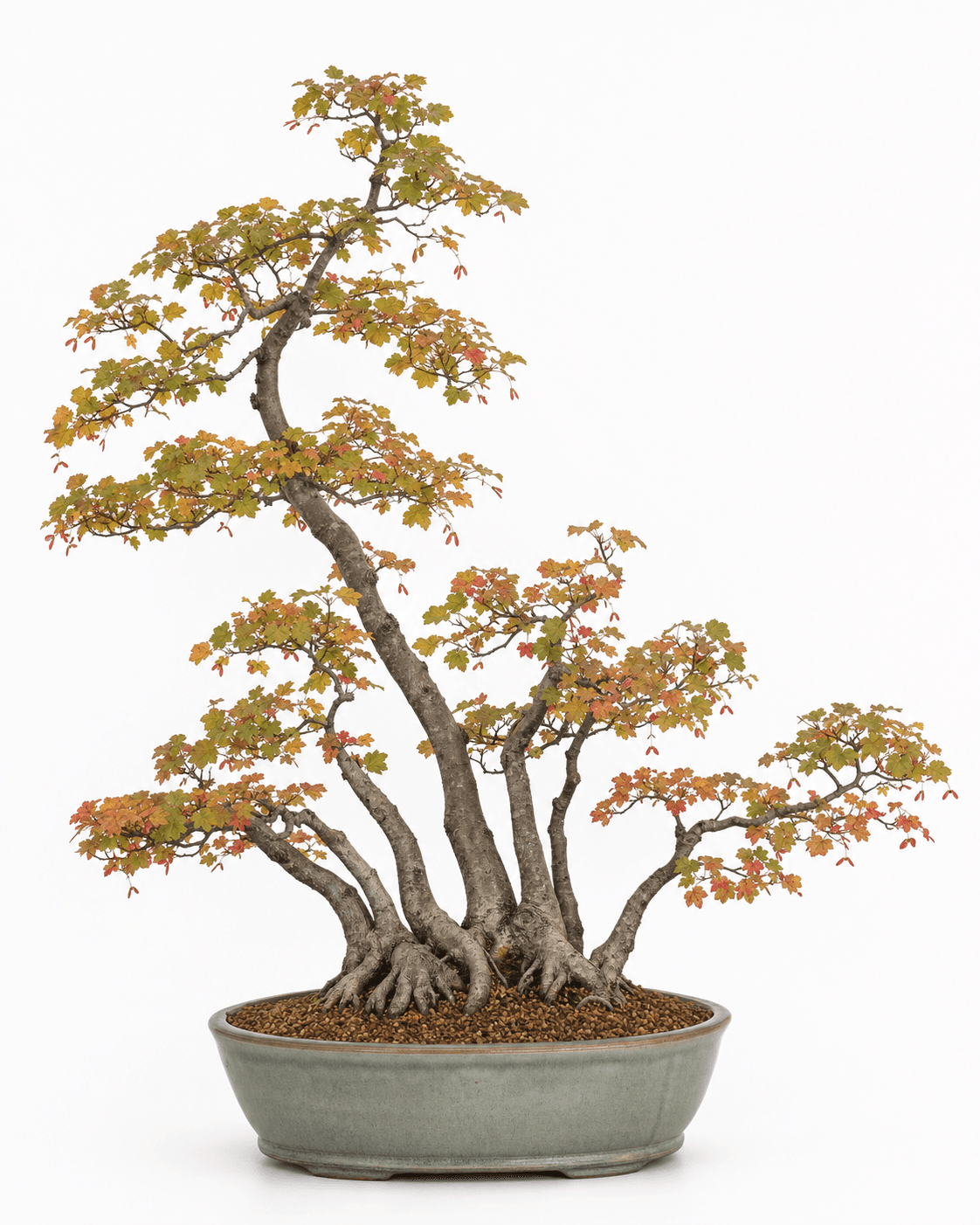
Vine maple is an outdoor deciduous bonsai candidate for growers who want Pacific Northwest woodland character: multiple trunks, arched branches, thin smooth bark, autumn color, and a soft broadleaf silhouette. It needs real winter dormancy, steady root moisture, and restraint in pruning so the tree keeps its natural horizontal grace.
Treat vine maple as Broadleaf > Deciduous in the EntGrove taxonomy. Kew accepts Acer circinatum in Sapindaceae and gives the native range as western Canada to northern California; NC State, Oregon State, USDA, and RHS describe a moist-woodland maple with sun-to-shade plasticity, spring flowers, red-winged samaras, and USDA Zone 4 to 7 or H6 landscape hardiness context.
The local Mirai corpus has no dedicated Acer circinatum file, so this guide transfers only Acer and deciduous broadleaf method from maple, watering, soil, repotting, pruning, wiring, propagation, and design files. That makes the page strongest on care logic and transparent where species-specific bonsai trial data is thin.
Updated June 17, 2026. Written by EntGrove Editorial. Last verified June 17, 2026.
Care fingerprint
Read the species through its shared care pattern.
Repot and structural prune around dormant-to-active transitions; protect new leaves; time refinement work after growth hardens. Use this as the starting point before local conditions and tree strength refine the calendar.
Note: Pacific Northwest native maple with shade-versus-sun habit differences; keep woodland and multi-stem character in the design.
Read the foliage first
Broadleaf stress usually shows in leaf color, leaf size, wilt, scorch, or delayed hardening before it becomes a branch problem.
Match work to dormancy
Deciduous, evergreen, tropical, succulent, and flowering broadleaf trees recover on different calendars.
Protect fine roots
Root work should preserve enough active fine roots for the tree to rehydrate quickly after the operation.
Care cadence
The calendar starts with the tree's seasonal state.
Placement
Timing: Keep outdoors year-round. Give winter dormancy, air movement, and container protection when roots are frozen, newly worked, or exposed to dry wind.
Watch for: Warm indoor storage, hot pavement, drying wind, late freezes after buds move, and bright exposure that outpaces the roots in a shallow pot.
Kew POWONC State ExtensionOregon State Landscape PlantsBonsai Mirai LibraryLight requirement
Timing: Use morning sun, high open shade, or full sun only where roots stay cool and moist. Let shade build graceful extension and sun build density.
Watch for: Long internodes in deep shade, leaf scorch in inland heat, weak fall color in low light, and hot bench surfaces under small pots.
NC State ExtensionOregon State Landscape PlantsRHSBonsai Mirai LibraryWatering
Timing: Water when the surface particles and top dressing begin to dry, then saturate until water exits the drain holes. Keep the root mass moist and oxygenated through active growth.
Watch for: Dry nursery cores, stale waterlogged organic soil, leaf-edge scorch after hot wind, reduced water demand after pruning, and shallow pots retaining water longer than expected.
Bonsai Mirai LibraryUSDA Forest Service FEISUSDA NRCS plant guideFertilizer
Timing: Feed by stage. Use stronger organic nutrition for trunk, root, and branch development, then reduce after first-flush hardening when short internodes and leaf scale matter.
Watch for: Coarse spring growth, shaded lower branches, late soft growth before winter, fertilizer on freshly reduced roots, and starvation after partial leaf work.
Bonsai Mirai LibraryPruning
Timing: Let the purpose decide the timing. Use post-flush pruning for refinement, cautious fall or dormant cleanup for structure, and delay large cuts if spring wounds bleed heavily.
Watch for: Opposite buds making bar branches, one leader stealing all energy, large cuts that erase the woodland line, heavy pruning that loses horizontal grace, and stacked root and top work on weak trees.
Bonsai Mirai LibraryOregon State Landscape PlantsRHSWiring
Timing: Wire young flexible shoots in fall or early structure windows, then inspect frequently once spring thickening begins. Use clip-and-grow and guy wires for older arched branches.
Watch for: Smooth bark scars, fast Acer wire bite, brittle older wood, leaves turned upside down after wiring, and bends that fight the species habit.
Bonsai Mirai LibraryUSDA Forest Service FEISRepotting
Timing: Inspect in spring as buds swell and before active growth depends on the full root system. Use 1 to 2 year checks in development, then extend intervals in refinement if drainage and vigor stay balanced.
Watch for: Dense nursery soil, dry exposed roots, weak tie-downs, heat or wind immediately after repotting, excessive root reduction on a weak tree, and poor soil contact after chopsticking.
Bonsai Mirai LibraryUSDA Forest Service FEISPest and disease checks
Timing: Inspect during spring flush, summer heat, after pruning, and when leaves scorch or branches weaken. Fix roots, water, light, and hygiene before treating symptoms as isolated pest problems.
Watch for: Aphids, caterpillars, Acer gall mite, horse chestnut scale, Verticillium wilt, Acer leaf scorch, honey fungus, root oxygen imbalance, and stress from hot dry roots.
RHSNC State ExtensionBonsai Mirai LibrarySpecies guide
Apply the species profile before copying another tree's calendar.
At a glance
Vine maple is a cool-rooted outdoor deciduous maple with woodland movement.
The species target is Acer circinatum Pursh, accepted by Kew in Sapindaceae. The common names to verify are Vine maple and Oregon vine maple, with older synonyms such as Acer macounii and Acer virgatum appearing in the taxonomic record rather than as separate bonsai targets. Kew POWONC State ExtensionUSDA NRCS plant guide
The horticultural profile is outdoor, deciduous, 10 to 25 ft in NC State landscape dimensions, 4 to 8 m in RHS garden dimensions, medium growth, opposite palmate leaves, spring flowers, red-winged samaras, autumn color, and a habit that shifts from open horizontal shade growth to denser sunny growth. NC State ExtensionOregon State Landscape PlantsRHS
For bonsai, the best fit is an outdoor grower in a cool, maritime, mountain, or otherwise moderate climate who wants clump, raft-adjacent, forest, or informal deciduous images. The main difficulty is preserving moisture and fine branching without pruning away the species character. Bonsai Mirai LibraryOregon State Landscape Plants
Wild habitat
Moist woods, streambanks, and shade-grown arches explain the care.
Kew gives the native range as western Canada to northern California. USDA NRCS places the plant in the Pacific Northwest from the Cascade Mountains to southern British Columbia and northern California, and USDA FEIS describes it through moist conifer forests, streambanks, alluvial terraces, openings, clearcuts, talus slopes, and lower open slopes. Kew POWOUSDA NRCS plant guideUSDA Forest Service FEIS
The wild growth form is unusually instructive. USDA FEIS describes a long-lived, shade-tolerant shrub or small tree whose stems can be erect, leaning, arched, rooted where branch tips touch the ground, or prostrate with the end turned upward. That is the visual vocabulary for the bonsai. USDA Forest Service FEIS
The care implication is stable moisture and oxygen, not saturated heaviness. In a pot, a moist-forest maple needs full saturation when watered, enough particle structure for root respiration, and protection from the dry heat that forest soil would buffer in the ground. Bonsai Mirai LibraryUSDA Forest Service FEISRHS
The design implication is restraint. Oregon State describes sunny plants as more upright and shade plants as horizontally graceful, then warns that heavy pruning can remove that grace. The best Vine maple bonsai should look edited, not forced into a generic deciduous dome. Oregon State Landscape PlantsBonsai Mirai / Asymmetry
Reading the tree
Separate development, refinement, energy correction, and display.
Mirai deciduous method starts with purpose: a branch may be elongating for girth, healing a wound, restoring root strength, building secondary structure, or refining ramification. On Vine maple, identify the purpose before cutting every extension short. Bonsai Mirai Library
Acer habits make energy visible. Opposite buds create easy bar-branch and swollen-junction problems, while spring extension can thicken wire scars quickly. Select one side of a node early unless a fork, clump division, or layered branch pair is intentional. NC State ExtensionBonsai Mirai Library
Refinement strength is temporary on deciduous bonsai. Mirai notes that highly refined deciduous trees are weaker than developmental trees because sugar and starch production has been deliberately controlled, so build release years into a Vine maple that has been held fine for several seasons. Bonsai Mirai Library
The species rewards records. Track bud swell, first-flush hardening, heat stress, fall color, wire timing, root density, and how much light each branch receives. That record matters because transferred maple method must be calibrated to the actual Acer circinatum on the bench. Bonsai Mirai LibraryOregon State Landscape Plants
Pruning
Prune for broadleaf structure, then preserve the woodland line.
Use the Mirai deciduous rule first: pruning action and timing follow the goal for that year. Development may require elongation and selected sacrifice growth, while refinement happens after the spring flush hardens and only on parts of the tree strong enough to respond. Bonsai Mirai Library
Treat Vine maple as a high-caution Acer until the individual tree proves otherwise. The Mirai corpus separates high-water-mobility deciduous species from lower-mobility species; if a spring cut darkens and stays wet, stop structural pruning and wait until the first flush hardens. Bonsai Mirai Library
For refinement, reduce strong shoots after hardening and use partial leaf reduction only on healthy intermediate-to-large leaf zones that need more interior light. Vine maple leaves are naturally larger than many classic maples, so full miniaturization is a multi-year branch and container project. Bonsai Mirai LibraryNC State ExtensionOregon State Landscape Plants
Large cuts deserve extra planning. Preserve the shoulder or ridge where compartmentalization begins, seal significant wounds, and avoid reducing a tree to a trunk with no redeemable structural branch. Mirai warns that broadleaf deciduous design loses decades when every branch is removed. Bonsai Mirai Library
RHS landscape pruning advice favors late autumn to midwinter cleanup, while Mirai bonsai method adds post-flush and fall windows based on bleeding, vigor, and wound response. On Vine maple, prefer smaller cuts, staged correction, and records over a single hard reset. RHSBonsai Mirai Library
Repotting
Repot at bud swell when roots, drainage, or structure ask for it.
Use Mirai spring repot timing as the baseline: buds swelling before active growth begins. The operation is justified by dense roots, broken-down soil, water failing to penetrate, aesthetic transition, planting-angle correction, or a nursery core that creates wet and dry zones. Bonsai Mirai Library
Moist habitat does not excuse stale roots. Mirai watering and repotting files frame the problem as water and oxygen across many cycles; USDA and RHS habitat notes support a mix that holds moisture while draining cleanly. Bonsai Mirai LibraryUSDA Forest Service FEISRHS
During the operation, protect fine roots from drying, seat the tree onto a substrate cone, tie it firmly, and chopstick until fine soil contacts fine roots. Poor soil contact after root work is especially punishing for a thin-leaf deciduous tree entering spring transpiration. Bonsai Mirai Library
Avoid a fixed repot calendar. Mirai deciduous wiring method says deciduous trees are repotted when the tree shows need, not because the calendar says so. Inspect often in development, then let a refined stable tree extend the interval if the substrate, roots, and water response remain sound. Bonsai Mirai Library
Soil and pot
Choose a water-retentive deciduous mix with enough oxygen for cool roots.
The public horticultural sources agree on moisture. USDA FEIS calls Vine maple an indicator of moist, well-drained soils, USDA NRCS places it on moist soils along streams and wet sites, and RHS gives moist but well-drained soil as the cultivation rule. USDA Forest Service FEISUSDA NRCS plant guideRHS
For a developing tree, start with a deciduous mix such as 2:1:1 akadama:pumice:lava or an akadama-forward variant that stays moist without turning stale. For refinement under reliable watering, Mirai deciduous method supports pure akadama because its particle scale and water-holding surface area help fine ramification. Bonsai Mirai Library
Pot depth should follow leaf mass and stage. A development tree with broad leaves and summer heat needs more reservoir than a refined tree with a smaller canopy. Shallow show pots can wait until the root system, branch density, and watering routine are already dependable. Bonsai Mirai LibraryNC State Extension
Pot pairing should be quiet and seasonal. Glazed containers can echo autumn red, orange, yellow, or cool woodland green, while muted unglazed containers can suit native clumps and raft images. Keep the pot subordinate to the horizontal branch rhythm and smooth bark. Bonsai Mirai LibraryOregon State Landscape PlantsRHS
Climate
Maritime, mountain, hot inland, and cold regions need different safeguards.
Pacific Northwest and other mild maritime benches are the natural fit. The tree can use cool nights, winter rain, and filtered light, but the grower still has to prevent dense nursery cores, wet anaerobic soil, and spring cuts in wet periods if the individual tree bleeds or dies back. USDA NRCS plant guideOregon State Landscape PlantsBonsai Mirai Library
Hot inland climates require shade strategy. Mirai watering guidance says thin-leaf deciduous and shade-adapted trees should be moved to shade once daytime heat exceeds the mid-90s F; Vine maple also has public-source warnings around hot dry conditions. Bonsai Mirai LibraryNC State Extension
Cold regions should separate landscape hardiness from pot hardiness. NC State Zone 4a to 7b, Oregon State Zone (4) 5, and RHS H6 do not mean a shallow root ball can sit exposed through freeze-thaw wind. Mulch, heel in, cold-frame, or otherwise protect roots while keeping the tree dormant. Kew POWONC State ExtensionOregon State Landscape PlantsRHS
Dry balconies and reflected heat are the hardest placements. A larger training pot, morning sun, bright shade, wind protection, and a moisture-retentive but open mix are usually more important than pushing for the smallest possible silhouette. Bonsai Mirai LibraryUSDA Forest Service FEIS
Pests and diseases
Most problems begin as root, heat, or timing stress before pests finish the work.
RHS lists Acer gall mite, aphids, caterpillars, horse chestnut scale, Verticillium wilt, Acer leaf scorch, and honey fungus as possible issues. NC State points to common maple insect and disease fact sheets while describing no serious problems in ordinary landscape culture. RHSNC State Extension
For bonsai, begin with roots and water. Mirai maple and watering files connect fine twig dieback in maples to root-zone water and oxygen imbalance, especially when soft root tips are compromised. Correct the soil, saturation pattern, light, and heat exposure before escalating to chemical treatment. Bonsai Mirai Library
Verticillium suspicion changes tool hygiene and buying decisions. Avoid collecting or buying material with unexplained branch collapse, vascular staining, sour soil, or repeated dieback. Clean tools, isolate the tree, and avoid grafting or propagation from suspect wood. RHSBonsai Mirai Library
Leaf scorch may be environmental before infectious. Check root moisture, afternoon exposure, reflected heat, wind, fertilizer strength, and recent root work. A tree from moist woodland ancestry can tolerate sun only when water and root temperature keep pace. USDA NRCS plant guideOregon State Landscape PlantsRHSBonsai Mirai Library
Wiring
Wire lightly, inspect early, and let pruning carry much of the shape.
Mirai deciduous wiring method warns that deciduous styling should preserve much of the existing natural movement. Wire only where a structural flaw needs correction, then stop before you erase the arched, layered habit that makes the species identifiable. Bonsai Mirai LibraryUSDA Forest Service FEISOregon State Landscape Plants
Aluminum wire is the safer default for smooth-bark, thin young deciduous shoots. Copper has holding power for structural work but can scar soft bark; if used, paper wrapping and close inspection matter. On Acer, Mirai warns that wire can tighten rapidly after spring leaf-out. Bonsai Mirai Library
Bend brittle broadleaf branches with rotation along the branch axis rather than a localized snap. If bark begins to split, stop, paste, and hold the bend only when the remaining tissue is still continuous. Mature Vine maple character is usually better refined by cutback, guy wires, and young-shoot wiring. Bonsai Mirai Library
Wire in leaf only when leaf orientation can be corrected. Mirai notes that upside-down leaves can burn because their undersides are not built for direct sun. After moving a shoot, rotate leaves back toward light and inspect daily during fast growth. Bonsai Mirai Library
Propagation
Seed, softwood cuttings, layering, grafting, and chip budding all have a place.
USDA NRCS describes seed propagation with immediate 90 day stratification at 41 F, plus spring or early-summer softwood cuttings taken in the morning and kept from wilting. NC State lists root cutting and seed, while RHS lists seed, late-winter grafting, and mid-to-late-summer chip budding. USDA NRCS plant guideNC State ExtensionRHS
The Mirai propagation primer supports the same physiology: take softwood cuttings after the first flush has hardened and warm nights support root initiation, limit foliage so transpiration does not outrun root formation, and use perlite for oxygen and humidity balance. Bonsai Mirai Library
Natural layering is part of the species ecology. USDA FEIS and USDA NRCS describe arched stems rooting when they contact the ground. For bonsai, that makes air-layering and ground-layering useful ways to rescue a branch, build clumps, or correct a poor base while preserving a local genotype. USDA Forest Service FEISUSDA NRCS plant guideBonsai Mirai Library
Grafting and chip budding are cultivar tools. Use them when the cultivar trait is the reason for the tree, such as red bark, dwarf growth, or dissected leaves. Inspect graft unions before buying and keep the graft from becoming the most visible feature of the future bonsai. RHSOregon State Landscape Plants
Buying and sourcing
Buy native character, root promise, and branch hierarchy before leaf novelty.
The best starter has multiple trunks or low branches that already suggest a woodland image, a visible base without one swollen knot, flexible younger shoots, and roots that can move from nursery soil into a bonsai mix. A straight whip is better saved for forests, propagation, or long development. USDA Forest Service FEISBonsai Mirai Library
Nursery material should be inspected for dense organic cores, circling roots, graft unions, scorch history, unexplained dieback, and cultivar truth. Little Gem, Pacific Sprite, and Sunglow can help scale, while Pacific Fire and Monroe are visual traits that still need bonsai structure underneath. Oregon State Landscape PlantsNC State Extension
Collected material deserves legal and horticultural restraint. Native-plant ethics, local rules, fine-root retention, and aftercare matter more than trunk novelty. A legally propagated layer or cutting often gives cleaner roots than a wild clump with little recoverable fine root. USDA NRCS plant guideBonsai Mirai Library
Mirai acquisition method for broadleaf deciduous trees is blunt: never buy a tree that lacks at least one redeemable dominant structural branch. On Vine maple, that branch might be a low arched defining branch, a second trunk, or a natural raft line. Bonsai Mirai Library
Troubleshooting
Read symptoms through roots, heat, timing, and excessive control.
Scorched leaf edges usually point to hot wind, reflected heat, dry roots, or recent root work. Move the tree to morning sun or open shade, stabilize watering, and protect the pot from heat while roots recover. USDA NRCS plant guideOregon State Landscape PlantsBonsai Mirai Library
Weak fine twigs with wet soil suggest oxygen failure. Mirai watering and maple diagnostics point first to substrate structure, drainage, and root health when Acer ramification begins to fail. Bonsai Mirai Library
Long internodes can come from shade, high nitrogen, unchecked leaders, or the development stage itself. Move toward brighter protected light, reduce fertilizer after hardening, and prune with a goal rather than cutting every shoot at the same length. NC State ExtensionBonsai Mirai Library
Bleeding or dark wet tissue after a spring cut means the timing was too early for that tree. Pause structural pruning, let the first flush harden, and resume only when the tree has rebuilt leaf mass. Bonsai Mirai Library
A dense, generic canopy usually means the tree has been treated like a hedge. Reopen negative space gradually, restore a defining branch and apex direction, and keep enough lower and interior structure to read as a natural deciduous maple. Oregon State Landscape PlantsBonsai Mirai / AsymmetryBonsai Mirai Library
Design
Design from shade-grown movement, not from conifer pad logic.
Start with where the tree lives. USDA FEIS gives arched, leaning, prostrate, and rooting stem forms, while Oregon State emphasizes the graceful horizontal quality of shaded plants. That points toward clumps, rafts, low informal uprights, and small forests. USDA Forest Service FEISOregon State Landscape PlantsBonsai Mirai / Asymmetry
Mirai design fundamentals reduce the composition to trunk line, defining branch, and apex. Vine maple usually suits harmony or quiet tension: a soft trunk or trunk group, one long asymmetric branch, and an apex that moves with the woodland story. Bonsai Mirai / Asymmetry
Use deciduous branch language. Mirai deciduous wiring files describe up-and-out architecture, billowing layered canopy zones, and youthful lower branches rather than uniform downward branches. The species looks older when negative space remains visible between soft branch shelves. Bonsai Mirai Library
Deadwood is a minor accent at most. Mirai broadleaf deciduous design treats long-term jin and shari as poor fits compared with hollowing, scars, or live deciduous architecture. Vine maple is strongest through line, bark, leaves, fall color, and branch rhythm. Bonsai Mirai LibraryRHS
Cultivars
Dwarf, red-bark, and dissected forms can help only when the base is already good.
Oregon State lists Little Gem as a dwarf shrub with small leaves, Monroe with deeply dissected leaves, Pacific Fire with red bark, Pacific Sprite as dwarf, often multi-trunked and slow-growing, and Sunglow with apricot and peach spring leaves fading to lime-chartreuse yellow. Oregon State Landscape Plants
NC State overlaps those names and adds Burgundy Jewel and JFS-Purple. These are landscape selections, so evaluate internodes, grafts, roots, branch placement, and climate response before treating the name as a bonsai solution. NC State Extension
Small-leaf or dwarf forms are most useful for shohin and medium trees, while species seedlings may be better for native forests and clumps. Dissected leaves can look delicate, but they also change the visual language away from the simple rounded leaf that gave the species its name. Oregon State Landscape PlantsBonsai Mirai / Asymmetry
Colored bark forms such as Pacific Fire should be protected from crude wiring scars. Buy the bark only when the trunk line, branch exits, and future wire strategy already make sense. Oregon State Landscape PlantsBonsai Mirai Library
History
The species is best understood as native Pacific Northwest material with modern deciduous method.
USDA NRCS records broad Indigenous and wildlife uses, including basketry, tools, bows for fishing nets, food for birds and mammals, and riparian buffer value. That cultural and ecological presence makes the tree more than a substitute for Asian maples. USDA NRCS plant guide
Oregon State notes its landscape reputation in the Pacific Northwest and quotes the shade-grown horizontal grace that makes the plant distinctive. In bonsai, that grace should remain visible through the first design, not recovered after over-pruning. Oregon State Landscape Plants
The local Mirai corpus is useful because design-fundamentals explicitly mentions Vine maple among species discussed, then the broader maple and deciduous files supply the transferable mechanics: water balance, high Acer wire vigilance, broadleaf wound care, fall vascular timing, and deciduous canopy design. Bonsai Mirai LibraryBonsai Mirai / Asymmetry
A serious Vine maple bonsai should be judged by native character, root health, seasonal rhythm, and restraint. The goal is a tree that still reads as Acer circinatum after years in a pot. Bonsai Mirai / AsymmetryKew POWO
Species questions
Answer the beginner questions before styling.
Is vine maple a good beginner bonsai?
Yes, for an outdoor grower in a cool or moderate climate who can water consistently and likes naturalistic deciduous forms. Hot, dry benches and tiny formal designs make the species harder.
Can vine maple bonsai live indoors?
Keep it outdoors. Vine maple is a temperate deciduous tree that needs seasonal light, airflow, winter dormancy, and weather cues.
How much sun does vine maple bonsai need?
Use morning sun, open shade, or full sun only where roots stay cool and moist. Sun builds density, while shade preserves the soft horizontal habit.
How often should I water vine maple bonsai?
Water when the surface particles begin to dry, then saturate the whole pot. The target is even moisture with oxygen, especially during spring growth and summer heat.
When should I prune vine maple bonsai?
Use post-flush pruning for refinement and cautious fall or dormant cleanup for structure. If spring cuts bleed or darken, wait until the first flush hardens before doing larger work.
Can I wire vine maple bonsai?
Yes. Wire young flexible shoots lightly, inspect often after leaf-out, and use clip-and-grow or guy wires for older arched branches.
When should I repot vine maple bonsai?
Inspect in spring as buds swell. Repot when roots are dense, drainage slows, soil breaks down, or a nursery core needs transition.
What soil mix works for vine maple bonsai?
Use an akadama-forward deciduous mix that holds moisture while draining cleanly. A 2:1:1 akadama:pumice:lava mix is a practical development start, with pure akadama reserved for refined trees under reliable watering.
Can vine maple be partially defoliated?
Use partial leaf reduction only on strong, refined zones after the first flush hardens. Large-leaf deciduous refinement depends on health, light, and recovery, not a routine annual strip.
Which vine maple cultivars are useful for bonsai?
Little Gem, Pacific Sprite, Sunglow, Pacific Fire, Monroe, Burgundy Jewel, and JFS-Purple are worth knowing. Choose by roots, trunk, internodes, bark, and climate fit before cultivar name.
What styles suit vine maple bonsai?
Clump, multi-trunk, raft-adjacent, small forest, informal upright, and low woodland styles suit the species. Preserve horizontal movement and negative space.
Sources
Species advice needs source discipline.
Next decisions
Plan the operation before copying the calendar.
A good care note for Vine maple records the tree's stage, the work done, and the aftercare used. That record matters more than a month-name rule.
Related species
Compare nearby trees before transferring advice.
Japanese maple
Acer palmatum
Trident maple
Acer buergerianum
Amur maple
Acer tataricum subsp. ginnala
Field maple
Acer campestre
Korean hornbeam
Carpinus turczaninovii