
Species guide
American Persimmon Bonsai Care
Diospyros virginiana
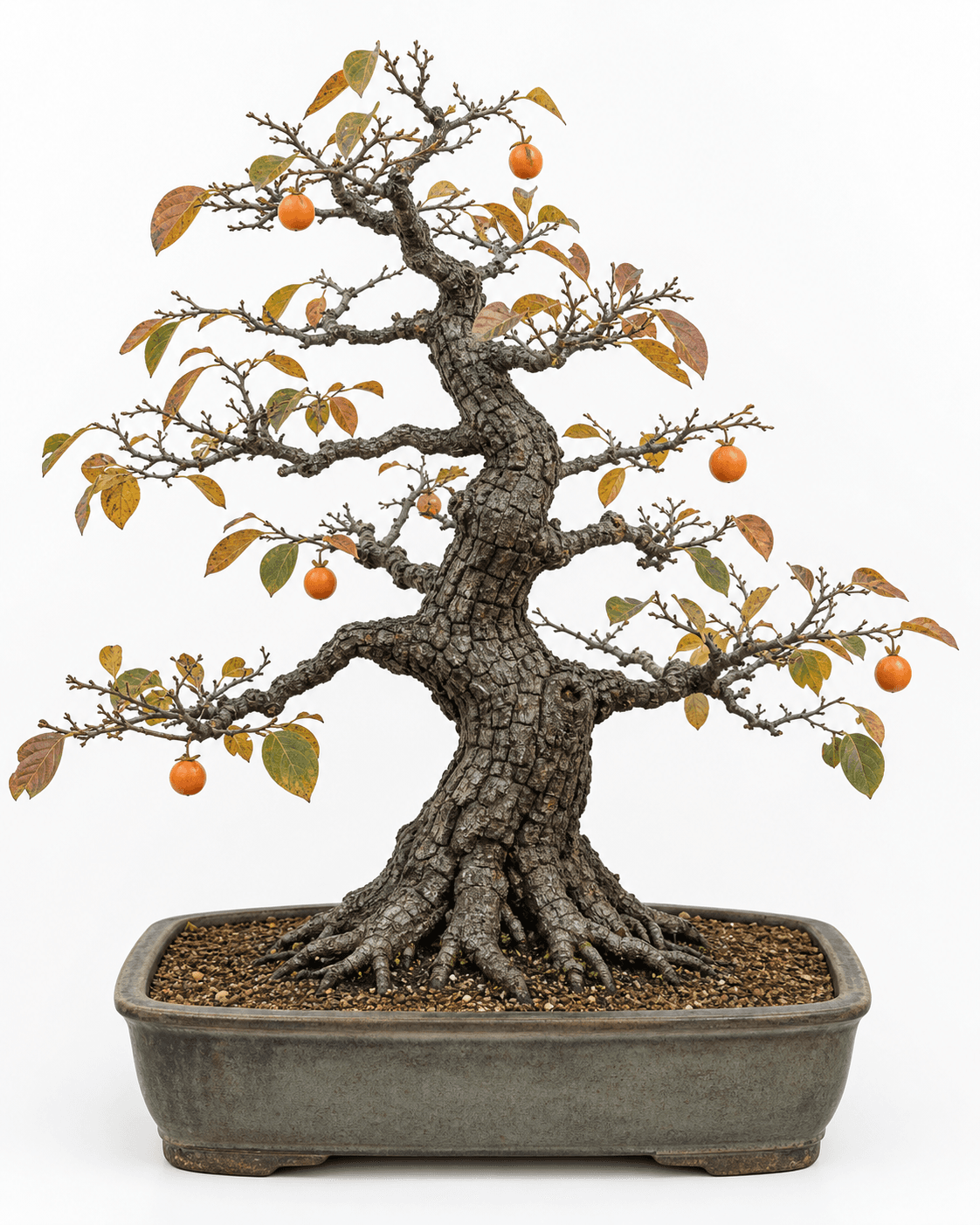
American persimmon bonsai is an outdoor deciduous native tree project, best for growers who want blocky bark, autumn color, and a restrained fruit display on a medium or larger design. It needs full outdoor light, a cold winter rest, steady water with oxygen, and patient root transition because the species forms a deep taproot and can sucker from the roots.
Kew accepts Diospyros virginiana in Ebenaceae and gives the native range as central and eastern United States. NC State lists American persimmon, common persimmon, eastern persimmon, date plum, possum apples, possumwood, simmon, and winter plum, so this page treats those names as one care cluster unless a cultivar or rootstock label proves otherwise.
The local Mirai corpus has no dedicated American persimmon file, so the bonsai method here is source-depth-aware: direct Diospyros references come through princess persimmon mentions, and the technique guidance transfers from Mirai fruiting, flowering, deciduous, watering, soil, repotting, wiring, propagation, energy, and design work.
Updated June 16, 2026. Written by EntGrove Editorial. Last verified June 16, 2026.
Care fingerprint
Read the species through its shared care pattern.
Repot and structural prune around dormant-to-active transitions; protect new leaves; time refinement work after growth hardens. Use this as the starting point before local conditions and tree strength refine the calendar.
Note: Usually dioecious in wild material; verify cultivar and pollination needs before promising fruit on a bonsai.
Read the foliage first
Broadleaf stress usually shows in leaf color, leaf size, wilt, scorch, or delayed hardening before it becomes a branch problem.
Match work to dormancy
Deciduous, evergreen, tropical, succulent, and flowering broadleaf trees recover on different calendars.
Protect fine roots
Root work should preserve enough active fine roots for the tree to rehydrate quickly after the operation.
Care cadence
The calendar starts with the tree's seasonal state.
Placement
Timing: Grow outdoors year-round. Use full sun as the default, then protect small pots from severe heat, drying wind, and deep winter freeze-thaw cycles.
Watch for: Warm indoor storage, shaded long internodes, late frost after bud movement, and cold wind drying a frozen shallow pot.
NC State ExtensionUF/IFAS ExtensionBonsai Mirai LibraryWatering
Timing: Water thoroughly when the surface begins to dry, especially from spring leaf expansion through summer heat and fall fruit sizing.
Watch for: Dry core soil, stale saturated soil, fruit drop after drought swings, and judging watering by calendar instead of leaf mass, pot size, weather, and drainage.
NC State ExtensionBonsai Mirai LibraryFertilizer
Timing: Feed according to phase. Development trees can receive stronger organic feeding after growth begins; refined fruiting trees need restrained nutrition after the first flush hardens.
Watch for: Excess nitrogen pushing coarse shoots, weak trees asked to carry fruit, and late feeding that delays hardening before winter.
Bonsai Mirai LibraryNC State Extension Gardener HandbookPruning
Timing: Separate structure years from fruit-display years. Let selected shoots extend and harden, then prune after the first flush when building branches; use leafless cleanup for visibility and health.
Watch for: Removing every future fruiting option, leaving root suckers to steal energy, pruning weak branches to force back buds, and overloading young branches with fruit.
Bonsai Mirai LibraryNC State ExtensionUSDA Forest Service FEISRepotting
Timing: Repot near spring bud swell when recovery can follow quickly. Work only when roots, drainage, soil breakdown, or planting angle make the operation necessary.
Watch for: Rough taproot reduction, compacted field soil left dry in the center, poor tie-down, heavy fruit allowed after root work, and root work on a weak tree.
Bonsai Mirai LibraryNC State ExtensionUSDA Forest Service FEISWiring
Timing: Wire young hydrated branches after growth is firm enough to move. Use pruning, props, guy wires, and replacement shoots for older hard wood.
Watch for: Wire hidden by large leaves, bark marking, branch cracks from dry tissue, and structural bends attempted after the tree has been weakened.
Bonsai Mirai LibraryUF/IFAS ExtensionFruit management
Timing: Let only strong, established trees carry a small fruit display. Remove fruit from young, weak, recently repotted, collected, or branch-building trees.
Watch for: No female or pollen source, seedling impatience, heavy branch sag, fruit kept for novelty, and edible fruit from trees treated with non-food-safe products.
NC State ExtensionNC State Extension Gardener HandbookBonsai Mirai LibraryPests and sanitation
Timing: Inspect from bud break through leaf drop. Keep the canopy open, remove fallen fruit and leaves, and clean tools between suspect cuts.
Watch for: Persimmon psyllid, claycolored leaf beetle, caterpillars, leaf spot, Verticillium wilt, fruit litter, root suckers, and lower-trunk damage.
NC State ExtensionUF/IFAS ExtensionBonsai Mirai LibrarySpecies guide
Apply the species profile before copying another tree's calendar.
At a glance
American persimmon is a native deciduous fruiting bonsai for outdoor growers.
American persimmon, Diospyros virginiana, is a deciduous tree in Ebenaceae. It is native to central and eastern United States, can show square blocky bark with age, and carries late-season orange fruit after spring to early-summer flowers on suitable female or pollinated material. Kew POWONC State ExtensionUF/IFAS Extension
The bonsai appeal is bark, native-tree character, autumn color, and a few deliberate fruit. The limits are equally important: 3 to 6 inch leaves, 1 to 3 inch fruit, a deep taproot, root suckers, and a growth rhythm that needs outdoor dormancy. NC State ExtensionUF/IFAS ExtensionUSDA Forest Service FEIS
Use Broadleaf > Deciduous care with fruiting-tree adjustments. Full sun, moisture with oxygen, spring root timing, development pruning after hardening, fall visibility, and restrained fruit load matter more than a fixed calendar copied from orchard culture. Bonsai Mirai LibraryNC State Extension
Wild habitat
Its eastern North American range explains both toughness and container caution.
Kew gives the native range as central and eastern United States. USDA FEIS describes a broad distribution from southern Connecticut and Long Island to Florida, west through parts of the Midwest and into Kansas, Oklahoma, and Texas. Kew POWOUSDA Forest Service FEIS
In habitat, common persimmon grows on many sites and performs best on stream terraces, river bottoms, and alluvial soils. NC State adds that it tolerates hot, dry conditions, poor soils, urban conditions, and wind, but grows best in moist, well-drained, sandy soils. USDA Forest Service FEISNC State Extension
The care implication is a bright outdoor bench with water discipline rather than pampering. The design implication is a native edge-tree image: a strong trunk, blocky bark, angular branching, autumn leaves, and a small number of fruit should carry more weight than fine twig lace. UF/IFAS ExtensionNC State ExtensionBonsai Mirai / Asymmetry
Reading the tree
Decide whether the tree is building structure, recovering roots, or displaying fruit.
Mirai energy guidance starts with tree health. If the water-to-oxygen balance is failing, if spring growth is weak, or if root work was recent, the correct American persimmon decision is recovery before pruning, wiring, or fruit display. Bonsai Mirai Library
In development, let selected shoots extend and harden so the tree builds vascular tissue, roots, and branch strength. Cut back only after the tree is energy-positive, then choose buds that send the next section of branch in a useful direction. Bonsai Mirai Library
In refinement, fruit becomes a chosen energy sink. NC State notes that fruit can remain after leaf fall, but a bonsai grower should keep only the fruit that improves the design and remove the rest before it drains a small root system. NC State ExtensionBonsai Mirai Library
Pruning
Build branches first, then allow a modest crop on a strong tree.
American persimmon should be pruned as a coarse fruiting deciduous species. Development work favors extension, hardening, and post-flush cutback so new branch sections are strong enough to support leaves and future fruit. Bonsai Mirai Library
Leafless structure work is valuable because the large leaves hide junctions, swelling, wire bite, and branch imbalance. Use that window to remove dead wood, crowded junctions, badly placed suckers, and branch options that weaken the trunk story. Bonsai Mirai LibraryNC State ExtensionUSDA Forest Service FEIS
Use fruit as a deliberate display feature. NC State says seed-grown trees can take 4 to 9 years to fruit and grafted trees about 3 years, while full production can take 10 years. A young bonsai may be progressing well long before it holds fruit. NC State Extension
Repotting
Root work should be staged around taproot habit and recovery energy.
Use spring bud swell as the public repotting window. Mirai repotting method places deciduous root work at the moment stored energy can become new roots and leaves, and this matters on a species with large leaves and fruiting potential. Bonsai Mirai Library
The species needs extra respect during first bonsai transitions. NC State says a deep taproot makes American persimmon difficult to transplant, and USDA FEIS likewise describes a deep taproot and transplant difficulty. Reduce field or nursery roots by stages, preserve fine roots, and secure the tree firmly. NC State ExtensionUSDA Forest Service FEIS
Repot for a reason: compacted core soil, decomposed substrate, roots filling the container, poor drainage, bad planting angle, or a planned container transition. After heavy root work, remove flowers or fruit and use mild aftercare until new growth proves recovery. Bonsai Mirai LibraryNC State Extension
Soil and pot
Use a moisture-retentive deciduous mix with enough depth for fruiting choices.
Mirai soil method favors akadama for refined deciduous bonsai because it holds water and nutrients while supporting fine root scaling. For American persimmon in development, add pumice and lava where climate, pot depth, or root age require more structure and air movement. Bonsai Mirai Library
Container depth should respect leaf and fruit demand. A shallow pot can be used on a refined strong tree, but training and fruit-display phases benefit from enough soil volume to keep water movement steady through summer heat and fall fruit sizing. Bonsai Mirai LibraryNC State Extension
Pot pairing should support the native fruit-tree character. Quiet glazed earth tones, muted ash surfaces, oval containers, and soft rectangles can all work if the bark, orange fruit, yellow to red fall color, and winter silhouette remain the focus. Bonsai Mirai / AsymmetryNC State ExtensionOregon State Landscape Plants
Climate
Translate broad landscape hardiness into bonsai root protection.
NC State lists USDA Zones 4a to 9b, UF/IFAS lists 4B through 9B, and Oregon State lists Zone 4. Those references describe landscape roots, while bonsai roots sit above ground in a small thermal mass. NC State ExtensionUF/IFAS ExtensionOregon State Landscape Plants
In colder regions, keep the tree dormant and cold, but buffer the pot. Set the container on the ground, mulch around it, or use an unheated cold frame so roots stay cold, damp, and protected from repeated freeze-thaw cycles. Bonsai Mirai LibraryNC State Extension
In hot regions, preserve sun while managing pot heat. Morning water discipline, top dressing, enough container depth, and temporary afternoon relief after repotting are better choices than permanent shade that weakens branch compactness and fruit quality. NC State ExtensionUF/IFAS ExtensionBonsai Mirai Library
Pests and diseases
Psyllids, beetles, caterpillars, leaf spot, wilt, fruit litter, and suckers are the routine watch list.
NC State flags persimmon psyllid, claycolored leaf beetle, caterpillars, leaf spot, messy fruit drop, and mature root suckers. UF/IFAS adds Verticillium wilt susceptibility and general pest and disease sensitivity. NC State ExtensionUF/IFAS Extension
Bonsai prevention is mostly cultural: full sun, open structure, air movement, clean fallen leaves, removal of rotting fruit, restrained nitrogen, and regular inspection of the underside of leaves, shoot tips, trunk base, exposed roots, and graft unions. Bonsai Mirai LibraryNC State Extension
Root suckers are a design and health issue. USDA FEIS notes stump sprouting and root suckers, and NC State says mature trees can produce suckers that become weedy. Remove unwanted suckers early unless one is being developed intentionally as a clump or future graft source. USDA Forest Service FEISNC State Extension
Wiring
Move young wood while it is hydrated, then let pruning carry mature structure.
Mirai structural wiring method applies: choose the branch for a design reason, size wire to hold the bend, use a 55 to 60 degree coil angle, keep even spacing, maintain contact without constriction, and distribute bending force across a wider section of tissue. Bonsai Mirai Library
American persimmon branches should be treated cautiously because the design value is often old bark and trunk character, while useful movement is easiest in younger wood. UF/IFAS describes current-year twigs as thin, which is the stage where fine direction can be set before the wood hardens. UF/IFAS ExtensionBonsai Mirai Library
Check wire early. Large leaves hide pressure, fruit changes branch load, and strong growth can tighten wire quickly. Older branches are often better shaped through pruning, clip-and-grow, guy wires, props, or replacement shoots. Bonsai Mirai LibraryNC State Extension
Propagation
Seed, grafts, root cuttings, and suckers all create different bonsai material.
NC State lists grafting, root cuttings, and seed as propagation methods. Seed is useful for long-term native projects, but sex expression, fruit timing, and fruit quality vary, so it should be chosen for trunk and root development rather than quick display certainty. NC State Extension
Grafted trees can fruit sooner, with NC State giving about 3 years as a fruiting timeline compared with 4 to 9 years for seed-grown trees. In bonsai, inspect graft height, swelling, bark mismatch, and whether the union will ever disappear into the design. NC State ExtensionBonsai Mirai / Asymmetry
Mirai propagation method emphasizes clean cuts, correct wood stage, oxygenated media, transpiration control, and patience. Because root distribution determines future nebari, root cuttings, suckers, and layers should be judged by radial roots before they are treated as bonsai stock. Bonsai Mirai LibraryUSDA Forest Service FEIS
Buying and sourcing
Buy base, bark, roots, and verified fruiting context before crop promise.
Good pre-bonsai has a believable base, visible taper, low branch options, healthy buds, manageable root transition, and no severe graft mismatch. A straight orchard whip with orange fruit can still be poor bonsai stock if the trunk and lower structure are absent. Bonsai Mirai / AsymmetryNC State Extension Gardener Handbook
Verify fruiting expectations before buying for display. NC State says persimmons are dioecious, and the handbook says wild trees are usually male or female and usually lack self-pollination. A named cultivar, known female tree, or compatible pollen source changes the plan. NC State ExtensionNC State Extension Gardener Handbook
For collected or dug native material, legal permission and root quality matter. The deep taproot and transplant difficulty make aftercare more important than trunk temptation, and a tree with little fine root should be recovered before styling. NC State ExtensionUSDA Forest Service FEISBonsai Mirai Library
Troubleshooting
Most problems trace back to water, roots, fruit load, light, or timing.
Start diagnosis with the container. Poor water penetration, a dry core, sour soil, or a recent repotting points to root-zone correction before adding more pruning, wiring, fertilizer, or fruit load. Bonsai Mirai Library
Then read the seasonal signal. Long pale growth usually points to shade or excess nitrogen, sudden wilt after root work points to lost water uptake, and poor fruiting may reflect age, sex expression, pollination, weak roots, or pruning of productive tips. NC State ExtensionNC State Extension Gardener HandbookBonsai Mirai Library
Fruit safety has a separate rule. Native persimmon fruit can be edible when fully ripe, but bonsai fruit should stay ornamental if the tree has received non-food-safe pesticides, systemic treatments, contaminated wire or lime sulfur overspray, or unknown nursery chemical history. NC State Extension Gardener HandbookNC State Extension
Design
Design for an old native fruit tree with blocky bark and seasonal restraint.
Mirai design fundamentals read a tree through base, trunk line, defining branch, and apex. American persimmon adds a species filter: blocky bark, a dominant curved trunk, broad deciduous crown, autumn color, and a few fruit should explain the composition. Bonsai Mirai LibraryUF/IFAS ExtensionNC State Extension
Strong styles include informal upright, slanting, twin-trunk, clump, orchard-tree, and broad naturalistic deciduous designs. UF/IFAS describes a dominant trunk with smaller lateral branches, which suits a tree where trunk authority matters more than tiny foliage pads. UF/IFAS ExtensionBonsai Mirai / Asymmetry
Deadwood should stay incidental. Deciduous age reads more naturally through bark, scars, branch hierarchy, hollow-compatible wounds, autumn color, and fruit restraint than through conifer-style jin or shari. Bonsai Mirai LibraryBonsai Mirai / Asymmetry
Cultivars and forms
Cultivar names help with fruit, but bonsai structure still decides value.
The NC State handbook lists C-100, Killen, Meader, Morris Burton, and Prok for American persimmon in North Carolina native fruit guidance. These names can guide fruit planning, while trunk, roots, and branch placement still decide bonsai value. NC State Extension Gardener Handbook
Oregon State notes several cultivars, and NC State describes seed and graft timing. For bonsai, the most useful cultivar questions are fruit size, fruit set, sex expression, vigor, graft quality, leaf size, bark character, and cold performance in your region. Oregon State Landscape PlantsNC State ExtensionBonsai Mirai / Asymmetry
Keep Diospyros labels precise. American persimmon, Japanese persimmon, Texas persimmon, and princess persimmon can share design conversations, but each has different native range, fruit scale, hardiness, and sourcing patterns. Kew POWOOregon State Landscape PlantsBonsai Mirai Library
History
American persimmon carries native food history and an underused bonsai silhouette.
NC State notes that the name persimmon comes from an Algonquin-derived word, and the species remains tied to edible landscapes, wildlife, native gardens, and late-fall harvest culture across much of its range. NC State ExtensionNC State Extension Gardener Handbook
As bonsai, the historical value is still emerging. American persimmon has native range, bark, fruit, and seasonal character, but its large leaves, fruit scale, taproot, and variable sex expression make it more of a serious native-material project than a standard beginner retail tree. NC State ExtensionUF/IFAS ExtensionBonsai Mirai / Asymmetry
The exhibition standard should be restraint. A convincing American persimmon can be shown leafless with bark and branch line, in fall color with no fruit, or with a few orange fruit that support the old-tree story without making the tree look overburdened. Bonsai Mirai LibraryNC State Extension
FAQ
American persimmon bonsai questions, answered directly.
The short answers below follow the full care guide: outdoor dormancy, full sun, moisture with oxygen, spring root work, conservative fruiting, cautious wiring, and clear separation from Japanese persimmon care. Kew POWONC State ExtensionUSDA Forest Service FEISBonsai Mirai Library
Species questions
Answer the beginner questions before styling.
Is American persimmon a good beginner bonsai?
Yes for a patient outdoor grower with sun, winter dormancy, and room for a medium or larger tree. It is less suited to tiny bonsai because leaves and fruit stay visually large.
Can American persimmon bonsai live indoors?
Grow American persimmon outdoors. It is a deciduous temperate tree that needs seasonal light, leaf drop, and a cold dormant winter, with the pot protected in severe cold.
How much sun does American persimmon bonsai need?
Use full sun as the baseline, roughly 6 or more hours where possible. Temporary afternoon relief helps after repotting, during severe heat, or on weak trees.
How often should I water American persimmon bonsai?
Water by demand. Check more often during spring growth, summer heat, wind, and fruit sizing, then water thoroughly when the surface and top dressing begin to dry.
When should I repot American persimmon bonsai?
Repot near spring bud swell when roots, drainage, soil breakdown, or planting angle make it necessary. Stage major root transition because American persimmon has a deep taproot habit.
Will American persimmon bonsai fruit?
It can, but fruit depends on age, sex expression, pollination, cultivar, vigor, and whether the tree is strong enough to carry a crop. Seed-grown trees may need years before fruiting.
Should I thin American persimmon fruit?
Yes. Keep only a small intentional display on strong refined trees. Remove fruit from young, weak, recently repotted, collected, or branch-building trees.
Is American persimmon the same as Japanese persimmon?
Keep them separate. American persimmon is Diospyros virginiana, while Japanese persimmon is Diospyros kaki. They differ in native range, hardiness, fruit behavior, pollination details, and sourcing.
What pests affect American persimmon bonsai?
Watch for persimmon psyllid, claycolored leaf beetle, caterpillars, leaf spot, Verticillium wilt, fruit litter issues, and pests that exploit weak or crowded growth.
Can I eat fruit from an American persimmon bonsai?
Only consider eating fruit if it is fully ripe and the tree has been grown without non-food-safe pesticides, systemic treatments, or unknown nursery chemical history. Otherwise treat bonsai fruit as display.
Sources
Species advice needs source discipline.
Next decisions
Plan the operation before copying the calendar.
A good care note for American persimmon records the tree's stage, the work done, and the aftercare used. That record matters more than a month-name rule.
Related species
Compare nearby trees before transferring advice.
Japanese maple
Acer palmatum
Trident maple
Acer buergerianum
Amur maple
Acer tataricum subsp. ginnala
Field maple
Acer campestre
Korean hornbeam
Carpinus turczaninovii