
Species guide
Japanese Persimmon Bonsai Care
Diospyros kaki
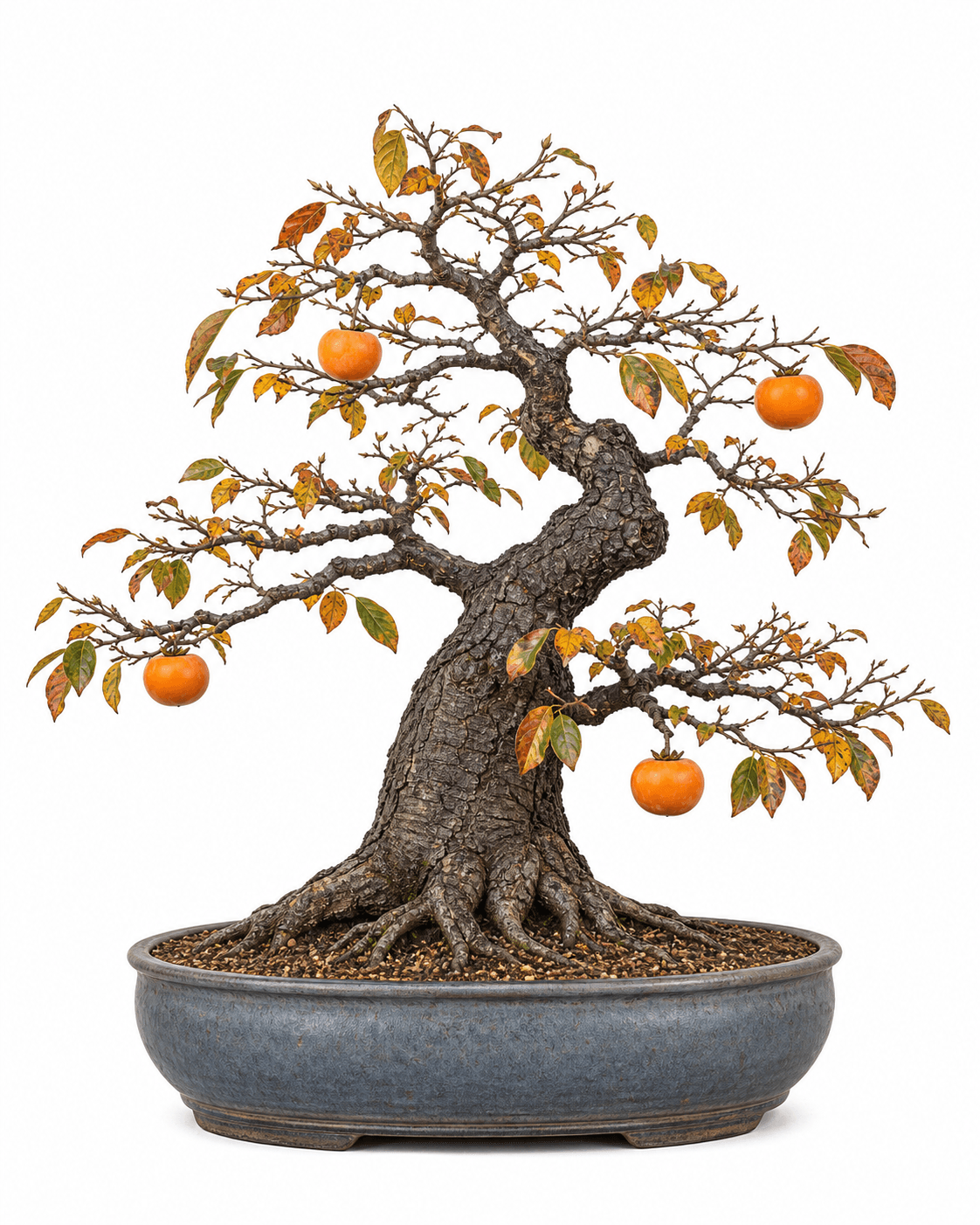
Japanese persimmon bonsai is an outdoor deciduous fruit tree grown for glossy summer leaves, autumn color, orange fruit, blocky bark, and a clean winter silhouette. The best care is seasonal and restrained: build roots, trunk, and branches first, then let a strong refined tree carry only a small fruit display.
Kew accepts Diospyros kaki in Ebenaceae, with a native range from Assam to central and southern China, Vietnam, and Taiwan. In horticulture the same species appears as Japanese persimmon, Asian persimmon, Oriental persimmon, Chinese persimmon, and kaki, so the label should be checked before care advice is applied.
The local Mirai corpus has only indirect Diospyros and princess persimmon mentions, so this guide is transparent about method transfer. Bonsai technique comes from Mirai fruiting, flowering, deciduous, root, soil, watering, wiring, propagation, and design files; species facts come from Kew, NC State, Oregon State, UGA, Clemson, LSU, and UC ANR.
Updated June 16, 2026. Written by EntGrove Editorial. Last verified June 16, 2026.
Care fingerprint
Read the species through its shared care pattern.
Repot and structural prune around dormant-to-active transitions; protect new leaves; time refinement work after growth hardens. Use this as the starting point before local conditions and tree strength refine the calendar.
Read the foliage first
Broadleaf stress usually shows in leaf color, leaf size, wilt, scorch, or delayed hardening before it becomes a branch problem.
Match work to dormancy
Deciduous, evergreen, tropical, succulent, and flowering broadleaf trees recover on different calendars.
Protect fine roots
Root work should preserve enough active fine roots for the tree to rehydrate quickly after the operation.
Care cadence
The calendar starts with the tree's seasonal state.
Placement
Timing: Grow outdoors through the year. Keep the tree cold and dormant in winter, with the container mulched, heeled in, or moved to an unheated shelter when the root zone is at risk.
Watch for: Warm indoor storage, late frost after mid-April bloom, roots freezing in a small pot, hot reflected walls, and winter wind drying frozen soil.
NC State ExtensionUniversity of Georgia ExtensionBonsai Mirai LibraryLight requirement
Timing: Use full sun during active growth. Add temporary shade only after root work, during severe heat, or when fruiting branches wilt before the soil can be rewetted safely.
Watch for: Long weak shoots, pale leaves, poor fruit set, weak autumn color, sun-scald on newly exposed bark, and leaf burn on a recently repotted tree.
NC State ExtensionLSU AgCenter plant materialsBonsai Mirai LibraryWatering
Timing: Water thoroughly when the surface and top dressing read dry. Check more often from leaf expansion through fruit sizing, then reduce winter frequency while keeping the root ball from drying hard.
Watch for: Fruit drop after drought or poor drainage, a dry central root mass, sour wet soil, cracked fruit, and small pots drying quickly while the crop is sizing.
University of Georgia ExtensionBonsai Mirai LibraryFertilizer
Timing: Feed by development phase. Use stronger organic feeding while building structure, moderate feeding while setting secondaries, and lighter feeding in refinement after the first flush hardens. Pull back during peak heat and after heavy root work.
Watch for: Excess nitrogen that contributes to fruit drop, late soft growth before cold, fertilizer on stressed roots, and coarse shoots on a tree meant to refine.
University of Georgia ExtensionClemson ExtensionBonsai Mirai LibraryPruning and fruiting
Timing: Use development pruning after shoots harden and structural cleanup in the leafless window. Keep fruiting tips only on refined branches, and thin fruit within the first month after bloom when the crop is heavy.
Watch for: Uniform heading cuts, removal of productive tips, spindly fruiting shoots, crop load on recently repotted trees, and biennial-bearing cycles after a heavy display.
UC ANR Master GardenersUniversity of Georgia ExtensionBonsai Mirai LibraryWiring
Timing: Wire young hydrated branches when they are vigorous enough to bend, often after hardening or in the leafless fall window. Use padding, guy wires, props, or clip-and-grow for brittle older wood.
Watch for: Brittle persimmon wood, fruit weight changing branch angle, wire hidden by large leaves, pressure scars, and bends attempted on dehydrated tissue.
UC ANR Master GardenersBonsai Mirai LibraryRepotting
Timing: Repot around spring bud swell when the tree can quickly rebuild roots. Work the surface, sides, and bottom, preserve the functioning central root mass, and anchor the tree firmly.
Watch for: Compacted nursery soil, decomposed akadama, slip-pot interfaces, hard root reduction before a fruit crop, and repeated repotting inside about two years.
Bonsai Mirai LibraryPests and diseases
Timing: Inspect from bud break through leaf drop, especially the lower trunk, exposed roots, twig bases, and leaf undersides. Keep the canopy open enough to dry after rain.
Watch for: Scale, mealybug, persimmon psyllid leaf curling, caterpillar feeding, persimmon borer at the lower trunk or tap roots, fungal leaf spot, twig dieback, powdery mildew, and ambrosia beetles on injured bark.
NC State ExtensionClemson ExtensionUniversity of Georgia ExtensionSpecies guide
Apply the species profile before copying another tree's calendar.
At a glance
Japanese persimmon is an outdoor deciduous fruit tree for disciplined growers.
Diospyros kaki is a deciduous Ebenaceae tree with several horticultural names: Japanese persimmon, Asian persimmon, Oriental persimmon, Chinese persimmon, and kaki. Kew accepts the species and places its native range from Assam to central and southern China, Vietnam, and Taiwan; Oregon State adds the long cultivated route through China, Korea, and Japan. Kew POWOOregon State Landscape Plants
In the EntGrove model, Japanese persimmon sits in Broadleaf > Deciduous with flowering and fruiting cautions. It wants full sun, fresh air, a cold dormant winter, moisture with oxygen, a spring root window, and crop control. It belongs outside even when the tree is being protected from hard freezes. NC State ExtensionOregon State Landscape PlantsBonsai Mirai Library
The display features are large enough to decide the scale. Oregon State records 6 to 18 cm leaves and 3.5 to 7 cm fruit, while UGA says Oriental persimmon fruit can reach peach size. Medium and large bonsai usually make the orange fruit and blocky bark feel proportional. Oregon State Landscape PlantsUniversity of Georgia Extension
Wild habitat
Warm-temperate origin explains the sun, drainage, and cold limits.
Kew describes Diospyros kaki as a shrub or tree of the temperate biome, native from Assam through parts of China, Vietnam, and Taiwan. Oregon State describes the cultivated tree as 15 to 30 ft tall, upright to round-headed, and hardy to USDA Zone 7. Kew POWOOregon State Landscape Plants
The care implication is bright outdoor culture with a winter rest and a careful container buffer. NC State says the tree grows best in full sun and loamy, moist, well-drained soil with pH 6.0 to 6.5, and lists 10 F as a cold-tolerance threshold. UGA gives the same 10 F injury line for Oriental persimmon and notes Great Wall, Peping, and Sheng can be hardier when grafted on native persimmon rootstock. NC State ExtensionUniversity of Georgia Extension
The design implication is a broad seasonal fruit tree. The strongest images lean into aged bark, heavy seasonal fruit, horizontal or drooping branch weight, autumn color, and a winter structure that still reads after the leaves fall. Oregon State Landscape PlantsLSU AgCenter plant materialsBonsai Mirai / Asymmetry
Reading the tree
Read energy before reading fruit count.
Mirai flowering and fruiting method treats fruit as a high-cost reproductive load. In primary and secondary development, the tree should spend energy on extension, thickening, wound healing, foliar expansion, back-budding, and root regeneration. Fruit becomes a refined-tree privilege. Bonsai Mirai Library
Japanese persimmon makes this easy to see. A young tree with long whips, a weak root system, a recent repot, or missing primary branches should be stripped of fruit. A strong refined tree can carry a few fruit placed where they support the design without bending weak branchlets. Bonsai Mirai LibraryUniversity of Georgia Extension
The source-depth caveat matters. The local Mirai corpus has indirect Diospyros and princess persimmon mentions rather than a dedicated Diospyros kaki lesson, so the page transfers only broad fruiting and deciduous method, then grounds cold, pollination, fruit, pruning, and pest claims in extension sources. Bonsai Mirai LibraryUC ANR Master GardenersUniversity of Georgia Extension
Pruning
Prune with fruiting tips, brittle wood, and development phase in mind.
UC ANR gives the most useful species-specific pruning warning: persimmon wood is brittle, fruit is borne on new and one-year-old wood, and the branch tips are often the most productive fruiting sites. Uniform heading cuts create chaotic regrowth and can remove the structure that would have carried fruit. UC ANR Master Gardeners
For bonsai development, let selected shoots extend and harden before cutting back to useful direction changes. Mirai deciduous method separates primary, secondary, and tertiary phases; in development, extension and recovery matter more than a tidy outline or a seasonal crop. Bonsai Mirai Library
For a refined tree, prune lightly around productive tips and remove dead, diseased, damaged, crossing, spindly, or badly placed branches. Clemson gives minimal pruning as the landscape baseline, while UC ANR advises thinning for even branch spacing and removing weak shoots that may break under fruit. Clemson ExtensionUC ANR Master Gardeners
Fruit thinning should happen early enough to protect the tree. UGA recommends thinning heavy Oriental persimmon crops to about 6 in apart within a month after bloom in orchard culture; a bonsai often carries far fewer fruit because the root and branch system is deliberately reduced. University of Georgia ExtensionBonsai Mirai Library
Repotting
Repot at spring bud swell, then let roots recover before fruit.
Use the conservative deciduous root window: repot around spring bud swell, when stored energy can become new roots and leaves soon after the operation. Protected collections may work earlier, but visible spring movement is the public recommendation for a fruiting deciduous tree. Bonsai Mirai Library
Handle Japanese persimmon as a shin-based or coarse fruiting deciduous root system unless the tree in front of you proves otherwise. Work the surface, sides, and bottom to restore oxygen and drainage, preserve the functioning central root mass, cut ragged roots cleanly, and anchor the tree so movement cannot tear new roots. Bonsai Mirai Library
Repot by condition rather than by habit. Slow percolation, decomposed akadama, circling nursery roots, a stale central root mass, weak spring push, or a required planting-angle change all justify work. A tree repotted heavily in spring should carry no fruit that season. Bonsai Mirai LibraryUniversity of Georgia Extension
Soil and pot
Give a fruiting tree moisture, oxygen, and believable scale.
The soil target is moisture with oxygen. NC State gives the horticultural version as loamy, moist, well-drained soil with pH 6.0 to 6.5, and UGA warns that poor drainage or drought extremes can cause serious fruit drop. In a bonsai pot, that means a granular mix, thorough watering, and real air space after each watering cycle. NC State ExtensionUniversity of Georgia ExtensionBonsai Mirai Library
For mature deciduous refinement, Mirai soil method favors solid akadama because root scaling can create finer roots, shorter internodes, smaller leaves, and refined ramification. During nursery conversion or trunk building, a coarser development mix can be acceptable while the tree still needs vigor and root transition. Bonsai Mirai Library
Pot depth matters more than a catalog silhouette. Fruit, large leaves, and summer heat all increase water demand, so a Japanese persimmon usually benefits from a deeper oval, rectangle, or soft-cornered container until roots and ramification are stable enough for a shallower exhibition pot. Oregon State Landscape PlantsBonsai Mirai Library
Climate
Landscape hardiness numbers need container translation.
The sources agree that Japanese persimmon is milder than native American persimmon. Oregon State lists USDA Zone 7, LSU lists Zones 7-9, and NC State plus UGA warn that Oriental persimmon can be injured below about 10 F. In a bonsai pot, root protection begins before the absolute top-hardiness number is reached. Oregon State Landscape PlantsLSU AgCenter plant materialsNC State ExtensionUniversity of Georgia Extension
Cold-region care should keep the tree dormant and buffered. Set the container on the ground, mulch around the pot, or use an unheated cold frame. Warm indoor winter storage weakens the seasonal cycle and can trigger light-starved growth before the bench is ready. Bonsai Mirai Library
Hot-region care should keep sun while managing container heat. Use morning water discipline, top dressing, enough pot volume, and temporary afternoon relief after repotting or during severe heat. Shade used as a substitute for watering will reduce fruiting strength and autumn color. NC State ExtensionLSU AgCenter plant materialsBonsai Mirai Library
Pests and diseases
Scale, psyllids, borers, and leaf disease deserve routine inspection.
NC State lists scale, mealybug, and leaf spot. Clemson lists scale, persimmon psyllid, leafrolling and defoliating caterpillars, persimmon borer, fungal leaf spot, twig dieback, and powdery mildew. UGA adds ambrosia beetles on injured or sun-scalded bark and termites on weak young potted plants in sawdust-heavy situations. NC State ExtensionClemson ExtensionUniversity of Georgia Extension
Persimmon borer is the pest to take most seriously in bonsai because the lower trunk, exposed roots, and tap-root region are often visible and valuable. UGA notes that larvae attack the lower trunk and tap roots; inspect old scars, graft unions, exposed roots, and trunk bases before damage becomes structural. University of Georgia ExtensionClemson Extension
Prevention is mostly cultural: full sun, open branch structure, clean leaf drop, good drainage, no fruit overload, restrained nitrogen, and prompt removal of damaged tissue. Use local extension guidance for chemical choices because pest timing and legal products differ by region. Clemson ExtensionUniversity of Georgia ExtensionBonsai Mirai Library
Wiring
Wire young wood, then let pruning do more of the old-wood work.
UC ANR calls persimmon wood brittle and recommends developing wide scaffold angles early. In bonsai terms, add meaningful movement while branches are young, hydrated, and vigorous; older persimmon wood should usually be repositioned with pruning, guy wires, props, or replacement growth. UC ANR Master GardenersBonsai Mirai Library
Mirai structural wiring method still applies: choose a branch for a design reason, size wire to hold the bend, keep a 55 to 60 degree coil angle, maintain even spacing, keep contact without constriction, and distribute bending force across the branch rather than one point. Bonsai Mirai Library
Check wire early. Large leaves hide wire bite, fruit changes branch load, and fall vascular thickening can tighten wire quickly. On smooth younger bark, the removal signal is wire getting tight, before a scar forms. Bonsai Mirai LibraryUC ANR Master Gardeners
Propagation
Seed, grafting, cuttings, and layers all create different bonsai problems.
Seed-grown Japanese persimmon can be useful for long-term roots and trunk projects, but fruit quality and sex expression vary. NC State notes that trees can be dioecious, sometimes carry both flower sexes, sometimes have perfect flowers, and can set parthenocarpic seedless fruit. For fruit predictability, UGA recommends known varieties from reliable nurseries. NC State ExtensionUniversity of Georgia Extension
Grafting is common in fruit production and matters in bonsai sourcing. UGA notes hardier Oriental cultivars grafted on native persimmon rootstock in colder parts of Georgia. Inspect graft unions before buying, because a high, swollen, or visually incompatible union may dominate the future trunk. University of Georgia ExtensionBonsai Mirai / Asymmetry
Cuttings and air layers should be treated as advanced experiments rather than the easiest path. Mirai propagation method emphasizes wood stage, clean razor cuts, oxygenated medium, transpiration control, and patience. Coarse flowering and fruiting species may produce uneven root starts, so the best propagation result is one that already supports future nebari. Bonsai Mirai Library
Buying and sourcing
Buy structure first, then cultivar value.
Choose material for base, taper, bark potential, low branch options, root health, pot drainage, and a recoverable graft union. A tree covered in orange fruit can still be poor bonsai stock if it is a straight orchard whip with no usable lower structure. Bonsai Mirai / AsymmetryUniversity of Georgia Extension
Cultivar names are still useful. NC State highlights Fuyu, Hana Gosho, and Jiro. UGA lists Eureka, Hana Fuyu, Fuyu, Ichikikei Jiro, Tanenashi, Tamopan, Great Wall, Sheng, and Peping, and explains that some produce quality fruit without pollination. For bonsai, cultivar value comes from fruit size, vigor, cold tolerance, branch habit, and graft quality. NC State ExtensionUniversity of Georgia Extension
Keep Japanese persimmon separate from American persimmon. Clemson and UGA both distinguish Oriental persimmon, Diospyros kaki, from native Diospyros virginiana; they differ in cold tolerance, fruit behavior, pollination details, and bonsai sourcing expectations. Clemson ExtensionUniversity of Georgia Extension
Troubleshooting
Most problems trace back to light, water, fruit load, roots, or cuts.
Fruit drop usually points to moisture extremes, excess nitrogen, parthenocarpic fruit behavior, weak roots, or a crop heavier than the tree can support. Check drainage and watering first, thin fruit, and avoid feeding hard to force a crop. University of Georgia ExtensionNC State ExtensionBonsai Mirai Library
Long weak shoots and poor color usually point to shade, excessive nitrogen, or development growth that missed timely cutback. Restore full outdoor light and choose whether the branch is building structure or refining. NC State ExtensionBonsai Mirai Library
Branch breakage during wiring points to persimmon wood quality, dehydration, old caliper, or timing. Move younger tissue earlier, use guy wires, and avoid repeating pressure on previously wired or bent points. UC ANR Master GardenersBonsai Mirai Library
Leaf spots, curled leaves, scale, and borer signs need early action. Improve airflow, remove diseased leaves, inspect lower trunk and exposed roots, and separate chemical decisions from diagnosis by checking local extension guidance. Clemson ExtensionUniversity of Georgia Extension
Design
Design for an old fruit tree rather than a fine foliage pad.
Mirai design fundamentals read every tree through base, trunk line, defining branch, and apex. Japanese persimmon adds a strong species filter: fruit, blocky bark, horizontal branch weight, and autumn color should explain the design choices. Bonsai Mirai LibraryBonsai Mirai / Asymmetry
Strong styles include informal upright, slanting, twin-trunk, clump, orchard-tree, and broad deciduous forms. The canopy can be layered and billowy, but the tree should keep enough openness that fruit, branch hierarchy, and winter lines remain visible. Bonsai Mirai LibraryOregon State Landscape Plants
Deadwood should stay incidental. Persimmon is a deciduous fruit tree, so age reads more naturally through bark, hollow-compatible scars, branch hierarchy, fruit restraint, and seasonal transitions than through conifer-style jin and shari. Bonsai Mirai LibraryBonsai Mirai / Asymmetry
Cultivars and forms
Cultivar choice affects fruit, vigor, cold tolerance, and graft visibility.
NC State recommends Fuyu, Jiro, and Hana Gosho, while UGA lists Eureka, Hana Fuyu, Fuyu, Ichikikei Jiro, Tanenashi, Tamopan, Great Wall, Sheng, and Peping. Oregon State notes several thousand cultivars and separates astringent types from non-astringent types. NC State ExtensionUniversity of Georgia ExtensionOregon State Landscape Plants
Astringency matters for eating but only indirectly for bonsai. Clemson explains that astringent Oriental persimmons need to be fully soft before eating, while non-astringent types can be eaten firmer. For a bonsai grower, the higher-value questions are fruit size, crop load, branch strength, cold tolerance, and display timing. Clemson ExtensionUniversity of Georgia Extension
Pollination language can also confuse buying decisions. NC State and UGA both describe variable flower behavior and parthenocarpic fruit set, and UGA notes heavier or more consistent crops can result from pollination. For bonsai, predictable modest fruit is usually more valuable than maximum crop. NC State ExtensionUniversity of Georgia Extension
Princess persimmon belongs in the same design conversation with a separate care page. The local Mirai corpus mentions Diospyros through princess persimmon in fruiting and propagation contexts, while this page is for Diospyros kaki and its orchard-derived cultivars. Bonsai Mirai LibraryKew POWO
History
The tree carries Chinese origin, Japanese naming, and fruit-display bonsai value.
Kew records Diospyros kaki as the accepted 1780 Thunberg name, and Oregon State summarizes the cultural route from China into Korea and Japan. The Japanese word kaki remains embedded in the botanical and common-name vocabulary. Kew POWOOregon State Landscape Plants
As bonsai, Japanese persimmon belongs with the fruiting deciduous tradition where seasonal display is powerful but secondary to tree quality. A great tree can be shown with no fruit in development, with one or a few fruit in refinement, or as a leafless winter silhouette after the autumn display has passed. Bonsai Mirai LibraryBonsai Mirai / Asymmetry
The exhibition standard should be restraint. Fruit should support the story of age, season, and structure; an overloaded small tree reads as horticultural stress. A strong base, convincing trunk, well-placed branches, and clean pot pairing matter before crop count. Bonsai Mirai LibraryOregon State Landscape Plants
FAQ
Japanese persimmon bonsai questions, answered directly.
The short answers below reflect the full care guide: outdoor culture, full sun, moisture with oxygen, spring root work, light fruiting on strong trees, and species-specific respect for brittle wood and productive branch tips. Kew POWONC State ExtensionUC ANR Master GardenersBonsai Mirai Library
Species questions
Answer the beginner questions before styling.
Is Japanese persimmon a good beginner bonsai?
Yes for an outdoor grower with sun, winter dormancy, regular watering, and discipline around fruit thinning. It is a better first fruiting tree than a tiny indoor shelf project.
Can Japanese persimmon bonsai live indoors?
Grow Japanese persimmon outdoors. It needs seasonal light, leaf drop, and a cold dormant winter, with the pot protected during hard freezes.
How much sun does Japanese persimmon bonsai need?
Use full sun as the baseline. Temporary afternoon relief helps after repotting, during severe heat, or when fruiting branches are losing water faster than the roots can supply it.
How often should I water Japanese persimmon bonsai?
Water by demand. Check more often during spring growth, summer heat, wind, and fruit sizing, then water thoroughly when the surface and top dressing read dry.
When should I repot Japanese persimmon bonsai?
Repot around spring bud swell when drainage, root density, soil breakdown, or a planting-angle change calls for it. Remove fruit after heavy root work so recovery has priority.
When should I prune Japanese persimmon bonsai?
Use development pruning after shoots harden, and structural cleanup in the leafless window. Prune lightly around productive branch tips because persimmon can bear fruit on new and one-year-old wood.
Should I thin fruit on Japanese persimmon bonsai?
Yes. Keep only a small, intentional fruit display on strong refined trees. Strip fruit from young, weak, recently repotted, collected, or branch-building trees.
What pests affect Japanese persimmon bonsai?
Watch for scale, mealybug, persimmon psyllid, leafrolling and defoliating caterpillars, persimmon borer, fungal leaf spot, twig dieback, powdery mildew, and ambrosia beetles on injured bark.
Is Japanese persimmon the same as American persimmon?
Keep them separate. Japanese persimmon is Diospyros kaki, while American persimmon is Diospyros virginiana. They differ in cold tolerance, fruit behavior, pollination details, and sourcing.
Why is Japanese persimmon usually medium or large as bonsai?
The leaves can reach 6 to 18 cm and the fruit can reach 3.5 to 7 cm across. Larger designs make those seasonal features feel proportional.
Sources
Species advice needs source discipline.
Next decisions
Plan the operation before copying the calendar.
A good care note for Japanese persimmon / kaki records the tree's stage, the work done, and the aftercare used. That record matters more than a month-name rule.
Related species
Compare nearby trees before transferring advice.
Japanese maple
Acer palmatum
Trident maple
Acer buergerianum
Amur maple
Acer tataricum subsp. ginnala
Field maple
Acer campestre
Korean hornbeam
Carpinus turczaninovii