
Species guide
Australian Bottle Tree Bonsai Care
Brachychiton rupestris
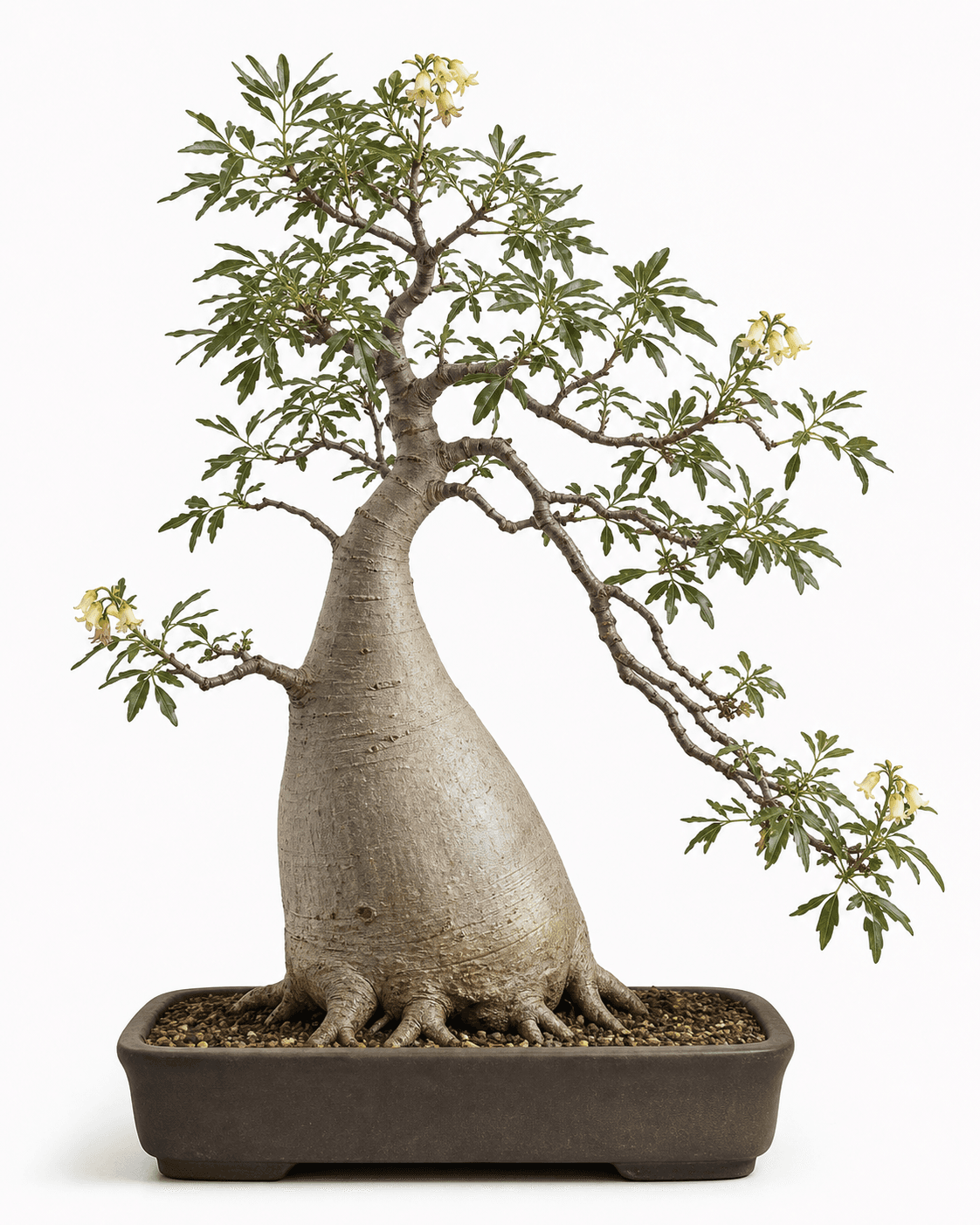
Australian bottle tree bonsai care starts with the trunk. Brachychiton rupestris is a Queensland bottle tree with a swollen water-storing base, variable narrow-to-lobed leaves, cream bell-shaped flowers, and woody seed follicles, so bonsai design should emphasize the base before twig density.
Treat it in EntGrove as Broadleaf > Succulent for care behavior, even though it is a Malvaceae tree rather than a cactus-like succulent. Use strong light, fast mineral drainage, warm active-growth root work, deep watering followed by oxygen return, and frost-protected wintering in a bonsai pot.
The local Mirai corpus has no dedicated Brachychiton file. This guide transfers Mirai succulent, tropical, watering, soil, repotting, wiring, fertilizer, propagation, and design method transparently, while Kew, GBIF, ANPSA, and public species summaries ground taxonomy, range, morphology, and label handling.
Updated June 13, 2026. Written by EntGrove Editorial. Last verified June 13, 2026.
Care fingerprint
Read the species through its shared care pattern.
Err on mineral drainage, warm recovery, and conservative watering; many tolerate pruning but not cold wet roots. Use this as the starting point before local conditions and tree strength refine the calendar.
Note: Queensland-centered swollen-trunk Brachychiton with variable leaves, cream bell-shaped flowers, woody follicles, and seed hairs that irritate skin. Treat as Broadleaf > Succulent for bonsai behavior, and keep generic bottle-tree labels separate from Ceiba, Adansonia, and other Brachychiton species until identity is verified.
Read the foliage first
Broadleaf stress usually shows in leaf color, leaf size, wilt, scorch, or delayed hardening before it becomes a branch problem.
Match work to dormancy
Deciduous, evergreen, tropical, succulent, and flowering broadleaf trees recover on different calendars.
Protect fine roots
Root work should preserve enough active fine roots for the tree to rehydrate quickly after the operation.
Care cadence
The calendar starts with the tree's seasonal state.
Placement
Timing: Use full sun or the brightest protected light during active growth. Reintroduce outdoor sun gradually after winter protection, shipping, greenhouse culture, or repotting.
Watch for: Sunburn on soft protected leaves, stretched low-light shoots, cold glass in winter, and wind rocking a top-heavy bottle trunk.
Australian Native Plants Society: Brachychiton rupestrisBonsai Mirai LibraryWatering
Timing: During warm leafed growth, water deeply when the pot is drying and the tree is using water. During cool or leafless rest, water lightly and less often.
Watch for: Soft trunk base, sour soil, yellowing after wet cold weather, panic watering after normal leaf drop, and a dry hot wind on a small pot.
Bonsai Mirai LibraryFeeding
Timing: Feed lightly to moderately during warm active growth after roots are functioning. Stop pushing growth as light, heat, or leaf activity declines.
Watch for: Oversized leaves, long internodes, salt buildup in dry pots, and fertilizer applied before root recovery after repotting.
Bonsai Mirai LibraryPruning
Timing: Prune in stable warm growth after shoots extend and begin to harden. Keep some leaf mass so the tree can replace roots and recover from cuts.
Watch for: Heavy reduction on a weak or leafless tree, large cuts before cold wet weather, and removing all lower trunk-building growth too early.
Bonsai Mirai LibraryBonsai Mirai / AsymmetryLeaf work
Timing: Use selective leaf reduction or partial defoliation only on strong trees in high light. Let developing trunks keep leaves to build storage and roots.
Watch for: Full defoliation used to force small leaves. Root maturity, light, pot size, and shoot selection give safer scale over time.
Bonsai Mirai LibraryRepotting
Timing: Repot during warm active growth, with nights reliably above about 60 F / 16 C and new extension or active buds visible.
Watch for: Cold wet aftercare, buried trunk bases, torn fleshy roots, unstable tie-downs, and heavy top work in the same session.
Bonsai Mirai LibraryWiring
Timing: Wire young branches while they are flexible and active, then check often. Use guy wires or pruning when older branches resist bending.
Watch for: Wire bite during warm swelling, cracked green bark, forced bends on brittle shoots, and branches that hide the bottle base.
Bonsai Mirai LibraryBonsai Mirai / AsymmetryWinter protection
Timing: Protect before frost and before cold rain saturates the pot. Keep protected trees bright, airy, and on a reduced watering rhythm.
Watch for: Wet cold roots, low-light leaf retention, weak indoor growth, mites or scale, and watering a resting tree on a summer schedule.
Bonsai Mirai LibraryPest and disease inspection
Timing: Inspect during warm flushes, greenhouse wintering, and after repotting. Cultural root rot is the first problem to prevent.
Watch for: Scale, mealybug, aphids, mites, sticky residue, leaf rollers, black roots, trunk-base softness, and organic soil that stays cold and wet.
Bonsai Mirai LibraryPublic species summary: Brachychiton rupestrisSpecies guide
Apply the species profile before copying another tree's calendar.
At a glance
Australian bottle tree is a swollen-trunk broadleaf for patient warm-climate bonsai.
Apply this page to Brachychiton rupestris. Australian bottle tree, Queensland bottle tree, narrow-leaved bottle tree, and bottle tree can all point to this species, although generic bottle-tree labels are ambiguous in the trade. Kew POWO search: Brachychiton rupestrisAustralian Native Plants Society: Brachychiton rupestrisPublic species summary: Brachychiton rupestris
EntGrove places it in Broadleaf > Succulent because the water-storing trunk, dry-season leaf rhythm, warm recovery, and rot-sensitive container roots are the practical care drivers. Bonsai Mirai LibraryPublic species summary: Brachychiton rupestris
The plant facts are clear enough for a source-depth-aware page: Malvaceae, Queensland-centered range, bulbous trunk, variable leaves, cream bell flowers, woody follicles, and easy seed propagation with irritant hairs in the pods. Australian Native Plants Society: Brachychiton rupestrisPublic species summary: Brachychiton rupestris
The bonsai-source limitation is also clear. The local Mirai corpus has no dedicated Brachychiton file, so this profile separates public plant facts from transferred Mirai succulent, tropical, and foundational bonsai method. Bonsai Mirai Library
Habitat
Queensland bottle-tree habitat explains the swollen base and dry-cycle care.
ANPSA frames the species in dry areas of central western Queensland and northern New South Wales, while public species summaries emphasize central Queensland and bottle-tree scrub in the Brigalow Belt. Australian Native Plants Society: Brachychiton rupestrisPublic species summary: Brachychiton rupestrisGBIF species search: Brachychiton rupestris
The habitat signal is seasonal resilience rather than constant wetness. Trees occupy rocky or heavy-soil landscapes and store water in the trunk, so bonsai culture should provide warmth and oxygen while avoiding cold saturated roots. Public species summary: Brachychiton rupestrisBonsai Mirai Library
For design, the wild ecology points toward a sturdy swollen base, sparse but deliberate branching, and visible empty space around the trunk. Dense hedge-like ramification can make the tree look generic. Bonsai Mirai / AsymmetryAustralian Native Plants Society: Brachychiton rupestris
Reading the tree
Read trunk firmness, leaf status, root oxygen, and extension strength.
A strong Australian bottle tree has a firm base, active buds or leaves in warm conditions, a drying mineral soil cycle, and no soft dark tissue where the trunk meets the soil. Bonsai Mirai Library
Development means building the bottle trunk, root flare, and primary branch options. Seedlings may need years of generous growth before the defining trunk character appears. Australian Native Plants Society: Brachychiton rupestrisBonsai Mirai / Asymmetry
Refinement means reducing to fewer better branches, controlling shoot length, and keeping the design readable when leaves are large or seasonally absent. The crown should serve the trunk. Bonsai Mirai / AsymmetryBonsai Mirai Library
Pruning
Prune during warm growth and use leaves to build the trunk.
Prune after shoots extend and begin to harden, while heat and light can support recovery. Cut to useful nodes or branch junctions, then let the tree rebuild before another round. Bonsai Mirai Library
Protect low growth while developing the bottle base. Lower sacrifice shoots can thicken the trunk, heal cuts, and make the eventual silhouette look earned. Bonsai Mirai / Asymmetry
Use leaf work sparingly. Variable leaves are part of the species, and repeated full defoliation on weak or indoor material can spend stored energy on replacement leaves instead of roots and trunk. Australian Native Plants Society: Brachychiton rupestrisBonsai Mirai Library
Large cuts should be timed with warm recovery ahead. Soft water-storing trunks and roots punish late-season wounding if the tree then sits cold and wet. Bonsai Mirai Library
Roots
Repot warm, preserve swollen roots, and keep the trunk crown high.
Use tropical-succulent timing for major root work: warm nights, visible active growth, and enough season left for new roots. In most cold-winter collections, that means late spring or early summer rather than early spring. Bonsai Mirai Library
Preserve hydration continuity. Mirai tropical repotting guidance cautions against severe root disturbance on leafy tropical material, and succulent repotting guidance adds extra care around fleshy roots. Bonsai Mirai Library
Set the trunk crown high enough to show the base and avoid wet bark. A buried swollen base hides the main feature and increases the chance of crown rot. Bonsai Mirai LibraryBonsai Mirai / Asymmetry
Anchor thoroughly. A top-heavy trunk in fresh soil can rock enough to break new roots, especially in wind or when the pot is moved for winter protection. Bonsai Mirai Library
Soil and pot
Use mineral drainage and a container that visually supports the base.
Start with a 1:1:1 mineral baseline of akadama, pumice, and lava, then adjust for climate. Hot active trees can use slightly more water retention; protected winter trees need faster drying. Bonsai Mirai Library
ANPSA notes tolerance of a range of soils in cultivation. Bonsai containers narrow that tolerance, so drainage and oxygen matter more than landscape adaptability. Australian Native Plants Society: Brachychiton rupestrisBonsai Mirai Library
Development containers should allow roots and trunk to build. Display containers can be quieter and heavier visually, such as deeper ovals or rectangles that stabilize the bottle form. Bonsai Mirai / Asymmetry
Leave watering headroom and keep the surface contour from funneling water into the trunk base. A broad swollen base should sit proud, dry quickly at the crown, and still be firmly anchored. Bonsai Mirai Library
Climate
Give heat, light, and dry-cycle discipline, then protect the pot from cold.
In warm subtropical and mild Mediterranean regions, Australian bottle tree can spend most of the year outdoors. Tie watering to active leaves, pot size, heat, and actual soil drying. Australian Native Plants Society: Brachychiton rupestrisBonsai Mirai Library
In cold-winter regions, use a bright greenhouse, conservatory, or strong indoor grow-light setup before frost. Cool dormant storage that works for temperate trees is too risky for a warm-climate bottle tree in a small pot. Bonsai Mirai Library
In humid regions, improve airflow and mineral drainage. The species tolerates drought better than stagnant wet soil, and container roots need oxygen after every watering. Bonsai Mirai LibraryPublic species summary: Brachychiton rupestris
In very hot dry regions, protect newly repotted trees from the harshest afternoon exposure until roots recover. Established active trees can take strong light when water and oxygen are balanced. Bonsai Mirai Library
Pests
Prevent root rot first, then watch protected trees for common sap feeders.
Soft tissue at the trunk base, sour soil, black roots, and decline after cold wet periods indicate root or crown rot pressure. Stop routine watering and restore warmth, airflow, and drainage before styling. Bonsai Mirai Library
Scale, mealybug, aphids, mites, and sticky residue are the likely protected-culture checks. Inspect young shoots, leaf undersides, branch junctions, and the shaded side of a swollen trunk. Bonsai Mirai Library
Public species summaries note insect associations such as kurrajong leaf roller and pale cotton stainer. In bonsai, the practical response is inspection, sanitation, airflow, and local integrated pest guidance when damage appears. Public species summary: Brachychiton rupestris
Leaf drop can be seasonal or stress-driven. Diagnose with trunk firmness, recent temperatures, light, and soil moisture before adding water or fertilizer. Public species summary: Brachychiton rupestrisBonsai Mirai Library
Wiring
Wire young flexible shoots and let trunk character carry the design.
Wire young active branches when they can bend without cracking, then check often during warm growth. Use guy wires or clip-and-grow where older branches resist movement. Bonsai Mirai Library
The design should reveal the bottle base. Over-wired dense branches can hide the feature that makes Brachychiton worth training. Bonsai Mirai / AsymmetryAustralian Native Plants Society: Brachychiton rupestris
Avoid wiring immediately after major root work. Let new roots anchor first, then adjust branch direction once the tree is clearly moving water again. Bonsai Mirai Library
Propagation
Seed is the best route for documented young material and root design.
ANPSA describes seed propagation as relatively easy and warns that pod hairs are irritating, so gloves are the sensible handling baseline. Australian Native Plants Society: Brachychiton rupestris
Seedlings are especially useful for bonsai because the grower can guide root flare, trunk swelling, movement, and branch placement from the start. Bonsai Mirai / AsymmetryAustralian Native Plants Society: Brachychiton rupestris
Cuttings and grafting may appear in broader Brachychiton horticulture, but this profile has no dedicated Mirai benchmark for those techniques on Brachychiton rupestris. Use them as specialist propagation choices. Bonsai Mirai LibraryPublic species summary: Brachychiton rupestris
Air-layering can solve a poor trunk or root base only when the new base would improve the bottle-tree reading. A seedling grown correctly is usually the cleaner long-term bonsai path. Bonsai Mirai / Asymmetry
Buying
Buy for verified labels, firm trunk tissue, and roots that can be converted.
Accept Australian bottle tree, Queensland bottle tree, narrow-leaved bottle tree, Brachychiton, and Brachychiton rupestris labels, then confirm the plant against leaves, trunk shape, pods, and nursery records. Australian Native Plants Society: Brachychiton rupestrisPublic species summary: Brachychiton rupestris
Look for a firm swelling base, visible root flare, low branch options, active buds, clean bark, and soil that can be converted gradually without destroying the root system. Bonsai Mirai LibraryBonsai Mirai / Asymmetry
Avoid soft trunk bases, sour wet soil, all branches high above a straight lower trunk, fresh severe chops, and vague wild-origin claims. Young seed-grown material is often better than impressive but compromised stock. Bonsai Mirai Library
Separate Brachychiton rupestris from Ceiba speciosa, Adansonia gregorii, Brachychiton populneus, Brachychiton compactus, and generic kurrajong labels before applying species-specific advice. Kew POWO search: Brachychiton rupestrisPublic species summary: Brachychiton rupestris
Troubleshooting
Most failures trace to cold wet roots, weak light, or impatient styling.
Leaves drop: check season, cold exposure, drought, rainfall, soil moisture, and trunk firmness. A firm tree in a drying pot may be resting; a soft base in wet soil signals danger. Public species summary: Brachychiton rupestrisBonsai Mirai Library
Base softens: warm the tree, improve airflow, stop routine watering, and inspect the soil core. Styling waits until the root problem is solved. Bonsai Mirai Library
Long weak shoots: increase light gradually, reduce nitrogen, and let the tree strengthen before pruning. Protected winter growth often lacks the energy to become useful structure. Bonsai Mirai Library
Bottle trunk fails to develop: give the plant more years, more root room during development, stronger light, and selected sacrifice growth. ANPSA notes the bottle shape may take 5-8 years to become noticeable. Australian Native Plants Society: Brachychiton rupestrisBonsai Mirai / Asymmetry
Large leaves persist: build roots, improve light, manage shoot tips, and accept that the species has variable leaves. Repeated defoliation is a poor substitute for maturity. Australian Native Plants Society: Brachychiton rupestrisBonsai Mirai Library
Wire marks appear: remove wire immediately and shift to pruning, guy wires, or clip-and-grow. Random scars distract from the smooth bottle-trunk character. Bonsai Mirai / AsymmetryBonsai Mirai Library
Design
Design from the bottle base, not from a generic branch template.
Start with base, trunk line, defining branch, and apex. On Australian bottle tree, the base is usually the main feature and the crown should make that swelling look old, stable, and intentional. Bonsai Mirai / AsymmetryAustralian Native Plants Society: Brachychiton rupestris
A broader upper crown can work on mature material because landscape and wild trees often hold small branches above a large trunk. Younger trees can use simpler upright or leaning readings while the base develops. Public species summary: Brachychiton rupestrisBonsai Mirai / Asymmetry
Keep negative space around the trunk. The viewer should immediately understand why the tree is Brachychiton: a swollen base, narrow or lobed leaves, and a dry-country silhouette. Bonsai Mirai / AsymmetryAustralian Native Plants Society: Brachychiton rupestris
Deadwood and carving should be restrained. The species already has sculptural trunk value, and large wet wounds on water-storing tissue can create horticultural risk. Bonsai Mirai LibraryBonsai Mirai / Asymmetry
Forms
Most confusion is between bottle-tree names and related swollen-trunk species.
Brachychiton rupestris should be kept separate from Brachychiton populneus, Brachychiton acerifolius, Brachychiton compactus, Brachychiton australis, and the Australian boab, Adansonia gregorii. Kew POWO search: Brachychiton rupestrisPublic species summary: Brachychiton rupestris
Generic bottle tree is ambiguous. In EntGrove search, Australian bottle tree and Queensland bottle tree should resolve here, while floss silk tree and Ceiba labels resolve to Ceiba speciosa. Australian Native Plants Society: Brachychiton rupestrisKew POWO search: Ceiba speciosa
Leaf shape changes with age and can vary on a single tree, so leaf form alone is a weak identification cue. Use trunk, pods, source records, and botanical labeling together. Australian Native Plants Society: Brachychiton rupestrisPublic species summary: Brachychiton rupestris
Hybrid and horticultural Brachychiton labels exist in the nursery trade. Confirm the plant before using hardiness, flowering, trunk, or bonsai-scale claims from this page. Kew POWO search: Brachychiton rupestrisPublic species summary: Brachychiton rupestris
History
Queensland bottle tree carries dry-country identity into bonsai.
The common name comes from the swollen trunk. Public species summaries connect the tree strongly with Queensland, especially the Roma region and bottle-tree landscapes. Public species summary: Brachychiton rupestris
ANPSA presents Brachychiton rupestris as a commonly cultivated Australian native with a trunk that makes it unmistakable. Bonsai borrows that same identity at a much smaller scale. Australian Native Plants Society: Brachychiton rupestrisBonsai Mirai / Asymmetry
A strong exhibition tree should show documented identity, a firm clean swollen base, stable roots, restrained branch structure, credible dry-cycle culture, and a design that still reads as Brachychiton when leafless. Bonsai Mirai / AsymmetryBonsai Mirai Library
Species questions
Answer the beginner questions before styling.
Can Australian bottle tree be grown as bonsai?
Yes. Brachychiton rupestris can be trained as a warm-climate swollen-trunk bonsai when it has strong light, mineral drainage, careful watering, frost protection, and a trunk-first design.
Is Australian bottle tree the same as Queensland bottle tree?
For this page, yes. Australian bottle tree, Queensland bottle tree, narrow-leaved bottle tree, and Brachychiton rupestris point to the same care profile.
Is bottle tree the same as floss silk tree?
The common name bottle tree is ambiguous. Brachychiton rupestris is the Australian or Queensland bottle tree, while Ceiba speciosa is usually sold as floss silk tree or silk floss tree.
Can Australian bottle tree bonsai live indoors?
It can overwinter indoors only with very bright light, warmth, airflow, and restrained watering. Outdoor warm-season growth or a greenhouse setup gives better long-term results.
How often should I water Australian bottle tree bonsai?
Water deeply during warm active leaf growth after the pot begins to dry, then let oxygen return. Water much less when the tree is cool, leafless, freshly repotted, or in weak light.
When should I repot Australian bottle tree bonsai?
Repot during warm active growth, usually once nights are reliably above about 60 F / 16 C. Preserve part of the root mass and keep the trunk crown high.
What soil works for Australian bottle tree bonsai?
Use a fast mineral mix such as equal parts akadama, pumice, and lava. Adjust water retention for local heat, pot depth, and winter protection.
Why is my Australian bottle tree dropping leaves?
Leaf drop can be normal during dry, cool, or low-light rest. Check trunk firmness and soil moisture first; a soft base with wet soil points to rot risk.
How long does the bottle trunk take to form?
The bottle shape can take several years to become obvious. ANPSA notes that trunk swelling may start to show around 5-8 years in cultivation.
What styles suit Australian bottle tree bonsai?
Bottle-trunk upright, informal upright, leaning trunk, exposed-root seedling, clump, and broad-crown specimen styles suit the species better than dense conifer-like pads.
Sources
Species advice needs source discipline.
Next decisions
Plan the operation before copying the calendar.
A good care note for Australian bottle tree records the tree's stage, the work done, and the aftercare used. That record matters more than a month-name rule.
Related species
Compare nearby trees before transferring advice.
Dwarf jade / elephant bush
Portulacaria afra
Jade plant
Crassula ovata
Madagascar palm
Pachypodium lamerei
Desert rose
Adenium obesum
Operculicarya
Operculicarya decaryi, Operculicarya pachypus