
Species guide
Sierra Juniper Bonsai Care
Juniperus grandis
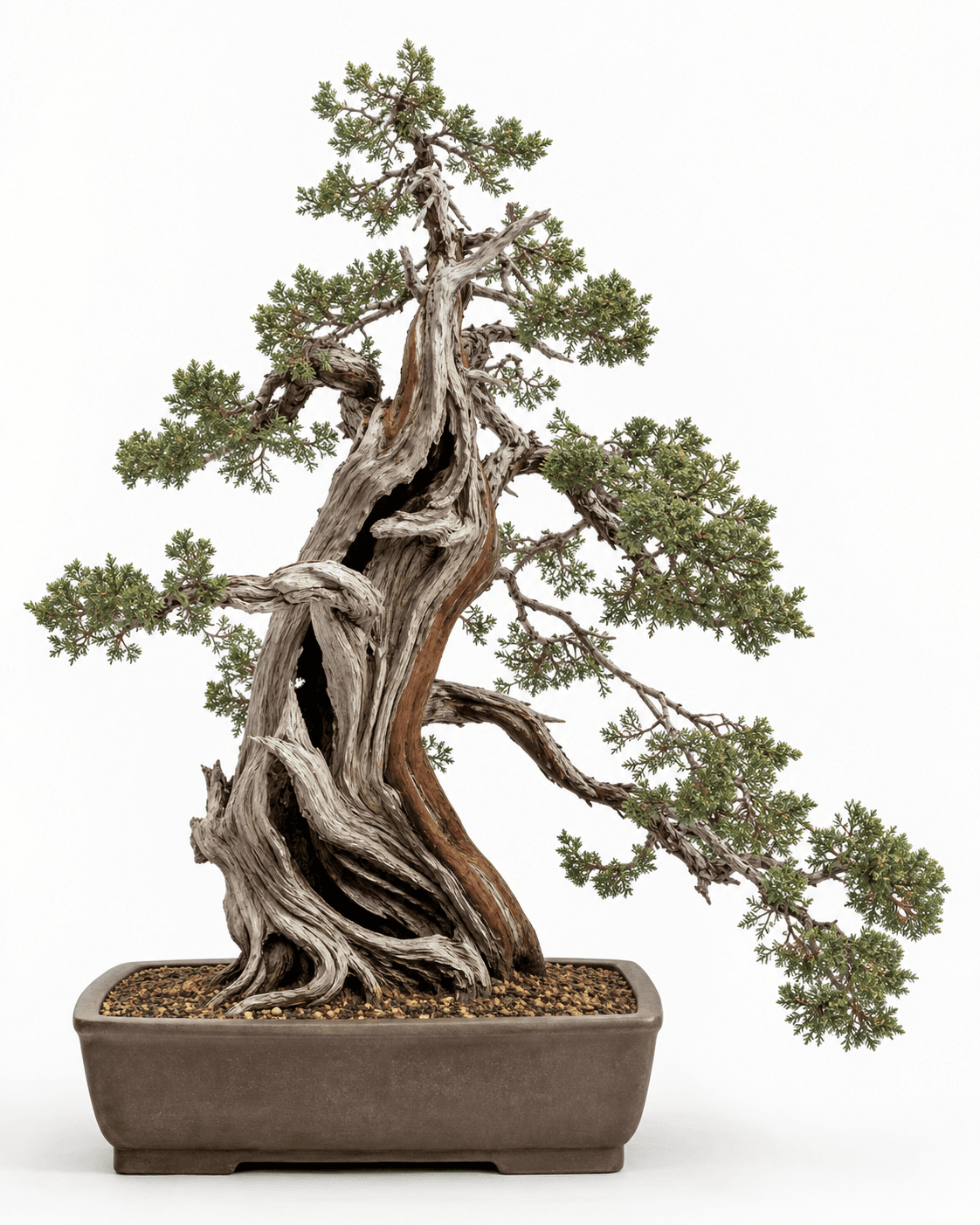
Sierra juniper is an outdoor, high-elevation North American juniper with heavy water demand, durable live veins, flexible old branches, and hollow interior deadwood. Grow confirmed Juniperus grandis in full sun, use moisture-retentive but oxygenated mineral soil, protect foliage mass after major work, and separate repotting from styling.
This guide treats Sierra juniper as Juniperus grandis, the Kew-accepted species formerly handled as Juniperus occidentalis var. australis. Bonsai guidance is grounded in dedicated Mirai Sierra juniper files, juniper physiology, live-vein, grafting, repotting, and design files, with public sources from Kew, Calflora, The Gymnosperm Database, Flora of North America, USDA Forest Service, Oregon State, and UC IPM for taxonomy, ecology, hardiness, and pest context.
Updated June 9, 2026. Written by EntGrove Editorial. Last verified June 9, 2026.
Care fingerprint
Read the species through its shared care pattern.
Protect old collected root systems, preserve live veins, and avoid combining major styling with aggressive root work. Use this as the starting point before local conditions and tree strength refine the calendar.
Note: High-elevation Sierra and western Nevada juniper with dedicated Mirai Sierra juniper coverage; Kew accepts Juniperus grandis separately from Juniperus occidentalis, so verify older occidentalis var. australis labels before applying care.
Keep foliage strong
Junipers recover through active foliage, so styling choices should leave enough healthy tips to power the tree.
Protect live veins
Old junipers often depend on narrow live veins between roots and foliage; root work and carving should respect that path.
Do not stack major work
Heavy bending, major foliage reduction, carving, and repotting belong in a staged plan rather than the same weekend.
Care cadence
The calendar starts with the tree's seasonal state.
Placement
Timing: Keep outdoors in full sun with strong airflow. Shade the pot or recovery area briefly only after fresh repotting, branch tears, grafting, or severe summer collection stress.
Watch for: Long soft shaded foliage, weak interior growth, hot black pots, wind-dried small containers, and post-work trees returned to harsh heat before roots can supply foliage.
Bonsai Mirai LibraryUSDA Forest Service vegetation descriptionsWatering
Timing: Water when the upper substrate begins to dry, then fully hydrate the root mass. In active summer weather, established Sierra junipers may need water two or three times in a day.
Watch for: Grow-then-dieback cycles, hydrophobic old field cores, random branch fade after dry periods, foliage that stays green after root failure, and assuming alpine origin means dry bonsai culture.
Bonsai Mirai LibraryFeeding
Timing: Feed moderately after the tree is healthy, rooted, and extending. Let foliage mass build the root system before demanding refinement.
Watch for: Chemical overstimulation that pushes juvenile foliage, fertilizer on recently collected or weak material, and clogged soil surfaces that reduce oxygen.
Bonsai Mirai LibraryPruning
Timing: Let runners extend first. Prune strong elongating tips back to strong secondary growth after the first flush hardens, while leaving weak branches and recovery foliage alone.
Watch for: Pinching scale tips, cutting all branches uniformly, stripping crotch growth that could become compression, and removing the tip battery from weak branches.
Bonsai Mirai LibraryStructural work
Timing: Use early spring before soft growth or the energy-positive post-hardened window from mid-summer into early fall for heavy bending, cleaning, and reduction.
Watch for: Heavy work during soft spring growth, combining major foliage reduction with repotting, branch tears without sealing, and winter styling followed by cold wet exposure.
Bonsai Mirai LibraryRepotting
Timing: Choose spring as growth begins or a locally proven juniper root window. Keep old roots intact where needed, secure the tree firmly, and avoid bare-rooting.
Watch for: Deeply buried collected trunks, poor native soil that holds water, flat-cut root systems, loose tie-downs, and styling in the same season as major root work.
Bonsai Mirai LibraryWiring
Timing: Wire enough to set permanent structure, and leave heavy bends on long enough for tissue to thicken into the new position. Remove wire branch by branch when bite approaches roughly half the wire gauge.
Watch for: Under-wiring heavy flexible wood, removing support too early, unsupported folds in live tissue, hidden wire under dense pads, and detail wiring before the defining branch and apex are settled.
Bonsai Mirai LibraryWinter protection
Timing: Established trees are cold durable in the landscape, but potted roots and recently reduced trees need protection around hard freezes, cold rain, and repeated freeze-thaw.
Watch for: Post-reduction trees left outside unprotected, cold wet benches, warm indoor storage, and root balls freezing dry in wind.
Bonsai Mirai LibraryOregon State Landscape PlantsGrafting
Timing: Approach graft refined Kishu, Itoigawa, or Shimpaku-type foliage only when native foliage fights the scale of the design or repeatedly weakens. Use strong hosts and skip grafting in repot years.
Watch for: Grafting weak hosts, grafting before the trunk design is worth it, curved contact surfaces, and leaving dominant native foliage to outcompete the graft.
Bonsai Mirai LibrarySpecies guide
Apply the species profile before copying another tree's calendar.
At a glance
Treat Sierra juniper as a high-water, high-sun collected juniper, then verify the label.
The accepted botanical name for the Sierra juniper bonsai subject is Juniperus grandis R.P.Adams. Kew accepts the species and treats Juniperus occidentalis var. australis and Juniperus occidentalis subsp. australis as older homotypic synonyms. Kew POWO
The care fingerprint is unusually specific for a western juniper: full sun, high water demand, fine fleshy roots with limited storage, foliage-powered recovery, live-vein preservation, hollow interior deadwood, and larger or more water-retentive containers than many Rocky Mountain or California junipers require. Bonsai Mirai Library
Use the common names carefully. Older bonsai demonstrations often say Juniperus occidentalis australis or western juniper, while current Kew and Calflora records support Juniperus grandis for Sierra juniper. Kew POWOCalfloraUSDA Forest Service FEIS
Wild habitat
The wild image is granite, altitude, wind, and water moving through a short growing season.
Kew gives the native range as California to western Nevada, while The Gymnosperm Database places Juniperus grandis in California at 1000-3000 m elevation on dry rocky slopes. USDA vegetation descriptions place the western or mountain juniper alliance on warm, dry, windy upper slopes, exposed granitic sites, and ridges, often around 6400-10000 ft in the southern Sierra. Kew POWOThe Gymnosperm DatabaseUSDA Forest Service vegetation descriptions
The associated trees matter for design. Public ecology sources connect Sierra juniper with Jeffrey pine, red fir, western white pine, lodgepole pine, whitebark pine, mountain hemlock, singleleaf pinyon, and upper montane chaparral edges. That is a high-country western forest image rather than a low-desert California juniper image. The Gymnosperm DatabaseUSDA Forest Service vegetation descriptions
Mirai translates that habitat into a cultivated paradox: the tree survives on granite and needle duff in nature, yet in a bonsai pot it is a high water user. Limited wild resources create tortured silhouettes; bonsai culture supplies enough water and oxygen to keep the living veins and foliage stable. Bonsai Mirai Library
For styling, the habitat points upward as much as downward. Mirai notes that Sierra junipers can grow along granite where wind carries foliage up and over stone, so branch lines may lift, trail, and twist instead of only drooping into conventional pads. Bonsai Mirai Library
Reading the tree
Read foliage mass first because it powers the roots and live veins.
Mirai treats juniper strength as foliage-driven. Tips generate the photosynthetic battery that rebuilds roots and vascular tissue, so weak Sierra junipers should be allowed to grow before pruning, wiring, grafting, or repotting. Bonsai Mirai Library
Development-stage trees need bulk. After initial styling or collection, let the canopy grow freely until mature interior foliage appears along useful branch runs. That interior growth is the signal that reduction and compression have material to cut back to. Bonsai Mirai Library
Refinement-stage trees need energy redirection. Remove the strongest elongating tips back to strong secondary growth, expose weak branches to more sun, and preserve enough foliage density across pads for the tree to keep feeding its roots. Bonsai Mirai Library
Juvenile foliage needs context. It can appear after over-reduction, root stress, rapid fertilizer-driven growth, shade, or sudden hot humid conditions. The response is better culture and time, not more pruning or stimulants. Bonsai Mirai Library
Pruning
Prune runners and protect weak foliage. Do not pinch Sierra juniper tips.
The practical rule is to let the tree extend, then prune strong elongating tips to a viable secondary shoot after the first flush has hardened. This removes apical auxin and redirects energy inward without deleting the foliage mass that powers roots. Bonsai Mirai Library
Uniform shortening is the wrong tool. Mirai emphasizes branch-by-branch decisions: leave weak branches alone, reduce only the strong running pieces, and use sun exposure to strengthen the parts that lag. Bonsai Mirai Library
Cleaning is separate from pruning. Remove weak dead interior twigs, downward growth from pad undersides, and crotch growth only when it has no future compression value. Some crotch growth becomes exactly the material needed to shorten a long branch later. Bonsai Mirai Library
Timing matters. Heavy juniper work is safest before soft spring growth emerges or after the first flush hardens and the tree is energy-positive. Once soft spring growth is active, cambium and xylem are more water-loaded and easy to separate. Bonsai Mirai Library
Roots
Repot for water movement, old-soil correction, and stability, not calendar neatness.
Sierra juniper has fine roots with high water uptake and low storage. That makes tie-downs, oxygen, aftercare, and foliage preservation more important than aggressive root reduction. Bonsai Mirai Library
Collected material should be sequenced by root condition. If the tree arrives in native soil that performs poorly or is buried deep to preserve trunk moisture, repot first and rebuild foliage before styling. If the roots are already in a good bonsai substrate, style first and reserve root work for a later season. Bonsai Mirai Library
Avoid combining major root work with heavy styling in the same season. The foliage mass regenerates the root system, and a repot consumes the energy that heavy canopy work also needs. Bonsai Mirai Library
Mirai flags flat-cutting old collected Sierra roots as a poor collection method because survival can be extremely low. For purchased material, roots and recovery history should matter more than deadwood drama. Bonsai Mirai Library
Soil and pot
Use akadama and pot volume to meet the species water demand while preserving oxygen.
The standard juniper mix in the Mirai corpus is 1:1:1 akadama:pumice:lava. Sierra juniper often moves wetter: 2:1:1 or even 3:1:1 akadama:pumice:lava when the tree is established, strongly watered, and being refined. Bonsai Mirai Library
Keep the small particle fraction. Mirai differentiates Sierra juniper from drier-environment pines by retaining particles down to about 1/16 in and up to about 1/4 in so the fine roots can branch and hold water without losing oxygen. Bonsai Mirai Library
Container size is a care decision. Sierra junipers can grow and then die back when a pot is too small to supply enough water to the foliage. A slightly larger or deeper container can be more correct than forcing refinement through drought stress. Bonsai Mirai Library
Pot pairing should echo granite and exposed age. Unglazed stoneware, rugged ovals, slabs, crescent or stone plantings, and quiet earth colors usually support the species better than glossy or delicate containers. Bonsai Mirai LibraryBonsai Mirai / Asymmetry
Climate
Cold hardy in the landscape does not mean carefree in a bonsai pot.
Public hardiness references are complicated because many older sources still publish Sierra juniper under western juniper. Oregon State lists Juniperus occidentalis as hardy to USDA Zone 4, and The Gymnosperm Database places Juniperus grandis in high-elevation California habitat. Oregon State Landscape PlantsThe Gymnosperm Database
Mirai separates landscape hardiness from bonsai root risk. Juniper foliage can tolerate significant cold, while confined fine roots lack the same cold durability. Protect potted roots around hard freezes, especially after heavy reduction, repotting, or cold rain. Bonsai Mirai Library
Warm climates can grow Sierra juniper when sun, water, and air are managed. Mirai records successful cultivation in warm regions and rejects the idea that the tree requires a cold mountain environment to survive. Bonsai Mirai Library
Regional adjustments are mostly water and oxygen adjustments. Hot dry regions need more frequent watering and pot-temperature control. Cool wet regions may need larger particles, less akadama, stronger airflow, and stricter old-soil correction. Bonsai Mirai LibraryUC IPM Juniper
Pests and disease
Inspect live veins, tips, roots, and bark before treating a symptom.
UC IPM lists juniper problems including aphids, bark beetles, cypress bark mealybug or cypress bark scale, cypress tipminer, flatheaded borers, foliage miners, sawflies, scales, spider mites, Armillaria, cankers, twig blights, Phytophthora, rusts, and wood decay fungi. UC IPM Juniper
Mirai gives a bonsai-specific borer window: adult borer activity and larval feeding are most important around May and June as junipers return to energy-positive growth. Bark cleaning, live-vein inspection, and sticky traps belong in that diagnostic season. Bonsai Mirai Library
Scale-like white marks are not always scale insects. Mirai notes that regular white exudate on the same point of every scale can be resin, while pest scale appears irregular. Use magnification before applying pesticide. Bonsai Mirai Library
Root stress is the hidden disease driver. UC IPM says junipers dislike heavy soils that remain wet, and Mirai connects poor water-oxygen balance with weak roots, juvenile foliage, dieback, and pest vulnerability. UC IPM JuniperBonsai Mirai Library
Wiring
Sierra juniper bends well, but the live vein still decides what is safe.
Mirai treats Sierra juniper as unusually bendable among junipers, sometimes safe to bend without raffia where other species would need wrapping. That does not remove the need for correct wire gauge, support, fulcrum control, and live-tissue protection. Bonsai Mirai Library
For heavy bends, preserve lever length, use wire as the lever rather than fighting it, and combine rotation with bending so force spreads through more vascular bundles. When tissue is exposed, seal and wrap promptly. Bonsai Mirai Library
Detail wiring follows structure. Set trunk line, defining branch, and apex before wiring every tuft. On refined branches, wire just short of the final foliage clump so the branch finishes in a compact tuft rather than a straight exposed line. Bonsai Mirai Library
Wire removal should be staged. Mirai removes wire when it has bitten about half its own gauge into bark, and it removes by branch order instead of stripping the whole tree at once. Bonsai Mirai Library
Propagation and grafting
Seed is possible, but bonsai propagation usually means grafting foliage or roots.
The Gymnosperm Database describes Juniperus grandis as usually dioecious with seed cones that mature over two years. Seed-grown trees are possible, but the bonsai timeline is long and variable. The Gymnosperm Database
Calflora lists Juniperus grandis as a California-native tree and records the older PLANTS names Juniperus occidentalis ssp. australis and Juniperus occidentalis var. australis. That helps identify source material but does not make seedling production quick. Calflora
For bonsai, approach grafting refined foliage is the practical propagation skill. Mirai says Kishu or Shimpaku-type grafting onto shohin and kifu Sierra juniper rootstock is justified when native foliage coarseness conflicts with the small scale. Bonsai Mirai Library
Root or air-layer work should be treated as major vascular surgery. A freshly separated layer loses much of its water-transport capacity and must grow freely until new vascular strength and interior mature foliage prove recovery. Bonsai Mirai Library
Buying and sourcing
Buy legal provenance, roots, and recovery history before deadwood.
Good Sierra juniper material has legal provenance, a confirmed Juniperus grandis or older australis label trail, anchored roots, active mature foliage, visible live-vein continuity, and deadwood that belongs to the trunk history. Kew POWOCalfloraBonsai Mirai Library
Ask when the tree was collected, how many growing seasons it has been stable, whether it has been repotted out of native soil, how much old field core remains, and what major styling or grafting has already been done. Bonsai Mirai Library
Avoid flat-cut root systems, fresh collection with no recovery record, loose trunks, hydrophobic native soil, dead roots under dramatic deadwood, major styling in the same year as collection, and foliage that looks green but has not extended since collection. Bonsai Mirai Library
Separate Sierra juniper from true western juniper before transferring care. USDA FEIS states that Sierra juniper was formerly classified under western juniper and is now Juniperus grandis, outside that western-juniper review. USDA Forest Service FEISKew POWO
Troubleshooting
Most Sierra juniper problems trace back to water supply, foliage loss, live-vein injury, or timing.
Symptom: random branch dieback after good growth. Likely cause: the container or soil cannot supply enough water to the foliage mass. Fix: increase watering frequency, inspect for hydrophobic cores, and move toward a more appropriate pot and akadama ratio at the next root window. Bonsai Mirai Library
Symptom: juvenile foliage after pruning. Likely cause: over-reduction, root stress, shade, or overstimulation. Fix: stop pinching, restore sun and water-oxygen balance, and let mature scale foliage return before more refinement. Bonsai Mirai Library
Symptom: branches fade weeks after styling. Likely cause: live-vein tearing, excessive foliage loss, weak roots, or unsupported heavy bends. Fix: stabilize the tree, protect from cold wet stress, preserve remaining foliage, and defer further work. Bonsai Mirai Library
Symptom: white marks on foliage. Likely cause: regular resin exudate or scale insects. Fix: use magnification and pattern recognition before treatment; regular same-location marks suggest resin, while irregular raised pests need diagnosis. Bonsai Mirai LibraryUC IPM Juniper
Symptom: boring dust, twig flagging, or bark galleries. Likely cause: beetles or borers attacking stressed live tissue. Fix: inspect in late spring and early summer, remove confirmed dead or infested tissue carefully, and seek local IPM guidance before chemical control. Bonsai Mirai LibraryUC IPM Juniper
Symptom: deadwood softens from the center. Likely cause: natural Sierra juniper interior decay. Fix: preserve old patina, remove only structurally unsound or visually excessive material, and carve new work as hollow interior decay rather than shredded exterior grain. Bonsai Mirai Library
Design
Design from live vein, granite, hollow deadwood, and asymmetric age.
Sierra juniper design begins with the relationship between live vein and deadwood. Mirai emphasizes that deadwood alone is insufficient; the living tissue must remain visible enough for the viewer to understand survival. Bonsai Mirai LibraryBonsai Mirai / Asymmetry
The species deadwood signature is hollowing from the inside outward. Mirai distinguishes Sierra juniper from Rocky Mountain juniper and western juniper by its fibrous, elastic, snow-splayed deadwood and interior rot pattern. Bonsai Mirai Library
When reducing deadwood, preserve weathered patina and old movement. Fresh carving should imitate the species interior decay, and old ancient deadwood should be left alone unless it overwhelms the composition or hides the living story. Bonsai Mirai Library
The defining branch sets the longest asymmetrical line. The apex should counterbalance the trunk and defining branch rather than stack into a youthful triangle. On mature trees that have overgrown, regain proportion with structural branch removal and jin remnants rather than tip-cutting the whole canopy backward. Bonsai Mirai LibraryBonsai Mirai / Asymmetry
Foliage should frame deadwood without burying it. Use positive foliage mass to push the eye out, use absence to pull it back in, and keep equal density across unequal pads so negative space reads clearly. Bonsai Mirai Library
Forms and labels
The main label problem is taxonomy, not named cultivars.
Kew accepts Juniperus grandis and lists Juniperus occidentalis var. australis, Juniperus occidentalis subsp. australis, and Sabina grandis as homotypic synonyms. Calflora also records the older PLANTS names under the accepted Sierra juniper record. Kew POWOCalflora
Flora of North America retains the older Juniperus occidentalis lower-taxa treatment and distinguishes var. australis by browner bark, larger cones, and mostly dioecious plants. Use that FNA detail as historical morphology support while naming the page by current Kew taxonomy. Flora of North AmericaKew POWO
The Gymnosperm Database explains the modern split from western juniper through leaf essential oil, genetic, morphological, ecological, and interbreeding evidence, while noting possible hybridization with Utah juniper in northwestern Nevada. The Gymnosperm Database
Bonsai labels may still say western juniper, mountain juniper, Juniperus occidentalis australis, or Sierra western juniper. Verify range, foliage, cones, bark, and source history before applying this page to a collected trunk. The Gymnosperm DatabaseUSDA Forest Service FEIS
History
Sierra juniper is one of the iconic American collected junipers.
The Gymnosperm Database notes that Sierra juniper is a popular bonsai subject and describes the Bennett Juniper as the largest known Juniperus specimen, with extraordinary age estimates and national champion status. The Gymnosperm Database
The same source records the Scofield Juniper as the oldest known tree for the species, with a crossdated age of 2675 years. That age context explains why bonsai design should prioritize patience, old tissue, hollow deadwood, and credible survival history. The Gymnosperm Database
The Mirai corpus includes several dedicated Sierra juniper demonstrations, including styling, revisiting, proportional design, stone planting, and legacy North American juniper work. The recurring lesson is sequence: roots, foliage mass, live vein, structure, and refinement over years. Bonsai Mirai Library
A strong Sierra juniper bonsai should read as a high-country western tree shaped by granite, snow, wind, water limitation, and long recovery. The design standard is species-specific age rather than generic juniper drama. Bonsai Mirai LibraryBonsai Mirai / Asymmetry
Species questions
Answer the beginner questions before styling.
Can Sierra juniper be grown as bonsai?
Yes. Sierra juniper is a major North American juniper bonsai subject, especially from legal collected material with strong live veins, hollow deadwood, active foliage, and recovered roots.
What is the scientific name for Sierra juniper?
Use Juniperus grandis R.P.Adams. Older labels include Juniperus occidentalis var. australis and Juniperus occidentalis subsp. australis.
Is Sierra juniper the same as western juniper?
Current Kew taxonomy treats Sierra juniper as Juniperus grandis and western juniper as Juniperus occidentalis. Older bonsai and forestry sources often grouped them, so verify the label before applying care.
Can Sierra juniper bonsai live indoors?
No. Keep Sierra juniper outdoors in sun, airflow, and seasonal change. Indoor display should be brief and followed by a return to outdoor growing conditions.
How often should I water Sierra juniper bonsai?
Water when the upper substrate begins to dry, then hydrate the whole root mass. In hot active weather, established containerized Sierra junipers may need water two or three times daily.
What soil works for Sierra juniper bonsai?
Use mineral soil that holds more water than many dry-country junipers: 1:1:1 akadama:pumice:lava as a baseline, or 2:1:1 to 3:1:1 favoring akadama for established refined trees that need more moisture.
Should Sierra juniper be pinched?
Avoid pinching scale tips. Let runners extend, then prune strong tips back to strong secondary growth while leaving weak or recovering foliage alone.
When should Sierra juniper be repotted?
Repot when drainage, old soil, root density, or planting angle requires it, usually in a spring or locally proven juniper root window. Do not combine major repotting with heavy styling.
Should Sierra juniper be grafted with Shimpaku or Kishu foliage?
Only when the trunk scale justifies it and native foliage cannot support the design, especially on shohin or kifu material. Graft strong hosts and avoid grafting in repot years.
What styles suit Sierra juniper bonsai?
Collected old-tree styles suit it best: informal upright, slanting, literati, semi-cascade, granite or stone planting, wind-influenced alpine form, hollow deadwood, and live-vein compositions.
Sources
Species advice needs source discipline.
Next decisions
Plan the operation before copying the calendar.
A good care note for Sierra juniper / Western juniper records the tree's stage, the work done, and the aftercare used. That record matters more than a month-name rule.
Related species
Compare nearby trees before transferring advice.
California juniper
Juniperus californica
Western juniper
Juniperus occidentalis
Rocky Mountain juniper
Juniperus scopulorum
Utah juniper
Juniperus osteosperma
One-seed juniper
Juniperus monosperma