
Species guide
One-seed Juniper Bonsai Care
Juniperus monosperma
One-seed juniper is an outdoor arid-land North American juniper from the Southwest and northern Mexico, with scale foliage, one-year berry-like cones, deep roots, and slow dry-site growth. In a bonsai pot, treat confirmed Juniperus monosperma as a foliage-powered scaled juniper: build strength first, preserve interior shoots, prune rather than pinch, and keep water and oxygen balanced.
The local Mirai corpus has no dedicated One-seed juniper file; it names one-seed within arid desert junipers for transferable Utah / California / one-seed method, live-vein cleaning, coarse-juniper wiring, and grafting behavior. Taxonomy, range, habitat, cones, roots, hardiness, and pest context are grounded with Kew, Flora of North America, USDA FEIS, NC State Extension, The Gymnosperm Database, and UC IPM.
Updated June 9, 2026. Written by EntGrove Editorial. Last verified June 9, 2026.
Care fingerprint
Read the species through its shared care pattern.
Protect old collected root systems, preserve live veins, and avoid combining major styling with aggressive root work. Use this as the starting point before local conditions and tree strength refine the calendar.
Note: Arid Southwest North American juniper with limited direct Mirai one-seed mentions inside desert-juniper method; verify against Utah, Rocky Mountain, Pinchot, alligator, eastern red cedar, and regional cedar labels before applying care.
Keep foliage strong
Junipers recover through active foliage, so styling choices should leave enough healthy tips to power the tree.
Protect live veins
Old junipers often depend on narrow live veins between roots and foliage; root work and carving should respect that path.
Do not stack major work
Heavy bending, major foliage reduction, carving, and repotting belong in a staged plan rather than the same weekend.
Care cadence
The calendar starts with the tree's seasonal state.
Placement
Timing: Keep outdoors in full sun with strong airflow once roots are established. Protect the container surface during severe heat without moving the foliage into deep shade.
Watch for: Indoor storage, shaded benches, freshly repotted roots in afternoon heat, loose recovery boxes, and cold wind after structural work.
NC State ExtensionBonsai Mirai LibraryWatering
Timing: Water when the upper quarter to half inch of substrate dries, then soak the whole rootball until drainage runs. Adjust for foliage mass, pot size, heat, and wind.
Watch for: Dry field cores, pot heat, chronic wet akadama in cool weather, and the false confidence that comes from a dry-country name.
Bonsai Mirai LibraryDevelopment feeding
Timing: Feed moderately during active growth when the tree is healthy. For post-collection recovery, follow a controlled aftercare program instead of force-feeding weak roots.
Watch for: Organic fertilizer clogging the soil surface, heavy feed after spring reduction, and fertilizing a declining tree into wetter soil.
Bonsai Mirai LibraryPruning
Timing: For refinement, prune running growth after the first flush hardens in late spring to early summer. For recovery, grow freely until foliage strength is obvious.
Watch for: Pinching active tips, cutting to bare stems, removing interior shoots before replacement growth exists, and over-thinning crotch growth on weak material.
Bonsai Mirai LibraryRepotting
Timing: Repot in a spring recovery window when the tree can rebuild roots. Tie the rootball rigidly and keep enough foliage to power the post-repot response.
Watch for: Bare-rooting, rootball movement, combining repotting with grafting, and holding old field soil indefinitely after recovery.
Bonsai Mirai LibraryWiring
Timing: Wire only when the tree is hydrated, rooted, and the live tissue has hardened. Coarse desert junipers may need 10 to 12 gauge wire into fine branching plus firm anchors.
Watch for: Loose detail wire, branch rolling, unsupported junctions, live-vein tearing, and small pots shifting under lateral force.
Bonsai Mirai LibraryLive vein cleaning
Timing: Clean live veins from mid-summer through winter after the first flush hardens and cambium adhesion improves.
Watch for: Spring bark slip, borer galleries under fissured bark, accidental xylem scraping, and fresh exposed tissue in hot sun.
Bonsai Mirai LibraryGrafting
Timing: Graft only after root establishment and strong foliage mass. One-seed is named with coarser native juniper rootstocks that accept finer scions more readily than Rocky Mountain juniper.
Watch for: Grafting weak yamadori, curved graft sites, removing native foliage too quickly, and deciding the final design before graft outcomes are known.
Bonsai Mirai LibraryPropagation
Timing: Seed is the documented public propagation path. Female cones mature in one year, seed may remain on the tree for 1 to 2 years, and germination can be poor.
Watch for: Assuming seedling vigor equals bonsai-ready material, collecting from restricted lands, and confusing one-seed with Utah or Rocky Mountain juniper seedlings.
Flora of North AmericaUSDA Forest Service FEISNC State ExtensionWinter protection
Timing: When temperatures fall near 25 F, move potted junipers off benches and insulate the root zone. Protect more aggressively after repotting or heavy work.
Watch for: Small containers, exposed slab or rock plantings, freeze-thaw cycles, dry winter wind, and warm indoor overwintering.
Bonsai Mirai LibraryNC State ExtensionSpecies guide
Apply the species profile before copying another tree's calendar.
At a glance
One-seed juniper is a Southwest scaled juniper with dry-site roots and coarse-juniper bonsai handling.
Kew accepts Juniperus monosperma as a Cupressaceae shrub or tree native from southern Nevada to Oklahoma and Chihuahua, Mexico. FNA places it in Arizona, Colorado, New Mexico, Oklahoma, and Texas, with dry rocky soils and slopes from about 1000 to 2300 m. Kew POWOFlora of North America
For bonsai, the source-depth caveat matters. Mirai names one-seed inside the arid desert-juniper group rather than in a dedicated species file, so the page transfers only broad one-seed-named method from Utah, California, live-vein, grafting, and running-juniper material. Bonsai Mirai Library
The practical care pattern is clear enough for an indexable guide: outdoor sun, full hydration, fast oxygen return, preserved foliage mass, post-harden pruning, careful live-vein work, and patient root conversion on collected material. Bonsai Mirai LibraryUSDA Forest Service FEIS
Habitat
Read the tree from dry rocky slopes, mesas, pinyon-juniper woodland, and desert grassland edges.
FNA gives the habitat as dry rocky soils and slopes. USDA FEIS places one-seed juniper with Colorado pinyon, Utah juniper, alligator juniper, Pinchot juniper, grasses, shrubs, oaks, and desert-edge plants across Arizona, New Mexico, Texas, Colorado, and Oklahoma systems. Flora of North AmericaUSDA Forest Service FEIS
USDA FEIS describes mature trees with both taproots and widespread lateral roots, with many lateral roots concentrated in the upper soil. Reported rooting depth can be extreme on dry sites, which explains the species ability to pause active growth during drought and resume when moisture improves. USDA Forest Service FEIS
The care implication is a staged transition from wild root architecture into bonsai roots. Recovery containers, rigid tie-downs, screened pumice, full sun when roots can support it, and eventual field-soil removal all matter more than quick styling. Bonsai Mirai Library
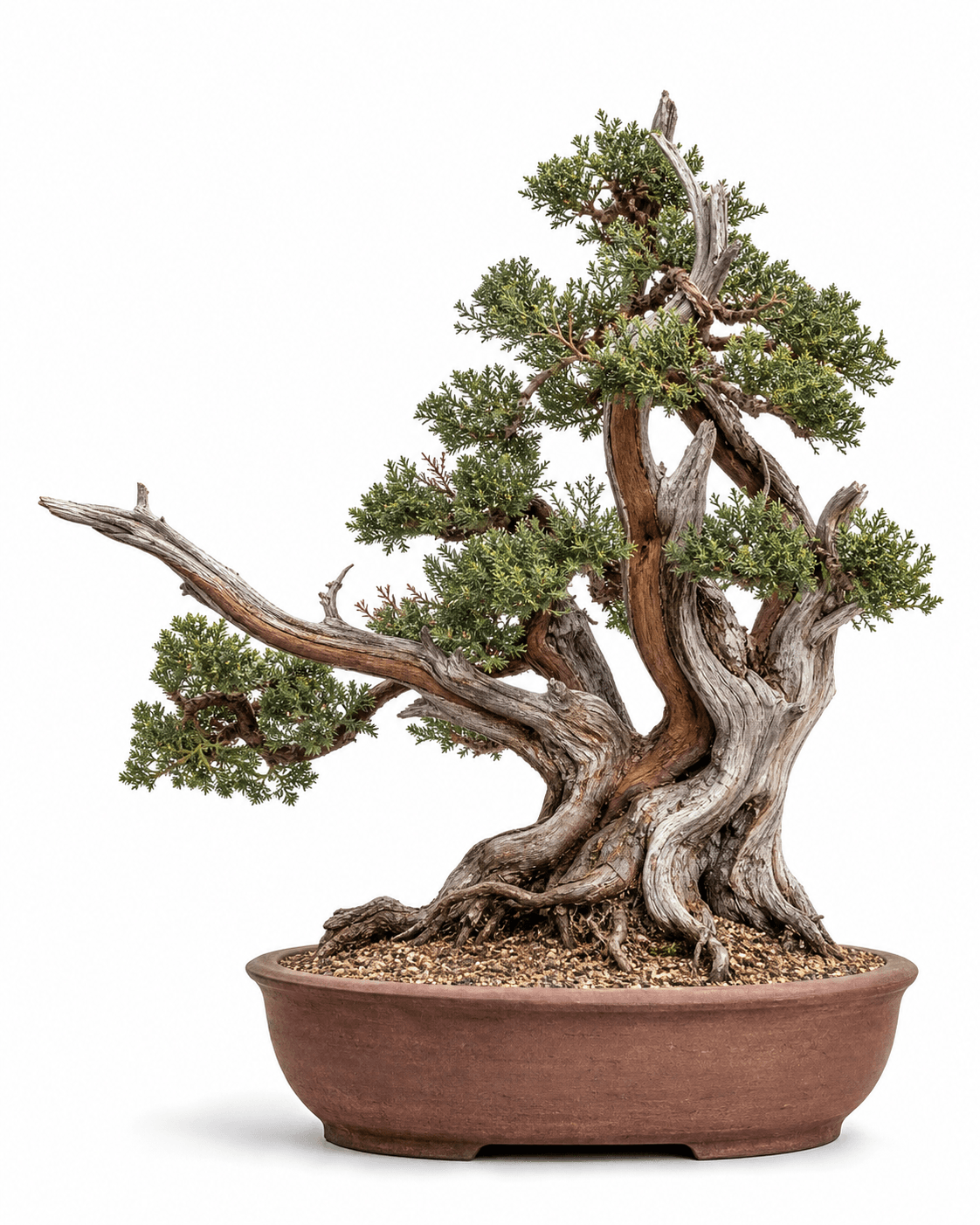
The design implication is equally direct: sparse foliage, exposed live veins, broken deadwood, and asymmetric masses read more honestly than lush rounded pads on a tree from hot open woodland. Bonsai Mirai / AsymmetryBonsai Mirai Library
Reading the tree
Judge strength from foliage volume, root stability, and whether interior shoots are still alive.
Mirai juniper physiology starts with foliage. Juniper foliage creates the sugars that rebuild roots, so a weak one-seed juniper should be allowed to grow before pruning, styling, grafting, or repotting. Bonsai Mirai Library
Desert juniper material can respond slowly and shed branches during the transition from raw collected stock to styled bonsai. Treat delayed extension as a signal to stabilize culture before choosing branches. Bonsai Mirai Library
Look for firm green tips, expanding runners, interior shoots that still receive light, a rootball that cannot move, and live veins that are easy to trace. Dull color, juvenile stress foliage, loose roots, and branch-base tearing all argue for waiting. Bonsai Mirai Library
FNA and Kew help keep identification disciplined. One-seed has one-year seed cones, usually one seed, and a southwestern range that overlaps label confusion with Utah, Rocky Mountain, Pinchot, alligator, and eastern red cedar in trade or field material. Kew POWOFlora of North AmericaThe Gymnosperm Database
Foliage work
Let running growth harden, then prune to live laterals. Do not pinch active tips.
Mirai running-juniper method uses post-harden pruning for refinement. Cutting after the first flush hardens calms the energy response and produces finer growth than heavy early spring pruning. Bonsai Mirai Library
Prune back only to stems with viable lateral shoots or buds. Junipers do not reliably produce new buds from bare wood, so every useful interior shoot is future insurance against a coarse outer shell. Bonsai Mirai Library
Heavy spring reduction has a role when a tree has fallen out of refinement or needs redevelopment, but it usually produces coarse growth. Hold fertilizer after heavy spring pruning and plan a later corrective pass. Bonsai Mirai Library
Scale-juniper pinching creates long-term decline by removing the young foliage before it has matured and resourced the tree. Use scissors, directional pruning, and light management instead. Bonsai Mirai Library
Roots
Convert dry-site roots patiently and keep the rootball locked in place.
USDA FEIS reports taproots, widespread lateral roots, and fine roots concentrated near the upper soil in mature one-seed junipers. Those wild roots are survival architecture, not the final bonsai root system. USDA Forest Service FEIS
For collected material, Mirai aftercare prioritizes a tight tie-down, screened pumice, oxygen, ground-level recovery placement, and exposure matched to root quality. Weak roots start in dappled protection; stronger rootballs move toward full sun sooner. Bonsai Mirai Library
Once recovery is established, old field soil has to be reduced over time. Leaving dense native soil in a bonsai container can create a hydrophobic core, a wet outer ring, or both, depending on climate and watering pattern. Bonsai Mirai Library
After any repot, preserve enough foliage to pull water and rebuild fine roots. Protect from intense heat and wind until new roots can hydrate the canopy. Bonsai Mirai Library
Soil and pot
Use mineral soil that restores oxygen after each complete watering.
Mirai juniper method starts with 1:1:1 akadama:pumice:lava, then adjusts water retention by climate and tree strength. In cool wet climates, keep akadama lower and particle size slightly larger. On vigorous refined trees, a 2:1:1 akadama:pumice:lava mix can support higher water and nutrient demand. Bonsai Mirai Library
NC State notes that one-seed tolerates well-drained sandy, loamy, clay, alkaline, dry, and moist soils in the landscape. Bonsai soil should translate that tolerance into oxygen and consistency rather than organic wetness. NC State ExtensionBonsai Mirai Library
Pot choice should follow the tree character. Rugged collected trunks suit unglazed containers, dry earth tones, asymmetric ovals, rectangles with softened corners, slabs, or understated rounds. Grafted refined foliage can support a quieter container that keeps attention on the old trunk.
Avoid tiny refinement pots until the tree has a dense root pad and stable watering rhythm. A desert juniper with a large foliage mass can dry a shallow pot quickly in hot wind. Bonsai Mirai Library
Climate
Adapt the Southwest tree to your bench without denying its need for sun and winter.
In arid and high-sun regions, water thoroughly, protect the pot from radiant heat, and check deep moisture rather than relying on a dry top dressing. A recovered tree can take strong sun, while a new recovery box needs exposure matched to root quality. Bonsai Mirai LibraryUSDA Forest Service FEIS
In humid or rainy regions, oxygen becomes the limiting factor. Use a more open mineral mix, avoid clogged organic fertilizer mats, and keep foliage dry when disease pressure is high. Bonsai Mirai LibraryUC IPM Juniper Twig Blights
In cold regions, landscape hardiness does not equal bonsai-root hardiness. Mirai recommends insulating potted juniper roots below about 25 F, especially after repotting, bending, or live-vein work. Bonsai Mirai LibraryNC State Extension
In warm-winter climates, the problem is usually weak dormancy rather than cold injury. Keep the tree outdoors, bright, and seasonal; avoid indoor overwintering that keeps foliage active while light is poor. Bonsai Mirai Library
Pests and disease
Watch for borers, scale, mites, twig blight, root rot, rust, and water-stress disorders.
UC IPM lists juniper problems including bark beetles, borers, scales, spider mites, twig blights, Phytophthora, rusts, cankers, scorch, nutrient disorders, and water stress. Those general Juniperus risks fit one-seed bonsai better than a houseplant-style pest list. UC IPM Juniper
Mirai live-vein work treats borers as a real risk on vigorous scaled junipers. Cleaning fissured bark from live veins removes egg-laying sites and reveals galleries, especially in folds and near soil level. Bonsai Mirai Library
Twig blights are most likely where pruning wounds, wet foliage, and poor airflow overlap. UC IPM recommends pruning out infected shoots, disposing of debris, improving dryness and airflow, and avoiding excess fertilization. UC IPM Juniper Twig Blights
Root rot is usually a water-oxygen failure first. Mirai deadwood and health files describe Phytophthora-like decline as abnormal older-foliage shedding, black roots, water-weeping tissue, and root sheaths that slip when pulled. Bonsai Mirai LibraryUC IPM Juniper
Wiring
Use enough wire, anchor the system, and protect live veins from concentrated force.
Mirai Utah styling names one-seed with coarse desert junipers that require structural wire strong enough to set the bend. Ten to 12 gauge wire may be needed even as work moves into finer branch structure. Bonsai Mirai Library
Wire function matters more than wire appearance. Coarse junipers with weak junctions may need crossed or paired wires, deadwood anchors, guy wires, raffia, and branch-by-branch decision making. Bonsai Mirai Library
During summer, wait until live veins harden. If tissue feels soft or begins to tear, move the fulcrum farther along the branch, reduce force, and stop when the tree tells you the timing is wrong. Bonsai Mirai Library
Small pots and recovery rootballs need special care because lateral force can break new roots. Double tie-downs, trunk stabilization, and staged bending protect the root system as much as the branch. Bonsai Mirai Library
Propagation
Seed is documented, grafting is a design tool, and collected material requires legal provenance.
FNA says one-seed cones mature in one year with usually one seed. USDA FEIS reports seed may persist on the tree for 1 to 2 years, seed crops can be periodic, and seedling establishment can be poor even when germination occurs. Flora of North AmericaUSDA Forest Service FEIS
NC State lists seed as the recommended propagation strategy. Seedlings are useful for learning the species, but old bonsai character usually comes from legal collected material or from long field development. NC State ExtensionBonsai Mirai Library
Air-layering is not a standard public method for one-seed, although related desert junipers can produce roots where branches remain in moist contact with ground. Treat any layering attempt as experimental and secondary to tree health. Bonsai Mirai Library
Grafting is a design choice rather than routine maintenance. Use native foliage if proportion and quality fit the tree; use approach or scion grafts only after roots and foliage mass are strong enough to support cambial fusion. Bonsai Mirai Library
Sourcing
Confirm the Latin name, the collection history, and the root status before buying.
One-seed juniper can be confused with Utah, Rocky Mountain, Pinchot, alligator, eastern red cedar, and regional cedar labels. Ask for Juniperus monosperma, collection region, collection year, aftercare history, and whether foliage has been grafted. Flora of North AmericaKew POWOThe Gymnosperm Database
For collected material, inspect rootball stability, percolation, foliage density, interior shoots, live-vein continuity, and evidence of old field soil. A famous trunk in a loose box is still a recovery project. Bonsai Mirai Library
Nursery or seed-grown stock is safer for beginners, though usually younger and less dramatic. Look for low movement, multiple trunks or basal curves, healthy scale foliage, and enough interior growth for future compression. NC State ExtensionBonsai Mirai Library
Red flags include recent collection with styling already performed, sparse dull foliage, hydrophobic cores, branch dieback after wiring, vague cedar labeling, and no legal collection documentation for wild material. Bonsai Mirai Library
Troubleshooting
Diagnose by symptom, likely cause, and the least dramatic correction that restores strength.
Symptom: new growth is weak or absent after collection. Likely cause: slow root recovery or unstable aftercare. Fix: secure the rootball, keep oxygen high, adjust sun to root quality, and wait for strength before styling. Bonsai Mirai Library
Symptom: water runs around the soil but the core stays dry. Likely cause: hydrophobic old field soil or compacted roots. Fix: soak carefully, protect from heat, and plan staged root work in the next safe repot window. Bonsai Mirai Library
Symptom: coarse juvenile or whip foliage appears. Likely cause: stress or overstimulation after pruning, root work, or heavy feeding. Fix: stabilize culture, grow strength, and prune after hardening. Bonsai Mirai Library
Symptom: interior foliage browns while exterior growth runs. Likely cause: shade-out from unmanaged outer growth. Fix: use post-harden directional pruning to preserve interior shoots. Bonsai Mirai Library
Symptom: tip browning after wet weather or pruning. Likely cause: twig blight. Fix: remove infected shoots, dispose of debris, improve airflow, keep foliage drier, and avoid excess fertilizer. UC IPM Juniper Twig Blights
Symptom: older foliage sheds abnormally and roots look black or waterlogged. Likely cause: Phytophthora or oxygen-starved roots. Fix: correct drainage and watering first, then decide whether chemical treatment is warranted. Bonsai Mirai LibraryUC IPM Juniper
Symptom: a branch dies after bending. Likely cause: live-vein tear, branch rolling, or force concentrated at a crotch. Fix: stop further bending, support the branch, and let remaining foliage rebuild. Bonsai Mirai Library
Design
Let dry-country ecology, live-vein contrast, and old wood define the composition.
Mirai live-vein work says juniper design begins by cleaning and reading live veins because the relationship between living tissue and deadwood reveals the usable front, trunk line, and design direction. Bonsai Mirai Library
Deadwood character should communicate species and habitat. For one-seed, use the arid pinyon-juniper landscape as the guide: broken tips, exposed veins, sparse foliage, and dry-country asymmetry. Bonsai Mirai LibraryBonsai Mirai / Asymmetry
Start with the defining branch, then structural movement, then apex. Avoid building the whole tree from a single junction, and preserve extra primary branches until the design proves which ones are dispensable. Bonsai Mirai Library
If native foliage is coarse or poorly placed, grafting may support a more refined image. Coarse one-seed rootstock feeding a finer shimpaku scion is technically more favorable than fine Rocky Mountain vascular tissue feeding a coarser scion. Bonsai Mirai Library
Forms and labels
Most label work is species verification, synonym cleanup, and regional cedar disambiguation.
Kew accepts Juniperus monosperma and lists synonyms including Juniperus californica var. monosperma, Juniperus mexicana var. monosperma, Juniperus occidentalis var. monosperma, Sabina monosperma, Juniperus gymnocarpa, and Juniperus monosperma f. gymnocarpa. Kew POWO
FNA lists one-seed juniper and sabina, treats no lower taxa, and says reports of hybridization with J. pinchotii have been refuted by chemical and morphologic characters. Flora of North America
NC State adds cherrystone juniper, New Mexico juniper, single-seeded juniper, and West Texas juniper. The Gymnosperm Database also records recent discussion of hybridization with Rocky Mountain juniper in the Guadalupe Mountains. NC State ExtensionThe Gymnosperm Database
There are no major bonsai cultivar groups equivalent to Kishu or Itoigawa. Track provenance, native foliage behavior, graft status, collection year, and recovery history instead. Bonsai Mirai Library
History
One-seed juniper is a defining tree of Southwest pinyon-juniper country.
USDA FEIS describes one-seed juniper as a native, long-lived evergreen tree, often shrubby, with several curved limbs arising near the base. It is an indicator in multiple pinyon-juniper shrubland and desert grassland systems. USDA Forest Service FEIS
The species supports wildlife through persistent cones, and NC State notes that birds and small mammals consume the fruit. USDA FEIS also describes bird and mammal dispersal as important to reproduction. NC State ExtensionUSDA Forest Service FEIS
Human uses include wood for fence posts and fuel, plus Indigenous use of fibrous bark for mats and cloth according to NC State. Those uses are part of the cultural context, not a reason to collect without permission. NC State Extension
In bonsai, one-seed belongs to the American collected-native tradition: legal sourcing, slow recovery, careful root conversion, live-vein preservation, and design that remembers the dry landscape where the trunk formed. Bonsai Mirai LibraryBonsai Mirai / Asymmetry
Species questions
Answer the beginner questions before styling.
Can One-seed juniper be grown as bonsai?
Yes. One-seed juniper can be bonsai when it is grown outdoors with full sun, stable roots, mineral soil, post-harden pruning, and enough foliage to power recovery.
Can One-seed juniper bonsai live indoors?
No. One-seed juniper needs outdoor light, airflow, seasonal temperature change, and winter dormancy. Indoor display should be brief.
How often should I water One-seed juniper bonsai?
Water when the upper quarter to half inch of substrate dries, then soak the whole rootball. The goal is complete hydration followed by oxygen return.
Should One-seed juniper be pinched?
Use pruning instead of pinching. Let running growth mature, then prune to live lateral shoots after the first flush hardens.
When should One-seed juniper be repotted?
Repot in spring when the tree can rebuild roots. Work in stages, secure the rootball, preserve foliage, and avoid bare-rooting collected material.
What soil works for One-seed juniper bonsai?
Use oxygen-rich mineral soil. A 1:1:1 akadama:pumice:lava mix is a conservative starting point, with more akadama only for vigorous trees that need more water retention.
How cold hardy is One-seed juniper bonsai?
NC State lists landscape hardiness in Zones 4a-8b. In bonsai, protect potted roots around hard freezes because container roots are more exposed than landscape roots.
Is One-seed juniper the same as Utah juniper?
They are separate species: Juniperus monosperma and Juniperus osteosperma. Their dry habitat and bonsai handling overlap, but identification should follow cones, range, foliage, and verified Latin names.
Should One-seed juniper be grafted with Shimpaku foliage?
Graft only when native foliage cannot serve the design and the tree is vigorous. Strong roots, abundant foliage, and straight accessible graft sites matter more than speed.
Why is my collected One-seed juniper slow to grow?
Slow response is common in arid collected junipers. Stabilize the rootball, manage water and oxygen, keep enough foliage, and wait for clear vigor before styling.
Sources
Species advice needs source discipline.
Next decisions
Plan the operation before copying the calendar.
A good care note for One-seed juniper records the tree's stage, the work done, and the aftercare used. That record matters more than a month-name rule.
Related species
Compare nearby trees before transferring advice.
California juniper
Juniperus californica
Sierra juniper / Western juniper
Juniperus grandis
Western juniper
Juniperus occidentalis
Rocky Mountain juniper
Juniperus scopulorum
Utah juniper
Juniperus osteosperma