
Species guide
Western Juniper Bonsai Care
Juniperus occidentalis
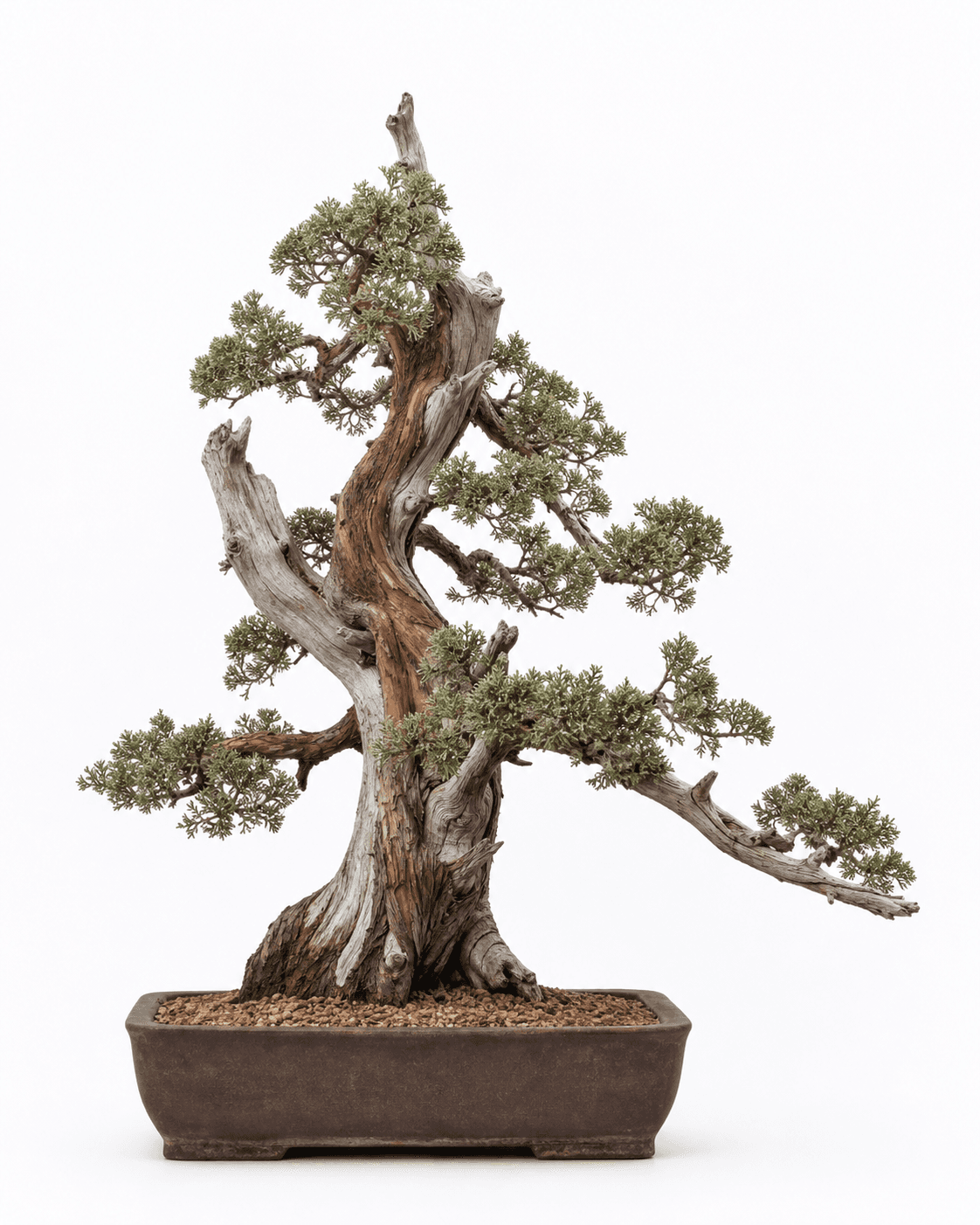
Western juniper, Juniperus occidentalis, is an outdoor North American running juniper from cold, arid country east of the Cascades. Grow it in full sun, preserve strong foliage before root or styling work, use mineral soil that drains faster than a Sierra juniper mix, and treat old collected roots as the limiting factor.
This guide separates true western juniper from Sierra juniper, which current Kew and USDA sources treat as Juniperus grandis. Bonsai guidance comes first from Mirai western-juniper and running-juniper material, then public sources from Kew, Flora of North America, USDA Forest Service, Oregon State, The Gymnosperm Database, UC IPM, PNW Plant Disease Management Handbook, and Utah State Extension ground taxonomy, habitat, hardiness, and pest context.
Updated June 9, 2026. Written by EntGrove Editorial. Last verified June 9, 2026.
Care fingerprint
Read the species through its shared care pattern.
Protect old collected root systems, preserve live veins, and avoid combining major styling with aggressive root work. Use this as the starting point before local conditions and tree strength refine the calendar.
Note: Arid Oregon and Great Basin running juniper with Mirai western-juniper and running-juniper coverage; separate true Juniperus occidentalis from Sierra juniper / Juniperus grandis before applying water and deadwood assumptions.
Keep foliage strong
Junipers recover through active foliage, so styling choices should leave enough healthy tips to power the tree.
Protect live veins
Old junipers often depend on narrow live veins between roots and foliage; root work and carving should respect that path.
Do not stack major work
Heavy bending, major foliage reduction, carving, and repotting belong in a staged plan rather than the same weekend.
Care cadence
The calendar starts with the tree's seasonal state.
Watering
Timing: Check daily in active weather; water when the top 1/4 in to 1/2 in dries.
Watch for: Sandpapery foliage texture, shrinking fine tips, or random dieback after hot wind means the tree ran short on water. Sour odor, blue-gray foliage, and slow spring recovery point toward excess wetness or root disease.
Bonsai Mirai LibraryPacific Northwest Plant Disease Management HandbookPruning
Timing: Let runners extend first; refine after the first flush hardens, often late spring to early summer.
Watch for: Do not pinch scale tips. Cut running tips back to strong secondary growth, keep weak interior shoots, and avoid bare-stem cuts that expect new buds from old wood.
Bonsai Mirai LibraryRepotting
Timing: Use spring movement or local juniper root windows; separate major root work from heavy styling.
Watch for: Collected or old nursery trees often need staged native-soil conversion. Freshly collected junipers should usually recover in high-oxygen pumice before refinement soil.
Bonsai Mirai LibraryWiring and structural work
Timing: Healthy trees can take structural work when vascular productivity is high; avoid spring soft-tip periods and winter cold-wet aftercare.
Watch for: Trace live veins before bends, use raffia on large work, support compression deadwood, and stop if sharp cracks indicate living tissue fracture.
Bonsai Mirai LibraryLive-vein and deadwood cleaning
Timing: Clean after recovery is proven; late winter, late spring borer inspection, or late summer can work depending on climate.
Watch for: Remove bark and moss carefully, preserve aged patina, inspect for borers, and wash deadwood with soft brushes rather than metal brushes.
Bonsai Mirai LibraryWinter protection
Timing: Protect potted roots when temperatures approach 25 F, especially after repotting or major work.
Watch for: Landscape western juniper is very hardy, but containerized fine roots have less cold durability. Place pots on the ground, mulch, or shelter from cold wet swings.
Bonsai Mirai LibraryOregon State Landscape PlantsSpecies guide
Apply the species profile before copying another tree's calendar.
At a glance
Treat western juniper as a dry-country running juniper with roots as the bottleneck.
Western juniper is Juniperus occidentalis, an accepted Kew species native to California, Idaho, Nevada, Oregon, and Washington. USDA FEIS now separates Sierra juniper as Juniperus grandis, so older occidentalis labels need range and provenance checks before care advice transfers. Kew POWOUSDA Forest Service FEIS
In bonsai, the useful shortcut is running juniper plus arid high-desert ecology. Let foliar mass build, prune only to viable secondary growth, keep roots oxygenated, and avoid the heavy-water Sierra juniper recipe unless the individual tree proves it needs that much retention. Bonsai Mirai Library
The species rewards patience. Strong old material can carry red heartwood, durable live veins, cylindrical UV-shaped deadwood, and sparse crowns that read as real age. Those same qualities make old collected trees slow to recover after root work. Bonsai Mirai LibraryThe Gymnosperm Database
Wild habitat
Design and care come from cold, arid country east of the Cascades.
USDA FEIS describes most western juniper habitat as continental: hot dry summers, cool to cold winters, low relative humidity, low annual precipitation, and high winds. Oregon Encyclopedia places it across central and eastern Oregon between sagebrush flats and pine forests. USDA Forest Service FEISOregon Encyclopedia
Soils vary widely. OSU Extension says western juniper occupies environments from poorly drained heavy clays to excessively drained pumice sands, while The Gymnosperm Database describes generally stony, weakly developed silicate soils in mature stands. OSU ExtensionThe Gymnosperm Database
The care implication is water with oxygen. A tree from dry ground does not become a cactus in a shallow pot; it loses the wild deep-root and seasonal-root cycle. Keep it hydrated, then let air return quickly enough to avoid Phytophthora and waterlogged roots. Bonsai Mirai LibraryPacific Northwest Plant Disease Management Handbook
The design implication is UV, wind, drought, fire, and sparse high-desert competition. Western juniper deadwood should read round, cylindrical, desiccated, and sun-eroded rather than hollow Sierra snow-splay or sandblasted Rocky Mountain grain. Bonsai Mirai LibraryThe Gymnosperm Database
Reading the tree
Foliage powers the roots, so health is visible at the tips.
Mirai teaches that juniper strength lives in the foliage. Western juniper roots in a container have little storage capacity compared with pine roots, so every major root, styling, and recovery decision should start by reading foliar mass. Bonsai Mirai Library
Running junipers such as Western, Rocky Mountain, Sierra, and California extend first and densify behind the tips later. Let extension happen, then cut the running tips after interior density forms, so the tree keeps the inner foliage needed for future proportion. Bonsai Mirai Library
Ready material shows aggressive spiking growth throughout the canopy, a full year of density behind tips, turgid foliage that feels slick rather than dry, and strong resinous scent when a disposable tip is crushed. Weak material gets more sun, water balance, and time. Bonsai Mirai Library
Juvenile foliage can mean stress from over-reduction, wiring injury, root trouble, or overstimulated growth. Context matters: juvenile shoots at weak interior crotches are a decline signal, while vigorous tip reversion after excess fertilizer may require slower growth rather than stronger feeding. Bonsai Mirai Library
Pruning
Let runners build density, then prune cleanly to secondary growth.
Avoid pinching western juniper tips. Mirai repeatedly frames pinching as a damaging old habit because it strips the photosynthetic battery, weakens roots, and prevents the density cycle a running juniper needs. Bonsai Mirai Library
For development, spring work before the new green flush can redirect strong stored energy, but it also produces coarser response. For refinement, wait until the first flush hardens, often late spring to early summer, then prune to strong secondary shoots. Bonsai Mirai Library
Never cut back to bare stem expecting dependable back budding. Preserve interior body branches, useful crotch growth on recovering trees, and replacement shoots that can take over before outer growth becomes too coarse. Bonsai Mirai Library
Prune the upper canopy more strongly than lower branches when the tree is healthy enough to rebalance. The defining branch sets the length and visual weight, while body branches supply depth and should stay shorter than the silhouette. Bonsai Mirai LibraryBonsai Mirai / Asymmetry
Roots
Repot only when the tree has enough foliage to pay for new roots.
Mirai separates major juniper styling and major repotting because foliage regenerates roots. A developing western juniper usually gets one major insult in a season: either root work or foliage and structure work. Bonsai Mirai Library
Freshly collected or recently acquired old material should be stabilized before design ambitions take over. Mirai gives a minimum two-year recovery cue for collected junipers, with strong elongating tips and dense foliar mass as the readiness signal. Bonsai Mirai Library
John Naka renewal material in the corpus gives one western-juniper-specific collection cue: around Bend, Oregon, spring thaw and saturated snowmelt soil are preferred because seasonal fine roots are active. Dry-ground collection is a failure pattern. Bonsai Mirai Library
For recovery, prioritize oxygen. Mirai often starts freshly collected junipers in pumice and warns against akadama during early recovery because it can hold too much water before the root system has rebuilt. Bonsai Mirai Library
Soil and pot
Use a faster western-juniper mix first, then tune retention for refinement.
The default juniper soil from Mirai is 1:1:1 akadama:pumice:lava in 1/16 in to 1/4 in particles. That is the honest western juniper baseline because the species comes from dry, windy country and because wet roots are a known juniper failure mode. Bonsai Mirai LibraryPacific Northwest Plant Disease Management Handbook
For established refinement trees, 2:1:1 akadama:pumice:lava can increase water and nutrient retention, shorten internodes, and help finer ramification. Use it only when the tree is rooted, drainage is excellent, and watering can be checked more than once in active weather. Bonsai Mirai Library
Compared with Sierra juniper, western juniper should usually need less akadama and less water-holding volume. If it repeatedly stays wet, return to 1:1:1, increase particle size, and improve airflow rather than watering by calendar. Bonsai Mirai LibraryPacific Northwest Plant Disease Management Handbook
Pot pairing should support the species character: rugged oval, nanban, slab, crescent, or subdued container forms that let deadwood and live vein dominate. Avoid tiny pots on developing or collected trees because container heat and water swings outrun compromised roots. Bonsai Mirai LibraryBonsai Mirai / Asymmetry
Climate
Cold-hardy foliage still needs protected fine roots in a pot.
Oregon State lists western juniper as USDA Zone 4 hardy in the landscape. In a bonsai pot, Mirai protects juniper fine roots when temperatures approach 25 F because small containers lose heat quickly and roots have low cold durability. Oregon State Landscape PlantsBonsai Mirai Library
In dry inland climates, full sun and steady water are the priority. Heat alone is usually manageable for established junipers, but a recently repotted or heavily styled tree may need morning sun and afternoon shade until foliage texture confirms hydration. Bonsai Mirai Library
In humid or maritime climates, the root zone is the risk. Reduce akadama, increase particle size, raise the pot out of standing splash, and avoid cold wet exposure after heavy winter styling. Bonsai Mirai LibraryPacific Northwest Plant Disease Management Handbook
In warm winter regions, do not grow western juniper indoors to compensate for missing cold. Use outdoor sun and airflow, then watch whether the tree gets a true rest period and whether the foliage retains normal seasonal color. Bonsai Mirai LibraryOregon State Landscape Plants
Pests and disease
Most problems start with stress, wet roots, or hidden bark habitat.
UC IPM lists juniper pests and disorders including aphids, bark beetles, cypress bark scale, tipminer, flatheaded borers, sawflies, scales, spider mites, Armillaria, cankers, twig blights, Phytophthora, rusts, and wood decay fungi. UC IPM Juniper
PNW Plant Disease Management Handbook describes Phytophthora root rot as favored by wet or waterlogged warm conditions, with stunting, blue-gray foliage, branch dieback, and necrotic roots or root crown tissue. Pacific Northwest Plant Disease Management Handbook
USDA Silvics says serious insect damage in western juniper is infrequent, but juniper bark beetle can kill weakened trees during drought. Utah State Extension notes cedar and cypress bark beetles prefer damaged or stressed hosts and feed under bark. USDA Forest Service SilvicsUtah State University Extension
Mirai adds a bonsai-specific prevention layer: clean live-vein margins where borers enter, remove bark cover near the soil line, preserve hydration after styling, and fix water-oxygen balance before treating black mildew or declining foliage as a surface problem. Bonsai Mirai Library
Wiring
Trace the live vein before bending old western juniper wood.
Western juniper should be wired as old running juniper material, not as flexible Sierra juniper. When in doubt, use raffia, support the branch shoulder, and bend with the live vein under tension rather than compression. Bonsai Mirai Library
Mirai teaches that the wire and raffia direction should match the natural rotation of the branch. Rotation distributes force through more vascular bundles, while bending against the edge of the live vein can tear tissue. Bonsai Mirai Library
Keep foliage orientation upright. Once a juniper branch grows at an angle it has a top and bottom; flipping the foliage underside into the sun can kill the branch even when the bend itself survives. Bonsai Mirai Library
Wire checks depend on vigor. Larger-foliage junipers can thicken quickly, while finer-foliage material can hold wire longer. Check structural wire often after strong summer growth, and remove before bite becomes permanent scarring. Bonsai Mirai Library
Propagation
Seed and legal nursery stock are cleaner paths than old collected roots.
FNA records seed cones maturing in two years, and USDA FEIS describes seed dispersal by gravity, water runoff, birds, mammals, and persistent soil seed banks. Seedlings are slow but avoid the ethics and mortality of old collected material. Flora of North AmericaUSDA Forest Service FEIS
USDA Silvics describes young western junipers as vigorous and single-stemmed, with rapid spring root extension and later lateral roots that exploit seasonal moisture. That makes seedling and young nursery plants good training subjects for larger native designs. USDA Forest Service Silvics
Cuttings and air layers are possible across junipers in general, but the Mirai corpus gives stronger propagation detail for other juniper species than for western juniper. Use them as experimental techniques, not the backbone of a beginner western-juniper plan. Bonsai Mirai Library
Approach grafting refined Kishu, Itoigawa, or Shimpaku-type foliage is a design choice for specific trunks, especially where native foliage is too coarse for the scale. Mirai cautions against grafting native yamadori by default because native foliage carries habitat character. Bonsai Mirai Library
Buying and sourcing
Verify the label, then inspect roots before admiring deadwood.
True western juniper is Juniperus occidentalis. Kew and USDA separate it from Sierra juniper, Juniperus grandis. Older tags, collector notes, and exhibition labels may still say western juniper for Sierra material, especially where the old var. australis name is involved. Kew POWOUSDA Forest Service FEISKew POWO
For collected trees, ask when it was collected, how long it has been stable, what soil remains, how many repots it has survived, whether the planting angle is final, and whether strong running growth has returned after the last root work. Bonsai Mirai Library
Red flags include freshly collected old trunks, deep field soil hidden in a box, sparse or sandpapery foliage, recent heavy styling plus recent repotting, brown interior dieback, excessive deadwood cleaning, borer holes, and labels that cannot separate western, Sierra, Utah, and Rocky Mountain juniper. Bonsai Mirai LibraryUSDA Forest Service FEIS
Nursery or seed-grown western juniper is slower to look ancient but easier to learn on. It lets you build trunk movement, live-vein continuity, and foliage management without gambling on delayed collected-material death. USDA Forest Service SilvicsBonsai Mirai Library
Troubleshooting
Read symptoms as root, foliage, or live-vein problems.
Symptom: random branch dieback after hot dry weather. Likely cause: foliage mass outran root supply, old soil dried unevenly, or a live vein was weakened by prior work. Fix: stabilize water, reduce heat exposure temporarily, preserve remaining foliage, and stop structural work. Bonsai Mirai Library
Symptom: blue-gray foliage, weak spring recovery, and sour or wet soil. Likely cause: waterlogged substrate or Phytophthora-type root disease. Fix: improve oxygen, keep pots out of standing water, remove saturated organic cores in stages, and seek local diagnosis before fungicides. Pacific Northwest Plant Disease Management HandbookBonsai Mirai Library
Symptom: brown tips while older interior foliage yellows normally. Likely cause: tip blight or stressed tips rather than ordinary seasonal shedding. Fix: separate tip browning from interior needle drop, improve airflow, keep foliage dry at night, and confirm locally before treatment. UC IPM JuniperBonsai Mirai Library
Symptom: boring dust, frass, holes, or twig flagging. Likely cause: cedar or cypress bark beetles, borers, or larvae under bark on stressed wood. Fix: inspect live-vein margins, remove confirmed dead infested material in winter where appropriate, and reduce host stress. Utah State University ExtensionBonsai Mirai Library
Symptom: juvenile foliage across the canopy. Likely cause: over-reduction, wiring damage, root stress, or overstimulated coarse growth. Fix: stop pinching, reduce salt-heavy feeding, let runners extend, and rebuild density before more pruning. Bonsai Mirai Library
Symptom: deadwood softens near the soil line. Likely cause: wet-dry cycling, moss, algae, and decay pressure at the interface. Fix: clean below soil grade when appropriate, keep the surface open, use soft brushes, and preserve old patina. Bonsai Mirai Library
Design
Make the tree read as arid, old, and wind-shaped.
Western juniper design starts with live vein and deadwood. Mirai treats apparent age in junipers as the interaction between living red vein and dead tissue, much like bark thickness in pines. Bonsai Mirai LibraryBonsai Mirai / Asymmetry
The species deadwood cue is round, cylindrical, UV-eroded wood shaped by high desert, grassland, fire, and desiccation. Avoid copying Sierra hollowing or Rocky Mountain sandblasted fine grain onto a western juniper unless the actual wood already shows it. Bonsai Mirai Library
Old western juniper can carry red, resin-rich heartwood that resists rot better than California or Utah juniper. Use that durability to support honest age, but leave old weathered surfaces alone unless reducing mass clearly improves the composition. Bonsai Mirai LibraryThe Gymnosperm Database
The defining branch should set an asymmetrical line that feels earned by wind and exposure. The apex should be compact, slightly irregular, and subordinate to trunk movement, live-vein continuity, and deadwood proportion. Bonsai Mirai LibraryBonsai Mirai / Asymmetry
Use negative space deliberately. Ancient junipers in the Mirai corpus read older when crowns are broken, sparse, and directionally related to deadwood rather than compressed into a perfectly even dome. Bonsai Mirai Library
Forms and labels
Most confusion comes from old taxonomy and local provenance.
Kew accepts Juniperus occidentalis and lists Sabina occidentalis as a homotypic synonym. Kew gives the native range as northwestern United States to northern California, with native records in California, Idaho, Nevada, Oregon, and Washington. Kew POWOKew POWO general information
FNA treats two lower taxa, var. occidentalis and var. australis, and distinguishes them partly by bark color, cone size, and monoecious versus dioecious tendency. Kew and USDA now separate the Sierra element as Juniperus grandis. Flora of North AmericaUSDA Forest Service FEISKew POWO
The Gymnosperm Database summarizes modern evidence for separating Juniperus grandis from Juniperus occidentalis, including morphological, molecular, essential-oil, ecological, and interbreeding differences. It also notes hybridization reports with Utah juniper in northwestern Nevada. The Gymnosperm Database
For bonsai, record provenance on the tag. A tree from central or eastern Oregon, southwestern Idaho, northwestern Nevada, or northeastern California behaves differently from Sierra high-country material even when older sources use overlapping names. USDA Forest Service FEISThe Gymnosperm Database
History
Western juniper is a landmark tree of the Oregon high desert.
Oregon Encyclopedia describes western juniper as emblematic of central and eastern Oregon, thriving in arid climate and extreme high-desert temperatures. It has expanded into sagebrush flats where fire suppression and grazing reduced grass fuels. Oregon Encyclopedia
OSU Extension summarizes western juniper as a species occupying millions of acres in central and eastern Oregon, northeastern California, southwestern Idaho, northwestern Nevada, and outlying southern Washington stands. OSU Extension
The Gymnosperm Database records trees over 1000 years old and an oldest sampled western juniper around 1600 years. That age context supports restrained styling: preserve ancient surfaces, keep crowns sparse, and avoid making every dead branch look newly carved. The Gymnosperm Database
Mirai and John Naka renewal material connect western juniper to the broader American collected-juniper tradition. The exhibition standard is slow, credible survival: roots recovered, live veins legible, deadwood species-specific, and foliage refined without erasing habitat. Bonsai Mirai LibraryBonsai Mirai / Asymmetry
Species questions
Answer the beginner questions before styling.
Can western juniper be grown as bonsai?
Yes. Western juniper is a strong North American collected and native-material bonsai subject when it has recovered roots, strong running foliage, and careful live-vein handling.
What is the scientific name for western juniper?
Use Juniperus occidentalis Hook. Current Kew taxonomy treats Sierra juniper separately as Juniperus grandis.
Is western juniper the same as Sierra juniper?
Current Kew and USDA sources separate them. Western juniper is Juniperus occidentalis, while Sierra juniper is Juniperus grandis, formerly handled as Juniperus occidentalis var. australis.
Can western juniper bonsai live indoors?
No. Keep western juniper outdoors in full sun, airflow, and seasonal temperature change. Indoor display should be brief.
How often should I water western juniper bonsai?
Water when the top 1/4 in to 1/2 in of substrate dries, then soak thoroughly. Let oxygen return before watering again.
What soil works for western juniper bonsai?
Start with 1:1:1 akadama:pumice:lava in 1/16 in to 1/4 in particles. Established refinement trees can move toward 2:1:1 favoring akadama if drainage and watering discipline are strong.
Should western juniper be pinched?
Avoid pinching. Let running tips extend and build density, then prune cleanly back to strong secondary growth.
When should western juniper be repotted?
Repot during a proven spring root window or local juniper repotting window, only when drainage, old soil, anchoring, or planting angle requires it. Do not combine major root work with major styling.
Should western juniper be grafted with Shimpaku foliage?
Only when the trunk and design scale justify it and the native foliage cannot support refinement. Native foliage carries habitat character, so grafting should solve a specific design problem.
What styles suit western juniper bonsai?
Rugged old-tree styles suit it best: informal upright, slanting, literati, semi-cascade, windswept high-desert forms, cylindrical deadwood, and live-vein compositions.
Sources
Species advice needs source discipline.
Next decisions
Plan the operation before copying the calendar.
A good care note for Western juniper records the tree's stage, the work done, and the aftercare used. That record matters more than a month-name rule.
Related species
Compare nearby trees before transferring advice.
California juniper
Juniperus californica
Sierra juniper / Western juniper
Juniperus grandis
Rocky Mountain juniper
Juniperus scopulorum
Utah juniper
Juniperus osteosperma
One-seed juniper
Juniperus monosperma