
Species guide
Utah Juniper Bonsai Care
Juniperus osteosperma
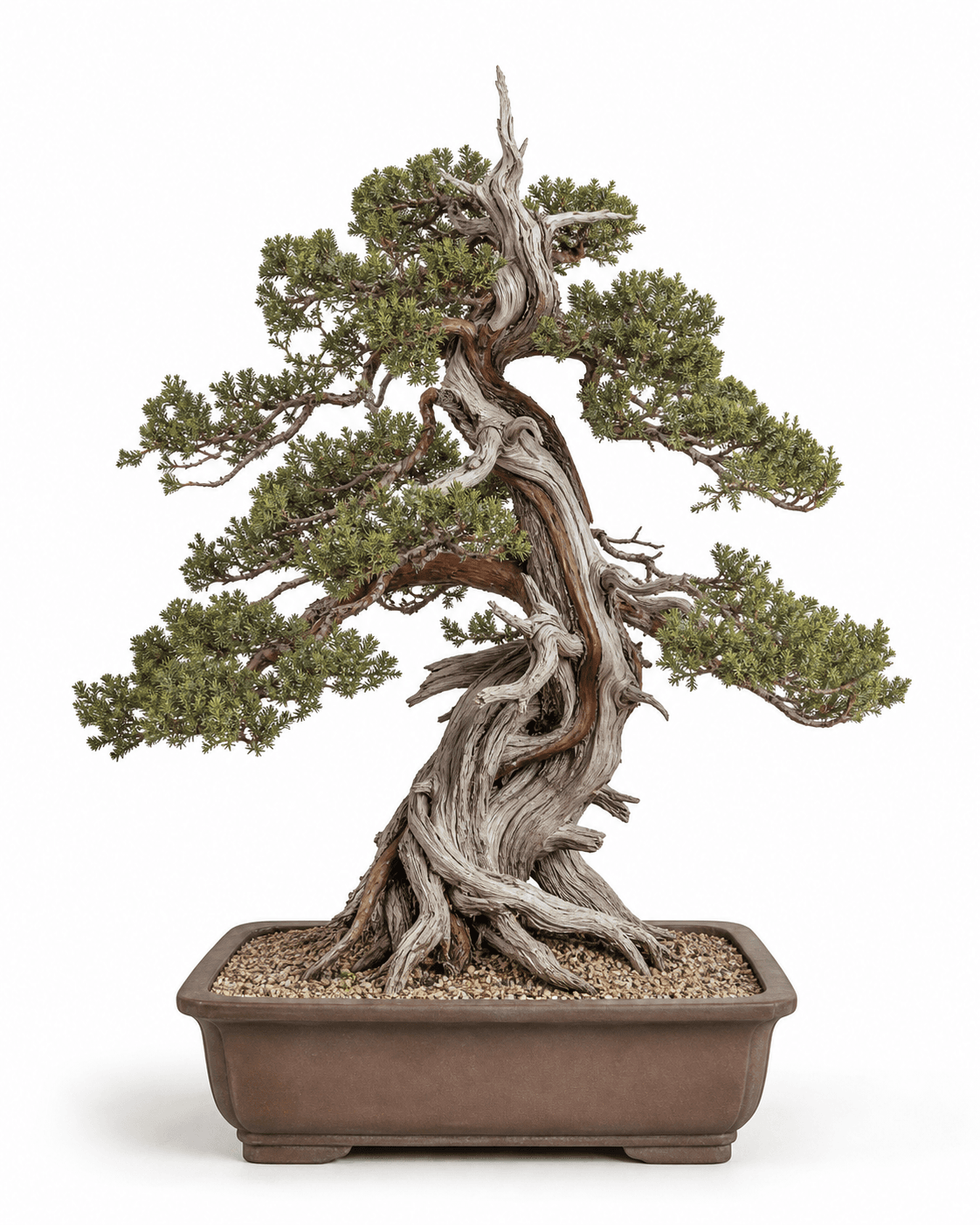
Utah juniper is an outdoor North American desert juniper with coarse scale foliage, fibrous deadwood, brittle branches, and a surprising appetite for water once it is in a bonsai container. Treat confirmed Juniperus osteosperma as a foliage-powered juniper: build strength first, prune runners after growth hardens, keep water and oxygen balanced, and delay styling until roots are stable.
This guide uses dedicated Mirai Utah juniper styling and structural-work files, broader juniper physiology and grafting files, and public references from Kew, Flora of North America, USDA FEIS, Utah State University, the National Park Service, The Gymnosperm Database, and UC IPM. The practical emphasis is pinyon-juniper ecology, collected-material recovery, live-vein preservation, no-pinching pruning, soil, climate adaptation, pest diagnosis, grafting decisions, and design that respects dry western habitat.
Updated June 9, 2026. Written by EntGrove Editorial. Last verified June 9, 2026.
Care fingerprint
Read the species through its shared care pattern.
Protect old collected root systems, preserve live veins, and avoid combining major styling with aggressive root work. Use this as the starting point before local conditions and tree strength refine the calendar.
Note: Coarse desert North American juniper with dedicated Mirai Utah juniper styling and structural-work coverage; verify against Rocky Mountain, one-seed, western, Sierra, California, alligator juniper, and eastern red cedar labels before applying care.
Keep foliage strong
Junipers recover through active foliage, so styling choices should leave enough healthy tips to power the tree.
Protect live veins
Old junipers often depend on narrow live veins between roots and foliage; root work and carving should respect that path.
Do not stack major work
Heavy bending, major foliage reduction, carving, and repotting belong in a staged plan rather than the same weekend.
Care cadence
The calendar starts with the tree's seasonal state.
Placement
Timing: Grow outdoors in full sun with strong airflow. During severe heat, protect the container or bench surface while keeping foliage bright.
Watch for: Indoor storage, deep shade, freshly repotted roots in afternoon heat, wind after heavy bending, and cold wet exposure after late work.
Utah State University Extension ForestryBonsai Mirai LibraryWatering
Timing: Water thoroughly when the upper quarter to half inch of substrate dries. Utah juniper can be one of the highest-water junipers in cultivation, so judge by the rootball and foliage mass.
Watch for: Hydrophobic field cores, fine roots drying after a hot wind, stale wet akadama in cool climates, and foliage that stays green after roots have already declined.
Bonsai Mirai LibraryDevelopment feeding
Timing: Feed moderately through active growth when foliage is healthy. After heavy spring pruning, hold fertilizer back until the response settles.
Watch for: Organic cakes clogging the soil surface, force-feeding weak collected trees, and coarse growth after spring reduction plus heavy feed.
Bonsai Mirai LibraryPruning
Timing: For refinement, prune runners after the first flush hardens in late spring to early summer. For recovery, let the tree run until strength is obvious.
Watch for: Pinching active tips, cutting to bare stems, removing useful interior shoots too early, and stripping crotch growth on a tree still rebuilding roots.
Bonsai Mirai LibraryRepotting
Timing: Repot in a spring activity window when roots can recover, or follow an experienced collector timing plan for old yamadori. Keep foliage mass high after root work.
Watch for: Bare-rooting, rootball movement, combining repotting with grafting or heavy styling, and assuming slow post-collection stillness means failure.
Bonsai Mirai LibraryWiring
Timing: Wire only after live veins harden enough to resist tearing. Coarse Utah branches often need heavier wire, branch-base support, raffia, guy wires, or split-branch technique.
Watch for: Thin wire that cannot control the branch, live veins placed on the wrong side of a bend, loose anchoring in small pots, and bark tearing during summer softness.
Bonsai Mirai LibraryLive vein cleaning
Timing: Clean and define live veins from mid-summer through winter after the first flush hardens and cambium adhesion improves.
Watch for: Spring cleaning while bark slips, tearing filament-like Utah live veins, borer galleries under fissured bark, and exposing fresh cambium to intense summer sun.
Bonsai Mirai LibraryGrafting
Timing: Graft only when roots, foliage mass, and host branches are vigorous. Use native foliage if it fits the design; use approach or scion grafts when proportion or branch quality requires replacement.
Watch for: Grafting weak yamadori, locking the design before grafts take, grafting on curved branch sections, and removing native foliage too quickly after a graft succeeds.
Bonsai Mirai LibraryCollected-material recovery
Timing: Expect newly collected Utah juniper to recover slowly. Mirai yamadori aftercare notes that pinyon and Utah junipers may show little new growth for two years.
Watch for: Moving the recovery box, bench heat, loose rootballs, premature styling, overwatering a dense old core, and treating delayed growth as an automatic failure.
Bonsai Mirai LibraryWinter protection
Timing: Protect potted roots during hard freezes, especially after repotting, live-vein cleaning, or heavy bending. Place pots on the ground or mulch the root zone when needed.
Watch for: Fine roots in small containers, wind desiccation, repeated freeze-thaw, rock plantings with little insulation, and greenhouse airflow drying freshly worked trees.
Bonsai Mirai LibraryUtah State University Extension ForestrySpecies guide
Apply the species profile before copying another tree's calendar.
At a glance
Utah juniper is a water-hungry desert juniper in a bonsai pot.
Kew accepts Juniperus osteosperma as a Cupressaceae shrub or tree native from the western United States to New Mexico, and FNA records it through the Great Basin, Colorado Plateau, and adjacent western states. Kew POWOFlora of North America
For bonsai, its essential contradiction is useful: the wild tree occupies dry rocky country, while Mirai Utah work says cultivated Utah juniper uses exceptional water for a juniper. The practical answer is frequent complete watering in mineral soil that drains fast enough to restore oxygen. Bonsai Mirai Library
The species has coarse scale foliage, fibrous bark, stringy deadwood, brittle branches, slow recovery, and a strong tendency to hold identity from its pinyon-juniper habitat. It rewards patience, strong sun, conservative root sequencing, and design decisions based on live-vein movement. Bonsai Mirai LibraryUtah State University Range Plants
Habitat
Read Utah juniper from dry plateaus, rocky slopes, pinyon woodland, and shallow alkaline soil.
FNA gives the habitat as dry rocky soils and slopes from about 1300 to 2600 m. USU Range Plants places Utah juniper on dry plains, plateaus, lower mountain elevations, alluvial fans, dry rocky hillsides, and shallow alkaline soils often between pinyon pine above and sagebrush grassland below. Flora of North AmericaUtah State University Range Plants
Mirai environmental-study material places pinyon pine and Utah juniper on hot, eroded, rocky exposures, sometimes less than a mile from moist counter-slopes where spruce, fir, and lodgepole dominate. That contrast explains the design vocabulary: sparse mass, exposed live veins, weathered roots, and foliage organized as survival rather than garden fullness. Bonsai Mirai Library
USDA FEIS describes extensive root architecture, including a deep taproot, long lateral roots, and fine roots concentrated near the surface. In a bonsai container, the old root ecology has to be converted in stages because the tree depends on foliage to rebuild fine roots. USDA Forest Service FEISBonsai Mirai Library
The care implication is direct: full sun, airflow, mineral substrate, and oxygen matter as much as water. The design implication is equally direct: avoid lush rounded pads that erase the dry exposed origin of the material. Bonsai Mirai / AsymmetryBonsai Mirai Library
Reading the tree
Judge strength from foliage, live-vein solidity, and the pace of new interior shoots.
Mirai juniper overview gives the governing rule for the genus: juniper strength originates in foliage. Healthy foliage regenerates roots, so a weak Utah juniper should accumulate growth before pruning, grafting, repotting, or heavy styling. Bonsai Mirai Library
Utah differs from Rocky Mountain juniper in several practical ways. Mirai structural work says Utah can tolerate meaningful root reduction at collection, can air-layer itself where branches touch moist ground, and can often be pruned back to small interior adventitious shoots with less branch-loss risk than Rocky Mountain juniper. Bonsai Mirai Library
That relative tolerance should still be paced. Mirai yamadori aftercare warns that pinyon and Utah junipers can show little visible new growth for two years, which is normal for slow recovering material. Bonsai Mirai Library
For a development tree, read extension, color, hydration, interior buds, and root stability. For refinement, read whether runners are lengthening evenly, whether old interior shoots are being shaded out, and whether pruning can be timed after hardening for a finer response. Bonsai Mirai Library
Foliage work
Prune running tips after hardening, preserve interior shoots, and skip pinching.
Mirai spring juniper pruning names Utah among running junipers. The refinement window is after the first flush hardens, roughly late spring to early summer in many climates, when pruning creates a calmer and finer response than early spring reduction. Bonsai Mirai Library
Use directional pruning to cut back to shoots that already point where future growth should go. Preserve viable interior shoots because junipers do not reliably bud from bare wood after hard cuts. Bonsai Mirai Library
The Utah-specific caution is crotch growth. Mirai Utah styling says aggressive crotch-growth removal can be risky because the species sheds foliage unpredictably even when healthy. Wait until growth has hardened and the tree is clearly strong before structural thinning. Bonsai Mirai Library
If a tree has fallen out of refinement, spring reduction can restart development, but expect a coarse response and a second corrective pruning later. Hold fertilizer back after heavy spring pruning so stored energy and fresh nutrition do not combine into long coarse runners. Bonsai Mirai Library
Roots
Convert roots in stages and keep the recovered rootball immobile.
Wild Utah juniper can carry deep and wide roots, with most biomass in the upper soil and fine roots concentrated near the surface. In a pot, the target is a compact, oxygen-rich fine-root system that can support full sun and foliage mass. USDA Forest Service FEISBonsai Mirai Library
For newly collected material, Mirai yamadori aftercare emphasizes rigid tie-downs, ground-level recovery placement, screened pumice in recovery boxes, and restraint. Rootball movement destroys new capillary roots before the tree can show progress. Bonsai Mirai Library
Once established, inspect every 4 to 6 years. Repot when water percolation, root density, old field soil, or angle correction justifies the work, then leave enough foliage to rebuild the roots that were disturbed. Bonsai Mirai Library
A slow response after collection or first repotting deserves patience. The warning signs are loose roots, black sour soil, foliage dulling in full sun, branch dieback after root movement, or a rootball that stays wet below a dry surface. Bonsai Mirai Library
Soil and pot
Use mineral soil that hydrates completely and reopens quickly.
Mirai juniper overview gives a standard 1:1:1 akadama:pumice:lava mix, with 2:1:1 favoring akadama when a healthy juniper needs more water and nutrient availability. Particle size around 1/16 in to 1/4 in fits fine juniper roots. Bonsai Mirai Library
For Utah juniper, begin with oxygen. A collected or uncertain rootball often belongs in pumice or a fast mineral recovery mix until new roots and water use are obvious. A refined vigorous tree in a dry climate can hold more akadama because the foliage mass drinks so much water. Bonsai Mirai Library
Pot choice should support the desert story. Unglazed, quiet, warm earth-toned containers suit old Utah juniper better than glossy color. A shallower container can work after roots are compact, but recovery and transition trees need depth and thermal buffering. Bonsai Mirai / AsymmetryBonsai Mirai Library
Avoid compacted organic fertilizer crusts, fine dust, and old hydrophobic field pockets. If the surface seals over, Utah juniper can be simultaneously wet below and oxygen-starved at the active roots. Bonsai Mirai Library
Climate
Adapt for hot dry sun, cold roots, and wet-climate oxygen risk.
USU Forestry describes Utah juniper as very drought, cold, and heat resistant in the landscape and lists Zones 3-7. A bonsai pot changes the risk profile because confined fine roots lose the insulation and reach of wild roots. Utah State University Extension ForestryBonsai Mirai Library
In hot dry regions, water generously, shade the pot rather than the foliage when possible, and watch afternoon wind. In humid or cool wet regions, use faster soil, larger particles, and careful bench placement so oxygen returns between waterings. Bonsai Mirai LibraryUC IPM Juniper
In winter, protect roots below hard-freeze thresholds, especially after recent work. Mirai juniper overview puts root protection around the mid-20s F for potted junipers, while heavy late work requires shelter with airflow managed carefully. Bonsai Mirai Library
Newly repotted trees should be shielded from intense sun until new roots can hydrate the foliage. Established trees should return to full sun because shade slows the foliage engine that powers juniper recovery. Bonsai Mirai Library
Pests and diseases
Prevent stress first, then watch borers, mites, twig blight, root rot, rust, and mistletoe.
UC IPM lists juniper pests and disorders including aphids, bark beetles, cypress bark scale, tipminers, flatheaded borers, foliage miners, twig girdlers, nematodes, sawflies, scales, spider mites, Armillaria, cankers, twig blights, Phytophthora, rusts, scorch, nutrient disorders, and water stress. UC IPM Juniper
Mirai live-vein work adds a bonsai-specific borer prevention practice: clean fissured bark on scaled junipers after the safe hardening window, because bark folds can hide egg-laying sites and larvae. Bonsai Mirai Library
UC IPM twig-blight guidance names Kabatina and Phomopsis, with wet foliage and wounds as infection routes. Good bonsai prevention is dry foliage overnight, airflow, sanitation cuts, and restraint with fertilizer. UC IPM Juniper Twig Blights
USDA FEIS notes juniper mistletoe and dense mistletoe can heavily infest Utah juniper. On bonsai, remove visible parasite growth, trace the affected area carefully, and improve vigor before major styling. USDA Forest Service FEIS
Wiring
Utah juniper can bend, but brittle branches and filament-like veins demand control.
Mirai Utah styling says coarse desert junipers often need substantial wire, including 10-12 gauge into fine branching, because thin wire fails to control position. Function matters more than a tidy wire pattern. Bonsai Mirai Library
Handle foliage from underneath rather than pulling it apart to apply wire. Branch junctions can be weak, so anchor to deadwood or stronger structural wire when needed, and support the branch base with the off hand. Bonsai Mirai Library
For heavy bends, Mirai juniper structure uses live-vein tracing, split-branch technique, heavy wire spines, flat wet raffia, guy wires, and incremental bending. The branch should rotate and bend through a length of tissue instead of kinking at one point. Bonsai Mirai Library
Utah branches are more brittle than Rocky Mountain or Sierra juniper, closer to California juniper in bending risk. If a live vein starts to tear, move the fulcrum farther along the branch, reduce pressure at the injury, and protect the wound. Bonsai Mirai Library
Propagation
Seed is natural; air-layering is plausible; grafting is a design tool.
USDA FEIS says Utah juniper reproduces by seed in cones, with dormant embryos and impermeable seed coats that often germinate in the second season after maturity. Animal transport helps disseminate seed in habitat. USDA Forest Service FEIS
Mirai structural work says Utah juniper can naturally air-layer where branches touch moist ground, unlike Rocky Mountain juniper. In bonsai terms, that supports air-layering as a possible advanced technique when enough foliage and aftercare can be maintained. Bonsai Mirai Library
Cuttings are possible across some junipers, but old Utah juniper value usually comes from collected trunks or legally sourced native material rather than quick propagation. Seedlings and nursery starts are better for learning horticulture than instant aged design. USDA Forest Service FEISBonsai Mirai Library
Grafting should solve a clear design problem. Mirai grafting strategy prefers native foliage when proportion and quality meet the design goal, and requires strong roots and abundant foliage before any approach or scion graft attempt. Bonsai Mirai Library
Sourcing
Choose legally sourced material with stable roots, enough foliage, and honest provenance.
The best Utah juniper bonsai material usually comes from legal collected stock, professional pre-bonsai, or seedlings grown long enough to show durable roots and branch options. Avoid vague cedar labels unless the seller can confirm Juniperus osteosperma. Kew POWOFlora of North America
Inspect root stability before trunk drama. A collected Utah with a strong trunk, loose rootball, sour field core, recent severe pruning, and no new extension is a long recovery project rather than styling-ready material. Bonsai Mirai Library
Expect delayed-decline signatures in junipers. Foliage can stay green after roots have failed, so ask when the tree was collected, when it was first repotted, how it was tied down, what substrate is inside, and what growth it has produced since collection. Bonsai Mirai Library
Verify the label against Rocky Mountain, one-seed, California, Sierra, western, alligator juniper, and eastern red cedar. FNA and USDA FEIS both note hybrid or contact-zone complexity involving Utah juniper and neighboring Juniperus species. Flora of North AmericaUSDA Forest Service FEISThe Gymnosperm Database
Troubleshooting
Diagnose by timing, foliage mass, root oxygen, and live-vein continuity.
Symptom: no visible growth for one or two seasons after collection. Likely cause: normal slow Utah recovery if foliage remains stable and roots are immobile. Fix: keep the box steady, protect from extremes, water by rootball condition, and postpone styling. Bonsai Mirai Library
Symptom: coarse juvenile or whip growth. Likely cause: stress or overstimulation after heavy pruning, root work, or strong feeding. Fix: restore steady culture, grow the tree strong, then prune after hardening. Bonsai Mirai Library
Symptom: interior foliage browns while exterior runners extend. Likely cause: shade-out from unmanaged running growth. Fix: use post-harden directional pruning to preserve useful interior shoots and reduce outer dominance. Bonsai Mirai Library
Symptom: branch dies after bending. Likely cause: live-vein tear, xylem break, or compression against deadwood. Fix: stop bending when tissue cracks sharply, support bends through a longer fulcrum, and wait before more work. Bonsai Mirai Library
Symptom: tips brown after wet weather or pruning. Likely cause: twig blight entering wet wounded foliage. Fix: prune out infected shoots, dispose of debris, keep foliage dry, increase airflow, and avoid overfertilization. UC IPM Juniper Twig Blights
Symptom: foliage dulls after a hot wind. Likely cause: fine-root drying or rootball heat. Fix: shade the pot, water completely, avoid pruning, and judge survival over weeks rather than hours. Bonsai Mirai Library
Design
Let fibrous deadwood, live-vein movement, and dry-country exposure shape the silhouette.
Mirai Utah styling distinguishes Utah deadwood as fibrous and stringy, compared with the more sandblasted and resin-filled Rocky Mountain character. That texture should guide carving restraint, jin length, and surface finishing. Bonsai Mirai Library
Start by tracing live veins and cleaning enough bark to understand sap flow. Mirai live-vein work says cleaning scaled junipers reveals the design before front selection and styling, while also reducing borer habitat. Bonsai Mirai Library
Design sequence matters on complex material: defining branch first, high-risk bends next, then trunk-to-apex line. On Utah juniper, a distant apex can be valid when the existing structure places the strongest top far from the base. Bonsai Mirai LibraryBonsai Mirai / Asymmetry
The most convincing designs often keep asymmetry, negative space, and visible age. Compressing every branch into a conventional mound can erase the pinyon-juniper woodland story that made the tree worth collecting. Bonsai Mirai LibraryBonsai Mirai / Asymmetry
Forms and labels
Most label problems come from cedar names, sabina synonyms, and neighboring junipers.
Kew accepts Juniperus osteosperma and lists synonyms including Juniperus californica var. osteosperma, Juniperus californica subsp. osteosperma, Juniperus tetragona var. osteosperma, Sabina osteosperma, Juniperus californica var. utahensis, and Juniperus utahensis. Kew POWO
FNA lists Utah juniper and sabina morena as common names, no lower taxa, and reports hybridization with western juniper in northwestern Nevada. USDA FEIS adds hybrid reports with one-seed, Rocky Mountain, and alligator junipers in Arizona. Flora of North AmericaUSDA Forest Service FEIS
USU Range Plants lists cedar as a common name, while The Gymnosperm Database records Utah juniper, sabina, cedro, desert cedar, and sabina morena. Those labels are useful for search, but care should follow the confirmed Latin name. Utah State University Range PlantsThe Gymnosperm Database
There are no major bonsai cultivar groups equivalent to Itoigawa or Kishu. Record provenance, collection date, native foliage quality, and any grafted foliage separately because those details change care and future design decisions. Bonsai Mirai Library
History
Utah juniper is a defining tree of Great Basin and Colorado Plateau pinyon-juniper country.
USDA FEIS calls Utah juniper the most common tree in the Great Basin and widely distributed through the arid West. USU Range Plants says nearly one-fifth of Utah land cover is Utah juniper, making it the predominant tree species in the state by total cover. USDA Forest Service FEISUtah State University Range Plants
The species has practical western uses as construction material, fence posts, firewood, pencils, Christmas trees, and wildlife food through berry-like cones. USU also notes decay-resistant wood, especially in the heartwood. Utah State University Range Plants
NPS Arches reports Utah juniper as widespread in Arches National Park, and notes a Utah tree aged at more than 1275 years. The Gymnosperm Database highlights the species as a familiar presence across the Great Basin, Colorado Plateau, and Utah national parks. National Park Service: ArchesThe Gymnosperm Database
In bonsai, Utah juniper belongs to the American collected-native tradition: old wood, legal collection, slow recovery, careful root conversion, and styling that reads the original landscape rather than applying a generic juniper silhouette. Bonsai Mirai LibraryBonsai Mirai / Asymmetry
Species questions
Answer the beginner questions before styling.
Can Utah juniper be grown as bonsai?
Yes. Utah juniper is a strong outdoor bonsai subject when it has full sun, stable roots, mineral soil, careful water and oxygen balance, and enough foliage to power recovery.
Can Utah juniper bonsai live indoors?
Utah juniper should live outdoors in sun, airflow, heat, and winter dormancy. Indoor display should be brief.
How often should I water Utah juniper bonsai?
Water when the upper quarter to half inch of substrate dries, then soak the whole rootball. Utah juniper can use exceptional water in a bonsai pot, but the soil must reopen for oxygen.
Should Utah juniper be pinched?
Use pruning rather than pinching. Let running tips extend, then prune back to strong lateral growth after the first flush hardens.
When should Utah juniper be pruned?
Refinement pruning is safest after the first flush hardens in late spring to early summer. Heavy spring reduction can restart development but usually produces coarse growth.
What soil works for Utah juniper bonsai?
Use oxygen-rich mineral soil. Start around 1:1:1 akadama:pumice:lava for recovery or wet climates, and use more akadama only when a healthy tree needs extra water retention.
How cold hardy is Utah juniper bonsai?
USU Forestry lists landscape Zones 3-7. In bonsai, protect the container during hard freezes because potted fine roots are more vulnerable than wild roots in ground.
Why is my collected Utah juniper not growing?
Slow recovery can be normal. Mirai yamadori aftercare notes that pinyon and Utah junipers may show little new growth for two years after collection.
Is Utah juniper the same as Rocky Mountain juniper?
They are separate species, Juniperus osteosperma and Juniperus scopulorum. Utah has coarser foliage, different deadwood texture, different water behavior in cultivation, and different hybrid-zone cautions.
Should Utah juniper be grafted with Shimpaku foliage?
Graft only when native foliage cannot meet the design goal and the tree is vigorous. Strong roots, abundant foliage, and clear branch geometry matter more than the idea of instant refinement.
Sources
Species advice needs source discipline.
Next decisions
Plan the operation before copying the calendar.
A good care note for Utah juniper records the tree's stage, the work done, and the aftercare used. That record matters more than a month-name rule.
Related species
Compare nearby trees before transferring advice.
California juniper
Juniperus californica
Sierra juniper / Western juniper
Juniperus grandis
Western juniper
Juniperus occidentalis
Rocky Mountain juniper
Juniperus scopulorum
One-seed juniper
Juniperus monosperma