
Species guide
Chinese Wisteria Bonsai Care
Wisteria sinensis
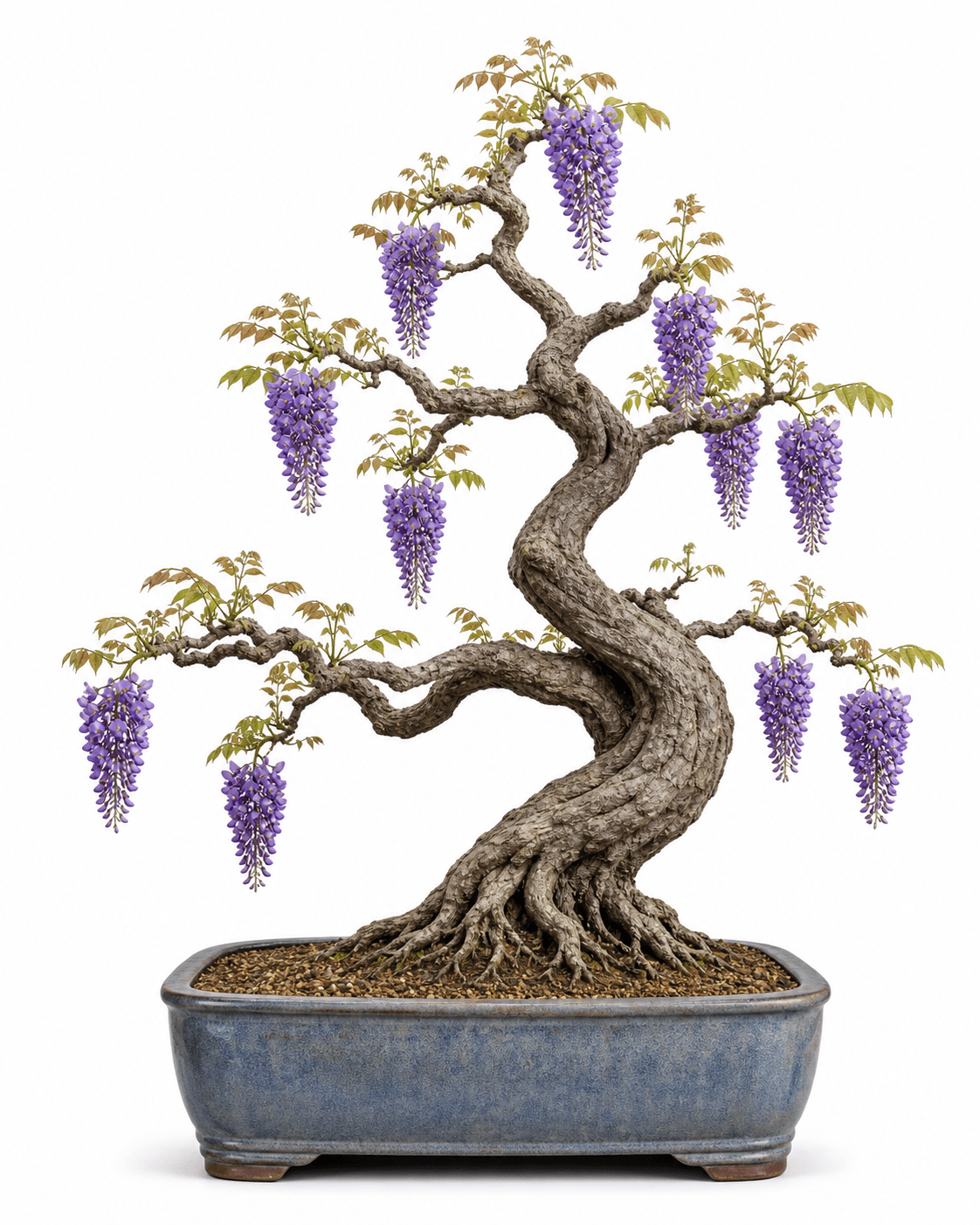
Chinese wisteria bonsai is an outdoor flowering-vine project for growers who can provide full sun, heavy active-season water, winter root protection, and strict containment. The spring bloom is the reward, while the tree must still read well through trunk, branch line, and winter silhouette.
Treat Wisteria sinensis as Broadleaf > Deciduous in the EntGrove taxonomy, with the same Mirai vine rules as Japanese wisteria: basal strength, compound leaves, brittle wood, preserved root sheen, deep containers, and branch tips kept oriented toward strength.
Start with mature, contained material if flowers matter. Chinese wisteria blooms in shorter racemes than Japanese wisteria, can be invasive in parts of North America, and should never be trained in open ground where escaped runners or seed pods are a regional risk.
Updated June 15, 2026. Written by EntGrove Editorial. Last verified June 15, 2026.
Care fingerprint
Read the species through its shared care pattern.
Repot and structural prune around dormant-to-active transitions; protect new leaves; time refinement work after growth hardens. Use this as the starting point before local conditions and tree strength refine the calendar.
Read the foliage first
Broadleaf stress usually shows in leaf color, leaf size, wilt, scorch, or delayed hardening before it becomes a branch problem.
Match work to dormancy
Deciduous, evergreen, tropical, succulent, and flowering broadleaf trees recover on different calendars.
Protect fine roots
Root work should preserve enough active fine roots for the tree to rehydrate quickly after the operation.
Care cadence
The calendar starts with the tree's seasonal state.
Placement
Timing: Grow outdoors in full sun and moving air through active growth. Protect the pot in winter before roots freeze hard, especially after recent root work.
Watch for: Shaded leafy runners, weak flower bud set, hot small pots after partial defoliation, wind toppling heavy crowns, and warm storage that wakes the vine too early.
NC State ExtensionBonsai Mirai LibraryWatering
Timing: Water by foliar mass, heat, wind, pot depth, and drainage. Strong summer canopies can need very frequent watering, but oxygen must return after every cycle.
Watch for: Leaf wilt during runner extension, stale wet winter soil, compacted top dressing, chronic water trays, and slow drainage after root congestion.
Bonsai Mirai LibraryFertilizing
Timing: Feed established trees strongly through active growth. Mirai favors balanced nutrition over old low-nitrogen or high-potassium flower-forcing habits.
Watch for: Weak flower buds, runaway tendril dominance, depleted recovery trees, and treating fertilizer as a substitute for sunlight, root health, and pruning timing.
Bonsai Mirai LibraryPost-flower pruning
Timing: After flowers drop, prune before seed pods form. Let needed extensions run long enough to refill strength, then return at the post-flush hardened stage.
Watch for: Seed pods draining a container tree, cuts between nodes, pruning away short flowering spurs, and cutting big branches before water flow has resumed.
Bonsai Mirai LibraryNC State Extension wisteria overviewPartial defoliation
Timing: Use on dense, vigorous trees after the first flush hardens, often early to mid summer. Reduce compound leaves by leaflets rather than stripping whole leaves.
Watch for: Sparse trees, newly repotted trees, weak interiors needing more leaflets, and sudden full-sun exposure of shaded interior foliage.
Bonsai Mirai LibraryWiring
Timing: Wire and bend just before spring bud push, or use repeated light corrections through the growing season on strong branches. Check active wire by early summer.
Watch for: Brittle old wood, wire marks restricting water flow, raffia hiding tearing signals, branch tips pulled below strength, and pad geometry forced onto a vine.
Bonsai Mirai LibraryRepotting
Timing: Repot after flowering for display trees, or at spring bud swell when root correction is worth sacrificing bloom. Avoid back-to-back repots.
Watch for: Bare-rooting, lost root sheen, midsummer percolation failure, old organic core collapse, and heavy root work paired with hard top reduction.
Bonsai Mirai LibraryPests and disease
Timing: Scout during watering, after dense summer canopy forms, before winter shelter, and whenever runners or branch tips weaken unevenly.
Watch for: Aphids, scale, mealybugs, Japanese beetles, leaf spots, powdery mildew, root rot from oxygen loss, crown gall, canker, borer damage, and toxic seed pods.
NC State ExtensionNC State Extension wisteria overviewBonsai Mirai LibraryContainment
Timing: Keep material in containers or fully controlled development systems in regions where Asian wisterias are invasive. Remove seed pods and runners before escape.
Watch for: Open-ground training, nodes rooting where they touch soil, escaped runners, viable seed pods, and mislabeled Chinese, Japanese, or hybrid Asian wisteria.
NC State ExtensionOregon State Landscape PlantsNC State Extension wisteria overviewSpecies guide
Apply the species profile before copying another tree's calendar.
At a glance
Chinese wisteria is an outdoor deciduous vine trained for old trunk and compact racemes.
Kew accepts Wisteria sinensis in Fabaceae and gives its native range as central and southern China. NC State describes it as a high-maintenance woody deciduous vine with counterclockwise twining stems, rapid growth, blue-violet fragrant flowers, flattened fuzzy seed pods, and USDA Zone 5a-8b landscape hardiness. Kew POWONC State Extension
The bonsai specification is practical: outdoor full sun, heavy active-season water, deep containers, 100 percent akadama in refinement, protected winter roots, and pruning that respects bloom timing. Mirai groups wisteria with sheen-based broadleaf deciduous subjects, so root work preserves connected fine roots rather than exposing the nebari bare. Bonsai Mirai LibraryNC State Extension
Chinese wisteria usually has shorter racemes than Japanese wisteria. NC State gives Chinese wisteria racemes at 6-12 inches and Japanese wisteria racemes at 12-18 inches, so Chinese wisteria can fit a slightly tighter medium-size display while still needing open vertical planes. NC State ExtensionNC State ExtensionBonsai Mirai / Asymmetry
Wild habitat
Its wild identity is a sun-seeking Chinese liana built for climb, reach, and light.
Kew places Wisteria sinensis in the temperate biome of central and southern China. In gardens and escaped landscapes, NC State describes a twining woody vine that climbs, spreads rapidly, and can dominate support structures or nearby vegetation. Kew POWONC State Extension
That ecology explains the care. Mirai describes wisteria as overstory-seeking and sun-demanding, with massive water mobility and strong basal energy. In a bonsai pot, the grower must supply sun, water, and oxygen while repeatedly redirecting vine energy away from runaway tendrils. Bonsai Mirai Library
It also explains the design. A convincing Chinese wisteria should feel like an old vine trained into tree form: muscular base, open laterals, visible age, and space for flowers to hang. Tight leaf pads fight the species and hide the bloom structure that gives it value. Bonsai Mirai / AsymmetryBonsai Mirai Library
Reading the tree
Read Chinese wisteria by stage: development, recovery, refinement, and display.
Development trees need extension. Mirai gives five reasons to let wisteria run: elongation, thickening, root rebuilding, healing, and vascular expansion for future interior buds. A young or recently collected vine should not be managed like a finished flowering show tree. Bonsai Mirai Library
Refinement trees need distribution. Once there is density, Mirai uses leaflet-level partial defoliation, tendril cutback, and branch spreading to even out energy across secondary and tertiary branch units. That creates better air, more interior strength, and flower-space for the following season. Bonsai Mirai Library
Display trees need restraint. A mature Chinese wisteria in bloom should not be exhausted by seed pods, heavy top work, and root work in one season. After bloom, remove pods, let the tree regain strength, then decide whether pruning, root correction, or recovery is the priority. Bonsai Mirai LibraryNC State Extension wisteria overview
Pruning
Preserve short flowering wood, remove pods, and cut compound leaves by leaflets.
NC State says Chinese wisteria flowers before leaves fully expand, with mildly fragrant racemes and fuzzy pods. Mirai places the first bonsai pruning after flowers drop and before seed pods form, because pod development is one of the largest energy drains on a containerized wisteria. NC State ExtensionBonsai Mirai Library
Post-flush work is the flower-bud setup for the next year. Mirai prunes and partially defoliates after leaves are fully formed and hardened, then cuts tendrils back to usable interior ramification so the vine cannot starve weaker branches by sending everything into one runner. Bonsai Mirai Library
Partial defoliation on wisteria means reducing leaflets within each compound leaf. In strong areas, Mirai commonly leaves the first fully formed pairs; in weak or interior areas, leave more leaflets so those branches keep enough photosynthetic mass to recover. Bonsai Mirai Library
Structural cut timing depends on the goal. Major reductions are strongest at early spring bud swell when stored energy is high, but that can cost the year's flowers. Reserve large weak-tree rebuilds for a stronger energy window than summer post-flush refinement. Bonsai Mirai Library
Repotting
Repot to preserve root sheen, accepting that root work can reduce bloom.
Mirai treats wisteria as a sheen-based deciduous species. Preserve a connected root mass, reduce from the surface, sides, and bottom, and avoid bare-rooting that removes the root sheen supporting the apex and far extensions. Bonsai Mirai Library
Timing follows the tree's goal. After-flowering repotting protects the display calendar. Spring bud-swell repotting is stronger for angle correction, root health, and development, with the expectation that flowers may be reduced that season. Bonsai Mirai Library
A 2 to 3 year inspection rhythm is a good starting point because wisteria fills containers quickly. Avoid back-to-back repots; if midsummer drainage fails, temporary tray triage can buy time, while chronic standing water produces coarse roots and stale soil. Bonsai Mirai Library
Soil and pot
Use akadama in refinement and choose depth for water movement.
Mirai is direct for refined wisteria: 100 percent akadama. Akadama supplies buffering and water retention while allowing oxygen return when the grower uses the right particle size, container depth, and watering cadence. Bonsai Mirai Library
Development and recovery trees can carry more organic matter. Mirai uses roughly 70 percent organic matter and 30 percent pumice on recovering yamadori or development trees to drive coarse roots, nutrition, and vascular mass before refinement soil. Bonsai Mirai Library
Pot depth is a horticultural tool. Mirai favors deeper containers for wisteria because a taller gravity column moves water through the soil and pulls oxygen back in. That supports a thirsty vine better than a shallow container that stays stagnant. Bonsai Mirai Library
Pot style should also serve the flowers. Chinese wisteria's shorter racemes allow slightly more compact displays than long-raceme Japanese cultivars, but the pot still needs weight, tie-down strength, and enough vertical clearance for bloom. NC State ExtensionNC State ExtensionBonsai Mirai / Asymmetry
Climate
Adapt for heat, humidity, winter root risk, and invasive-region rules.
Landscape hardiness gives only a baseline. NC State lists Zones 5a-8b and Oregon State lists Zone 5 hardiness, but a bonsai pot freezes, thaws, dries, and warms faster than garden soil. Keep the tree dormant and seasonal while protecting the root ball from hard freeze and drying wind. NC State ExtensionOregon State Landscape PlantsBonsai Mirai Library
Climate shifts the work calendar. Mirai notes that post-flush hardening can land around mid June in the Pacific Northwest and earlier in warmer southern climates. Use leaf maturity, cuticle hardening, root function, and canopy density as the trigger rather than the calendar alone. Bonsai Mirai Library
Containment is part of the species profile. NC State marks Chinese wisteria invasive in North Carolina, and Oregon State warns that Japanese, Chinese, and hybrid wisterias have invaded natural habitats in many eastern and southern states. Use containers and secure waste handling where Asian wisterias are a regional problem. NC State ExtensionOregon State Landscape PlantsNC State Extension wisteria overview
Pests and disease
Most Chinese wisteria pest pressure follows density, weakness, and wet roots.
NC State lists aphids, brown scale, powdery mildew, leaf spot, crown gall, canker, root rot, and wisteria borer for Chinese wisteria. The broader NC State wisteria overview also lists mealybugs and Japanese beetles among common wisteria pests. NC State ExtensionNC State Extension wisteria overview
Dense summer foliage invites hidden pests and stagnant interiors. Mirai uses partial defoliation first for air movement, with light penetration as a secondary gain. Scout inside the canopy, especially after runners have shaded inner leaves. Bonsai Mirai Library
Root rot begins with oxygen loss. If leaves yellow, runners collapse, or branch tips die back after wet storage, check drainage, particle breakdown, root smell, pot depth, and chronic tray use before reaching for treatments. Bonsai Mirai LibraryNC State Extension
Handle seed pods carefully. NC State flags Chinese wisteria toxicity for humans and animals, with seeds noted as a poisonous part. Removing pods helps both tree energy and bench safety. NC State Extension
Wiring
Wire before spring push, bend in small increments, and remove wire early.
Mirai prefers the window just before spring bud push for wisteria wiring and styling because the wood is more flexible and the full growing season follows. Use wire to distribute branches and open bloom lanes, then let pruning maintain the structure. Bonsai Mirai Library
Brittleness controls the work. Mirai warns against radical bends, raffia that hides tearing signals, and wire marks that restrict water movement. Paper-wrapped copper, guy wires, and repeated incremental bends are safer than forcing old vine wood in one session. Bonsai Mirai Library
Branch tips must keep strength. Mirai treats downward-pointed vine tips as a dieback risk, so set movement while keeping living tips angled toward growth. Remove active-season wire as soon as marks begin, often by late June or early July. Bonsai Mirai Library
Propagation
Cuttings, layers, grafts, seed, and urban recovery all carry different timelines.
NC State lists seed, stem cutting, root cutting, leaf cutting, and grafting for Chinese wisteria. It also warns that plants propagated by seed may take years before flowering, which matters when the bonsai goal is spring display. NC State ExtensionNC State Extension wisteria overview
Mirai favors softwood or semi-hardwood cuttings after flowering in early summer, when stems are sugar-loaded. Air layers are possible around late May to early June, but wisteria layers can start trunk rot above the layer, reducing long-term value. Bonsai Mirai Library
Urban recovery often produces the best trunks. Mirai describes quality wisteria bonsai material as old landscape material from foundations, restaurants, institutions, and legal removals, followed by a root-rebuild period before styling. Bonsai Mirai Library
Buying
Buy living trunk, flower proof, correct identity, and legal containment.
The strongest purchase is mature material already proven to flower. NC State notes that wisteria grown from seed may take several years to flower, so buying a blooming plant or a known flowering clone is more reliable than buying the cheapest seedling. NC State Extension wisteria overviewNC State Extension
Inspect the trunk as a living structure. Mirai values completely living wisteria trunks because rot keeps advancing and deadwood preservation is difficult in a frequently watered vine. Hollow character can be dramatic, but vascular mass is the long-term reserve. Bonsai Mirai LibraryBonsai Mirai / Asymmetry
Red flags include field-dug material with little recovery, sour nursery soil, old wire scars, escaped runners, uncontrolled seed pods, graft unions that interrupt the trunk, and sellers who cannot separate Chinese, Japanese, American, or hybrid wisteria. NC State ExtensionOregon State Landscape PlantsBonsai Mirai Library
Troubleshooting
Diagnose by symptom, then decide whether the problem is energy, roots, light, or containment.
Symptom: long green runners and no flowers. Likely causes: immaturity, shade, weak roots, runner dominance, or pruning at the wrong stage. Fix: increase sun, use mature material, build roots, cut pods after bloom, and prune after post-flush hardening. NC State Extension wisteria overviewBonsai Mirai Library
Symptom: branch tips or far extensions die back. Likely causes: root or nutritional weakness, cuts between nodes, branch tips wired downward, or heavy cutback on a refined potted tree. Fix: restore root function, cut to raised nodes, keep tips upward, and rebuild vigor before structural reductions. Bonsai Mirai Library
Symptom: leaf scorch after summer work. Likely causes: interior leaves exposed too quickly after partial defoliation or a newly repotted tree returned to full heat. Fix: use morning sun and afternoon shade until interior growth responds, then reintroduce full sun gradually. Bonsai Mirai Library
Symptom: weak roots and stale smell. Likely causes: shallow stagnant container, broken-down soil, chronic water tray use, old organic core, or wet winter storage. Fix: improve percolation at the correct window, preserve root sheen, use a deeper pot, and water for oxygen return. Bonsai Mirai Library
Symptom: runners root beyond the pot or seed pods form in an invasive region. Likely causes: uncontrolled development culture. Fix: remove pods, prune runners before nodes root, dispose of waste securely, and avoid open-ground training where Asian wisteria is regulated. NC State ExtensionOregon State Landscape PlantsNC State Extension wisteria overview
Design
Build a tree that flowers, with open vertical lanes for compact racemes.
Mirai sets the design priority for wisteria around tree form first and flowering second. A Chinese wisteria needs trunk age, branch hierarchy, and winter interest so the bonsai has value outside its bloom week. Bonsai Mirai / AsymmetryBonsai Mirai Library
The branch layout should be open. Mirai recommends widely spaced, non-overlapping lateral branches so each pendulous raceme has its own vertical plane. Chinese wisteria's shorter racemes make the display somewhat easier to scale than long Japanese forms, but crowding still ruins the flower effect. Bonsai Mirai LibraryNC State ExtensionNC State Extension
Deadwood needs restraint. Mirai treats deadwood as a long-term liability on wisteria because trunk rot keeps progressing. Old living bark, muscular vine movement, and supported living vascular tissue carry more value than carved hollows that slowly weaken the tree. Bonsai Mirai LibraryBonsai Mirai / Asymmetry
Cultivars
Choose Chinese wisteria forms by flower proof, scale, and regional legality.
NC State lists Blue Sapphire, Jako, Prolific, and White Diamond among Chinese wisteria cultivars, and notes that Prolific usually flowers at a younger age than other varieties. That matters for bonsai because juvenile seed-grown vines can remain vegetative for years. NC State ExtensionNC State Extension wisteria overview
Chinese wisteria is often chosen when the flower scale needs to be more compact. NC State lists Chinese wisteria racemes at 6-12 inches, while Japanese wisteria commonly carries longer racemes and long-raceme cultivars. NC State ExtensionNC State Extension
Separate Chinese, Japanese, American, and hybrid wisterias before applying a care note. NC State describes Chinese wisteria as counterclockwise twining, Japanese wisteria as clockwise twining, and American wisteria as less aggressive than the Asian species in the wisteria overview. NC State ExtensionNC State ExtensionNC State Extension wisteria overview
History
Chinese wisteria bonsai quality usually comes from old human landscapes.
Kew records Wisteria sinensis as an accepted species in Fabaceae, and NC State notes that the genus name honors Caspar Wistar. In gardens, Chinese wisteria became popular for fragrant spring bloom, fast cover, and vigorous twining growth. Kew POWONC State Extension wisteria overview
Mirai frames high-quality wisteria bonsai material as urban yamadori from old foundation plantings, restaurants, institutions, and removals rather than young nursery vines. Those sources can offer trunk age that nursery stock takes a long time to build. Bonsai Mirai Library
That history carries responsibility. Oregon State warns that Chinese, Japanese, and hybrid wisterias have invaded natural habitats in many eastern and southern states. A strong bonsai record should include permission, recovery notes, identity, and containment choices. Oregon State Landscape PlantsNC State Extension wisteria overviewBonsai Mirai Library
Species questions
Answer the beginner questions before styling.
Is Chinese wisteria a good beginner bonsai?
It is a reasonable second outdoor bonsai for a patient grower with full sun, heavy watering discipline, winter root protection, and mature material. Seedlings and low-light projects delay flowering for years.
Can Chinese wisteria bonsai live indoors?
Grow it outdoors. Chinese wisteria needs seasonal sun, dormancy, moving air, and cold root protection rather than warm indoor shelf culture.
Why will my Chinese wisteria bonsai not flower?
Common causes include immaturity, shade, weak roots, incorrect pruning, letting runners dominate, seed-pod exhaustion, or poor water and nutrition.
How often should I water Chinese wisteria bonsai?
Water by demand. A vigorous summer canopy can be very thirsty, but every watering should be followed by oxygen returning through the soil. Winter watering is slower and more cautious.
When should I prune Chinese wisteria bonsai?
Prune after flowers drop and before seed pods form. Use post-flush hardened summer work for tendril cutback and leaflet-level partial defoliation on dense, strong trees.
When should I repot Chinese wisteria bonsai?
Use after-flowering repotting when preserving the display matters. Use spring bud swell when root correction or health is more important, understanding that bloom may be reduced.
Is Chinese wisteria invasive?
Yes in some regions. NC State marks Chinese wisteria invasive in North Carolina, and Oregon State warns that Chinese, Japanese, and hybrid wisterias have invaded natural habitats in many eastern and southern states.
What is the difference between Chinese and Japanese wisteria bonsai?
Chinese wisteria is Wisteria sinensis, commonly counterclockwise-twining, with 6-12 inch racemes that open before leaves fully expand. Japanese wisteria is Wisteria floribunda, generally clockwise-twining, with longer racemes that open as leaves emerge.
Should I fully defoliate Chinese wisteria?
Use partial defoliation only on dense, vigorous trees. Reduce the number of leaflets on compound leaves, leave more leaflets in weak areas, and protect interior leaves from sudden full sun.
What soil is best for Chinese wisteria bonsai?
Mirai specifies 100 percent akadama for refined wisteria. Development or recovery trees can use a higher organic fraction with pumice before transitioning toward refinement soil.
Sources
Species advice needs source discipline.
Next decisions
Plan the operation before copying the calendar.
A good care note for Chinese wisteria records the tree's stage, the work done, and the aftercare used. That record matters more than a month-name rule.
Related species
Compare nearby trees before transferring advice.
Japanese maple
Acer palmatum
Trident maple
Acer buergerianum
Amur maple
Acer tataricum subsp. ginnala
Field maple
Acer campestre
Korean hornbeam
Carpinus turczaninovii