
Species guide
Japanese Wisteria Bonsai Care
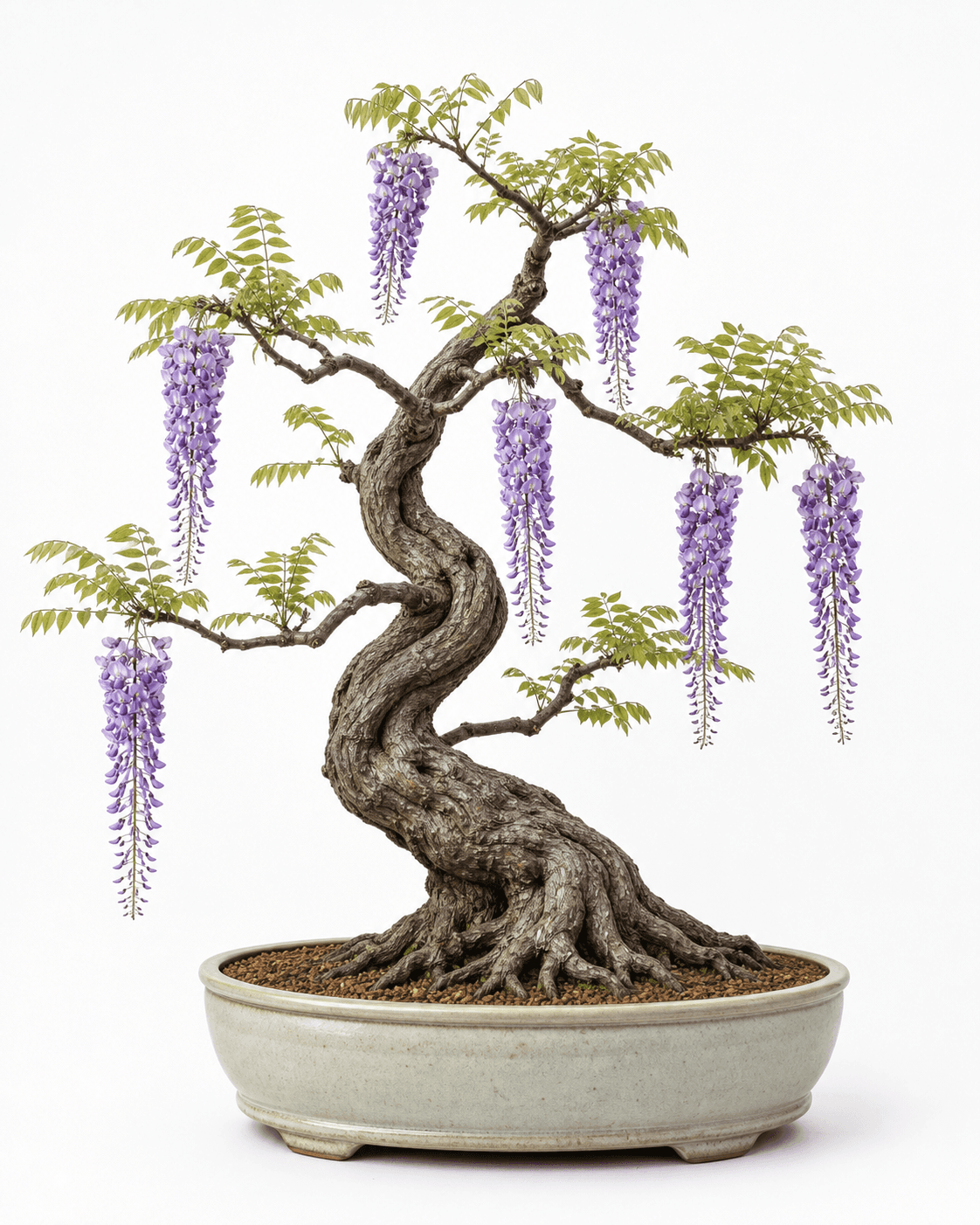
Wisteria floribunda
Japanese wisteria bonsai is an outdoor flowering-vine project built around old living trunk, full sun, heavy active-season water, and disciplined pruning after bloom. The flowers are the reward for maturity and root function, while the year-round quality comes from tree form.
Treat Wisteria floribunda as Broadleaf > Deciduous in the EntGrove taxonomy, with special vine rules: strong basal energy, compound leaves, brittle branches, deep containers, preserved root sheen, and branch tips kept upward.
Start with mature, contained material if flowers matter. Seedlings can spend many years in juvenile vegetative growth, and Asian wisterias require strict containment in regions where they are invasive or regulated.
Updated June 15, 2026. Written by EntGrove Editorial. Last verified June 15, 2026.
Care fingerprint
Read the species through its shared care pattern.
Repot and structural prune around dormant-to-active transitions; protect new leaves; time refinement work after growth hardens. Use this as the starting point before local conditions and tree strength refine the calendar.
Read the foliage first
Broadleaf stress usually shows in leaf color, leaf size, wilt, scorch, or delayed hardening before it becomes a branch problem.
Match work to dormancy
Deciduous, evergreen, tropical, succulent, and flowering broadleaf trees recover on different calendars.
Protect fine roots
Root work should preserve enough active fine roots for the tree to rehydrate quickly after the operation.
Care cadence
The calendar starts with the tree's seasonal state.
Placement
Timing: Grow outdoors in full sun and moving air through active growth. Protect the pot in winter before roots freeze hard, especially after recent root work.
Watch for: Shaded leafy runners, weak flower bud set, hot small pots after defoliation, wind toppling heavy crowns, and warm indoor storage that breaks dormancy early.
NC State ExtensionBonsai Mirai LibraryWatering
Timing: Water by foliar mass, pot depth, heat, wind, and drainage. A strong summer canopy can need very frequent watering, but the root zone still needs oxygen after each cycle.
Watch for: Leaf wilt during runner extension, stale wet winter soil, dense top dressing hiding dry akadama, and root decline after chronic standing water.
Bonsai Mirai LibraryFertilizing
Timing: Feed established trees strongly through active growth. Mirai rejects starving wisteria with zero-nitrogen formulas; flower quality depends on overall health and trace-element balance.
Watch for: Weak flower buds, excessive tendril dominance, depleted recovery trees, and treating potassium as a substitute for root health and sunlight.
Bonsai Mirai LibraryPost-flower pruning
Timing: After flowers drop, prune before seed pods form. Then let necessary extensions run long enough to refill energy before post-flush hardened pruning.
Watch for: Seed pods draining a container tree, cuts between nodes, early cutback before water flow resumes, and removing the short shoots that will carry bloom.
Bonsai Mirai LibraryNC State Extension wisteria overviewPartial defoliation
Timing: Use only on dense, vigorous trees after the first flush hardens, often early to mid summer. Shorten compound leaves by leaflets rather than stripping whole leaves.
Watch for: Interior shade, poor airflow, weak branches needing more leaflets, newly repotted trees, and sudden full-sun exposure of shaded interior leaves.
Bonsai Mirai LibraryWiring
Timing: Wire and bend just before spring bud push, or use repeated light adjustments through the growing season on strong branches. Check active wire by late June or early July.
Watch for: Brittle old wood, wire marks that restrict water flow, raffia hiding tearing signals, branch tips pulled below strength, and fine twigs forced into pad geometry.
Bonsai Mirai LibraryRepotting
Timing: Repot after flowering for display trees, or at spring bud swell when root correction is worth sacrificing bloom. Avoid back-to-back repots.
Watch for: Bare-rooting, lost root sheen, slow percolation in midsummer, chronic water trays, old organic core collapse, and heavy root work paired with hard top reduction.
Bonsai Mirai LibraryPests and disease
Timing: Scout during watering, after dense summer canopy forms, before winter shelter, and whenever runners lose strength unevenly.
Watch for: Aphids, scale, mealybugs, Japanese beetles, stagnant humid interiors, root rot from oxygen loss, and dieback that points to root or nutrition trouble.
NC State Extension wisteria overviewBonsai Mirai LibraryContainment
Timing: Keep material in containers or fully controlled development systems in regions where Asian wisterias are invasive. Dispose of seed pods, runners, and cuttings responsibly.
Watch for: Open-ground training, nodes rooting where they touch soil, escaped runners, viable seed pods, and mislabeled Japanese, Chinese, or hybrid Asian wisteria.
NC State ExtensionOregon State Landscape PlantsNC State Extension wisteria overviewSpecies guide
Apply the species profile before copying another tree's calendar.
At a glance
Japanese wisteria is an outdoor deciduous vine trained for tree form and spring racemes.
Kew accepts Wisteria floribunda in Fabaceae and gives its native range as south-central and southern Japan. NC State describes Japanese wisteria as a high-maintenance woody deciduous vine with clockwise twining stems, 15-19 leaflets, spring racemes, and USDA Zone 4a-9b landscape hardiness. Kew POWONC State Extension
The bonsai specification is practical: full sun, heavy water during active growth, deep containers for water-out and oxygen-in exchange, 100 percent akadama in refinement, protected winter roots, post-flower pruning, post-flush leaflet reduction, and strict containment where Asian wisterias escape. Bonsai Mirai LibraryNC State ExtensionOregon State Landscape Plants
Beginner fit is conditional. A sunny outdoor grower with mature nursery, grafted, air-layered, or recovered landscape material can build a strong tree. Seed-grown vines and low-light patio projects delay the flower display that makes the species worth the space. NC State Extension wisteria overviewBonsai Mirai Library
Wild habitat
Design from a sun-seeking Japanese liana with aggressive water movement.
Kew places Wisteria floribunda in the temperate biome, and Oregon State describes a deciduous vine that climbs at least 25 feet and twines clockwise. In the landscape, that overstory-seeking habit means the plant climbs toward light, expands foliar mass quickly, and sends energy to runners unless the grower redirects it. Kew POWOOregon State Landscape PlantsBonsai Mirai Library
That ecology drives care. Japanese wisteria needs sun to produce flower buds, enough water to support a large transpiring canopy, and soil that returns oxygen fast enough for roots to keep up. Shade may keep leaves green, but it produces long vegetative runners and weaker bloom. NC State ExtensionBonsai Mirai Library
The same wild strength also creates a public-land problem. NC State marks Japanese wisteria invasive in North Carolina, and Oregon State warns that Japanese and Chinese wisterias and their hybrids have invaded natural habitats across many eastern and southern states. Container culture and responsible waste handling are part of the care plan. NC State ExtensionOregon State Landscape Plants
Reading the tree
Read Japanese wisteria as a basally powerful vine with branch tips that need to rise.
Mirai describes wisteria as basally dominant. Under stress, the tree can shed far extensions and regrow from the base. A strong root system, upward branch tips, and even leaf mass across primary branches keep energy moving through the designed canopy. Bonsai Mirai Library
Development and refinement ask for different vigor. Development lets runners elongate on scaffolding, then cuts them back to interior ramification. Refinement uses container restriction, post-flush pruning, and leaflet-level partial defoliation to balance the canopy without exhausting the tree. Bonsai Mirai Library
The warning sign is uneven dieback. Mirai ties significant wisteria dieback to root or nutritional problems more often than branch styling alone. Tip loss after a bend, weak interior twigs, or runner dominance should send the grower back to roots, light, water, fertilizer, and energy distribution. Bonsai Mirai Library
Pruning
Prune after bloom, then manage the first hardened flush by leaflets.
Mirai gives the first seasonal rule: prune after flowers drop and before seed pods form. Seed production is one of the largest energy expenses for a containerized wisteria, so remove developing pods unless they are the deliberate display on a very strong tree. Bonsai Mirai LibraryNC State Extension
Post-flush work starts when leaves have hardened, not on a fixed calendar. Mirai commonly places that window in early to mid summer, with warmer climates reaching the stage earlier. Cut tendrils back to usable interior growth so one runner does not drain the rest of the canopy. Bonsai Mirai Library
Partial defoliation means reducing leaflets on each compound leaf. Strong zones may be reduced to the first fully formed leaflet pairs, while weaker or interior zones keep more leaflets. The goal is airflow, light moderation, and equal energy across branch units. Bonsai Mirai Library
Large structural cutbacks belong on trees with development-level vigor. Once wisteria is in a bonsai pot, heavy cuts into old vine tissue can produce dieback. If big changes are needed, grow the tree in a development container for several years first. Bonsai Mirai Library
Repotting
Repot to preserve root sheen, accepting that root work can cost the current bloom.
Mirai places wisteria among sheen-based deciduous species: preserve a working root mass and avoid bare-rooting. Reduce roots from the surface, sides, and bottom, then keep enough connected fine roots to support the apex and far extensions. Bonsai Mirai Library
Timing follows the goal. If the display matters, repot after flowering as vegetative growth begins. If root correction, angle, or health matter more, spring bud swell is the stronger energy window, with the expectation that flowering may be reduced that year. Bonsai Mirai Library
Avoid emergency repetition. Mirai cautions against back-to-back repots; if percolation fails in midsummer, a temporary water tray can be triage, while chronic standing water builds coarse roots and weakens refinement. Bonsai Mirai Library
Soil and pot
Use akadama in refinement and choose a deeper pot for water movement.
Mirai is direct for refined wisteria: 100 percent akadama. The reason is root function, not nostalgia. Akadama supplies water and nutrient buffering while still letting the grower manage oxygen through particle size, container depth, and watering cadence. Bonsai Mirai Library
Development mixes can hold more organic material. Mirai uses roughly 70 percent organic matter and 30 percent pumice on recovering yamadori or development trees, which drives coarse roots and nutrition while keeping enough aggregate structure for later transition. Bonsai Mirai Library
Pot depth matters more than many growers expect. Mirai favors deeper containers for wisteria because a taller gravity column moves water through the soil and pulls oxygen back in. That supports a thirsty vine better than a shallow pot that stays wet and stagnant. Bonsai Mirai Library
Climate
Adjust for heat, humidity, winter root risk, and invasive-region rules.
In cool maritime climates, spring development can be slower, roots can be high quality, and post-flush timing may arrive closer to mid June. In warmer southern climates, the same physiological stage can arrive in early to mid May, and shade after defoliation may matter more. Bonsai Mirai Library
Winter protection should keep the tree seasonal while protecting the pot. Landscape hardiness in Zone 4a-9b does not mean a shallow container can freeze hard, desiccate in wind, or warm up repeatedly in a greenhouse without consequences. NC State ExtensionOregon State Landscape PlantsBonsai Mirai Library
Containment is a regional adaptation, not an optional ethics note. NC State warns that Asian wisterias escape into natural areas, and Oregon State reports Japanese, Chinese, and hybrid wisterias invading many eastern and southern states. Use containers, controlled escape culture, or a native alternative where needed. NC State Extension wisteria overviewOregon State Landscape Plants
Pests and disease
Most wisteria pest pressure follows density, weakness, and wet roots.
NC State lists common wisteria insect problems including aphids, scale insects, mealybugs, and Japanese beetles. In bonsai, scout at watering because compound foliage can hide early pest colonies until leaves yellow or runners weaken. NC State Extension wisteria overview
Dense summer foliage is also a disease setup. Mirai frames partial defoliation as airflow first and light penetration second. Reducing leaf mass in strong zones lowers stagnant humidity inside the canopy and helps interior growth photosynthesize. Bonsai Mirai Library
Root rot is a watering and soil-oxygen problem before it is a chemical problem. If leaves fade, runners collapse, or old branches die back after wet storage, check percolation, particle breakdown, root smell, pot stability, and whether the tree has been kept in chronic standing water. Bonsai Mirai Library
Treat toxicity with the same caution as landscape growers. NC State lists seeds as the poisonous part for humans and also flags problems for cats, dogs, and horses. Remove pods from benches where children or pets can reach them. NC State Extension
Wiring
Wire early, bend slowly, and keep every branch tip oriented toward strength.
Mirai prefers the window just before spring bud push for wisteria styling because the wood is more flexible and the full growing season follows. Use wire to distribute branches and open raceme space, then let pruning do much of the long-term directional work. Bonsai Mirai Library
Brittleness sets the limit. Mirai warns against radical bends, raffia that hides tearing signals, and wire marks that restrict water movement. Paper-wrapped copper, guy wires, and repeated incremental bends are safer than forcing old vine wood in one session. Bonsai Mirai Library
Remove wire early. Mirai expects wisteria wire to begin biting in the same season, often by late June or early July, and treats deep bite as a branch-lifespan problem because it constricts the tissue that moves water. Bonsai Mirai Library
Propagation
Cuttings, air layers, grafts, and urban recovery all have different costs.
NC State lists seed, stem cutting, root cutting, leaf cutting, and grafting among propagation strategies for Wisteria floribunda. For bonsai, seed is the slowest path to flowering because juvenile vines can spend years building vegetative mass before bloom. NC State ExtensionNC State Extension wisteria overview
Mirai favors softwood or semi-hardwood cuttings after flowering in early summer, when stems are sugar-loaded and capable of rooting. Air layers are possible around late May to early June, but wisteria layers can start trunk rot above the layer, which limits long-term value. Bonsai Mirai Library
Collected landscape wisteria can produce the best trunks, but only from legal removals and with responsible containment. Mirai describes successful recovery as a root-rebuild project first: heel the stump, protect from harsh afternoon sun, and let it run for roughly two years before styling. Bonsai Mirai LibraryOregon State Landscape Plants
Buying
Buy trunk age, flower proof, and legal containment before color.
The strongest purchase is mature material already proven to flower. NC State advises buying wisteria in flower when flower age is important, because seed-grown material can take several years to mature. NC State Extension wisteria overview
Inspect the trunk as a living structure. Mirai values completely living wisteria trunks more than hollow, rotting ones because rot keeps advancing and deadwood preservation is difficult in a frequently watered vine. Bonsai Mirai LibraryBonsai Mirai / Asymmetry
Red flags include field-dug material with little recovery, sour nursery soil, uncontrolled stolons, old wire scars, a graft that ruins the trunk line, flower racemes out of scale for the intended size, and sellers who cannot distinguish Japanese, Chinese, American, or hybrid wisteria. NC State ExtensionOregon State Landscape PlantsBonsai Mirai Library
Troubleshooting
Diagnose by symptom, then decide whether the problem is energy, roots, light, or containment.
Symptom: long green runners and no flowers. Likely causes: immature material, shade, excessive runner dominance, weak root function, or repeated pruning at the wrong time. Fix: increase sun, buy mature material, build roots and ramification, and prune after bloom and post-flush hardening. NC State Extension wisteria overviewBonsai Mirai Library
Symptom: branch tips or far extensions die back. Likely causes: root or nutritional weakness, cuts between nodes, branch tips wired downward, or heavy cutback on a refined potted tree. Fix: restore root function, cut to raised nodes, keep tips upward, and rebuild vigor before structural reductions. Bonsai Mirai Library
Symptom: leaf scorch after summer work. Likely causes: interior leaves exposed too suddenly after partial defoliation or a newly repotted tree returned to full heat. Fix: use morning sun and afternoon shade until new interior response appears, then move back gradually. Bonsai Mirai Library
Symptom: weak roots and stale smell. Likely causes: shallow stagnant container, broken-down soil, chronic water tray use, or winter wetness. Fix: improve percolation at the proper window, use a deeper pot, preserve root sheen, and water for oxygen return. Bonsai Mirai Library
Symptom: runners rooting beyond the pot or seed pods forming in an invasive region. Likely causes: uncontrolled development culture. Fix: remove pods, prune runners before they root, dispose of waste securely, and avoid open-ground training where Asian wisteria is regulated. NC State ExtensionOregon State Landscape PlantsNC State Extension wisteria overview
Design
Make a tree that flowers, with open vertical lanes for racemes.
Mirai sets the design priority clearly: build tree form first and flower display second. A Japanese wisteria with no winter silhouette, branch hierarchy, or off-season trunk interest becomes a one-week display rather than a durable bonsai. Bonsai Mirai / AsymmetryBonsai Mirai Library
The branch layout should be open. Mirai recommends widely spaced, non-overlapping lateral branches so each pendulous raceme has its own vertical plane. Fine twig pads suit maples and elms; wisteria reads through line, trunk, negative space, and hanging flowers. Bonsai Mirai Library
Deadwood needs restraint. Mirai treats deadwood as a long-term liability on wisteria because trunk rot keeps progressing. Old living bark, muscular vine movement, and supported living vascular tissue carry more value than carved hollows that slowly weaken the tree. Bonsai Mirai LibraryBonsai Mirai / Asymmetry
Cultivars
Choose cultivars by raceme scale, flower proof, and bonsai proportion.
NC State lists named Wisteria floribunda cultivars including Alba, Carnea or Kuchibeni, Issai, Ivory Tower, Longissima Alba, Macrobotrys, Multijuga, Nuda, Rosea, Snow Showers, Variegata, Violacea Plena, and White Blue Eye. NC State Extension
Scale is the first bonsai filter. NC State gives typical Japanese wisteria racemes at 12-18 inches and Macrobotrys at 2-4 feet. Oregon State gives racemes of 20-50 cm and notes a longer bloom period with less concentrated color than Chinese wisteria. NC State ExtensionOregon State Landscape Plants
Separate Japanese wisteria from Chinese and American wisteria before applying advice. Japanese wisteria generally twines clockwise and blooms as leaves emerge; NC State describes Asian seed pods as fuzzy and American wisteria as less aggressive with lower natural-area risk. NC State ExtensionNC State Extension wisteria overview
History
The best wisteria bonsai usually come from old human landscapes.
Kew records Wisteria floribunda as accepted since 1825 publication in de Candolle, while NC State notes the genus name honors Caspar Wistar. In gardens, Japanese wisteria became famous for long scented racemes trained over strong supports. Kew POWONC State Extension wisteria overview
Mirai frames high-quality bonsai material as urban yamadori from old foundation plantings, restaurants, institutions, and removals rather than young nursery vines. Those sources can offer trunk age that nursery stock takes a very long time to build. Bonsai Mirai Library
That history creates a responsibility. Old landscape vines can be ecologically risky if they are Asian wisteria in an invasive region, so the bonsai story should include permission, recovery records, cultivar identity, and containment. Oregon State Landscape PlantsNC State Extension wisteria overview
Species questions
Answer the beginner questions before styling.
Is Japanese wisteria a good beginner bonsai?
It is a reasonable second outdoor bonsai for a patient grower with full sun, water discipline, winter protection, and mature material. Seedlings and low-light projects delay flowering for years.
Can Japanese wisteria bonsai live indoors?
Grow it outdoors. Japanese wisteria needs seasonal sun, dormancy, moving air, and cold root protection rather than warm indoor shelf culture.
Why will my Japanese wisteria bonsai not flower?
Common causes include immaturity, shade, weak roots, pruning at the wrong stage, letting runners dominate, or exhausting the tree with poor water and nutrition.
How often should I water Japanese wisteria bonsai?
Water by demand. A vigorous summer canopy can be very thirsty, but every watering should be followed by oxygen returning through the soil. Winter watering is slower and more cautious.
When should I prune Japanese wisteria bonsai?
Prune after flowers drop and before seed pods form. Use post-flush hardened summer work for tendril cutback and leaflet-level partial defoliation on dense, strong trees.
When should I repot Japanese wisteria bonsai?
Use after-flowering repotting when preserving the display matters. Use spring bud swell when root correction or health is more important, understanding that bloom may be reduced.
Is Japanese wisteria invasive?
Yes in some regions. NC State marks it invasive in North Carolina, and Oregon State warns that Japanese, Chinese, and hybrid wisterias have invaded natural habitats in many eastern and southern states.
What is the difference between Japanese and Chinese wisteria bonsai?
Japanese wisteria is Wisteria floribunda, generally with clockwise twining and long racemes that open as leaves emerge. Chinese wisteria is Wisteria sinensis and has its own source profile and containment cautions.
Should I fully defoliate Japanese wisteria?
Use partial defoliation only on dense, vigorous trees. Reduce the number of leaflets on compound leaves, leaving more leaflets in weaker areas, and protect interior leaves from sudden full sun.
What soil is best for Japanese wisteria bonsai?
Mirai specifies 100 percent akadama for refined wisteria. Development or recovery trees can use a higher organic fraction with pumice before transitioning back toward refinement soil.
Sources
Species advice needs source discipline.
Next decisions
Plan the operation before copying the calendar.
A good care note for Japanese wisteria records the tree's stage, the work done, and the aftercare used. That record matters more than a month-name rule.
Related species
Compare nearby trees before transferring advice.
Japanese maple
Acer palmatum
Trident maple
Acer buergerianum
Amur maple
Acer tataricum subsp. ginnala
Field maple
Acer campestre
Korean hornbeam
Carpinus turczaninovii