
Species guide
Colorado Blue Spruce Bonsai Care
Picea pungens
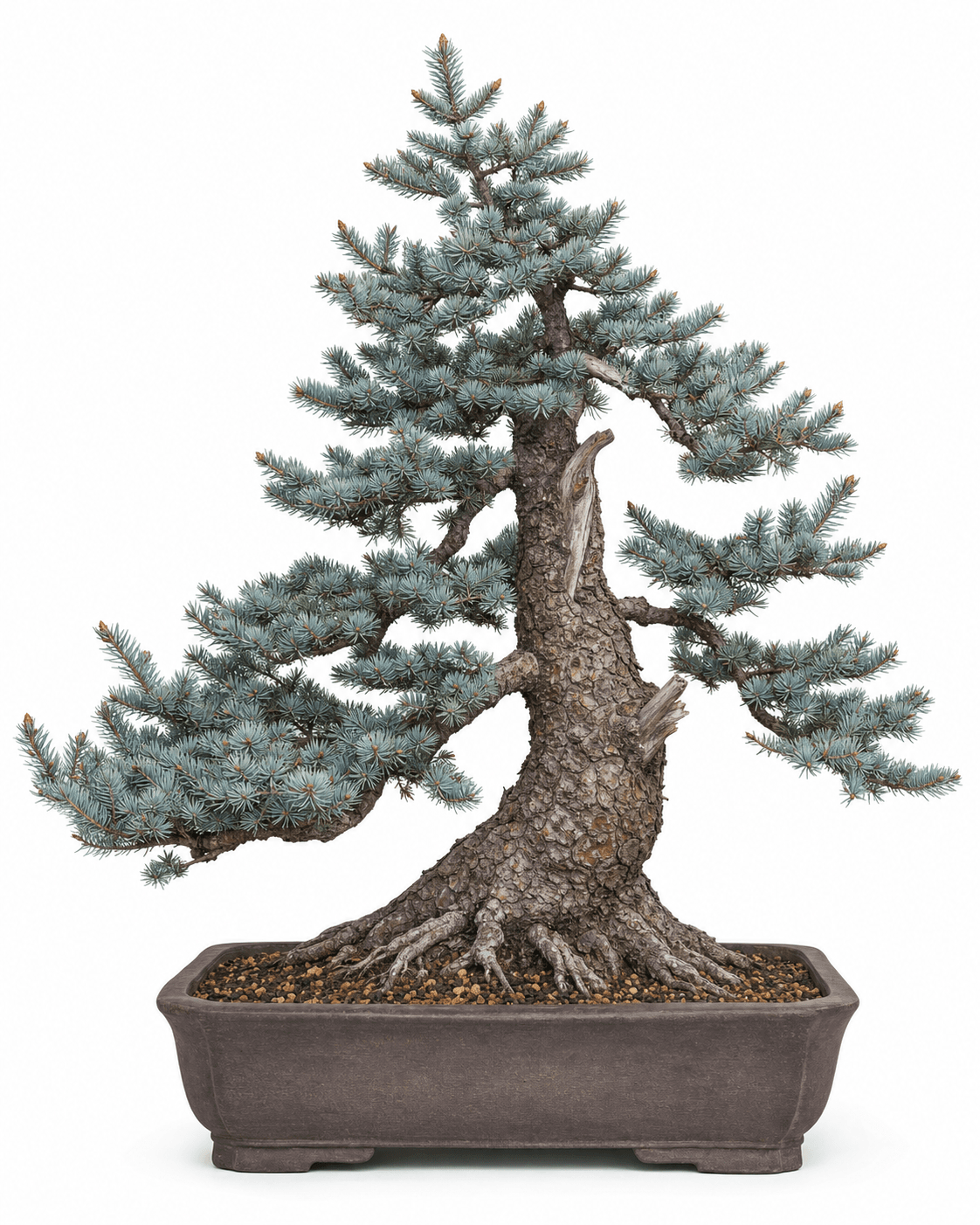
Colorado blue spruce bonsai is an outdoor Rocky Mountain spruce for growers who can give bright light, cold dormancy, oxygenated roots, and deliberate timing. Picea pungens has stiffer, coarser, sharper needles than Engelmann spruce, which makes small refinement harder but gives the tree unusual tolerance for sun, drought, root work, and wiring compared with finer spruce species.
Treat Colorado blue spruce as an elongating conifer: build vascular strength first, pinch only refined soft spring shoots, prune after the flush hardens, and reserve heavy structural work for spring bud swell or early fall. The practical care pattern is full sun in cool climates, afternoon protection during severe heat, staged nursery-soil conversion, no bare-rooting, frequent mite and needle-cast checks, and design that preserves Rocky Mountain toughness instead of forcing generic conifer pads.
This guide uses the local Bonsai Mirai Colorado blue spruce, spruce pinching, post-harden pruning, slab planting, rootbound nursery-stock, energy, watering, soil, wiring, and design corpus first, then grounds taxonomy, range, hardiness, morphology, cultivars, and disease context in Kew, Oregon State, USDA, NC State, University of Minnesota, and Michigan State sources.
Updated June 4, 2026. Written by EntGrove Editorial. Last verified June 4, 2026.
Care fingerprint
Read the species through its shared care pattern.
Strong light, cool-root management, conservative root work, and post-extension pruning dominate the care calendar. Use this as the starting point before local conditions and tree strength refine the calendar.
Note: Kew accepts Picea pungens and places the native range in the U.S.A. Rocky Mountains. Oregon State, USDA Silvics, USDA NRCS, and NC State sources use Colorado blue spruce, blue spruce, Colorado spruce, silver spruce, pino real, Parry spruce, water spruce, Picea parryana, and Picea pungens var. glauca labels; silver spruce is ambiguous with Engelmann spruce, so verify the exact Picea identity before applying care.
Do not prune like a pine
Elongating conifers extend from buds and shoots, so candle-cutting assumptions can remove the exact growth the tree needs.
Preserve interior growth
Spruce, fir, hemlock, cedar, redwood, cypress, and larch all become harder to design when interior buds are shaded out.
Keep recovery cool and steady
Many elongating conifers respond best when roots stay evenly moist, oxygenated, and protected from hot dry swings.
Care cadence
The calendar starts with the tree's seasonal state.
Placement
Timing: Grow outdoors year-round. Give full sun in cool seasons and cool climates, then protect the pot and soft growth from hot afternoon sun, dry wind, and reflected heat.
Watch for: Warm nights, soft spring needles after greenhouse protection, drying slabs, newly wired branches, and heat stress outside the species native mountain pattern.
Oregon State Landscape PlantsBonsai Mirai LibraryWatering
Timing: Water thoroughly when the upper root zone begins to dry. Read foliage mass, container volume, wind, temperature, and whether water is entering the old nursery or collected core.
Watch for: Runoff around a dry core, sour organic soil under the trunk, shallow slab dry-down, gray mite-stressed foliage, and watering by calendar.
Bonsai Mirai LibraryFertilizer
Timing: Feed development, recovery, and post-styling trees strongly during active growth and fall. Refined trees can be fed more selectively around pinching and needle-size goals.
Watch for: Coarse extension in refinement, fertilizer on a tree with poor uptake, salt in shallow containers, and weak fall buds from underfeeding.
Bonsai Mirai LibrarySpring pinching
Timing: Pinch only refined, healthy shoots while the new growth is soft. Work in multiple passes as strong, medium, and then weaker shoots reach the correct softness.
Watch for: Removing the whole new shoot, pinching a development branch, pinching after root work, using scissors on folded primordial needles, and missing the brief window.
Bonsai Mirai LibraryPost-flush pruning
Timing: After the spring flush hardens, reduce coarse extensions back to buds or useful ramification, organize junctions, and open light to interior buds.
Watch for: Cutting mid-internode, exterior shell pruning, keeping three or more pieces at a junction, and stripping needles that resist light removal.
Bonsai Mirai LibraryStructural work
Timing: Do heavy pruning and wiring in spring before push or in early fall when vascular tissue is active. Avoid peak summer heat and avoid combining heavy root and foliage reduction.
Watch for: Fall wire bite, soft spring growth, under-gauged wire, hollow or old collected branches, and heavy styling on a recently repotted tree.
Bonsai Mirai LibraryRepotting
Timing: Repot as buds swell, while the tree is well hydrated and freezing can be excluded during aftercare. Convert nursery or field soil over two to three repots.
Watch for: Bare-rooting, torn roots, unstable tie-downs, excessive foliage reduction before root work, and constant saturation after the first deep watering.
Bonsai Mirai LibraryNeedle cleaning
Timing: Clean dead or old needles only when they release with light rubbing. In post-flush work, third-year needles can be thinned on strong trees to improve air and wiring access.
Watch for: Tearing live needles, plucking bottom needles for pine-style display, crushing needles under wire, and stripping weak branches that still need photosynthetic mass.
Bonsai Mirai LibraryPest and disease inspection
Timing: Inspect in late spring, damp early summer, dry late summer, and fall. Colorado blue spruce is especially worth monitoring for spruce spider mites, Rhizosphaera needle cast, Cytospora canker, aphids, scale, budworms, and bagworms.
Watch for: Gray stippling, webbing, black fruiting bodies on needles, purple-brown older needles, resinous branch cankers, random branch death, and decline after drought or winter injury.
NC State ExtensionMichigan State University ExtensionUniversity of Minnesota ExtensionWinter protection
Timing: Keep dormant and cold. Protect container roots from severe freeze-thaw, exposed wind, and drying, especially on slabs or after heavy work.
Watch for: Indoor storage, dry frozen soil, sparse foliage after styling, wire hidden under needles, and warm storage that breaks dormancy early.
Oregon State Landscape PlantsBonsai Mirai LibrarySpecies guide
Apply the species profile before copying another tree's calendar.
At a glance
Colorado blue spruce is the durable, coarse-needle end of the bonsai spruce spectrum.
Picea pungens is an evergreen spruce native to the Rocky Mountains of the western United States. Kew accepts the name, and public forestry sources use Colorado blue spruce, blue spruce, Colorado spruce, silver spruce, pino real, Parry spruce, and water spruce labels. Kew POWOUSDA Forest Service SilvicsUSDA NRCS Plant Guide
As bonsai, it belongs with alpine elongating conifers. The calendar is driven by spring bud swell for root work and setup, soft spring shoots for refined pinching, post-flush hardening for pruning, early fall for structural work, and winter for cold dormancy. Bonsai Mirai Library
The species has a practical advantage over finer spruce: its coarse, stiff needles correlate with better tolerance for heat, drought, root work, and wiring. The tradeoff is visual scale. Small bonsai need dwarf or compact selections, while larger rugged trees can use the native needle character honestly. Bonsai Mirai LibraryOregon State Landscape Plants
Wild range
Read the tree from watercourses, canyon bottoms, and bright mountain air.
USDA Silvics places blue spruce in cool, generally humid central and southern Rocky Mountain climates, often with much of the annual precipitation arriving during the growing season. It grows best with abundant moisture while tolerating drought better than other spruces. USDA Forest Service Silvics
USDA NRCS describes blue spruce on stream banks, moist canyon bottoms, gentle to steep mountain slopes, Douglas-fir or spruce-fir woods, and mid-montane elevations from 1800-3000 m. That habitat explains why bonsai culture should combine bright exposure with a root zone that never becomes stale. USDA NRCS Plant GuideBonsai Mirai Library
Design should also start there. Branches can feel horizontal, drooping, wind-loaded, broken, or slab-rooted because old mountain spruce survive snow load, stream corridors, rock pockets, and storm damage. Bonsai Mirai / AsymmetryBonsai Mirai Library
Its ability to survive neutral to slightly alkaline mountain soils is a tolerance signal, not a bonsai soil recipe. Mirai energy guidance treats harsh native substrate as competitive adaptation, while container culture still needs oxygen, water availability, and aggregate structure. USDA Forest Service SilvicsBonsai Mirai Library
Reading
Judge phase before choosing pinching, pruning, wiring, or repotting.
A developing Colorado blue spruce needs needle mass. Let extension build vascular tissue, let that vascular tissue generate buds, then let those buds elongate into actual foliage before asking for refinement. Bonsai Mirai Library
A refined branch is read by bud density, needle generations, and silhouette. Pinching makes sense only after a branch has useful ramification and a target outline; otherwise post-flush pruning and extension are better tools. Bonsai Mirai Library
Old or collected spruce can show top growth before roots are ready. Use water uptake, fall buds, old-wood budding, and root stability to judge readiness instead of one attractive spring flush. Bonsai Mirai Library
Nursery material needs a different read. First find the true trunk flare, then inspect for rootbound cores, grafted blue cultivars, inverse swelling at whorls, poor interior buds, and foliage that exists only at the tips. Bonsai Mirai LibraryNC State Extension
Spring growth
Pinch refined soft tips, prune after hardening, and never decandle spruce.
Pinching means removing only the soft tip of new growth while supporting the shoot. Removing the whole new shoot can kill the tip because spruce replacement buds need retained new-growth tissue at the base. Bonsai Mirai Library
The window is short. Work when the central shoot is soft enough to break cleanly with fingers and before the vascular bundle hardens. Scissors can slice folded primordial needles, so fingertip control is safer in the soft stage. Bonsai Mirai Library
Post-flush pruning handles development and transition work. After new growth hardens, reduce strong extensions to existing buds or ramification, organize junctions to two useful pieces, and bring light back to interior buds. Bonsai Mirai Library
Spruce should not be decandled like Japanese black pine. It is an elongating conifer, and spring work is either careful soft-tip pinching on refined shoots or later prune-back to viable buds. Bonsai Mirai Library
Roots
Repot at bud swell and convert old soil in stages.
Spring bud swell is the strongest repotting window. The tree should be hydrated before root work, then protected from freezing, drying wind, and harsh sun while new roots form. Bonsai Mirai Library
Colorado blue spruce can tolerate meaningful root reduction when foliage mass is intact, especially compared with finer spruce. That tolerance should be used through clean cuts, stable tie-downs, and aftercare, not through bare-rooting. Bonsai Mirai Library
Rootbound nursery trees should be approached from the top first. Find the real nebari, reduce depth, remove circling roots cleanly, and leave part of the native root mass intact so microbial and root function remain active. Bonsai Mirai Library
For slab plantings, Mirai uses Colorado blue spruce as a direct example of aggressive but protected root work. After a heavy slab repot, water thoroughly, secure the tree, and place it where foliar desiccation is unlikely. Bonsai Mirai Library
Soil and pot
Use open aggregate soil, then choose containers that support rugged mountain character.
For an established spruce bonsai, a useful baseline is 3 parts akadama, 1 part lava, and 1 part pumice. Adjust particle size, watering, and akadama proportion to your climate, tree strength, and container depth. Bonsai Mirai Library
A nursery tree may begin in peat, bark, clay, or field soil that behaves badly in a shallow pot. Replace that old core over two to three repottings so new aggregate can colonize with roots before the center is removed. Bonsai Mirai Library
Unglazed containers usually suit Colorado blue spruce best because the species reads as rugged, evergreen, cold-site material. Strong blue foliage can also pair with quiet warm clay, gray stone, or slab surfaces rather than glossy color. Bonsai Mirai / AsymmetryBonsai Mirai Library
For development, a shallow training flat with high oxygen exchange often beats a decorative bonsai pot. For slabs, the limited substrate volume makes water availability and tie-down quality the real horticultural controls. Bonsai Mirai Library
Climate
Cool, bright regions are easiest; humid lowland summers raise disease pressure.
Oregon State lists Zone 3 hardiness, and USDA Silvics describes strong cold, drought, and high-light tolerance compared with associated spruce. A bonsai pot still exposes roots sooner than a landscape root system. Oregon State Landscape PlantsUSDA Forest Service Silvics
In cool mountain or northern climates, use full sun and protect roots mainly from deep freeze and dry winter wind. In hot inland climates, protect the pot during heat while keeping enough light for interior buds. Bonsai Mirai LibraryNC State Extension
In humid eastern or midwestern regions outside its native range, the tree may grow but often carries more Cytospora canker and Rhizosphaera needle-cast risk. Airflow, morning sun, clean needles, and local extension diagnosis matter. University of Minnesota ExtensionMichigan State University Extension
After repotting, heavy wiring, or late-summer styling, use morning sun and afternoon shade until weather cools. Spruce recovers best when roots can callus and foliage can transpire without being pushed into heat stress. Bonsai Mirai Library
Pests and diseases
Watch mites, needle cast, and canker before they hollow the tree from inside out.
Spruce spider mites are a serious bonsai concern because dry, dusty, dense needles let mites build quickly. Gray stippling, dull foliage, webbing, and late-summer decline should trigger close inspection. Bonsai Mirai LibraryNC State Extension
Michigan State identifies Colorado blue spruce as the primary host for Rhizosphaera needlecast. Diagnostic black fruiting bodies appear in rows on infected needles, and older inner needles often yellow, redden, brown, purple, and drop. Michigan State University Extension
University of Minnesota Extension notes Cytospora canker as common on stressed spruce and most common on Colorado blue spruce in Minnesota. Resinous cankers near the trunk, scattered branch death, and purplish-brown needles are warning signs. University of Minnesota Extension
Bonsai prevention is mostly cultural: open light channels, avoid wet-foliage nights, remove debris, keep roots oxygenated, reduce drought stress, and confirm disease before spraying. Mirai specifically warns against Daconil formulations with weather-stick adjuvant on spruce. Bonsai Mirai LibraryMichigan State University Extension
Wiring
Colorado blue spruce tolerates wiring better than fine spruce, but wire bite arrives fast.
Clean first, then wire. Remove dead needles and weak unbudded shoots when the tree has enough strength, reduce crowded junctions, and make wire paths that do not crush live needles. Bonsai Mirai Library
Compared with Engelmann spruce, Colorado blue spruce has coarser needles and stronger tissue. It usually accepts heavier wiring and root work better, but old collected branches, hollow trunks, and recently repotted trees still need staged handling. Bonsai Mirai Library
Use enough gauge to hold the branch against phototropism. Spruce branches lift toward light, and fall vascular swelling can both set bends and scar bark quickly, so wire checks are part of the work. Bonsai Mirai Library
Soft spring shoots should be left alone during wiring. Wait until the growth hardens, or handle structure before the push begins in spring. Bonsai Mirai Library
Propagation
Seed, grafted cultivars, nursery stock, and collected trees all exist, but each carries tradeoffs.
USDA sources describe sexual reproduction from seed, cone crops every two to three years on mature trees, and spring or summer germination after dispersal. Seedlings give clean roots but require years before bark and movement feel convincing. USDA Forest Service FEISUSDA NRCS Plant Guide
NC State and Oregon State list many ornamental cultivars and blue selections, many chosen for color and crown form. Grafted landscape cultivars can be useful if the graft, base, internodes, and needle scale support bonsai design. NC State ExtensionOregon State Landscape Plants
Cuttings and air layers are secondary routes for spruce bonsai and should be treated as advanced or experimental. Seed, nursery stock, grafted compact forms, and legally collected yamadori are more common paths. Bonsai Mirai Library
Collected material can provide old bark, deadwood, small mountain growth, and natural movement. It also demands legal permission, site repair, stable aftercare, and delayed styling until roots and buds prove recovery. Bonsai Mirai / AsymmetryBonsai Mirai Library
Buying
Buy for root potential, interior buds, and scale, not just blue color.
Good nursery material has a visible or discoverable root flare, live interior buds, strong fall buds, manageable whorls, and enough branch options to build asymmetry. Perfect cones with no interior growth are usually landscape trees, not bonsai material. Bonsai Mirai Library
Blue color is valuable only when the structure works. Oregon State notes that silvery-blue forms dominate ornamental trade selections, and NC State lists numerous blue or compact cultivars, but many are grafted or too coarse for small trees. Oregon State Landscape PlantsNC State Extension
Inspect the soil core before buying. A dense peat or field-soil column in a deep nursery pot can take several repots to correct, and severe circling roots may force a long development path. Bonsai Mirai Library
For collected trees, ask when it was collected, how much native soil remains, how it has been overwintered, whether it has been styled, and whether it has produced strong buds for more than one season. Bonsai Mirai Library
Troubleshooting
Most failures trace to old soil, heat, mites, needle disease, or premature refinement.
Symptom: interior hollows while exterior tips run. Likely cause: development energy stayed at the ends and interior buds lacked light. Fix: grow to build vascular mass, then prune after hardening to viable interior buds and open light channels. Bonsai Mirai Library
Symptom: gray or dusty needle color in late summer. Likely cause: spruce spider mites, heat stress, or drought stress. Fix: inspect with magnification, rinse dust when appropriate, improve airflow, and treat only after diagnosis. Bonsai Mirai LibraryNC State Extension
Symptom: older inner needles turn yellow, reddish, brown, or purple and drop. Likely cause: Rhizosphaera needlecast or similar needle disease. Fix: confirm with black fruiting bodies or a lab, improve airflow, avoid wet pruning, and follow local extension guidance. Michigan State University Extension
Symptom: random branch death with resin near the trunk. Likely cause: Cytospora canker after drought, winter injury, insect feeding, or other stress. Fix: reduce stress, prune infected branches during dry weather, disinfect tools, and protect the bonsai from repeated drought. University of Minnesota Extension
Symptom: yellowing after repotting. Likely cause: a water-oxygen mismatch inside an old root core, unstable tie-downs, or too much root and foliage work together. Fix: stabilize aftercare, protect from wind, and plan staged core reduction later. Bonsai Mirai Library
Symptom: long coarse needles after spring work. Likely cause: pinching too hard on a weak tree, poor feeding strategy, or using refinement work on a developing branch. Fix: rebuild strength, then pinch only where the silhouette and branch phase justify it. Bonsai Mirai Library
Design
Let the tree read as Rocky Mountain spruce, with age, asymmetry, and enough roughness.
Start with base, trunk line, defining branch, and apex. Colorado blue spruce often carries strong horizontal or drooping branches, pyramidal youth, sharp needles, and blue-gray color, so the design should decide whether it is showing elegance, tension, or mountain survival. Bonsai Mirai / AsymmetryOregon State Landscape Plants
Collected trees can support rugged informal upright, cascade, semi-cascade, literati, and slab compositions. Nursery trees often need tension or dynamic design to add interest when the trunk is plain. Bonsai Mirai / AsymmetryBonsai Mirai Library
Spruce deadwood should look broken, aged, and weathered. Mirai guidance favors natural jin and existing dead features, with caution around manufactured shari because spruce wood is softer and can rot when carved without a convincing biological story. Bonsai Mirai Library
Pads should begin flat and well-spaced in early structure, then become more refined only after the tree produces interior buds. Colorado blue spruce can tolerate strong first styling, but the design still improves through repeated grow, harden, prune, and wire cycles. Bonsai Mirai Library
Cultivars
Blue color, compact habit, and grafts need honest evaluation.
Kew treats Picea pungens as the accepted species and lists many synonym or form names, including blue and compact labels. Oregon State notes that silvery-blue forms dominate ornamental nursery selection. Kew POWOOregon State Landscape Plants
NC State lists cultivars such as Baby Blue Eyes, Bakeri, Compacta, Fastigiata, Fat Albert, Glauca, Glauca Globosa, Glauca Pendula, Hoopsii, Mission Blue, Montgomery, Pendula, and others. Treat each as material to inspect rather than as a guarantee of bonsai suitability. NC State Extension
Dwarf or compact forms can solve scale but introduce grafts, reverse taper, congested whorls, or weak root systems. Strong blue color can be useful in display, yet the best bonsai choice is still the tree with a workable base, buds, and branch structure. Bonsai Mirai LibraryNC State Extension
Silver spruce language is ambiguous across sources. Confirm Picea pungens before applying this page because Engelmann spruce, white spruce, and other Picea species can carry overlapping common names. Kew POWOUSDA NRCS Plant Guide
History
Colorado blue spruce moved from mountain species to ornamental icon to rugged bonsai material.
USDA Silvics describes blue spruce as a slow-growing, long-lived tree planted widely for symmetry and color, while noting it is relatively scarce and not important as timber. USDA Forest Service Silvics
USDA NRCS notes its state-tree status in Colorado and Utah, its broad ornamental use, and its many horticultural cultivars based on needle color and crown form. USDA NRCS Plant Guide
In contemporary North American bonsai, Colorado blue spruce is important because it combines native Rocky Mountain character with stronger handling tolerance than many fine spruce. It is often used for yamadori, slab, cascade, and rugged alpine images. Bonsai Mirai / AsymmetryBonsai Mirai Library
A credible exhibition Colorado blue spruce should show clean needle work, protected interior buds, visible root stability, controlled wire, and a design that makes the coarse needles feel intentional rather than oversized. Bonsai Mirai Library
Species questions
Answer the beginner questions before styling.
Can Colorado blue spruce be grown as bonsai?
Yes. Colorado blue spruce can be grown as bonsai when it is kept outdoors with cold dormancy, strong light, oxygenated roots, and careful timing around spring growth, post-flush pruning, and early fall structural work.
Can Colorado blue spruce bonsai live indoors?
No. Colorado blue spruce needs outdoor sun, moving air, cold dormancy, and seasonal temperature change. Indoor rooms are too warm and dim for long-term health.
How much sun does Colorado blue spruce bonsai need?
Use full sun in cool climates and cool seasons. In hot climates or after heavy work, give morning sun and afternoon protection until the tree is stable.
When should I repot Colorado blue spruce bonsai?
Repot in spring as buds swell. Hydrate the tree first, avoid bare-rooting, keep part of the old root mass intact, tie the tree firmly, and protect it from wind, hard sun, and freezing afterward.
Should I pinch Colorado blue spruce?
Pinch only healthy refined shoots while the new tip is soft. Development branches should usually extend first, then be pruned after the flush hardens to build interior buds and branch structure.
Can Colorado blue spruce be decandled?
No. Decandling is for multiflush pines such as Japanese black pine. Colorado blue spruce is managed through soft-tip pinching, post-flush pruning, needle cleaning, and stage-aware wiring.
What soil mix works for Colorado blue spruce bonsai?
A practical established-tree baseline is 3 parts akadama, 1 part lava, and 1 part pumice. Nursery or field soil should be converted gradually over multiple repots.
Why is my Colorado blue spruce bonsai turning brown inside?
Common causes include shaded interior buds, old needle shed, spider mites, Rhizosphaera needlecast, Cytospora canker, stale soil, or heat stress. Inspect needles, branches, and water movement before treating.
Is Colorado blue spruce easier than Engelmann spruce?
It is usually more tolerant of heat, drought, root work, and wiring because it has coarser needles and stronger tissue. Engelmann spruce often refines better at small scale but is more sensitive.
What styles suit Colorado blue spruce bonsai?
Informal upright, slanting, literati, cascade, semi-cascade, forest, slab planting, rugged yamadori, and deadwood-accented mountain designs suit Colorado blue spruce when the scale fits the needles.
Sources
Species advice needs source discipline.
Next decisions
Plan the operation before copying the calendar.
A good care note for Colorado blue spruce records the tree's stage, the work done, and the aftercare used. That record matters more than a month-name rule.
Related species
Compare nearby trees before transferring advice.
Subalpine fir
Abies lasiocarpa
Balsam fir
Abies balsamea
White fir
Abies concolor
Noble fir
Abies procera
Mountain hemlock
Tsuga mertensiana