
Species guide
Engelmann Spruce Bonsai Care
Picea engelmannii
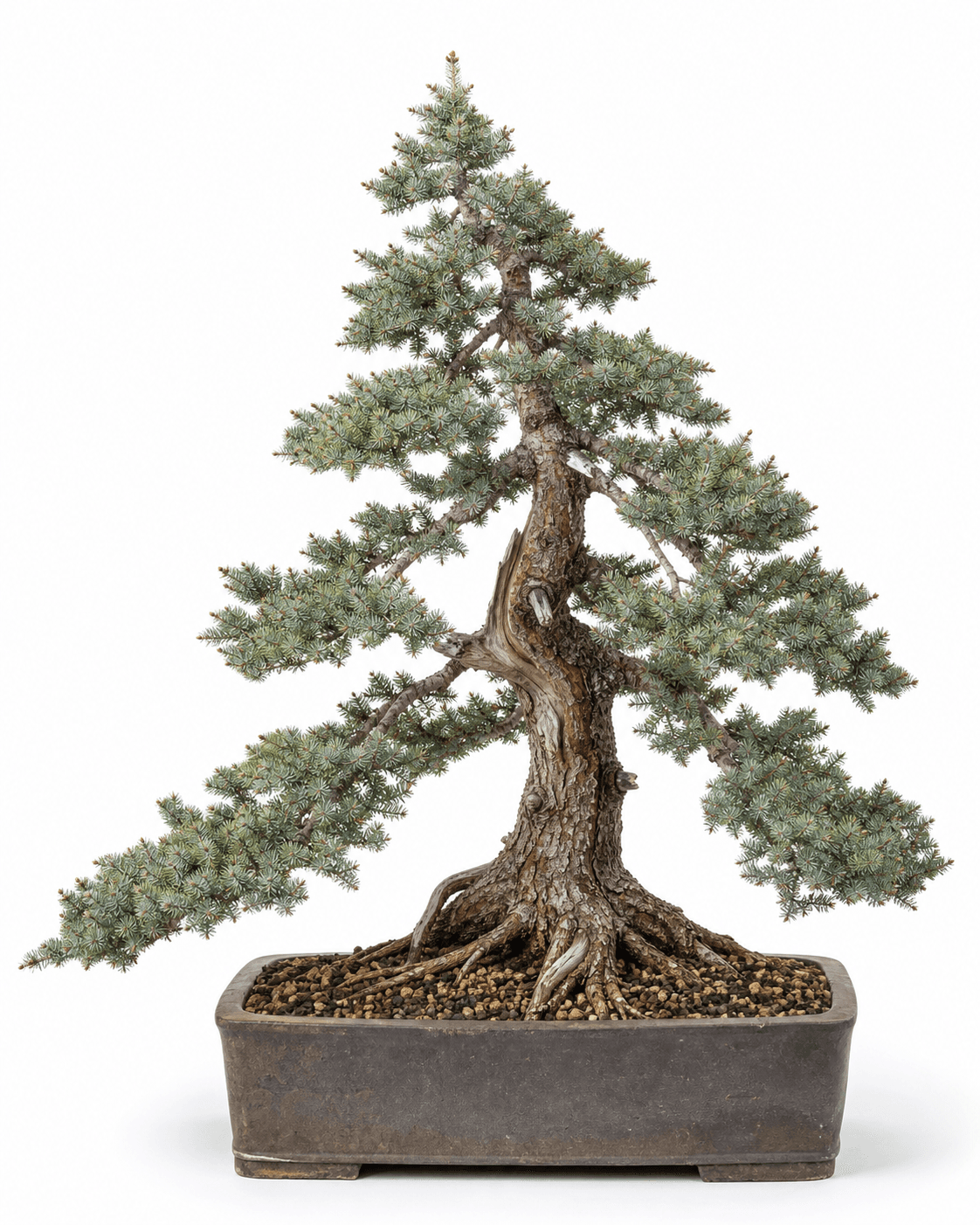
Engelmann spruce bonsai is an outdoor alpine Picea for growers who can provide cool roots, bright light, careful water movement, and patient recovery after collection or repotting. Picea engelmannii has fine needles and strong mountain character, which makes it one of the most refined native North American spruce candidates and also one of the more sensitive to heat, torsion, stale roots, and rushed work.
Treat Engelmann spruce as an elongating conifer: refine soft spring shoots only on healthy finished zones, do structural pruning and wiring in spring before push or early fall after heat, and keep root work separate from styling on raw or recently collected trees. The practical care pattern is cool alpine exposure, oxygenated but water-available soil, intact needle generations, frequent wire checks, and recovery decisions based on buds, water uptake, and old-wood response rather than fresh top growth alone.
This guide uses the local Bonsai Mirai Engelmann spruce, spruce pinching, yamadori aftercare, exhibition wiring, and alpine design corpus first, then grounds taxonomy, range, hardiness, ecology, and pest context in Kew, Oregon State, USDA Silvics, USDA FEIS, and USDA NRCS sources.
Updated June 4, 2026. Written by EntGrove Editorial. Last verified June 4, 2026.
Care fingerprint
Read the species through its shared care pattern.
Strong light, cool-root management, conservative root work, and post-extension pruning dominate the care calendar. Use this as the starting point before local conditions and tree strength refine the calendar.
Note: Kew accepts Picea engelmannii. Oregon State, USDA Silvics, USDA FEIS, and USDA NRCS sources use Engelmann spruce, mountain spruce, silver spruce, and related regional labels; verify the exact Picea species before applying this page to blue spruce, white spruce, Sitka spruce, Ezo spruce, Black Hills spruce, or dwarf Alberta spruce.
Do not prune like a pine
Elongating conifers extend from buds and shoots, so candle-cutting assumptions can remove the exact growth the tree needs.
Preserve interior growth
Spruce, fir, hemlock, cedar, redwood, cypress, and larch all become harder to design when interior buds are shaded out.
Keep recovery cool and steady
Many elongating conifers respond best when roots stay evenly moist, oxygenated, and protected from hot dry swings.
Care cadence
The calendar starts with the tree's seasonal state.
Placement
Timing: Grow outdoors year-round. Give strong light in cool weather, then cool the pot and protect soft growth during hot sun, dry wind, and warm spring transitions.
Watch for: Spring sunburn after greenhouse protection, heat above the mid-70s F on soft growth, dry wind, weak interior buds from shade, and warm nights that keep roots stressed.
Bonsai Mirai LibraryOregon State Landscape PlantsWatering
Timing: Water deeply when the root zone begins to dry, with attention to the center of the old root mass. Keep the tree moist and oxygenated rather than cycling hard dry to saturated.
Watch for: Black organic field cores, water bypassing the center, sour smell, yellowing from anaerobic roots, and pumice drying around a wet native core.
Bonsai Mirai LibraryFertilizer
Timing: Feed development and recovery trees through active growth and into fall when roots are working. Refined trees can receive lighter spring feeding until pinching and needle size goals are clear.
Watch for: Coarse tips in refinement, salt buildup, fertilizer on a tree with poor uptake, and feeding used to compensate for heat or root problems.
Bonsai Mirai LibrarySpring pinching
Timing: Pinch only healthy refined zones while the new tip is soft, green, and still supported by the base of the shoot. Plan two or three passes about 7-10 days apart when needed.
Watch for: Removing the whole new shoot, pinching development branches, tearing hardened stems, pinching a weak or recently repotted tree, and letting soft foliage burn during the window.
Bonsai Mirai LibraryPost-flush pruning
Timing: After spring growth hardens, reduce coarse tips back to useful twos, select buds, and set secondary or tertiary wire. Avoid radical redesign in this window.
Watch for: Conglomerated tips with five to eight buds, exterior shell pruning, shaded interiors, and cutting past the last viable bud.
Bonsai Mirai LibraryStructural work
Timing: Do heavy pruning and wiring in spring before the flush or in early fall after peak heat. Raw or collected material should receive one major operation per calendar year.
Watch for: Styling after a repot, heavy root and foliage reduction together, under-gauged wire, torsion on fine-needle branches, and fall wire bite during vascular swelling.
Bonsai Mirai LibraryRepotting
Timing: Repot in spring as buds swell, or delay until the tree has recovered enough to show strong buds and stable water uptake. Avoid bare-rooting spruce.
Watch for: Weak root systems, old field soil under the trunk, roots rocked by poor tie-down, top pruning in the same season, and dry aftercare during bud push.
Bonsai Mirai LibraryNeedle cleaning
Timing: Clean only needles that release with light pressure. In spring on strong trees, remove older third- and fourth-year needles; in fall, preserve the current year and keep at least two years of needles.
Watch for: Stripping all old needles, crushing needles under wire, tearing vascular tissue, and cleaning weak or recently collected trees before they rebuild capacity.
Bonsai Mirai LibraryPest and disease inspection
Timing: Inspect spring soft growth, late-summer dry periods, and fall needle color. Spruce mites, spruce beetle context, western spruce budworm, Rhizosphaera, and Swiss needle cast deserve regular attention.
Watch for: Speckled gray needles, purpling older needles, yellow-to-brown bands, webbing, boring dust, resin, dieback, and branch decline after drought or heat.
Bonsai Mirai LibraryUSDA Forest Service SilvicsWinter protection
Timing: Keep dormant and cold, with container roots protected from severe freeze-thaw and dry wind. Snow, mulch beds, cold frames, or ground contact can buffer the pot.
Watch for: Warm indoor storage, dry frozen soil, exposed shallow slabs, late nitrogen, and wire left unnoticed under winter foliage.
Oregon State Landscape PlantsBonsai Mirai LibrarySpecies guide
Apply the species profile before copying another tree's calendar.
At a glance
Engelmann spruce is a fine-needle alpine conifer with narrow technique windows.
Picea engelmannii is an evergreen spruce native to cold western North American mountains. It carries short stiff needles, hanging cones, a high-elevation ecology, and a strong visual association with snow, wind, and subalpine forests. Kew POWOOregon State Landscape PlantsUSDA Forest Service Silvics
As bonsai, it belongs with alpine elongating conifers. The main work calendar is spring bud swell for repotting and structural setup, soft spring tips for refined pinching, post-flush hardening for secondary cleanup, early fall for heavier pruning and wiring, and winter for protected dormancy. Bonsai Mirai Library
The species is compelling because its fine native needles can scale well in bonsai. The same fineness demands more careful handling than coarse Colorado spruce: less torsion, better heat control, cleaner water-oxygen balance, and more patience after collection. Bonsai Mirai Library
Wild range
Read care from cold spruce-fir forests, snowpack, and short summers.
USDA Silvics describes Engelmann spruce as a high-elevation species of the Rocky Mountains, Cascades, and related western ranges. It often grows with subalpine fir, lodgepole pine, Douglas-fir, and other cold-site conifers. USDA Forest Service Silvics
USDA FEIS ties the species to cool, humid, subalpine conditions, with long winters, snowpack, and short growing seasons. In bonsai, that translates to cool containers, stable moisture, and careful protection during hot dry periods. USDA Forest Service FEISBonsai Mirai Library
Mirai design work reads spruce from its habitat. Snow load, wind, rock pockets, avalanches, and old breakage can produce cascades, raft forms, multi-apex tops, dead branch remnants, and triangular directional foliage masses. Bonsai Mirai / AsymmetryBonsai Mirai Library
Care and design meet at the roots. A tree collected from heavy black organic field soil carries a different watering problem than a tree lifted from rock pockets, so the aftercare medium should match the root ball before the tree is converted into a finished bonsai mix. Bonsai Mirai Library
Reading
Judge strength by buds, needle generations, roots, and water movement.
A development Engelmann spruce needs foliar mass and root recovery before refinement. Let useful shoots elongate, preserve interior buds, and avoid cleaning or pruning that removes photosynthetic capacity before the tree can replace it. Bonsai Mirai Library
A refined spruce is read through bud placement. Mirai spruce pinching emphasizes that new buds after pinching usually appear at the base of last year growth, so a useful branch needs visible buds, intact needle generations, and light reaching the interior. Bonsai Mirai Library
Visible top growth can mislead after collection or repotting. Elongating conifers can produce foliage while roots remain underdeveloped, so water uptake, old-wood budding, and a full recovery season matter more than one flush of green tips. Bonsai Mirai Library
The species is strongly phototropic. Branches will lift toward light, weak shaded interiors will fade, and under-gauged wire may lose the position as vascular tissue sets. Read the light before blaming the wire. Bonsai Mirai Library
Pinching
Pinch only refined soft tips, then prune after hardening.
Pinching means removing only the soft tip of new growth while supporting the shoot. Removing the whole new shoot can kill the tip because spruce needs retained new-growth tissue to form replacement buds. Bonsai Mirai Library
Pinching belongs to refinement. Apply it only where a branch is already placed, healthy, and dense enough that shorter internodes and smaller needles matter. Development branches should usually extend and feed the tree first. Bonsai Mirai Library
Timing is visual. The window is open while the central stem is soft and mint green; it closes when the stem turns pale or straw colored and begins to harden. Engelmann can push early among spruce, so watch the tree rather than the calendar. Bonsai Mirai Library
After the flush hardens, reduce tips to usable pairs, remove coarse bud clusters, and wire secondaries or tertiaries. Leave the tree alone afterward so it can rebuild reserves for the next season. Bonsai Mirai Library
Roots
Protect the root system and separate repotting from styling.
Spruce roots are weaker and less forgiving than pine or juniper roots in the Mirai corpus. Repot in spring as buds swell, keep a portion of the old root mass intact, and secure the trunk so new roots are not torn by wind or watering. Bonsai Mirai Library
Avoid bare-rooting Engelmann spruce. Old soil can be reduced in stages: bottom depth, side width, and selected core work over multiple repots. A struggling tree in dense organic soil may need targeted core cleaning before a full repot. Bonsai Mirai Library
Collected Engelmann spruce often arrives with heavy black organic root balls. Mirai yamadori aftercare uses roughly half nursery-style organic material with pumice for those roots, then moderates watering so the wet interior does not drown while the surrounding aggregate dries. Bonsai Mirai Library
Keep the one-major-operation rule strict on raw stock and yamadori. Repotting and heavy styling in the same year asks one weak root system to fund too many wounds, too much foliage loss, and too much new tissue at once. Bonsai Mirai Library
Soil and pot
Use water-retentive aggregate without a sour organic core.
For established spruce, Mirai uses a benchmark conifer mix of 3 parts akadama, 1 part pumice, and 1 part lava, sieved to hold water and nutrients while preserving oxygen space through a longer repot cycle. Bonsai Mirai Library
Climate should adjust the mix. Hot dry benches may need more moisture buffering, deeper pots, or shade on the container; cool wet benches may need faster drainage, more airflow, and stricter root inspections. Bonsai Mirai LibraryUSDA Forest Service FEIS
Pot choice should reinforce the mountain identity. Unglazed ovals, rectangles, slabs, crescent forms, and rugged stone-like containers suit literati, cascade, raft, and collected alpine designs when they still leave enough soil volume for cool roots. Bonsai Mirai / AsymmetryBonsai Mirai Library
Avoid shallow exhibition containers too early. Engelmann spruce may look alpine in a thin slab, but the tree earns that reduction only after the root system is compact, oxygenated, and stable through summer heat. Bonsai Mirai Library
Climate
Cold is easy for the species; container heat is the harder problem.
Landscape hardiness is strong. Oregon State lists Zone 2, and USDA sources describe a species adapted to severe mountain cold. Bonsai pots still need winter buffering because fine roots in shallow containers face freeze-thaw and dry wind directly. Oregon State Landscape PlantsUSDA Forest Service Silvics
Cool mountain, northern, and coastal growers can use more sun, provided the root pad remains moist and oxygenated. Warm inland growers should prioritize morning sun, afternoon shade, pot shading, mist only as temporary foliage support, and wind reduction during heat. Bonsai Mirai Library
Spring acclimation matters. A spruce that spent winter in a greenhouse or protected structure can lose sun tolerance, and its new soft growth lacks cuticle. Move it gradually into strong light before the first warm sunny spell. Bonsai Mirai Library
Regional pest pressure also shifts. Western collected material may face spruce beetle, budworm, dwarf mistletoe, mites, and needle disease; nursery or urban material may face spider mites, root rot, and heat stress before forest pests appear. USDA Forest Service SilvicsBonsai Mirai Library
Pests
Watch mites, needle cast, budworm, beetle stress, and root souring.
Spider mites are a routine bonsai risk on spruce because fine needles, dust, dryness, and late-summer heat create favorable conditions. Stippled gray needles, webbing, and dull color should prompt close inspection. Bonsai Mirai Library
Mirai spruce pinching flags Rhizosphaera and Swiss needle cast as spring infections that often become visible in fall. Rhizosphaera can show purpling older needles; Swiss needle cast can show yellow-to-brown banding. Bonsai Mirai Library
USDA Silvics and FEIS give the forest context: spruce beetle, western spruce budworm, dwarf mistletoe, rots, and drought stress are part of Engelmann spruce ecology. Bonsai prevention starts with strong roots, airflow, and avoiding heat or drought stress before pests exploit the tree. USDA Forest Service SilvicsUSDA Forest Service FEIS
Root disease in a bonsai pot often begins as water and oxygen imbalance. Sour organic soil under the trunk, water bypassing the core, or a wet field ball inside dry pumice can yellow the tree before any visible pest is present. Bonsai Mirai Library
Wiring
Use stronger wire, less torsion, and clean needles before placement.
Clean spruce before wiring by removing only needles that release without tearing. Crushed or torn needles spend energy on compartmentalization and make it harder for the tree to support buds after styling. Bonsai Mirai Library
Fine-needle Engelmann spruce has lower torsion tolerance than coarse blue spruce. Big bends should combine rotation with linear flexion, with guy wires ready before the bend so force can be distributed if the branch begins to fail. Bonsai Mirai Library
Use heavier wire than intuition suggests on structural branches. Spruce phototropism can lift weakly wired branches back toward the light, and fall vascular swelling can set structure while also creating wire scars quickly. Bonsai Mirai Library
When wire passes through foliage, shape it as a loose tube around the needles instead of compressing them. Tight contact belongs on lignified shoulders and woody sections where the wire must control the bend. Bonsai Mirai Library
Propagation
Seed and collected material define most Engelmann spruce bonsai paths.
USDA sources treat seed as the primary natural propagation route, with cone crops, seed dispersal, and germination ecology tied to cold mountain conditions. Seedlings give clean roots but require many years before convincing alpine character appears. USDA Forest Service SilvicsUSDA NRCS Plant Guide
Collected yamadori can deliver aged bark, compact needles, deadwood, and mountain movement immediately, but it also brings fragile roots and ethical constraints. Permission, site restoration, and long aftercare are part of the material. Bonsai Mirai Library
Cuttings and air layers are less dependable bonsai routes for spruce than for many broadleaf or high-water-mobility conifers. Use them experimentally, keep foliage intact, and expect slow root response. Bonsai Mirai Library
Grafting can preserve selected foliage or nursery cultivars, but graft unions must be evaluated honestly. A grafted spruce bonsai still needs a coherent trunk, believable base, and root system that can support the design. Bonsai Mirai / AsymmetryOregon State Landscape Plants
Buying
Buy roots, buds, and mountain character before silhouette.
Good Engelmann spruce material has compact buds, live interior foliage, fine needles, an interesting trunk line, stable roots, and at least one design-defining feature. Shape alone is secondary if the tree cannot recover from work. Bonsai Mirai Library
Collected material should come with collection date, aftercare history, legal permission, root status, and evidence that it has recovered. A recently collected tree with fresh top growth still needs proof of root strength before styling. Bonsai Mirai Library
Nursery spruce should be dug at the trunk base before purchase so the real root flare, graft status, reverse taper, and old soil core are visible. Reject perfect cones with no interior buds or severe whorl swelling. Bonsai Mirai LibraryOregon State Landscape Plants
Labels need care. Engelmann spruce, blue spruce, white spruce, Sitka spruce, Black Hills spruce, Ezo spruce, and dwarf Alberta spruce are all sold under familiar spruce language, but their needle size, vigor, heat tolerance, and root response differ. Kew POWOOregon State Landscape PlantsBonsai Mirai Library
Troubleshooting
Most failures trace to heat, stale roots, premature work, or lost needle mass.
Symptom: yellowing or dull foliage after potting. Likely cause: dense organic native soil has turned anaerobic or the wet core and dry outer mix are being watered as one system. Fix: stabilize water, improve oxygen, and plan staged core work at the next safe root window. Bonsai Mirai Library
Symptom: soft new growth burns in spring. Likely cause: sun exposure rose faster than the cuticle hardened, especially after greenhouse protection. Fix: shade during warm spells, acclimate gradually, and avoid fertilizer as a first response. Bonsai Mirai Library
Symptom: no back-budding after collection or styling. Likely cause: weak roots or inadequate prior foliage reserves. Fix: stop pruning, keep useful needles, feed lightly when uptake is active, and wait through a full recovery cycle. Bonsai Mirai Library
Symptom: interior becomes hollow while tips thicken. Likely cause: exterior shell pruning, poor light penetration, or pinching without branch-by-branch purpose. Fix: open windows, preserve interior buds, and reduce coarse tips after hardening. Bonsai Mirai Library
Symptom: older needles purple or band yellow and brown in fall. Likely cause: Rhizosphaera or Swiss needle cast. Fix: confirm the disease, improve airflow, avoid wet foliage at night, and use labeled treatment only when history and diagnosis justify it. Bonsai Mirai Library
Symptom: wire scars appear quickly or branches lift after wiring. Likely cause: under-gauged wire, phototropism, or fall vascular swelling. Fix: check often, remove before swelling distorts the branch, and reset structure with better anchor points. Bonsai Mirai Library
Design
Let the tree read as alpine spruce rather than generic conifer.
Start with base, trunk line, defining branch, apex, and the direction of environmental pressure. Engelmann spruce often looks strongest when the design preserves mountain asymmetry, negative space, and compact triangular foliage masses. Bonsai Mirai / AsymmetryBonsai Mirai Library
Cascades and semi-cascades are credible when they show snow load, rock-pocket roots, and light access. Lower cascading branches need enough sun exposure to stay alive and should not be buried under upper pads. Bonsai Mirai Library
Deadwood should follow spruce character. Mirai design guidance favors tearing living hydrated tissue to reveal grain when creating broken spruce deadwood, while preserving a softer, weathered mountain feeling instead of bright carved juniper contrast. Bonsai Mirai LibraryBonsai Mirai / Asymmetry
Multi-apex and raft forms can be convincing because old alpine conifers often respond to apex damage by replacing leaders. The goal is hierarchy among tops, not a row of equal spikes. Bonsai Mirai Library
Forms
Species, regional forms, and nursery labels need careful separation.
Oregon State and USDA sources use several common labels for Picea engelmannii, including Engelmann spruce and mountain spruce. Some regional trade language also overlaps with white spruce or blue spruce, so confirm botanical identity before applying care. Oregon State Landscape PlantsUSDA NRCS Plant Guide
Kew treats Picea engelmannii as the accepted species name. Infraspecific and regional labels may appear in forestry or nursery contexts, but the bonsai page should stay anchored to the verified Picea engelmannii plant. Kew POWO
Landscape nurseries may offer compact or blue-toned spruce selections under broader Picea names. Evaluate the actual needle size, bud density, graft, root flare, and heat tolerance instead of trusting the marketing label. Oregon State Landscape PlantsBonsai Mirai Library
For native North American spruce comparisons, Mirai notes Engelmann and Black Hills spruce as among the finer-needle options, while Colorado blue spruce tends to be stronger and coarser. Choose the tree that matches both the design scale and your climate. Bonsai Mirai Library
History
Engelmann spruce brings western mountain ecology into bonsai.
The species name honors botanist George Engelmann, and Oregon State notes the common name Engelmann spruce alongside mountain spruce. Its identity is tied to western North American mountains rather than lowland garden culture. Oregon State Landscape PlantsUSDA Forest Service Silvics
USDA NRCS and Forest Service sources describe an important timberline and high-elevation forest species with wildlife, watershed, and timber value. Those roles explain why responsible sourcing matters when collectors seek old mountain material. USDA NRCS Plant GuideUSDA Forest Service Silvics
In contemporary North American bonsai, Engelmann spruce is valued as yamadori because fine needles, old bark, dead branch remnants, and harsh-site movement can create a mature image with relatively little forced stylization. Bonsai Mirai / AsymmetryBonsai Mirai Library
A credible exhibition Engelmann spruce should show strong interior buds, clean needle work, thoughtful wire removal, stable roots, and a design that feels informed by snow, rock, wind, and age. Bonsai Mirai Library
Species questions
Answer the beginner questions before styling.
Can Engelmann spruce be grown as bonsai?
Yes. Engelmann spruce can be grown as bonsai when it is kept outdoors with cold dormancy, cool roots, strong light, careful water movement, and patient timing around spring growth and early fall vascular activity.
Can Engelmann spruce bonsai live indoors?
No. Engelmann spruce needs outdoor light, cold dormancy, moving air, and seasonal temperature change. Indoor rooms are too warm and dim for long-term health.
How much sun does Engelmann spruce bonsai need?
Use full sun in cool climates and morning sun with afternoon protection in hot climates. Protect soft spring growth during warm spells because new spruce tips can sunburn before the cuticle hardens.
When should I repot Engelmann spruce bonsai?
Repot in spring as buds swell, then protect the tree from wind and harsh sun. Avoid bare-rooting, keep some original root mass intact, and do not combine a serious repot with major styling in the same year.
Should I pinch Engelmann spruce?
Pinch only healthy refined branches while the new tip is soft. Development branches, weak trees, and recently repotted trees should usually extend first so they can rebuild strength.
What soil mix works for Engelmann spruce bonsai?
For established trees, a practical spruce mix is 3 parts akadama, 1 part pumice, and 1 part lava, adjusted by climate. Collected trees from heavy organic soil may need a more organic recovery mix before later conversion.
Why is my Engelmann spruce bonsai turning yellow?
Common causes include stale organic soil, a wet native core inside dry aggregate, heat stress, mite pressure, needle cast, or root weakness after collection. Start by checking water movement and root oxygen.
Can I collect Engelmann spruce for bonsai?
Only with legal permission and a serious aftercare plan. High-altitude spruce often need long recovery, careful root handling, and delayed styling even when the foliage looks active.
Does Engelmann spruce back-bud on old wood?
It can produce useful interior buds when healthy, but bare old wood is unreliable. Preserve interior needles and buds, open light paths, and build density through refined pinching and post-flush pruning.
What styles suit Engelmann spruce bonsai?
Informal upright, literati, cascade, semi-cascade, raft, forest, windswept, multi-apex, and deadwood-accented yamadori designs suit Engelmann spruce when they preserve alpine movement and fine foliage scale.
Sources
Species advice needs source discipline.
Next decisions
Plan the operation before copying the calendar.
A good care note for Engelmann spruce records the tree's stage, the work done, and the aftercare used. That record matters more than a month-name rule.
Related species
Compare nearby trees before transferring advice.
Subalpine fir
Abies lasiocarpa
Balsam fir
Abies balsamea
White fir
Abies concolor
Noble fir
Abies procera
Mountain hemlock
Tsuga mertensiana