
Species guide
Escallonia Bonsai Care
Escallonia spp.
Escallonia bonsai is best treated as a mild-climate broadleaf evergreen hedge shrub: bright outdoor light, mineral soil, spring root work, post-harden pruning, and protection from freezing drying wind in a shallow pot. It earns a place on the bench for small glossy leaves, coastal wind tolerance, strong pruning response, and red, pink, or white summer flowers.
Use this page as a genus-level guide unless the nursery tag is clear. Kew accepts Escallonia as a genus in Escalloniaceae and accepts Escallonia rubra, the red escallonia or redclaws species most often implied by western nursery material, with E. rubra var. macrantha as an accepted variety and Escallonia macrantha as its homotypic synonym.
The local Mirai corpus has no dedicated Escallonia file. The bonsai method here transfers Mirai broadleaf-evergreen physiology and timing, then grounds identity, range, coastal tolerance, severe-pruning response, flower scale, and soil/salt behavior in Kew POWO and Botanic Gardens SA Plant Selector.
Updated June 12, 2026. Written by EntGrove Editorial. Last verified June 12, 2026.
Care fingerprint
Read the species through its shared care pattern.
Protect from hard freezes when species demands it, prune with active foliage in mind, and repot when roots can recover without dormancy cues. Use this as the starting point before local conditions and tree strength refine the calendar.
Note: Genus-level parent page for mild-climate evergreen hedge-stock escallonia. Verify the tag before applying red-flowered E. rubra, E. rubra var. macrantha, or cultivar-specific hardiness and flower-scale claims.
Read the foliage first
Broadleaf stress usually shows in leaf color, leaf size, wilt, scorch, or delayed hardening before it becomes a branch problem.
Match work to dormancy
Deciduous, evergreen, tropical, succulent, and flowering broadleaf trees recover on different calendars.
Protect fine roots
Root work should preserve enough active fine roots for the tree to rehydrate quickly after the operation.
Care cadence
The calendar starts with the tree's seasonal state.
Placement
Timing: Grow outdoors in full sun to part shade. Favor bright maritime airflow and shelter newly worked trees from freezing or desiccating wind.
Watch for: Long internodes from shade, leaf scorch in hot dry wind, flower loss after late pruning, and cold damage on exposed container roots.
Botanic Gardens SA Plant Selector: Escallonia rubraBonsai Mirai LibraryWatering
Timing: Water thoroughly when the surface begins to dry. Let the upper soil regain air before watering again, especially in cool wet weather.
Watch for: Wilt in hot wind, water bypassing old hedge soil, yellow leaves in a wet pot, and foliage staying dull after repeated light watering.
Botanic Gardens SA Plant Selector: Escallonia rubraBonsai Mirai LibraryFeeding
Timing: Feed moderately in development after active growth proves root function. In refinement, feed lightly after the first flush hardens and again in fall if the tree is still active.
Watch for: Coarse shoots, oversized leaves, flower drop from stress, and fertilizer applied before a repotted tree has pushed strongly.
Bonsai Mirai LibraryPruning
Timing: Let spring growth extend and harden, then prune back to interior buds. If summer flowers are the goal, prune immediately after the display and keep later cuts lighter.
Watch for: A clipped hedge shell, blind interiors, swollen knuckles, and removing every flowering shoot while trying to preserve bloom.
Bonsai Mirai LibraryBotanic Gardens SA Plant Selector: Escallonia rubraFlower management
Timing: Choose bloom or refinement each cycle. Let selected shoots flower for display, then cut back while the tree still has enough season to rebuild foliage.
Watch for: Spent flowers left in dense pads, weak interior shoots shaded by flowering tips, and styling that ignores flower scale.
Botanic Gardens SA Plant Selector: Escallonia rubraBonsai Mirai LibraryRepotting
Timing: Repot in spring as buds swell. Preserve working foliage, stage old-soil conversion, tie the tree firmly, and protect from wind until recovery is visible.
Watch for: Full bare-rooting of weak evergreen material, combining severe root work with major styling, and leaving a compacted nursery core that sheds water.
Bonsai Mirai LibraryWiring
Timing: Wire after growth has firmed and before branches become too brittle. Use smaller wire on fine shoots and check often because fast hedge growth can bite.
Watch for: Wire hidden by glossy leaves, bark scuffing on red or young shoots, snapped stiff branches, and foliage inverted into sunburn.
Bonsai Mirai LibraryBonsai Mirai / AsymmetryClimate protection
Timing: Use coastal tolerance as an advantage, but protect pots from freezing wind, prolonged wet soil, and inland heat spikes.
Watch for: Brown wind-burned tips, stalled spring growth after cold exposure, root chill in wet soil, and dry leeward sides in salt wind.
Botanic Gardens SA Plant Selector: Escallonia rubraBonsai Mirai LibraryPests and disease
Timing: Inspect before styling, after nursery purchase, and during dense summer growth. Keep the canopy open enough for light, drying, and pest checks.
Watch for: Scale, aphids, mites, leaf spotting, twig dieback after cold or wet stress, root rot in stale soil, and pests hidden under overlapping leaves.
Bonsai Mirai LibraryBotanic Gardens SA Plant Selector: Escallonia rubraSpecies guide
Apply the species profile before copying another tree's calendar.
At a glance
Escallonia is a coastal hedge shrub that can become a flowering broadleaf evergreen bonsai.
Escallonia is an accepted genus in Escalloniaceae, native from Costa Rica to southern South America. For bonsai, the most useful working identity is genus-level Escallonia, with E. rubra and E. rubra var. macrantha as the clearest red-flowered reference taxa. Kew POWO: EscalloniaKew POWO: Escallonia rubraKew POWO: Escallonia rubra var. macrantha
The landscape plant gives bonsai several useful traits: glossy evergreen leaves, fast hedge growth, severe-pruning tolerance, coastal windbreak use, moderate frost tolerance, soil salinity tolerance, and tubular red summer flowers. Botanic Gardens SA Plant Selector: Escallonia rubra
The source-depth caveat matters. Mirai has strong broadleaf-evergreen technique but no dedicated Escallonia file, so this page transfers group method only where the plant behaves like a retained-foliage broadleaf shrub. Bonsai Mirai LibraryBotanic Gardens SA Plant Selector: Escallonia rubra
Habitat
Read the plant through cool South American range, coastal nursery use, and hedge recovery.
Kew gives E. rubra as native from central and south Chile to southern Argentina, growing primarily in the temperate biome. Kew also records introduced status in Oregon, Great Britain, Ireland, New Zealand, Hawaii, France, and Spain. Kew POWO: Escallonia rubra
Plant Selector places red escallonia in second-line coast, coastal footslopes, and plains landscapes, and lists drought, lime, soil salinity, and moderate frost tolerance. That is a useful clue for bonsai placement: it likes air movement and drainage but still wants the pot protected. Botanic Gardens SA Plant Selector: Escallonia rubra
For care, the wild and landscape signal is oxygenated root culture with enough water to keep evergreen foliage active. A bonsai pot removes the deep soil reservoir that makes a hedge resilient. Botanic Gardens SA Plant Selector: Escallonia rubraBonsai Mirai Library
For design, lean into the ecology. A convincing Escallonia should read as a low coastal shrub, flowering hedge stump, or broadleaf evergreen tree with layered branch exits, rather than a conifer pad system. Bonsai Mirai / AsymmetryBotanic Gardens SA Plant Selector: Escallonia rubra
Reading the tree
Confirm whether the tag means genus, E. rubra, E. rubra var. macrantha, or a garden cultivar.
Kew accepts Escallonia rubra and accepts E. rubra var. macrantha. It also lists Escallonia macrantha as a homotypic synonym under that accepted variety, so older macrantha tags should be handled carefully rather than discarded. Kew POWO: Escallonia rubraKew POWO: Escallonia rubra var. macrantha
Red escallonia is the strongest species anchor, but many nursery plants are garden hybrids or cultivars selected for flower color, compactness, and hedge performance. Keep the label through repotting because hardiness, leaf size, and bloom timing can vary. Kew POWO: EscalloniaBotanic Gardens SA Plant Selector: Escallonia rubra
Then read stage. Development trees need trunk selection, root conversion, extension, and interior branch creation. Refined trees need post-harden cutback, partial leaf reduction only when leaf size demands it, and enough light inside the canopy. Bonsai Mirai Library
Separate Escallonia from privet, myrtle, pyracantha, cotoneaster, boxwood, and holly before assigning details. The hedge-stock habit overlaps, but fruit, flowers, leaf texture, cold response, and pest pressure are different. Botanic Gardens SA Plant Selector: Escallonia rubraBonsai Mirai / Asymmetry
Pruning
Use post-harden cutback for structure and post-bloom pruning when flowers matter.
Mirai broadleaf-evergreen refinement lets the first flush extend and harden, then prunes back to interior buds so a finer second flush can build ramification. That is the default Escallonia refinement rhythm. Bonsai Mirai Library
Plant Selector says E. rubra tolerates severe pruning. In bonsai, that strength should be used selectively: cut back to interior buds, keep light inside, and avoid turning the canopy into a clipped hedge shell. Botanic Gardens SA Plant Selector: Escallonia rubraBonsai Mirai Library
Flowering changes the timing. If bloom is a goal, let chosen shoots carry flowers through the summer display, then prune while the tree still has warmth and light for replacement growth. Botanic Gardens SA Plant Selector: Escallonia rubraBonsai Mirai Library
On larger leaves, Mirai partial-defoliation logic can reduce remaining leaf surface after the flush hardens. On small leaves or weak areas, cutback alone is enough and safer. Bonsai Mirai Library
Roots
Repot in spring, keep working foliage, and convert old hedge soil in stages.
Repot Escallonia in spring as buds swell. Mirai places broadleaf-evergreen repotting in the spring window, when stored energy is high and the tree can rebuild roots under retained foliage. Bonsai Mirai Library
Avoid full bare-root work on weak evergreen material. Broadleaf evergreens depend on retained root biology and moderate water mobility, so staged conversion is usually safer than a single dramatic soil reset. Bonsai Mirai Library
Old landscape material may hold compacted nursery or hedge soil. The first repot should solve water entry, oxygen, tie-down security, and drainage before chasing a finished nebari. Bonsai Mirai LibraryBotanic Gardens SA Plant Selector: Escallonia rubra
After repotting, anchor the trunk firmly, water thoroughly, shelter from wind, and withhold fertilizer until new growth confirms that roots are working. Bonsai Mirai Library
Soil and pot
Use drainage-first broadleaf evergreen soil, then refine with akadama when roots are ready.
Plant Selector says red escallonia is fast growing, prefers well-drained soil, and tolerates loam, sand, acidic, neutral, alkaline, lime, drought, and soil salinity. In a bonsai container, that becomes a demand for air and reliable dry-back. Botanic Gardens SA Plant Selector: Escallonia rubra
Mirai broadleaf-evergreen soil guidance favors akadama-heavy mixes for refined roots and leaf scale. Use solid akadama only when the tree is established, the akadama quality is high, and watering is precise. Bonsai Mirai Library
For development, old hedge roots, hot inland summers, or wet winter benches, use 1:1:1 akadama:pumice:lava or add extra pumice. The goal is to prevent stale wet pockets while retaining enough water for evergreen leaves. Bonsai Mirai LibraryBotanic Gardens SA Plant Selector: Escallonia rubra
Pot choice should support a flowering broadleaf image. Muted glazed ovals, soft rectangles, and slightly deeper containers are practical until the root system is domesticated. Bonsai Mirai / Asymmetry
Climate
Coastal tolerance helps, but shallow-pot winter wind is the limiting factor.
Escallonia is valuable in mild coastal climates because Plant Selector lists windbreak use, coastal siting, soil salinity tolerance, drought tolerance, and moderate frost tolerance. Those traits are useful, but a bonsai pot is more exposed than a hedge. Botanic Gardens SA Plant Selector: Escallonia rubra
In cool maritime regions, give bright exposure, wind protection after work, and free drainage through winter. In hot inland regions, use morning sun and afternoon protection during heat spikes. Botanic Gardens SA Plant Selector: Escallonia rubraBonsai Mirai Library
In cold regions, overwinter like a tender broadleaf evergreen: protect the pot from freeze-thaw, keep foliage in light, and avoid dark storage that prevents retained leaves from contributing energy on mild days. Bonsai Mirai Library
Salt and wind tolerance do not remove the need for water checks. Coastal benches can dry one side of the tree quickly, and salt spray on young foliage can still burn fine growth. Botanic Gardens SA Plant Selector: Escallonia rubraBonsai Mirai Library
Pests
Dense glossy foliage hides problems until light, air, or root oxygen has already slipped.
Inspect Escallonia before pruning or wiring. Dense evergreen foliage can hide scale, aphids, mites, and early leaf spotting, especially on nursery plants that were grown as hedges. Bonsai Mirai Library
Root problems usually show as dull leaves, yellowing, weak extension, or leaf drop after repeated wet cycles. The fix starts with water entry, oxygen, bench airflow, and spring repot planning. Bonsai Mirai LibraryBotanic Gardens SA Plant Selector: Escallonia rubra
Cold or drying wind can look like disease because tips brown while sheltered leaves remain green. Check exposure, root temperature, and hydration before treating every brown shoot as a pathogen. Botanic Gardens SA Plant Selector: Escallonia rubraBonsai Mirai Library
When spots, dieback, or sticky foliage appear, isolate the tree, identify the pest or disease, remove badly affected leaves or shoots, improve airflow, and delay styling until vigor returns. Bonsai Mirai Library
Wiring
Wire hardened shoots and protect the glossy foliage from hidden damage.
Wire after the spring flush firms. Mirai places broadleaf-evergreen wiring after post-hardening, when water movement and sugars are balanced enough to reduce scuffing and breakage. Bonsai Mirai Library
Escallonia shoots can be fine and leafy, so use small wire, rounded turns, and branch support with the off hand. Avoid crushing leaves while placing wire because damaged foliage still costs the tree energy. Bonsai Mirai Library
Use wiring for primary and secondary direction, then use pruning to build finer shape. Wiring every fine tip can make a flowering broadleaf shrub look stiff and mechanical. Bonsai Mirai / AsymmetryBonsai Mirai Library
Check often during fast growth. Wire bite can hide behind glossy leaves, and hedge-stock shoots can thicken quickly after pruning and feeding. Bonsai Mirai LibraryBotanic Gardens SA Plant Selector: Escallonia rubra
Propagation
Cuttings preserve cultivar behavior; layers are for better trunks and lower starts.
For bonsai, cuttings are the cleanest way to preserve a cultivar with small leaves, compact growth, and flower color. Keep the label attached because many garden escallonias are cultivar or hybrid material. Kew POWO: EscalloniaKew POWO: Escallonia rubra var. macrantha
Air-layering fits broadleaf evergreen physiology once active foliage can feed new roots. Small branches may root in one season, while trunk-sized layers should be treated as multi-year projects. Bonsai Mirai Library
Seed is useful for botanical work but less useful for bonsai predictability. It will not preserve cultivar traits, and Kew records introduced Escallonia in several regions, so escaped seedlings deserve caution. Kew POWO: EscalloniaKew POWO: Escallonia rubra
Grafting is uncommon for ordinary Escallonia bonsai. Nursery stock, cuttings, and layers usually provide simpler roots and more reliable labels. Bonsai Mirai / Asymmetry
Buying
Buy Escallonia as coastal hedge stock only when the base, roots, and tag justify the work.
Good material has a visible base, low branches, active interior growth, glossy clean leaves, and a trunk line that can become a small flowering broadleaf. The best tree usually has a useful base before styling begins. Bonsai Mirai / AsymmetryBotanic Gardens SA Plant Selector: Escallonia rubra
Prefer a clear tag. Escallonia, E. rubra, E. rubra var. macrantha, red escallonia, Crimson Spire, Apple Blossom, Iveyi, and Donard labels can imply different flower color, growth habit, and cold performance. Kew POWO: EscalloniaKew POWO: Escallonia rubraKew POWO: Escallonia rubra var. macrantha
Avoid plants with buried bases, waterlogged nursery cores, sparse interiors, branch dieback after cold wind, scale colonies, or flower-first nursery shapes with no low structure. Bonsai Mirai LibraryBotanic Gardens SA Plant Selector: Escallonia rubra
Collected hedge material should be legal, healthy, and moved with enough foliage to support recovery. Plan the first season around roots and water entry before styling ambition. Bonsai Mirai Library
Troubleshooting
Diagnose Escallonia by roots, wind, flower timing, density, and actual label.
Symptom: brown tips on the exposed side. Likely cause: drying wind, cold wind, salt stress, or a recently worked root system. Fix: move to shelter, hydrate thoroughly, and wait for active growth before pruning hard. Botanic Gardens SA Plant Selector: Escallonia rubraBonsai Mirai Library
Symptom: yellow leaves with wet soil. Likely cause: stale old nursery soil, root rot, or insufficient oxygen. Fix: improve airflow and watering rhythm now, then repot in spring if water entry or drainage is poor. Bonsai Mirai Library
Symptom: long coarse shoots and few flowers. Likely cause: shade, heavy feeding, or pruning that favors vegetative extension. Fix: increase light gradually, reduce refinement feeding, and choose bloom shoots early. Botanic Gardens SA Plant Selector: Escallonia rubraBonsai Mirai Library
Symptom: no interior buds. Likely cause: repeated hedge shearing that shaded the center. Fix: open windows, prune back to living interior growth, and rebuild branch structure over multiple flushes. Bonsai Mirai Library
Symptom: sticky leaves or speckling. Likely cause: aphids, scale, or mites hidden in dense foliage. Fix: isolate, identify, clean the canopy, and delay wiring until the pest is controlled. Bonsai Mirai Library
Symptom: the page advice does not match the plant. Likely cause: the tag is a different broadleaf evergreen hedge shrub or a hybrid Escallonia cultivar. Fix: verify genus, leaf, flower, and nursery label before applying cultivar details. Kew POWO: EscalloniaBotanic Gardens SA Plant Selector: Escallonia rubra
Design
Style Escallonia as a flowering coastal broadleaf, not as a clipped mini hedge.
Start with base, trunk line, defining branch, and apex. Mirai design method asks the tree to declare movement first, then uses species habit to decide how branch masses should express that movement. Bonsai Mirai / Asymmetry
Escallonia works best with visible branch exits, soft billowy foliage, and selected flower areas. A uniformly clipped exterior hides the very branch structure that makes hedge material interesting. Bonsai Mirai LibraryBonsai Mirai / Asymmetry
Useful images include low coastal shrub, informal upright, clump, old hedge stump, flowering broadleaf, and windswept-leaning material when the trunk already supports it. Botanic Gardens SA Plant Selector: Escallonia rubraBonsai Mirai / Asymmetry
Deadwood should stay restrained. Smooth bark, red young shoots, glossy leaves, and summer flowers are stronger species signals than carved pale features on most Escallonia material. Bonsai Mirai / AsymmetryBotanic Gardens SA Plant Selector: Escallonia rubra
Cultivars
Treat cultivar names as care clues until the plant proves its actual growth behavior.
Kew accepts E. rubra var. macrantha and lists Escallonia macrantha as its homotypic synonym. That matters because older nursery and bonsai labels may use macrantha language for red-flowered material. Kew POWO: Escallonia rubra var. macrantha
Crimson Spire, Apple Blossom, Iveyi, Donard Radiance, Peach Blossom, Pride of Donard, and related garden names should be kept with the plant through repotting. Flower color, compactness, and hardiness can be cultivar-dependent. Kew POWO: EscalloniaKew POWO: Escallonia rubra var. macrantha
Choose cultivars by internode length, leaf size, interior budding, root quality, and flower scale. A dramatic bloom is less useful than a plant that can build branch structure in a shallow container. Bonsai Mirai / AsymmetryBonsai Mirai Library
When a tag says only escallonia, use genus-level care and avoid species-specific hardiness claims until the plant has been identified more narrowly. Kew POWO: Escallonia
History
Escallonia enters bonsai through ordinary nursery hedges, coastal plantings, and flower-scale opportunity.
Kew shows the genus as American in origin, and Plant Selector frames E. rubra as a coastal windbreak, screen, habitat, and ornamental shrub. That is the pathway most bonsai material will follow: landscape plant first, refined tree later. Kew POWO: EscalloniaBotanic Gardens SA Plant Selector: Escallonia rubra
The lack of a large famous-tree tradition is part of the honest assessment. Escallonia should be approached as promising regional material, especially for mild coastal growers, rather than as a standard beginner species. Bonsai Mirai / AsymmetryBotanic Gardens SA Plant Selector: Escallonia rubra
Its best bonsai use is practical and visual: small glossy leaves, flowers, quick pruning response, and the possibility of making common hedge material feel deliberate. Botanic Gardens SA Plant Selector: Escallonia rubraBonsai Mirai Library
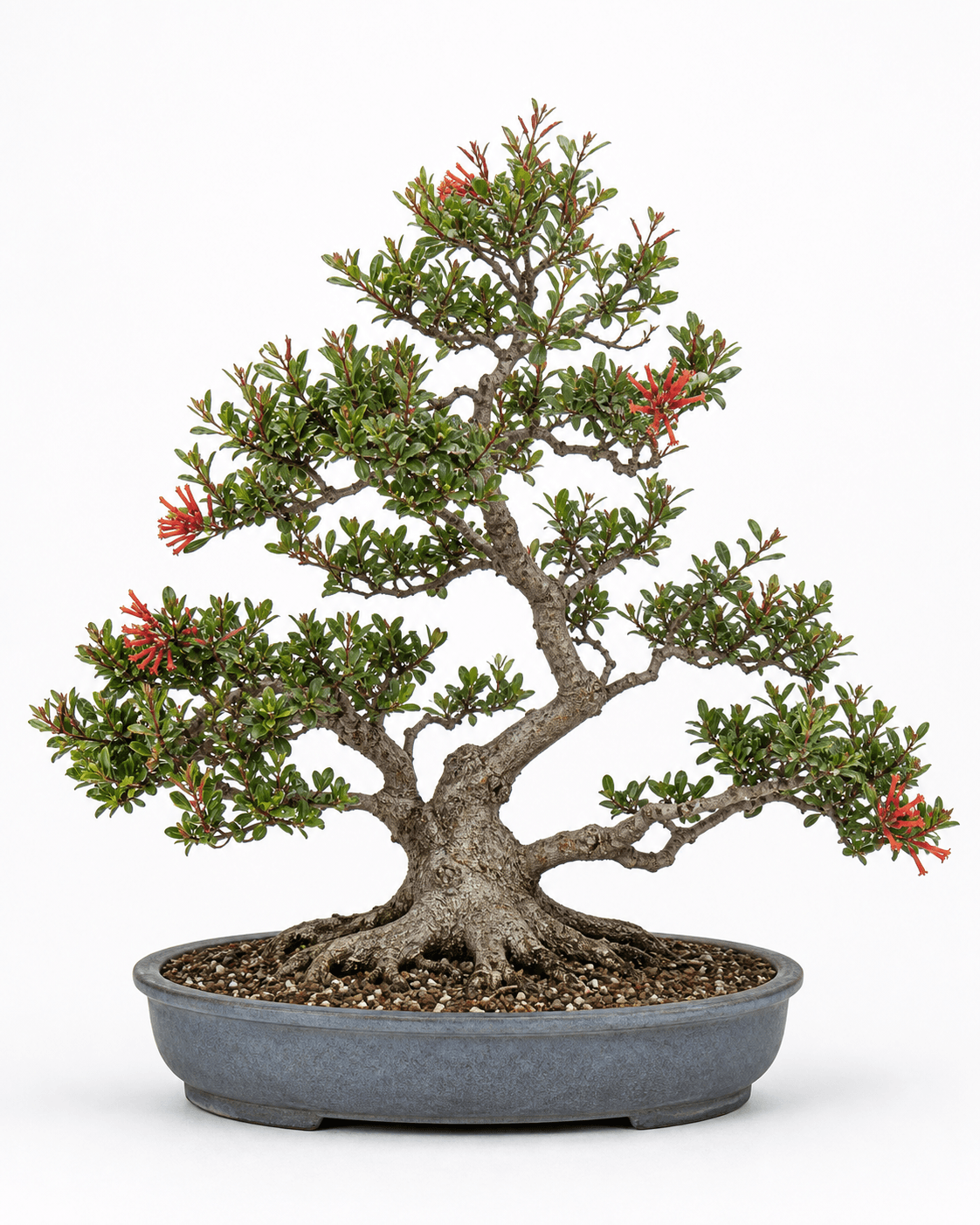
A mature Escallonia bonsai should show clean roots, visible broadleaf branch structure, compact leaves, selected flowers, and a design that makes coastal shrub ecology legible. Bonsai Mirai / Asymmetry
Species questions
Answer the beginner questions before styling.
Is Escallonia good for bonsai?
Yes, for growers in mild outdoor climates who can manage evergreen hedge roots, post-harden pruning, and winter wind protection. It is promising regional material rather than a universal beginner species.
Which Escallonia is most relevant for bonsai?
Use genus-level care unless the tag is specific. Escallonia rubra and E. rubra var. macrantha are useful red-flowered anchors, and many nursery plants are cultivars or hybrids selected for hedges and flowers.
Can Escallonia bonsai live indoors?
Use outdoor culture as the baseline. Escallonia needs bright light, air movement, seasonal cues, and winter protection that is cool and bright rather than warm and dim.
When should I prune Escallonia bonsai?
For structure, let the spring flush harden and prune back to interior buds. For flowers, allow selected shoots to bloom, then prune after display while enough growing season remains.
When should I repot Escallonia bonsai?
Repot in spring as buds swell. Convert old hedge soil in stages, keep useful foliage, anchor firmly, and avoid combining heavy root work with major styling in the same season.
What soil is best for Escallonia bonsai?
Use a well-drained mineral broadleaf-evergreen mix. Refined established trees can move toward akadama-heavy soil, while development and old hedge stock are safer in 1:1:1 akadama:pumice:lava or a pumice-weighted variant.
Does Escallonia tolerate salt and wind?
E. rubra is used as a coastal windbreak and Plant Selector lists soil salinity tolerance, but bonsai pots still need wind protection after repotting, wiring, heat, or cold exposure.
Why is my Escallonia dropping or browning leaves?
Check exposure and roots first. Drying wind, cold wind, stale wet soil, compact nursery cores, and pest pressure can all cause browning or drop on broadleaf evergreen hedge material.
Is Escallonia the same as privet or myrtle?
No. Escallonia is in Escalloniaceae, while privet is Ligustrum and myrtle is Myrtus. They can all appear as evergreen hedge shrubs, but labels, flowers, fruit, hardiness, and pruning details differ.
Sources
Species advice needs source discipline.
Next decisions
Plan the operation before copying the calendar.
A good care note for Escallonia records the tree's stage, the work done, and the aftercare used. That record matters more than a month-name rule.
Related species
Compare nearby trees before transferring advice.
English boxwood
Buxus sempervirens
Japanese boxwood
Buxus microphylla
Korean boxwood
Buxus sinica var. insularis
English holly
Ilex aquifolium
Japanese holly
Ilex crenata