
Species guide
Common Myrtle Bonsai Care
Myrtus communis
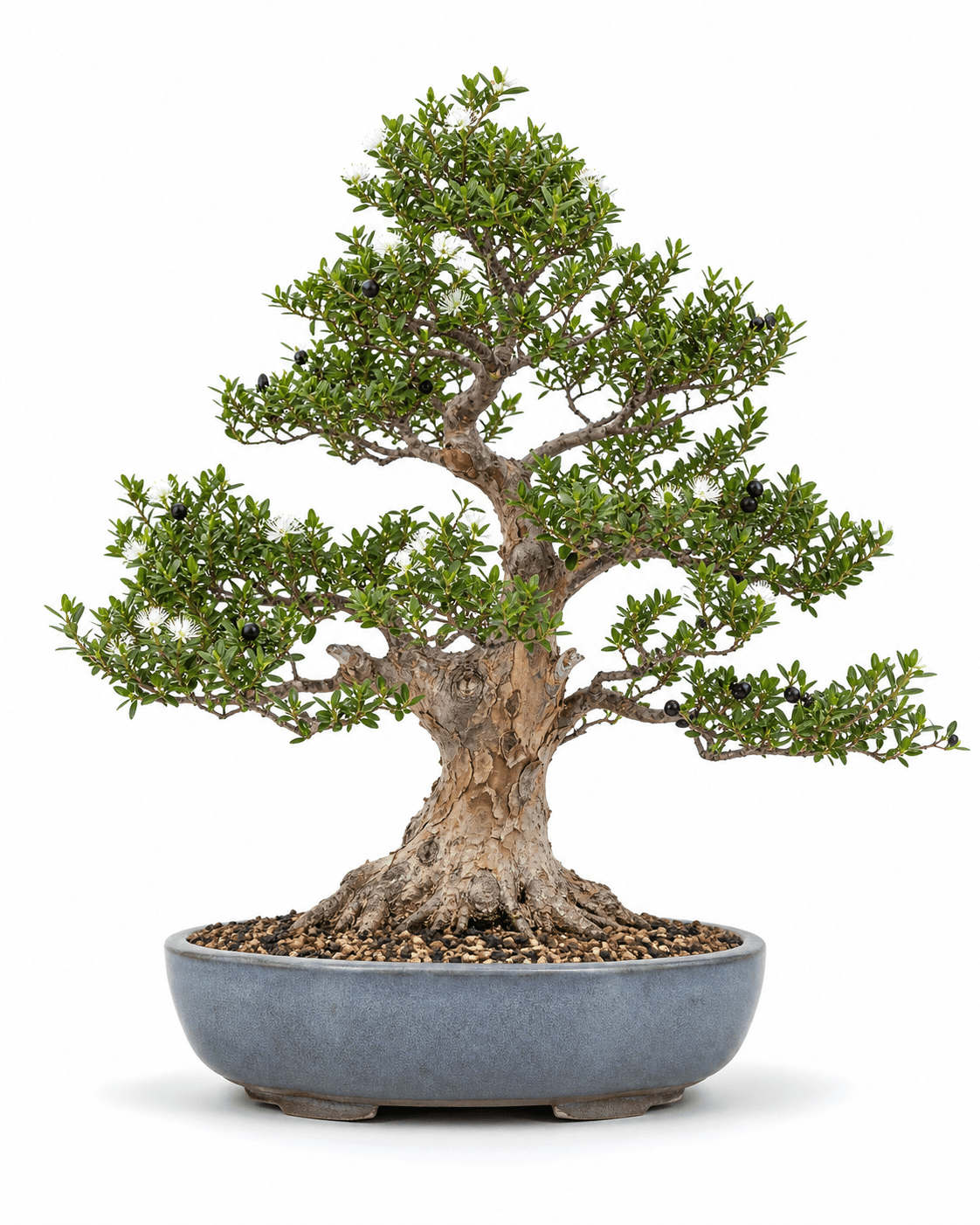
Common myrtle bonsai should be grown as a Mediterranean broadleaf evergreen: bright outdoor light, fast drainage, steady container water, spring root work, and pruning after growth has hardened. The species has small aromatic leaves, white flowers, dark berries, fine twigging potential, and old bark that can make a restrained evergreen broadleaf image.
The correct botanical name is Myrtus communis. Common labels include common myrtle, true myrtle, sweet myrtle, true Roman myrtle, foxtail myrtle, myrtle bonsai tree, and plain myrtle, while Compacta, Nana, Microphylla, Tarentina, Leucocarpa, and variegated labels describe forms that need source records.
The local Mirai corpus has no dedicated Myrtus communis file. This page uses Mirai for broadleaf-evergreen timing, watering, soil, repotting, wiring, and design method, then anchors myrtle identity, hardiness, morphology, cultivar labels, and pest risk to NC State, Oregon State, Kew-indexed taxonomy workflow, and USGS rust-risk context.
Updated June 11, 2026. Written by EntGrove Editorial. Last verified June 11, 2026.
Care fingerprint
Read the species through its shared care pattern.
Protect from hard freezes when species demands it, prune with active foliage in mind, and repot when roots can recover without dormancy cues. Use this as the starting point before local conditions and tree strength refine the calendar.
Note: Mediterranean broadleaf evergreen with aromatic opposite leaves, white flowers, dark berries, and Zone 8 baseline hardiness. Verify Myrtus communis before applying this page because crepe myrtle, wax myrtle, Oregon myrtle, California bay, creeping myrtle, and myrtle spurge are different plants.
Read the foliage first
Broadleaf stress usually shows in leaf color, leaf size, wilt, scorch, or delayed hardening before it becomes a branch problem.
Match work to dormancy
Deciduous, evergreen, tropical, succulent, and flowering broadleaf trees recover on different calendars.
Protect fine roots
Root work should preserve enough active fine roots for the tree to rehydrate quickly after the operation.
Care cadence
The calendar starts with the tree's seasonal state.
Placement
Timing: Grow outdoors in full sun to part shade, with shelter from cool drying wind and hard freezes. Give extra protection after repotting and during late-spring frost events.
Watch for: Long internodes in shade, scorched foliage in shallow hot pots, wind-burned tips, and spring growth damaged by late frost.
NC State Extension: Myrtus communisOregon State Landscape Plants: Myrtus communisBonsai Mirai LibraryWatering
Timing: Water when the surface begins to dry, then water until drainage confirms the root mass is saturated. Let air return before the next cycle.
Watch for: Yellowing leaves in wet soil, water bypassing old nursery peat, sour smell, wilt on hot afternoons, and dry pockets under dense surface roots.
Bonsai Mirai LibraryNC State Extension: Myrtus communisFeeding
Timing: Feed moderately during trunk and branch development. In refinement, feed lightly after the first flush hardens and again in fall to build reserves without coarse extension.
Watch for: Large leaves, long internodes, salt buildup in heat, and fertilizing a recently repotted or root-stressed tree before it resumes growth.
Bonsai Mirai LibraryPruning
Timing: Let spring shoots extend and harden, then prune back to two useful nodes or directional buds. Remove strong suckers before they thicken and shade the interior.
Watch for: Repeated shearing that creates an outer shell, pruning weak interior twigs out of existence, and cutting flower wood before the display goal is chosen.
Bonsai Mirai LibraryNC State Extension: Myrtus communisLeaf management
Timing: Use selective leaf reduction only on vigorous refined trees. Cut large exterior leaves or remove old leaves with petioles left intact where the tree has enough active growth to respond.
Watch for: Annual full defoliation habits, weak interior shoots with all leaves removed, and cool climates where heat is insufficient for a fast second flush.
Bonsai Mirai LibraryRepotting
Timing: Repot in spring as growth wakes. Convert old nursery soil in stages, secure the tree firmly, and keep the aftercare bright, sheltered, and evenly moist.
Watch for: Bare-rooting a weak evergreen, combining heavy top and root work, late frost on exposed roots, and organic cores that stay wet after the mineral soil dries.
Bonsai Mirai LibraryNC State Extension: Myrtus communisWiring
Timing: Wire young and semi-hardened shoots after growth firms. Use clip-and-grow for older branch taper, then wire secondary structure while bark is still forgiving.
Watch for: Wire bite on smooth young bark, brittle old branch bases, one-point bends, and wire hidden under dense evergreen foliage.
Bonsai Mirai LibraryOregon State Landscape Plants: Myrtus communisPests and disease
Timing: Inspect during hot dry weather, after indoor display, and after import or nursery purchases. Keep regional quarantine awareness for Myrtaceae rust risks.
Watch for: Scale, spider mites, thrips, mealybug, whitefly, root rot, orange rust-like pustules on new Myrtaceae growth, and late-frost dieback.
NC State Extension: Myrtus communisUSGS Open-File Report: Puccinia psidiiSourcing
Timing: Buy by trunk, leaf size, and cultivar record. Old hedges, Compacta, Nana, Microphylla, Tarentina, Leucocarpa, and variegated forms can all be useful when the base earns the work.
Watch for: Generic myrtle labels, crepe myrtle confusion, wax myrtle confusion, California bay or Oregon myrtle labels, weak indoor topiary stock, and rootbound peat cores.
NC State Extension: Myrtus communisOregon State Landscape Plants: Myrtus communisSpecies guide
Apply the species profile before copying another tree's calendar.
At a glance
Common myrtle is a Mediterranean evergreen for small leaves, flowers, and old bark.
Common myrtle is Myrtus communis, a broadleaf evergreen shrub or small tree in Myrtaceae. NC State records common myrtle, foxtail myrtle, myrtle, myrtle bonsai tree, sweet myrtle, true myrtle, and true Roman myrtle as common names. NC State Extension: Myrtus communis
The bonsai promise is compact: small opposite leaves, aromatic foliage, white flowers, dark berries, fine twigging, and bark that becomes more interesting with age. Oregon State describes dense foliage, glossy dotted leaves, white or pink-white flowers, blue-black fruit, and bark that peels into tan and brown segments as it matures. Oregon State Landscape Plants: Myrtus communis
The source-depth caveat matters. Mirai has no dedicated Myrtus communis file in the local distilled corpus, so this page transfers only broadleaf-evergreen method: spring root timing, harden-then-prune refinement, root oxygen, cautious defoliation, and design from base, trunk line, defining branch, and apex. Bonsai Mirai LibraryBonsai Mirai / Asymmetry
Habitat
Read it as a Mediterranean shrub with drought memory and container-water limits.
NC State gives the origin as northern Africa, southwestern Asia, and southern Europe. Oregon State calls the native range Mediterranean and southwest European, while noting uncertainty from centuries of cultivation. NC State Extension: Myrtus communisOregon State Landscape Plants: Myrtus communis
For care, translate that background into sun, drainage, air movement, and winter shelter. Myrtle can handle drought once established in the ground, but a bonsai container removes the deep soil reserve that made the shrub resilient. NC State Extension: Myrtus communisBonsai Mirai Library
For design, avoid generic clipped-ball styling. Mediterranean myrtle should read as a small evergreen tree or old shrub shaped by light, drought, pruning, and exposure: compact foliage, visible trunk, restrained pads, aromatic leaves, and seasonal flowers or fruit when the tree is strong enough. Bonsai Mirai / AsymmetryOregon State Landscape Plants: Myrtus communis
The wild signal also informs winter handling. A Zone 8 landscape shrub may survive brief cold, while a refined bonsai with fine twigs and exposed roots needs a colder-night plan well before garden shrubs are damaged. Oregon State Landscape Plants: Myrtus communisBonsai Mirai Library
Reading the tree
Confirm true Myrtus before applying this care calendar.
Start with the name. Myrtus communis is common or true myrtle. Crepe myrtle is Lagerstroemia, wax myrtle is Morella or Myrica, Oregon myrtle or California bay is Umbellularia californica, and creeping myrtle is Vinca. Those labels need different care. NC State Extension: Myrtus communisOregon State Landscape Plants: Myrtus communis
Then inspect leaves and bark. True myrtle has opposite simple leaves, entire margins, glossy surfaces, and transparent oil dots. Oregon State notes that the bark begins smooth and gray-brown, then peels and develops warmer tan segments with age. Oregon State Landscape Plants: Myrtus communisNC State Extension: Myrtus communis
Read the tree by stage. Development trees need extension, feeding, root conversion, and branch selection. Refined trees need restrained feeding, post-harden pruning, selective leaf reduction, and interior light. Bonsai Mirai Library
Read flowers and fruit as a design choice. A tree being built for structure can sacrifice some flower buds to grow branches; a display tree needs enough retained shoot tips to set white flowers and dark berries without exhausting a weak root system. NC State Extension: Myrtus communisBonsai Mirai Library
Pruning
Let shoots harden, then prune for bifurcation and light.
Myrtle is often grown as a hedge because it tolerates clipping, but bonsai pruning should build structure. Let spring shoots extend until the cuticle and stem color show hardened growth, then cut to two useful nodes or a directional bud. Oregon State Landscape Plants: Myrtus communisBonsai Mirai Library
On refined broadleaf evergreens, Mirai accepts a coarse first flush fueled by stored energy, then prunes once that flush is energy-positive to produce a finer second flush. Use that sequence on healthy myrtle instead of chasing every new tip as it appears. Bonsai Mirai Library
Thin before you shear. Open interior windows, remove unusable suckers, and keep weak interior leaves so they continue photosynthesizing. A clipped green shell with no inside growth becomes hard to repair. Bonsai Mirai Library
Full defoliation should be reserved for vigorous refined trees with active new tips across the canopy. For most myrtles, selective leaf cutting and post-harden pruning give safer control while preserving the evergreen engine. Bonsai Mirai Library
Roots
Repot in spring and keep the evergreen recovery engine intact.
Repot common myrtle in spring as buds wake and temperatures are moving upward. Mirai places broadleaf evergreen root work in the same spring window as deciduous repotting, with extra attention to retained foliage and winter-root vulnerability. Bonsai Mirai Library
Old nursery and topiary stock often carries organic soil that holds too much water inside the root ball. Work the core in stages, remove dead or sour pockets, and tie the tree firmly so new roots are protected from movement. Bonsai Mirai LibraryNC State Extension: Myrtus communis
Do enough root work to restore water entry and oxygen, then stop. A myrtle that keeps leaves after repotting can power recovery, but a tree stripped of roots, foliage, and stored energy may collapse when heat arrives. Bonsai Mirai Library
Protect repotted trees from late frost and drying wind. NC State warns that young spring growth can be damaged by late frost, and container roots are less protected than roots in the ground. NC State Extension: Myrtus communisBonsai Mirai Library
Soil and pot
Use mineral soil and quiet pots that suit a small-leaved evergreen broadleaf.
NC State says common myrtle needs proper drainage to prevent root rot and adapts to clay, loam, and sand when drainage is good. In bonsai, use granular mineral soil rather than heavy potting soil. NC State Extension: Myrtus communisBonsai Mirai Library
A 1:1:1 akadama:pumice:lava mix is the practical development default. Akadama holds nutrients and moisture, pumice buffers water, and lava protects oxygen movement. Increase akadama only when the tree is refined and the climate supports the watering demand. Bonsai Mirai Library
Pot choice should reinforce the species character. The Mirai ceramic corpus groups myrtle with boxwood and Mediterranean oaks as small-leaved evergreen broadleaves that pair well with restrained glazes. Use quiet color, modest depth, and enough soil volume for summer water. Bonsai Mirai LibraryBonsai Mirai / Asymmetry
Reserve very shallow pots for refinement. During nursery-core conversion, use a deeper or wider training pot until water movement, root growth, and foliage response are predictable. Bonsai Mirai Library
Climate
Zone 8 culture still needs bonsai-specific winter protection.
Use Zone 8 as the conservative baseline. NC State lists Zones 8a to 9b, and Oregon State lists Zone 8 with well-drained soil and protection from cool drying winds. NC State Extension: Myrtus communisOregon State Landscape Plants: Myrtus communis
In coastal Mediterranean and mild maritime climates, grow in full sun with wind shelter and careful winter drainage. In hot inland climates, use morning sun, afternoon protection during heat waves, and enough water to keep the pot from cycling between bone dry and saturated. Oregon State Landscape Plants: Myrtus communisBonsai Mirai Library
In cold-winter regions, overwinter in a cold greenhouse, unheated bright shelter, or protected frame where the tree stays dormant to semi-dormant without root freeze. Warm indoor rooms encourage weak growth and pests. NC State Extension: Myrtus communisBonsai Mirai Library
In humid regions, prioritize airflow, quick drainage, and clean foliage. Root rot, scale, thrips, and mites become more likely when a dense canopy sits in stale air or when the root ball remains wet. NC State Extension: Myrtus communis
Pests
Most failures come from wet roots, dry-room pests, frost, or Myrtaceae quarantine risk.
NC State lists root rot as the drainage problem to prevent. Yellowing foliage, sour soil smell, and slow collapse after styling usually point to low root oxygen or an old organic core staying wet. NC State Extension: Myrtus communisBonsai Mirai Library
Scale, spider mites, and thrips can damage outdoor plants during hot dry weather. Indoors, NC State flags scale, mealybug, and whitefly under warm, low-light, low-moisture conditions. NC State Extension: Myrtus communis
Myrtle rust, Puccinia psidii or Austropuccinia psidii in newer naming, is a broader Myrtaceae biosecurity issue. The USGS report describes its broad host range across the myrtle family and notes California cultivated myrtle outbreaks in the 2005 Hawaii risk history, so imported or shipped Myrtaceae material deserves quarantine discipline. USGS Open-File Report: Puccinia psidii
Late frost can damage young spring growth. Delay heavy pruning on a frost-hit tree until you can tell which shoots are alive, then rebuild from healthy buds after the root system is active. NC State Extension: Myrtus communisBonsai Mirai Library
Wiring
Wire young wood, then let pruning build the old-tree structure.
Wire common myrtle after shoots firm enough to hold a bend. Use consistent 55 to 60 degree coils, no gaps, and enough wire length to apply smooth pressure without twisting the branch. Bonsai Mirai Library
Smooth young bark can mark quickly, so inspect often during active growth. Cut wire off before it bites, especially on branches that are being fed heavily for thickening. Bonsai Mirai LibraryOregon State Landscape Plants: Myrtus communis
Older branches should be bent conservatively. Use clip-and-grow, guy wires, and replacement shoots to create taper rather than forcing a stiff old section into a dramatic curve. Bonsai Mirai Library
Keep branch tips rising toward light after placement. Myrtle reads best when the structure has a broadleaf logic: visible branch shoulders, fine twigging, and compact evergreen mass rather than conifer-like clouds. Bonsai Mirai LibraryBonsai Mirai / Asymmetry
Propagation
Use cuttings for cultivars and seed for variable stock.
NC State lists seed and stem cuttings as recommended propagation strategies. Seed can produce useful rootstock or experimental material, but seedlings vary in leaf size, habit, flower timing, fruit color, and eventual bonsai usefulness. NC State Extension: Myrtus communis
Use cuttings to preserve Compacta, Nana, Microphylla, Tarentina, Leucocarpa, variegated forms, or a specific old hedge selection. Keep cultivar names with the plant through styling, sale, or article sourcing. NC State Extension: Myrtus communisOregon State Landscape Plants: Myrtus communis
Air layering is reasonable when a branch has mature bark, compact leaves, and better movement than the base. Layer during active growth and separate only after the new roots can sustain the evergreen canopy. Bonsai Mirai Library
Grafting is a specialty choice for root correction, cultivar preservation, or replacing a poor branch with matching foliage. Most bonsai growers will get better results from cuttings, layering, and careful nursery selection. Bonsai Mirai Library
Buying
Buy the trunk, leaf scale, and verified Myrtus label.
Good common myrtle stock often appears as nursery shrubs, topiary starts, old hedges, or Mediterranean landscape removals. The best candidates have a visible base, small leaves, low branches, healthy roots, and bark already beginning to age. NC State Extension: Myrtus communisOregon State Landscape Plants: Myrtus communis
Compacta, Nana, Microphylla, and Tarentina labels are worth inspecting for shohin and medium bonsai because compact habit can reduce the years needed for scale. Leucocarpa and variegated forms are display choices that should still be judged by trunk and root quality. NC State Extension: Myrtus communis
Red flags include a buried base, a topiary ball with no trunk line, severe reverse taper from hedge cuts, rootbound peat that repels water, scale under leaves, spider-mite stippling, and frost-blackened spring growth. NC State Extension: Myrtus communisBonsai Mirai Library
Verify common-name labels before buying. Crepe myrtle, wax myrtle, and California bay may all be called myrtle in trade or local speech, and each belongs to a different care calendar. NC State Extension: Myrtus communisOregon State Landscape Plants: Myrtus communis
Troubleshooting
Diagnose common myrtle by roots, light, pests, frost, and identity.
Symptom: yellow leaves while the soil stays wet. Likely cause: root rot, compacted organic soil, or low oxygen. Fix: improve drainage, stop fertilizer, shelter from heat, and postpone pruning until new healthy growth appears. NC State Extension: Myrtus communisBonsai Mirai Library
Symptom: fine webbing, stippled leaves, or sticky foliage. Likely cause: spider mites, scale, mealybug, whitefly, or thrips. Fix: isolate, wash foliage, improve light and airflow, and use locally appropriate treatment before styling. NC State Extension: Myrtus communis
Symptom: blackened new shoots after a cold night. Likely cause: late frost on tender spring growth. Fix: protect from further frost, wait for clear live buds, then prune dead tips after recovery begins. NC State Extension: Myrtus communis
Symptom: long shoots with few flowers. Likely cause: too much shade, too much nitrogen, or repeated pruning before flower display. Fix: increase sun safely, moderate feeding, and choose whether structure or flowers matter most this season. NC State Extension: Myrtus communisBonsai Mirai Library
Symptom: orange rust-like pustules on young Myrtaceae growth after shipping or regional exposure. Likely cause: a rust-risk event that needs quarantine attention. Fix: isolate the plant, avoid moving cuttings, clean tools, and follow local plant-health guidance. USGS Open-File Report: Puccinia psidii
Symptom: advice seems wrong even though the label says myrtle. Likely cause: the plant is Lagerstroemia, Morella, Umbellularia, Vinca, or another myrtle-named plant. Fix: confirm leaves, flowers, bark, family, and source record before applying this page. NC State Extension: Myrtus communisOregon State Landscape Plants: Myrtus communis
Design
Style common myrtle as a quiet evergreen broadleaf with visible structure.
Begin with base, trunk line, defining branch, and apex. Myrtle material with a humble trunk can use tension or dynamic design to add interest; older bark and fragrant seasonal display often call for a calmer composition. Bonsai Mirai / AsymmetryOregon State Landscape Plants: Myrtus communis
The defining branch should feel like broadleaf growth that reached light. Keep branch junctions readable, use foliage masses with negative space, and let flowers and fruit remain secondary to structure. Bonsai Mirai / AsymmetryBonsai Mirai Library
Deadwood should be minimal and believable. Myrtle age reads through bark, peeling texture, compact leaves, branch taper, and old hedge scars more than through carved drama. Bonsai Mirai / AsymmetryOregon State Landscape Plants: Myrtus communis
A restrained glazed or lightly textured pot can support the leaf, flower, and fruit character. The pot should stay quiet enough that aromatic foliage and old bark remain the subject. Bonsai Mirai LibraryBonsai Mirai / Asymmetry
Cultivars
Compact forms help scale, but the trunk still decides the bonsai.
NC State lists Buxifolia, Compacta, Compacta Variegata, Leucocarpa, Microphylla, Nana, Tarentina, and Tarentina Variegata. Oregon State also notes Compacta as a dwarf dense form. NC State Extension: Myrtus communisOregon State Landscape Plants: Myrtus communis
Compacta, Nana, Microphylla, and Tarentina are the most relevant bonsai labels because smaller leaves and compact habit can reduce refinement time. Still judge the plant by base, low branches, health, and root quality before cultivar romance. NC State Extension: Myrtus communisBonsai Mirai / Asymmetry
Leucocarpa is a white-fruited form, and variegated forms can be useful for display or collection diversity. Use them with restraint because variegation can make weak growth, scars, and pest damage more visible. NC State Extension: Myrtus communis
Keep true myrtle separate from crepe myrtle, wax myrtle, California bay, Oregon myrtle, creeping myrtle, and myrtle spurge. Shared common names are weak evidence for shared bonsai timing. NC State Extension: Myrtus communisOregon State Landscape Plants: Myrtus communis
History
Common myrtle carries garden, wedding, culinary, and Mediterranean signals.
NC State notes that ancient civilizations used common myrtle leaves for medicinal and culinary purposes, and that the white blooms were a symbol of love. It also records the plant in British wedding-bouquet tradition after its introduction to England in the 16th century. NC State Extension: Myrtus communis
For bonsai, the cultural signal should remain modest. Treat culinary and symbolic history as context, while the tree itself is judged by root health, trunk age, branch structure, leaf scale, flowers, and fruit. Bonsai Mirai / AsymmetryNC State Extension: Myrtus communis
Mediterranean bonsai often rewards restraint: weathered bark, quiet pot color, compact foliage, and seasonal details rather than theatrical intervention. Myrtle belongs in that vocabulary beside olive, boxwood, Mediterranean oaks, and other small-leaved evergreen broadleaves. Bonsai Mirai LibraryBonsai Mirai / Asymmetry
Because the species is widely cultivated and common-name confusion is high, the most useful record for a notable myrtle bonsai is provenance: exact botanical label, cultivar, source, collection date, root-conversion history, and seasonal response. Kew POWO search: Myrtus communisNC State Extension: Myrtus communis
Species questions
Answer the beginner questions before styling.
Is common myrtle good for bonsai?
Yes. Myrtus communis can make a strong bonsai when grown outdoors with bright light, fast drainage, and winter protection. It offers small aromatic leaves, white flowers, dark berries, fine twigging, and aging bark.
Can common myrtle bonsai live indoors?
Use outdoor culture as the baseline. Indoor display should be brief and bright. Long-term warm low-light rooms invite weak growth, scale, mealybug, whitefly, and root problems.
When should common myrtle be repotted?
Repot in spring as growth begins. Inspect every 3 to 4 years, or sooner when an old nursery core blocks water. Convert organic soil gradually and protect the tree from late frost after repotting.
What soil should I use for common myrtle bonsai?
Use fast-draining mineral soil. A 1:1:1 akadama:pumice:lava mix is a reliable development default. Refined trees can use more akadama if the climate and watering rhythm support it.
Should common myrtle be defoliated?
Use selective leaf reduction on vigorous refined trees rather than routine annual full defoliation. Keep foliage on weak interior branches and prune after the first flush hardens.
How cold hardy is common myrtle bonsai?
Use USDA Zone 8 as the conservative landscape baseline, with NC State listing Zones 8a to 9b and Oregon State listing Zone 8. Bonsai roots need protection before landscape shrubs would be damaged.
Why are my common myrtle leaves turning yellow?
Wet roots, compacted organic soil, low oxygen, pests, or cold damage are the common causes. Check drainage and root smell first, then inspect leaf undersides for scale, mites, thrips, mealybug, or whitefly.
How do I tell common myrtle from crepe myrtle?
Common myrtle is Myrtus communis in Myrtaceae and holds opposite aromatic evergreen leaves. Crepe myrtle is Lagerstroemia, a different genus with different flowering, pruning, and winter behavior.
Which common myrtle cultivars are best for bonsai?
Compacta, Nana, Microphylla, and Tarentina are the most useful labels because compact habit and smaller leaves help scale. Buy the trunk and roots first, then value cultivar detail.
Does common myrtle get myrtle rust?
Myrtle rust is a broader Myrtaceae biosecurity concern. Treat shipped or imported myrtle-family plants cautiously, quarantine new material, clean tools, and follow local plant-health guidance if rust-like orange pustules appear.
Sources
Species advice needs source discipline.
Next decisions
Plan the operation before copying the calendar.
A good care note for Common myrtle records the tree's stage, the work done, and the aftercare used. That record matters more than a month-name rule.
Related species
Compare nearby trees before transferring advice.
English boxwood
Buxus sempervirens
Japanese boxwood
Buxus microphylla
Korean boxwood
Buxus sinica var. insularis
English holly
Ilex aquifolium
Japanese holly
Ilex crenata