
Species guide
Loropetalum Bonsai Care
Loropetalum chinense
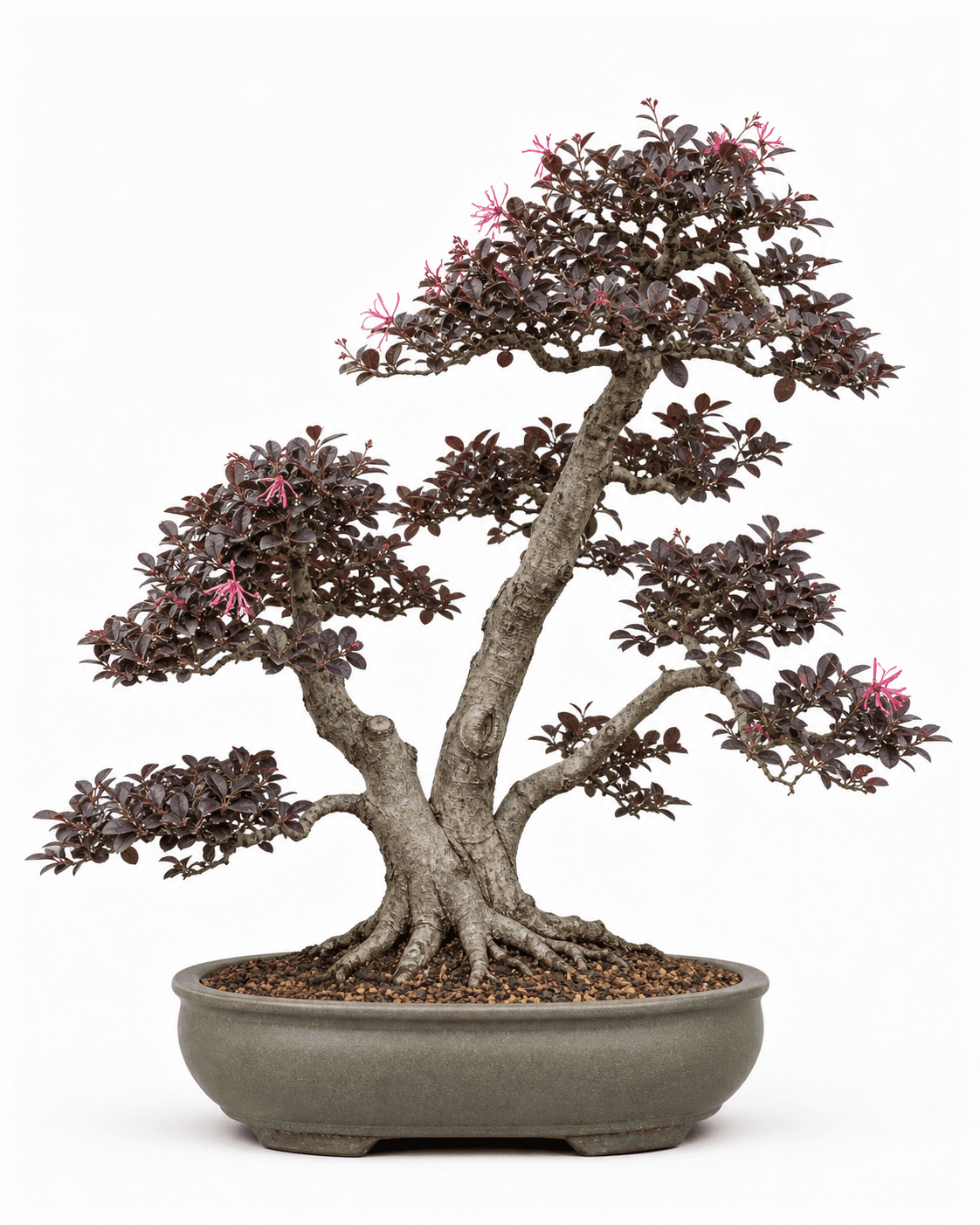
Loropetalum bonsai is a warm-temperate broadleaf evergreen or semi-evergreen shrub for outdoor culture: bright light, acidic well-drained soil, spring root work, post-harden pruning, and protection from cold drying wind. It is most useful when selected for small leaves, low branches, visible trunk movement, and manageable purple or green foliage.
Use Loropetalum chinense, Chinese fringe flower, fringe flower, Chinese witchhazel, evergreen witchhazel, and strap flower as the same working care subject unless a cultivar tag proves otherwise. Purple-leaf var. rubrum and named dwarf cultivars can be better bonsai candidates than coarse hedge plants, but they still need label-aware pruning and winter protection.
The local Mirai corpus has no dedicated Loropetalum file. This page transfers Mirai broadleaf-evergreen method transparently, then grounds identity, range, USDA Zone 7b to 9b landscape hardiness, acidic-soil behavior, flowering, cultivars, and pest risks in NC State Extension, Clemson HGIC, and a Kew POWO accepted-name workflow.
Updated June 12, 2026. Written by EntGrove Editorial. Last verified June 12, 2026.
Care fingerprint
Read the species through its shared care pattern.
Protect from hard freezes when species demands it, prune with active foliage in mind, and repot when roots can recover without dormancy cues. Use this as the starting point before local conditions and tree strength refine the calendar.
Note: Warm-temperate flowering broadleaf evergreen or semi-evergreen shrub. Verify cultivar scale, purple-leaf retention, and gall-free branch health before applying bonsai refinement.
Read the foliage first
Broadleaf stress usually shows in leaf color, leaf size, wilt, scorch, or delayed hardening before it becomes a branch problem.
Match work to dormancy
Deciduous, evergreen, tropical, succulent, and flowering broadleaf trees recover on different calendars.
Protect fine roots
Root work should preserve enough active fine roots for the tree to rehydrate quickly after the operation.
Care cadence
The calendar starts with the tree's seasonal state.
Placement
Timing: Grow outdoors in full sun to part shade. Give purple forms enough sun for color, then protect shallow pots from hot afternoon exposure and cold wind.
Watch for: Greened-out purple foliage from shade, scorched leaves in heat, semi-evergreen cold drop, and winter wind injury in exposed pots.
NC State Extension: Loropetalum chinenseClemson HGIC: LoropetalumBonsai Mirai LibraryWatering
Timing: Water deeply when the surface starts to dry, then let air return to the root zone. Increase frequency in spring flush, summer heat, and flower-heavy canopies.
Watch for: Wilt after dry wind, yellowing in stale wet soil, water bypassing old nursery cores, and repeated light watering that never wets the whole pot.
Clemson HGIC: LoropetalumBonsai Mirai LibrarySoil pH
Timing: Keep the root environment acidic and well drained from the first repot. Correct alkaline irrigation or media before chlorosis becomes chronic.
Watch for: Yellow leaves with green veins, weak growth after lime exposure, and nursery soil that stays sour despite a dry surface.
NC State Extension: Loropetalum chinenseBonsai Mirai LibraryFeeding
Timing: Feed moderately in development after growth proves root function. In refinement, feed lightly after the first flush hardens and again in fall if the tree remains active.
Watch for: Coarse purple shoots, oversized leaves, weak interiors, and fertilizer applied before repot recovery is visible.
Bonsai Mirai LibraryPruning
Timing: For structure, let spring growth harden and prune back to viable interior nodes. For flower display, prune after spring bloom.
Watch for: Removing flower buds before display, clipped hedge shells, branch knuckles, blind interiors, and pruning hard when leaves are yellow from root stress.
NC State Extension: Loropetalum chinenseClemson HGIC: LoropetalumBonsai Mirai LibraryLeaf reduction
Timing: Use partial leaf reduction only on vigorous refined trees after the first flush hardens and leaves are too large for scale.
Watch for: Cut leaves on display trees, weak shaded shoots, annual defoliation habits, and reducing foliage on development branches that need strength.
Bonsai Mirai LibraryRepotting
Timing: Repot in spring as buds swell. Preserve useful foliage, stage old-soil conversion, and protect the tree from wind while new roots form.
Watch for: Full bare-rooting of weak evergreen material, combining severe root work with major styling, and keeping a compact root core that sheds water.
Bonsai Mirai LibraryNC State Extension: Loropetalum chinenseWiring
Timing: Wire young hardened shoots and primary structure after growth firms. Use pruning to build the finer flowering outline.
Watch for: Wire bite hidden by leaves, scuffed tender bark, snapped arching branches, and inverted foliage that sunburns after bending.
Bonsai Mirai LibraryBonsai Mirai / AsymmetryPests and disease
Timing: Inspect after nursery purchase, during dense spring growth, and whenever branch dieback appears. Sanitize tools before pruning suspicious galls.
Watch for: Mites, aphids, root rot, chlorosis, powdery mildew, anthracnose, and bacterial gall causing branch dieback.
NC State Extension: Loropetalum chinenseClemson HGIC: LoropetalumSpecies guide
Apply the species profile before copying another tree's calendar.
At a glance
Loropetalum is a flowering witch-hazel relative for warm-temperate broadleaf evergreen bonsai.
Loropetalum chinense is a shrub or small tree in Hamamelidaceae. NC State describes it as broad-leaved evergreen or semi-evergreen, native to China, Southeast Asia, Japan, and nearby regions, with rough alternate leaves and strap-shaped spring flowers. NC State Extension: Loropetalum chinense
Clemson gives USDA Zones 7b to 9b, full sun to part shade, well-drained soil, drought tolerance after establishment, and pruning after spring bloom. Those are landscape baselines; bonsai pots need earlier water, wind, heat, and cold adjustments. Clemson HGIC: LoropetalumBonsai Mirai Library
The source-depth rule is straightforward. Mirai does not provide a Loropetalum-specific file, so the bonsai technique here stays inside broadleaf-evergreen physiology: retained foliage, spring root work, hardened-flush pruning, conditional partial defoliation, and water-oxygen balance. Bonsai Mirai Library
Habitat
Read Loropetalum through woodland edges, thickets, acid roots, and warm rainy-season growth.
NC State places Chinese fringe flower in woodlands and thickets, with origin from China to northeastern Thailand, Japan, and Taiwan. Clemson extends the origin framing to China, Japan, Thailand, Taiwan, and India for the white-flowered green-leaf form. NC State Extension: Loropetalum chinenseClemson HGIC: Loropetalum
For care, that habitat points to bright filtered edges, moisture that drains, acidic soil, and protection from harsh winter wind. The plant can handle sun, but a shallow bonsai container heats and dries faster than woodland soil. NC State Extension: Loropetalum chinenseBonsai Mirai Library
For design, use the natural arching, rounded-to-vase habit. A convincing tree can show layered broadleaf branches, spring flowers, and asymmetric negative space while keeping the plant readable as a flowering shrub or small tree. NC State Extension: Loropetalum chinenseBonsai Mirai / Asymmetry
The pH signal matters more in a pot than in the ground. NC State says alkaline soil can cause chlorosis, so water quality, media, and fertilizer choices should preserve acid root function. NC State Extension: Loropetalum chinense
Reading the tree
Start with the label, then read leaf color, flower timing, root condition, and stage.
A plain Loropetalum chinense tag often means the white-flowered green-leaf form. Var. rubrum and many modern selections carry pink, red, or burgundy flowers and purple to burgundy foliage. NC State Extension: Loropetalum chinenseClemson HGIC: Loropetalum
For bonsai buying, cultivar habit can decide the project. Compact cultivars may offer shorter internodes and smaller leaves, while large screening forms can outgrow small designs quickly. NC State Extension: Loropetalum chinenseClemson HGIC: LoropetalumBonsai Mirai / Asymmetry
Then read development stage. Development material needs root conversion, trunk selection, low branch building, and extension. Refined trees need post-harden cutback, interior light, selective leaf reduction, and restrained feeding. Bonsai Mirai Library
Separate Loropetalum from azalea, camellia, myrtle, privet, holly, and gardenia before applying details. They can share evergreen shrub habits, but family, root pH, flower timing, fruit, pest risks, and pruning windows differ. NC State Extension: Loropetalum chinenseClemson HGIC: LoropetalumBonsai Mirai / Asymmetry
Pruning
Prune after bloom for flowers, and after hardened growth for structure.
NC State and Clemson both place pruning after flowering when pruning is needed. That preserves spring bloom and gives the tree warm-season time to rebuild foliage. NC State Extension: Loropetalum chinenseClemson HGIC: Loropetalum
Mirai broadleaf-evergreen refinement adds the bonsai layer: let the first flush elongate and harden, then prune back to two viable interior nodes when the tree is energy-positive. Bonsai Mirai Library
On vigorous refined trees with oversized leaves, reduce remaining leaf surface after the flush hardens. Leave small interior leaves and weak areas alone so they keep photosynthesizing. Bonsai Mirai Library
Avoid repeated hedge shearing. Loropetalum can tolerate pruning, but bonsai structure improves when cuts return to interior branch choices, not only to an exterior outline. NC State Extension: Loropetalum chinenseBonsai Mirai Library
Roots
Repot in spring and solve acid root health before styling ambition.
Repot Loropetalum in spring as buds swell. Mirai places broadleaf-evergreen root work in the spring window, when stored energy is available and retained foliage can help rebuild roots. Bonsai Mirai Library
NC State says the shrub transplants easily in landscape conditions. In bonsai, that does not justify a full bare-root reset on weak evergreen stock; old nursery soil should be converted in stages. NC State Extension: Loropetalum chinenseBonsai Mirai Library
The first repot should fix water entry, oxygen, root pH, and tie-down stability. A beautiful angle is secondary if the old core sheds water or stays anaerobic. Bonsai Mirai LibraryNC State Extension: Loropetalum chinense
After repotting, shelter from wind, keep the root zone evenly moist with air returning between waterings, and withhold fertilizer until new growth confirms recovery. Bonsai Mirai Library
Soil and pot
Use acidic mineral soil with enough water retention for broad leaves and enough air to avoid root rot.
NC State specifies rich, moist, well-drained, acidic soil and warns about chlorosis in neutral to alkaline conditions. Clemson also emphasizes well-drained soil and avoiding poorly drained areas. NC State Extension: Loropetalum chinenseClemson HGIC: Loropetalum
For development and nursery conversion, use 1:1:1 akadama:pumice:lava or a slightly akadama-weighted version if water quality and summer heat allow. The mix should drain cleanly while retaining enough moisture for retained foliage. Bonsai Mirai Library
For refined established trees, akadama-heavy broadleaf soil can improve fine roots and leaf scale. Monitor breakdown because decomposed particles reduce oxygen and amplify root-rot risk. Bonsai Mirai Library
Pot pairing should support a flowering broadleaf image. Quiet glazed ovals, subdued rounds, and soft rectangles usually suit purple foliage and strap flowers better than rugged conifer containers. Bonsai Mirai / Asymmetry
Climate
Zone 7b to 9b is a landscape range; bonsai roots need a narrower comfort band.
NC State lists USDA Zones 7b to 9b, and Clemson says Loropetalum can be grown from the South Carolina foothills to the coast. Near Zone 7b, use protected placement away from winter winds. NC State Extension: Loropetalum chinenseClemson HGIC: Loropetalum
In cold climates, expect semi-evergreen behavior, bronzing, or leaf drop after exposure. The tree may survive while the small pot suffers root damage, so protect roots before deep freezes. NC State Extension: Loropetalum chinenseBonsai Mirai Library
In hot inland climates, provide morning sun and afternoon shade during peak summer. Mirai broadleaf guidance treats container heat as a root and leaf-cooling problem, especially above the mid-90s F. Bonsai Mirai Library
In humid southeastern climates, keep the canopy open and the soil oxygenated. Clemson now flags bacterial gall, and NC State also lists powdery mildew, anthracnose, root rot, mites, and aphids as watch points. NC State Extension: Loropetalum chinenseClemson HGIC: Loropetalum
Pests and diseases
Most problems start with roots, pH, dense foliage, or bacterial gall sanitation.
NC State says Chinese fringe flower has no serious insect or disease issues overall, while still listing root rot in poorly drained soil, chlorosis in alkaline soil, mites, aphids, bacterial gall, powdery mildew, and anthracnose. NC State Extension: Loropetalum chinense
Clemson identifies bacterial gall caused by Pseudomonas savastanoi as a serious concern that can cause branch dieback and eventual plant death. Sanitize tools, avoid pruning through wet infected tissue, and isolate suspicious material. Clemson HGIC: Loropetalum
Root rot prevention is bonsai prevention: open mineral media, complete watering, air returning after watering, and no compacted nursery core that stays wet after the surface dries. NC State Extension: Loropetalum chinenseBonsai Mirai Library
Dense purple foliage can hide mites, aphids, scale-like residue, or early dieback. Inspect leaf undersides and branch junctions before wiring because styling a stressed tree widens the problem. NC State Extension: Loropetalum chinenseBonsai Mirai Library
Wiring
Wire young hardened wood, then let pruning create the flowering outline.
Loropetalum has arching, multi-stemmed growth. Wire primary and secondary direction while shoots are hardened but still responsive, using firm off-hand support and rounded bends. NC State Extension: Loropetalum chinenseBonsai Mirai Library
Mirai structural-wiring method prioritizes continuous contact, even spacing, and bends distributed across tissue. On leafy broadleaf shoots, cut foliage away from wire paths instead of crushing it. Bonsai Mirai Library
Do not wire every fine flowering tip. Use wire to set branch exits and silhouette movement, then use post-bloom and post-harden pruning to build ramification. Bonsai Mirai / AsymmetryBonsai Mirai Library
Check wire frequently during warm growth. Purple and green foliage can hide bite, and fast recovery after pruning can thicken shoots before scars are obvious. Bonsai Mirai Library
Propagation
Cuttings preserve cultivar behavior; layers help turn landscape shrubs into bonsai starts.
NC State lists stem cutting as the recommended propagation strategy. That is the most useful bonsai path for preserving leaf color, flower color, compact habit, and cultivar identity. NC State Extension: Loropetalum chinense
Air-layering fits broadleaf evergreen method after the first flush has hardened and foliage can feed root formation. Small layers may be one-season projects, while trunk layers should be planned conservatively. Bonsai Mirai Library
Seed has limited bonsai predictability because it will not preserve named cultivar traits. Use seed mainly for botanical interest or long-term selection work. NC State Extension: Loropetalum chinenseBonsai Mirai / Asymmetry
Grafting is less useful for ordinary Loropetalum bonsai than cuttings, layers, and good nursery stock. If a plant is grafted, inspect the union because swelling can dominate a small trunk. Bonsai Mirai / Asymmetry
Buying
Buy the trunk first, then choose cultivar color and flower display.
Good Loropetalum material has visible basal flare, low branch options, healthy interior growth, clean leaves, and a trunk line that still looks useful after flowers fade. Bonsai Mirai / AsymmetryNC State Extension: Loropetalum chinense
Keep cultivar labels attached. NC State lists Carolina Midnight, Hillier Form, var. rubrum, Shidare, Snow Dance, and Snow Muffin, while Clemson discusses many green-leaf, purple-leaf, compact, and dwarf landscape selections. NC State Extension: Loropetalum chinenseClemson HGIC: Loropetalum
Avoid buried bases, oversized screening cultivars with long internodes, waterlogged organic cores, yellow chlorotic leaves, gall-like swellings, and plants pruned into a hard shell with no interior buds. NC State Extension: Loropetalum chinenseClemson HGIC: LoropetalumBonsai Mirai Library
Landscape removals can work when legal and healthy. Preserve enough foliage for recovery, plan the first season around roots and water entry, and delay refinement until the plant grows strongly in bonsai soil. Bonsai Mirai Library
Troubleshooting
Diagnose Loropetalum by pH, roots, bloom timing, leaf color, and gall risk.
Symptom: yellow leaves with green veins. Likely cause: alkaline soil or irrigation-driven chlorosis. Fix: confirm pH, stop lime exposure, use acid-compatible media and fertilizer, and protect roots from stale wet conditions. NC State Extension: Loropetalum chinense
Symptom: yellowing plus wet soil. Likely cause: root rot or poor oxygen in old nursery soil. Fix: improve watering rhythm and bench airflow now, then repot in spring if drainage or water entry is poor. NC State Extension: Loropetalum chinenseBonsai Mirai Library
Symptom: few flowers. Likely cause: too much shade, heavy nitrogen, or pruning before bloom. Fix: increase light gradually, reduce refinement feeding, and prune after spring flowers finish. NC State Extension: Loropetalum chinenseClemson HGIC: Loropetalum
Symptom: purple foliage turns dull green. Likely cause: shade, cultivar behavior, or low vigor. Fix: improve sun exposure within heat limits and verify that the cultivar is meant to hold dark foliage. NC State Extension: Loropetalum chinenseClemson HGIC: Loropetalum
Symptom: branch dieback with gall-like swelling. Likely cause: bacterial gall. Fix: isolate the tree, sanitize tools, prune only into clean tissue when conditions are dry, and avoid propagating from affected branches. Clemson HGIC: Loropetalum
Symptom: bronzed or dropped leaves after winter. Likely cause: cold wind, root chill, or semi-evergreen cold response. Fix: move to protected outdoor shelter and wait for new growth before major pruning. NC State Extension: Loropetalum chinenseBonsai Mirai Library
Design
Style Loropetalum as a flowering broadleaf with arching movement and visible branch exits.
Begin with base, trunk line, defining branch, and apex. Mirai design method uses those elements to decide whether the tree should feel harmonious, tense, or dynamic. Bonsai Mirai / Asymmetry
Loropetalum gives design cues through arching branches, vase-shaped habit, spring flowers, rough leaves, and purple or green foliage. Let those cues shape the silhouette before imposing a generic bonsai outline. NC State Extension: Loropetalum chinenseBonsai Mirai / Asymmetry
The strongest images are low flowering shrub, informal upright, clump, twin-trunk, broadleaf broom, exposed-root, and old hedge stump with soft negative spaces. Bonsai Mirai / AsymmetryNC State Extension: Loropetalum chinense
Deadwood should be restrained and mostly incidental. Flower, foliage color, branch layering, and trunk movement are the main species signals. Bonsai Mirai / Asymmetry
Cultivars
Cultivar choice determines scale, color, bloom, and whether the plant fits the intended bonsai size.
NC State names var. rubrum as the purple-leaf, pink-to-red flowered form that became available in the 1980s. Clemson also separates green-leaf white-flowered Loropetalum from redleaf var. rubrum selections. NC State Extension: Loropetalum chinenseClemson HGIC: Loropetalum
NC State lists Carolina Midnight, Hillier Form, Shidare, Snow Dance, and Snow Muffin. Those names are useful starting clues for flower color, weeping habit, compactness, and leaf scale. NC State Extension: Loropetalum chinense
Clemson groups modern cultivars by green-leaf white-flowered types, purple-leaf pink-flowered types, and dwarf selections. For bonsai, dwarf or compact plants can reduce the time spent fighting internode length. Clemson HGIC: Loropetalum
Evaluate each plant directly. Small leaves, low buds, short internodes, clean roots, and a credible trunk matter more than retail flower color. Bonsai Mirai / AsymmetryBonsai Mirai Library
History
Loropetalum is a modern nursery-shrub bonsai candidate with strong regional promise.
NC State says the species was introduced to the United States in the 1880s, while Clemson gives 1908 for the white-flowered green-leaf form. Both sources frame later purple-leaf red-flowered material as much more recent in U.S. horticulture. NC State Extension: Loropetalum chinenseClemson HGIC: Loropetalum
That history explains its bonsai status. Loropetalum appears first as landscape shrub, screen, foundation plant, hedge, espalier, or small flowering tree, then becomes bonsai material when growers find a base and cultivar scale worth developing. NC State Extension: Loropetalum chinenseBonsai Mirai / Asymmetry
The page should be treated as a regional and cultivar-aware guide. It is especially promising for warm-temperate growers who already manage camellia, holly, boxwood, gardenia, and other acid-leaning evergreen shrubs. NC State Extension: Loropetalum chinenseClemson HGIC: LoropetalumBonsai Mirai Library
A mature Loropetalum bonsai should show clean acidic root culture, compact leaves, chosen flowers, arching branch rhythm, and an old broadleaf image that still feels like Chinese fringe flower. Bonsai Mirai / Asymmetry
Species questions
Answer the beginner questions before styling.
Is Loropetalum good for bonsai?
Yes, especially in warm-temperate outdoor climates. Choose compact material with a good base, small leaves, low branches, and a cultivar habit that fits the intended bonsai size.
Can Loropetalum bonsai live indoors?
Use outdoor culture as the baseline. Loropetalum needs strong light, airflow, acidic root function, and cool-season cues, so indoor placement should be limited to short display.
When should I prune Loropetalum bonsai?
Prune after spring bloom when flowers matter. For structure and ramification, let new growth harden first, then cut back to viable interior nodes.
When should I repot Loropetalum bonsai?
Repot in spring as buds swell. Preserve useful foliage, convert old nursery soil in stages, secure the tree firmly, and protect it from wind while new roots form.
What soil does Loropetalum bonsai need?
Use acidic, well-drained mineral bonsai soil. A 1:1:1 akadama:pumice:lava mix is a good development baseline, while established refined trees can move more akadama-heavy if oxygen stays high.
Why are my Loropetalum leaves turning yellow?
Check pH and roots first. Loropetalum can develop chlorosis in alkaline soil, and stale wet soil can cause root stress or root rot.
Should Loropetalum bonsai be defoliated?
Use partial leaf reduction only on vigorous refined trees after the first flush hardens and leaf size is too coarse. Development trees and weak interior branches should keep foliage.
What pests and diseases affect Loropetalum bonsai?
Watch for mites, aphids, root rot, chlorosis, powdery mildew, anthracnose, and bacterial gall. Clemson highlights bacterial gall as a serious Loropetalum problem that requires sanitation.
Is Loropetalum the same as Chinese witch hazel?
Chinese witchhazel and evergreen witchhazel are common-name labels for Loropetalum in horticultural sources. Verify Loropetalum chinense because true witch hazels in Hamamelis have different seasonal and pruning behavior.
Sources
Species advice needs source discipline.
Next decisions
Plan the operation before copying the calendar.
A good care note for Loropetalum records the tree's stage, the work done, and the aftercare used. That record matters more than a month-name rule.
Related species
Compare nearby trees before transferring advice.
English boxwood
Buxus sempervirens
Japanese boxwood
Buxus microphylla
Korean boxwood
Buxus sinica var. insularis
English holly
Ilex aquifolium
Japanese holly
Ilex crenata